- Book info
- Sample
- Media
- Author updates
- Lists
Synopsis
JOHNSTONE COUNTRY. WITH A SHORTER BARREL, STAND CLOSER TO THE TARGET.
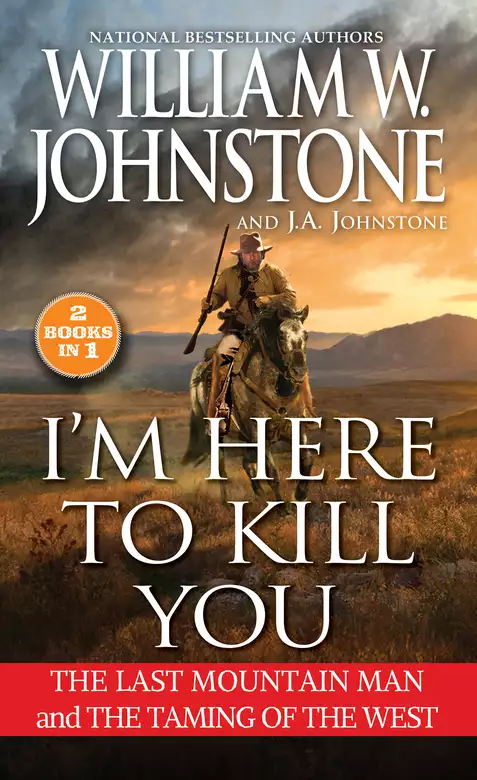
Two action-packed tales about the greatest gunslinger to ever ride the Wild West. When the scales of justice need to be set right, nothing stands in the way of the Mountain Man.
Brutal Night of the Mountain Man
Kate Coldane has sweated blood and tears for her saloon. Now Silas Atwood, the richest rancher in Hudspeth County, is trying to push her around. When her son guns down one of Atwood’s goons, they’ll need Smoke Jensen’s help to wage war against more than two dozen of Atwood's blood-hungry killers. Drunk with power and afraid of no man, Silas Atwood believes Smoke can be stopped with brute force alone. Problem is, Silas Atwood has never heard the legend of the Mountain Man . . .
Venom of the Mountain Man
When Smoke Jensen sees a gang of outlaws holding up a stagecoach, his gunfighter instincts take over and he storms in with guns blazing. He kills one of the gunmen, the rest scatter like rats. But the dead man is the brother of the notorious outlaw Gabe Briggs, who takes revenge by kidnapping Smoke’s wife, Sally. When Smoke gets word of her kidnapping, he boards the first train east where she is reportedly being held. But Briggs’s kill-crazy henchmen are along for the ride. Unless Smoke can punch their ticket to hell first, they’ll blow this train sky high . . . making Smoke a widower.
Release date: April 29, 2025
Publisher: Pinnacle Books
Print pages: 656
* BingeBooks earns revenue from qualifying purchases as an Amazon Associate as well as from other retail partners.
Reader buzz
 Please log in to recommend or discuss...
Author updates
I'm Here to Kill You
William W. Johnstone
Bo Willis, Tony Clinton, Abe Creech, and Danny Reed rode for Atwood, though they couldn’t exactly be called cowboys since their positions for the ranch called for a set of skills that were different from those required by working cowboys. Atwood called such men his “special cadre.” At the moment, Willis and the others were at Glen Creek, a year-round stream that supplied water for this part of the county. They were near the spillway where, even now, water was pooling into a widening lake behind gate number one. Closing the gate stopped the creek from flowing onto the Double Nickel Ranch. A medium-size ranch, the Double Nickel had, so far, managed to survive blizzards and droughts.
Bo Willis took a leak against an ocotillo cactus, aiming at a sunning frog as he did so. He laughed when the creature, caught in the stream, hopped away. Buttoning his pants, he walked back over to the others.
“See anything yet?” Willis asked.
Clinton spit a wad of tobacco before he answered. “Nope,” he said. “I’m not sure anyone will be here.”
“Oh, someone will be here all right. Either Dumey or some of his men,” Willis said. “They’re goin’ to want to know what happened to the stream.”
Reed laughed. “When they find out, I don’t reckon Dumey is goin’ to be all that happy about it.”
“Yeah, well he can bitch all he wants, Mr. Atwood has a court order allowin’ us to close the gate, so there’s nothing he can do about it. Nothing legal, that is. That means that if he, or any of his men, show up, it can only be to cause us trouble. And remember, when they do arrive, they will be trespassing, which means we have every right to shoot them down.”
“Hey, Bo,” Creech said. “Looks like we’ve got company comin’.”
Creech pointed out three riders.
“All right, you fellas stay out of sight,” Willis said. “Have your rifles loaded and ready. When I give the signal, shoot ’em.”
“Shoot at them?” Reed asked.
“No, shoot them,” Willis said. “You got a problem with that? ’Cause if you do, it may just be that you’ll need to find another place to work.”
“No, I ain’t got no problem with that,” Reed insisted. “I just wanted to be sure that’s what Mr. Atwood wanted, is all.”
“He give us fifty dollars apiece to come out here ’n do just that,” Willis said. “I don’t intend to go back ’n tell ’im the job didn’t get done. So if you ain’t got it in you, just go on back now, ’n I’ll take your fifty dollars.”
“Like hell you will,” Reed said. “You just give me the word, then step out of the way so they don’t none of them fall on you.”
Clinton and Creech laughed at Reed’s comment.
“Go on, then, ’n get out of sight,” Willis ordered.
Clinton, Creech, and Reed got out of sight behind an outcropping of rocks. Willis walked out to the middle of the road and stood, waiting until the three riders came close enough for him to identify them. One of them was Gus Dumey, son of the owner of the Double Nickel. The other two were Paul Burke, who was the foreman of the Double Nickel, and a man named Poke, who was one of the Double Nickel riders. Poke was the only name Willis knew him by.
“That’s far enough!” Willis called out, holding his hand up to stop the riders. “You three men are trespassing on Eagle Shire Ranch property.”
“Is that you, Willis?” Burke asked.
“Yeah. What are you three doin’ here, Burke?”
“Our crick has run dry,” Burke said. “We’re tryin’ to find out why.”
“It’s run dry ’cause we closed the gate,” Willis said.
“What?” Dumey shouted. “Why the hell did Atwood do that?”
“It ain’t Mr. Atwood’s doin’,” Willis replied. “Judge Boykin ordered it shut down so as to divert some water to the other ranches because of the drought.”
“There aren’t any other ranches serviced by Glen Creek except Eagle Shire and the Double Nickel,” Dumey said angrily. “And there isn’t a drought.”
“Well, then, if their ain’t no drought, you got no need for the crik, do you?” Willis said with a smug smile.
Dumey started toward the gate.
“Where do you think you’re a-goin’?” Willis asked.
“I aim to open that gate,” Dumey replied.
Willis looked toward the concealed men and nodded. Shots rang out and Dumey, Burke, and Poke all three went down as a cloud of gunsmoke drifted up over the rocks.
Clinton and the others came out then. “Dead?” Clinton asked.
“Yeah,” Willis replied.
“Let’s get ’em throwed over their saddles, then take ’em into Marshal Witherspoon. Mr. Atwood wants this done all legal-like.”
Smoke Jensen and Cal Wood were standing in the crowd of some fifty or so spectators, watching the horseshoe-pitching contest. They were here to support their friend Pearlie, who was representing Big Rock in the Eagle County championship match. Pearlie was defending his position as county champion, but he was facing stiff competition this time from Jim Wyatt, who represented Red Cliff.
The two men were tied, and Wyatt, who was up, held the shoe under his chin, studied the pit at the far end, then made his toss. His shoe hit the stake and lay there, in contact with the stake.
“Good toss, Wyatt,” someone called.
“Yeah? Watch this one.”
Wyatt threw his second shoe. There was a loud clang as the horseshoe hit the iron stake, then fell. The judge made a quick examination of the shoe, then called back, “The ends are all the way through. It’s a ringer.”
“That gives Wyatt twenty-one points, Pearlie,” someone shouted. “Looks to me like you ain’t a-goin’ to be the horseshoe-throwin’ champion of Eagle County no more.”
The man who called out was Beans Evans, one of the wagon drivers for Big Rock Freighters.
“Don’t count ’im out yet, Beans,” Cal said. “He’s got two more throws.”
“He ain’t hit a ringer in the last ten tosses,” Beans replied. “He ain’t likely to do it now.”
Pearlie threw the shoe. It hit the stake and then whirled around. Pearlie held his breath until it dropped.
“It spun off,” Wyatt said.
“No, it didn’t,” the judge replied, examining the shoe. “Mr. Wyatt’s ringer is canceled, and there is zero score for either man.”
“You’re at nineteen points, Pearlie. Another ringer is all you need.”
“I bet you five dollars he don’t get it,” Beans said.
“Now, Beans, I know you don’t really want to bet that much,” Smoke said. “Suppose we just bet a beer on it.”
Beans laughed. “Yeah,” he said. “I was gettin’ a little carried away there, wasn’t I? All right, I’ll bet you a beer.”
Sally Jensen was sitting on Eagle Watch, the high escarpment that guarded the north end of the ranch. She had found this place shortly after she and Smoke were married, and she came here quite often to enjoy the view. From here she could see the house, a large two-story edifice, white, with a porch that ran all the way across the front. It had turrets at each of the front corners, the windows of which now shined gold in the reflected sunlight. Also in the compound were several other structures, including the bunkhouse, cook’s shack, cowboy dining hall, barn, granary, and other outbuildings.
Now was bluebell season, and at her insistence some of the meadow was left free of any livestock so she could enjoy the tulip-shaped blooms and their rich color from deep blue, to almost purple. Although Sally had grown up in New England, she was now living the life of her dreams; married to the man she loved.
Smoke Jensen’s reputation reached far beyond the Colorado state lines, far beyond the West. He was someone whose reputation as a rancher, and as a courageous champion of others, was the stuff of heroes, and indeed, there had already been many books written about him.
Even as such thoughts played across her mind, she looked down onto Jensen Pike and smiled at the sight of three approaching riders. They were, she knew, Smoke, Pearlie, and Cal. Pearlie and Cal were their two top ranch hands, but they were much more than that. The two young men had been with them for a long time, having come to the ranch when they were relatively young. As a result, Smoke and Sally looked at them more as if they were members of the family than just employees.
Sally mounted her horse, then rode back down the trail to meet them, arriving back at the house at about the same time Smoke, Pearlie, and Cal did.
“I made some bear sign,” Sally said. “I figured they would be good as consolation in case you lost, or as a celebration in case you won. Which was it?”
Pearlie reached down into his saddlebag, then, with a big smile, pulled out a brass cup.
“We’ll be celebratin’,” he said, holding the cup up so she could see it.
“My,” Sally replied. “I do believe that one is even prettier than the other three.”
“It is, isn’t it?”
“They all look just alike,” Cal said.
Smoke laughed. “I believe you have just been subjected to a bit of Sally’s sarcasm.”
There were two separate bunkhouses on the Eagle Shire Ranch. The larger of the two bunkhouses was for the men who were actually cowboys, men who rode the range, kept the fences repaired, pulled cattle out of mud holes, and maintained the wagons and equipment. The smaller bunkhouse was for Silas Atwood’s cadre of gunmen. It was because Silas Atwood was so successful that he justified the presence of his own personal army of gunmen. He suggested that a man of his wealth and prominence was always in danger of being attacked.
The working cowboys weren’t jealous of the special cadre. In fact, honestly they gave the gunmen little thought.
“They have their job, we have ours,” is the way Miner Cobb, the foreman of the ranch, explained it. Because of the decreasing number of area ranches, the working cowboys of Eagle Shire were just thankful for the job.
Steady employment was not the norm for the cowboys working at any of the few remaining ranches. It was not only that none of the other ranchers had the economic clout as Silas Atwood, it was that many of the smaller ranches that had started the year under the ownership of one man had changed hands when they found the challenge of trying to survive in the shadow of a huge ranch, like the Eagle Shire, to be more difficult than they could handle.
Some sold out to Atwood on his first offer. They were the lucky ones. Those who insisted that they could survive sometimes found that their source of water was compromised, or mysterious fires burned away their grass. Also, because Atwood owned so much land, he had the smaller ranches blocked so that passage in and out of town was possible only by paying high toll fees. Most gave up, and abandoned their ranches with only what they could carry with them.
It wasn’t just the ranchers who were having to deal with Atwood, several of the businessmen of the town of Etholen found their livelihood threatened as well.
“Do you know anything about the old feudal system of England?” Atwood once asked. “Men who owned large areas of land, and who controlled the village, became members of the peerage. We don’t have peerage here, but I intend to have as much power as any duke in the realm.”
Atwood already controlled the law in Etholen, not only the marshal and his deputy but the city council and the circuit judge as well. It was Atwood’s control of the law that allowed him to bring in the bodies of Gus Dumey, Paul Burke, and Poke without having to face any consequences.
The only official in town that Atwood did not control was Mayor Joe Cravens. But he intended to take care of that in the next election.
The most popular saloon in town was the Pretty Girl and Happy Cowboy Saloon. If he could gain control of that saloon, Atwood felt that it would give him influence over much of the rest of the town. The Pretty Girl and Happy Cowboy Saloon was enjoying a peaceful Saturday afternoon. There was a friendly card game going on at one of the tables, and the teases, touches, and flirtatious laughter of the girls who gave the saloon its name were in play all through the room. The owner of the saloon, Kate Abernathy, was sitting at a table with Mayor Joe Cravens and Allen Blanton, the editor and publisher of the Etholen Standard.
Rusty Abernathy, Kate’s son, was playing the piano, his music adding to the ambience of afternoon. Unlike the pianos in most saloons, this wasn’t an upright . . . this was a Steinway Grand Piano, and, unlike most saloon piano players, Rusty had natural talent, great skill, and classical training. It was relatively rare when he played classical music, but even when he played the saloon classic songs, such as “The Old Chisholm Trail,” “The Cowboy’s Lament,” or “I Ride an Old Paint,” he offered a melodic poignancy that made the musical experience in the Pretty Girl and Happy Cowboy to be quite unique.
“Atwood said that young Dumey, Burke, and Poke came out there to tear down the gate, and when they were challenged, they opened fire,” Mayor Cravens said. “They said they were killed in self-defense.”
“You don’t believe that, do you, Joe?” Blanton asked.
“Not for a minute. But Witherspoon believed it. And so did Judge Boykin, so that’s the end of it.”
“I don’t think that Witherspoon or Boykin believe it any more than we do. They’re both in Atwood’s pocket. You know that,” Blanton said.
“Yes, well, it doesn’t matter whether Boykin absolved Willis and the others out of belief or graft, he’s made his ruling, and there’s nothing we can do about it.”
“You’re the mayor,” Kate said.
“I can’t do a thing without the backing of the city council, and Atwood controls them as much as he does Witherspoon and Boykin.”
“Maybe you can’t do anything, but I’ve got the newspaper and freedom of the press,” Blanton said. “And I intend to use it.”
“You’re a good man, Allen,” Mayor Cravens said.
“Thank you. And, speaking of the paper, I’ve got some advertising copy I have to set, so, if you two will excuse me.”
“I’ll come with you,” Mayor Cravens said.
The two men stood, then turned toward Kate. “Kate, my dear,” Cravens said, taking her hand and lifting it to his lips. “It has been a pleasure visiting with you. You are like a long, cool drink of water in the midst of a blazing desert.”
“Damn!” Blanton said. “And here I am supposed to be the one with a facility for words.”
Kate laughed. “You gentlemen make my day.”
Silas Atwood never went anywhere without at least two of his gunmen. Tonight, when he rode into town, he took Jeb Calley and Tony Clinton with him. He never hired anyone unless he knew quite a bit about them. Calley had deserted the army and robbed a stagecoach up in Wyoming, before drifting down to Texas. Clinton was wanted for murder back in Arkansas. The fact that Atwood knew so much about the men he hired for his special cadre helped him exercise control over them.
Kate saw Atwood and his two men come into her saloon, and she braced herself because she knew that Atwood was going to come to her table to talk to her. She also knew what he was going to talk about, because the subject came up every time Atwood came in. The Pretty Girl and Happy Cowboy Saloon was more than a mere saloon. It was almost like a country club, so that even women of the town could come in without being scandalized. The Pretty Girls of the saloon were just that, pretty girls who acted as hostesses and who provided the cowboy customers with what, for most of them, was their only opportunity to ever have a pleasant conversation with a woman.
Because of the popularity of the Pretty Girl and Happy Cowboy Saloon, Atwood had made it a point to try to buy it. He wanted to control the entire town, and it was his belief that control of the Pretty Girl and Happy Cowboy would give him enough of a presence, and influence over the town, that he would be able to realize his ambition.
As she expected, Atwood, leaving his two bodyguards standing at the bar, came over to Kate’s table.
“You may as well sell out to me, Kate,” Atwood said. “You must know that no decent woman would ever own a saloon. I have made you a very generous offer.”
“I appreciate the offer, Mr. Atwood. But my late husband opened this saloon, and I intend to manage it for as long as there is breath in my body.”
“I’m sorry to hear you say that. I fear that you may find that remark to be most prophetic.”
“Prophetic. What do you mean by that?”
“Let’s just leave it at that, shall we?”
Atwood got up to leave, but on his way out, he stopped to say something to a man who was standing at the end of the bar that was nearest the door. As Atwood left the saloon, Clinton left with him, but Calley stayed behind.
Kate was sure Atwood had ordered him to stay behind, but why? After Atwood left, Calley looked directly at her, and with that glance, Kate was certain that their brief conversation had had something to do with her.
For a few moments after Atwood left, Calley continued to stand at the bar, then he shouted over to Rusty, “Hey you! Play ‘Wait for the Wagon’!”
Rusty held up his hand, nodded, then played the song Calley requested. After he completed the song, he started another one.
“Play ‘Wait for the Wagon’!” Calley called again.
Rusty chuckled, waved, and continued with what he was playing.
“Play ‘Wait for the Wagon’!” Calley shouted.
Rusty nodded again, then hurried through the song he was playing. “Mr. Calley, do you really want to hear it again?” he asked.
“Yeah,” Calley replied.
“All right, here it is again.”
Rusty played the song through to the end, even adding a few of his own flourishes. Then, he started another song.
“Hey, you! Play ‘Wait for the Wagon’!” Calley demanded.
Rusty continued with the song he was playing.
“I told you to play ‘Wait for the Wagon’!”
Rusty stopped in the middle of his song and turned around to face his heckler. “Mr. Calley, I have played that song for you, twice. There are other people who have asked that I play something for them, and I’m going to honor their requests. After that, I will play your song again, but that will be the last time tonight.”
“If you don’t commence a’ playin’ that song by the time I count to ten, I’m goin’ to draw my gun and shoot you dead,” Calley said menacingly.
There were fifteen other people witnessing the event, counting the customers, plus Kate and the “girls” who worked for her. One of the fifteen was Deputy Tim Calhoun, but he couldn’t exactly be called a witness, since he was sitting at a table in the back of the room, too drunk to be aware of what was going on. At Calley’s words, all conversation came to a halt as they looked at the drama that was playing out before them.
“Mr. Calley, surely you don’t mean that,” the bartender said.
“Peterson, you got that scattergun under the bar?”
When Peterson didn’t answer, Calley drew his pistol and pointed it at the bartender.
“I asked you a question. Do you still have that scattergun under the bar?”
“Yeah,” Peterson replied quietly.
“Pull that gun out by the barrel ’n lay it up on the bar,” Calley ordered.
With shaking hands, Peterson reached down under the bar, then came up with his hands wrapped around the two barrels of the double-barreled, twelve-gauge, Greener shotgun. He put the gun on the bar.
“Good for you,” Calley said. Then, with a grin that could only be described as malevolent, he turned back to Rusty.
“Piano player, you ain’t started playin’ yet,” Calley said.
“I’ve no intention of playing ‘Wait for the Wagon’ again,” Rusty said resolutely.
“Then I aim to commence a’ countin’, ’n if you ain’t a’ playin’ that song by the time I get to ten, I’m goin’ to shoot you,” Calley said. “One!”
Rusty stood up, then moved out from behind the piano bench. “Mr. Calley, I wish you wouldn’t do this,” he said.
“Deputy Calhoun, do something, please!” Kate said, calling back to the deputy marshal, whose head was on the table in front of him.
“Ha!” Calley said. “You think that drunk’s goin’ to be able to do anything?” He added to the count. “Two.”
“Mr. Calley, as I am sure you are fully aware, I’m not a gunman,” Rusty said. “Perhaps you have noticed, by now, that I’m not even wearing a pistol. I don’t think you want to shoot an unarmed man, do you?”
“You,” Calley said, pointing to one of the other customers. “Take your pistol over there, ’n lay it on the bench beside ’im.” Calley laughed, though there was little humor in his laugh. “He’s right, I don’t want to shoot an unarmed man, ’n when I kill ’im, I don’t want no one to say I wasn’t bein’ fair.”
“That ain’t fair, Calley,” the customer said. “Like Rusty said, he ain’t no gunfighter. Hell, all he does is play the piano and help his ma around the place.”
“Take your pistol over there ’n lay it on the bench beside ’im like I told you to, or use it yourself,” Calley said menacingly.
“You got no call to make me do that,” the customer said.
“Either do what I told you to do, or draw your gun when I get to three.” Calley smiled, an evil smile. “And mayhaps you mighta noticed, I’m already up to two.”
“All right, all right!” the customer said, holding his hands out in front of him. “I’ll do it!”
“Walk over there, take your gun out just real slow like, ’n put it on the bench alongside of ’im, then get out of the way. I wouldn’t want you to maybe get yourself shot when I kill the piano player here.”
Under Calley’s watchful eye, the customer walked over to the bench. “I’m sorry, Rusty,” the customer said. “But you can see how it is. What else could I do?”
“That’s all right, Doodle, I understand,” Rusty replied.
Doodle pulled his pistol, put it on the piano bench, then stepped back up to the bar.
“Three,” Calley said after Doodle stepped away.
Rusty felt a hollowness in the pit of his stomach, and his throat grew dry.
“Four.”
Calley continued to count. When he got to seven, he interrupted the count for a moment.
“Boy, if you think I’m just foolin’ you, then you got another think comin’. By the time I get to ten, I’m goin’ to kill you. Onliest chance you got is to pick up that gun ’n try ’n beat me. You ain’t goin’ to beat me, but you can at least try. Eight.”
“Calley, what you’re a’ doin’ is murder, pure ’n simple!” one of the other customers said.
“I tell you what,” Calley said to Rusty. “If that whore mama of your’n would be willin’ to sell this place to Mr. Atwood, why maybe I wouldn’t kill you.”
“Wait a minute! Is that what this is all about?” Kate asked. “This is so I’ll sell my place to Atwood? I saw Atwood talking to you just before he left. Did he put you up to this?”
Calley turned to look toward Kate. “Nah, he didn’t say nothin’ like that to me. But I know he wants to buy this place, so I figure, if I could talk you into it, why he might just be real thankful for me doin’ ’im a favor like that.”
Out of the corner of her eye, Kate saw Rusty moving his hand slowly but steadily toward the pistol that Doodle had put on the piano bench. She decided to keep Calley’s attention as long as she could.
“You can tell Atwood for me that I have no intention of selling my place to him.”
“Well now, that’s pure-dee a shame, ain’t it?” Calley said. “I guess I’m just goin’ to have to continue with the countin’. Nine . . .”
Suddenly the room was filled with the explosive sound of a gunshot. Blood squirted out from a bullet hole in Calley’s temple, and he went down quickly, dead before he hit the floor.
Rusty stood there in shock, staring at the body of the man he had just shot. He was still holding the pistol, and he could smell the gunsmoke that curled up in a thin stream from the barrel.
“Damn!” Peterson said.
“Rusty!” Kate yelled, hurrying over to her son. She embraced him.
“I . . . I shot him, Mom,” Rusty said, speaking the words in quiet awe. “I’ve never shot anybody before.”
“You didn’t have any choice, boy,” Peterson said. “The son of a bitch was about to shoot you.”
By now several people were coming into the saloon from the street, some drawn by the sound of the shot, and some because word of what had happened had already begun to spread.
One of those who came in was Marshal Witherspoon. He saw Rusty standing there holding the gun.
“Did you do this?” Witherspoon asked.
“Yes,” Rusty answered.
Witherspoon walked over to take the gun. Rusty offered no resistance.
“You’re under arrest for murder,” he said.
Judge Henry L. Boykin rapped his gavel on the bench of the Circuit Court of Etholen.
Rusty looked over at Emil Cates, his court-appointed defense counsel. Rusty could smell whiskey, and Cates was so drunk he could barely hold his head up. He groaned when he saw the makeup of the jury. He recognized Willis, Clark, Booker, Creech, Walker, Pardeen, and Clinton, all members of Atwood’s special cadre.
“Mr. Cates, can’t you do somethin’ about the jury?” Rusty asked. “Seven of them ride for the Eagle Shire Ranch.”
“But five of them are citizens of the town,” Cates replied. “Four are members of the city council, plus the manager of the bank is on the jury. They are all outstanding citizens, and it would do no good to challenge.”
“Atwood owns the bank, and everyone knows that he controls the city council.”
“Court will now come to order,” Judge Boykin said. “Are counsels for prosecution and defense present?”
“Prosecution is present,” C.E. Felker said.
“Defense?”
“Present.”
“I want another lawyer,” Rusty said.
“Mr. Cates has been appointed to defend you,” Boykin said.
“I don’t need a court-appointed attorney. I’ve got enough money to hire my own lawyer. I’ll get a lawyer from El Paso.”
“You are out of order. This trial is about to commence. Prosecutor, you may make your case.”
“Prosecution calls Marshal Witherspoon,” Felker said.
After Witherspoon was sworn in, he told about coming into the saloon and seeing Jeb Calley’s body lying on the floor. He also testified that he saw Rusty Abernathy holding a gun.
“Did you question the defendant?” Felker asked.
“Yes, I asked him if he killed Calley.”
“What was his answer?”
“He said yeah, he did it.”
“Your witness,” Felker said.
“No questions,” Cates replied.
“Wait a minute!” Rusty said. “What do you mean, no questions? I told him I did it in self-defense.”
Boykin began banging his gavel on the bench. “You are out of order! Witness is dismissed.”
“Your Honor, prosecution rests,” Felker said.
“Mr. Cates, do you have any witnesses?”
“No witnesses, Your Honor.”
“What do you mean, no witnesses?” Kate Abernathy screamed from the gallery. Her protest was joined by a dozen others, all of whom had come to testify on Rusty’s behalf.
“Order!” Boykin shouted. “If there is one more outburst, I will have this court cleared.” Boykin turned back to Cates who, at the moment, was drinking from a whiskey flask.
“Are you prepared to present a case for the defense?” Boykin asked.
Cates corked the bottle, wiped the back of his hand across his lips, then stood, shakily.
“Your Honor, the boy said he did it in self-defense.” Cates burped. “Defense rests, Your Honor.”
It came as no surprise that after a deliberation of less than two minutes, the jury returned a verdict of guilty. Boykin dismissed the jury, then pronounced sentence.
“It is the sentence of this court that the defendant be held in jail until Friday next, at which date, with the rising of the sun, he is to be hanged by the neck until dead.”
“No!” Kate screamed.
“Court is adjourned.”
Smoke, Pearlie, and Cal had left Smoke’s ranch, Sugarloaf, earlier this morning, pushing a herd of one hundred cows to the railhead in town. Shortly after they left, Sally had gone into town as well, but she had gone in a buckboard so she could make some purchases. Her shopping complete, she was now on Red Cliff Road halfway back home. The road made a curve about fifty yards ahead, and, for just an instant, she thought she saw the shadow of a man cast upon the ground. She had not seen anyone ahead of her, and the fact that no man materialized after the shadow put her on the alert. The average person would have paid no attention to the shadow, but one thing she had learned in all the years she had been married to Smoke was to always be vigilant.
“I’ve made a lot of enemies in my life,” Smoke told her. “And some of them would do anything they could to get at me. And anyone who knows me also knows that the thing I fear most is the idea that you might be hurt because of me.”
Smoke had also taught Sally how to use a gun, and she was an excellent student. She once de
We hope you are enjoying the book so far. To continue reading...