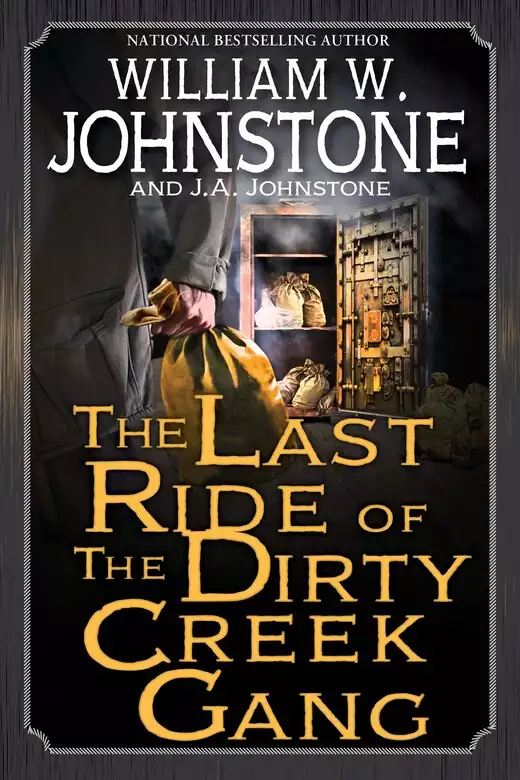
In this explosive new series from the bestselling Johnstones, a once-notorious gang of retired bank robbers reunite for one last ride—and one last shot at glory . . .
Clay Carson thought his outlaw days were behind him. Years ago, he rode with the fearsome Dirty Creek Gang—and robbed half the banks in Texas. But then a fatally bungled heist in Fort Worth brought it all crashing down. The gang broke up, went their separate ways, and that was the end of that. But today the past came calling for Carson in the form of a telegram. It’s from Lemuel Jones—his old gang leader—who asks him to do something reckless, stupid, and downright crazy: round up the old gang for one last ride.
Jones says he hid away the gang’s biggest payday from their boldest bank job, and he just needs Carson and the gang to help him get it. Carson assumed his old boss gambled it away—and has doubts about his old gang members, too. All but one of them has gone straight, with respectable jobs like store clerk, ranch hand, and even banker. The only outlaw left has been captured and sentenced to hang. Which means the crew would have to bust him out of jail and ride off with a posse on their tail. It’s crazy, all right. But the Dirty Creek Gang is just crazy enough to give it a shot—even it’s their last . . .
JOHNSTONE COUNTRY. THERE’S ALWAYS ROOM FOR ONE LAST HEIST.
Release date:
February 24, 2026
Publisher:
Pinnacle Books
Print pages:
320
* BingeBooks earns revenue from qualifying purchases as an Amazon Associate as well as from other retail partners.
As the buckboard rattled along the dusty Texas road, he kept glancing over his shoulder. Worse, he slid his foot over to rest against the stock of his rifle. A deft kick could lift it for a quick grab. He knew from experience he could lever in a round, aim, and fire in the blink of an eye. Too many varmints had doubted that and now lay dead, scattered across Texas and Indian Territory.
A few of the varmints had been men who were inclined to put an ounce or two of lead into his hide. So far, he had always beaten them to the draw. But those were the old days. At least a year in the past. Carson had no reason now to suspect every stranger he saw or worry about a lone rider on the road behind him. He had no reason—but old habits died hard, especially when they had kept him alive.
He wished he had his trusty six-gun slung at his hip, but the rifle would do, provided he kept trouble at a distance.
“What’s got into me today?”
The mule pulling the buckboard ignored him. It kept its flop-eared head down, straining to pull its load. While out plowing and tending the fields, the mule, named Solomon for its stubborn wisdom, had been his only company on the lonely farm for most of the past year. Carson had come to trust the animal more than he did most men. Solomon didn’t ask questions, didn’t pry into the past, and never judged.
“Maybe it’s been too quiet. Maybe I can’t help but think it’s time for the other boot to drop.”
Even his own reassuring words did nothing to prevent him from looking behind him again.
Nothing.
He rode along the empty road, the vast flat prairie land stretching as far as the eye could see—miles of open space without a living soul in sight. The mesquite and live oaks stood like lonely sentinels scattered here and there, while wind-devils spun dust into the air and vanished just as quick. Overhead, the sun hung low and hot, turning sweat stains into permanent tattoos on his shirt.
He snapped the reins, urging Solomon to move along a little faster. The sooner he got to town, loaded supplies for the farm, and returned to his cozy niche that had been his home for nigh on a year, the easier he’d breathe.
The town appeared first as a shimmery mirage, then hardened into real buildings with a few people moving around between them. Several old men, propped up in chairs under shady awnings, waved to him as he drove past. He returned their greeting.
He might be the only thing out of the ordinary for them all day.
Ferguson wasn’t the crossroads of anywhere.
Since the railroad had bypassed the town a couple years back, it had hung on by the skin of its teeth. Many businesses had pulled up stakes, moving closer to the steel rails to chase prosperity, while others simply shuttered their doors for good.
That was one reason he’d decided to stay here.
The nearsighted, overweight town marshal hadn’t so much as looked at a Wanted poster in years. Carson had once heard him bragging about using them to start fires in his potbellied stove, to keep warm in the winter and to brew his vile coffee year-round. With a sleepy marshal like that, and a town that saw few travelers, Ferguson was the perfect place for a man hankering to stay lost.
Clay Carson smiled crookedly at the thought. The law from half a dozen other towns had probably given up hunting for him. Other crimes must occupy their interest by now.
He still looked around, taking special care to check his back trail. Old habits died hard.
He climbed down and stretched his cramped limbs. He was lean and still mean—he hoped—but Father Time was beginning to take his due. Working on the cotton farm was still easy enough for him, though some nights required a liberal application of horse liniment to ease his aching muscles. Other mornings not even the potent liniment worked out the kinks in his back for him to face another day toiling in the field.
A quick look in the window of Ferguson’s only general store showed the reflection of a man edging into his middle years. He tugged his straw hat down to hide the retreating hairline of what had once been a full head of brown hair. He was beginning to look too much like all the old-timers in town, which bothered him.
“You need to grow back that big, bushy beard, Mr. Carson. I thought it looked real fine when you first came to Ferguson.”
The woman speaking stood in the doorway, leaning on a broom. The pile of dust around her feet showed that she would never win against the persistent grit, but was too stubborn to admit defeat. Even a touch of breeze caused swirls to form faster than anyone, even someone dedicated to the pursuit, could sweep it all back into the street, where it belonged.
“Miz Cline.” He touched the brim of his straw hat. “You’re looking mighty fine today.”
“You’re such a liar,” she said, gracing him with a bright grin. “But don’t you stop now, you hear?”
She pushed a stray wisp of graying hair back toward the bun perched on her head.
“You’re not buttering me up to give you more credit, now are you?”
“That’s between Mr. Cline and my boss.”
“You’re more pleasant to talk to than Frank Bellamy,” she said. “And to look at. If you’re doing the asking, I’ll be doing the agreeing.”
She flirted with him because they both knew it passed the time and wouldn’t amount to anything. Dottie Cline was firmly married to Ezra. Even if she hadn’t been so devoted to the crusty owner of the store, Carson wasn’t inclined to make a play for her. As affable as she was, she reminded him too much of his third-grade teacher in Arkansas who had made life miserable, if not downright intolerable, because of her hectoring.
That had been the same year his ma died of tetanus. He’d never been happier to move on with his itinerant snake-oil-selling pa and his endless parade of ladies. The education he got was more about people than book learning, but along the way he had developed a taste for dime novels. The more lurid, the better. He took special interest in yarns about the outlaws. Wild imaginations fueled those stories, which he knew firsthand. Someday, he’d try his hand at writing one with real characters and situations.
Most likely, editors would reject those stories because they would seem too wild, if not downright loco.
“Mr. Bellamy needs fifty pounds of flour, what sugar you can spare, and his missus wants a dozen spools of thread she saw in your window last time she was in town.”
“You get Ezra to help you load the flour. I’ve got a five-pound bag of sugar set aside, but the thread?” Dottie Cline pursed her lips. “Don’t rightly know if I have that many spools anymore. I’ll check in the back room.”
“Will that take long?”
“Not if you help me,” she teased.
“If I did that, we’d spend the rest of the day hunting.”
“Then why don’t you go on over to the Horny Toad and wet your whistle? I won’t be too long, I don’t think.” She frowned, pushing the broom ahead of her as she vanished into the store.
Carson heard Ezra Cline growling like a hungry bobcat as she dragged him into the storeroom.
Knowing the search for the elusive thread would take a spell, Carson turned toward the town’s only saloon.
At this time of day, it was as deserted as a ghost town. He poked his head in and looked around. The barkeep sat on a stool at the end of the bar, head on his crossed arms and snoring up a storm.
Carson wasn’t particularly thirsty. Certainly not enough to risk waking the barkeep. The man had a temper. Disturbing his hibernation brought out the grizzly in him. Besides, two half-drunk customers ran bugs up the barkeep’s arm racing for some finish line under his collar. Whichever bug won would awake a sleeping behemoth.
That was more excitement than Carson wanted.
Carson backed out and looked around town. Over the past year, he’d been here on errands dozens of times. Sometimes he brought in bales of cotton to ship over to San Angelo when the mule skinners drove their wagons in. Other times, like today, he hauled supplies for the farm. Keeping two sections of farmland under cultivation took considerable effort—and not a little backbreaking work. At least he didn’t have to do it alone. The Bellamy sons were good workers, but they were close to the age of wanting to spread their wings and fly away from home and hearth.
He could tell them about the world away from their farm. It might curl their hair. Or it might intrigue them so much they’d leave right away. With things the way they were in the Bellamy family, Frank wouldn’t take kindly to anything that drove his two boys away.
Carson settled into a chair by the two swinging batwing doors and rocked back like the old men he’d seen on his way to the general store.
It felt wrong doing nothing. It made him antsy when he wasn’t on his feet, doing and fetching and losing himself in work.
What it really meant was his guilt hadn’t faded one whit over the past year, and he jumped at shadows. That made him wonder if it wasn’t time to ride on. If he made an effort, he could reach Montana in a month or so. Or California. He’d never seen the Pacific Ocean, nor had anyone he’d ever ridden with. The descriptions in books he read made it sound odd and dangerously wonderful, especially for the men in ships crossing to China or curling around the Horn to reach far-off Boston.
As exciting as that sounded, he’d never want to go that far across endless stretches of water. He could barely swim, not that a sailor had much need for such skills. If a ship went down a hundred miles offshore, none of the crew could swim to safety on dry land unless they grew gills and tail fins.
“Stay astride a good horse with solid ground under my hooves,” he said. Sailing off to the Orient was daring and worth reading about. He’d have to content himself with something less adventurous—and with the chance of walking to the next town if his horse pulled up lame.
“Carson! Clay Carson!”
At the sound of his name, he rocked forward and tensed. His hand pressed hard into his right hip. All he felt was the rough expanse of his jeans. His six-gun hung in its holster from a peg in the barn back at the farm. And his rifle was still in the buckboard.
“Didn’t mean to startle you.”
The smallish man ran up to him, waving a dingy white envelope.
“It’s just that I was glad to see you, so I didn’t have to ride all the way out to Frank’s place to give you this.”
He thrust out an acid-stained hand holding the envelope. Dark brown spots marred his fingers where sulfuric acid had eaten away the skin. When the man moved just right, so he turned upwind, the stench of lead and acid was enough to churn Carson’s stomach.
Carson wondered how the telegrapher endured his life cooped up in the Texas and Pacific Telegraph office. Fumes rose from the lead-acid batteries and made anyone used to being outdoors choke and cough. Carson felt his nose stopping up and his eyes watering as he thought about the last time he’d gone to the office to send a telegraph for Mr. Bellamy.
“I just lost my balance in the chair,” Carson lied. “You have a ’gram for Mr. Bellamy?”
The telegrapher’s woolly-worm eyebrows wiggled about. He shook his head, checked the name on the envelope, and then thrust it out.
“No, sir, it’s for you.”
Carson froze. Nobody knew he was in Ferguson.
“You mean you want me to take it to Mr. Bellamy?”
“Nope, not a lick of it, Mr. Carson. This here’s for you. It came over the wires in the middle of last night.”
Carson stared at the man.
“I know what you’re thinking. How’s he record a ’gram that comes in at three in the morning? Well, sir, I work long hours and just happened to be behind the bug—that’s what we professionals call that telegraph key—when the clacking started. Here.” He stepped forward and shoved the envelope within inches of Carson’s grasp, as if afraid he’d get his hand bit by a rabid dog.
Carson stared at the paper.
“You take care now, Mr. Carson, sir. And don’t you go killing anybody.” The telegrapher backed away, wiped his sweaty palms on his pant legs, and almost ran off.
Carson looked up and down Ferguson’s main street. These days it was about the town’s only street, unless alleys and rutted paths counted as streets. He saw nothing unusual.
Hands quaking, he tore open the envelope. A quick scan did nothing to stop the shakes. It was worse than he’d feared.
He understood why the telegrapher had hightailed it like he had the pox. The man had written every letter as it came from Hidetown, at the far northwest corner of the Panhandle. He had received a wire from the most infamous outlaw in Texas who wasn’t John Wesley Hardin. Carson forced himself to read the telegram three times, to be sure it said what he feared:
Come pronto STOP
Need to dig up Fort Worth loot before I die STOP
/s/ Lemuel Jones
Clay Carson stuffed the telegram into a vest pocket. For a long moment, he stood frozen to the spot. He had ridden long miles and taken curious turns to avoid anyone finding him. Lemuel Jones had shown himself to be as crafty as Carson had always known he was. Somehow, the man had tracked him down and sent the message to his hidey-hole.
“Dying?” Carson pushed his hat back on his head and thought about that. Of all the things Jones could have said to get him out of hiding, this was it. That, and mention of the loot from their last disastrous bank robbery in Fort Worth.
Not for the first time, Carson regretted not having used a summer name when he had finally circled Ferguson and decided this was where he wanted to fold his wings and make his nest. In his eagerness to find sanctuary, he had relied too much on hiding his trail and not enough on hiding himself. When Miz Cline had asked his name, he never thought of giving something made up. He’d blurted out “Clay Carson” and was stuck with it. Explaining away another name after giving his real name would have drawn too much unwanted attention.
He should have ridden on, but he took a liking to her smile and jovial demeanor. It happened that Bellamy and his missus were in the store when he came up short paying. The farmer had offered him a job on the family cotton farm. The hand who had worked for them over the past two seasons had left because of family sickness down in San Antonio, and the farmer needed help with such a large crop.
Bile rose in his throat and nearly gagged him. How dare Lemuel Jones summon him like this? He turned and followed the telegraph agent to the narrow whitewashed building where telegraph wires angled down from two different directions. The town provided a way station for the electric communication. After the railroad had bypassed them by a couple dozen miles, this was the only thing keeping Ferguson from drying up and blowing away in the ceaseless prairie wind.
The wind tugged at his coat as he walked, bringing with it the sharp, dry scent of sunbaked mesquite and the ever-present dust that clung to boots and bone alike. His boots scuffed across the warped wooden planks of the boardwalk, echoing against shuttered windows and rusted hinges. The town was quiet, too quiet for his liking.
“A stopover and nothing else,” Carson grumbled as he went to the office door. He shouldn’t have stayed. He had been found far too easily.
He kicked the door open. It slammed hard into the wall with a sound like a gunshot. The agent jumped to his feet and turned even paler. One shaking hand was pressed to his mouth as if anything he might say would be wrong.
“Where?” Carson bellowed like a wounded bull as he stepped into the office. “Where’d the telegram come from?”
“I-it’s on the ’gram, Mr. Carson. You got all the information I got. Really.”
“Has anyone been poking around, asking for me?”
“A stranger, you mean?” The man’s mouth opened and closed like a fish with a hook caught in its lip. “Not recently.”
Carson stepped closer. His hand ran up and down his right side, hunting for a six-shooter that wasn’t there. The telegrapher saw the action and went even paler. Only gunmen moved like that. He wobbled a mite and braced himself against the counter.
“Don’t you go passing out on me,” Carson warned, wagging his finger. “You won’t like how I’d bring you back.”
The man’s mouth gaped and closed a couple more times. His Adam’s apple bobbed, and sweat beaded his forehead.
“I … I promise not to faint, Mr. Carson.” He wasn’t going to say more, but the silence that descended on the office felt like a funeral shroud. “It … He came ’round a couple months back. Maybe that. My memory’s not good for things like dates, but I know the code. I can—” He swallowed hard when Carson glared at him. “He asked if I knew a whole passel of men. You were the only one he named that I’d ever heard of.”
“Describe him.” Carson pounded on the counter with his fists. The drumbeat caused the telegrapher to jump with every thud.
“Nothing special. Just a trail bum. I don’t remember much about him, but he wore eyeglasses. The kind that pinch down on your nose. And …”
“And?” Carson stopped his drumming and leaned closer. “What else?”
“He had hair the color of straw. And he wore his gun down low on his hip, tied down. Like a gunslick. He moved quicklike, eyes darting about. Little beady black eyes. Like a snake. I didn’t much like his look, but he was nothing but polite.”
“He asked after me but never came around the farm?”
“I told him you worked for Mr. Bellamy, so he shoulda been able to find you real easy.”
“A month or two back? And now I get a telegram?”
“From this here Lemuel Jones in Hidetown. I’m not for certain sure where that town is, but there was an outlaw by that name—”
Clay Carson stormed from the office, leaving the man behind him stuttering, trying to explain, apologizing, and offering to make amends. He wasn’t sure what kind of amends the man thought he could make, but Carson knew that he himself needed to be gentled or he’d buck halfway to the sun. Not even a drink would settle him down. Not even an entire bottle of Old Crow.
Stride long and almost running, he went to the general store. Dottie Cline was nowhere to be seen, but her husband worked to patch the cracker barrel just inside the door. Ezra Cline looked up, his sour expression never changing. For once, Carson’s mood matched the merchant’s.
“A month or two ago, did a man come around asking after me?”
Cline cocked his head to one side. Being disturbed while patching a mouse hole in the bottom of the barrel irritated him more than usual. Then he saw the storm cloud that swirled around his usually quiet, peaceable customer.
“Nope.”
“He’d have asked after me or men named Potter or Wylie.” He took in a deep breath and added, “Or Lemuel Jones.”
Cline frowned. “Said there wasn’t. I loaded Frank’s supplies into your buckboard for you. Put it on his bill. Tell your boss he’ll have to settle up ’fore I give him another dime’s worth of credit.”
Cline always sent Carson back to the farm with the same admonition. It meant nothing. And the merchant had no reason to lie about anyone asking after Lemuel Jones and his friends. Carson climbed into the driver’s box and took the reins. The mule brayed loudly and began pulling. It knew the way back to the cotton farm better than Carson. He gave the animal its head so he had a chance to look all around.
The uneasy feeling of being watched grew as he drove along the dusty, double-rutted road. He tried to make sense of what had crashed down around his ears. If he never heard from Jones again, it’d be a day too soon.
But who was the man who’d ferreted out his hiding place for Lemuel Jones? It wasn’t anywhere near describing any of the others in the Dirty Creek Gang.
It certainly wasn’t Jones.
“If that old reprobate had found me months back, why leave and send a telegram now? Especially if he’s actually dying?” he asked aloud.
None of that made a lick of sense to him.
He craned his neck around to study his back trail as the mule turned up the narrow lane leading to the distant farmhouse. Carson felt a bit stupid. All he had was a gut feeling of someone after him today. He’d not caught even a flash of anyone on his trail. If it had been a lawman, there was no reason to be so coy. And Jones had found him a couple months earlier.
“Why now?” He shook his head.
The rest of the day passed in a slow burn. Carson couldn’t shake the tension that coiled in his gut like a rattler beneath dry leaves. Every shadow felt too long, every distant noise too sharp. Something was stirring, something he couldn’t see just yet.
Bellamy’s voice brought him out of his thoughts.
“You gonna sit in that wagon all day, or are you gonna unload the supplies?” A husky man of medium height, with hands the size of mason jars, pointed to the cargo. Frank Bellamy sounded gruff, but he had a decent heart beating under his faded bib overalls. After all, he had given Carson a job weeding the cotton fields and saved him the need of asking others around Ferguson for a job.
That was even more generous of the man, since he had two young teenaged sons to help out with the chores, to tend the fields, and to do work Carson did at half the speed. The only skill Carson brought to the farm that had been lacking was his skill as a cook. All that meant was he hadn’t poisoned any of the Bellamys since he’d hired on. Miz Bellamy was a fragile thing, sickly and hardly able to do more than the laundry and some cleaning. She spent much of her day sewing and looking out a bay window at the prairie. Carson had taken over the cooking chores to give her an easier time of it. From what the two boys said, he was a better cook than their mother had been.
Carson found it hard to believe how their ma wasn’t a good cook, but the two boys weren’t inclined to sugarcoat anything. Like their pa, if something displeased them, they said so right out loud. Even Miz Bellamy complimented him on his culinary skills, but why shouldn’t she? She didn’t have to do more than fix a simple lunch while Carson prepared both breakfast and supper. It had taken a few weeks for him to work out a schedule that allowed that. The hardest meal was supper after a day in the field, but he had learned how to get stews made that took a long time to cook, but without much tending. The family might not eat fancy food, but it ate well enough. Some days, Carson considered learning how to make a decent fruit pie. So far, though, his efforts had been sorry.
He hopped down, hesitated when his fingers brushed across his rifle, then left it to move the supplies into the house. He loaded the sacks of flour and cornmeal, jars of pickled beets, and a small bolt of cloth Miz Bellamy had requested. He moved like a man trying to burn off a storm inside him. Every footstep had a purpose; every lifted box came down with just a bit too much force. The creak of the floorboards and the thud of burlap on the table matched the agitation in his gut.
Inside the house, the stillness was a comfort. It smelled of soap, stove ash, and lemon oil—clean, lived-in, the smell of honest work. The ticking of the old mantel clock matched the rhythm of his thoughts. He paused long enough to glance through the open doorway into the dim parlor, where Miz Bellamy lay resting beneath a faded quilt. Her breathing was light, like the whisper of silk, barely ruffling the lace collar of her nightdress.
Carson moved to the kitchen and got to work fixing a decent meal for the other men. They’d been working in the field while he’d been riding into town. Miz Bellamy likely was taking a nap to build up her strength. He prepped with quick, precise motions, hands moving instinctively. The skillet hissed with bacon fat, and soon the smell of frying meat and warm biscuits filled the farmhouse.
He had used some of the flour to bake biscuits. When they were golden brown, he called for the others to come eat. The lady of the house wasn’t up to joining them.
He stood for a while by the window, watching the boys move through the rows of cotton, their silhouettes framed against the low setting sun. Shadows grew long across the yard, stretching like fingers toward the barn. The wind stirred the clothesline and made the drying sheets whisper secrets he couldn’t quite hear.
Then came Bellamy’s question, one that had been hanging unspoken between them like a dusty chandelier swaying in still air.
“What’s eatin’ you, Clay? I ain’t seen you this pensive since the day you wandered up the road to the Clines’ store.”
He denied being preoccupied, but Frank Bellamy wasn’t having any of it. He knew Carson too well. The farmer leaned his weight against the doorframe, arms folded over his chest, a crooked smile pulling at the edge of his wind-chapped mouth.
“It’s like this,” Carson said. “I got word that a … friend is at death’s door.”
Bellamy cocked his head, the smile vanishing. “He wants you to come by and say goodbye ’fore he kicks the bucket?”
“That’s what he claimed.”
“But you’re not inclined? Is it too far? I can see not wantin’ to g. . .
We hope you are enjoying the book so far. To continue reading...

 Please log in to recommend or discuss...
