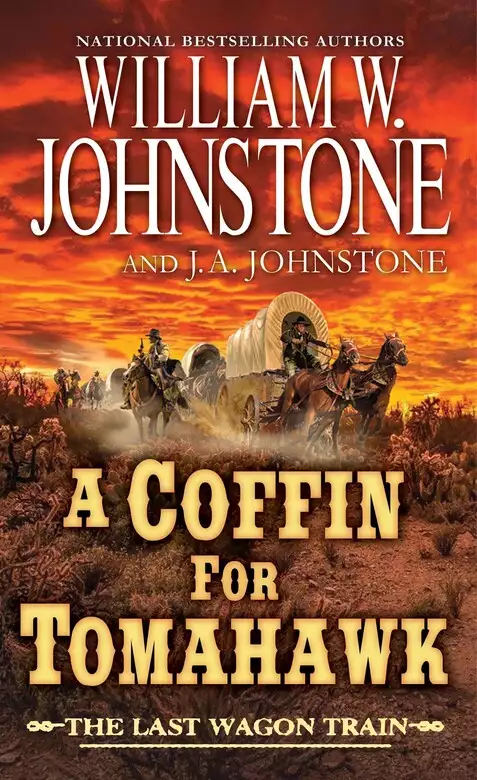
Western legend Luke “Tomahawk” Callahan agrees to lead one last wagon train across the Mexican border—where revolution is brewing, bullets are flying, and all roads lead to death . . .
With just a single journey under his belt, first-time wagoneer Tomahawk Callahan became a national hero. It started as a challenge waged by a railroad mogul—a race between an old-time wagon train and a brand-new rail line—with the whole world watching. Against all odds, Tomahawk led his family business to victory. At the time, he thought it would be his first—and last—wagon train. But at his sister’s urging, he’s agreed to take on one final job, a never-before-attempted trip across the Mexican border . . .
But Mexico is undergoing bloody changes. After a brutal coup, General Porfirio Diaz is determined to bring “order and progress” to the country—while revolutionaries plot against him. Tomahawk’s wagon train could help modernize Mexico, bringing railroad workers, miners, and supplies—across a desert full of rattlesnakes, Apache, and other threats. The deadliest of all is a former priest known as Generalissimo “Padre” Rodriguez, who has his bloodthirsty sights set on the wagon train. Tomahawk’s got to drive his wagons out of this frying pan and into the fire—or they’ll all end up on a wagon trail to Hell . . .
Release date:
October 28, 2025
Publisher:
Pinnacle Books
Print pages:
320
* BingeBooks earns revenue from qualifying purchases as an Amazon Associate as well as from other retail partners.
“He’s a big one, all right. You sure you want to be doing this on your wedding day?”
Luke “Tomahawk” Callahan knelt in the mud next to the grizzly bear track. It was as big as a dinner plate. They’d tracked the bear two miles already, and Callahan wasn’t about to call it quits now. Anyway, the wedding wasn’t until later in the afternoon.
Callahan squinted up at George Berringer. “Don’t worry, George. Becky won’t get stood up. But this grizzly’s made off with two of Ida’s goats, one of Old Man Morrison’s sheep, and Fred Lumen’s prize hog. And don’t forget he tore into Barney Kroeger’s smokehouse last week. The bear knows it can eat good around here for little effort, so he’s not going away on his own. Goats today. Maybe somebody’s toddler next time. We’re going to kill this animal while we’ve got the chance.”
Berringer scratched behind one ear, thinking hard, making all the lines on his weathered face scrunch together like a cranky old prune. A light frosting of white stubble down each cheek and across his chin. He was spry for a man in his late sixties and had insisted on coming along as going into the woods alone after a killer bear was nobody’s idea of smart thinking. He rested a Sharps carbine on his shoulder, his relaxed posture in direct contradiction to the nervousness both men felt.
“A big, mean bear might take a few rifle shots and not think it’s very funny,” Berringer said. “Might just get him mad.”
Callahan’s grip tightened on his Henry rifle. “Then we’d better make sure we shoot straight. Come on.”
They stalked deeper into the woods, listening, eyes open, Callahan stopping periodically to examine a broken branch or another track. No more banter between the two men; they could feel it, like the whole forest was holding its breath—the animal was close. Callahan suddenly found he was second-guessing himself. Maybe Berringer was right about this being a bad idea. It wouldn’t have delayed them too long to round up a few more of the men.
Forget all that, he scolded himself. You made your call, now stand by it. The rest is distraction.
They slowed their pace further still and froze when a rustling noise off to their left drew their attention. Callahan raised the Henry and held his breath. A heavy silence had fallen over the world, Callahan’s heartbeat in his ears the only sound.
An explosion of shrubbery.
Callahan swung his rifle to the right.
A pair of flapping, fat doves winged past him then spiraled upward, vanishing into the canopy.
Callahan and Berringer grinned nervously at each other.
Easy, mister. Don’t get spooked by every little thing. He tried to will his thumping heart to calm. Nervous Nellies don’t shoot straight.
They moved deeper into the woods, stepping even more cautiously than before. The entire area seemed impossibly silent, and by contrast, each of Callahan’s footfalls—no matter how gingerly he stepped—seemed like a crackling racket of dry leaves and twigs. A minute later, he knelt next to another huge bear track, clearly outlined in the mud. Something had smeared the bottom half of the track. Callahan’s eyes narrowed as he wondered what he was looking at. He stood and moved a few feet to the left, glancing ahead.
He knelt again, examining a new set of tracks. They angled in, crossing the first set of tracks. He squinted closer. Bear tracks. And they looked to be the same size as the first set. It only took Callahan a split second to realize it was the same animal making a circle.
But why would he double back …
Oh, no!
Callahan spun, bringing the rifle up just as the gigantic animal came barreling through the brush, snarling, and then letting out a terrific bellowing roar. The grizzly was massive, the biggest bear Callahan had ever seen.
Callahan fired the Henry, and a laughably small chunk of lead disappeared into the wide, fur-covered chest of the grizzly. As Berringer had predicted, the shot only served to enrage the animal, and it reared up on its hind legs with another earsplitting roar, towering over Callahan at least nine feet tall.
Berringer pumped lead into the beast with his carbine, but the shots might as well have been horsefly bites.
Callahan levered another shell into the Henry’s chamber but never got the chance to fire. The bear swept forward with a big paw, claws raking across Callahan’s chest, ripping through his buckskin jacket and the shirt and flesh underneath, knocking the Henry away in the same motion.
Callahan took half a step back and drew his Peacemaker as the bear leapt for him. He fanned the hammer, emptying the six-shooter into the animal, just as it pounced.
The bear’s entire weight slammed into Callahan, driving him to the ground. He landed hard on his back, and the wind was knocked out of him, fur shoved into his face, the animal’s weight making it impossible to catch his breath.
He lay beneath the grizzly, trying to squirm out from under, and realized the animal lying on top of him wasn’t moving.
With grunts and groans, George Berringer managed to shift the bear just enough for Callahan to crawl out from under. Callahan crawled a few feet away, panting for breath. He sat against the trunk of a big-leaf maple and opened his shirt.
Three red lines about four inches long. Lots of blood. He prodded at the wounds, investigating the damage.
“Not too deep,” Callahan said. “But it hurts like the devil.”
Berringer bent over to squint at the claw wounds. “Could have been worse. Animal like that? Could have been a lot worse.”
Callahan stumbled to his feet and retrieved his rifle.
Berringer gestured to the dead bear. “Lot of good meat there. Good pelt, too.”
“We’ll send somebody back,” Callahan said. “I’ve got a wedding to get to.”
They hiked at a brisk pace back to the place where they’d left the horses tied. Callahan was covered in sweat, the wounds in his chest throbbing. They mounted up and rode for Salem, the farms and fields passing by.
Salem wasn’t a bad town, but Callahan had grown accustomed to the wilderness. He’d built a small log cabin overlooking a shallow stream, and he liked his solitude, but in the past year, he’d gotten to know the folks who lived and worked on the outskirts. He liked them and wanted to help them when the bear had started causing a problem.
And, truth be told, he wasn’t always perfectly comfortable walking down the streets of Salem. Not because the people weren’t friendly, quite the opposite. Callahan was something of a local celebrity, and people were still clapping him on the shoulder or buying him drinks whenever the opportunity presented itself. He appreciated the sentiment but found the attention uncomfortable. He considered himself a normal, simple man just going about his business.
Tomahawk Callahan had led a wagon train from Kansas City to Oregon. That, in and of itself, while an accomplishment, was not newsworthy. Hundreds of other wagon trains had made the same journey over the years. But Callahan hadn’t just led settlers west.
He’d been in a race.
A boastful rogue named Kent Arbuckle had been building a branch line to Salem and had wagered he could finish building the new rail line and that his train would pull into Salem long before Callahan and his meandering wagon train even crossed the state line. By luck or skill or the Good Lord’s intervention, Callahan had won the bet in dramatic fashion, and the historic event was still a popular topic of conversation nearly a year later.
They galloped into Salem, reining in the horses in front of Winchell’s Butcher Shoppe, not because they were looking for a good cut of meat but because Delbert Cole lived in a room upstairs. Callahan might have asked one of the boys from the wagon train to stand up for him, but they’d gone back to Kansas City to work for Aunt Clara. Cole had become an occasional drinking buddy, had been instrumental at the last minute in helping Callahan win his bet with Arbuckle, and was a good-natured sort in general. Callahan could do a lot worse for a best man.
Callahan leaned against his horse, breathing hard, his chest throbbing. Sweat matted his hair.
“You don’t look so good,” Berringer told him. “You might want to have Doc Parker look at your chest.”
Callahan groaned. “I’ve got to get up to Delbert’s place. He’s got my good suit. I’ve got to change.”
Berringer took his pocket watch out and looked at it. “You’ve got time. You don’t want an infection.”
“Okay, but let’s hurry,” Callahan said. “But if he’s not in, it’ll have to wait for later.”
Doc Parker’s office was two doors down, and he did happen to be in.
Parker tsked and fussed and grumbled about the wisdom of chasing giant bears into the woods as he peeled off Callahan’s bloody and ruined shirt. Callahan winced and hissed when Parker hit the slashes with disinfectant.
“I’ve seen deeper cuts,” Parker said. “But you should still have stitches.”
“No time, Doc,” Callahan said. “I’ve got an appointment with a bride.”
Parker shrugged. “Don’t say I didn’t warn you. I can at least wrap it up tight.”
“Thanks, Doc.”
Callahan winced and grunted when the doctor cinched the bandages tight.
“Hurts?” Parker asked.
Callahan nodded. “It hurts.”
“Hold on,” Parker said. “I have something for that.”
Doc Parker mixed two liquids and a white powder into a glass and stirred it vigorously before handing the glass to Callahan. “A little mixture of my own I’ve perfected over the years. That’ll make you feel good. Numb the pain.”
Parker turned away from Callahan to wash his hands in a ceramic basin.
Callahan tilted his head back and drained the liquid in one go. The bitter taste almost made him spit it out again, but he managed to get it all down.
Parker dried his hands on a towel. “Have a small swallow now, and I’ll give you a flask to take the rest as you need it.” He turned, blinked at the empty glass in Callahan’s hand. “Where’d it go?”
“I drank it.”
The doctor blinked again. “All of it?”
“You gave it to me,” Callahan said defensively.
“Oh.” Parker tsked. “Well, you’ll need to be someplace comfortable in about twenty minutes. That’s strong stuff.”
Callahan grabbed his buckskin coat and shrugged into it. “Gotta go, Doc. I can’t pass out before I get married.”
Parker shouted, “Good luck!” as Callahan raced from the room.
He ran down to the butcher’s shop and climbed the back stairs two at a time. He knocked on the door.
The door swung open and Delbert Cole stood there. He was a tall man and wide, and his muscles fit awkwardly into a brown suit, but his hair was slicked back, and he was clean-shaven, ready to be Callahan’s best man.
“Where you been?” Delbert asked. “You better get a move on or—what happened to you?”
“I ain’t got time for long stories, Delbert,” Callahan said. “Where are my clothes?”
By the time Callahan had changed into his blue suit, he could feel it, a vague lightheadedness, a warm numb feeling to the tips of his extremities. The pain from the wounds on his chest had faded to a dull and distant ache.
“Come on!” Callahan’s own voice echoed strangely in his ears. “We’re late!”
They ran to the end of the street and a block over to the side door of the Methodist church. Callahan’s legs felt strangely heavy even as the rest of him felt oddly light, like his head might detach and float away. They entered, and the pastor glowered at them.
“Sorry to be late, Parson,” Callahan said.
“Never mind. You’re here now.”
Becky’s daughter, Lizzy, stood on the other side of the pastor, giggling at Callahan. She wore a pink bridesmaid’s dress, a ring of white flowers perched atop her head like a crown. Callahan winked at her and grinned. It had been easy this past year to start thinking of the little girl as his own.
The pastor signaled to an old woman at an upright piano along the far wall, and she began to play a popular wedding tune. The notes sounded hollow and tinny in Callahan’s ears, and the world was starting to blur at the edges. He felt no pain now, but there was a wetness on his chest. Blood was coming through the bandages. He hoped it wouldn’t come through the shirt, too.
Callahan looked out across the interior of the church. Maybe two dozen people sat in the pews on both sides of the aisle, friends and acquaintances he and Becky had made in the last year.
He felt Delbert grab him under one arm.
“You’re swaying,” Delbert whispered. “You gonna be okay?”
“Just don’t let me fall,” Callahan whispered back.
He spotted an old woman in the back pew, and it struck Callahan she was familiar. He couldn’t recall where he’d seen her around town. Maybe she was a friend of Becky’s or—
Aunt Clara!
Maybe it was Doc Parker’s odd brew that had rattled Callahan’s brain, or maybe it was the fact he couldn’t remember the last time he’d seen his aunt in a dress, but she was almost unrecognizable at first glance. She still ran the wagon train outfit that had belonged to his uncle before he’d been murdered, and usually, she wore the same sort of clothing as the wagon train crew: patched, threadbare trousers, a heavy man’s shirt, and a floppy, sweat-stained hat. Now her hair was pulled back in a neat bun, and she wore a new dress with a pink and blue floral pattern.
Callahan had sent a letter weeks ago to tell her he was getting married. And while she was, of course, invited, he really didn’t expect his aunt to make the long trip all the way from Kansas City.
She gave him a wave, fingers wriggling. He smiled and nodded in reply.
Then the double doors at the end of the aisle opened and Becky came through, a bouquet of white flowers in her hands. She looked radiant. Indeed, there seemed to be a hazy glow around her, and Callahan again realized it was the doc’s brew still doing a number on him.
She held on to the arm of the mayor of Salem of all people, who’d agreed to give her away. The man had given Callahan the key to the city when he’d won the bet with the railroad man. It was stuffed in a chest or something. Callahan hadn’t seen it in months.
Becky’s dress was one of the prettiest things Callahan had ever seen, and, of course, she’d made it herself. It drew in at the waist to show off her figure. Her red hair flowed down over her shoulders, which added to the golden glow about her. She beamed, and he felt love swell in his heart.
Halfway down the aisle, Becky looked at him, and her smile fell into little pieces. The mayor handed the bride off to Callahan, and she continued to look at him with a mixture of concern and disapproval.
“You look terrible,” she whispered from the side of her mouth. “There’s blood coming through your shirt.”
“Long story,” Callahan whispered back.
“Dearly beloved,” the pastor began. “We are gathered here today …”
“I got hurt,” Callahan whispered. “Doc Parker gave me something for the pain. I hate to say this, but I might pass out.” Callahan felt even more dizzy now, the room threatening to spin.
“Oh, no, you will not,” Becky hissed at him.
The pastor cleared his throat. “Is something the matter?”
“He’s hurt,” Becky said. “We might need to hurry this along.”
“Hurt?” The pastor looked from Becky to Callahan. “Perhaps we should postpone—”
“No!” Becky said quickly. “Nobody’s postponing nothing.”
“How’d you get hurt?” the pastor asked Callahan.
“Got tangled up with a grizzly bear.”
The pastor rolled his eyes. “Look, if you don’t want to tell me …”
“Pastor,” Becky urged.
“Oh. Right.” The pastor flipped through the book he was holding. “Uh … if anyone can see any reason these two should not be joined—”
“Nobody sees any reason like that,” Becky insisted.
Callahan felt his legs go. Becky held him up on one side, Delbert, the other.
“Pastor!” Becky said with a grunt, struggling to hold up the groom. “Hurry it up.”
“Do you take him?” the pastor asked.
“Yes!” Becky said.
“And you take her?”
“I do,” Callahan said.
“Then I pronounce you man and wife,” the pastor said proudly. “Go on and kiss.”
Becky grabbed the back of Callahan’s head and pulled him close. Their lips met, and a jolt of lightning sizzled the length of Callahan’s body.
And then he fell over.
A sensation of clean, cool sheets. Dusty morning light seeped into the room through the crack in the curtains.
Tomahawk Callahan’s eyes creaked the rest of the way open, and he recognized Becky’s bedroom. A dresser. A glory box at the foot of the bed. A vanity with a round mirror, ceramic pitcher, and washbasin. A chair next to the window. Becky kept the room—the whole place really—neat as a pin.
When Callahan had won the big wager, half the money had gone to Aunt Clara. He’d kept the other half for himself and purchased a corner building in a good part of Salem. The downstairs was perfect for Becky’s shop, with big windows out front to display the dresses she made. Stairs in the back led up to the living space on the second floor.
And she’d been successful. In a few months of making dresses and offering alteration services for the ladies around town, she’d started making enough to pay rent to Callahan. He’d tried to refuse, but the woman was stubborn and independent-minded, and it finally was just easier for him to accept the payments. He put the money into a bank account, knowing he’d eventually spend it on her anyway.
He sat up and stretched. His head was clear. The claw wounds in his chest ached, but not so much that he couldn’t stand it. The bandages had been changed.
The door creaked open, and Becky stuck her head into the room. “He’s alive.”
“I remember getting married,” Callahan said. “I hope that wasn’t just a dream.”
“That was yesterday.” Becky pushed the door open and came into the room. She was barefoot, hair loose, wearing a green flannel nightshirt. “As long as you were out, Doc Parker figured it was a convenient time to give you them stitches and change your bandage.”
“Some honeymoon.”
“You’re going to have many years as an old married man to make it up to me,” Becky said. “First things first. Get your stuff out of that cabin and join me here in civilization. If you think I’m moving out to the wilderness like some hermit, you can guess again.”
Callahan wasn’t sure what to say to that. Of course they’d live together now that they were married. And yet …
“Where’s Lizzy?” he asked, partly just to change the subject.
“With your Aunt Clara,” Becky said.
“Clara!” So his aunt hadn’t been a dream, either. She’d come all the way from Kansas City! “I’ll need to see her, to thank her for making the trip.”
“We can all have dinner together, but not right now.” Becky reached behind her neck to the tie holding up the nightshirt. She pulled it loose. “You still owe me some of that honeymoon you were talking about, but you have to be quick about it.”
Tomahawk Callahan walked into the lobby of the Riverside Hotel & Bistro whistling a happy tune. He went to the front desk and rang the bell.
The clerk emerged from the back room. “Oh, Mr. Callahan. What can I do for you?”
Callahan didn’t know the man’s name, but it seemed like everyone in town knew Callahan.
“Is Clara Callahan in by any chance?” he asked.
“No, she left a while ago with a little girl,” the clerk told him. “But if you’d like to leave a note, I can—oh, here they come now.”
Callahan turned to see them enter the lobby, his aunt leading Lizzy by the hand. Lizzy vigorously licked a red and white striped peppermint stick, no doubt a treat provided by Aunt Clara.
“There you are, Luke Callahan,” Clara said, grinning. “Looking fit as a fiddle.”
They embraced.
Clara pulled back and looked him over. “Still as handsome as ever, I see … when you’re not falling on your face.”
Callahan rubbed the back of his neck. “Well, now, come on, Aunt Clara. I’m already embarrassed enough.”
“Serves you right, chasing off after wild animals on your wedding day.”
“How about you?” Callahan asked Lizzy. “You gonna stick up for me or pile on with everyone else?”
Lizzy took the candy from her mouth just long enough to say, “You should listen to Aunt Clara.”
“Bribing her with sweets to turn against me,” Callahan told Clara. “That’s low.”
Clara put her hand on Lizzy’s shoulder and gave her a smile. “I need to talk business with my nephew, Lizzy. Can you run along back to the dress shop and tell your mother we’ll be there later?”
“Bye!” Lizzy headed for the door, turned to wave, and was gone.
“Tell the truth,” Clara said. “Are you okay or not?”
“It’s one of those cases of the cure being worse than the ailment,” Callahan explained. “The wounds sting a little, but I’m right in the head. Don’t worry about me.”
“Good,” she said. “Is there someplace we can talk?”
“Are there chairs in your room?”
“Talk and drink,” Clara said. “I need a stiff one, and I’m betting you will, too.”
Callahan wasn’t sure he liked the sound of that. It was barely after noon, but he said, “I’ll take you to the White Horse. It’s close.”
They left the hotel and started walking.
“Don’t get me wrong, Aunt Clara, I’m glad you made it for the wedding, but I didn’t really expect you to come all that way,” Callahan said.
“I hate to say it, but the railroad is every bit as fast and as safe as they say,” she admitted. “The wagon trains take months. A fast locomotive … a couple days. It’s the reason I’m here.”
“You mean the reason you’re here so soon.”
“That, too,” Clara said. “It’s why we need to talk.”
They turned in to the White Horse Saloon and took a table near the window. Callahan went to the bar and came back with a bottle and two shot glasses. He filled one for himself and one for his aunt. She tossed it back in a single gulp, then signaled he should fill it again. He obliged her.
This was the hard-bitten woman Callahan knew. Never one to go to prayer meetings or sit meekly and knit a shawl, his Aunt Clara was a product of tough, brave wagon train folk and had operated the outfit out of Kansas City with her husband, Howard, for years right up until the time he was killed. She didn’t know how to be meek, and there was no quit in her.
She took a smaller sip, then said, “I made a dumb mistake, Luke. A big one.”
Callahan sat back in his chair and blew out a sigh. “Well … let’s hear it.”
“I want to tell you, Luke, I was tickled pink when you beat that skunk Arbuckle and won the wager against the railroad. If ever a man deserved to be put in his place it was him,” Clara said. “And it wasn’t the money. It was justice for Howard. It was a bit of pride back for the Callahans, but … truth be told … I didn’t hate winning that ten thousand dollars. Five for you and five for me. That’s a lot of money to hold in your hand all at one time.”
Callahan couldn’t disagree. He’d spent a good bit of it buying the building where Becky now lived and worked, but there’d still been a nice chunk left to put in the bank, where it still sat. He couldn’t rightly say what he was supposed to do with it. Invest in some business? Spend it on Becky? He’d always been a simple man. He’d never needed much.
“And here’s what I should have done—what I was going to do but didn’t,” she said. “I should have hung on to that money, and sold the outfitters, and put my feet up and lived a happy life.”
“But you didn’t,” Callahan said.
Clara shook her head. “I didn’t.”
Callahan refilled both their glasses. “Go on.”
“It was the pride, I guess,” Clara said. “I know my Howard. He wouldn’t have just gone quietly into retirement. And after you won the big race, I reckon some of that notoriety rubbed off on me. People came knocking on my door. If they were headed west in a wagon train, then it might as well be one run by Callahan Bros. Outfitters. I took that five thousand bucks and invested it, bought new equipment, hired more men, good ones with experience.”
Callahan stifled a groan. He could see what was coming from ten miles away.
“It worked for a while,” she said. “We had a big wagon train at the start of the new season, even bigger than the one you led when you won the bet.”
“I remember.” Callahan had gotten a letter from her saying how well everything was going. He remembered thinking how glad he was he wouldn’t have to worry about her.
“But then the next wagon train was half the size,” Clara told him. “And the next one after that fell apart before I could finish getting it organized. I’d hired experienced men, but all the outfits want experienced men, and they kept getting hired away from me. And then after a while, it was plain that the wagon train business just wasn’t going to work anymore. Not enough business and too many outfits. After all this, after winning that bet with the railroad, it turns out to be true. Wagon trains are over. The railroads won.”
They sat in silence a moment. Callahan refilled the shot glasses with whiskey again.
Finally, Callahan asked, “Is there any of that money left?”
“A bit,” she said. “Not much. I put it back into the business. I thought I was expanding.”
Another long silence. More whiskey.
Callahan cleared his throat. “Come stay with us. Becky has room. You’re famil. . .
We hope you are enjoying the book so far. To continue reading...

 Please log in to recommend or discuss...
