
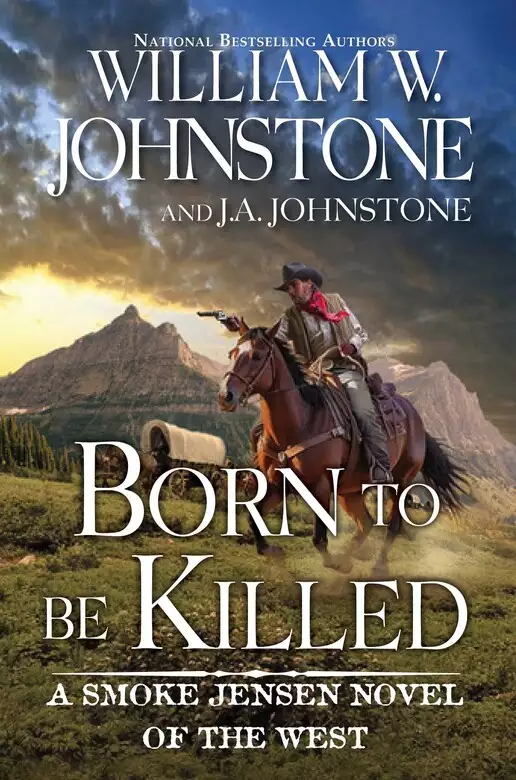
Born to Be Killed
- eBook
- Paperback
- Audiobook
- Hardcover
- Book info
- Sample
- Media
- Author updates
- Lists
Synopsis
The epic saga of Smoke Jensen takes a wild and dangerous turn when the legendary mountain man joins a wagon train of war widows—on a doomed journey through hell . . .
Big Rock, Colorado, has seen its share of wagon trains pass through town, but never one like this. For starters, it’s led by a woman—a sweet southern belle named Annabelle—and the passengers are young Civil War widows and orphans. The only man on board is Annabelle’s father, a former colonel blinded in the war. They’re on their way to Purgatory Butte, Wyoming, to run the ranch the colonel inherited. Smoke’s wife, Sally Jensen, thinks it’s a noble goal and wants to help the women out—by volunteering her husband’s protection on the treacherous journey north. In spite of his doubts, Smoke agrees.
The trouble starts before they even leave town. First a pack of ruffians harass the women, then a pair of saloon girls decide to join the wagon train. To top things off, Sally insists on coming along,—giving Smoke one more thing to worry about.
They say the road to hell is paved with good intentions. But this road has plenty of bad ones, too. If Smoke Jensen can’t figure out which is which, this whole train will be dead on arrival.
Johnstone Country. Where Legends Are Born . . . To Be Killed.
Release date: April 28, 2026
Publisher: Pinnacle Books
Print pages: 304
* BingeBooks earns revenue from qualifying purchases as an Amazon Associate as well as from other retail partners.
Reader buzz
 Please log in to recommend or discuss...
Author updates
Born to Be Killed
William W. Johnstone
The vehicles, with their arched canvas covers over the beds, drew a considerable amount of attention as they entered the settlement from the south and turned onto the main street. Once, wagon trains had been a fairly common sight in these parts, but since the arrival of the railroad a year or so earlier, not many came through here anymore.
This group was unusual, too, in its size: only four wagons, each drawn by a team of six sturdy horses. In previous years, before the completion of the transcontinental railroad, when wagons had carried hundreds of thousands of immigrants on their westward trek, a typical wagon train had forty or fifty or even more wagons in it.
“Would you look at that?” Sally Jensen said as she stood on the front porch of the Big Rock Mercantile with her husband, “Smoke,” who thumbed his hat back on his head and smiled.
“Yeah, it’s been a while since we’ve seen a wagon train around here,” he said. “I wonder where those pilgrims are headed.”
“Maybe they plan to settle around here,” Sally suggested.
“The valley is pretty big,” Smoke said. “Still plenty of room for new folks.”
That was true. Smoke and Sally’s ranch, the Sugarloaf, was the largest in the area, and there were several other good-sized spreads in the region, too. Even so, good, unclaimed land was still there for the taking. Land with thick grass and good water, which would provide plenty of grazing for cattle.
However, the folks in this wagon train didn’t appear to be cattlemen, Smoke noted.
In fact, with one exception, they weren’t men at all.
This was a wagon train full of women.
The driver handling the reins of the first vehicle was in her midthirties, Smoke estimated. Even though she was sitting on the driver’s bench, he could tell she was tall and had a splendid figure in a square-necked blue dress. Thick honey-colored hair was pulled together and tied at the back of her head.
The lone male in the group sat beside her, swaying back and forth slightly as the wagon rocked along. With his snowy hair and bushy white eyebrows, he appeared to be an older man. He wore a brown suit and a flat-crowned cream-colored hat, and even sported a vest and a cravat over his white shirt, not typical garb for somebody in a wagon train. A walking stick rested on the floorboards between his knees, and his knobby-knuckled hands were clasped on the stick’s silver head.
“She’s a very attractive woman, isn’t she?” Sally asked.
“Who, the lady on the lead wagon?”
“Yes. The one you’re looking at so intently.”
Smoke chuckled. “I don’t think I was looking any more intently at her than I was at the old fella riding beside her. I always pay attention to newcomers. Seems to me there’s a resemblance between those two. Father and daughter, I’d say.”
“Yes, I can see that,” Sally agreed. “And I can’t blame you for keeping up with strangers. You feel a certain responsibility to look after Big Rock, since it wouldn’t be here without you.”
Smoke’s forehead creased a little in a frown at Sally’s comment. She wasn’t the first one to give him credit for Big Rock’s existence, but such things didn’t sit all that well with Smoke’s natural modesty.
It was true that he’d played a major part in the founding of the town a couple of years earlier, but so had a lot of other people. Plenty of folks had risen up against the tyranny of Tilden Franklin and his army of gunmen when Franklin tried to take over the area, operating from the stronghold of the town he had established and called Fontana.
At the urging of Smoke and others, Big Rock had been founded as an alternative to Fontana. The honest citizens had abandoned Tilden’s town, and Big Rock had flourished. Fontana was nothing but a memory now—a bad memory for most of those who had lived through that turbulent time.
Smoke’s recollections of those days were bittersweet. Quite a few good people had died or been injured in the violence, and he had been forced to buckle on his gunbelts again after several years of having set his Colts aside. But he had new friends in men such as Wes “Pearlie” Fontaine, currently the foreman of the Sugarloaf, and Monte Carson, the sheriff of Big Rock. Both men had been brought to the valley by Tilden Franklin as hired guns, but they had seen the evil of what was going on and switched sides, becoming staunch allies of Smoke and the other good people of the valley.
All that was in the past. Big Rock had continued to grow, especially after the arrival of the railroad. Maybe these newcomers would add to the town’s expansion, mused Smoke as he looked over the rest of the vehicles.
A plump blonde in her twenties was on the driver’s seat of the second wagon. Her short hair framed a round, friendly face. A woman with dark brown hair handled the reins of the third wagon’s team. The driver of the fourth and final wagon in the string was the youngest in the bunch, probably no more than eighteen, a coltish girl with long, wavy chestnut hair. All were dressed in plain, simple outfits intended to stand up to the rigors of long days on the trail.
Smoke saw a few more women looking out from the openings at the front and rear of the canvas covers on the wagons, but no men. The elderly gentleman on the lead wagon appeared to be the only man in the group. That was just downright odd.
So was the way he held his head aimed straight forward, never glancing to the left or right, even though his female companions all seemed interested in gazing about at their new surroundings. Smoke suddenly wondered if the man was blind. That would explain his apparent lack of interest.
“Where do you think they’re going?” Sally asked.
“Probably out to that open area on the west side of town with the trees around it,” Smoke said. “That’s a mighty good place for wagons to camp. Pilgrims have stopped there before.”
Sally nodded and said, “I’m sure you’re right. I’ll go on in and see if Mr. Baker has my order ready.”
She had a standing order with Don Baker, the owner and proprietor of the mercantile, for the supplies they needed out at the ranch. Earlier this morning, she had driven the buckboard into town to pick up the provisions, while Smoke rode alongside on his big black stallion, Drifter.
She added, “I’ll meet you at Louis’s in a little while. We can have some coffee and a bit of lunch before we start back out to the ranch.”
“Sounds good to me,” Smoke said. He bent and brushed a quick, affectionate kiss across her forehead, under her thick dark hair. They smiled at each other and then parted, Sally turning to go into the store, while Smoke moved along the boardwalk at a deceptively lazy pace.
He might look like he was just loafing along, but in reality every sense was on alert and his instincts would let him know if there was even the slightest sign of potential trouble. His hands were never far from the walnut grips of the twin Colt .45 Peacemakers holstered on his hips. He had carried two guns for many years, switched to just one for a while, but recently had gone back to packing two irons in crossed gunbelts. He just felt more balanced out that way.
Smoke was a man of medium height, but incredible strength, and unusually wide shoulders. He had a ruggedly attractive face and a shock of ash-blond hair under his broad-brimmed brown hat. With the friendly, open grin he usually wore, he didn’t really look like a dangerous man, but in reality he was, perhaps, the fastest man on the draw and the most deadly accurate with his guns west of the Mississippi—and east of the “Father of Waters,” too, if you wanted to throw in the rest of the country.
He had been a lot of things in his short life: gunfighter, outlaw—although the charges laid against him by some of his enemies were false, lawman, gold miner, scout, horse trader, and rancher. In recent years, he had concentrated on establishing the Sugarloaf and building it up into a successful spread, and, most importantly, he had been married to the former Sally Reynolds and was building a life with her, too. It would be perfectly fine with Smoke if he never had to use his guns again.
But trouble seemed to have a way of finding him, and those instincts had stirred faintly inside him, in fact, as he watched that little wagon train roll past—although for the life of him, he didn’t see how there could be any threat in a bunch of women and an old man traveling together.
Annabelle Wilkinson was used to people staring at her and her companions. She knew they were an unusual sight, especially in these frontier towns where folks were desperate for anything unusual to break up the humdrum existence of day-to-day life.
Even so, she felt a prickling of annoyance go through her. It wasn’t like they were a traveling circus or a blasted freak show. There was nothing out of the ordinary about them—at least, not on the surface.
“What did you say this place is called again?”
“Big Rock, Colonel. Big Rock, Colorado.”
Beside her on the driver’s seat, the old man grunted. “Named that because there’s some outsized boulder somewhere in the area, I’ll wager.”
“More than likely,” Annabelle agreed.
“Not very imaginative, these small-town folks.”
She heard the tone of disdain in her father’s voice. It was easy for him to look down on the simple farmers and ranchers, storekeepers and blacksmiths, saddlemakers and dressmakers, who were pushing ever westward and bringing civilization to this part of the country. He still remembered what it had been like to be the richest man in the country, back in Mississippi, the lord of all he surveyed and the man the common folks bowed and scraped to when he drove by in his fancy carriage.
Annabelle remembered those days, too. Remembered them well. But they were all blown to hell and gone now.
Now each day was a matter of survival, although with any luck things might not be that way forever.
“We’re going to stop here, aren’t we?”
“That’s right, Colonel. We need supplies, and it probably wouldn’t hurt to let the horses rest for a few days, either. We’ve been on the trail for a good long while and have been moving pretty steadily.”
“Now, I don’t know if that’s a good idea or not.” The old man’s voice held a petulant tone. “We don’t ever know if trouble could be coming up behind us.”
“We’ve traveled a long way from home,” Annabelle said. “If trouble was going to catch up with us, don’t you think it would have by now?”
“You never know, child. You just never know.”
Annabelle felt her face warming with anger. She was far from a child. Hadn’t been one for a long, long time, in fact. But she supposed that to a parent, a child never completely grew up. In some ways, the colonel still felt responsible for her, even though, in truth, she had been the one taking care of him for quite some time.
“We’ll get the supplies, stop overnight, and then figure out what to do in the morning,” she told him. “Just resting for half a day might be enough to help the horses.”
“I hope so, I truly do.”
Annabelle suppressed the sigh of exasperation that tried to escape from her. It wouldn’t do any good.
“I can see a place up ahead at the edge of town,” she went on. “It looks like it would make a decent campsite for us.”
“I trust your judgment, Annabelle. You always were a mighty smart little thing for a girl.”
She laughed and shook her head. That was better than getting angry at him, which wouldn’t accomplish anything. He’d just sull up like a possum and act like she was being unfair.
A group of riders was coming toward them in the street up ahead, she noted. Seven men on horseback. She had trained herself to pay attention to details and be a good judge of character, especially when it came to men.
She didn’t have to look at these riders for very long to get the feeling that they might be trouble.
They were dressed roughly, like cowhands or prospectors, but most men in those lines of work weren’t as heavily armed as this bunch. Each man wore at least one holstered revolver, and most of them had sheathed knives, too. Rifle butts stuck up from three or four saddle scabbards. A couple of the men had full beards, and the faces of the others hadn’t felt the touch of a razor in several days. Their saddles had known a lot of hard use, and their horses looked tired, as if they had been on the trail for quite a while.
Most of the men rode with shoulders slumped and their eyes downcast. They looked as weary as their mounts.
Annabelle suddenly wondered if they were tired because someone had been chasing them.
The man riding in the lead, slightly ahead of the others, wasn’t like that, though. His head was up and he was alert. Clearly, he had noticed the wagons full of women because he straightened in the saddle and watched them intently as the two groups approached each other.
The man was stocky and barrel-chested, with a beefy face that reminded Annabelle of a bulldog. Black stubble covered his cheeks and chin, and his hair was dark under a hat that looked like it might have belonged to a cavalryman at one time, before it got so battered and stained.
The hat was the only thing about his garb that was even vaguely military. He wore a dark brown vest over a faded gray shirt with the sleeves rolled up to reveal brawny forearms thickly covered with dark hair.
His face split in a grin as the two groups passed in the street. The man’s front teeth had a noticeable gap between them, which didn’t improve his looks. He reached up and ticked a finger against the sagging brim of his hat as he nodded to Annabelle.
She didn’t acknowledge the gesture, just continued staring straight ahead as she flicked the reins of the team.
The other riders had noticed the wagons by now. The rough-looking men perked up considerably at the sight of the women. Several of them grinned and rode straighter. A few low-voiced comments were exchanged. Annabelle couldn’t make out what they were saying, but she didn’t have to understand the words to know that they were probably lewd and suggestive. At least, the men didn’t call out any crude comments to her or her companions as they went by.
She was glad when the men were past, plodding on along the street to wherever they were bound. They were trouble, she was sure of that.
The kind of trouble that she, her father, and her friends absolutely didn’t need right now.
Gus Gerhardt reined his horse toward one of the hitch rails in front of the first saloon he came to after he and his friends rode into Big Rock. The front window was a little grimy and the paint was already starting to peel from the sign on the awning over the boardwalk. The sign proclaimed THE EMPIRE SALOON, even though the building probably wasn’t more than a year or two old.
Gerhardt didn’t need anything fancy, just somewhere that served beer and whiskey. If poker games and loose women were available, too, then so much the better.
Now that he thought about it, he didn’t care that much about the poker. After taking a good long look at that high-toned blonde on the wagon, his appetite for female companionship was whetted.
“Did you see that, Gus?” Danny Murphy asked excitedly as he brought his horse alongside Gerhardt’s at the hitch rail.
“See what?” Gerhardt responded, even though he knew perfectly well what Murphy was talking about.
“Those women! A whole wagon train full of pretty women!”
Gerhardt swung down from the saddle and looped his horse’s reins around the railing. He chuckled as he said, “Say, I must’a missed that.”
“No, you didn’t,” Murphy said as he followed suit and dismounted. “I saw the way you was lookin’ at that gal handlin’ the lead wagon. She was sure a looker. A mite old, maybe, but still fine, sure enough.”
Murphy was a kid, a pugnacious redheaded Irish sprout, otherwise he wouldn’t have considered that blonde old. Gerhardt was pushing forty, and she’d seemed like just the right age to him. He supposed Murphy was more interested in the girl driving the final wagon in line, who’d looked like little more than a kid herself.
Lean, dark-faced J.D. Styles and rawboned Abner Farnum dismounted and tied their horses at the same hitch rail. Stan Hamilton, Al Townsend, and “Concho” Warren put their mounts at the other rail in front of the saloon.
Styles looked like what he was, a former gambler who had given it up because his hands, while fine for pulling a gun, weren’t quite deft enough to manipulate the pasteboards with the skill necessary to make a living that way.
Farnum, on the other hand, looked like he was right off the farm, but, in truth, he had never spent even a minute behind a plow. He liked to boast that he’d been on the wrong side of the law ever since he’d learned to walk.
Hamilton and Townsend were both the sort of fellows that you could look at, and five minutes later you wouldn’t remember enough about them to describe them. In their line of work, being forgettable didn’t hurt a thing.
Warren was a Texan, dubbed Concho because he came from around the river of the same name. He looked like a ’breed, but none of the others knew for sure, one way or the other, because he was touchy about that and they didn’t see any reason to get him on the prod.
The seven of them together were a pretty salty bunch. They had been over in Utah recently and had gotten crossways with some Danite hard cases. Those Mormons were tough as nails, and since you couldn’t go much of anywhere in Utah without running into more of them, Gerhardt decided it would be a smart move to light a shuck out of there.
They had headed east into Colorado, and now they had come to this good-looking settlement. Gerhardt didn’t know the name of the place, but it looked big and prosperous enough to have a bank, so that was promising, anyway.
“Are you thinking about pulling a job here, Gus?” Styles asked quietly as the men stepped up onto the boardwalk in front of the saloon.
“I don’t know yet,” Gerhardt answered honestly. “It’s something to think about, but there’s no need for us to get into any hurry.”
“I want a drink before we do anything else,” Warren said.
“My thoughts exactly,” Styles agreed.
Gerhardt entered the saloon first, pushing through the batwings and advancing a couple of steps so the other men would have room to come in behind him.
Then he stopped to take a gander around the place and size it up for any possible threats.
The Empire Saloon looked like hundreds of other such drinking establishments scattered across the frontier, from the Rio Grande to the Milk River. A thin layer of sawdust was spread on the floor to soak up anything that was spilled on it, from beer to blood and everything in between. The bar was on the left-hand side of the room, running from near the front window most of the way to the back wall. At its far end was a door that probably led into an office. Wooden tables and chairs were laid out in rough rows in the center of the room, along with a couple of slightly larger, baize-covered tables toward the back for poker games. A roulette wheel and a keno layout, neither in use at the moment, stood on the right side of the room. Near the front window on that side was a piano, also not being used.
Only one of the regular tables was occupied. Three men in town clothes sat around it, discussing something and sipping whiskey from glasses they had filled from a bottle in the center of the table.
A man in a gray tweed suit sat alone at a poker table, dealing himself a hand of solitaire. A fancy stickpin glittered in his cravat. He was lean to the point of gauntness. His drooping mustache and a short spike beard gave his face a satanic cast. He looked up with interest when Gerhardt and the others entered the saloon.
Four younger men, cowhands by the look of them and their outfits, stood at the bar nursing mugs of beer, while a bald-headed bartender ambled back and forth, aimlessly polishing a glass with a rag. They glanced around at the newcomers, but didn’t seem all that interested in them.
The Devil-looking gent looked down at the cards on the table and studied the hand he’d dealt. Then he made a face and swept the cards back into the deck, which he tapped square and left lying on the table as he stood up.
“Welcome to the Empire, gentlemen,” he greeted Gerhardt and the others. “Come on in and have a drink.”
Longmont’s was several different things: saloon, restaurant, gambling hall, and the home of another of Smoke’s best friends, the former hired gunman Louis Longmont. Snake-fast and almost as deadly as Smoke, he had put those dangerous, adventurous, drifting days behind him and settled down here in Big Rock.
Lean and dapper, he spent most of his time sitting at his personal table in the back of the room, sipping endless cups of coffee, reading, and occasionally venturing to one of the other tables to play a low-stakes game of poker with friends. His real profession these days, he had been known to say, was avoiding trouble.
That was the reason for the slight creasing of his forehead when he spied Smoke Jensen coming across the room toward him.
Smoke grinned and said, “Why, Louis, you look like you aren’t happy to see me.”
“It’s not that, Smoke. You’re always welcome here, and you know it. But when you walked in just now, I realized that it’s been quite a while since any trouble broke out around you.”
Smoke pulled out an empty chair at the table and sat down. He signaled to the bartender for a cup of coffee, like the one Louis was drinking, and then went on, “You make it sound like I’m some kind of lodestone for ruckuses.”
“Well, when you consider your history …” Louis lifted his cup toward Smoke in a small salute.
“You’ve burned quite a bit of powder in your time, too, you know.” Smoke nodded to the aproned man who set a cup in front of him. “Thanks, Barney.”
“I’ve never denied my colorful past,” Louis said. “And yet most of my days and nights pass peacefully now.”
“Mine did, too, for a while. You know, before Tilden Franklin showed up in the valley, I’d gone three years without ever touching a gun in anger.”
“And yet since that trouble and the founding of Big Rock, violence has erupted on several occasions. Not only that, but any time circumstances have taken you elsewhere, you’ve run into one calamity after another in those places, so it’s not just Big Rock.”
“Well, shoot,” Smoke said as he leaned back in his chair. “Put that way, you make it sound like I’m nothing but a blasted jinx.”
Louis smiled over his coffee cup. “You said it, my friend, not me.”
Smoke scowled and sat forward again. He wrapped his hands around his cup and asked, “What do you reckon I can do about it?”
“Honestly, at this point it seems that the universe is in the habit of dumping trouble in your lap. I’m not sure you can do anything about it other than deal with the problems as they arise.” Louis took another sip of his coffee and went on, “Let’s move on to a more pleasant subject. What brings you to Big Rock today?”
“Sally.”
“See? A much more pleasant subject. I assume you accompanied her on her weekly trip into town to pick up supplies?”
“That’s right. She said she’d meet me here later, once she’d taken care of business over at the mercantile.”
“I’ll be pleased to see her, as always.” Louis put his hand on a book that was sitting on the table and pushed it toward Smoke. “Have you seen this? The new novel by Henry James.”
A dubious look appeared on Smoke’s face. He didn’t reach for the volume. Instead, he said, “I remember that other book of his you recommended to me. It was kind of like a herd of buffalo.”
Louis looked puzzled and said, “Henry James is like what?”
“Here’s what I mean. You’ve been out on the plains hunting buffalo, right?”
“I have.”
“When you come on a herd that’s on the move, you can sit on a hill and watch them go past, and the herd stretches all the way as far as you can see in all directions, and it can be like that all day without ever stopping, just so many buffalo the mind can’t really grasp how many there are.”
Louis nodded. “Yes, I understand what you’re talking about, but I still don’t see how it has anything to do with Henry James.”
Smoke grinned and said, “He’s got as many words as there are buffalo in one of those herds, and they just keep on streaming past you until you’re just overwhelmed by all of them.”
Louis just stared at him for a moment and then laughed. “I suppose that’s a valid criticism,” he said. “James can be a bit verbose. But I admire his skill at characterization. You don’t want to borrow this volume, I take it?”
“I’ll pass,” Smoke said, “but I’m obliged to you for thinking of me.”
The two of them continued to chat and sip their coffee. Smoke wasn’t really aware of how much time had passed until he realized that Sally should have finished her chore at the mercantile and joined them by now.
The same thought must have occurred to Louis. “I believe you said Sally was coming by here when she was done at the general store?”
“That’s right,” Smoke said. “I hope she hasn’t run into any problems.” He drank the bit of coffee that was left in his cup and then set it on the table as he pushed back his chair. “I suppose I ought to go. . .
We hope you are enjoying the book so far. To continue reading...
