JOHNSTONE COUNTRY. WHERE LIGHTNING STRIKES ANY PLACE IT WANTS.
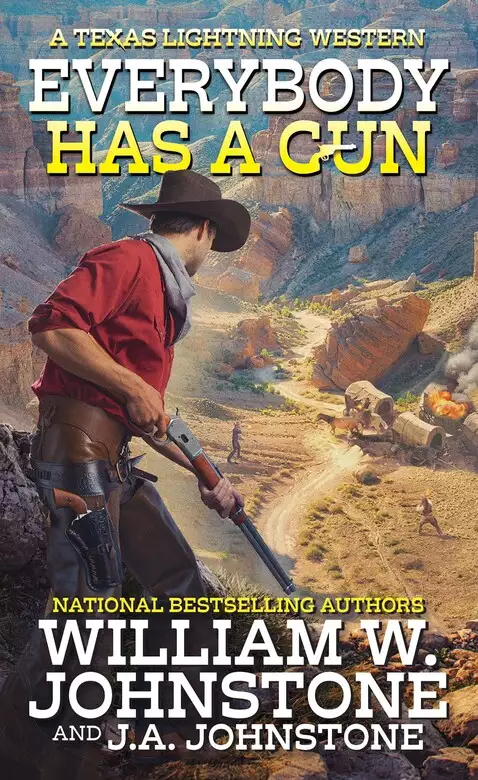
“The Fastest Gun in the Territory ” returns—and the ultimate showdown begins—in the latest, greatest Jon Gage adventure from the bestselling Johnstones . . .
Like any gunslinger with a bloodstained past, Jon Gage needs to keep moving to stay alive. Too many people know the legend of “Texas Lightning”—and too many people want him dead. Trying to keep a low profile, he stops at a supply post in Utah Territory to stock up before hitting the trail. There, he meets a wagon train of farmers from Kansas doing the same. They seem like good, decent folks, but they’re about to make a very bad decision. The route they’ve chosen leads straight through the Chosen Valley. Which is like walking through the Valley of the Shadow of Death . . .
Ruled by a notorious and powerful cult—known for their cruel and unusual punishments—the Chosen Valley is worse than a dead end. It’s a trap. Especially for a wagon train of farmers, who are easy targets in a brutal ambush by black-robed zealots. Alerted by the gunshots, Gage tries to help the farmers by donning a robe and infiltrating the cult. What he learns shocks him. The cult plans to kill the farmers, steal their supplies, and force their children into slave labor. Gage is not about to let that happen—even if has to take on the entire cult himself.
Every one of them has a gun. But none of them are as fast—or as deadly—as Texas Lightning . . .
Release date:
July 29, 2025
Publisher:
Pinnacle Books
Print pages:
320
* BingeBooks earns revenue from qualifying purchases as an Amazon Associate as well as from other retail partners.
“What . . . else . . . can I fetch for you . . . mister?”
The red-faced shopkeep looked over the lenses of the half-moon spectacles that rode far down his bulbous nose. Beneath that bristled a peppery moustache that looked more suited to being a whisk broom than lip hair. The sides of the man’s head sported tufty muttonchops that could not conceal his impressive jug-handle ears. The top of the man’s bald head glistened with a sheen of sweat, owing largely to the fact that he kept dashing around the counter and feeding chunks of stump wood into the glowing maw of his potbelly stove.
Then he would scoot back around the counter, seeming to lose his fight with breathing, more and more, with each return trip from the stove.
The customer to whom he spoke struggled to keep a smirk off his mouth. He was a tall, angular fellow holding a low-crown fawn hat in his gloved hands. He regarded the shopkeeper a moment longer through slate-blue eyes the color of high-country river ice in January. Finally his trim, bearded mouth opened. “I wouldn’t mind looking at wool coats, if you have any.”
The merchant’s bristly eyebrows rose. “Do I have any! Why . . . why . . .” Once more, he bustled around the far end of the counter, his pink hand pivoting on the wood.
The customer noticed that the very spot where the portly man’s hand rested and spun had been polished to a honey glow from what he assumed had been years of repeated scurrying to and fro.
Although the day outside had turned out warmer than it had promised to be when the tall man awoke that morning, bedded down in the hay near his horse in the small but homey stable at the east end of town, it was still nippy, a portent of the winter to come.
He followed behind the bustling man toward an annex at the back of the store he’d not seen on his one quick turn through the place long minutes before.
“Here’s where my wife keeps the garments that are ready to sell.”
“What happens with the ones that aren’t?” wondered the stranger aloud.
“Huh?” said the merchant, waddling forward ahead of the man and wiping his sweaty pink hands on his apron.
“Never mind. Just kidding you.”
“Oh, okay. Well”—the merchant stopped before a short, built-in wall of shelving. He tapped his pooched lips a moment, his brows pulled together in concentration. “That there line of cubbyholes”—he gestured toward a vertical row of shelves—“is filled with just what you are looking for. Coats for men such as yourself—you know, large size and wide in the shoulder. You could do worse than to walk out of here wearing one.”
The man agreed in silence as he eyed the offerings. They were all plaid, of varying shades and hues, mostly with reds and greens and browns, with two showing a distinctive blue-gray color.
“You mind if I go ahead and try one on?”
“No, no, you go ahead. I’ll be out front, filling the rest of your order. They’re all marked at fourteen dollars, by the way. Oh, and we do have two or three used coats, those are half that price, but I believe you’ll find they have less than half the wear on them. They’re lower, to the right.”
The merchant pointed to other folded coats down lower on the shelves. “You shout if you need help, all right?”
“Appreciate it.” The man waited until the shopkeep once more set himself in motion; this time, he burbled on out of the little garment stockroom.
As the man turned his attention back to the stacked shelves, he reached for a new slate-and-black–checked coat. It was folded neatly and he felt bad about lifting it down and shaking it out, but he liked the idea that he might be the first to wear the thing. He set his hat down, tugged off his canvas work coat, and shrugged into the new one—a double-thick mackinaw with an ample collar. The buttons were all ample rounds, cut from the base of antlers, and polished. It seemed like a solid quality coat.
As the tall man looked over the coat, eyeing the seams and the obvious decent workmanship, he heard a noise behind him. It was the merchant again, who looked, if anything, even more red in the face and flustered. But he was smiling.
“Tell you what, you buy the new coat and I’ll throw in a pair of wool mittens at . . .” The merchant scratched his chin and looked up at the ceiling, as if the answer to what he was mulling might be nested up there among the hanging baskets, ladies’ hats, hanks of rope, and other odds and ends. “At half the marked price.”
The tall man nodded and tugged on the top pair of mittens on the stack to his left. They, too, were doubly thick, and he could tell they would be plenty warm, especially inside a larger pair of leather outer mitts, which he already owned. His old pair of mittens were thinner and worn through in the thumbs and a few other spots.
“Sold,” he said. “On both counts.” He tugged off the mittens and handed them to the man.
“Excellent choice, sir. Now, you don’t mind me speculating, but it looks to me like you’re making for high country. The mountains hereabouts?”
The tall man waited a moment, then offered a half nod. “I am considering it. Have a mind to do a little trapping.”
The merchant nodded. “You’ll need snowshoes. The white stuff piles pretty deep in those high valleys. Keep you on top of the pond ice, too. Evens out your weight, you see?” He spread his pudgy fingers wide and walked with his hands in the air in front of him, demonstrating, the tall man assumed, how one might walk in the snowshoes.
“Yes, I had wondered about them. I don’t suppose you have any in stock?” Somehow, thought the tall man, he bet he knew the man’s response. And he was not disappointed.
“Do I? Do I? Why, only the best sort, made by a man who learned the craft from genuine Indians back East, so he told me. Forgot just where.”
As he searched, an old, slow-moving man with a cane and dressed in dapper togs made his way from the door over to the counter, and helped himself to a peppermint stick. He looked at the tall stranger, then down, then up at him once more.
“Ain’t you . . .” The old man, who eyed him with a hard sideways glance, narrowed his eyes even more, as if that might help him to make up his mind. “Naw, naw.” He shook his head and turned his gray, wrinkle-cheeked face once more to the candy stick.
The stranger stared hard at the old man. Despite the old-timer’s demeanor and haggard face, he looked to be well dressed. This meant little to the stranger, but he had learned from life on the drift these many years that, to a person, folks were always far more complicated than he could initially guess. And nothing, absolutely no detail in life, was useless. You never knew when on down the trail, a look or a cough or the custom and cut of a man’s clothes might prove useful.
He’d spent enough time on that trail alone, save for his boon companion, Rig, his trusty chestnut gelding, and as solid a companion as man could ask for, for far too long to afford to ignore most anything.
But all that was incidental to him. For the old-timer had done the very thing he didn’t want anyone to do—and yet so many folks did. He had recognized the tall man, somehow. And while the old man told himself that he couldn’t be right, the tall stranger knew that he was.
And he knew, from long experience, that the old man would dwell on it and circle back to the notion that he was right. He did recognize the man beside him there in the shop. And any moment now, he’d turn back to facing the stranger, with that squint-eyed look of his, his candy stick cradled between his work-hardened fingers.
The tall stranger was Jonathan Gage, also known as Texas Lightning, late of Sourwood Springs, Texas. The Texas Lightning tag was a name that had dogged his back trail for years as he roved the West, doing his level best to outlive and outlast the dark infamy of his gunfighter past.
His success in shedding himself of that grim time was hit or miss, more miss than hit in the past few years, but when he was recognized, he had vowed long ago he’d not deny it.
Was today one of those days? He never knew, especially when he rode into a town new to him.
The thing that never failed to surprise Gage, even after all this time, was how people could still recognize him. After all, it had been seven years since he’d dropped his six-guns in the street and vowed not to resume the life of a gunfighter.
He’d aged since then, grown grayer about the temples and throughout his chin hairs. He’d taken to wearing a full beard and moustache, albeit trimmed and somewhat tidy, for a good many years, too.
He’d also grown a little thicker, if he had to admit it. Mostly, if he’d had a long spell of laying low at a ranch, he’d whittle or darn socks or mend tack with other ranch hands around a potbelly stove in a bunkhouse.
But those times had been few and far between. There were always men, everywhere, it seemed, like the old man here now, who had recognized him. A few of them wanted his head as soon as they found out who he was, for a killing in his past. What he considered a long, distant past, but he knew that was not the case to those who still grieved their dead.
It had never seemed to matter to them that the law found the shootings justified. Truth was, Gage had never been able to figure out how he’d survived all those times he’d been called out to the street.
He’d made certain he never started the fights, but as his father, the long-dead, useless, drunk rancher Jasper Gage, had told him: “If somebody else starts a fight, you make certain to be the one to finish it.” And Jonathan had. Too well and for too long.
“You . . .”
Here we go, thought the tall stranger, shifting the new coat and mittens slightly in his arms. He hadn’t fully faced the old man yet. He knew what he’d see and he knew it would change everything about his so-far enjoyable, if brief, stop in Higgins, Utah Territory. Based on past experiences, Gage had opted for stopping off at the mercantile first, hoping to avoid this sort of thing in case it might prevent him from laying in his supplies.
At that moment, all he wanted to do was finish this rare bit of shopping, walk outside into the chill October air, check his bags and strapped load, and mount up to ride on out of Higgins, without arousing any further interest in himself.
For Jonathan Gage had no interest in the least in ever discussing his past. A past that, to his mind, was nothing more than a congealing lake of blood stippled with the gore-slick arms of his victims upthrust from the viscous surface, beckoning him, always beckoning him.
No matter how far, or how long, he rode all over the vast West, from mountains to oceans, to deserts and prairies, Gage was never able to outrun the brutal dreams that haunted his scant, restless, fitful sleeping hours. Nor did the dreams pester him solely in the dark.
They lingered on behind him all through his days, as if they, too, were astride horses, ragged mounts more bone than horse. Clopping steadily behind, they always seemed to gain, and never faded behind. Mostly, they were not there when he turned fast in his saddle. He knew they were about, though, for he had come to learn that he did not need to see a thing to believe it existed.
He also knew that someday, when he was caught unaware, he would be called out for his past and its vile misdeeds, and he would be laid low, to bleed out into the dust and grime of some lonely street in some town in which he was forever a stranger. And he knew it must be that way.
“Hey, mister,” said a voice, cracking into Gage’s reverie.
The tall man looked to his left to see that the same old man had moved closer, and stood staring once more at him. But this time, there was no cloud of doubt on his wrinkled, gray-stubbled features. This time, the old man knew who he was.
Would today be the day? thought Gage. Would this day be the day when I pay my paltry offering toward the unscalable mountains of debt I owe? Will this be the day that I die?
“Yes?” said Gage. “Do I know you?” He didn’t usually even have to say that, but despite the notion that he’d long abided by—to remain quiet and humble and as unseen as possible—he still found himself annoyed, irritated, by the infrequent, but still occurring, discoveries by people recognizing him.
The old man in the dapper suit of clothes leaned closer, his eyes watery. “You . . . you’re him, ain’t you?”
Gage didn’t quite know what to say for a moment. The man had at least leaned in and kept his voice low, which was appreciated by Gage. But that he knew who Gage was, or had been, tainted this otherwise-promising day. Now he’d have to leave Higgins sooner than he would have liked.
“What I mean to say is,” continued the old man, “I know you are. Him, I mean. I know who you are, and, well, I just want to say. . .”
The old man did something that Gage had not experienced in a good many years. He held out a shaking old hand, more bone than meat to the thing, but from the swollen digits Gage could tell that the old-timer had at one time long since, no doubt, put years’ worth of hard effort into his life.
Gage stared at the proffered hand a moment. It had been his long-standing promise to himself that while he would never go out of his way to tell people who he was, and what he had done in the past, neither would he take any extraordinary measures to disguise who he was, and what he had done in the past to earn that reputation.
And what’s more, he would always admit it to whoever might be calling him out. He did this because he was no coward, nobody to run away from the truth. He felt he owed it to all those people he had gunned down, and all their families. And to all the family members who would never be, because he had laid those folks low, he owed it to them to tell the truth about who he was.
And so, looking at that old man with the hand held out, he said, “Who is it that you think I am, sir?” in an equally low voice, hoping to not stir any more interest in their conversation from surrounding ears than had already been raked up.
“Why, you’re . . .” Then the old man remembered he was trying to speak low and close to this tall, dark stranger. “You’re him!” The man looked about them, although there were no other customers in sight. “You’re Texas Lightning.”
Hearing that, the final nugget of truth to fall from the man’s mouth, Gage could only nod and, since the man still held out his old wrinkled paw, he gave the man’s hand a shake, firmly as his father had taught him to do: “Boy, whenever you shake a man’s hand, you always look him in the eye as long as the shake lasts, and you grasp his hand firmly. Don’t you squash his fingers, for that marks you as a small man with something to prove. Be nothing more than a man, and you’ll be fine.”
If that had been the end of Jasper’s slice of solid wisdom and advice, young Jonathan Gage would have carried it with him with pride for all the long days of his life to come, and without needing to layer on top of it anything else. But Jasper, as a bullying drunkard himself, had continued by yanking the boy close, their nose tips touching, breathing his foul whiskey breath into Jon’s face.
And then, in a low growl, he’d said, “And if I ever see or hear of you offering another man a weak shake, or not looking him in the eye, I will beat you as hard and as deep as a child has ever been whupped. You hear me, boy?”
Jonathan had nodded with vigor to his father’s question, and he had never forgotten the moment. Of course, it had always colored how he met other men, and his father’s leering, red-veined face was nested there in his mind, riding rough over his thoughts, even all these years after the old man’s death following the last in a series of fisticuff brawls that the then-grown Gage and his old, drunken father had engaged in. Gage had punched the old man in the chest and he suspected that’s what had finally done the old wreck in.
By then, Jonathan had ridden away from the pathetic ranch they owned, his father too far in his cups to do much more than stagger around the place each morning, issuing orders and cursing at anything that displeased him, which was just about everything.
On that vile day years before, Gage had ridden into town to let his fool of a father rage and howl back at the ranch. It had happened before and Gage knew the only solution was time.
Once in town, that being Sourwood Springs, Texas, Gage knew he would embark on his own excursions into a life of indulging in hard liquor. What else had he going for himself?
And that is when it had happened. A seemingly minor exchange of words with a stranger while sitting at the bar, an exchange Gage took as little more than ribbing, ended up with him being called out into the street. He’d been drunk enough to heed the call, despite the warnings from the barkeep Monty, his old friend, at the Top Palace.
And wonder of wonders, as inexperienced and as drunk as he was, Jonathan Gage had discovered something about himself: At the moment when he actually faced the man, time had slowed, at least for Gage.
Sound, too, became a muddled blur in his ears, echoing softly in his head, and he had grown oddly keen-sighted and sharper overall, somehow. He could not explain it, but he was thankful it had happened, nonetheless.
And for good or ill, and years later he would decide it was definitely the latter, this slowdown allowed Jonathan Gage to draw, aim, and fire before his opponent had fully raised his own weapon.
Gage’s bullet had sought its target, the other man’s chest, and had burrowed its way in as if it were a living thing.
It was as if Gage had been born to the task of killing. It was not until sometime later that Gage, roused from his reverie by the town marshal, learned that man he had killed was none other than famed gunfighter Lee “Lightning” Shiller, late of Arkansas.
Some say Gage’s kill had been born of luck, some say rather that he was born into the skill, a divine gift bestowed on him to rid the world of bad men, such as Shiller. As for Gage, he continued the family tradition of climbing down into the bottle, carried ever deeper into that boozy abyss by his backslapping new “friends,” who bought him round upon round of drink following that first kill.
They had also bestowed on him the title of Texas Lightning, an homage of equal parts to the first man he had killed and the place from whence he himself hailed.
When he emerged, groggy and shaking and ill three days later, and stumbled down the saloon staircase from the soiled bed of an equally soiled dove, it had taken the lawman and several others to fully remind the young man of just what it was he had done. And that his father had been found dead, back at the wretched little Gage family ranch, some miles outside of town.
It all came back to him in a sloshing torrent of memory that morning, and from then on, Gage’s reputation as an amazing gunfighter grew and grew. It soon outdistanced the facts, until he became, much to his growing unease, a living legend.
For years following his ouster from his own hometown of Sourwood Springs, Texas, after his second kill there on the main street, and not long after laying Shiller low, Gage left a trail of corpses, their blood leaking and leaching into the dry dirt of the West.
At first, he was welcomed into towns and given free rooms, space at every gambling table, offered fine weapons, clothes, food, and more fun, particularly with women, than he could ever have imagined was possible in this world.
It took years, and killings upon killings, before the young man grew not so much older as weary, and began to tire of the adulation of the children chasing him down the streets shouting, “Bang! Bang!” and begging him to show how fast he could draw his gun.
By the end, he had shot north of two dozen men, each one the result of a round-faced farmhand or a tipsy cowboy calling him out into the street. They had all been for a quick dollar on the growing bounty placed on his head by the frightening number of angry family members of his growing legion of dead.
Despite the raw numbers of his dead, and despite the fact that he did not once beg the fights to take place, nor did he instigate them, his reputation in those early years was such that it trotted on into each town well before he did.
By the time he slid from the saddle and swaggered into the nearest saloon, he was expected, and he heard the murmurings of men and women saying, “He’s killed more than fifty,” or “No, no, double that and you’re still not close! The man can’t go a day without laying low another! Stay clear, stay clear!”
Long before he grew tired of the lifestyle he had unwittingly cultivated for himself, Gage longed for an escape from the growing anger of others, the sneers and the frightened looks of women and children, and the unhidden rage of men eager to see him dead. It had not always been this way, he told himself. Surely, surely, it would one day be kind and amiable again.
But no, even then he sensed this was not to be. He was a killer, and the world knew him as such. Somewhere, somehow, the public’s view of him had changed. It turned from admiration and awe to fear and loathing. He became someone nobody wanted to associate with. And the bounties on his head grew.
He became convinced he was going to be shot in his sleep, his head hacked off his shoulders and stuffed in a gunnysack as proof to those posting the increasing dollar amounts that Texas Lightning was well and truly dead.
Gage slept less and less, and worried more and more, and drank more and more, and dreamed more and more. And one day, in a small town in Akin, Colorado, when a slight farmhand called him out into the street, he did not want to go, and yet . . . he did.
And it had happened, as the first had happened, as all his misdeeds had happened, as if time had slowed, as if the clock had been dosed with laudanum. And then it had ended, as they all did—the youth lay dead, while Gage stood dazed and staring at the inevitable.
And yet, that time had been different. That time, as he walked toward the dead or dying young man, pushing his way through the sneering, hate-filled eyes of the gathered locals, as he had looked down, he saw what he expected to see: a dying young fool out to build a reputation, out for money.
And yet, he also saw something he did not expect to see—the tender, unlined, and stunning face of a beautiful young woman, framed with golden hair and with sky-blue eyes.
She had hidden her pretty hair beneath her hat, and the ill-fitting clothes were those of a man, the gun too large for her hand. And too late, far too late, Gage had recalled the voice that had called him out.
It had been a too-high voice, yet the youth had refused to listen to his warnings to back down and walk away. The girl had drawn and fired—and Gage realized she had actually caught him with her own shot, up high on his left side, her bullet digging a furrow in his flesh and bouncing off a rib bone before leaving him.
Yes, the youth had been a pretty young woman, and in a different life, he might well have come to love and to spend his mortal years with her.
But not to shoot dead. And as he had looked down at her, he had seen the last of her precious young life leave her pretty, clear eyes—eyes that far too soon took on the film of death.
“Mister. Say, mister?”
It took another such round of questions to pull Jon Gage from his reverie. “What? Oh, sorry.”
“Well,” said the red-faced merchant, “you seemed lost in thought, and I believe I’ll soon have other folks requiring my assistance.”
The amiable shopkeeper nodded toward something beyond Gage’s right shoulder. The big former gunman looked to see two men, a woman, and beyond them four or so children—he thought there might be others beyond them back by the door—standing and conversing with each other in low tones.
They didn’t pay any attention to Gage or the shopkeeper. But he could hardly blame them, for it looked to him as if they were considering their finances. One of the men held a bulging coin purse in one hand; while the other man, younger and lean, but solid-looking, nodded and whispered something low.
The woman stood with her back half turned to Gage and the merchant. He reckoned this was in part to keep an eye on the brood of mostly behaved youngsters.
Gage turned back to the merchant. “The old man who was in here . . .”
“Oh, old Ronson? Hope he didn’t pester you too much. He’s old and lonely. Nice fellow, but a real talker. He’s gone on home to annoy his wife, I expect.”
“Right,” said Gage, a small sense of relief washing over him. “I think that about does it for me.” His stomach let out a low rumble. He was sure enough hungry, and feeling less rushed than mere minutes before. “Should I wait for the foodstuffs, or wo. . .
We hope you are enjoying the book so far. To continue reading...

 Please log in to recommend or discuss...
