JOHNSTONE COUNTRY. JUSTICE WITH A SIDE OF GUNFIRE.
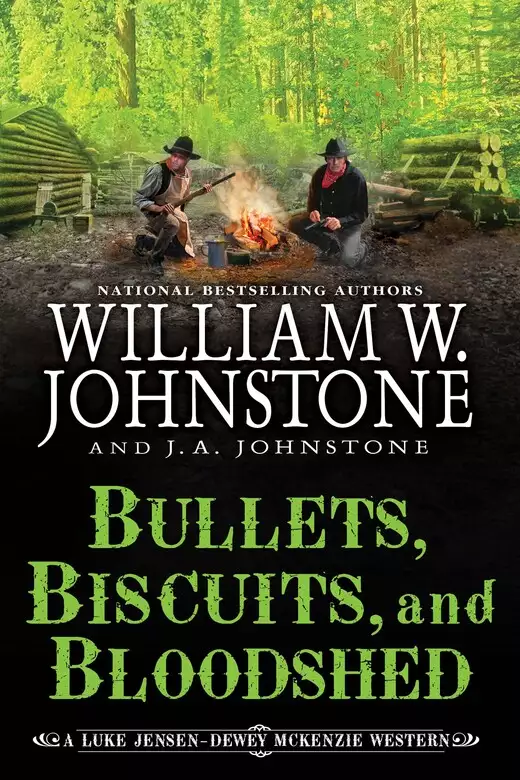
Legendary bounty hunter Luke Jensen enlists the help of chuckwagon cook Dewey “Mac” McKenzie in a deadly manhunt—but ends up neck-deep in an even deadlier range war. . . .
Dewey “Mac” McKenzie doesn’t have much of an appetite for bounty hunting. Before he was a cook, Mac had a price on his head—and bounty hunters on his tail. Nowadays, he’d much rather be stewing beef over an open fire than opening fire on another man. Then he met Luke Jensen, bounty hunter extraordinaire. As a favor to his new friend, Mac agrees to join Luke on the trail of a wanted fugitive. A trail that leads them deep into Oregon timber country—and smack dab in the middle of a brewing war . . .
The trouble starts in a saloon, a knuckle-busting brawl between the loggers from Pine Knob and some cowboys from a nearby ranch. When the ruckus turns bloody, Luke and Mac join the fray. Funny thing is, Luke takes the side of the ranchers while Mac teams up with the loggers. Which works out in their favor. By splitting up, they can now search for the fugitive in both groups at the same time. Mac steps in as the loggers’ new cook, while Luke joins the cowboys at the Triangle 7 Ranch, where this feud first ignited—and is getting hotter by the day. For Luke and Mac, that means stepping out of the frying pan—and into the gunfire.
Release date:
April 28, 2026
Publisher:
Pinnacle Books
Print pages:
304
* BingeBooks earns revenue from qualifying purchases as an Amazon Associate as well as from other retail partners.
Dewey McKenzie tightened his grip on the gun he held, a Smith & Wesson Model 3 .44 caliber revolver.
He said in a quiet voice, “I’m not so sure about this.”
From where Luke Jensen stood, with his back pressed against the cabin wall on the other side of the door, he said, “You can’t mean you’re nervous, Mac. You’re as cold-nerved a fellow as I’ve ever met.”
Mac shook his head. “It’s not that. I’m not scared of this bunch. But I’m just not sure I ought to be hunting fugitives this way. For years, I had bounty hunters chasing me for the price on my head, and it wasn’t a nice feeling.”
Luke grunted, shook his head, and said, “There’s a big difference. You weren’t guilty of the crime that put that price on your head. Having lawmen and bounty hunters coming after you wasn’t right.”
Luke paused for a second and then went on, “I promise you, the Bishop brothers deserve everything that’s coming to them. They’ve got plenty of blood on their hands. You don’t need to lose a minute of sleep worrying over what happens to them.”
“That’s true, I suppose,” Mac said, remembering all the charges on the wanted posters Luke had shown him: murder, armed robbery, rape, assault, arson. … The list of atrocities went on. Dave, Warren, Brad, and Mingo Bishop were bad hombres, no doubt about that.
And Luke was right. This situation was totally different from the dangerous time Mac had spent on the run from the law some ten years earlier. That had been what they sometimes call a miscarriage of justice.
What he and Luke Jensen delivered? That was actual justice.
“All right,” he said to Luke with a nod that was barely visible in the predawn gloom. “Let’s do this.”
Luke returned the nod, wheeled away from the wall, raised his right leg, and kicked the cabin door open. He went through it in a rush, his hands filled with a pair of long-barreled Remington revolvers.
Mac followed close behind him, the Smith & Wesson up and ready.
The Bishop brothers had been asleep; Luke and Mac knew that from the raucous snores that filled this isolated hideout cabin.
But the crash of Luke kicking the door open jolted them awake. They tried to leap out of their bunks as they grabbed for holstered guns that hung within reach.
Luke and Mac could have started blasting as soon as they cleared the entrance. Even better, maybe, Luke could have stood in the door and blazed away from there while Mac fired through the cabin’s one window.
The Bishops wouldn’t have had a chance.
But that wasn’t the way Luke had carried out his business during the years he’d been a bounty hunter, and since Mac was pretty new at this game, he followed Luke’s lead.
Luke leveled the Remingtons and shouted, “Hands up! Don’t touch those guns!”
The outlaw brothers ignored the warning, just as Mac had a hunch they would. A lantern with its wick turned low hung from a hook on the wall, and the faint glow from its flame reflected from gun barrels as steel slid out of leather.
Luke dropped the hammer on both Remingtons as those menacing gun barrels started to tip up.
Foot-long tongues of flame gouted from the muzzles of the .44s in Luke’s strong, capable hands. One of the bullets launched from those weapons crashed into the chest of a wild-eyed owlhoot struggling to get clear of his blankets even as he tried to line up a shot at Luke.
The other round smashed the left shoulder of another Bishop brother. Luke had aimed at his chest, too, but the man had darted aside just in time to avoid a fatal impact. The hammer-blow of lead against flesh twisted him halfway around, but the gun in his right hand flashed up anyway.
The Smith & Wesson in Mac’s hand barked. The wounded man’s head snapped back as a red-rimmed hole appeared just above his right eye. Mac’s bullet bored into his brain and dumped him on the hard-packed dirt floor.
Two bunks were built against the back wall, with another bunk on each side wall. The men Luke and Mac had shot had been sleeping in those back bunks. As those two outlaws went down under the onslaught of lead, Luke swung right and Mac pivoted left to deal with the remaining Bishop brothers.
Luke triggered both revolvers again. Neither shot missed as the wanted man on that side of the room surged to his feet and tried to fight back. The bullets threw him back against the wall above the bunk. He slid down onto the thin mattress and rolled limply to the floor.
Mac, turning the other way, caught his breath sharply. The bunk on the left side of the room was empty. Where was the fourth and last Bishop brother?
He got the answer to that question even as it flashed through his brain.
A bellowed curse behind him made Mac jerk his head around to look over his shoulder. A man carrying a double-barreled shotgun loomed in the doorway. Each barrel looked like the mouth of a cannon as the Greener swung toward Mac.
He threw himself backward into a diving roll that carried him underneath the rough-hewn table in the center of the room. The outlaw fired one barrel, the sound of its report a deafening boom that pounded the ears painfully in the cabin’s close confines.
The range was too close for the load to spread out much. The buckshot peppered the tabletop, for the most part.
Mac experienced what felt like a bee sting in his left calf as he hit the floor. He twisted and tried to bring the Smith & Wesson to bear, thinking he might be able to shoot one of the legs out from under the outlaw.
Before he had a chance to do that, Luke’s Remingtons blasted again, and the shotgun hit the floor with the second barrel unfired. The fourth Bishop brother followed it down, landing hard and grunting as he pawed at the blood-spouting holes in his chest. A shudder went through him and then smoothed out, leaving him motionless in death.
There had been so much racket that the silence following it seemed to echo, too. Into that hollowness, Luke asked urgently, “Mac, are you all right?”
Mac crawled out from under the table and sat on the floor to check his injury. A single piece of buckshot had torn the leg of his denim trousers and left a red welt on the flesh underneath, but he didn’t see any blood.
“Just a little graze, and about as close to a clean miss as you can get and still hit something,” he reported to his partner. “I’ll be fine.”
“That’s too close to suit me.”
“Anywhere around a scattergun is too close when it’s going off,” Mac said.
He climbed to his feet while Luke checked the outlaws.
“All four dead,” he said. “Well, as usual, we collect on ’em either way, and this makes things simpler, so I guess I can’t complain.”
“One of them was outside the cabin somewhere.” Mac made that comment as he began to replace the rounds he had fired.
“Probably went out to answer the call of nature before we got here and didn’t hear us ride up, didn’t know we were here until the shooting started. Him showing up like that could have been a mighty unlucky break for us.”
“Why did he have a shotgun with him?”
Luke shrugged. “Bears like to roam around in the early morning like this. I suspect he didn’t want one of them coming along and interrupting important business.”
Mac chuckled and holstered his reloaded revolver. “I can’t really blame him for that, either—although I would have been mighty unhappy if more of that buckshot had wound up in my hide.”
Luke looked around the room and said, “We might as well load up the supplies they have here, too. They sure don’t need them anymore.”
“Where do you figure on heading next?”
Luke holstered the left-hand Remington and began reloading the other revolver. “We’re in Oregon now,” he said. “We crossed the border from Idaho late yesterday afternoon.”
That didn’t answer Mac’s question, but it piqued his curiosity. “How do you know that? I don’t recall seeing any signs.”
“I’ve been through these parts before. It’s been a while, but once I’ve traveled somewhere, I usually remember it pretty well.” Luke pouched the iron he had just reloaded and then tugged at an earlobe as he frowned in thought. “The closest good-sized town is Pine Knob, west of here. We ought to be able to collect on these carcasses there. And that reminds me of something …”
His voice trailed off. Mac waited a moment before saying, “What does it remind you of?”
“I need to look through my collection of reward dodgers. I’ll do that once we’ve loaded everything up and gotten started.”
“You mean you have an idea which wanted man we’re going after next?”
“An idea,” Luke agreed. “But just because we have a place to start looking, that doesn’t mean it’ll be easy to find him.”
It was midmorning when Luke rode into the settlement of Pine Knob, a good-sized town nestled in a range of beautiful, pine-forested hills. The snowy peaks of the Blue Mountains rose not far to the west.
He drew a great deal of startled attention from the town’s occupants, which came as no surprise to him. Trailing a string of horses with dead hombres lashed face down over the saddles tended to do that.
Luke was alone now, Mac having stopped a couple of miles back because his horse had gone lame. He was going to walk on into town, leading the animal. Luke had offered to stay with him, but Mac had said for him to go on ahead.
“Maybe you can settle up with the sheriff before I get there,” Mac had said with a rueful smile. Even though the bogus charges against him had been quashed long ago, he had been leery of lawmen for so long that it was hard for him to break the habit of avoiding star packers.
Luke had ridden on ahead, taking the dead Bishop brothers with him. The railroad and the telegraph hadn’t reached the settlement yet, but there would be a stagecoach traveling to the bigger settlements to the west. The local lawman could send word that way about Luke’s claim and arrange for the rewards to be paid.
When the citizens stopped staring at the outlaw corpses and looked at the bounty hunter instead, they saw a man who looked as if he had followed plenty of hard trails in his life—and that was the truth.
Luke Jensen was in his forties, a weathered, craggy-faced man with crisp dark hair under his black hat and a thin mustache under his slightly prominent nose. His face was much too rugged to be considered handsome, but it possessed a powerful strength that men admired and to which women were attracted.
His shirt and trousers were black, like his hat. He wore a brown, sheepskin-lined coat, and the ivory handles of his Remingtons somewhat relieved the darkness of his aspect as well. He wore the guns butt-forward on each hip in cross-draw rigs.
While a young man, Luke had endured the bloody ordeal of the Civil War as a Confederate soldier, having enlisted back in the Missouri Ozarks at the beginning of the conflict. In the last days of the war, he had been betrayed by men he believed were friends and comrades, men whose greed for a shipment of gold had drawn them to commit evil treachery.
Left for dead, Luke had recovered, but guilt at his failure to carry out his mission had plagued him. Calling himself Luke Smith, because he didn’t want to bring that shame on his family, he had let them believe he was dead. Instead of going home, he wandered the West as a bounty hunter, putting the violent skills he had gained to good use.
Then the day had come when he was reunited with his younger brother Kirby—who by then was famous as the gunfighter Smoke Jensen—and Luke had rejoined the Jensen family, meeting his adopted brother Matt and eventually discovering that he had two fine, strapping sons he hadn’t known about, the Jensen boys who went by the nicknames Ace and Chance.
But even though he now used his real name, and it would have been easy to settle down into a comfortable middle age on Smoke’s Colorado ranch, the Sugarloaf, the years spent wandering had left Luke too fiddle-footed for a life like that. He had to be on the move, and bounty hunting was what he knew, so he continued doing it.
Some months earlier, while delivering a prisoner over in Wyoming, Luke had met Dewey McKenzie. A former chuckwagon cook with a troubled past of his own, Mac actually had settled down for a while, using his knack for cooking to start a café.
But Luke had a knack, too—for finding trouble. A shooting war had erupted in that Wyoming town, and when it was over, Mac had given in to his own restless nature and ridden out with Luke, since the two of them had hit it off and become friends.
Since then, they had corralled several wanted fugitives and collected rewards on them. Neither man worried about how long this partnership was going to last; they were content to ride together and watch each other’s back, for now.
Luke spotted a squarish, sturdy-looking stone building ahead on his left. A sign reading MARSHAL’S OFFICE hung from the awning over its porch. It was the only stone structure he had seen so far; lumber was easy to come by here since Pine Knob was located in timber country.
There were ranches in the area, too, mostly north and east of town. Being a supply center for both logging and cattle interests meant that Pine Knob was a bustling, growing settlement.
Luke angled his mount toward the marshal’s office and led the other horses with their grisly burdens. One of the townspeople hurried along the boardwalk on that side of the street and ducked into the office.
Probably alerting the lawman to the fact that some stranger had just ridden into town bringing a bunch of dead bodies with him, Luke mused.
Sure enough, the office door opened again and a man stepped out to regard Luke with a suspicious stare. The man was of medium height, thick-bodied but not flabby, mostly bald with a fringe of dark hair around his ears and the back of his head. A dark mustache curved above his mouth. He wore an open black vest over a white shirt, and a badge was pinned to that shirt.
Luke reined in and nodded to the lawman. “Hello, Marshal,” he said in his deep, cultured voice, which was somewhat at odds with his rough-hewn appearance.
“What in blue blazes do you have there?” Before Luke could answer the man’s question, the marshal held up a hand to stop him. “Never mind, I can see for myself.” He squinted in thought. “Did you just happen to find those carcasses, or are you responsible for making them that way?”
“I think they bear the actual responsibility for their ultimate fate,” Luke said, “since they’re the ones who lived a reprehensible existence as murderers and owlhoots.”
The marshal sighed. “I had a hunch you were going to say something like that. Maybe not quite so long-winded and highfalutin.”
Luke leaned his head toward the bodies and went on, “Marshal, meet Dave, Warren, Brad, and Mingo Bishop.”
“The Bishop boys!” The marshal’s startled exclamation was mirrored on his face as his bushy eyebrows crawled upward.
“I take it you’ve seen reward posters on them?”
“Sure I have. Every lawman in this part of the country has. I thought they were still holed up somewhere over in Idaho, though.”
“If it’s all right, I’ll come in your office and tell you about it.”
“Sure, sure, come ahead.”
“And I suppose someone should summon your local undertaker …”
The marshal turned his head and opened his mouth to say something to the wide-eyed townie who had brought word of Luke’s arrival to him. The man had been goggling over the marshal’s shoulder as the lawman talked to Luke.
“Randolph, go fetch—”
“No need, Marshal,” the townie interrupted. He pointed and went on, “Here comes Mr. Endicott now. Somebody must’ve told him he had some business pendin’.”
Luke turned his head to look where the townsman was pointing. He saw a tall, slender man in a black frock coat and top hat walking along the street, rubbing his hands together in an anticipatory manner. Behind him, a burly man in work clothes drove a wagon pulled by a couple of mules.
Luke had thought more than once that there must be a school somewhere that taught potential undertakers how to dress and act. Most of the ones he had encountered during his long career possessed definite similarities. This one managed to look solemn and gleeful at the same time as he came up to the marshal’s office.
“What have we here, Abner?” he asked.
The marshal waved a hand at the bodies and said, “You can see them just as well as I can, John. You won’t need the wagon. Just leave them on the horses and take them back down to your place.”
He added, “Just lay them out for now. I’ll be down in a little while to take a look at them and confirm who they are.”
The undertaker had stopped rubbing his hands together but looked like he wanted to start again. He nodded and said, “Of course.” He held out his hand to Luke, who passed the lead rope to him.
Luke swung down from the saddle as Endicott headed back toward the undertaking parlor. He looped his own mount’s reins around the hitch rail in front of the marshal’s office and stepped up onto the porch.
A glance back along the street told Luke that Mac was nowhere in sight. That wasn’t surprising. Mac would take his time walking into town with his lame horse.
The marshal waved Luke into the office and followed him, closing the door behind him even though several curious bystanders were just outside and might have come in, too, if the lawman had allowed it. He went behind his desk, sighing and shaking his head as he did so.
“You and your, ah, friends are the biggest thing to hit this town in quite some time,” the marshal commented as he went behind the paper-littered desk.
“The Bishop boys were no friends of mine,” Luke said. “They were a blight on the face of the earth and needed to be removed. And the rewards for them add up to a nice sum, as well.”
“If you’re going to do something good, you might as well get paid for it, eh? I figured you for a bounty hunter as soon as I laid eyes on you. My name’s Abner Sundell, by the way.”
He didn’t offer to shake hands, just waved Luke into the worn leather chair in front of the desk.
“Sit down and tell me about it. I want to hear how one man took down four vicious outlaws like the Bishop brothers.”
As Sundell sat down, he added, “I noticed they didn’t have any bullet holes in their backs.”
Luke had started to relax after settling into the chair, but he stiffened at the lawman’s words and said, “I’m not a backshooter, Marshal. And I didn’t take the Bishops down by myself. I had help from my partner.”
“You have a partner? Where’s he?”
“He’ll be here soon, I expect,” Luke said, but in truth, he didn’t know exactly where Mac was, right this minute.
The roof on top of the building was painted a bright, eye-catching blue. It sure caught Mac’s eye as he walked into Pine Knob leading his horse.
He also noticed and recognized the four horses being led up an alley beside a building across the street. They were the mounts that had belonged to the Bishop brothers and, in fact, those grim, blanket-wrapped bundles he and Luke had tied over the saddles early this morning were still there.
The frock-coated man leading the horses disappeared with them around the building’s rear corner. Mac didn’t need a sign to tell him that was the undertaking parlor over yonder, and the man who had taken charge of the horses and the bodies was no doubt the proprietor.
In all likelihood, that meant Luke had spoken already to the local law and might still be talking to the star packer. Mac turned his gaze back the other way toward the building with the cheerful blue roof.
Curtains hung in the front windows, and gilt letters on the left-hand window announced BLUE TOP CAFÉ. On the right-hand window, on the other side of the door, the words GOOD EATS were painted.
A simple message was often the most effective, Mac thought. The sign on the awning in front of his café back in Wyoming had had GOOD EATS on it, along with MAC’S PLACE.
He told himself he would pay a visit to the café later. He took a professional interest in such places, having operated one himself, and besides, it was the middle of the day and he was getting hungry.
First, though, he needed to tend to his horse. He raised a hand to stop a man passing by on the boardwalk and said, “My horse has gone lame, friend. Is there a livery stable in town where somebody could take a look at it?”
The man nodded and pointed. “Patterson’s Livery, on the right there, two blocks down.” He brightened. “Say, were you here a while ago when that fella brought in all those dead outlaws?”
“No, I missed that,” Mac replied, not adding that he had, in fact, been responsible for sending one of those owlhoots across the divide.
“Biggest thing to happen in Pine Knob in a month of Sundays.” The man sobered and added, “Well, if you don’t count all the trouble between the Triangle 7 and those lumberjacks. That brawl a couple of weeks ago in the Lonesome Pine was quite a ruckus!”
“Missed that, too,” Mac said. He wasn’t interested in local gossip, and he wanted to get his horse’s problem taken care of as quickly as possible. He nodded his thanks to the man and moved on.
He found Patterson’s Livery without any trouble, and after examining the horse’s injured leg, the red-bearded liveryman declared he had some liniment that ought to fix it right up, along with a few days of rest. That sounded good to Mac, who paid him for four days and nights in advance.
More than likely, he and Luke would have to wait in Pine Knob at least that long before they could collect the rewards on the Bishop brothers.
As he strolled out of the stable, Mac spotted Luke’s horse tied at a hitch rail in the next block on the other side of the street. The horse was in front of the marshal’s office, which confirmed Mac’s hunch that Luke might still be talking to the lawman.
Once again, Mac told himself that Luke could handle all the details concerning the rewards just fine by himself. He turned to the left and headed his steps back toward the café.
The place was as cheery and welcoming inside as outside. Round tables covered with blue-checked cloths filled most of the room. A counter with stools in front of it was to the right, with a door behind it leading into a kitchen.
The young woman working behind the counter glanced in Mac’s direction as he closed the door behind him and made the little bell mounted above it jingle a second time.
He liked what he saw.
She was past the first flush of youth but was no more than twenty-three or twenty-four. Blond hair fell in waves around her pretty face and brushed her shoulders. She wore a light-blue dress with white lace at the sleeves and collar. She looked about as wholesome as could be, but even across the room, Mac saw some fire flashing in her eyes.
He got the distinct impression that, for some reason, she didn’t approve of him.
Well, he supposed he looked sort of like a saddle tramp. He wore a brown duster that had seen better days over canvas trousers, with suspenders that went up and over the shoulders of a faded blue shirt. His slouch-brimmed black hat and his high-topped boots looked as well-worn as the rest of him. Long dark hair touched here and there with streaks of premature gray hung from under the hat.
He didn’t wear a gun belt, but the walnut grips of the Smith & Wesson were visible where the revolver was stuck into the waistband of his trousers.
Mac put a smile on his face as he headed for one of the empty stools at the counter. There were only a few of them, and all the tables had customers sitting at them. The Blue Top Café was doing good business.
He sat down and took his hat off, ran his fingers through his long hair to straighten it as the young woman came along the counter toward him.
“What can I do for you?” she asked in a cool, professionally polite voice.
Tell me why the sight of me put a burr under your saddle, Mac thought, but he said, “I’ll have a cup of coffee to start.” He glanced at the menu chalked on a board on the wall between the main room and the kitchen. “What do you recommend, the stew or the steak?”
“That’s up to you. They’re both good.”
“I’ll have the steak, then. It’s been a while.”
“All the trimmings?”
“Sure.”
She pushed the swinging door open and called the order in to the kitchen where, obviously, someone else handled the cooking. Then she got a cup and saucer from a shelf and filled the cup from a pot simmering on a small, wood-burning stove.
“That’s mighty good,” M. . .
We hope you are enjoying the book so far. To continue reading...

 Please log in to recommend or discuss...
