
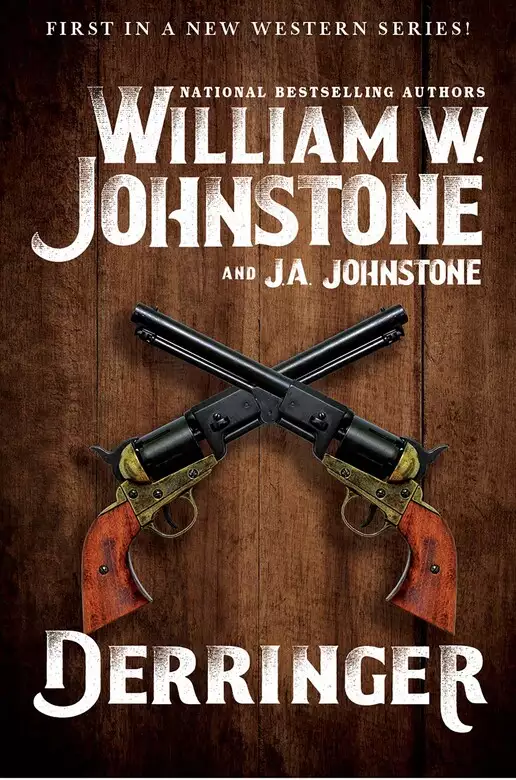
Derringer
- eBook
- Audiobook
- Hardcover
- Book info
- Sample
- Media
- Author updates
- Lists
Synopsis
Introducing a gun-blazing new series from the masters of the classic Western. Meet Jesse Derringer. Troubleshooter for the Union Pacific Railroad. Where there’s trouble, there’s Derringer. And where there’s Derringer, there’s shooting . . .
On the Fourth of July in 1867, the Union Pacific Railroad announced plans to expand their line into the remote mountains of Dakota Territory. They chose a site near Crow Creek Crossing to be their headquarters and named it Cheyenne. Almost immediately, new residents began to arrive: dreamers and schemers, drifters and grifters, good folks and bad. The owners of Union Pacific knew there’d be problems. Between settling disputes, laying down tracks, and keeping the peace, they’d need a troubleshooter. A reliable man of steely resolve. A concealed weapon . . .
His name is Derringer. Like the gun.
Arriving by cattle car with two of his beloved horses, Jesse Derringer is not your typical railroad employee. With the eyes of a scout, he looks for trouble before it becomes a problem for the construction crews—and sometimes starts trouble himself. Usually he handles hot-tempered troublemakers with a cool head and steady hand. But then there are problems that are more complicated and it’s Derringer’s job to defuse them—before they ignite a full-blown bloodbath.
Jesse Derringer is about to learn the true definition of trouble-shooting.
Release date: August 26, 2025
Publisher: Pinnacle Books
Print pages: 400
* BingeBooks earns revenue from qualifying purchases as an Amazon Associate as well as from other retail partners.
Reader buzz
 Please log in to recommend or discuss...
Author updates
Derringer
William W. Johnstone
“You send for me, General?” Jesse Derringer asked when he approached Dodge.
“Yes, I did, Sergeant,” Dodge replied. “Did you get something to eat?”
“Yes, sir, I ate,” Derringer said. “What can I do for you?”
Dodge smiled in response to Derringer’s submissive attitude. The general would be willing to wager that he was the only person on the planet who commanded much respect from the burly sergeant. “Now that the horses have had a chance to rest, I’m going to go on a little scout up into those mountains to see if those Indians kept running. You wanna go with me?”
“I reckon I’d better,” Derringer said, thinking that wasn’t the smartest idea the general had ever had. “You want me to mount up a detail of fifteen?”
“No, I was thinking about just the two of us,” Dodge said. “I feel pretty sure they’re not planning to attack us. You said you were sure they headed for home, didn’t you?”
“Yes, sir, but I didn’t know you were plannin’ to go ridin’ up into the mountains by yourself.” He paused for a few moments before asking a question. “This have anything to do with the railroad?”
“As a matter of fact, it would be interesting to see if there’s any place the railroad could go through this line of mountains. It would sure cut off a lot of miles of track if it could, and they’re too damn high to climb.”
“I expect it would,” Derringer said. He knew how interested the general was in the construction of the cross-country railroad and that he had already been involved in planning the path of that track. The general had told him it would shorten the route a hundred and fifty miles if the tracks were brought this way from Council Bluffs, if they could go straight across this line of mountains. It was by coincidence that they followed the raiding party to the base of the very mountain range that was blocking Dodge’s preferred path to the West for the Union Pacific Railroad. Since they were here by chance, it would seem a shame to leave without giving the general the opportunity to estimate the possibility of somehow getting past this mountain range.
“Jesse,” Dodge said, “when we leave here, we’re going straight back to Fort Laramie. I don’t know when I might get a chance to get back to this place again.”
“That is a fact, sir,” Derringer responded. The general addressed him by his first name only when he was asking a favor, instead of giving a direct order. “I expect we oughta go up those mountains and take a little look around.” He felt pretty sure they wouldn’t find any of those Arapaho warriors waiting for them. “I’ll get the horses.”
They followed the path the fleeing Arapaho warriors had taken to ascend the mountain, since it was obviously the easiest way up. All the way to the top, Derringer kept a cautious eye on the trail left by the Indians. They had made no real effort to disguise their retreat and once they reached the top of the ridge, they varied their direction only to the extent of picking the easiest way down the other side. Only then was Derringer willing to dismiss them from his concern.
Dodge wanted to scout the ridge to the north first, so they made their way along it for almost a mile before they stopped when they found the mountains grew higher the farther north they rode. “Too steep to climb and too far to tunnel through,” the general conceded. When he looked at Derringer for a response to his comment, he found the sergeant staring at a large outcropping of rock ahead of them. Staring back at them, a lone Indian warrior stood motionless, as fully surprised as they were. When Derringer pulled the Henry rifle out of his saddle scabbard, the Indian turned and fled, disappearing in the rocks.
Derringer was immediately after him. “Stay here!” he told the general. “I’ll try to see if he’s alone!” He gave his horse a kick and worked his way through the rocks, where he found a trail on the other side, leading down the mountainside. He caught a glimpse of the Indian just before he disappeared again when the trail bent around a clump of trees. When he got to that clump, he reined his horse to a sliding halt because he saw the Indian he had been chasing pulling up before a camp beside a small stream. A war party, he thought, for they were wearing paint. He did a quick count of those he could see and figured there were about twenty of them. The one he had been following didn’t dismount but was gesturing wildly and pointing back in the direction he had fled. “Damn,” Derringer swore, and wheeled his horse around when he saw the warriors scrambling to get to their horses.
He started yelling to Dodge before he reached him. “War party! We’ve got to ride like hell!”
“Can we hold them off?” Dodge yelled back.
“Too many!” Derringer answered. “We’ve gotta ride like hell,” he repeated. The general still waited until Derringer caught up to him before falling in behind him, preferring to have the rugged scout lead the way. They rode south along the ridge as fast as they safely could to the sound of war hoops from their pursuers. It began to look as if they might be trapped on top of this mountain ridge, so when they came to what looked like a narrow pass, Derringer didn’t hesitate; he guided his horse down into the pass and followed it. To his surprise, it continued to gradually descend until it took them all the way to the prairie floor. “You all right, sir?” Derringer asked when he reined back to let the general catch up.
“That was a helluva ride,” Dodge said. “They didn’t even see us drop down in that pass, so I expect they’re wondering where we went.” He laughed in relief. “I’ll tell you the truth, I thought you’d lost your mind when you dropped down in that gully. And I thought I was crazy to follow you. How did you know that narrow ravine was a pass that would take us down to the prairie?”
“It just looked like a narrow pass that would just naturally lead down to the prairie,” Derringer lied. In fact, he had given up hope of outrunning the war party and was looking for some place where they might hold them off. But since it had turned out to be a safe way down to the bottom, he figured he might as well take credit for a smart move.
Dodge just shook his head, still amazed that they had escaped. “I’ll tell you one thing, though. If we can save our scalps, I believe we’ve found a pass through which the Union Pacific can go.”
“Well then, I reckon the scout was worth it,” Derringer responded. “I expect we oughta get along back to the column now before those boys up there on that mountain figure out we ain’t up there no more.” He paused before suggesting another option. “Unless you wanna wait for that war party to find out we’re down here on the plains, so we can lead ’em back to our camp. It ain’t but about a mile from here and then they wouldn’t waste all that war paint they’re wearin’.”
“I don’t know what that war party was doing up on the top of that mountain,” Dodge remarked. “Where were they going? There’s no settlement south of these mountains.”
“That’s a fact,” Derringer said. “I suspect they mighta been thinkin’ about settlements east, back along the South Platte, and there’s a few of them. Hard to tell what they’re thinkin’ now. They mighta run into those Arapaho we chased up on top of that mountain. If they did, then they know there’s a column of a hundred and fifty soldiers right behind them.”
“I know we put a stop to that Arapaho raiding party, but we’re two and a half days’ march back to Fort Laramie,” Dodge said. “I swear, damn it, I can’t leave now when we know there’s a war party of twenty or more savages probably on their way to attack some settlement east of here.”
“I reckon I could go back up there and ask ’em what they’re plannin’ to do, so we’d know what we oughta do,” Derringer japed. “Since it ain’t but about a mile back to camp, how ’bout we take you back to your command? Then I can come back here and keep an eye on this war party. There ain’t no sense in makin’ a hundred and fifty men worry about their commandin’ officer when they could just have to worry about one sergeant.”
The general couldn’t help chuckling in response. “I’m sure Colonel Walsh is standing ready and willing to take command of the column in the event of my absence.”
Derringer started to laugh but stopped short. “He might get his chance,” he said when he saw the warrior suddenly appear in the mouth of the narrow pass. “It’s time to go!” He gave the general’s horse a smack on the behind just as they heard the war cries coming from the base of the mountain. They were off at a gallop with twenty-two screaming Cheyenne warriors in hot pursuit. “Head for the gap in that line of trees!” he shouted to the general. “I’m gonna slow ’em down some!” Dodge did as he was instructed and continued to gallop toward the gap in the trees that outlined the creek where his men were camped.
Derringer pulled his horse to a stop and wheeled around to face the war party chasing them. One particular brave was out in front of the rest of the war party and he was gaining on them. So Derringer drew his Henry rifle from his saddle scabbard. He waited for the horse to be still while he cranked a cartridge into the cylinder, guessing the warrior was at a distance of about one hundred and twenty yards and closing fast. Then he took dead aim and knocked the racing warrior off his horse. Thinking also to put the detachment of soldiers on alert, he fired twice more at the war party. It caused them to spread out and those with rifles answered fire. “That oughta do it,” he said, wheeled his horse again and raced after General Dodge. Now it’s up to you, Colonel Walsh, he thought. The colonel was already up to the surprise. He stepped out of the trees and signaled the general to come to him. Seeing him, General Dodge headed straight for him and Derringer was not far behind.
As he rode into the cover of the trees, Derringer passed through a long line of soldiers lying in ambush and waiting for the command to fire at the charging party of twenty-one unsuspecting Cheyenne warriors. Derringer’s first thought upon riding into the safety of the trees was, That answers the question why they didn’t run into the fleeing Arapaho on the mountain. He and the general quickly dismounted and took cover while Colonel Walsh commanded the men to hold their fire. When the war party was about thirty-five yards away, he gave the order to fire and the trees erupted in a long line of rifle fire that decimated the hapless Indian war party. It was reduced to half a dozen in a few minutes’ time and half of them were wounded. They promptly retreated as best they could. Walsh reported to General Dodge and asked if he wanted to mount a patrol to go after the survivors. Dodge gave him a “Well done,” but said no. He thought the war party had been sufficiently discouraged from any raids they had sought to perform on any settlement. “We’ll start back to Fort Laramie after the noon meal.”
With six other soldiers Derringer walked out among the bodies left on the prairie. Their purpose was to make sure all the bodies were dead, so as not to prolong suffering. Those who survived the ambush would most likely come back to take care of the dead after the soldiers left. Derringer’s purpose, however, was to identify the dead, and he found that he was right in thinking they were Cheyenne. He reported the fact to General Dodge and Colonel Walsh. Walsh, known for his sense of humor, made a suggestion when planning future campaigns. “Instead of mounting patrols of fifteen or more men, why not just send you and Sergeant Derringer out as bait? And you can just lead them back to an ambush like you did today.” Overheard by some of the soldiers close by, it became a running joke among the regiment.
The ambush of the Cheyenne war party happened in September of 1865. It turned out to be the last campaign of that nature for the general and the sergeant. During the following months, the general was called back to Washington to plan the building of the railroad while the sergeant was assigned to a cavalry regiment. In May of 1866, General Dodge resigned from the army and later that same year was appointed chief engineer of the Union Pacific Railroad. When news of the general’s appointment finally got around to Sergeant Jesse Derringer, he was not surprised at all and he was happy for his old boss. He realized how much he missed the days when he was the general’s personal scout and how little he liked serving in a regular cavalry company. So he decided to resign from the army, fully convinced he had no desire to retire from it. He preferred to find out what else was out there to see before he became too old to see it. It had been some time before the war since he had been back to the family farm near Omaha, so he decided to visit the old homeplace. His younger brother, Dan, and Dan’s wife, Shirley, had taken over the farm after his parents were gone. They had passed away while Jesse was serving in Dakota Territory.
Jesse’s visit with his brother was a brief one, lasting only a couple of days. Although Dan and Shirley made a show of welcoming him home, Jesse was aware of a sense of concern from both of them that he was planning to claim his inheritance and move in with them and their two boys. He assured them that he had no desire to settle down on the farm, so he would be on his way again the next day. His statement relieved the tension immediately and they persuaded him to stay over an extra day. When he left, Dan asked where he was heading and Jesse simply answered, “West.”
William C. Cartwright, assistant construction supervisor, sat at his desk in the Council Bluffs office of the Union Pacific Railroad. He was studying a large map spread out across the desk when one of his clerks stuck his head in the door and announced that there was a gentleman who wanted to see him. Cartwright was not inclined to waste his time granting interviews to newspaper reporters, so he asked, “Newspaper reporter?”
“I don’t know,” the clerk responded. “He doesn’t look like one. He was a rather direct gentleman, however, when he said it was important.”
“Oh, he did, did he?” Cartwright replied. “Did he give his name?”
“Yes, sir. He said his name is Derringer.”
“Derringer?” Cartwright responded. “The only Derringer I know about is no gentleman. Send him in here, Lewis. Hell, I sent word for him to come see me.” He got up from the desk to receive him when Lewis withdrew his head from the door and opened it for Derringer to come in. “Sergeant Derringer!” Cartwright announced, grinning from ear to ear. He stepped forward to extend his hand to the tall, serious-looking man.
“Sergeant?” Jesse Derringer responded with a genuine look of surprise. “It’s been a while since anybody’s called me Sergeant. I mustered out of the army when there wasn’t nobody left to fight. How did you know I was in the army?”
“I know that you served as a scout for my boss at Union Pacific, General Grenville M. Dodge, and I know he’s looking for you.”
“I heard that General Dodge was workin’ for the railroad,” Derringer said. “I didn’t know he was lookin’ for me, though. How did you know I was in Council Bluffs?”
“I didn’t,” Cartwright responded, “but the general remembered you had a home in Omaha before the war and he thought you might be passing through here sometime on your way there. So I gave your name to the bartender at the Whistlestop Saloon. And I told him if Jesse Derringer ever stops in, tell him I want to see him and it’s important.”
“Yes, sir, it sure surprised me when he told me that,” Jesse said. “Mickey Deal’s his name, ain’t it? The last I heard about General Dodge was that he won an election for congressman, but he’s workin’ for the Union Pacific Railroad now.” He looked around him and nodded, smiling. “I see they fixed him up in a nice office.”
“Yes, but he doesn’t spend much time in it,” Cartwright was quick to reply. “My job is assistant superintendent of construction for the railroad across the country to connect with Central Pacific Railroad to form a transcontinental railroad. The general is in the field with the surveyors, mapping out the right of way for the tracks, so I’m glad you got here when you did. General Dodge wants me to offer you a job with the Union Pacific.”
“That’s mighty thoughtful of the general, but I don’t know anything about workin’ on the railroad,” Derringer responded as he pictured himself swinging a pickax or driving a spike, and it wasn’t the kind of work that suited him.
“Mr. Derringer, the general says you’re the best damn scout he’s ever had the pleasure of working with,” Cartwright informed him. “He said that maybe you’re the only man he trusts to fill the job he’s got in mind. The railroad has given him the task of planning the route of the railroad from Council Bluffs into Dakota Territory. Right now, General Dodge is at Crow Creek Crossing where they’re building a bridge across Crow Creek. After Crow Creek, they’re faced with a rougher route to follow up across what the general’s calling Sherman Hill. The general said that back in 1865, in the Black Hills campaign, your outfit had to escape from an Indian war party, and it was you who found a pass out of that mess. He said he thought at the time that it would serve as a pass skirting the Black Hills for the railroad, west of the Platte River.”
“Yes, sir,” Derringer remarked with a chuckle, “I remember that time.”
“So how about it? Are you ready to go back to work as the general’s scout? You’ll go on the Union Pacific payroll starting today if you are. I can authorize some advance expense money so you can get what supplies you need right away.”
“Well, I could say I’d have to think about it, since I had other plans,” Derringer said, “but that would be a lie. So I reckon I’m your man.” He didn’t say as much to Cartwright, but when he mentioned the money in advance, it was a done deal. His financial state was down to pocket change. When he rode into town the day before, the thought that he would ever see General Dodge again never entered his mind as a possibility. And with winter coming on, he was expecting to be riding the grub line, hoping to sign on as a cowhand with some rancher.
“Excellent!” Cartwright responded. “That’s going to make the general very happy. He’s told me some tales about your time in the army.”
“Is that right?” Derringer responded. “Well, I hope you didn’t believe all of them.”
“When did you get in town?” Cartwright asked.
“Yesterday mornin’,” Derringer answered.
“Did you take a room in the hotel?”
“No, sir, I spent last night in the jailhouse,” Jesse told him.
“Oh? Did you drink a little too much of the demon whiskey?” Cartwright asked.
“No, sir, I only had a couple of drinks, but the fellow at the end of the bar had way too much to drink. And I reckon it affected his eyesight, because he said he didn’t like the way I was lookin’ at him. He invited me to settle it with our guns, and when I told him I druther not, he said he was gonna shoot me down, anyway. When he drew his gun, I grabbed his arm and he shot himself in the leg. The bartender sent for the sheriff, and I reckon we musta caught him at a bad time, because he took me to jail, even though Mickey and I both tried to tell him I didn’t shoot that fellow. I didn’t put up too much fuss about it, though, since I’m a little short of money and I couldn’t afford a hotel room. I figured I’d at least have a place to sleep and maybe a meal or two, and they put my horses in the stable, too. So I figure I came out ahead on that deal.”
Cartwright shook his head, not sure if Derringer was serious or not. “If you’re broke, what were you thinking about doing next?”
“I was thinkin’ about maybe robbing the bank, but I hadn’t made a final decision on that yet, so I’m glad you have a job for me.”
“I’ll get you a room in the hotel tonight,” Cartwright said, thinking Derringer was joking, but not willing to bet on it. “So you’ll have tomorrow to take care of your horses and any needs you might have in personal supplies or ammunition. He looked at the clock on the wall. “It’s about dinnertime,” he announced. “Let’s go to the hotel to get something to eat. Then I’ll get a room for you for tonight and tomorrow night. Then you can hitch a ride on a train that’s leaving at ten o’clock Wednesday mornin’, heading for the end of the track.”
“How far will that take me?” Derringer asked, since he was going to have to buy supplies for the trip. Cartwright said the general was at Crow Creek Crossing and that had to be about five hundred miles from Council Bluffs.
Cartwright took another look at his map. “Here’s where they were when he wired me two days ago. Based on the rate they’ve been laying track, about three miles a day, that ought to put them close to Crow Creek.”
“Well, I’ll be . . .” Derringer started. “How many days will I be on the train?”
Cartwright shrugged. “Depending on how many hours they travel a day, I’d say about two and a half days.”
Derringer shook his head and grinned. “I expect it would take me the better part of two weeks to ride my horse that far. I reckon I won’t need as many supplies as I thought.”
As Cartwright suggested, they walked down to the hotel dining room for dinner. Jesse left his two horses tied at the hotel hitching rail. After dinner, they went to the front desk in the hotel to get Jesse a room. When that was taken care of, Cartwright took a roll of money out of his pocket and peeled off fifty dollars and gave it to him as an advance. “That oughta be enough to get you set to travel,” he said. “Are your horses in good shape?”
“Yes, sir,” Jesse replied. “I always take care of them, so they’ll take care of me. I’ll take ’em back to the stable. I just picked ’em up before I came to your office.”
“Tell John Walker to put the fee on my bill,” Cartwright said. “He seems to take pretty good care of my horses. I’ve got to meet with some people this afternoon, so I’m going back to the office. I may not see you tonight, so check in with me sometime tomorrow. All right?” Jesse said that he would, so Cartwright started back to his office with the air of a man who had accomplished an important item on his list of things to do. “Don’t spend all that advance in the Whistlestop,” he called back.
“Right,” Jesse responded as he took his rifle and his saddlebags off the gray gelding. “I’ll spread it around in the other saloons.” Then he took his things up to his room before taking his horses back to the stable.
“Howdy,” John Walker greeted him when he rode up to the stable again. “I didn’t expect to see you back so soon.”
“I got a job when I got outta jail,” Jesse replied. “So I’m gonna need to leave my horses with you until Wednesday mornin’. But instead of the sheriff paying for ’em, this time you can charge General Grenville Dodge’s account, or the Union Pacific’s, whichever.”
“Is that so?” Walker responded. “You goin’ to work for the railroad?”
“I reckon so,” Jesse shrugged.
“Doin’ what?”
“Whatever he says,” Jesse replied. “I worked for General Dodge for quite a while as a scout durin’ the war and after that in the Indian Wars. Looks like I’m gonna start out doin’ that right away, scoutin’ for the railroad this time.”
“So you’ll be leadin’ the Union Pacific Railroad across the country to join up with the Central Pacific Railroad?” Walker asked.
“I wouldn’t put it that way,” Jesse said. “General Dodge is the one who says which way to go. My job is just to take a look to see if there’s anything he might stub his toe on ahead of him.”
“That still sounds important, so you better be careful you don’t run into nobody else like Stony Packer before you leave town,” Walker said.
“Who’s Stony Packer?”
“He’s the fellow you shot in the leg yesterday that landed you in jail,” Walker said with a chuckle.
“I didn’t shoot that fellow,” Jesse immediately replied. “He shot himself. I tried to tell that sheriff that I was just tryin’ to keep him from shootin’ me. Hell, he pulled the trigger, the damn fool.”
“Tell you the truth, Warner Black ain’t really the sheriff. He’s just takin’ on the job until we get another one,” Walker said. “He’s the blacksmith, and I expect the situation was a little bit unusual for him and he wasn’t sure what to do.”
“To be honest with you,” Jesse confessed, “I didn’t give him any argument that amounted to much because I figured I could use a bed for the night. He was pretty reasonable about it this mornin’, though. Even got me a breakfast before he let me go.”
“I expect there’s a lotta folks that woulda liked it better if you had turned Stony’s gun up at his head, instead of down toward his leg,” Walker said. “Him and those two saddle tramps he hangs out with think they own the town, now that Luke Collins left to take the marshal’s job in Omaha. It wouldn’t be a bad idea to stay clear of those two friends of his while you’re at it.”
“It’d help if somebody would hang a sign around their necks with their names on it,” Jesse said. “I really didn’t pay much attention to who was with him yesterday.”
“Travis Stacy and Rob Gentry,” Walker announced. “Each one of ’em is worse than the other one.”
“Well, now, right off, that don’t sound too good,” Jesse remarked. “I was hopin’ to enjoy some of the town’s hospitality before startin’ out on a trip that’s liable to take almost two and a half days on a train. And when we get there, there won’t be a saloon to celebrate the journey.”
Walker chuckled again. “Yeah, but you’ll be part of history.”
“That’s right,” Jesse replied, “the part they throw. . .
We hope you are enjoying the book so far. To continue reading...
