JOHNSTONE COUNTRY. THERE’S GOLD IN THEM THAR HILLS.
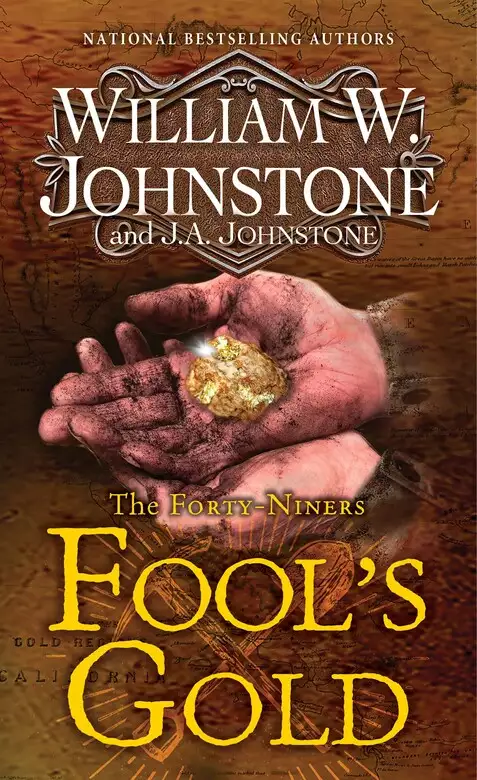
This is the story of how gold fever turned one small mining camp into a bustling boomtown—with a highly explosive mix of dreamers, schemers, and gun-crazy killers. . . .
Cord Bennett staked his claim in the gold-rich Rio Oro Canyon in 1849 at the dawn of the California Gold Rush. That’s when all hell broke loose. What started as a makeshift mining camp is now a full-blown boomtown—fueled by greed, plagued by grifters, and overrun by opportunists of every stripe. As town marshal, Cord has the unenviable job of keeping the peace. Which is easier said than done. Here in Rio Oro City, brawls can break out at any moment—whether it’s a ruthless rivalry between competing saloons or an all-out turf war between miners and timberjacks. And when money’s at stake, brawls can turn deadly real fast . . .
In other words, Cord Bennett has his work cut out for him. His new deputy, a massive Englishman named “Boom Boom” Blackstone, packs his punches with blasting powder. The new church pastor is as handy with his fists as he is with a Bible. And Kat Olmsted, the sister of Cord's sweetheart Glory, is fighting to save her saloon from a hostile takeover. But that’s nothing compared to Cord’s latest challenge. A mysterious cadre of gunmen have arrived in town—and they didn’t come for the gold. They came for vengeance. Cold, calculating, and cutthroat, they were hired for one reason and one reason only: To kill Cord Bennett . . .
Release date:
June 30, 2026
Publisher:
Pinnacle Books
Print pages:
352
* BingeBooks earns revenue from qualifying purchases as an Amazon Associate as well as from other retail partners.
A full yellow moon hung low in the darkening sky as the man in black rode into town.
Although covered by a light coating of dust, his jacket and trousers were still dark, as his shirt front was still distinctively white and cut by the severe black string tie of the saddlebag preacher. A worn black homburg sat level on the man’s head, and his face held a watchful expression—so watchful that it seemed almost fierce, although the wrinkles around the mouth and eyes suggested a capacity for warmth.
The man in black was strong as the Rock upon which he based his faith, but his own rock was worn smooth by a lifetime of service and suffering. He had learned how to be both firm and gentle. It was with just such firmness and gentleness that he drew on the horse’s reins and paused on the hilltop to survey the town below.
Although shrouded by dusk, the town’s features were still discernible. Rio Oro bore all the hallmarks of a gold mining boomtown. Buildings in various states of completion lined both sides of a wide, dirt main street. The man in black reckoned that street would be busy during daylight hours and, in wetter weather, likely a river of mud.
He spied several large buildings, most darkened at this hour, but the two spilling out light and music he figured for saloons or hotels, perhaps both. The building he sought was not visible from this height, but no matter. Deciding it was likely still under construction, he resolved to search for it once he arrived in town. For now, he tapped the horse’s sides with booted heels and guided it down the narrow path of the draw to the valley floor.
A figure detached itself from the shadows of the outlying buildings as the preacher approached the outskirts of town. It took a few steps down the road toward the stranger before pausing to hook both arms around the wooden beam supporting a sign:
“H-h-h-hi!” called the man holding on to the signpost. “W-w-welcome! My n-name’s Hap!”
The man in black drew the reins on his mount and brought it to a stop. He cocked his head, studying the fellow who had introduced himself as Hap. His severe expression softened into a light smile.
“Well, hello, Mr. Hap,” he said in a gravelly rumble. “It’s nice to meet you. My name is Reverend Garrison Lomax.”
“A r-r-reverend?” The slender man with the stutter snatched off his hat and held it before his chest. “W-w-well, gadzooks! You m-must be coming to fill the v-v-vacancy at our church!”
“Indeed I am, Hap. You wouldn’t perchance happen to know where my church is, would you?”
“Yonder.” Hap pointed. “I’ll show you!”
“Much obliged.”
Hap trotted ahead of Lomax down the dirt track that widened into Rio Oro’s main street. The shops and dwellings on the outskirts were dark and the wooden sidewalks deserted. But there was light and activity a little farther up the way. Lomax followed Hap past the lit façades of two saloons, one on either side of the street. The sign on the one to his left was indistinct, but he could make out the word Nugget on the one to his right. Raucous voices rose from within, underlined by the jangle of an upright piano, badly played.
“L-lord, they’re having a hoot in th-there!” cried Hap.
“Hmph. I can tell, from the painted women and bad music, it’s a real den of iniquity.” Lomax frowned. “I shall therefore be obliged to pay it a visit at the earliest opportunity.”
“Planning to g-give ’em fire and brimstone, Preacher?”
“Perhaps.” He scratched his cheek. “But more likely I’ll just have a beer.”
“Ha!”
Hap trotted another hundred yards ahead to pause at the intersection of the main street and its sole cross-street. The town was growing now, expanding cautiously outward on its new axis. A few ramshackle buildings clung to this new street’s edges, and a cluster of shacks with Chinese lettering on them hugged the outskirts of the fledgling avenue. In a vacant lot across the way, the façade of a partially built church loomed in the shadows.
“There it is!” Hap cried proudly, flinging an arm at the building frame. “Volunteers been putting ’er up!”
“Hmph. Have you been helping, Hap?”
“Gadzooks, no! Th-they say I’m too s-stupid to be trusted with a hammer!”
“Is that right?” Lomax grimaced. “We’ll have to do something about that.”
Lomax studied the partially built structure, pleased with its dimensions and present condition. Yes, it would make a fine church for a town the size of Rio Oro. And if Lomax had his way, the congregation would expand, and additions would soon be necessary.
He knew from experience that towns and settlements grew up best with a godly presence in their midst. In a rough mining town such as this one, his work would very surely be cut out for him. Lomax clamped his eyes shut, breathing a short prayer to the Lord for the humility and fortitude necessary to do God’s will in this new parish. When he was done, he opened his eyes and nodded at Hap.
“You’ve been mighty helpful, Hap,” he said softly. “I’m obliged to you. What say we head back to that Nugget place, and I’ll buy you a beer?”
“Why, s-sure!” Hap seemed surprised. “That’s m-mighty kind of you!”
“Least I can do.” Lomax nodded and turned his mount back toward the noise and music. “What’s that building over yonder?” he asked, pointing at a tall shadow in the west.
“Ponder’s lumber mill,” replied Hap. “He’s been d-doing good business lately!”
“I’m sure he has,” said the preacher. With the gold rush in full swing, he reckoned places like Rio Oro, situated near large claims, were expanding by leaps and bounds. Growth meant building, and building meant lumber. Men like this fellow Ponder were getting fat on the expansion west.
Hap led them back to the town core. Turning onto the main street, they approached the lights and commotion from the two saloons.
“Do many folks live down in this part of town?” Lomax asked.
“G-gosh no, Reverend.” Hap shook his head firmly. “Most people bunk f-further up thataway.” He gestured vaguely over one shoulder. “Some f-folks do, though. I guess. Mr. Casterline has a loft above his office. Marshal does, too. And I reckon some of the s-soiled doves live in the rooms above the Nugget.”
“Soiled doves, eh?” Lomax frowned. He did not disapprove of prostitution per se. Jesus himself had forgiven and uplifted such women, rescuing many from a life of sin. The preacher did not judge the women but knew they were often the victims of unscrupulous and controlling men—men for whom he nursed a righteous and bitter rage.
There was a hitching rail just outside the saloon whose full name was the Golden Nugget. Lomax dismounted and tied up his horse alongside a tired-looking paint and a long-suffering mule. Both stood despondent, so Lomax gave each a few gentle strokes on the way past. Soiled doves weren’t the only creatures on God’s earth in need of love and forgiveness. He followed Hap through the batwing doors into the barroom.
A scattering of tables occupied the main floor, which was ringed by a balcony above. Grouped around the tables were perhaps a half-dozen different clusters of men, some chatting, others engaged in card games. A long bar lined the left-hand wall. The piano stood against the right-hand wall, its player absent just now. A few women loitered in the shadows, their tattered clothes and hungry eyes telegraphing their profession even at a distance. As Lomax shook the dust from his hat, one drifted over and spoke to Hap.
“Hello, Hap,” she said kindly. “It’s nice to see you, but I figured you should know the Griffith brothers are here tonight.”
“Oh?” Hap’s eyes widened in sudden alarm, his attention turning toward three burly men clustered around a far table. “Well, I’m th-thinking I’d b-best be on my way then—”
“What are you talking about?” Lomax set his hat back on his head and laid a hand on Hap’s shoulder. “C’mon, son. Let me buy you a beer.”
But Hap shrank from the preacher’s touch. “You d-don’t understand, Preacher,” he whispered. “Them Griffith b-boys h-hate m-me! Gadzooks, they’re a terror! I d-don’t want no t-trouble!”
“And you won’t have any, I promise.” Lomax wrapped an arm around Hap’s shoulders, guiding him to the bar. “Come on with me.”
The barkeep, a balding, mousy fellow, peered nervously at them from behind wire-rimmed spectacles as they approached. Leaning forward to buff the bar with a rag, he whispered urgently to Hap.
“Hiya, Hap,” he said quietly. “Listen. The Griffith boys are—”
“Barkeep!” interrupted Lomax, slamming a palm down on the bar. “Two beers, if you please. One for me and one for my good friend, Hap, here.”
Finishing this statement, he tossed a coin onto the bar before turning to lean his back against it, pushing his fingers into the front pockets of the vest under his black coat.
At the mention of Hap’s name, the three burly men at the far table looked up. One, a snaggletoothed redhead, poked his nearest brother with an elbow and snickered. Then he rose and made his way toward the bar.
“Uh-oh,” breathed Hap as the barkeep set two schooners of beer down before them.
“Relax, Hap,” said Lomax, raising his beer and taking a sip. He studied the broad-shouldered redhead as he sauntered closer. He was a big man, a full head taller than Hap. He had an inch or two on the preacher as well. The redhead’s clothes were worn but clean, his freckled face clean-shaven, and the smile on his lips puckish and charming.
But the slant of the eyes and the gleam in them spoke of a mean streak, one that became obvious as he posted himself before Hap and planted his hands on his hips.
“Well, well. If it ain’t my old friend Hap.” This last word coincided with a slap on the back that caused Hap to stumble and spill some beer from his schooner. “I’m surprised to see you in here, Hap! Especially since we told you not to bother us. And yet here you come—”
“He’s not bothering anybody.”
Lomax’s words, uttered in a voice that was low and guttural, sounded more like a growl than human speech. The redhead stopped speaking, affecting surprise as he did so. After a shocked second or two, he turned to Lomax.
“And who might you be?” he asked. “I don’t believe we’ve been introduced.”
“We haven’t been introduced.” Lomax set his beer on the bar and stepped up to the redhead. “Not formally, at any rate. But I’d say you’ve already made a first impression. And, son, I tell you: It ain’t a good one.”
At this, the redhead’s eyes narrowed. Hap shifted nervously as the man balled his left hand into a fist and firmed his jaw. He knew the signs.
“I ain’t your son,” the redhead snarled.
“Damn right you’re not. My son would have some manners.” Lomax reached for his beer glass. “Tell you what. Why don’t you run along back to your brothers over there? Leave me and my pal Hap in peace. We’ll talk another day.”
With that, Lomax turned his back on the man and leaned on the bar.
The stillness that fell over the barroom was glacial and complete. Every eye in the place was on the Griffith brother, waiting to see how he would react to such a calculated display of disrespect.
As it turned out, they didn’t have to wait long. He reached out and grabbed Lomax’s shoulder, intent on whipping him around. But he hadn’t reckoned on a brimming schooner of beer crashing into the side of his head at full force. When it did, he went down like a bag of rocks.
“Marshal!”
Cord Bennett surged awake and sat upright in the narrow bed upstairs from his office. He had been dreaming of his fiancée, Glory. In the dream she had been standing on the shore of a pond as he sank beneath the waves, one hand reaching out to her, his voice muffled by the rising water—a rushing noise that rose until it became …
“Marshal! Open up! It’s Hap!”
He swung his stockinged feet to the floor. Cord slept in his work clothes when bunking here in town. He far preferred sleeping in the cabin he was building for himself and Glory up Ghost Canyon, a short piece from Rio Oro and within riding distance of the claim he owned. But a few nights of trouble in the saloons had convinced him to come down and spell his deputy, who had been doing night shift for a week.
He rose, stretched, and moved to the door, which he unlocked and opened a crack. Hap was alone on the outside steps leading up to the loft, breathing heavily from his run up from the street.
“Sheriff, you g-gotta come quick! The Griffith b-boys have g-got into a s-scrap with the new preacher over at the G-Golden Nugget!”
“The new preacher? He’s here?” Dazedly, Cord groped for his gun belt and boots. “And he’s gotten into a fight? In the saloon?”
“Truth be told, Marshal, he was defending me from Billy Griffith.” Hap looked ashamed, although there was no reason for him to be. “Him and his two brothers are in town.”
“Right.” Cord clapped the hat down on his head and followed Hap downstairs at the double quick. It was for occasions such as this that he had chosen to sleep in town. Reaching the street, he pivoted and sprinted up Main Street.
The Golden Nugget was just a short distance away. The road’s surface remained uneven from its mangling during the muddy season. Cord had to hop, dodge, and occasionally balance along the back of little dirt ridges to make headway. Before long, he reached the Nugget. His arrival coincided with a stampede of customers out the front door.
“Marshal, he’s crazy!” hooted one old miner.
“Never seen a man fight like that before, Marshal!” echoed another.
Once the rush had passed, Cord approached the saloon. He heard a crash, a crunch of tinkling glass, and a scream, before it all went silent inside. Squaring up, he pushed through the batwing doors and beheld the spectacle inside.
Well, I’ll be damned, he thought.
Sprawled out on the floor were the unconscious forms of Billy, Bobby, and Beau Griffith, the meanest bunch of ruffians in Rio Oro. They and their father, Ulysses, had arrived in town less than twelve weeks before but had already earned a reputation as the town’s most hellacious hell-raisers. Cord and his deputy, Bart Blackstone, had been called to deal with them on more than one occasion. Each time had proved a donnybrook. But none of that prepared him for what he saw now.
Billy Griffith, lying curled up as if asleep, bled from a deep gash on the side of his head. Bobby and Beau both lay straight, stiff as boards, as though slammed by identical blows to exactly the right nerve to knock them out cold. The Griffith brothers, each more than two hundred pounds, were in deep hibernation.
And it all seemed to do with the man standing at the bar.
He was a big fellow—a looming, broad-shouldered bear of a man, with outsize hands, a barrel chest, and a pair of eagle-sharp eyes that found and fixed Cord Bennett the moment he entered the room. Cord knew at once this man had been responsible for the Griffith brothers’ state and that, regardless of circumstances, he would never go against this man unarmed and alone.
“Well,” said Cord, affecting a friendly tone. “Seems somebody decided to take a nap.”
“Indeed they did. You would be the town marshal.” The big man nodded. “Garrison Lomax. I had hoped our first meeting would be under more pleasant circumstances. I find myself posted to Rio Oro as pastor of the nascent church.”
“I see.” Cord flicked a glance down at the Griffiths to ensure they were still out before continuing. “Mind if I ask you, padre, are you armed? And, if so, would you be so kind as to surrender your weapon?”
“Certainly.” With a deft flick of his right arm, the preacher reached around and plucked out a revolver from the belt at the small of his back. He handed it across to Cord deferentially, who recognized it as a modified Colt Walker. The preacher carried a version with a curtailed barrel. Cord had never seen one like it before.
“Much obliged, Reverend Lomax.” His eyes scanned the room. One by one, the bar staff and soiled doves were emerging from hiding. “Truth be told, since I’m up, I might as well have a drink.” He kicked the toe of Billy Griffith’s boot. “Care to help me haul these Sleeping Beauties to cells? Then we can reconvene here and you can give me a statement.”
“Sounds very fine.” The preacher drained his beer and placed his glass on the counter. He bent and hooked his hands under Billy’s arms, lifting him from the sawdust-littered floor with seemingly effortless ease as Cord took Billy’s legs.
It took three trips for the Griffith brothers to be piled neatly into the cell in Cord’s office. They were still snoring soundly as he shut the door and led the way back to the Golden Nugget. Once there, he signaled to the barman for two beers.
“So, Reverend,” he said. “Tell me your story.”
Unlike Cord and his family, who had had a farm in the Ozark Mountains of Arkansas before heading west, Lomax was a city dweller. Born in Boston and abandoned at an orphanage, he had been raised in the care of the state. At sixteen, he fled the workhouse and fell in with a traveling carnival. Beginning as a roustabout, his bulk and temperament made him a natural for the boxing ring. He became the troupe’s challenge pugilist, traversing several states by caravan and collecting coin from the men dumb enough to bet a dime they could knock him down. Most nights, Lomax could make two or three dollars in admission fees and tips. There were also plenty of men willing to buy him drinks and plenty of women eager to bed the beefy brawler. Life was good.
“Everything changed one evening in Richmond,” he said. “I attended a service. Took place in a tent out under the stars. An evangelist was inviting folks forward to testify and be saved. I scoffed … at first. But I watched something amazing happen to those who chose to become converted. It was something I had to learn about. Something I had to follow.”
Despite his lack of much formal education beyond the bare minimum, Lomax managed to gain acceptance to a Bible college. It was to be the beginning of a lifelong adventure—and the closest Lomax would ever come to having a family of his own.
“Upon graduation, I was ordained to the ministry. I was assigned to the western circuit.” Lomax took a healthy slug of beer and narrowed his eyes at Cord. “You mentioned having had brothers. Past tense. I hope they’re not …”
“They are.” Cord toasted the preacher with his mug. “Passed to glory. They helped establish this town. And they were among the first buried here. There was a great deal of violence and lawlessness when we arrived.”
“Is that what drew you to become town marshal?”
“This?” Cord smiled self-consciously, fingertips straying up to stroke the star pinned to his vest. “It began as a provisional appointment. I wasn’t expecting or intending to make this my work, but over time, it stuck. My family came here to stake a claim, so I understand these people. Understanding their hopes and frustrations makes it easier for me to reach them. Knock on wood, the worst of Rio Oro’s growing pains are over, and now we can just focus on making the town grow.”
“I’ll raise a glass to that,” said Lomax. He took a swallow of beer before saying, “Any chance you’ll give me my gun back, Marshal?”
“Sure thing.” Cord pulled the short-barreled pistol from his belt and handed it across. “Do most preachers carry guns these days?”
“The ones who ride out this way do, certain sure.” Lomax received his weapon and vanished it back beneath his coat. “Being a saddlebag preacher in frontier territory is dangerous work even at the best of times. Having a piece and knowing how to use it is no violation of a man’s vow to serve the Lord. Not how I see it, leastways.”
As Lomax spoke, he reached up to scratch at his neck. As his shirt collar slipped down, Cord saw a band of bright red scar tissue circling the flesh of his throat.
“Ah.” Lomax smiled and sat back. “My scars.”
“That’s a nasty one,” Cord said. “How’d that happen?”
“It was a gift.” Lomax offered a proud and bitter smile. “I was a guest, you see. Of the Apache.”
“The Apache?” Cord breathed out slowly. “Lord, I’ve heard they’re, well, I don’t know what the word would be, but—”
“Diabolical.” Lomax said it flatly, without rancor. “I was traveling by stage through the Arizona territory when they fell upon us. My God, it was terrifying. I was one of only two men left alive once their attack was finished. I think the fact that I fought them and had to be knocked cold bought me their respect. I was kept tied in the lodge of a large man who would come in and torture me from time to time. He used clubs. And a whip.” Lomax touched his neck. “It went on for weeks until one night when he was out, I managed to untie myself and escape. I had lost a great deal of blood but would prefer to die on the run rather than as a miserable captive. By the grace of God, I made it.”
Cord’s respect for Lomax only grew. To escape captivity and live to tell the tale showed him to be a man of real fortitude. Such men were rare.
“Do you miss your family?” Lomax was watching Cord now, holding his beer just below his chin, waiting for Cord’s answer to drink.
“Sure.” He nodded. “It’s not easy outliving your entire family. But I’m blessed to have my fiancée, and hers.”
“Fiancée, eh?” Lomax flashed a grin. “You planning a church wedding?”
“Yes, Preacher, we sure are.” Cord spread his hands. “We were just waiting for you to arrive. Glory—she’s my girl—is going to be over the moon that you’re finally here and we can be about the business of getting hitched.”
“It will be my pleasure, Marshal.” Lomax nodded gravely at this. “A town’s leading citizens should be stable, family-oriented men. When those in power lead ordered lives, it tends to flow downward to inform society and its institutions.”
“Law and order are what this town needs,” Cord affirmed.
“And children.” Lomax’s eyes twinkled. “You and Glory will have a special responsibility in that regard, you know.”
“How do you figure?”
“Well, you’re going to be married!” Lomax laughed. “Making children is a part of that!”
“I, uh, yeah.” Cord smiled. “Yeah, I guess you’re right.”
“You don’t sound too confident!”
“Oh, no.” Cord grinned. “I’m just having a hard time getting over my good luck!”
Cord managed to bed down and grab another few hours’ sleep before full daylight. He woke with the sun streaming through the curtained window of his little loft and rose to peer down through the glass at the street below.
Already, Rio Oro pulsed with the morning rhythms of shop workers and saloonkeepers streaming to work, delivery wagons rolling from doorway to doorway, and the timbermen of Ponder’s lumber mill lining up at the front gate to get into the yard.
A few lone horsemen threaded their way through traffic, one of whom was Clyde Casterline, heading out on an errand from the surveyor’s office. Cord made a mental note to stop in and see him later. Then, with a tired sigh, he turned to the mirror, finger-combed his hair into place, dragged on his boots, and thumped downstairs to the marshal’s office.
His was a simple work area—two desks and some chairs, a small potbellied wood stove for heat and coffee. A full quarter of the room was taken up by a cell large enough to accommodate a dozen men.
This morning, it held only three: the Griffith brothers. They were being watched from behind one of the desks by a large, bearded man who studied them as if planning to inflict violence upon their sleeping forms.
“Good day to you, sir,” said the bearded man crisply. He spoke with a thick British accent. Cord moved to the stove and poured himself a cup of fresh coffee from the pot sitting on it.
“Good morning, Bart.” Cord blew on the coffee before taking a cautious sip. He let the liquid rest in his mouth for a long moment before swallowing. His eyes teared up at the taste. “Boy, that’s … great. Thanks, Bart.”
The man behind the desk flashed a proud smile. Bartholomew “Boom Boom” Blackstone took immense pride in his ability to make perfectly awful coffee. His logic went something like this: Coffee is bad for you but useful in staying awake, so why not accentuate the effect by adding eye-wateringly bad flavor?
Having come from England with a pickax and a canvas bag full of mining tools, Blackstone had gone bust on his claim but made a place for himself in town as Cord’s deputy. His nickname of Boom Boom was the result of his fondness for using blasting powder to work his claim.
“Yonder scoundrels remain unconscious, Marshal,” Blackstone grumbled. “Shall I set up a hearing with Judge Davenport for when they wake?”
“No. Just cut them loose with a warning. Tell them I don’t want to see them in town for a week.” Cord took another hard swallow before setting down the cup.
“Who punched them up? He did a fine job, whoever he is,” said Blackstone approvingly.
“Our new preacher. Reverend Lomax.” Cord clapped his hat on his head. “Came into town last night.”
“Is that a fact?” Blackstone grinned. “So, you and that pretty fiancée of yours will get that church wedding you always wanted!”
“Reckon so. I’m headed out to let her know about it right now.”
Astride his horse and headed north along Main Street, Cord surveyed the storefronts and gaggle of pedestrians scurrying for the day’s occupations. The morning rush usually lasted until about ten o’clock, when the day’s temperature started to climb and sensible creatures sought refuge in the shade. They would emerge again around noon, headed home for lunch or down to one of the two saloons for lunch and a bracer. Cord paused as he drew level with a young woman emerging through the doorway of one.. . .
We hope you are enjoying the book so far. To continue reading...

 Please log in to recommend or discuss...
