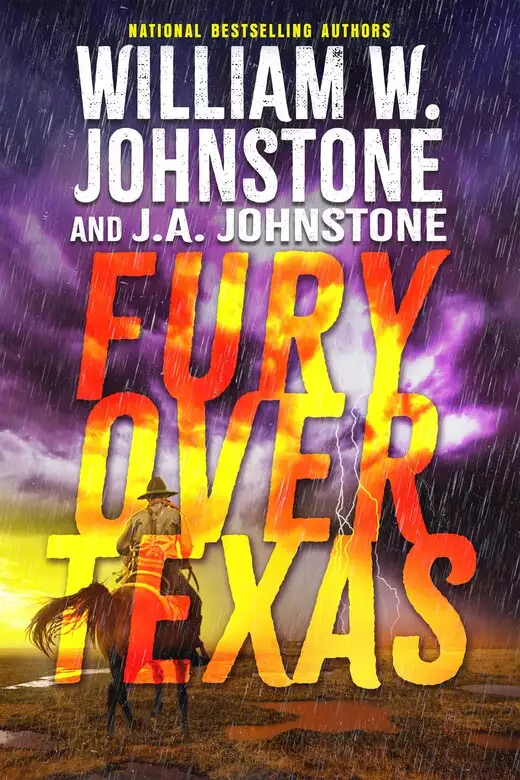
The bestselling masters of the Great American Western pit heroes and villains, men and women, survivors and the unlucky, against the shocking power of Mother Nature in this epic standalone adventure set on the Texas frontier.
A stranger on a mission of revenge. A hurricane on a path of destruction.
THE STORM OF THE CENTURY HITS TEXAS—WITH A VENGEANCE.
At the height of the Civil War, a Confederate soldier was captured and held in New York’s infamous Elmira prison camp. He managed to escape during a snowstorm—after killing a sadistic guard—and made his way to Texas. There, he started a new life in the small lumber town of Pine Lick where he served as sheriff until he retired. Today, his son wears the badge; his nightmares of the war are long forgotten. But tonight, his past will return with a vengeance . . .
When nature unleashes its fury.
Sheriff Mack Armstrong is as fine a lawman as his father, dedicated to protecting the townspeople of Pine Lick—especially when trouble shows up. But when he hears that a mysterious newcomer is armed, angry, and looking to kill a man named Armstrong, he barely has a chance to react. Another force of nature arrives—even deadlier than the stranger. It’s a once-in-a-lifetime hurricane, the worst he’s ever seen. The windstorm tears apart the sawmill, the church, the homes. The torrential rains destroy the dam then flood the streets. And all Sheriff Armstrong can do is save as many people as he can—before the stranger gets revenge. . . .
Release date:
June 30, 2026
Publisher:
Pinnacle Books
Print pages:
352
* BingeBooks earns revenue from qualifying purchases as an Amazon Associate as well as from other retail partners.
Whiskey pulled the wet bandana from his back pocket and patted his sweaty face. He leaned back in the wooden chair as far as he could go without toppling over, hoping to catch a stray breeze wafting through the open door.
The humidity set his joints to hurting something fierce. He considered grabbing the bottle in the sheriff’s bottom drawer just to take the edge off. Instead, he got up and walked over to the table just big enough to hold the washbasin. He dipped his head in the lukewarm water, using his cupped hand to pour some of it across the back of his neck.
“Why don’t you bring some of that water over here, boy.”
The man in the cell looked like a hundred pounds of melting lard wearing filthy clothes.
“I ain’t your boy, and if you wanna keep talking like that, I’m happy to open that cell door and make you forget all about the heat.” Whiskey dunked his bandana in the water and draped it around his neck. Whatever bit of cooling it brought couldn’t compare to the heat of his anger.
“I’m happy to take my chances,” the man said with a lopsided grin on his bearded face. His fingers gripped the iron bars, twisting them as if he could pull them apart. He was a scoundrel Whiskey had caught in Maxel’s General Store the night before. The man, a stranger to the town, had first beat up Pap Maxel’s teenage daughter as she was closing shop, before helping himself to three burlap sacks’ worth of goods. Luckily, Whiskey had been making his rounds and heard the commotion. When he spied through the window Miss Lana on the floor doubled over in pain, the top of her dress nearly torn right off, he kicked in the door and had a go at the would-be thief. His knuckles still hurt, but it was a good kind of hurt. The kind that meant a job well done.
Quicker than a jackrabbit, Whiskey grabbed the shovel handle he kept by his desk and cracked it against the man’s fingers. The prisoner flew back from the bars, howling like a whipped dog. He jammed his hands under his armpits.
“You broke my damn fingers, you no-good rat!”
Whiskey settled back in the creaking chair and leaned the shovel handle against his desk. “Well then, if you’re a praying man, you might want to get down on your knees and give a little thanks to the Lord that your fingers are all I broke. Now sit down and shut your mouth before I really get angry.”
Moaning in agony, the man said, “I need a doctor.”
“How about I get a seamstress to sew that mouth of yours up? After what you did to Miss Lana, there’s plenty women in town who would volunteer for the privilege. And some of them aren’t as nice as me.”
The prisoner shut up for a while, but more so because he set to whimpering in pain than from Whiskey’s threat.
Whiskey heard the ring of familiar spurs as he was popping his knuckles, hoping it would release some of the pain.
“Morning, boss,” he said as the sheriff strolled in.
“Whiskey.”
The sheriff removed his tan Stetson and wiped his brow with the sleeve of his shirt. He spotted their prisoner and turned to his deputy.
“He broke into Maxel’s and put a beating to Miss Lana.”
“She okay?”
“She’ll be hurting some the next couple of days.” Whiskey tapped the side of his head. “How long this will take to heal is anyone’s guess.”
The prisoner, sitting on the unpadded bunk, lifted his swollen and bleeding fingers so the sheriff could see.
“Your houseboy did this to me!” A trail of snot went from his nose to the fibers of his overgrown mustache and into his mouth. “I want a doctor and to press charges!”
The sheriff pulled up a chair beside Whiskey. “What’d he do?”
“Called me boy.”
“Like he did just now?”
Whiskey made it a point not to look into the cell, lest his ire get the better of him again.
“Mmm-hmm.”
The sheriff addressed the prisoner. “You say that again to my deputy and I’ll come in there and finish what he started.” He sauntered to the cell and stared hard at the man’s hands. “Claws like that won’t be much good for stealing … or hitting on defenseless women. Might be, in the end, ol’ Whiskey did you a favor. He just might have saved your neck from a future hanging.”
They eyed each other for a while, before the prisoner broke first and went back to his suffering.
“What’s your name?” the sheriff asked him.
“That’s none of your business,” the man said with his back to him.
“I’m about to make it mine in five seconds.” The sheriff took the key to the cell out of his pocket and brandished his pistol. When the man turned around, his eyes went wide.
“All right! Fine! Name’s Kelly.”
“Kelly what?”
“Kelly Marsden.”
The sheriff grinned. “Your momma named you Kelly? No wonder you have a hair up your rear.” His laughter clearly irritated the man, who once again turned away from him to nurse his hand.
“You look tired,” the sheriff said to Whiskey. “Go on home. I’ve got it from here. I’ll see if there are any warrants for ol’ Kelly.”
Whiskey slowly extracted himself from the uncomfortable chair and tucked the wet bandana in his back pocket. “I’ll make a round first before hitting the hay.”
It was going on eight o’clock and the town was just coming alive, seeing as it was a Sunday. Pretty soon the sounds of church bells would fill the air.
“You had to babysit this plug-ugly fella all night. I’ve got morning rounds. Get some sleep. You earned it.”
The sheriff was a quarter of a century younger than Whiskey, but the deputy always deferred to him, and for very good reason. He’d known the man since he was knee high to a grasshopper and respected the hell out of his father.
“Thank you, boss. Much appreciated.”
Whiskey had gotten no more than one foot out the door when the sound of beating hooves stopped him in his tracks. He spied a young man on a blood bay headed straight for the sheriff ’s office.
“Company’s coming.”
The sheriff was beside Whiskey just as the rider dismounted, holding tightly on to the reins. The boy was covered in sweat and out of breath.
“You the sheriff ?” he asked. The towheaded rider looked to be no more than ten or eleven.
“Pretty sure I am,” the sheriff said as he tapped the star on his vest.
“You need to come to the reservoir quick! There’s been a murder!”
“Just slow down, son.”
The boy’s chest heaved mightily, and his mouth opened and closed like a catfish on land. It looked as if tears had carved a path through the dirt on his face.
“Now, what’s your name?” the sheriff asked calmly.
“Arch … Archibald Gibbons.”
“Okay, Archibald. Who’s been murdered?”
The boy’s upper lip trembled. “My pa.”
Sheriff Armstrong’s spine stiffened.
“Did you see who did it?” In a way, he hoped the child was not witness to his father’s murder, but rather having found the body after the fact. It would make his job more difficult finding the murderer, but it would be less of a blight on the child’s mind.
“I don’t know. A man. He came to the edge of the lake and started yelling his head off. My pa yelled back, and they started fighting, us in the water, and him on land. Then out of nowhere, he shot my pa dead!”
Whiskey looked to the sheriff. “My bed can wait.”
“All right, then.” He asked the kid, “You in shape to take us there?”
“Yes, sir.”
“Then lead the way.”
Whiskey and the sheriff mounted their horses, a pair of paints from the same breeder, and put the spurs to them as they followed the boy to the scene of the crime. Whiskey knew that even though the Lord took the seventh day off to rest, misguided men were always busy at their dirty work.
The hard run to Lake Stanton just a few miles away cooled the sweat on Sheriff Mack Armstrong’s face and neck. Sure, there were better reasons to get out of that stifling office, but murder wasn’t a new or rare occurrence in Pine Lick. Ever since the lumber boom, folks from every point on the compass had been coming to the growing town in search of the almighty dollar.
Situated just south of the over 30 million acres of Piney Woods, Pine Lick was a perfect location to take advantage of the country’s increasing need for lumber. The railroad hadn’t made it there yet, so the cut trees traveled by river to the sawmill in town, where they were processed before heading farther south along the Angelina River.
With the economic boom came a never-ending stream of bad actors. One of the previous sheriffs had been shot down while having his supper at the Sawdust Saloon. He never had a chance to see who hated him enough to take his life. After him was another short-lived sheriff, who went by the name of Bushwack Bill. Old Bill had had his horse shot out from under him by a gang of bank thieves. They took off with the loot, while Bill suffocated under his horse’s deadweight.
Then came Mack’s father, Branch, who had maintained law and order while keeping this side of the grass. He’d retired his tin star to fill his time building the modest family farm. He saw what Pine Lick was itching to become, and decided he’d rather live out the rest of his life in relative peace and hard work while his body could still stand it. The last thing he’d wanted Mack to become was anything even remotely related to law enforcement.
Mack figured he wasn’t the first son to go against his father’s wishes, and was damn sure he wouldn’t be the last.
“Getting close,” he said to Whiskey. His deputy slipped his Colt revolver from its holster.
Riding alongside the worried kid, he said, “Fall back behind us and stay there.”
The kid did as he was told.
The paints dug into the grass and soil, hugging up the rise to the lip of the lake. Sheriff Armstrong gave the dam a quick look, as he always did, just to make sure there were no signs of leakage. Hastily constructed years ago, the dam’s worsening condition kept him up plenty of nights.
For the moment, that wasn’t his top concern.
The man lying in the grass beside a canoe with his arms stretched above his head was front and center. A large man wearing worn overalls standing beside the body saw them and waved them over. He was dripping wet and holding his moth-eaten hat in his thick, callused hands.
“I seen what happened and swam across. Thought maybe I could help, but he was already gone.”
Armstrong and Whiskey’s heads were on a swivel.
“Good man, Bear. Did you see who shot him?”
Michael “Bear” O’Hanlon nodded his head. His wiry black beard brushed against his chest. “My eyes may not be what they once were, but I swear it was that fancy fella who’s building the lodge over yonder.”
“Cheever?” Whiskey asked.
“Yep. That’d be him.”
Armstrong dismounted and checked the man’s pulse. He saw the neat hole in his throat and motioned with his head to Whiskey to make sure the boy didn’t come any closer.
“You see Cheever shoot this man?”
“I sure enough did. What with all the shouting going back and forth, it was hard not to.”
The sheriff nodded at his deputy. “Stay here with the boy and Bear. I’ll find Cheever.”
“Maybe it’d be wiser if I went with you. He did just shoot a man.”
Armstrong’s stomach coiled with disgust. “Yes, an unarmed man in a boat with a young boy. Cheever’s a gutless coward. I’ll be fine.”
Buzzards had already started circling in the leaden sky. “Bear, make sure that body isn’t touched.”
The big man looked up and said, “Can do, Sheriff.”
The Arcadian Men’s Retreat was just a hundred yards from the scene of the crime. The main house had been completed, the fresh smell of wood from Pine Lick’s own sawmills riding what warm, moist breeze was about. Half a dozen smaller bungalows were in various states of construction, most of them complete. Since it was a Sunday, the working crew had the day off. The sheriff had heard that there were plans to build a dozen more, granted, if the opening was a success.
Armstrong tied up his horse at the hitching post and pushed his way inside the main house. The heat of anger burned red on the back of his neck. He flexed his fingers and balled them into fists.
“Cheever! Where the hell are you?”
After a slight pause came a reply. “In the study, Sheriff.”
Striding through the vestibule, Armstrong opened a door to an empty room. He’d yet to pay a visit to the lodge house and had no idea where the study was located.
“I’m not in the mood for hide-and-seek,” he said. “Why don’t you just come to me with your hands over your head.”
“If you insist.”
Cheever sounded as if Armstrong’s presence was an inconvenience. Armstrong pulled his Colt out of its holster, ready to see the wealthy snob catch a bullet if needed.
Tony Cheever had arrived at Pine Lick a year prior, leaving his home in Chicago “to tame the South,” as he’d been overheard by many within earshot, and add whatever level of sophistication was possible. His goal was to build a men’s retreat catering exclusively to the wealthy. Hunting, fishing, a chance to get away from the hustle and bustle in the fledgling cities of the Midwest and Northeast, were the advertised main attractions, though anyone with half a brain knew there would be a lot of power brokering going on over expensive scotch and cigars. Cheever was going to charge astronomical fees to enjoy the very things the citizens of Pine Lick did every day of their lives for free.
But to do so, he had to make the lake and neighboring land a rare and exclusive commodity. To that end, he’d been buying up what he could and making a general nuisance of himself to anyone who dared trespass. One thing Cheever did not do was share. Not for nothing anyway.
Cheever emerged from an open doorway on the left side of the oak-paneled hall. He wore a white three-piece suit, his jet-black hair slicked back on his head, a pencil mustache plastered on his lip. His hands were half-raised in clear defiance of Armstrong’s order.
“To what do I owe the honor?”
“I’m taking you in, so if you’ll oblige, I’d like you to turn around and put your hands behind your back.”
He arched an eyebrow. “Taking me in. What for? Is it a crime to read a book on a Sunday morning? I admit it wasn’t the Bible, but that shouldn’t be an offense to anyone but the local preachers around these parts.”
Armstrong stepped closer. Cheever did not turn around or put his hands at his back.
“I’m happy to do this the hard way.”
“I’d like to know what I’m being arrested for, if that’s too much to ask.”
Not punching Cheever in the face was just about too much for Armstrong to ask of himself. Instead, he grabbed the man by his upper arms, wheeled him around, and pushed him against the wall.
“You’re too smart to play this dumb. I’m taking you in for murdering a man at the lake.”
Cheever grunted as Armstrong slapped the cuffs on him, driving his knee into his back, but managed to keep his composure.
“Murdering a man at the lake? That’s patently ridiculous.”
Armstrong turned him around so they could see eye to eye.
“I have two witnesses. You care to change your statement?”
Cheever’s eyes went dead and cold. “I’ve never murdered anyone in my life. You sure you want to go through with this? My lawyers can make your life very unpleasant.”
Armstrong had heard that Cheever had amassed his fortune from being a card sharp who bounced from city to city, adding to his coffers at every stop. Looking at the man’s blank, unreadable face, he understood all the stories told about him. His was a poker face that told no tales.
“I’ll take my chances,” Armstrong said, roughly leading him out of the lodge house.
Armstrong was hot and angry and in need of some kind of release. When Cheever stopped at the doorstep and was about to open his mouth, the sheriff walked through him as if he were cigar smoke hanging in the air. Cheever went down like a sack of flour. With his hands cuffed behind his back, his face smacked off the wooden porch with a satisfying crunch, followed by a spate of yowling that would bring the chickens on home.
For the first time that day, Sheriff Armstrong smiled.
The rain came down in sheets so thick, it was hard for Branch Armstrong to see the barn from the field. The humidity had been rising all day, and Branch knew sooner or later the skies had to pop. He guided his sorrel, Gypsy, back home at a slow trot.
As he passed the unassuming house he’d built with his own two hands over a decade ago, he spotted his wife, Kate, standing outside the open door, letting the rain wash over her. She waved when she saw him before tilting her head back and smiling into the storm.
There was a time during the Civil War when he thought he’d never see Kate again. Not when Fort Fisher, where he was stationed, was being pounded by cannon fire from invading ships in the harbor, and especially not when he was captured by the Union soldiers and sent to the Elmira Prison Camp in New York, a state he’d never had any intention of visiting.
Those were bleak days, and try as he might to put them behind him, there were some things that he knew would never go away. His slight limp was a constant reminder of one particular night that both saved him and troubled him. Frostbite had led to him losing three toes that night. It was a minor nuisance compared to the lost limbs and disfigurements so many other men suffered, which is why he never complained, not even to his wife.
The town of Pine Lick attracted people from every walk of life. Prosperity had a way of doing that. There were quite a few Civil War veterans in town, from both sides of the war, looking to make the last half of their lives more tolerable. He knew them by their missing legs and arms, or in some cases, the vacant glaze that would fall over their eyes from time to time.
It had been a dry summer and more than just the crops had suffered. A day like today was a long overdue gift from above. During his Sunday sermon, last week and today, Reverend Smiley had said a special prayer, asking God Himself if He might send a few rain clouds Pine Lick’s way. He’d beseeched the Lord with a loud voice and song. It had reminded Armstrong of the rain dances he’d heard tale of Indians conducting when the land was dry and dusty, crops wilted, and wild game skinny and ragged.
Armstrong had been a churchgoing man because his wife insisted on it. He had to admit, there was a kind of comfort to those Sunday mornings, even when the church was hotter than a bonfire or colder than the deep end of a well. Something about the ritual, the familiarity of it, had a way of settling his soul. Reverend Smiley’s sermons, long-winded and meandering on his good days, were something Armstrong could do without.
This rain, this is what made him feel closer to God.
“So long as it doesn’t peter out,” he said to Gypsy as the entered the barn. He patted her neck, dismounted, and went about unsaddling her before walking her to her stall and making sure she had plenty of food and water.
Kate had gone back into the house. He found her dripping wet next to their wood-burning stove. Branch came up behind her and pulled her close. Kissing the raindrops from her neck, he let his hands wander.
“Aren’t you frisky?” she said, dropping the spoon into the pot of stew.
“You can’t go getting yourself soaked to the skin and not expect a reaction.”
“The house is so hot, I couldn’t resist.”
Branch turned his wife around and looked deep into her chestnut eyes. She may not be the young filly who bedeviled his brain with her looks and curves, quick laugh and even quicker wit. But to Branch, she was even more beautiful than when they’d courted. Knowing exactly what was under those clothes had him riled up and anxious. With their son grown and out of the house, their marital relations had never been better.
“I can’t resist, either,” he whispered in her ear.
They stripped off by the stove, some part of the back of Branch’s mind thinking it was best to leave the clothes in a heap right there. Maybe the stove would dry them some.
He carried her to the bed, where they made love. After, they lay together. Branch rested his head on his wife’s chest, listening to her heartbeat go from a wild gallop to a slow and steady lope.
The sound of rain pattering the roof lulled them into an easy but brief sleep.
After a while, Kate shifted, waking Branch up. “The stew’s going to burn.”
“Just add a little more water,” Branch replied sleepily.
She got up and put on her robe, a threadbare thing that her mother had given her when they’d married almost thirty years ago. Branch had promised her many times to buy her a new one, but she’d flatly refused. Kate was a sentimental woman, as well as frugal as a banker. As long as it fit—she’d put on a few pounds, but not nearly enough to come close to bursting the seams––and covered what it needed to cover, what was the sense of replacing it?
“You coming back to bed?”
“No, and you’re getting up as well. We need more wood.”
He reached out for her. She playfully slapped his hand away. “Sakes. I keep waiting for you to settle down a bit. We’re not young anymore.”
“You make me feel young. Besides, we’re just making up time lost to the war and raising that son of ours.”
Kate grinned. “Oh, I think we’ve more than made up for it.”
Branch had just swung his legs out of bed to put on his overalls when there was a pounding at the door. Kate’s face clouded with concern. It wasn’t often people came calling, much less practically breaking down their door.
With no time to fiddle with clothes, Branch grabbed his Schofield from the holster hung over a peg in the wall and motioned for his wife to get as far from the door as possible.
Pine Lick was a town on the rise, thanks to the constantly buzzing sawmills and lumber trade. There wasn’t an empty lot in all of Main Street. That also made it an attraction for a never-ending stream of unsavory characters looking to make a quick buck and cause a lot of trouble in doing so. Branch put his finger to his lips. Kate took their hunting rifle off the wall.
The pounding continued.
“Yeah!” Branch shouted.
There was no answer.
The pounding became more urgent.
“Who is it?”
Now fully aggravated, Branch whisked the door open and raised his pistol. A blast of rain pelted his naked flesh.
The short man standing in the doorway looked more relieved than worried. The deep lines in his rawhide face tilted up just a bit when he smiled. He had a thick cigar tucked into the corner of his mouth.
“Is this the way you have come to greet your guests?” he said, exhaling a plume of smoke.
Branch exhaled and lowered his pistol. “Why in hell didn’t you answer me, Otto? I thought you were trying to bust my door with all that hammering.”
“I could not hear you,” Otto said. “Your door is thick, and my ears are not those of a young man.”
“Well, come in before the whole place floods.”
Otto was a Kickapoo Indian, who had traveled anywhere that was not a reservation. He’d settled in Pine Lick five years ago, taking up land abutting Branch’s. In that time, Otto, whose Indian name he said had been something that translated to Gliding Otter, had become a good friend and handy neighbor. His long, braided gray hair hung wetly down the center of his back.
Branch knew that people talked behind his back, wondering why he associated himself with an Indian, and, when he’d been sheriff, selecting a Black man as his deputy. What they didn’t know was that he’d seen enough division between men during the Civil War. Atrocities that would forever haunt him had also changed his way of thinking. He didn’t care about the color of a person’s skin or where they were from. All that mattered was that they were good, fine people.
Otto certainly fell into that category.
Something had to be wrong because Otto was not one to go slamming on doors.
“What has you all fired up that you scared me out of my underwear?”
When Otto spied Kate, sans rifle, he removed his moth-eaten hat and gave a slight bow. “Sorry to be a bother, Miss Kate.” He also tamped out his cigar on the bottom of his boot, fully aware that Kate was not a fan of the smell of cigars or cigarettes.
“You’re never a bother. You just gave us a start.”
Otto eyed Branch up and down. “I do not believe I am the reason for your lack of underwear.”
“Hold on.” Branch went to fetch his clothes.
“What seems to be the problem?” Kate asked their usually reserved neighbor.
“There is trouble in town. Men from an outfit in Arkansas are tearing up the Sawdust Saloon. And I hear the jail is already full with a thief and Mr. Cheever.”
Branch emerged from the bedroom fully clothed and slipping on his holster. “Cheever? What did he do, other than be a pain in the rear?”
Water dripped from Otto onto the wood floor. “They say he killed a man just for fishing.”
“He’s a nasty piece of work, but I never took him for a killer. Strange. How many men from this outfit?”
Otto tilted his head in thought. “I think ten or twelve. No, ten. That little Timmy told me when I was going into town for a drink. I think they will need some help.”
Though it had been a couple of years since Branch Armstrong had been sheriff, he knew he could never fully retire until his son removed his star. Mack was young and smart and strong, not to mention pretty handy with a gun, but still, Branch worried about him. With the exception of his own time keeping the town safe, sheriffs in Pine Lick didn’t have a firm grip on longevity, most of them ending up in a pine box or crippled.
Branch kissed Kate on the cheek. “Be back soon.”
“It doesn’t sound like it.”
“You know how much I love your stew.” To Otto, he said, “You armed?”
“Always.”
Tugging on his oilskin, Branch ran to the barn. Gypsy would not be happy going out again, but such was the life of a horse.
And, it appeared, retired lawmen.
Sheriff Mack Armstrong got word about the goings on at the Sawdust Saloon from several frightened patrons as they poured in the jail’s doors. With everyone talking over one another, he was a dog’s hair close to firing his pistol into the ceiling to get them to settle down.
Cheever looked amused at the chaos, while Kelly the would-be thief begged for someone to get him a doctor. The townsfolk paid him. . .
We hope you are enjoying the book so far. To continue reading...

 Please log in to recommend or discuss...
