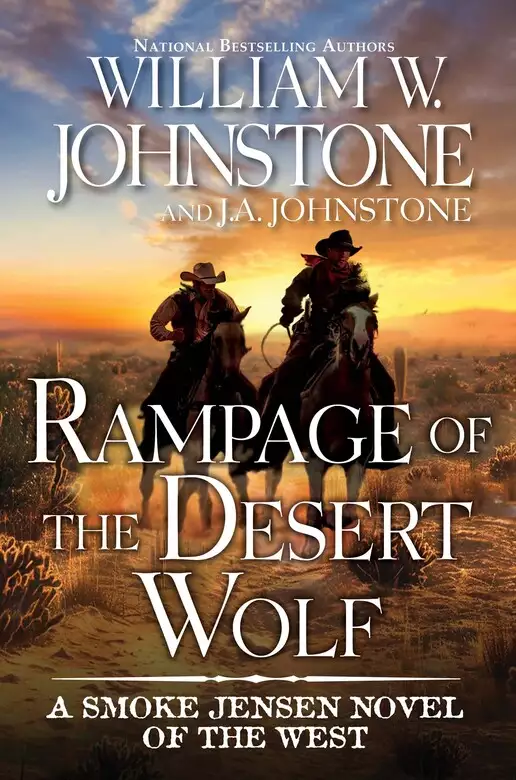
It sounds like a sweet deal, almost too good to be true. The U.S. Army needs horses and the Sugarloaf Ranch has got ‘em. The only problem? Getting a herd safely to Fort Craig in New Mexico without losing lives or spilling blood. If anyone can do it, it’s legendary mountain man Smoke Jensen. For backup, he’s bringing his new friend Dean McKinley, a young rancher who helped him stop a robbery in Big Rock. He’s a good man, a hard worker, and together they manage to lead the horses to Socorro without incident. That’s when their luck runs out. . . .
Her name is Virginia Griffin. She’s got a stable full of male admirers and takes a quick shine to McKinley, sparking an all-out brawl with a jealous suitor. But before this powderkeg explodes, Smoke gets word of an Apache ambush at Fort Craig, so he and McKinley head off to help—leaving the horses at the mercy of thieves. By the time they return, the horses are gone—and the race is on. Smoke heads off across the barren badlands in pursuit of the gang, led by a notorious outlaw known as Lobo del Desierto: the Desert Wolf. To make matters worse, this leader may be connected to a band of Mexican revolutionaries with a deadly plot of their own. Not to mention that vixen Virginia, who may be at the center of it all. . . .
JOHNSTONE COUNTRY. WHERE EVERY JOURNEY BEGINS WITH A SINGLE GUNSHOT.
Release date:
August 25, 2026
Publisher:
Kensington Books
Print pages:
304
* BingeBooks earns revenue from qualifying purchases as an Amazon Associate as well as from other retail partners.
As the sound of gunfire erupted, shattering the warm, peaceful morning, Smoke Jensen wheeled around and gazed up the main street of Big Rock, Colorado. His hands flew to the Colts holstered on his hips, and his strong, supple fingers closed around the guns’ walnut grips.
Several men charged out the front door of the train station at the end of the street, a couple of blocks from where Smoke stood on the boardwalk in front of Louis Longmont’s restaurant and saloon.
On the far side of the large, redbrick depot building, a train was stopped next to the platform, steam still belching from the diamond-shaped stack of the big Baldwin locomotive.
The men who had just hurriedly exited the station wore long dusters and bandanna masks over the bottom halves of their faces. Their hats were pulled low to further obscure their features. The guns in their hands spouted fire and lead as they sprayed bullets around the street to discourage any interference with their getaway.
Smoke didn’t have any idea what those owlhoots had stolen, but he didn’t intend to let them get away. Their indiscriminate gunfire was threatening innocent bystanders, and Smoke needed to put a stop to it.
He pulled both irons, stepped into the street, and walked toward the outlaws, alternating shots left and right.
The five men might not have noticed Smoke at first, but they became aware of the threat the hard way as one of them went down hard, drilled through the body. The man next to him yelled a warning to his companions. All four of them threw a storm of lead toward Smoke.
Angling across the street, Smoke left his feet in a dive as slugs tore through the air around him. Dust puffed up as he hit the ground on his left shoulder and rolled.
That roll carried him behind one end of a watering trough. Outlaw bullets thudded into it but couldn’t penetrate.
Smoke came up on one knee, leveled the Colts over the water trough, and returned the fire. Another outlaw jerked halfway around as a bullet caught him in the upper left arm, but he managed to stay on his feet.
The masked men had been trying to reach their horses, which were tied to a hitchrack in front of the depot, when they burst out of the building. Smoke’s deadly accurate fire had drawn a curtain between them and that goal. The four men still on their feet retreated behind a parked wagon, the closest thing that offered them any cover from Smoke’s bullets.
The people who had been in harm’s way when the shooting started had scattered. Smoke risked a look for anyone cut down by the flying lead and was glad to see that none of the townspeople were lying in the street.
After crawling around behind the water trough to put himself in a better position relative to the outlaws, he began thumbing fresh cartridges into the Colts’ cylinders.
While he was doing that, a gun blasted unexpectedly to his right. A bullet plowed into the dirt only a couple of feet from him. He jerked his head up and saw that the man he’d shot in the chest wasn’t dead after all. Mortally wounded, more than likely, but he had pulled himself up onto his feet and now staggered along in front of the boardwalk, thrusting a revolver toward Smoke.
Muzzle flame spewed from the gun again, but Smoke was already rolling toward the boardwalk. The bullet ripped a gouge on the trough’s side where Smoke had been stretched out a heartbeat earlier.
Before Smoke could lift one of his Colts and return the fire, a man stepped out from the recessed alcove of a building not far from him. This man had his gun out and he crouched slightly as he loosed a shot at the wounded outlaw. The bullet punched a second hole in the man’s chest, spun him around, and dropped him limply on his face.
Smoke looked at the man who had gunned down the outlaw and nodded his thanks. The man was a stranger to him—young, rangy, dressed like a cowboy with the deeply tanned face and hands of a man who spent most of his time working outdoors.
He smiled faintly and returned Smoke’s nod. Then he had to retreat into the alcove as a bullet whistled past his head and shattered a window in the building. The remaining outlaws raked the area around Smoke and the young stranger with a fierce volley.
Rapid, pounding footsteps on the opposite boardwalk drew Smoke’s attention. Taking a chance, he looked in that direction and saw his friend Monte Carson, Big Rock’s sheriff, running toward the train station. Monte had a shotgun in his hands and looked like he was trying to get close enough to the outlaws to use it.
One of the masked men must have noticed his approach. Monte ducked as a bullet hummed close to his head and jumped off the boardwalk to land behind a parked buggy.
The horse harnessed to the buggy suddenly screamed, reared up, and jerked away from the hitch rail where its reins were tied. The reins pulled loose, and as the horse’s front hooves came back down on the ground, it lunged ahead in a wild run, hauling the buggy behind it.
Smoke figured one of the slugs flying through the air had creased the animal, and the pain had spooked it into bolting. Whatever the reason, the result was the same.
Monte Carson was left out in the open, an easy target for outlaw lead.
Smoke had just reloaded his Colts again; he had a full wheel in each gun. To give Monte a chance to reach some other cover, Smoke surged to his feet and blasted away with both irons. Splinters flew from the body of the wagon the outlaws were using as a shield.
The stranger who had helped Smoke earlier joined in, as well. He stepped out of the alcove and emptied his gun toward the outlaws.
Either he or Smoke scored a hit. One of the duster-clad men reeled out from behind the wagon and collapsed, pitching limply to the ground and lying there in a crumpled, motionless heap mutely eloquent of death.
That left three men, and one of them might be wounded. The odds were even already and soon could be stacked high against the outlaws as more of the townspeople responded to the shooting. Many frontier settlers, even the ones who lived in towns such as Big Rock, owned guns and didn’t mind pitching in on the side of law and order whenever trouble cropped up.
From the corner of his eye, Smoke saw Monte bound onto the boardwalk again and charge ahead until he reached an alley. The lawman ducked into that opening, used the corner of the next building as cover, and loosed both barrels at the outlaws. He ducked back, broke the shotgun open, and thumbed fresh shells into it.
Smoke stretched out behind the water trough and began reloading again. The stranger was doing the same thing in the nearby alcove.
This created a momentary lull in the firing, and the masked lawbreakers decided to try to take advantage of it.
They burst out from behind the wagon and made another dash for their horses, shooting wildly as they sprinted toward the animals.
If they had had another couple of seconds, they might have made it, but the constant crash of gunfire made their mounts nervous enough that the horses danced away when the outlaws reached for them.
Smoke came up on a knee again with his freshly reloaded Colts in his hands. The revolvers boomed and bucked as he opened fire.
A few yards away, the stranger joined in once more, too, and across the street, Monte Carson got in on the fight with a thunderous roar from the shotgun he wielded.
Two of the outlaws went down, driven off their feet by the smashing impact of buckshot and bullets. The third man was able to jerk his horse’s reins loose from the hitch rail and get his foot in the stirrup, but as he tried to pull himself into the saddle, bullets from Smoke and the stranger tore through him. He cried out and fell backward, away from the horse.
His foot hung in the stirrup, and as the animal gave in to its panic and stampeded away from the station, it dragged the unfortunate owlhoot. The man bounced against the ground for a good hundred yards along the street before his foot finally slipped from the stirrup, leaving him lying there, motionless.
Smoke still had a couple of rounds in both Colts. He kept the guns trained on the outlaws who had fallen in front of the depot as he stalked toward them. He heard footsteps nearby and a glance to the side revealed that the man who had helped him was joining him to check on the owlhoots.
At the same time, Monte Carson set the shotgun aside, drew his revolver, and trotted down the street toward the man who’d been dragged by his horse.
It didn’t take Smoke and his companion long to confirm that the four men at this end of the street were dead. Satisfied that they were no longer a threat, Smoke pouched his left-hand iron and began replacing the expended shells in the cylinder of the other gun.
As he did that, his fingers efficiently accomplishing the task he had carried out thousands of times, he nodded to the young man and said, “I’m much obliged to you for your help, amigo. That first fella might have gotten me if you hadn’t taken care of him.”
A rakish grin spread across the young man’s face.
“No, I reckon you’d have drilled him a second or two later if I hadn’t,” he said. “Those varmints weren’t any match for Smoke Jensen.”
“You know who I am?” Smoke said.
“I’ve seen your picture in Harper’s Illustrated Weekly. I’ve read some of those dime novels about you, too, but to be honest, the way they draw you on those yellow covers doesn’t look a whole heap like you.”
Smoke had to laugh at that, as he slid the freshly reloaded Colt back into leather.
“There’s not much about those dime novels that’s accurate,” he said as he began refilling the cylinder of the other gun. “I sometimes think the publishers must find the fellas who write them in one of those homes for the feeble-minded.”
“Yeah, after reading about you in those yarns, it seems like you ought to be ten feet tall, at least.”
In truth, Smoke was only medium height. Maybe a tad more, but not much. His shoulders were exceptionally broad, but that was really his only distinguishing physical characteristic. He had a shock of ash blond hair, a keen, penetrating gaze, and faint lines around his eyes that came from living much of his life outdoors and in danger, which meant he had to keep a careful lookout around him at all times.
There were also lines at the corners of his mouth showing that he was quick to smile and had a ready laugh.
Folks sometimes talked about a man being comfortable in his own skin. Smoke Jensen was just about as comfortable in his own skin as a man could get.
But he didn’t look like a man who had a reputation as one of the fastest guns—maybe the fastest gun—west of the Mississippi or anywhere else. In the little more than a dozen years since he and his father had headed west from the Jensen family’s hardscrabble farm in the Missouri Ozarks, numerous legends had grown up around Smoke.
He had been a wanted outlaw for a time, the charges against him false ones framed on him by enemies. He had been a deadly avenger, settling the score for the murders of his brother, his father, and most of all, his young wife and their infant son. He had been a lawman, albeit a somewhat reluctant one, wearing a star to help him in his quest for justice.
But in recent years, he’d been content to be a rancher, establishing the Sugarloaf spread with his second wife, Sally, as well as being one of the founders of the town of Big Rock. At heart, he was a peaceable man, and it would have been fine with Smoke if trouble took another trail and left him alone. Sometimes it did for a while—but it seemed as if those intervals of peace and quiet never lasted long.
Monte Carson walked up the street to join Smoke and the stranger. Monte had the shotgun open and tucked under his arm.
Smoke nodded to the double-barreled weapon and said, “I reckon you won’t be needing that anymore.”
“Not right now, anyway,” Monte agreed. “That fella down the street is as dead as he can be. I’m assuming the others are, too?”
“I’m afraid so,” Smoke said. “I wonder what they were after in the depot.”
“Don’t know, but I intend to find out.” Monte looked at the stranger. “Before I do, though … Who might you be, mister? I like to keep track of who’s in my town, and I don’t believe we’ve met.”
“I just rode in a little while ago,” the man said. “Name’s McKinley. Dean McKinley.”
“Didn’t I see you trading shots with those outlaws?”
Smoke said, “Dean here saved my bacon by taking a hand when he did.”
“Mr. Jensen exaggerates how much I did,” McKinley said, “but I’m glad I was able to help out.”
“What brings you to Big Rock, McKinley?” Monte asked.
“An old dun horse,” McKinley replied with a smile. Before the lawman could take offense at the answer, he went on, “I’m riding the chuck line, Sheriff. Just looking for a job.”
“Ranch work?” Smoke asked.
“All I’ve been doing for the past eight years.”
“How old were you when you started? Twelve?”
“Fourteen,” McKinley said.
Smoke inclined his head toward Longmont’s.
“Come on with me,” he invited. “We’ll get a cup of coffee and jaw for a spell. It’s on me.”
“Now I’m obliged to you,” McKinley said.
Monte started toward the train station. Smoke told him, “Stop by Louis’s on the way back to your office, Monte.”
The sheriff lifted a hand in acknowledgment of the request.
Now that the shooting was over, the citizens had emerged from their temporary hiding places and were gathering to stare at the bodies of the dead outlaws. The women didn’t get too close, and they struggled to hold back the youngsters who wanted to take a good look at the bloody corpses. A hum of excited conversation came from the men. Anything that broke the monotony of day-to-day life was welcome in frontier communities—even if it came with the price of some bullets flying around.
When Smoke and Dean McKinley entered Longmont’s, Smoke led the way across the room toward the rear table where the proprietor always sat. Nattily dressed and sleekly handsome, Louis Longmont had a dual reputation as a gambler and a gunfighter. He was also one of Smoke’s oldest friends.
Smoke signaled to the bartender to bring coffee for him and McKinley. Louis already had a cup in front of him with tendrils of steam rising from the dark black liquid.
“I’m surprised we didn’t see you out there on the street once the guns started going off,” Smoke said as he sat down and motioned McKinley into one of the other empty chairs. “You’re usually as dependable as an old firehorse hearing the alarm bell.”
“I was indisposed,” Louis said. “Truthfully, I still am, a bit.”
Smoke grinned. “You’re hungover!”
“I received a shipment of especially fine wine,” Louis explained. “You wouldn’t expect me to serve something I hadn’t sampled myself, would you?”
“Oh, of course not,” Smoke said, still smiling.
“And I had a lady friend who, ah, helped me sample it,” Louis added. He waved an elegantly manicured hand. “Besides, I’d seen you through the window a short time earlier. I knew you were out there and would handle the situation, whatever it might be.”
“Yeah, I was about to come in here when the shooting started. Figured I’d have a cup of coffee with you before I went on down to the train station—which, as it happens, is where the trouble seems to have started.”
Quickly, Smoke filled Louis in on what had happened.
“I still have business down there,” he concluded, “but it can wait until Monte gets through talking to them.”
“You have something coming in on the train that arrived a short time ago?” Louis asked.
“Nope. I need to check and see if there’s a telegram waiting for me and send a reply if there is.”
Louis nodded but didn’t press Smoke for further explanation. Instead, he looked across the table at McKinley and asked Smoke, “Who’s your friend?”
McKinley extended his hand, and said, “Dean McKinley, Mr. Longmont. It’s a real pleasure to meet you.”
Louis clasped the young range rider’s hand. “You know who I am?”
“He’s read the dime novels,” Smoke said dryly.
McKinley laughed and reached toward the hip pocket on his jeans.
“That’s right,” he said as he pulled out a thin yellow-backed book that he had folded in half so it would fit in his pocket. “Just bought one I haven’t read before. That’s what I was doing when the shooting started. Sorry, Mr. Jensen, but it’s not one that has you in it.”
“That’s all right, I promise you,” Smoke told him.
The bartender arrived with coffee, setting the cups in front of Smoke and the young cowboy. McKinley took an eager sip and then looked surprised.
“What’s that taste in it?” he asked.
“Chicory,” Louis said. “Very popular in the Cajun country where I’m from.”
“Well, it’s good, that’s for sure.”
Smoke said, “It’s probably not too late in the morning to get the cook to rustle up some flapjacks and bacon, if you’re hungry, Dean.”
“Well, come to think of it, I haven’t eaten anything yet this morning, and I am a mite short on funds …”
“And yet you just bought a dime novel,” Louis pointed out.
“A fella’s mind gets hungry, just like his belly.”
Smoke laughed and clapped a hand on the young man’s shoulder.
“Let’s get you a good breakfast,” he said, “and then there’s something else I want to talk over with you.”
Dean McKinley had quite an appetite, which came as no surprise to Smoke. Despite being called chuck line riders, young cowboys on the drift, looking for a job, often went a long time between meals.
McKinley had polished off a big stack of flapjacks with butter and syrup, and was just finishing the plate of bacon that came with it, when Monte Carson came into Longmont’s and headed for Louis’s table.
Monte raised a finger to the bartender, who knew that meant to bring him a cup of coffee. He pulled out an empty chair at the table and thumbed his hat back as he sat down.
“The bank was sending a bunch of old bills back to the mint in Philadelphia to be taken out of circulation,” he said. “Until then, though, they would still spend just fine, and those boys got wind of it somehow and decided to latch on to them.”
“Doesn’t the bank usually notify you when an unusual amount of currency will be coming or going?” Louis asked.
Monte nodded. “That’s right. This was just a misunderstanding. The bank president thought one of the tellers had told me about it, and the teller thought the president had. Like that old saying about the right hand not knowing what the left hand is doing.”
“Or not doing, in this case,” Smoke said with a smile.
“Yeah. But then it was all for nothing, because the shipment wasn’t ready to go when the eastbound rolled in this morning, and they’re going to have to postpone it until the day after tomorrow. So those varmints went in there figuring to grab themselves a small fortune and came out empty-handed.”
Louis said, “But now you’ll be prepared to make sure there’s no trouble when the shipment does go out.”
“That’s right,” Monte said. He nodded his thanks to the bartender as the man placed a cup of coffee in front of him. After taking a sip, the sheriff looked across the table at Dean McKinley. “Judging by those empty plates in front of you, young fella, I’d say you had yourself a good surrounding just now.”
“I bought breakfast for Dean,” Smoke said. “Seemed to me like he earned it.”
“Oh, I’m not disputing that. I saw the way he pitched in against those outlaws.” Monte paused for a moment as he regarded McKinley, then went on. “You know, most lawmen would consider it a mite suspicious that you rode into town the same morning as a gang of owlhoots tried to steal a money shipment.”
McKinley leaned back in his chair and his eyes widened. “Sheriff, you’re not saying you think I had anything to do with those lawbreakers, are you?”
“Dean gunned down a couple of them,” Smoke pointed out.
Monte shrugged. “Outlaws have turned on their own plenty of times, for lots of different reasons.”
McKinley’s face flushed. His tawny eyebrows drew down in a scowl.
Monte lifted a hand to forestall the young cowboy’s angry reaction.
“Now, let me be clear. I’m not saying that’s what happened here. But the thought occurred to me, and I’m not going to lie about it.”
McKinley still didn’t look happy, but his voice was calm and controlled as he said, “I don’t suppose I can fault you for that, Sheriff. A lawman’s job is just naturally to be suspicious, I reckon. But for what it’s worth, and you can believe me or not, I never laid eyes on any of those varmints until I was trading gunshots with them.”
When he was finished, silence hung over the table for several heartbeats before Monte Carson nodded.
“For what it’s worth, I do believe you,” he said.
“So do I,” Smoke added.
Monte smiled faintly. “And if I had any lingering doubts, Smoke speaking up for you would take care of them. I don’t figure I’ve ever met a better judge of character than him.”
The comments appeared to mollify McKinley. He nodded and said, “I appreciate that, sir. I really do. And Mr. Jensen, having you stick up for me is a real honor.” He smiled. “I’ve read about you, too, Sheriff, so I’m mighty pleased you don’t think I’m an owlhoot.”
“Read about me? What are you—” Monte stopped short and rolled his eyes a little. “You’ve read some of those ridiculous dime novels they’ve started writing about Smoke and his friends, haven’t you?”
“As far as I know, I’ve read all of them,” McKinley said. “There aren’t that many so far, but they come out pretty regular-like.”
“Well, don’t put too much stock in them. Those old boys who write them have—ah, been known to exaggerate.”
Smoke grinned and said, “That’s what I’ve been telling him.” He grew more serious as he went on. “About that other thing I want to discuss with you, Dean. You know I have a ranch not far from here?”
McKinley nodded. “Sure.”
“It’s a big place, and I can always use another hand. How about it?”
The young man’s eyes widened. “You mean I could ride for Smoke Jensen’s Sugarloaf Ranch? That’s what you’re asking me to do?”
“You said you were looking for a riding job.”
“You don’t have to make that offer just because of what happened this morning,” McKinley said. “I would have taken a hand against those outlaws, anyway, once I saw the way they were throwing lead around all over the street. Somebody had to stop ’em before they hurt a woman or a kid. Shoot, when I stepped out of that alcove and drew down on them, I didn’t even know who you were, Mr. Jensen. I hadn’t gotten a good look at you yet.”
“I’m not trying to pay you back for that,” Smoke said. “I consider it just a lucky turn of events that put us together. I can use a hand, and you can use a job. That’s all it amounts to.”
“In that case”—McKinley extended his hand—“I’ll be mighty pleased and honored to ride for your brand, Mr. Jensen.”
Smoke shook hands with him and added, “My foreman, Pearlie Fontaine, will have to agree, but I don’t anticipate any trouble there. Pearlie is a pretty keen judge of character himself.”
The two of them finished their coffee, then Smoke said, “I’ll walk on down to the station and take care of my business there. If you want to gather your gear and get your horse, Dean, we can meet back here in a little while and ride out to the Sugarloaf together.”
“There’s no gathering to do,” McKinley replied. “Everything I own is in my saddlebags and my war bag, and they’re still on my horse. I hadn’t gotten around to looking for a place to stay and a stable for him. So I’m ready to go whenever you are, Mr. Jensen.”
“Then you can walk down to the station with me. And call me Smoke. Anybody I’ve fought beside, shoulder to shoulder, has earned that.”
“It’d be my pleasure, Mr.—I mean, Smoke.”
They said their farewells to Monte and Louis, and left the restaurant. By now, the undertaker and his assistants had loaded up the bodies of the fallen outlaws and taken them off to be prepared for burial. The gang’s horses had been rounded up and corralled at the livery stable. They would be sold, along. . .
We hope you are enjoying the book so far. To continue reading...

 Please log in to recommend or discuss...
