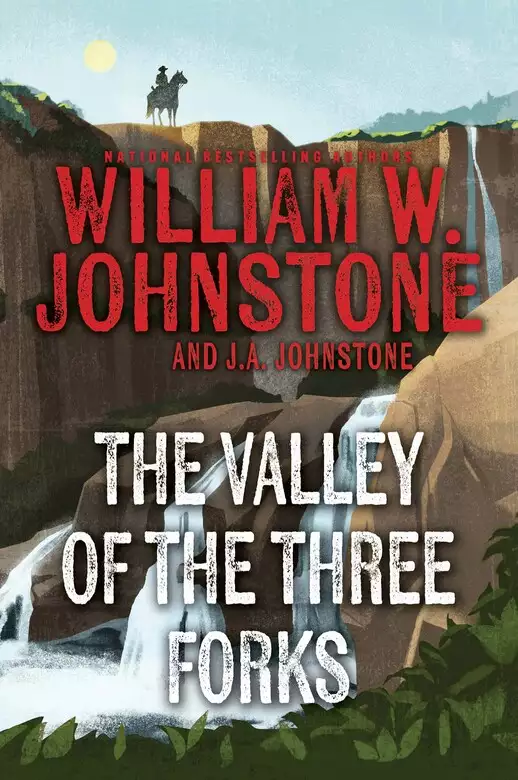
Fate—and a couple of murders—in Three Forks, Idaho, lead one innocent man on a quest for justice, redemption—and revenge—in this blazing new series from the bestselling Johnstones . . .
Once, Logan Trent was a well-respected man. A decent and hard-working deputy sheriff in the town of Three Forks, Idaho, his life changed forever when his rival for the affections of a beautiful saloon owner was found dead. Murdered in cold blood. And Logan was the obvious suspect. Despite no evidence—no arrest, no conviction—everyone believed he did it. So, Logan quit his job and left. Bought a saloon in Montana. Tried to forget the past . . .
But the past never forgets. And neither do Logan’s enemies.
When Logan learns that his brother’s been murdered, the nightmare comes rushing back. After all these years, Logan must return to Three Forks to console his grieving father—and find his brother’s killer. But on the way, he’s ambushed and forced into a deadly gunfight. One of the attackers is a Donovan, the family of the man Logan was accused of killing. Seems the whole clan is waiting for his return—and want him deader than dead. Now, Logan has one last chance to clear his name. And no way out—without spilling more blood . . .
JOHNSTONE COUNTRY. WHERE YOU CAN’T KEEP TROUBLE FROM VISITING, BUT YOU DON’T HAVE TO OFFER IT A CHAIR.
Release date:
August 25, 2026
Publisher:
Kensington Books
Print pages:
304
* BingeBooks earns revenue from qualifying purchases as an Amazon Associate as well as from other retail partners.
Logan Trent poured whiskey for a prospector named Wiley Phillip, then corked the bottle and reached under the bar for his sawed-off twelve gauge, or his “Peacemaker,” as he called the old stagecoach gun that had been used by many shotgun messengers here in Big Creek in the shadow of the Absaroka Mountains, Montana Territory.
It had cut many a man in two and in even smaller pieces. Amazing how much damage a seasoned shotgun messenger could inflict with such a weapon when the chips were down, and it was his job to keep “his” strongboxes out of the hands of trail scum.
Wiley Phillip saw the move and grinned, showing a mouthful of whiskey- and tobacco-stained teeth. He’d seen it before and knew that trouble was on the horizon. Trent owned the Stray Dog, here in Big Creek, having purchased the saloon nearly five years ago, and he was known to cut trouble off at the pass, so to speak.
Or nearly cut it in two with a double load of double-ought buckshot to the belly.
Wiley glanced over his shoulder. Trouble was on the horizon, indeed, for a big Swedish woodcutter, Lars Holstrom, had nabbed one of Trent’s bar girls, Miss Clara. He had pulled her onto his lap and was nuzzling her neck against her ever-loudening protestations. She struggled to free herself from the woodcutter’s brawny arms, but Holstrom was a big, powerful man. He was also drunk, as he usually was, and wasn’t of a mind to let the girl go.
Wiley returned his gaze to Trent and saw rage building in the saloon owner’s eyes. Logan Trent was a big man, too, nearly six-six, none of it tallow, and he ruled the Stray Dog with an iron fist … er, with the iron Peacemaker, which still had old bloodstains on it from past violence. Truly, the twelve gauge had known violence in its day. Wiley Phillip had a feeling, judging by the ever-building darkness in Trent’s eyes, it was going to get another round of it soon.
Sure enough, when Miss Clara squealed, “Oh, won’t you please leave me alone—you’re hurting me!” out came the Peacemaker from under the bar, and the apron-clad Trent, dark-haired and dark-eyed, with a severely chiseled, handsome face, pushed through a swing door to Wiley’s left and marched over to the table where the big Swede was molesting Trent’s eighteen-year-old serving girl. He held the savage popper straight down along his right leg.
He stopped six feet from the Swede’s table and said quietly but tightly, “All right, Holstrom, you’ve had your fun—let her up.”
The Swede pulled his face out from the girl’s neck, where he’d been nibbling the girl’s right ear, and said with casual defiance and a jeering grin, “Nah. Don’t want to.” He laughed and went back to chewing the girl’s ear.
“I don’t care what you want,” Trent said with quiet menace. “You either do it, or I’ll smash your face in. If that doesn’t work, you’ll get buckshot to the belly, and you will not be walking out of here.”
The smile left the Swede’s bearded face. There were maybe a dozen other drinkers in the rough-hewn place. Now they all went quiet, swiveling their heads toward the scene of the trouble, until there were only the sounds of Miss Clara’s protestations.
The Swede glared up at Trent.
Trent glared down at the Swede.
Holstrom flared his nostrils, face reddening with rage. He said in his thick Swedish accent, “Who in the hell are you, Logan Trent? No one knows a damn thing about you. You show up five years ago on that big roan of yours and you don’t say a damn thing about yourself!”
“If I wanted you to know, you’d know. Now let her go.”
“You know what I think?” Holstrom said. “I think you’re hunted! I think you’re a wanted man hiding out in Montana!”
“You think what you want, but if you don’t let that girl off your lap, you’re going to get your face caved in.”
The Swede’s lips quivered as he hardened his jaws.
He threw the girl off his lap and straight into Trent, who dropped his shotgun as he caught her. The Swede leaped out of his own chair, charging like a bull buffalo at Trent. Trent threw the girl into a chair an eye blink before the Swede, who was two inches taller than Trent, barreled into the saloon owner, knocking him flat on his back onto a table that was vacated quickly by the two miners who’d been sitting there playing poker.
The Swede slammed a ham-sized fist into Trent’s face, scrambling the saloon owner’s brains. The Swede pulled his fist back and slammed it forward once more, but it got only halfway to its target before Trent, suppressing his aching head and blurred vision, reached up and wrapped both hands around the woodcutter’s big fist, stopping it. The Swede’s gray eyes widened in renewed rage, but he yelled out in pain when Trent head-butted him twice and slammed a knee into the man’s groin—maybe not a sporting move, but this was no sport.
It was survival.
The Swede groaned and fell off the table to the floor.
Trent bounded off the table and picked up the Peacekeeper from the floor. He turned to see Holstrom bounding toward him once more, roaring like a gut-shot griz. Trent flipped the shotgun around and slammed the butt into his opponent’s face. The man’s nose and mouth exploded like a ripe tomato.
The Swede staggered backward, clutching his nose in both big paws. As he did, Trent slammed the shotgun’s butt against the man’s forehead. That dropped Holstrom like a poleaxed bull. He lay groaning, writhing, and glaring up at the saloon owner.
Trent flipped the Peacemaker again, drew back both rabbit-ear hammers, and aimed down the side-by-side barrels at Holstrom, the muzzles a foot from the man’s face.
“No!” the Swede begged, turning his head to one side, steeling himself for two rounds of double-ought buck.
Trent started to draw both triggers back.
“Logan!” a man shouted.
The saloon owner looked up to see the Big Creek town marshal standing between the saloon’s batwing doors, gazing warningly at Trent.
The lawman, Lou Gentry—tall, gray-mustached, and gray-headed under his high-crowned black Stetson—gave his head a single admonishing wag.
“Turn around, Lou,” Trent said. “You don’t want to see this. Not gonna be pretty!”
Gentry released the batwings and walked into the saloon.
He stopped seven feet from where Trent stood, still holding the shotgun’s barrels close to the terrified Swede’s bearded, bloody face. He looked at Trent. He didn’t say anything, didn’t even shake his head again. He just stared at the saloon owner, who, after several seconds, gave a frustrated chuff, depressed the shotgun’s hammers, and raised the gun until its barrels were aimed at the ceiling.
Trent kept his eyes on the Swede, whose nose was turned sideways on his face, and said through gritted teeth, “Get the hell out of here. You ever come back, not even Gentry will be able to save you.”
Gentry said to Holstrom, “I won’t even try.”
The big Swede gained his feet heavily, miserably, grabbed his whiskey shot off the table, threw it back, and slammed the glass down hard. Glaring at Trent and Gentry, he set his feathered canvas hat on his head, then stomped across the still-silent saloon and through the batwings.
Immediately a low roar of conversation rose from the other drinkers.
Gentry looked at Trent and jerked his head toward the bar. “Buy ya a drink, Logan?”
“I’ll buy.”
Trent pushed through the swing door, set the shotgun on a shelf behind the bar, and, as Gentry leaned over the bar and entwined his hands on top of the scarred mahogany, filled two shot glasses, sliding one to the aging lawman he considered a friend. Gentry lifted the glass, said, “That was close,” and threw back the entire shot.
Miss Clara came to the bar, set her tray on it, and said, “Thanks, Logan.”
“Why don’t you take the rest of the night off? I can handle it to closing.”
“Thanks.”
When she was climbing the stairs, Gentry glanced at her bodice, corset, and matching skirt, then said to Trent, “Pretty girl. Ever seen others of that cut … from where you came from …?”
“Oh, sure, sure.” Trent smiled, knowing the lawman was probing him for secrets.
“Where is that, Logan?”
Trent shrugged and refilled the lawman’s shot glass. “Here an’ there.”
“You sure keep your cards close to your chest, Logan.”
“Never thought of it that way.” Trent threw back his whiskey.
“Oh, I think you have, Logan. And it’s not just because you’re a man of few words.”
“Why, then?”
Gentry grimaced, deeply curious. “Can’t figure it out.”
Trent left the lawman to pour drinks. When he returned, he finished his shot and refilled both their glasses.
“I’ll figure it out,” Gentry said.
“It’s not worth it, Lou.”
“I got me a feelin’ it is. Just to satisfy my curiosity, of course.” The marshal raised his glass in salute.
Steeling his voice a little, Trent said, “Let it go, Lou. You’d just be bored.”
“Ah, another clue.” Gentry sipped his whiskey. “When a man rides to town on a fine horse, buys a saloon, and doesn’t seem to have a story—at least, none he wants to talk about—it makes people curious. Makes people think he’s got a past he’s runnin’ from.”
“People should mind their own business.” Trent threw back his shot to try to temper his annoyance. He didn’t like sharing much about himself with anyone—not even with his only friend in town. Gentry was a former cowboy and shotgun rider before age caught up to him and he became the lawman of a small, mostly peaceful town in the Montana mountains.
Trent knew Gentry’s story, but that didn’t mean Gentry needed to know his.
Gentry refilled his glass from the bottle on the bar and removed his hat, putting it down on the bar beside him. He winced and scratched the back of his head. “Seems to me, if I remember right—I’ve had the memory of an old man for years—when I was trailing owlhoots over in Idaho, I heard a story about some trouble down in the Valley of the Three Forks of the Wolf River.”
Trent just stared at the man, squeezing his empty shot glass. Warm blood rose in his face.
“What was it now?” Gentry said. “I don’t think I got the whole story, just that some deputy sheriff was accused of killin’ some young man from a wealthy ranching family over a woman in a town called Three Forks. He went to trial, but the jury said they couldn’t convict him because they didn’t have enough evidence. I guess everyone in the county figured he did it because this deputy and the dead man were blood enemies. Feelin’ disgraced and wantin’ to spare his family further scandal, this deputy fled town soon after the trial.”
The lawman shook his head, as if he didn’t know what to make of the tale.
“Crazy story,” Trent said.
“A sad one, too. Especially if he was innocent, with everyone believing him guilty.”
Gentry sighed resignedly and set his empty glass on the bar. He put his Stetson on his head. “Reckon I best get back to my night rounds. Have a good night, Logan.”
He tapped his knuckles on the bar and headed for the batwings.
“You too, Lou.”
The lawman had taken only two steps when he stopped, turned back around, and pulled a small leaf of yellow paper out of his pocket. “Almost forgot—you got a telegram earlier. Ain’t it a coincidence? It came from a place called Three Forks in the Idaho Territory. Imagine that!”
He laughed as he put the note on the bar, then started once more for the batwings.
Trent stared down at the penciled telegram addressed to Logan D. Trent of Big Creek, Montana Terr.:
LOGAN, YOU’RE NEEDED AT HOME. TROUBLE—DAD
Three days later, in Hell’s Canyon in southwestern Montana Territory, he sat astride his big roan, Wolf, so named as the horse had been born on Trent’s family ranch in the Wolf Mountains near Three Forks. He stared down into the muddy offshoot of the Jefferson River, which he and Wolf had traversed minutes ago. He and the horse were soaked, but despite the river’s strong current, Wolf had gotten them across safely.
As soon as they’d gained the opposite bank, Wolf lifted his head high and whinnied. From experience of fording previous waters with the roan, Trent knew what was about to happen. Quick as lightning, he leaped off the horse, landing flat-footed, just before the big stallion shook himself so violently, ridding himself of the river water, that he shook off his saddle, as well as his bridle. Trent’s saddle scabbard, in which lay his Winchester “Yellowboy” repeater, went flying with the saddle, saddlebags, and bedroll wrapped in his rain slicker.
Trent turned to the horse, the light of mischief in the mount’s eyes, and said, “Doggonit, Wolf—why do you always have to do that?” The horse took one step forward, whinnied shrilly, and did it again, showering Trent with water from his soaked roan hide.
Trent used his sleeve to swab his big, chiseled face, spiked with three days’ growth of dark-brown beard stubble. He knew how the horse felt, however. His own denims, a good strip of his shirt, and his vest were soaked from just above his cartridge belt. His pants hung heavy on him, clinging uncomfortably. The Jefferson was deep, and it flowed rapidly, violently in places, so when horse and rider had plunged into it from the bank on the opposite side, the current had swept them downstream as the roan had fought his way to freedom. They’d been in the river for several long minutes, however—always a bit of a harrowing maneuver. Trent wouldn’t have tried it with any other mount, but only with a tall, tough, determined stallion like Wolf.
The horse turned to him now, craning his neck, and that devilish glint remained in his eyes. There was pride there, too—oh, make no mistake! He was a ham, Wolf was, and he enjoyed showing off for his beloved rider, who loved him back in every way.
“You suppose I can put your saddle back on now, ya ornery cayuse?” Trent said with fake frustration. “We best keep movin’.” He glanced at the sky, where clouds were building. “I think we’re gonna get rain in a coupla—”
Trent cut himself off. Just then he spied a foreboding glint from atop a low rise, maybe a hundred yards to the north. He cast his gaze to the ridge crest just as the crown of a hat dropped down behind the ridge. He’d been watched, surveyed through a spyglass or field glasses. He’d be damned if he hadn’t been. He was a veteran of the long coulees, having been an outlaw of petty sorts as a much younger man, before his father, owner and operator of the Wolf Mountain Ranch in the foothills of the Wolf Mountains, had put the kibosh on that, threatening his youngest son with a bull-whipping and being stripped of his considerable inheritance. Ben Trent had taken the hangdog, humiliated Logan Trent to the town of Three Forks and had coaxed its sheriff, Dan True, into giving his firebrand son a job as deputy sheriff.
He cast his cautious gaze again to the top of the ridge.
Who’d been eyeing him?
Could just be range riders wanting to know who was crossing their range. On the other hand, many men salivated at the sight of the handsome roan. Whoever was up there might be following him and Wolf, hoping to get their hands on the horse. Many men were killed for their horses and long rifles, whatever coin or greenbacks they had in their pockets. The West was largely still a wild, untamed frontier.
Trent quickly resaddled and bridled the roan, getting everything strapped back into place. As he did, he kept a watchful eye on the crest of the low ridge to the north, not wanting to get dry-gulched. He stepped up into the saddle, loosened his Winchester in its sheath, and cast another cautious glance at the ridge, relieved not to see any more hatted heads and, best of all, no rifles trained on him.
When he was a good mile away from the crossing, threading his way between long, sloping rises, spiked with the sage and pines that made him know he was in Montana, he began to let his guard down a bit.
“Prob’ly just a cattle puncher keeping an eye on his boss’s range.” Rustlers were a dime a dozen out here.
After he and Wolf had gone another quarter mile, Trent looked up. Lightning flashed as purple clouds built and a coolness touched the building breeze. Thunder rumbled throatily, and the smell of rain grew stronger.
Time to seek shelter.
He surveyed a pair of stony dikes rising around him. In the one on his left, sitting atop a grassy apron slope peppered with pines, he thought he spied a notch cave beneath a stone overhang. Perfect … if the cave wasn’t already occupied by some mountain lion or some other wild beast that wasn’t looking for company. He swung Wolf off the trail and heeled the mount into a gallop.
Wolf took the slope easily, weaving around the pines and occasional aspens. They wound their way through the forest in about three minutes. When they came out on the other side, the high sandstone dike rose before them, its face sheer. The cave was near the bottom, at the top of a gravelly low rise sheathed by two large boulders sitting about fifteen feet out from the dike’s wall. They, too, were shielded from above by a stone overhang.
Perfect place to shelter Wolf.
Now, if only the cave itself was unoccupied.
Trent slid his Yellowboy from its sheath, swung his right leg over the saddle horn, and slid smoothly down from the saddle. He racked a round into the Winchester’s action, then moved to the cave, crouching, peering inside, which was nearly all shadow. With his right gloved index finger snugged against the cocked rifle’s trigger, he stepped up to the entrance and crouched even lower, poking his head inside to give the place thorough scrutiny.
Empty.
There was the sweet, wild smell of some animal of the forest that had recently occupied the cavern, with bits of rabbit fur and broken bones scattered here and there, but it was empty, all right.
Quickly Trent leaned his rifle against the face of the dike and went to work, unsaddling Wolf and laying out his gear in front of the cavern entrance, under the stone overhang, which would be a good place to build a fire, if he could find dry wood before the storm hit. When he’d secured Wolf between the boulder to the left of the cavern and the dike’s front wall, ground-reining the well-trained horse, he hurried off on foot back down the slope, gathering two good armloads of fallen pine and aspen branches. He’d just returned to the cavern’s entrance when he felt the first drop of cold rain.
He built a fire ring from surrounding stones, beside the pile of branches, and had a smoking fire going just as the rain began to fall in earnest, the thunder building now to the tone and volume of kettledrums. Trent hauled his speckled tin coffeepot out of his burlap possibles bag, filled it from his canteen, set it on an iron claw in the fire, then sat back, enjoying the soothing warmth of the crackling flames as the water began to sigh and gurgle.
When it came to a boil, Trent pulled a handful of ground Arbuckles’ from a small burlap sack, then pulled the pot out of the fire and dropped the coffee into the water. He set the pot back on the claw. When it came to a boil again, the bubbling dark-brown brew gurgling out of the spout and steaming in the fire, he pulled it off the claw with a worn leather swatch, lifted the lid, and added cool water from his canteen to settle the grounds. He then filled one of his two white-speckled black tin cups, which he’d also pulled from his possibles sack, and sat back with the steaming cup in both hands.
A contented man.
He looked over the fire at the rain curtaining down off the overhang six feet away from him. It smelled like minerals, forest, and mountain rain. Rain smelled different in the mountains. In his thirty-four years, he had spent time in both the mountains and plains, and he knew the difference.
It was good to be back in the country. Mountain country.
He’d grown up on a mountain ranch, as beautiful a place as a man could ever see, and he’d preferred it to town. He’d punched cattle from dawn to midnight, and he’d broken horses for his father. But, to no one else’s fault other than his own, he’d spent a good many years working as a deputy sheriff in Three Forks and then as a saloon owner in Big Creek. He yearned for the wide-open spaces again. Running a saloon entailed a lot of responsibility, but he thought it would help him blend in with the rest of humanity. He supposed he could have lived like a mountain man, but that was a lonely life. A life where he’d have bitten off more than he could chew. He could no longer break horses, because he’d been nearly stomped and thrown to death more times than his body could tolerate. He may have been only thirty-four, but he often felt ten years older than that. When he’d come to Big Creek and bought the saloon, he’d wanted to hide from his past.
But now with one thin yellow scrap of paper with seven simple words scribbled on it, he was about to ride back into the past he’d tried so many times to forget.
He may have been a grown man, but he could not defy his father.
He could not defy Ben Trent.
His aging, crippled-up, leonine-headed father, shorter by several inches than Trent and stove-up from tangles with wild horses and dangerous and mercurial bulls and heifers—he’d even been attacked by a grizzly once and had been near death for two months—still made Trent feel like that eighteen-year-old firebrand his father had hauled out of bed by his ear.
He wondered what the trouble was.
But for his father, the only one who knew of Trent’s whereabouts, to have summoned him home, it had to be for a good reason. Probably not one that Trent even wanted to hear about, but hear about it he would.
Dread touched him, tempering his enjoyment of the coffee, the fire, the rain. …
He was glad for the storm, though. It slowed his progress along the trail back to Three Forks. He was in no hurry to arrive in that cauldron of ancient trouble, though he knew his father was waiting for him and he’d had a damn good reason for calling his boy back to where he’d endured so much strife and scandal, dodging the bullets of many men who’d been out to kill him and even kill the woman he’d loved.
Still loved.
Clarita Ortiz …
The sound of her name, the image of the beautiful Mexican saloon owner in his head, bit him deep.
He sipped his coffee, lowered the cup, and shook his head, staring through the curtain of rain once more at what was a very thin curtain on his past. “Damn, Pa,” he said, witches’ fingers of lightning forking nearly right above his head, his voice nearly drowned by the thunder and the rain. “Why … why … why …? Liable to get me killed. Liable to get others killed as well. You have to know that.”
Still, Logan Trent, whose past was a yoke on his shoulders, was on his way home.
“Hello, the camp!” a man’s deep voice rose distantly, muffled by the storm.
Instantly, one of Trent’s two Russian .44s was in his hand, his coffee cup lying on the ground between him and the fire.
His heart was a war drum in his chest.
To Trent’s right, between the boulder and the dike, Wolf whinnied. The horse. . .
We hope you are enjoying the book so far. To continue reading...

 Please log in to recommend or discuss...
