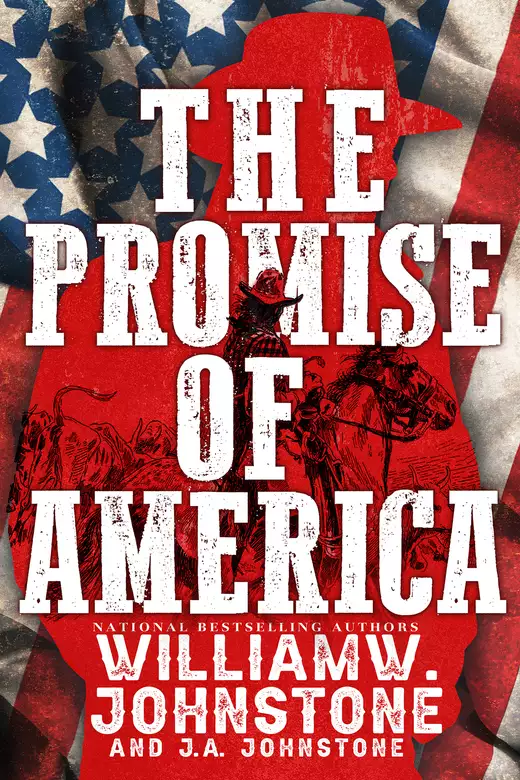
In a land conquered by blood, sweat, and tears, two men lay down their own laws with any force necessary in this action-packed Western . . .
In Arizona territory, the prosperous town of Copper Canyon owes its existence to Stinnett’s Crooked S Ranch and Alistair Duncan’s copper mines. The wealth each man has amassed is beyond measure. They have divided the land’s resources between them, employing most of the townsfolk as ranchers and miners. They use their power and profit to maintain control over their empires from competing business interests—and to keep the peace between them.
Alistair Duncan’s mines aren’t his only legacy. His children, including son Brock and daughter Fiona, will one day inherit everything he’s built. Stinnett has no heirs. To ensure his ranch’s future, he sets his sights on courting Fiona, and considers hiring Brock as a cowboy. But when Stinnett learns that the Duncans plan to expand their operation after discovering coal and gold in a cave, he dynamites it—unaware Alistair and his sons were inside.
Stinnett was also unaware that Brock survived. With his father and brothers dead and his grieving sister finding solace with their family’s murderer, Brock loads his six guns, hellbent on a quest for revenge . .
JOHNSTONE COUNTRY. WHERE BULLETS KEEP EVERYONE IN LINE.
Release date:
December 15, 2026
Publisher:
Pinnacle Books
Print pages:
320
* BingeBooks earns revenue from qualifying purchases as an Amazon Associate as well as from other retail partners.
Tyler Stinnett kept a tight grip on his stallion’s reins as they rode beside the cattle herd. Thunder loved to run, but this was no time for speed.
Stinnett wanted to give his prize bull—Old Ed—plenty of room to roam. He stayed back while the bull led the herd to town, loping along the well-trod cow path toward town at his own pace. Old Ed had been leading Stinnett cows to market for fifteen seasons now. He knew the way as well as any human.
Market Day had long been a grand occasion for the few people who called Copper Canyon home. It was the one day of the year when they turned out in droves to see the fruits of their labor. Stinnett bringing his cows from the Crooked S Ranch through the heart of town to the railhead in Apache Creek drew a bigger crowd each year.
Some had wondered why the railroad had not built an extension to Copper Canyon. It would have saved the copper mine and the cattle ranch the trouble of traveling more than a day to Apache Creek. The two men who ran that part of the territory had refused to allow the railroad to build a station in their town. Copper Canyon was a small town and meant to stay that way.
The town had been established more than twenty years before with the sole purpose of serving the two main interests in the area. One was Tyler Stinnett’s Crooked S Ranch. The second was Alistair Duncan’s copper mine. The town was not meant to be fancy. It provided food, lodging, and supplies for both cattlemen and miners. Aside from Market Day, the town’s few visitors were mostly bankers or representatives from mining and cattle concerns across the country. Except for a few dryland farmers scattered around the area, Copper Canyon was Stinnett and Duncan land. And they would do anything necessary to make sure it stayed that way. A day’s trip to the railhead at Apache Creek was worth the effort.
Stinnett heard a rider approaching him from behind and knew it was Kelly. His ranch foreman would give him a report on how his men and beasts were faring through the first stage of their journey.
“Nothing much to report, boss,” Kelly said in his clipped Irish brogue. “All present and accounted for, and no stragglers, to speak of. A few fell behind at first, but our boys got them back in line right quick.”
Stinnett was pleased to hear it. Kelly had shown up on Stinnett’s fledgling ranch after the war with a small herd of horses and a young bull calf, who grew to become Old Ed. Kelly kept the ranch running while Stinnett expanded their empire. “Glad to hear it. We’ll be in town in a few minutes. Warn the men to keep a sharp eye on the herd as we move through. It’s still rattlesnake season in these parts. It only takes one shake of a rattle to send them running.”
“I’ve already told them,” Kelly said, “but I’ll remind them. They’ve been using them as target practice in the pasture all week. I’ll sure be glad when we move the herd back into the old pasture next year.”
“The year after is my aim,” Stinnett said. “I want to give the land some more time to heal. We’ve got enough in the other fields to keep their bellies full until then.”
“You always know best, Mr. Stinnett.” Kelly favored formality, even when no one else was around to hear it. Stinnett did nothing to discourage it. While he never wanted Kelly to keep anything from him, Stinnett knew familiarity bred contempt. He had seen what happened when foremen started believing they knew more than their employers. Stinnett demanded a strict hierarchy on his ranch. There was only enough room at the top for one man.
Kelly pointed up the trail. A few young children began to cheer before running back toward town. “Looks like the natives have sent out a scouting party, sir. Guess we’re in for quite a welcome.”
Stinnett saw it in another way. Old Ed was not as young as he used to be. The bull had grown ornery in the past couple of years. He was easier to startle and slower to react. In some ways, Stinnett knew how he felt. He would be forty-one in a few weeks’ time.
He told Kelly, “Ride back and tell the boys to start tightening up. We’ll be in town before we know it and there’s bound to be some drunks down there hooting and hollering. Tell the boys to keep the herd tight so they don’t fan out.”
Kelly rode back to spread the word. Stinnett remained up front. He noticed the cows had closed the distance behind Old Ed, but remained in good formation. He would cut in front of the bull when they reached town limits and lead him through there as quickly as possible. If any old drunk staggered in the way, he would deserve whatever happened to him.
Stinnett began to hear the cheers and applause rise from town as they caught sight of Old Ed and the herd.
That was when Stinnett saw a rattlesnake coiled on the side of the trail.
The rancher reached for the Colt on his hip as the snake sprang. It buried its fangs high on the bull’s left flank before dropping away.
The bull cut loose with a yell and bolted toward town. The rest of the herd followed the bull’s lead and charged closely behind him.
The trek to town had dissolved into a full-fledged stampede.
Stinnett dug his heels hard into his mount’s sides as he tried to catch up to the charging bull. But Thunder bucked as the cows began to break formation. They cut him off, almost knocking Stinnett and Thunder to the ground.
Stinnett worked his way clear of the herd as Kelly and the men did their best to keep the cattle in line.
Stinnett rode away from the cows and stood up in his stirrups. He saw Old Ed careening toward town, his head down as his hooves kicked up a cloud of dust and dirt behind him. The crowd cheered, unaware that countless tons of frightened cattle were hurtling their way.
Stinnett grabbed his lasso from his saddle and dug his heels into Thunder’s flanks. They raced toward town. He hoped he could catch up to Old Ed before the bull ran headlong into the first building he saw.
Thunder galloped hard along the packed dirt of Copper Canyon. Stinnett took a shortcut around the back of The Copper Cup—the only saloon in town—in the hopes of heading off the bull and bringing him under some sort of control.
Up ahead, on the outskirts of town, he saw a large young man of about twenty or so climb on his horse and ride toward Old Ed. Stinnett called out to warn the boy, but his voice was drowned out by the loud rumble of the stampede.
He watched the boy swing his rope and lasso the bull’s left horn. He pulled the charging beast forward and to the left, keeping him on the trail the cattle had always followed through town.
Stinnett was surprised the bull followed the rider. But he was not surprised when the rope slacked as Old Ed aimed his bulk at the unfamiliar horse and rider.
As he raced on, Stinnett watched in awe as the young man rode just far enough in front of the bull to keep himself and his horse from being gored by Old Ed’s sharp horns. He saw his men ride beside the rest of the herd, keeping them from barreling through buildings or over unsuspecting spectators. Families cheered wildly as the cows dashed by. They were all unaware of how close they had come to disaster.
When Stinnett caught up to the strange rider, there was less slack in the rider’s rope as Old Ed began to slow down considerably.
It was only then that Stinnett recognized the rider was Alistair Duncan’s boy—his oldest son, Brock. He had known the lad since he was but a toddler.
As Stinnett caught up to him, he watched Brock work his lasso off Old Ed’s horn and gather the rope back to him as he rode.
“For a miner, you can rope and ride pretty good,” Stinnett told Brock as he fell in beside him at the head of the herd.
“I’ve seen you do it enough times.” Brock beamed. “Been watching you my whole life.”
Stinnett laughed. He knew Brock’s father had designs on his oldest boy joining him in the family’s copper-mining business. “Don’t let your pa hear you say that. It’d ruin his day.”
Stinnett looked behind him. Kelly and his men had gotten the herd to slow down a great deal. The cattle had fallen into a slower rhythm behind Old Ed.
Brock asked him, “How many head you figure you lost just now?”
“Hopefully, none,” Stinnett said. “I’d best ride back and take a look for myself.” He had an idea. “Want to help me?”
“You don’t have to ask me twice.”
Brock joined Stinnett in bringing his horse around in a wide circle. Stinnett passed by Miller, one of his men, and told him to take point behind Old Ed.
As Miller raced away, Stinnett and Brock continued riding back toward town.
Stinnett said, “That was a mighty brave thing you did just now, Brock. A lot of boys your age wouldn’t have known what to do. Hell, even my own men got caught flat-footed.”
Brock shrugged. “Just did what needed doing. Didn’t think about it. Guess it was kind of foolish. Old Ed could’ve stuck us good if he’d had a mind to.” Brock blushed as they rode. “What set them to running anyway?”
“A rattler jumped up and bit Old Ed. Happened in a blink of an eye. Before we knew it, we had a stampede on our hands. What you did was dangerous, but you didn’t hesitate.”
Brock looked at the bull. “Shouldn’t someone be tending to that snake bite? Won’t he get sick?”
Stinnett smiled. “One snake bite isn’t enough to kill a bull his size.” He patted Brock on the back. The boy had grown up tall and strong. Smart too. “You’ve got good instincts, son. You can’t teach that sort of thing. A man’s either born with them, or he’s not. You’re off to a fine start in life. Your pa must be proud of you.”
“He is in his way,” Brock said. “You think my instincts are good enough for me to come work for you someday?”
Stinnett slowed Thunder to a walk. He wondered if the boy understood what he was asking. “Alistair’s got ideas about you working his copper mine. He wouldn’t think too kindly about you working anywhere else. Even for me.”
Brock slowed his horse, too. “That’s the problem. I’m not much of a miner. I do it, of course. I do anything Pa tells me to do. But Collum’s a natural. He’s got ore in his veins, just like Pa. I’d be much happier working for you. Breathing clean air. Feeling the sun on my face instead of dirt and dust.”
“Plenty of dirt and dust in my line of work,” Stinnett told him. “And lots of danger to go along with it. You handled yourself well just now, but there’s more to working cattle than stampedes. It’s a lot of long days and even longer nights, where nothing much happens until it does. And when it does, you’ve got to move fast or you might get yourself killed. Or worse, get one of the men working with you killed.”
But Brock’s enthusiasm could not be dampened. “I know I don’t even know the half of it, but I can’t think of a better way to learn except by working for your outfit. Would you talk to my pa about it, Mr. Stinnett? I’d be forever grateful if you’d just think about it.”
Stinnett grinned. The young were always in such a hurry to grow up. “I promise I’ll think about it. I’ll give you my answer when I get back from Apache Creek. That fair enough?”
“More than fair. Thank you.”
Stinnett decided Market Day was as good a day as any to have a little fun. “Let’s see how good you set a horse. Last one to the saloon owes the winner a dollar.”
The two riders raced along the herd back toward town. It did Stinnett good to pretend to be young again.
Fort Dodge, Kansas
Kermit “Andy” Anderson had not known what to expect when he had first joined the Pinkerton Detective Agency after the War Between the States had ended. He had banked on a life of danger and travel. Of meeting men and women whom a former soldier like him might not usually meet. People of means who had found themselves in some manner of trouble and had enough money to get themselves out of it.
Being a poor boy from the slums of Chicago, he had never known what it was like to be wealthy, but being around such people beat making a living as a farmer or bartender.
The War Between the States had taken a lot away from Anderson, but it had also given him an appetite for violence. He figured a man should make the most of the gifts the Lord above had seen fit to give him.
He knew he would need that gift now as he walked into Custer’s Saloon that evening. He was once again on enemy ground and knew he would find few friends among the drinkers and gamblers and sporting ladies inside. But Anderson had not been ordered to Fort Dodge to make friends. He had been sent there to get answers.
Anderson entered the saloon and found himself in a world of hazy lamplight, cigar smoke, and sound. Men, both in and out of uniform, stood three deep at the bar as they swapped stories and lies over mugs of warm beer. At half a dozen tables covered in bright green felt, men of all ages, from all walks of life, tried their luck at poker. Others stood at blackjack and faro tables, cheering and groaning over fortunes made and lost at the turn of a card.
Anderson moved past them all, tuning out the curses and celebrations as he saw the man he was looking for.
Lieutenant Jack Mabry was holding court at a table at the back. Three other lieutenants were sharing bottles of whisky with their host. Each had a young woman either sitting on his lap or draped around his neck. A box of expensive Havana cigars sat open on the table as an afterthought. The spirits and cigars had been sent by post to young Jack courtesy of the Mabry family of Boston, Massachusetts. The Mabrys were a reasonably respectable family of bankers that boasted of lineage as far back as the Mayflower. Young Jack was expected to join the family firm as soon as his service in the Army was over.
But the family business would have to wait until Anderson’s business with him was concluded.
Anderson reached the table as Jack finished telling his guests a rather bawdy joke. Their laughter was more out of duty than genuine mirth.
Jack looked up when he saw Anderson was not laughing. He rolled his eyes and said to his companions, “Looks like we have another stray sniffing around us, boys.” He looked at Anderson. “No, you can’t have our whisky, and no, you can’t have a cigar. They’re from my family’s finca in Cuba. A finca is—”
“A farm,” Anderson said. “I’m not here for that. I’m here for you, Lieutenant.”
“Me?” Jack laughed. So did his companions, but not as heartily as their host. Jack patted the arm of the woman on his lap. “I’m afraid I’m a bit busy at the moment. You’ll have to wait your turn.”
One of his companions said, “Come back on the Fifth of Never.”
The others laughed.
Anderson did not. “This can’t wait. Molly Evers has waited long enough.”
Jack pushed the painted lady aside as he stood. The girls scattered from their targets as the other men stood, too.
Jack’s face was bright red. “Who do you think you are?”
“Name’s Anderson. I’m with the Pinkerton Detective Agency. And Mr. Evers wants me to ask you a few questions about what you did with his daughter.”
“A Pinkerton.” Jack sneered. “I’m in the Army, Anderson. You’re a civilian. You’ve got no claim on me.”
Anderson noticed Jack’s friends were all in their early twenties and soft. He doubted any of them had been in a fight before, much less seen action. If trouble started, it would come from Mabry, not them.
“You’re here,” Anderson said. “So am I. I was hoping to get your statement without going through the chain of command. Less embarrassing for you and for Molly that way.”
“Molly Evers.” Jack said the name like it was a curse. “She has no claim on me, and neither do you. I won’t dignify her allegations with an answer. Talk to my family’s attorney if you want an answer. A Mr. Halloran of—”
“Boston,” Anderson answered for him. “My boss contacted him. He was less than helpful. That’s why I’m here. Figured I might get further with you in person.”
“You figured wrong,” Jack said. “This is Kansas, Mr. Anderson, and Boston is more than a thousand miles back east. I can’t even remember the last time I was there.”
“December of last year. That’s when the incident with Molly happened.”
Jack’s nostrils flared. “According to her.”
“According to the two other people who saw you leaving the room.”
“None of whom saw me lay a finger on her,” Jack countered.
“They didn’t have to. They saw what you did to her. Got her a doctor, which is more than you did.”
Anderson watched the other officers begin to get embarrassed.
Jack saw it, too. “She professed her love for me. I told her I wasn’t interested. She got hysterical. Started flying all over the room like a wounded bird. She tripped on a settee as I left. I hear she struck her head on the fireplace mantel. It was entirely her fault and none of my doing. Molly always was a clumsy girl.”
“Was mighty pretty, too,” Anderson said. “She’s not anymore, thanks to you. If you want to put this matter to rest, come with me and I’ll take your official statement.”
Jack sat down and folded his arms. “And if I refuse?”
“You won’t like what happens next.”
Mabry’s companions slid away from Jack’s table. There were only a few feet of table and glassware between them.
Jack looked at the distance. Anderson already had. Both knew it was not enough for Jack to escape.
Jack slowly stood again. He took his hat from the back of a chair and pulled it on. He closed the box of cigars and tucked it under his arm. He grabbed the half-empty bottle of whisky and pushed the cork back into it. “From my family’s distillery in Scotland. Bet you didn’t know we had one.”
Anderson did. He knew everything about Jack Mabry. He knew what he was capable of doing when cornered. Or, in the case of Molly Evers, refused.
Anderson gestured for the lieutenant to leave first. The officer told his companions, “Keep the table warm for me, boys. This won’t take long.”
Most of the other patrons of the saloon paid them little notice. Custer’s Saloon was just outside Fort Dodge. Officers and enlisted men came in and out of there all the time.
Anderson let Jack walk several paces in front of him. He lifted his Colt from his holster and held it flat against his leg. He knew Mabry would not come quietly. In fact, he was counting on it.
When they reached the boardwalk, Mabry shattered the whisky bottle on a porch post and swung to bring the broken bottle to Anderson’s neck.
Anderson raised his Colt and pressed the barrel under Jack’s jaw.
The lieutenant froze.
Anderson thumbed back the hammer. “Drop it.”
Jack obeyed. The broken bottle hit the boardwalk.
Anderson holstered his Colt. “Keep walking. My hotel’s just up the street.”
Jack turned in that direction, then fired an elbow straight back at Anderson’s jaw.
The Pinkerton stepped back, easily dodging it.
Jack turned and threw a haymaker aimed at Anderson’s head.
Anderson slipped it and fired a straight jab. The impact broke Mabry’s nose. The lieutenant staggered off the boardwalk and tumbled into the thoroughfare.
Anderson slowly stepped off the boardwalk and stood over him. “Try that again and I’ll hurt you.”
Mabry kicked out at him. Anderson moved back to the bottom step of the boardwalk.
Jack moved into a crouch. Anderson kicked him under the chin. The blow sent Mabry sprawling into the muddy thoroughfare.
Passersby out for an evening stroll stopped to watch the spectacle now taking place in the middle of the street.
Anderson stepped down again as Jack rolled away. He had just managed to get on all fours when Anderson delivered a swift kick to his ribs. Jack collapsed and rolled away again.
Anderson kicked him in the kidneys once, then two more times.
Jack tried to crawl away. Anderson delivered a hard boot to his backside, sending him lurching forward near the far boardwalk.
“It doesn’t feel too good, does it?” Anderson asked him. “Being pummeled like this. Feeling alone. Scared. Like there’s nothing you can do to stop it. Feeling powerless while someone hurts you.”
Anderson pressed his boot down hard on Jack’s neck. He forced half his face deeper into the muck and mud of the street. “That’s how Molly felt, Jack. Alone with you that night in the drawing room. First you plied her with wine. Then you talked her into leaving with you. Then you got angry when she rejected you.”
Mabry cried out as he pawed weakly at Anderson’s boot.
Anderson put more weight on him, making him sink farther. “You liked scaring her, didn’t you? Liked making her afraid. Making her pay for refusing you. How does it feel, Jack? How does it feel breathing through a broken nose?”
Anderson realized a crowd had gathered to watch them now. It would get complicated if a soldier or a citizen stepped in to save a man in uniform. Jack Mabry had hurt enough innocent people. Anderson would not allow him to bring other people down with him.
He took his boot off Jack’s face and stepped back. He waited until he began to get up again. When he was almost standing, Anderson grabbed him by the filthy collar of his tunic and shoved him onto the boardwalk. He fell against a building, but managed to remain on his feet.
Anderson grabbed him by the collar again. He fast-walked him toward his hotel. “This is what’ll happen next. I’m going to bring you inside and sit you down at a table. You’re going to write a letter to Molly admitting everything you did and beg her for forgiveness. Then you’re going to write a letter to your attorney and tell him to give her any amount of money her father demands. Do you understand?”
Mabry cradled his broken nose. He looked down at the tooth that had spilled out of his mouth. “Never. I’ll never write anything like that.”
Anderson threw him against the wall and buried a hard punch into his gut. He grabbed Jack’s neck and forced him to stand upright. “If you don’t, I’ll do damage that won’t heal.”
Mabry was easier to steer toward the hotel then. He shoved the broken man in the sullied uniform into the lobby, then pushed him down onto a couch by the clerk’s desk.
The clerk looked frightened as Anderson walked toward him. “I need some paper, a pencil, and an envelope, and I need them right now.”
The clerk fumbled to give Anderson what he had asked for, then said, “A telegram arrived for you this afternoon, sir. Would you like it now or can it wait?”
Anderson was not expecting a telegram. Only a few people at the agency knew he had been sent to Kansas. It must be important. “I’ll take it now.”
The clerk dashed over to where guest mail was kept, took the envelope from the slot, and handed it to Anderson. “The man from the telegraph office said a reply is expected tonight. The office is remaining open until you arrive.”
Anderson opened the envelope and read the telegram.
It was from Allan Pinkerton himself. The governor of the Arizona Territory had hired the agency to fill a vacancy for sheriff in Apache and Copper Canyon counties. Anderson had been chosen to fill both.
Apache County was a lively place. Copper Canyon was a small mining county that mostly took care of its own business itself.
He re-read the telegram to make sure he had not made a mistake. He had not. He had been planning on returning to Chicago after he was done here in Kansas. It appeared that fate—and Mr. Pinkerton himself—had other plans.
Anderson pocketed the telegram and gathered up the paper and pencil.
The clerk cleared his throat as Anderson turned to leave. “Will your guest require anything, sir? He seems somewhat bad off.”
Anderson looked at Mabry examining another tooth.
“An undertaker if he doesn’t do what he’s told.”
Two Years Later
Tyler Stinnett led his men across the arid plain he owned. He believed a leader should always ride out in front of a group. Following was not allowed.
Stinnett had been a leader for as long as he could remember. Owning the largest cattle ranch in the Arizona Territory had not been enough for him. He had to make sure he remained the top hand on the Crooked S, too.
It was a goal that had become more difficult as the years kept rolling by. Everything was always more difficult in such an unforgiving land. The larger the ranch, the more headaches that came with it. It meant more mou. . .
We hope you are enjoying the book so far. To continue reading...

 Please log in to recommend or discuss...
