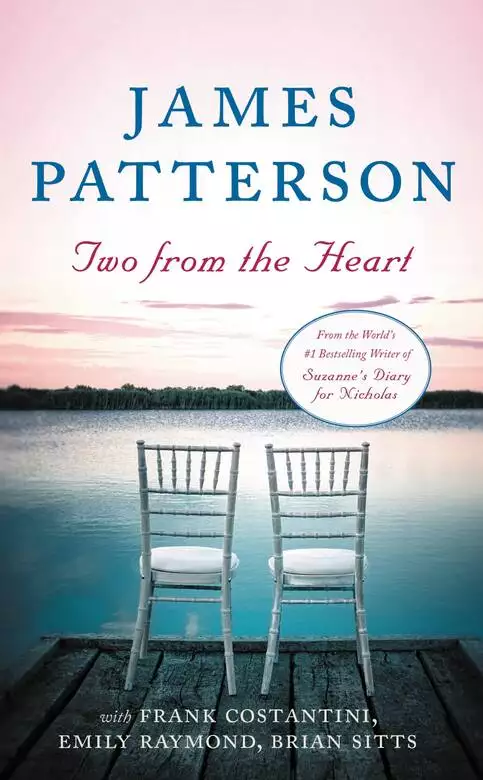
Two heartwarming tales about the power of a good story to open our eyes to life’s possibilities.
Anne McWilliams has lost everything. After her marriage falls apart and a hurricane destroys her home, she realizes that her life has fallen out of focus. So she takes to the road to ask long-lost friends and strangers a simple question, “What’s your best story?” Can the funny, tragic, inspirational tales she hears on her journey help Anne see what she’s been missing?
Tyler Bron seemingly has it all: a successful company and more money than he knows how to spend. But he has no life. So he hires a struggling novelist to write one for him. There are no limits to the fictional world that Bron’s money can transform into a reality, and he becomes the protagonist of a love story beyond his wildest imagination. But will Tyler Bron be able to write the happy ending himself?
Release date:
April 10, 2017
Publisher:
Little, Brown and Company
Print pages:
304
* BingeBooks earns revenue from qualifying purchases as an Amazon Associate as well as from other retail partners.
A STORM was coming. Even an island transplant like me could tell.
From the deck of my little cottage, thirty yards from the beach, I could see the gray Atlantic churning wildly, furiously, like something alive. The gusting wind whipped my hair into my coffee when I tried to take a sip.
My neighbor Bill was watching the ocean from his deck, too. He turned to me and yelled, “The tropical depression got upgraded to a Category 1 hurricane. Gonna make landfall tonight near Myrtle Beach.”
“Kind of exciting!” I called back.
Bill snorted. I could see what he was thinking: Fool Yankee—she’ll probably walk around with that dang camera of hers, trying to take pretty storm pictures. But I had no intention of doing that. I was going to sit on my couch with a glass of wine and a good book and wait the whole thing out.
“Well, it’s probably going to be fine,” he allowed, “but it’s not going to be fun.”
“But Myrtle Beach is over a hundred miles south of us,” I pointed out.
Bill glanced up at the sky, then back at me. “You don’t know what a hurricane’s going to do until it’s done it, Anne,” he warned. “You’d better cover your windows.”
“I’m about to.”
“You got supplies? Food, water?”
I nodded. I had bottled water, a well-stocked pantry, and a case of good pinot—I was ready for a siege. But I wasn’t afraid of the coming weather. I’d lived on this island for two years now with no storms to speak of. Everything was going to be okay.
The first drops of rain began to fall. Like an idiot, I welcomed them.
“Best get moving on them windows,” Bill said.
I hurried down below my cottage (like most houses on this North Carolina island, it was built on stilts), and, one by one, hauled up the six big pieces of plywood I needed.
An hour later, I was high on my rickety ladder, struggling with the last unwieldy piece, when the rain started really coming down. Then the wind suddenly got crazy, and it started raining sideways.
Bill came out again and shouted over the gusts. “You need help, Anne?”
“I’m okay—this is the last one,” I called.
“I hope Gimme Shellter gets blown out to sea,” he yelled.
Gimme Shellter belonged to my other neighbor, Topher, a software executive from Oklahoma City who’d just planted enormous, spot-lit palm trees all around his brand-new McMansion so it looked like a mini Las Vegas casino. The only good thing to say about Topher was that he was rarely home.
“Worse things could happen,” I called back.
The rain stung my face as I wrestled the last window covering into place, banging the wood into tension clips mounted to the window frame. Then I stumbled inside, exhausted and soaking wet.
Maybe I’d been wrong, thinking this was going to be exciting.
Through the tiny glass pane in the front door I could see green sheet lightning flashing over the Atlantic. The clouds had gotten lower, like they were trying to press down against the earth and squash it. The big fronds of Topher’s date palms were being ripped off and sent pinwheeling through the air.
Half an hour later, the water was white with foam and surging up the beach toward my house. Would it crest the small dune, the only thing between me and the open ocean?
The rain was torrential now, and debris flew high into the sky. A trash can someone had forgotten to tie down shot down the beach like a bullet.
It looked as if the wind were trying to tear the world to pieces.
I turned on the TV, but before I’d even found the right station, the power went out.
Like Bill said, things will be fine, they just won’t be fun, I reminded myself.
I didn’t have a battery-operated radio, so I didn’t know that the storm had changed course.
Or that it had gotten bigger and was headed right toward me.
Outside, the wind roared like a freight train. I crawled under the kitchen table, which was shaking right along with the house. How dumb I’d been: I’d thought I’d be drinking a glass of wine on my couch, and here I was, cowering on the rattling floor.
After what felt like forever I got up, my knees weak with fear. Wanting better shelter, I threw every pillow I owned into my bathtub and grabbed my laptop and phone. Something—a tree limb, another trash can, I don’t know—crashed into the side of my house. There was another bang as something smaller hit my deck.
I was too scared to look at the ocean again.
I was just about to climb into the bathtub and cover myself with the pillows when the sound of the wind grew quieter.
The rain stopped abruptly.
I stood up again. I crept toward the front door. I paused, and then I opened it.
Looking up at the sky, I could see huge walls of clouds on every side, brilliant white in the sunlight. The air was warm and wet. Only the ocean still surged, just a few feet from the dune.
For a minute, I thought it was over. That I was safe.
But as everyone knows, hurricanes have eyes. And the wind comes back—maybe even stronger.
And pretty soon, it came, flinging needles of sand into my face before I ran back inside.
If I said that hurricane had the same name as the woman my husband left me for—Claire—you might not believe me. But it’s true.
And if I thought that in losing him, I had lost enough—well, that wouldn’t turn out to be true at all.
An hour later, I watched Bill’s shed fly away like the farmhouse in The Wizard of Oz. Through the tiny window in my front door I watched as waves as big as my house crashed ashore only yards away.
My house creaked and shook, trying to stand its ground against the wind. The rain was relentless. Horizontal.
I ran back to my bathroom and shut the door. I crawled into the bathtub and pulled the pillows over me. The wind was screaming banshees. I swear I saw the walls moving, pushing in and out as if they were breathing.
Then something huge smashed into my house, and the whole world seemed to shake. The shrieking wind was even louder now. And was that the sound of rain falling right outside the bathroom door? Falling inside my house?
The door rattled but held. I burrowed down under pillows and prayed to anyone who would listen, Don’t let me die. Don’t let me die.
Water—waves or rain—slid under the bathroom door. The wind sounded like a thousand people screaming.
I screamed, too.
I THOUGHT I’d be swept out to sea in the middle of the night. But I woke on dry land, curled up in my bathtub.
The walls around me still stood, and for a moment I was sure that I’d escaped the storm unscathed. But when I crawled from the tub and stepped into the hallway, I saw the extent of the destruction. My house wasn’t a house anymore—it looked like a pile of debris with a bathroom.
Topher’s biggest palm tree, the one that had cost him $15,000, had fallen onto the back half of my cottage and demolished it.
I sank down to my knees. I would have thrown up, but there was nothing in my stomach.
It wasn’t just losing the house, the sweet little cottage I’d just painted a cheerful yellow. It was my darkroom, now crushed under that ridiculous tree. My passion—and my livelihood.
I was probably the only photographer in the southeastern United States who didn’t use a digital camera. I processed the negatives and printed the photos myself—steps that were as much a part of the art as taking the original picture.
Needless to say, I’d uploaded exactly nothing to the cloud.
Which meant I had exactly nothing left of my portfolio.
I was too gutted to cry.
“Annie, Annie, are you okay?” Bill called. He stood below the ruined edge of my house with a ladder. “Come down this way,” he urged.
Numb, my body vibrating with shock, I climbed down and looked around me. There was a creek running down the street behind my house, and in it bobbed tree branches, a baby stroller, and a laundry basket. At first I thought my car was gone, too, but then I spotted it twenty-five yards north of where I’d parked her, partially submerged in a giant puddle.
Topher’s garage roof was gone. Most of Bill’s siding had been ripped off, and his deck, like mine, had been swept away.
But it looked like I’d been hit hardest.
“You said everything would be fine,” I cried.
Bill’s normally stern face seemed to crumple. “I said probably,” he reminded me. “Anne, I’m so sorry.”
For the first time in over a year, I ached for my ex-husband. I’d ignore Patrick Quinn’s wandering eye forever if he’d only come back and help me deal with this mess. And if sometimes, at night, he’d still hold me close.
Bill reached out and roughly patted me on the shoulder. I felt like someone had scooped out my insides, and I had to turn away. I couldn’t even bear to look at what else was lost.
And so, wearing ratty sweats and a pair of waders, I headed north toward town.
The beach was covered in trash and the air smelled rank, but the birds were back, pecking around in the wreckage.
The sun came out as I walked, and then, as if by magic, the air filled with butterflies.
My mother would have told me there was a message in this—something about beauty after a storm—but she’d been dead almost twenty years now. And I wouldn’t have believed her anyway.
BARNACLE BILL’S Diner looked like it had been hit hard, too, but then again it had looked that way before the hurricane. That was one of the reasons only locals went there. Despite its faded, decrepit exterior, inside it was bright and clean, and almost everyone I knew was tucked into the red vinyl booths, sharing stories about the storm.
When I staggered in, though, the room went quiet. It was clear to everyone that my night had not gone well.
Lorelei and Sam, my best island friends, rushed over. “Are you okay? Was it bad? Tell us what happened,” they cried.
I collapsed into a booth.
“Sustenance on its way, stat,” Lorelei said. She was a nurse, a marvel of efficiency.
Phil, son of the original Barnacle Bill, brought me three powdered-sugar donuts and a chocolate cruller. I stuffed half of the latter into my mouth at once. If now wasn’t a time to stress-eat, I didn’t know what was.
“Power’s still off, so Mary made coffee on the grill out back,” Phil said, handing me a napkin.
I looked up at them gratefully as Mary poured me a cup.
“All you need’s a big lobster pot, bottled water, and about two pounds of beans,” she explained.
I took a single sip. Then I burst into tears.
Sam slid over to my side of the bench and put her arm around me. “The roof of my store got peeled back,” she said. “It looks like the lid of a dang tuna can. What happened to you, baby?”
I waved my hands in the air helplessly. I couldn’t speak.
“Phil, make this woman a Bloody Mary,” Lorelei called.
“Make that three,” Sam added.
“You know I don’t have a liquor license, Lo,” Phil said.
Lorelei lifted one carefully penciled eyebrow at him. “I also know you have vodka stashed underneath the counter, so why don’t you be a pal and bring it out.”
Phil grinned and pulled out the bottle. No one could say no to Lorelei—not even a former heavyweight boxer who still weighed upwards of 220 pounds.
“Is the Piping Plover going to be okay?” I managed to ask Sam.
“The roof’s fine on the west side,” she said. “I can run the shop out of half the space if I need to. But we’re at the end of tourist season anyway. How many LIFE’S A BEACH shirts am I going to sell?”
Lorelei said, “We got a little flooded, but everything’s fine. What happened to you, Anne?”
I waited until our Bloody Marys were delivered and I took a sip. Maybe it was the state of shock I was in, but I felt lightheaded almost immediately. “I basically have half of a house left,” I said.
“Which half?” Lorelei asked immediately.
“The darkroom’s gone.”
They both gasped. “Oh, Annie,” Sam said.
I tried to shrug. Tried to sound… undevastated. Was that even a word? I told them what had happened, and then I attempted a brave smile. “I never cooked much, so the kitchen can go.”
“That’s the glass half full,” Sam said.
“And… maybe I need to take a break from wedding and pet photography.”
“But you do more than that,” Lorelei protested. “You were going to have that show—”
I interrupted her. “Just because the gallerist said he liked my photos doesn’t mean he was going to give me a solo show. Anyway, brides and dogs paid the mortgage. Not my art photography.” I put my face in my hands.
“We’ll help you get back on your feet,” Lorelei said gently. “Everything’s going to be okay. Seriously. Someday this’ll be just another story you’ll tell.”
“Everybody has a storm story,” Sam added. “Do you have any idea how many times my dad told about the time he went fishing during Tropical Storm Charlie, got swept off his boat, and spent twenty-nine hours in the ocean, clinging to a cooler? When the Coast Guard finally rescued him, the first thing he did was open that cooler, crack a Budweiser, and ask those heroes if they had any chips.”
“He dined out on that story for years,” Lorelei said, rolling her eyes.
I laughed, despite myself. “I guess some people just know what they want,” I said.. . .
We hope you are enjoying the book so far. To continue reading...

 Please log in to recommend or discuss...
