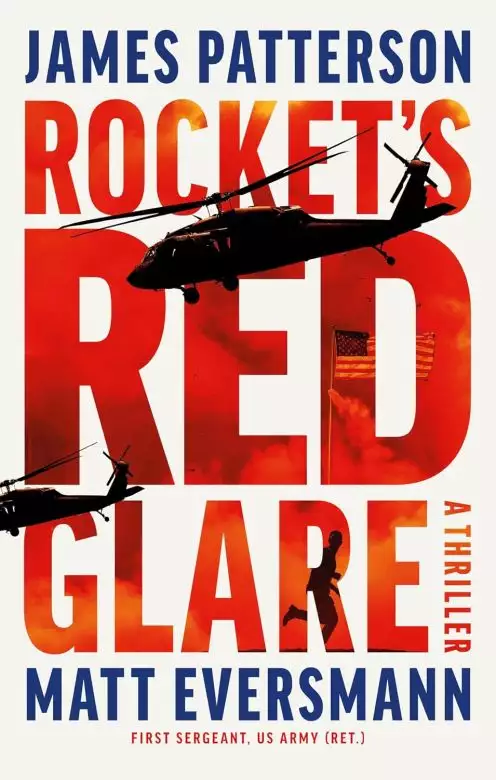
A team of ex-Special Forces-turned-domestic ops is code named “Rocket's Red Glare.”
Nat Phillips leads an elite roster of military mercenaries. They are ex-Special Forces, combat divers, medics, communications specialists, and intelligence officers. They are decorated veterans of the U.S. military and experts in international warfare. Now U.S.-based, these operators are in training and on stand-by—until a presidential campaign is interrupted by murder. Suddenly, the plan is no longer the stuff of Mission: Impossible. Emergency operations happening not overseas but on the island of Nantucket. This national crisis is real.
Release date:
May 25, 2026
Publisher:
Little, Brown and Company
Print pages:
400
* BingeBooks earns revenue from qualifying purchases as an Amazon Associate as well as from other retail partners.
My latest deployment in Iraq had ended in a blazing firefight.
Team Rhino and I had fought our way out of an ambush south of Baghdad, and Al-Qaeda had put a bounty on my head for greasing one of their suicide bombers.
Now I was standing in the middle of a holding cell on the tiny island of Nantucket in Massachusetts.
I’d made it back to the island via the last ferry, parked my car and grabbed my gear. It’s good to be home, I’d thought as I walked to my house.
Actually, I hadn’t exactly walked to my house—it was more like I sneaked in. And to be clear, the gear I’d grabbed was a Sig Sauer pistol, a Colt .45, an AR-15, and an HK MP5 submachine gun with all the fixings.
I get why that might’ve seemed suspicious.
Moments later, I was laid out on my kitchen floor, forcibly arrested by the seven legitimately deputized agents of the federal government who’d been waiting inside.
My overseas heroics didn’t seem to matter much to the guys who’d thrown me in jail last night. I’ve been shot at on many occasions and made it out without a scratch. But this was my first time in jail. Not exactly Rikers or Sing Sing, I know—not much violent crime on this island since Nantucket’s days as the whaling capital of the world—but a pain in the ass all the same.
So here I was, my pesky ego starting to hurt as much as the ass kicking I’d gotten from the feds earlier. I could see the local boys in blue and the other agents glancing over their shoulders at me in the cage. Fuck them. I just stared back. I didn’t hide my contempt.
I shook my head, gathered my thoughts, and took stock of my surroundings, though I sure as shit wasn’t planning on staying here long.
I had a cellmate. He was about eighteen—twenty, max—and not going to pose much of a threat. As soon as we made eye contact, he shifted nervously and looked at the floor. It must have been his first time in jail, too.
“Nice watch,” I said.
“Uh, thanks,” he replied, nervously trying to pull the sleeve of his sweater down over the glistening silver band. He was a tall, good-looking kid with a lanky runner’s body that stretched to just over six feet. The few days of summer growth on his face didn’t amount to much. He was dressed like a typical summer resident; shorts, sandals, an old fishing sweater—and a $6,000 Rolex, the Submariner with the green bezel.
I had an old stainless Submariner, which had cost me a little over three grand about fifteen years ago. No way this kid had spent a dime of hard-earned cash on his watch. Doubtful he’d ever worked hard enough even to get a blister.
“Is that the fiftieth-anniversary model?” I asked.
He seemed resistant to my line of questioning about the Rolex, so I figured I’d go in a different direction to boost his ego just a tad.
“So, what are you in for?”
“I wrecked a car,” he said curtly. Then, echoing my emphasis: “What did you do?”
Touché, asshole.
“Well, I got into a fight with a state trooper. Or maybe a local cop—not quite sure. Apparently, because of those love taps, I got flagged as a threat to someone important—a senator, I think. Some asshole who’s staying in the house next to mine. What are the odds?” I shrugged my shoulders and raised an eyebrow.
“Senator Harrison?” The kid was pretty astute.
“Yeah, that sounds right. You know him?”
“He and his wife have a house up here,” he said sullenly.
Switching gears, I asked, “The wreck—anyone get hurt?”
“No,” he sighed. “And I didn’t really wreck it, either.” He placed his head between his hands, rubbed his temples, and breathed deeply, as if deliberating how much he wanted to share with me.
“Well, what’s the issue, then?”
He lifted his head from his hands and stammered, “Okay—Jesus—alright, I took my mom’s car out for a ride with some friends.”
“Then what happened?”
“We went to Madaket to see some girls. We had a few beers and then drove out on the beach. I got it stuck in the sand, and the tide came in. It’s ruined.”
The scene was getting more dramatic by the second.
“I hate it when that happens. What kind of car?”
He scowled and shook his head mournfully. “It was a fucking Porsche, okay? A Cayenne.” He hung his head back down in shame.
I took a moment to consider the disconnect. This kid with the $6,000 watch had just ruined his mom’s $100,000 car, while I’d gotten my ass kicked by a bunch of cops just for walking into my own house. Classic Nantucket.
I straightened up a little and tried to sound serious. In my best older-brother voice, I said, “Well, listen, man, seriously, no one’s dead. Trust me, that’s always a good start. And second, no one is shooting at you. A car is a car; your mom will have to get another one, right? Sure, I bet she’s pissed right now, but deep down she’s pretty psyched that you’re still alive, I swear. Where do you live, anyway?”
“Summer or winter?”
It was the ultimate gentrified Fuck you. But this pretentious little asshole clearly had a wiseass streak, meaning the kid had potential. I decided to play along.
“I’ll take WHERE YOU WINTER for $200, Alex.”
“Palm Beach, Florida. We come up here in the summer. Our place is over on Cliff Road.”
Of course it was. Cliff Road is probably the most expensive real estate on the island. People who live there don’t worry about sunken Porsches. It’s budget dust. They’ll laugh about it at the yacht club or at the next commodore’s ball or cotillion or whatever these people do for fun.
“Phillips?” said the desk sergeant at the cell door.
“Nathan R., that’s me,” I said, standing up.
Time for me to make my phone call. I gave my new buddy a knowing nod, stood, and walked toward the door.
The group of officers and curious onlookers had grown to half a dozen, including a pair dressed in business suits. Federal types, I assumed. I was about a foot taller than any of them and in far better shape than the entire group. While everyone watched me for signs of dementia or some other category of lunacy, I politely held out my wrists for the officer to cuff.
“Thank you, sir. May I have another?” I said to no one as I stepped to the telephone.
“One call,” the desk sergeant said curtly.
I smiled my kindest smile and picked up the receiver. I dialed a phone number I knew by heart, a number known to only a handful of people in the world. If ever there was a man who could fix anything, Tristan Dent was that guy. He had always taken care of me.
The phone on the other end rang, as it always did, exactly three times.
“Nat, my man,” the familiar voice bellowed down the line. “How’s it feel to be the most wanted man in America?”
“Brother, I need a little favor.”
Harrison Campaign War Room
Baxter Road, Nantucket
Senator Coleman R. Harrison of Pennsylvania took a sip of whiskey and tried to concentrate on the heat sliding down his throat. Usually by his third drink he felt warm and loose, but not today. Today he felt nothing but fear and regret.
He should have felt on top of the world. He had a beautiful wife, a house in Bryn Mawr, and a summer place in Nantucket. He had access to a private plane and could walk into any Michelin-rated restaurant without a reservation. Hell, he’d been welcomed to palaces from Paris to Tokyo and had played polo with William, Harry, and even Charles himself.
And as a rising political star, he was closing in on the coup de grâce, the political Stanley Cup, the absolute cherry on top: winning the next primary on the way to accepting his party’s nomination for President of the United States.
Senator Harrison’s numbers were as solid as a front-runner’s could get. He was an easy twelve points ahead of Theresa Larson, Governor of Colorado, and favored for the party nomination this August. And the pundits were already projecting a landslide victory over Harrison’s presumed opponent, a former professional wrestler.
He was in political nirvana—and personal purgatory.
Harrison tried to focus on all the goodness in his life, yet try as he might, he could picture only the disappearing act. And he was the star of that one-man show.
He knew his wife, Elise Courville, had married him with dreams of becoming his first lady, politically and personally. Their home life was civil enough, but it had been loveless almost from Day One. Harrison’s fidelity had lasted a year into their five-year marriage. They now slept in separate bedrooms, leaving him to rationalize that she had basically forced him into having affairs.
Of course, when Elise had abruptly kicked him out of the Cliff Road house they’d shared until a month ago, all his theories about her began to unravel—along with the advantages she’d provided.
The money was hers. The Gulfstream was hers. The house on the Main Line was hers. And she was taking it all away. “No more restaurants, no more polo matches, no more trips to Paris, and certainly no Time magazine cover or Washington Post headlines,” she’d told him. “At least not the ones you want.”
His wife made no mention of divorce, but she’d dropped a far worse threat: “I am going to tell my father.”
Her words stung. As did the political reality that his father-in-law, Charles Courville, French ambassador to the United States, was not someone to have as an enemy.
Thankfully, Harrison could still count on his staunchest ally: his campaign director, Walter Fitzgerald. Fitzgerald called in a favor from a loyal donor and got them set up in a house on Baxter Road, on the other side of the island.
Fitzgerald also made sure to leak the fact that this location was Harrison’s new campaign war room, a necessity for planning the grand strategy that would propel them from Pennsylvania Senator to Pennsylvania Avenue. “Publicizing it,” Fitzgerald told Harrison, “will keep you from fucking this thing up even more.”
Tonight’s fundraising event at the house had gone smoothly, but Harrison had been acting on autopilot, barely holding it together beneath the surface as he glad-handed donors. The last ones hadn’t left until well past one in the morning.
The senator looked out the window of the Nantucket summer home into the darkness, where the Atlantic waves rolled onto the eroding beaches of Siasconset. Just like my luck, he thought, the waves keep crashing and crashing. Nantucket was on the western edge of a nor’easter that would leave everything from New York to Maine socked in for the rest of the night.
Coleman Harrison was close to becoming the leader of the free world, but he wasn’t in charge. What Walt Fitzgerald didn’t know was that Elise Courville was not the only woman who’d given Harrison an ultimatum.
Aimee Sullivan—Harrison’s twenty-eight-year-old redheaded press secretary/mistress, equally gifted at manipulating the media and her boss—was about to make him pay dearly for his sins. The night before last, after staffers had vacated the campaign war room, Sullivan was scheduled to prepare Harrison for the upcoming debate. But within minutes, they’d abandoned the office for the bedroom. The debate prep morphed into an unusually rough session featuring some of Sullivan’s more sinister talents.
Afterward, Sullivan proceeded to explain her priorities. Despite her relative youth and her inexperience in military matters, what she wanted was a seat at the table of the National Security Council.
Harrison didn’t know if he could resist Aimee Sullivan’s unrelenting demands. Give me what I want, Coleman, or you’ll never fuck me in the Lincoln bedroom.
Nantucket County Jail
My conversation with Tristan Dent lasted less than ninety seconds. I hung up the receiver and was ushered back to my cell.
I sat down, crossed my legs, looked at my cellmate, and tried to make nice.
“My name’s Nat Phillips.” I put my hand out for a shake.
The kid straightened up immediately and had a surprisingly firm grip. “Josiah Wilson, sir, good to meet you. Everyone calls me Si.”
He looked me in the eye. “Man, I really fucked myself this time. This is way worse than when I got bounced out of school.” He muttered woefully, “My father wanted to teach me a lesson, so he called the cops. What do you think they’ll do to me?”
“Who, these dudes?” I pointed with my thumb at the local cops outside the cell. “Take a look at that fat bastard, Si. Are you kidding me?”
“They told me my father’s not coming for hours; he’s so pissed at me.” Si looked seriously distressed about being here in jail.
“It’ll be alright,” I told him. “Clearly your dad is not planning on having you face charges. I’d put money on him just wanting to make you sweat over your expensive joy ride for a little while longer.”
I folded my hands around my crossed knee. “Look, it could be worse. Last week Al-Qaeda tried to teach me a lesson. After I killed one of their suicide bombers, they put a bounty on my head. I mean, seriously? The guy was on his way to die anyway, right?”
It was true. But the bounty was a risk the State Department wasn’t going to take, especially after the ambush. That’s what got me and my team sent home from Iraq less than two days ago.
Si and I had a few hours to kill before Tristan could get me out of here, so I told the kid why I’d been in Iraq, and sketched my work with Chesapeake Security and Training Company—CSTC for short.
Si was all ears, hanging on my description of life with an outfit I liked to call “Disney for gunslingers,” where we routinely trained Delta and SEAL teams. I had the kid on the hook. How often does anyone get to spend the night in jail with a special operator?
I ran down CSTC’s three operating groups: “Land, Sea, and Air. Each group consists of three teams, a who’s who of special operators and security specialists. I lead Team Rhino in the Land Group. We also have Bear and Bull. Mako, Tiger, and Hammerhead are our Sea Teams, and Eagle, Hawk, and Falcon are Air.”
I said, “If you’ve got to do a dangerous mission, at least do it with good people, a smile on your face, and try to have fun. That’s what we do.”
I continued the play-by-play, talking about the events in Iraq. “Anyway, if you ever meet my teammate Meg Fuller, don’t believe a single word she says, ’cause I shot the guy first. Of course, after the lead injection, his thumb released the detonator and he went kerflooey and blew himself to smithereens. Hey, happy martyrdom to him. All I did was help the guy on his merry way without taking any of us with him, the fucker. The nerve of them getting all worked up over a dead suicide bomber. You see the irony, Si?”
He couldn’t help smiling at my little routine, but seemed suitably impressed. Si showed some humility as he detailed his own situation. He was twenty years old, an only child, “in-between” colleges, hoping to begin a new slate at Dartmouth in the January term as a government major with a minor in computer science. Until then, he was dividing his time between Nantucket and Palm Beach, living at home with his parents, Alan and Constance Wilson.
Tough life.
Alan Wilson was chairman of the Wilson Group, one of the most successful hedge funds, rivaled only by BlackRock Capital. Old Al was a big hitter and definitely wasn’t going to end up at the soup kitchen over his wife Connie’s Porsche currently being parked in Davy Jones’s locker.
Si and I bullshitted for a while and I had to admit, I really liked the younger Wilson. He seemed like a good kid. I suspected he just needed a bit more purpose and direction—and probably an ass kicking too, for good measure. Everybody needs one from time to time. I couldn’t fault the old man for trying to get his only child energized by something other than girls and beer. Successful dynasties aren’t normally run by delinquents.
I had some money saved from my last trip to Iraq and desperately needed some work done around my place—starting with repairing the doors the feds had just kicked off their hinges—and the kid obviously needed something useful to do with his time, so I suggested I talk to his dad about having Si come help me out. It seemed like a good fit for both of us.
At 6:00 a.m., I had just finished laying out the plans when the front door of the county jail opened to a man on a mission. The gray-haired sixty-something, dressed in a dark suit and carrying a briefcase in one hand and an umbrella in the other, walked directly to the duty officer’s desk. He put his leather briefcase down, adjusted his tortoiseshell glasses, and went to work.
This must be Tristan’s guy.
I couldn’t hear the exchange, but the finger-pointing between the suit and the duty officer was heated. Then the officer picked up the phone and started dialing.
The duty officer practically stood at attention as he listened to whoever was on the other end, then motioned to another cop to unlock the door to our cell.
I told Si to call me later, and walked out to meet my liberator.
Samuel Starnes,” the man in the suit said to me, holding out his card without taking his eyes off the duty officer.
The flustered sergeant finally hung up and flashed an apologetic smile at me.
“Mr. Phillips, I apologize for the inconvenience and the unfortunate events of last evening.”
The officer paused as he searched his memory for the words he had just been told over the phone:
“The attorney general thanks you for your service to the country,” he recited. “You are free to go, sir.”
Holy shit—the attorney general? Say what you want about Tristan Dent, but don’t ever say he isn’t resourceful.
Without speaking another word, Starnes waved at me to follow him. We exited the building. A shiny black Mercedes sedan was parked in front, its engine running. There had been a storm earlier, but now the rain had just about stopped.
“I’m sorry I can’t escort you home this morning, Mr. Phillips,” Starnes said. “A Coast Guard chopper is waiting to take me back to Boston before the storm picks back up. Call me direct if anyone gets pissy with you.”
He opened the sedan’s back door, jumped in, and sped away.
I fished his card from my pocket and learned that the Honorable Samuel Starnes was a retired federal judge with senior status who, according to his card, worked on Special Projects. I had to laugh. Starnes would be a good friend to have on speed dial if Chesapeake Security and Training Company and Team Rhino were going to rise to their next great challenge: Rocket’s Red Glare.
Sometimes I had to remind Tristan that the whole concept of CSTC had been my idea. What started out as me sharing war stories from Iraq had turned into a place for former military to shoot our guns and play with Army toys.
I remember that day vividly. Sipping bourbon and smoking cigars, Tristan and I—fast friends since our days together at Fort Benning—had been watching sailboats tack their way across the Choptank River. Since 9/11, the military’s elite units had been searching desperately for offsite training areas, and I asked him about his farm. Tristan and his wife, Alison, owned 2,500 acres on the Eastern Shore of Maryland, perfectly wedged between two environmental preserves and the Chesapeake Bay.
We envisioned using all that land to make some dough from Uncle Sam.
Not that Tristan needed the money. Tristan Dent was not only the first millionaire I ever met—a few years later he became the first billionaire too.
His father, Henry Dent, had come home from Europe after fighting in the Hurtgen Forest and threw himself into work, by day selling real estate to returning veterans and by night tinkering in his garage building collapsible stretchers. Over the following decades, Henry had expanded his empire from affordable veteran housing to commercial real estate, and he now held a lucrative patent on a product highly sought after by the Department of Defense.
By the time Tristan entered the world, the Dent family fortune was worth a healthy $50 million. Thirty years later, it was worth a little over half a billion. Shortly after that, Tristan’s then-girlfriend urged him to consider investing in an online bookstore, and that Christmas Tristan pulled the trigger twice—first buying a sizable chunk of Amazon.com, then buying Alison West a five-carat diamond ring at Tiffany.
Well before that, however, Tristan’s father had mandated that his only child serve at least one enlistment in the Army before taking the reins of the Dent family business. Otherwise, control would go to a distant cousin.
Tristan didn’t see the condition as an obstacle. He embraced it as a great adventure. Not only did he challenge himself to try out for the hardest unit at Fort Benning, Georgia (home of the Infantry), but he made the cut—and thrived. Had it not been for a broken back after a parachute malfunction, Tristan could have ended up a career Army Ranger.
That’s where we. . .
We hope you are enjoying the book so far. To continue reading...

 Please log in to recommend or discuss...
