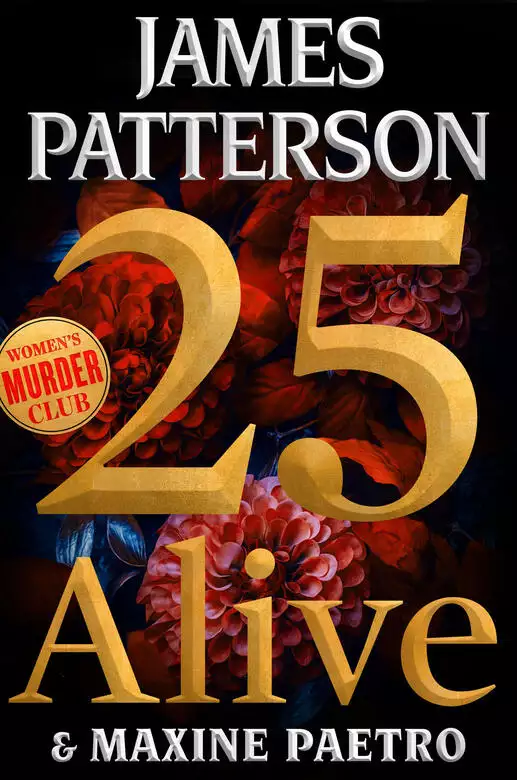
Sergeant Lindsay Boxer’s friend and former partner is brutally murdered in San Francisco’s Golden Gate Park.
SFPD homicide detective Lindsay Boxer knows her way around a crime scene.
But nothing can prepare her for the shock of recognition: the is victim Warren Jacobi, Lindsay’s onetime partner who rose to chief of police.
A top investigator until the end, Jacobi managed to leave Lindsay a clue.
Following a trail of evidence along the west coast, the Women’s Murder Club pledges to avenge Jacobi’s death before the killer can take another one of their own.
Release date:
April 28, 2025
Publisher:
Little, Brown and Company
Print pages:
400
* BingeBooks earns revenue from qualifying purchases as an Amazon Associate as well as from other retail partners.
JUST AFTER SIX that morning, Warren Jacobi, a sixty-year-old retired homicide lieutenant and former chief of police, parked his Ford F-150 within walking distance of one of the eastern entrances to Golden Gate Park.
Jacobi was edgy in the best possible way, amped up, excited, feelings he hadn’t had in years. Today was the day. After weeks of planning and tracking, within the next hour, he would bring down a killer.
He was a big man, 240 pounds, but he’d stayed in shape. This morning, he wore his bird-watching gear, camouflage pants, and a matching sweater under his tac vest. Binoculars hung from a strap around his neck, and his weapon was wedged against the small of his back by the waistband of his pants.
Jacobi entered the park, keeping to the tree shadows, looking for a merciless killer who delighted in outfoxing the police. Jacobi had to do this alone, and he could—but he was still haunted by the bureaucratic bull crap that had forced him into early retirement. He hadn’t been able to shake the humiliation. Bottom line, he would not, could not, close out his life’s work by leaving this psychotic predator at large.
Jacobi quickly slipped into a narrow pocket of rampant vegetation, a cleft in the living walls of dense vines and saplings. Inside this natural bivouac, he was virtually invisible but had partial views of the path looping around the Lily Pond below and back up to the street.
Years ago, he’d been walking the park when he saw a man acting suspiciously near the Lily Pond. When a teenage girl’s dead body was pulled from the pond later that day, Jacobi knew what he’d witnessed—and what he’d failed to do earlier. He’d been too far away, and it had happened too quickly, for him to even make an ID.
Parting branches and peering around a clump of trees now, Jacobi saw a great blue heron swoop down between the treetops and veer toward the pond. Through the zoom lens in his phone, Jacobi followed the large heron’s flight path, then took pictures of the bird with its dark crown and long gray plumes on its breast. Below the heron, at the edge of the pond, Jacobi spotted his subject wearing a dark windbreaker, jeans, and a dark-colored baseball cap. The killer took a gun from his pocket and threw a shot at the bird. The bird veered away at the sound, and the shooter tossed the gun into the water. There was a splash, and then he turned on the path and slowly began to retrace his steps uphill.
Jacobi waited impatiently. He didn’t have the authority to perform an arrest, but the former detective had zip ties in his vest pocket. Jacobi planned to surprise the guy as he walked past his hidey-hole and bodycheck him to the ground. Then, once he’d immobilized the SOB, he’d call Chief of Police Charles Clapper to let him know that he had a wanted killer secured and ready for roasting.
THE WINDOW BLINDS were half open, slashing the morning light to ribbons and flinging them into my face. Am I late for work? My phone was on the nightstand, and I picked it up to read the time. No. I had just over an hour to eat, dress, play.
I turned to hug my husband, but he wasn’t there. Lying beside me in the bed was Julie, our five-year-old little girl, clutching her plush stuffed cow she’d named Mrs. Mooey Milkington.
“Hey,” I said, hugging her, “you’re not Joe.”
“Nope,” she said, laughing at me.
“Is he making breakfast?”
“No, Mommy. He had to go out.”
“Out where?” I asked her.
“He took the car,” she said.
Yes, I love her with all my heart, but this complicated daughter of ours is smart as well as so damned cute, she gets away with maddening behavior—all the time.
“Julie, this is what we cops call ‘pulling teeth.’ Just tell me where Dad went and why. Please.”
“Huh? What does ‘pulling teeth’ mean?”
“‘Pulling teeth’ means someone is saying as little as possible about what they know, so the other person must really work hard to get their little girl to tell.”
“Ohhhhh,” she said. “So, you want me to say that Daddy took Martha to the vet and he’ll bring breakfast home after?”
Talk of my elderly border collie, Martha, and her veterinarian in the same sentence turned my heart into a fist. I’ve known Martha longer than I’ve known Joe. I’d adopted her from a dog rescue, and it had been love at first sight for both of us. Lately, I’d been consciously ignoring signs of her aging, of her mortality.
I was scared, but I had to ask.
“Why did Daddy take her to the vet, Julie?”
“I’m not pulling your teeth, Mommy. Daddy didn’t say why. He just picked Martha up and said he was taking her down to the car.”
“Okay. That sounds… I’m sorry.”
“Sorry for what?” Julie asked me.
“For—grrrrr—snapping at you. Okay, we’ve got to get dressed and eat something, then I’m taking you to the school bus.”
“I don’t know what to wear,” Julie said, bouncing out of bed and running for her room.
I KNEW WHAT to wear. Pushing worry for Martha into the back of my mind, I stripped the dry cleaner’s bag from one of my half dozen pairs of blue trousers. I did the same with a blue striped men’s tailored shirt, and once dressed, stepped into my regulation brown lace-up shoes.
I called Joe’s phone. No answer. Fear was back, morphing into panic. I pressed Redial again. I got his regular upbeat outgoing voicemail message.
I was in the bedroom brushing tangles out of my hair when I heard the front door open and Julie call out, “Daddddddddyyyyy!”
Joe was home, thank God. But Martha wasn’t with him. I came into the kitchen and saw he was scowling as he set a bag of pastries down on the kitchen counter.
“Hon? What’s wrong with Martha?” I asked.
He said, “Don’t know. She just seemed… lethargic. Doc’s going to run some tests on her.”
I sucked in a breath and Joe came over to give me a big hug. “Tests are good. Martha is having a CAT scan… I’ll call Dr. Clayton later.”
Julie reached her arms around her father’s waist and said, “Dogs get CAT scans?”
Joe was beginning to explain when my phone buzzed.
The text from Claire was brief and urgent.
Call me.
I tapped my phone right away and Claire picked up mid-ring.
“Linds. There’s been a murder. You should come before we move… the body.” She yelled away from the phone, “Hey. Step back.” Claire Washburn, San Francisco medical examiner and my BFF, sounded rattled. She came back on the line and told me she was on the path by the Lily Pond in Golden Gate Park, and that I should hurry. What the hell?
“On my way,” I told her. Now that Joe was back home, he could handle getting Julie off to school.
I took my Glock from our gun safe, shrugged on my shoulder holster, and slid the weapon into place. As I was hanging the chain with my badge over my head, Joe called out that he’d brought crullers and had put the coffee on. I called back that I was needed at work.
“Please call me as soon as you know something about our good dog,” I said as I hurried into the kitchen to say good-bye before leaving.
“The tech won’t be in until this afternoon,” Joe pointed out.
I nodded. I kissed my husband, then stooped to kiss our little girl on each cheek, checking for tears shed over Martha. None yet. I squeezed Julie’s shoulders, and she hugged me hard around my neck. I murmured that Martha would be home soon, then stood up and kissed Joe again. I felt two pairs of eyes on me as I made for the door.
I fled down the stairs to the street.
I PHONED MY boss, Jackson Brady, from the car to let him know that Claire had called me to a murder scene at Golden Gate Park. “She wants me to see the body in situ in the park, ASAP.”
Brady said, “Check in with me when you get there. I don’t know squat about this homicide.”
I copied that and strapped in. I took a quick detour on my way to the park, stopping at the car pool in front of the Hall of Justice just long enough to exchange my blue Explorer for a squad car. I translated Claire’s urgency as Code 3, meaning all lights, sirens, and maximum speed.
The street that accessed the park’s Lily Pond was blocked by three squad cars, and both the Forensics unit and the coroner’s van. I pulled up to the curb, disembarked, and followed a spur of pavement to a parking area that was cordoned off with yellow barrier tape—a warning to joggers and curiosity seekers to stay the hell out.
I badged a uniform named Maggie Cannon. She held up the tape and gave me a warning look, like I was headed toward a five-car pileup. I didn’t question her, just ducked under the tape and kept going. I found Claire standing with four uniformed officers inside a smaller taped-off perimeter within the larger one. Even from a dozen paces, I could see that the victim was lying face down in a pool of blood.
“Who’s in charge?” I asked.
“I just spoke to Brady,” said Claire. “You’re it.”
I knew two of the uniforms protecting the scene: sergeants Nardone and Einhorn. I texted Brady to give him an update and gloved up.
Einhorn handed me a pair of booties, and Nardone said, “Lean on me,” which I did as I slipped the booties over my shoes.
I entered the smaller perimeter and looked at Claire. She shook her head and said of the victim, “I just can’t believe this. It’s… it’s so bad…” Her voice cracked.
I didn’t understand what she’d said. “Are you okay, Claire?”
She didn’t answer me, just looked down at the dead man, whose face was turned away from me. I could see that he had bled profusely from wounds in his lower back, and from a ragged tear halfway around his neck and face. The only other things I could really determine from where I stood was that he was a gray-haired white man dressed in camouflage pants, a matching sweater, a tactical vest, and rubber-soled shoes. A CSI flag was next to a pair of binoculars lying just outside the tape, half hidden in the shrubbery. Was this guy a bird-watcher?
Claire’s primary investigator, Sage Dugan, had stooped beside the body and was taking photos. Since Claire seemed unresponsive, I asked Dugan, “Did he have a camera?”
“If he had one, it’s gone,” she said. “Just a cell phone. And the binoculars are not the photographic kind.”
“Any sign of the murder weapon?”
The CSI held out a plastic evidence bag with a knife inside. It was a KA-BAR and it was made for killing. The blade was sturdy, good for jabbing and slashing. The handle was equal in length to the blade, rounded for a firm grip and designed for bludgeoning.
I remembered that there’d been some holdups in this neighborhood. A masked robber, or a pair of them, had stolen expensive camera gear—thousand-dollar cameras with German lenses—but nothing more violent had been reported than shouts of “Don’t make me hurt you! Hand over the camera!”
“We’ve got his wallet?” I asked.
Claire spoke up. “No wallet. Had some loose cash and credit cards, and an ID in his vest pocket. He’s carrying, too, but the gun is still in his waistband.” She paused, then said, “Linds. This is going to hurt.”
I don’t know the victim—do I? Something was trying to break through the smoke screen obscuring much of my working memory.
Claire called my name, and I turned to her.
“What is it, Claire? Who is the victim?”
She sputtered, then said, “It’s Warren Jacobi. He was… killed.”
CLAIRE CLEARED HER throat, then ran the facts.
“Time of death, approximately two, two and a half hours ago, so, say 6 something a.m. The killer surprised him from behind and knew how to use a blade.”
Einhorn said, “Plus a matchbook we found in the ferns over there.”
“Let me see.”
CSI Dugan opened her kit and held up a small, clear plastic evidence bag containing a matchbook with JULIO’S printed on the cover. I recognized the design. It matched the look of the sign belonging to a dark hole of a bar on Valencia Street at the edge of the Mission District. I’d driven past it but never been inside.
“Don’t know if it belonged to the victim or it’s been there for days. But either way, it’s interesting,” Dugan said. “Look at the writing inside.”
I managed to open the matchbook without removing it from the evidence bag and saw that someone had used a ballpoint pen to inscribe a message in block lettering on the inside cover. I could just make out the words: I SAID. YOU DEAD.
What? What the hell does that mean?
I handed the bagged matchbook back to Dugan and addressed the people around me. “‘I said. You dead.’ We’re assuming this was left here by the killer. Is the killer bragging? Fulfilling a prophecy? Has anyone heard this statement before?”
There were no ideas at that moment, but we were just getting started.
I edged out of the scene to let the CSIs and the Forensics unit do their work as ME’s team raised the tape, hefted Jacobi’s body onto a gurney, and rolled it toward the van.
I walked like a zombie to my squad car. I turned it on, released the brake, backed up, then headed east on Nancy Pelosi Drive and toward the Hall of Justice.
At a stoplight, my mind was flooded with fresh images of Jacobi’s lifeless, bloodied body, the horrible sight of his head half sawn off by a strong hand with a killing knife. Tears spilled and I didn’t try to stop them. Warren Jacobi had been a great cop as well as my mentor, partner, and friend to the end.
That made his murder personal.
CINDY THOMAS WAS at her desk at 8 a.m.
The petite, curly-haired blonde wearing a rhinestone-studded hair band and loose-fitting clothes looked nothing like what she was—a tenacious investigative reporter, twice-published bestselling true-crime author, and leading writer on the San Francisco Chronicle’s crime beat.
Cindy’s coffee mug was beside her right hand, her police scanner crackled on the windowsill, and her laptop was open. She was completely absorbed in her reading: the editorial page of a New York tabloid called the City News Flash. The top letter to the editor took up most of the screen—and it was making her sick.
The headline above the letter read, NEWS FLASH. “I SAID. YOU DEAD.”
The text read, “NOT a joke. I just stumbled upon the blood-soaked body of corrupt former San Francisco Homicide cop Warren Jacobi inside Golden Gate Park.”
That sentence raised the hairs on the back of Cindy’s neck. What kind of crap is this? Warren Jacobi was not corrupt and he was not dead. She reread the letter, which claimed to be a first-person account of a passerby who had just come across Jacobi’s dead body, wrote it up, and sent it to the Flash. The second graf described the clothing Jacobi had been wearing as “a bird-watching outfit” and said that he’d been “knifed to death.” It went on to say that a matchbook with the message “I said. You dead” had been left nearby.
The author was “Anonymous,” and nowhere did the writer say that the crime or the victim’s name had been verified by law enforcement. But the last time Cindy spoke to Jacobi, he had told her that he was photographing birds, recording their signature songs. Bird-watching was his new hobby.
Oh, my God. Cindy clapped her hands over her eyes. This could not be true. No newspaper, not even a rag like the Flash, would print anything about a murder without a statement from the police. But there was no such confirmation. Nothing from Chief Clapper or Lieutenant Brady. She’d tried reaching her cop husband, but her call had gone straight to Richie’s voicemail. Had she missed a mention of it on the scanner? No. This crime hadn’t happened. No freaking way.
Cindy dropped her hands from. . .
We hope you are enjoying the book so far. To continue reading...

 Please log in to recommend or discuss...
