
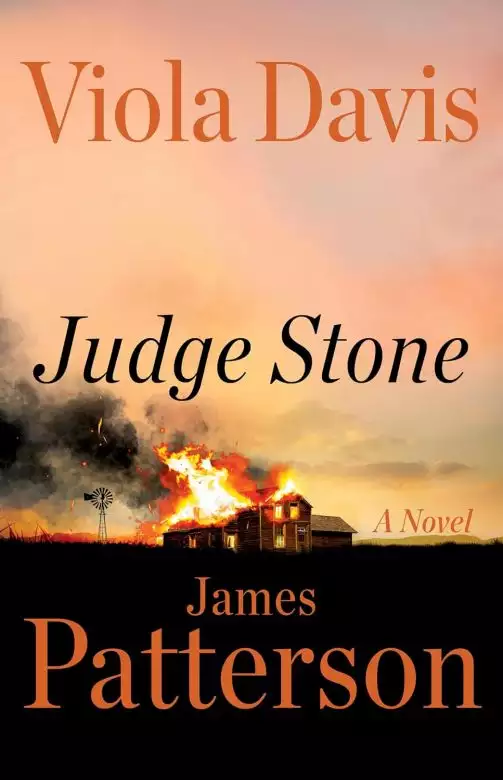
Judge Stone
- eBook
- Paperback
- Audiobook
- Hardcover
- Book info
- Sample
- Media
- Author updates
- Lists
Synopsis
Viola Davis and James Patterson have written an incredible courtroom drama and created the most unforgettable character in years.
All rise…for Judge Stone.
The most respected citizen in Union Springs, Alabama (population 3,314), is Judge Mary Stone. She holds two responsibilities sacred: running her family farm and presiding over her courtroom. It's there she draws the most controversial case in the history of the South.
Criminally, it’s open-and-shut.
Ethically, there is no middle ground.
Essentially, it’s a choice between life and death.
No judge can satisfy everyone. It would be dangerous to try. But Judge Stone is willing to fight to bring justice to the people and place she loves.
Release date: March 9, 2026
Publisher: Little, Brown and Company
Print pages: 432
* BingeBooks earns revenue from qualifying purchases as an Amazon Associate as well as from other retail partners.
Reader buzz
 Please log in to recommend or discuss...
Author updates
Judge Stone
James Patterson
UNION SPRINGS, ALABAMA
Bria Gaines stood at the back door of the small brick office building she rented in Union Springs, Alabama, population 3,314. She pulled her phone from her pocket to check the time. Six minutes past midnight. They were late.
Maybe they weren’t coming.
Maybe she’d be spared.
It was dark out, mostly quiet except for frogs, the spring peepers, singing in the narrow creek that wove through trees leafing out for the season.
She heard the rattle of an approaching vehicle before the flash of its brights signaled the arrival of the old Toyota SUV.
Pulling up onto the gravel space that served as a parking lot, the driver cut the engine, killed the headlights.
Bria’s nerves were strung tight, heart pounding. She knew the risk when she’d agreed to do this thing. Nobody had forced her into it. Sometimes, she’d realized, a person has to take a stand.
Bria tried hard not to let fear overcome her certainty. But when she flipped on the back door light, panic sent her pulse racing. Something was wrong already. Only two people emerged from the car. Bria had expected three.
She recognized the driver. It was Cocheta Bass, the nurse practitioner who worked at Union Springs Middle School. The passenger was a female wearing a hoodie that left her face in shadow.
Bria watched Cocheta pat the girl’s shoulder as they climbed the back steps together. She pushed the door wide, to let them in, then immediately flipped off the outdoor light. Pulled the door shut and turned the dead bolt. They needed to be locked up tight.
Bria led them into her office waiting room, toward the table lamp that dimly lit the space around the reception desk. Checking to see that the blinds were shut, Bria flipped the overhead light on.
The school nurse spoke in a whisper, as if fearful of being overheard. “Dr. Gaines, this is Nova.”
The girl pulled the hood off her head and pushed her hair away from her face to reveal cheeks and a forehead glistening with sweat.
Nova Jones was tall, standing five feet, eight inches, and her body had already matured. Bria recognized the frightened girl as the attentive big sister who chased around town after a brood of younger siblings.
She smiled and said, “Hi, Nova. I’ve seen you at church, over at Victory Baptist. How old are you now?”
Nova looked down at the floor and whispered, “Thirteen.”
So. This was actually happening. A first for Bria Gaines, that was certain.
She’d never committed a felony before.
But a key person was missing. Bria couldn’t overlook that. She glanced from Nova to the school nurse. “So where’s Ms. Jones, Nova’s mom?”
Nova’s breath caught. She took a step backward, like she might bolt. “No! No, ma’am, Mama can’t know. Never!”
Bria spoke gently to the girl. “You need your mother’s support. She’ll need to care for you, help you through this.”
Nova’s voice shook as she said, “She’ll be so mad. She’ll think I’m a bad girl. That I was out there being fast.” The girl’s chest heaved, like her distress was combusting, getting ready to explode.
Bria had the uneasy feeling that she was walking straight into a predicament—a precarious situation even more out of control than she’d been led to believe.
Bria didn’t let her agitation show as she walked over to a supply cupboard. She pulled a clean hospital gown from a stack of linens and handed it to Nova. “The exam room is right over here,” she said, opening another door and flipping the interior light switch. “You can change in there. Take everything off, okay? Even your bra and panties. Let me know when you’re done.”
She used her doctor voice—encouraging, brisk, professional. The girl wiped her wet eyes with her sleeve as she stepped into the examination room, shutting the door behind her.
Cocheta pressed her hand against her chest. “How you doing, Doctor? I’m so nervous, it’s making me lightheaded. I was afraid I’d keel over, just from walking up those stairs.”
Bria turned to the nurse, taking care to keep her voice low. “You said her mother would be here with her.”
Cocheta heaved a deep breath. “I tried, I did! Nova won’t tell her mother about it. Absolutely won’t budge on that. She’s scared to death about what her mother will do if she finds out.”
“Cocheta, I’d feel a lot better about this if she had family support.”
The nurse darted a look at the exam room door before she responded. “That girl got her first period when she was nine years old. You know what her mother did? Gave her a pad and told her if she ever brought any babies home, she’d kick her ass out.”
“Oh, my God.” It was a tragic situation, but it also scared her. She turned away from the nurse, wishing she had time to think it through.
The nurse said in an urgent whisper, “If you don’t fix this tonight, I can’t guarantee what the outcome’s gonna be. That poor child actually threatened to try a coat hanger. Lord! I swear, I thought those days were history.”
The suggestion terrified Bria. She rubbed her eyes, taking a moment to compose herself. There was only one reasonable solution. The stakes, though, were enormous. “Who got her pregnant, who’s the father? Did you get her to open up about that?”
Sounding rueful, Cocheta said, “I asked. She still won’t say. So legally, I’m supposed to call the Division of Human Resources, or the police. As you know.”
Bria did know. “Mandated reporter statute.”
“Yeah, we’re mandated reporters under Alabama law. But I grew up on the Creek reservation in Poarch. So I never really felt like state law governed me, because my tribe had a treaty with the feds. Does that make sense?”
“No.” The discussion made Bria’s head hurt. Cocheta’s interpretation of her legal liability was flat wrong. “We’re both mandated reporters in Alabama. Both subject to Alabama state law.”
“Okay, right. But if we call the police or DHR, you know what’s going to happen, what they’ll force her to do. She’s just thirteen, Dr. Gaines. Barely thirteen.”
Bria knew what the child’s fate would be. She also knew that the assistance that Nova Jones and Cocheta Bass wanted her to provide could end her medical practice and send her to prison.
Alabama had the toughest anti-abortion law in the country, and it placed criminal liability squarely on the backs of doctors. Under the Alabama Human Life Protection Act, intentionally performing an abortion was a Class A felony.
Maybe Cocheta could read her mind. She said, “Doctor, I know the spot I’m putting you in. Good Lord! We’re both putting our lives on the line for this girl. I threw up twice today, just from nerves. Thought about backing out. But I couldn’t live with myself if I did that.” Her voice cracked when she added, “If she ends up trying to kill herself or butcher herself—”
Cocheta didn’t finish the sentence, because the door to the examination room opened. Nova stepped out with bare feet, clutching the loose ends of the blue hospital gown behind her back. Nova’s toes curled up on the tile. But it wasn’t the cold from the air-conditioning that made the girl tremble.
Nova’s voice was shaking when she said, “Please, Doctor. Help me.”
Bria caught her breath. Everything fell into place inside her head. She smiled as she reached out and wiped away the tears under Nova’s eyes. “I’m going to take care of you, sweetheart. Gonna do what’s right. Everything will be okay, don’t you worry.”
Judge Mary Stone
STONE FAMILY FARM BULLOCK COUNTY, ALABAMA
One day, I’m going to strangle that goddamn rooster. Maybe I’ll strangle him today.
That was my first thought after being rudely—no, savagely—awakened on a Monday morning in late March.
The night before, I’d spent the wee hours staring up at the farmhouse ceiling. I grew up on this farm in rural Alabama. So I never developed a habit for sleeping in because farm life is too hard to afford that luxury. My daddy used to say he couldn’t take a vacation day until the livestock agreed to take one, too.
It’s not so different for judges. Pending cases take up residence in the mind.
I’d been agonizing over a decision I’d be called on to make. It was no exaggeration to say I’d been dreading this cursed day for weeks. Counting down the hours until I had to choose between life and death. And trying to determine the wisest course.
I rolled out of bed, pulling a long-sleeved T-shirt over my head and fastening the suspenders of my overalls. Didn’t bother to glance at my reflection in the mirror while I brushed my teeth. At that hour, it didn’t much matter how I looked.
Inside the mudroom door, I stepped into a pair of rubber chore boots. Stuffed my pant legs into the boots to discourage ticks from latching onto me. Then I exited the farmhouse just as the sky overhead was lightening from black to indigo blue.
I crossed the hard, bare ground of the side yard, heading to the weathered barn my great-grandfather had built with his own hands. The rooster followed along, scolding me. I was not having it.
“Don’t mess with me, Foghorn Leghorn. I’m in no mood,” I said. When he continued to squawk, I resorted to threats. “I’ll chop you into pieces and fry you up in a pan. You hear?”
My quarter horse, Tornado, trotted up to meet me. She was my pride, a cross-rein-trained mare that was a joy to ride. But not these days. Tornado was swelling with a new foal. I wasn’t about to mount the pregnant mare to ride the rounds. She wasn’t livestock. She was dear to me.
Inside the barn, I climbed onto the John Deere tractor and drove it to the east pasture, where I keep bales of hay stored under a plastic tarp. Used the pallet fork on the tractor to carry hay to the spot where my cattle grazed. I had twenty head of Charolais, including a bull that I rented out for stud. My cows were high-breed beef cattle, some of the best in the region.
As I drove the tractor across the field, the cattle looked up, eager to eat. I called out to them, just like my mama and daddy used to do.
The cattle lowed in response as they ambled toward me. I fed them the hay, mixed with barley and oats from a burlap sack. While I scattered the feed, one of the cows brushed up against me. I stroked her neck behind the ears before climbing back on the tractor.
As I drove back, the sun had risen high enough to turn the sky pink, casting a rosy glow on my land. The sight of that early light generally gave me pleasure. On that morning, though, it served as a reminder. Nothing could stop this day from coming.
Just contemplating the terrible task ahead sent a zing into my lower back. I ignored it. I had no time for back trouble. I needed to muck out my horse’s stall before I got into the shower.
After twenty minutes of shoveling shit, replacing it with fresh wood shavings, and setting out food and water for my mare, I left the barn and headed back to the house. Foghorn scuttled up to squawk at me again as I crossed the yard. He hushed up when I tossed a handful of seed for him to peck.
I quickly showered and dressed. Chugged a cup of coffee while I stared at my reflection in the mirror, just thinking. I almost shoved the cosmetic bag out of my way, tempted to forgo that process. But at fifty, a woman can’t rely on the glow of youth. So I did the bare minimum. Rubbed in some moisturizer, applied foundation. A lick of blush and a swipe of lipstick.
I was aware that I might be facing an audience. The press.
Before I left through the front door, I picked up my briefcase and pulled the black judicial robe off the coatrack, draped it over my arm.
BULLOCK COUNTY COURTHOUSE UNION SPRINGS, ALABAMA
I pulled into my designated spot in the Bullock County Courthouse parking lot. One of the sweetest perks of my elected position was that nine-foot-by-twenty-foot slice of asphalt directly under the window of my chambers on the second floor. Marked by two white stripes and a small sign that clearly stated: RESERVED FOR CIRCUIT JUDGE MARY STONE.
I left that beautiful sight for a familiar one.
Aurora Freeman, a member of the custodial staff, was smoking a cigarette by the back door. As I passed by, toting my bright red leather briefcase and black robe, she blew out a cloud of smoke and said, “Morning, Judge Mary.”
“Morning, Aurora.” I pulled the door open, pausing to say, “How’s your hip? Seems like you should be home with your feet up.”
She waved off the suggestion with a flip of her hand, sending ashes flying. “Don’t you worry about me, honey, I’m good. You run along now.”
Aurora is well over seventy, old enough to be my mother. Back when I was a student at Union Springs Elementary School, Aurora was as influential as any teacher. She worked in the lunchroom and she ruled that cafeteria with an iron hand. Aurora regularly threatened to whoop our butts, and it was not an empty threat.
Now I spend a fair amount of my life in the confines of this courthouse, a three-story brick structure topped by two towers. The National Register of Historic Places recognizes it as one of the finest courthouses in the state of Alabama, and the only one built in the Empire style. I’m a circuit judge, not a student of architecture, so I’m not sure what all that entails. But it’s a pretty building, the centerpiece of the historic district in our small town.
No debating that. Nor the weight of the past.
Every day I climbed the double curved staircase toward the courtroom where I presided at the oak bench. Hearing and deciding cases inside that historic structure where my people weren’t permitted to vote for damn near one hundred years after the courthouse was built in 1871. My great-grandpa and great-great-grandpa couldn’t vote because the Klan wouldn’t let them. One grandpa couldn’t afford to pay the poll tax they imposed; the other’s vote was blocked by a literacy test. None of the women in my family could cast a vote in my current workplace before the passage of the Voting Rights Act of 1965.
At nine thirty this morning, I would be handing down a sentence.
My administrative clerk, Luna Young, lingered in the open doorway, her mouth turned down in a worried frown. She was young, barely thirty, but I’d observed her air of maturity when I hired her. She’d also demonstrated a gift for handling people in tough situations. A judge’s clerk has to conduct communications with attorneys, law enforcement, and the public. I was lucky that Luna possessed more tact than I generally exhibited.
When I walked past Luna’s desk, she said, “Judge Mary, you’ve got the sentencing set in State v. Gray today.”
Luna didn’t need to provide a reminder of the murder charges against Ferrell Gray, the contentious jury trial over a case where the evidence of guilt was overwhelming.
At trial, the defendant had been hard to control, disrupting the proceedings with violent outbursts on more than one occasion. I was tempted to remove him from the courtroom. Threatened to do it at least twice, informing him that he could watch the case unfold on a monitor inside the county jail.
The jury had found him guilty and recommended punishment, but imposing sentence is the judge’s job. That was the dilemma that had kept me awake the night before. Trying to decide whether I should impose the penalty that the jury recommended.
The death penalty.
I stepped into chambers, dropped my briefcase beside the desk. Through the door, I called to the clerk. “Get the sheriff on the line for me, Luna. I’m going to request some extra security at the sentencing hearing today.”
Luna sped into chambers and was standing beside my desk before I had time to hang up my robe. “The sheriff’s already been here,” she said. “He told me to give you this letter. Warned me not to look at it. He said you should read it before you go into court.”
Luna handed me a plastic bag protecting a plain paper envelope. My name was scrawled on the front, below a distinctive return address: Ferrell Gray, Bullock County Jail.
Settling into my chair, I opened the envelope and saw a sea of blue ink scribbled across the front and back of two sheets of paper.
I scanned the letter quickly. And then I set both pages on my desk pad and slowly reread it. Gave it a thorough review.
“Sweet Jesus,” I muttered.
Luna said, “Is it something terrible? I never saw the sheriff bring a letter to the courthouse before.”
That was true. It was a harbinger of ill tidings. Mick Owens and I went way back. He was the sheriff of Bullock County and did not, as a rule, deliver the mail.
Hastily, she added, “You can tell me to mind my own business. But I can’t believe someone about to be sentenced would have the nerve to write a personal letter to you.” Her head shook in disbelief. “That man’s crazy.”
“Yeah, it’s to me, no question. The salutation reads: ‘To Judge Stone, you fucking whore.’”
Luna slapped her hand over her mouth. When she remained in the doorway, I asked, “You want to hear more?”
She shook her head no. Then changed her mind, I guess, because, with her mouth still covered, she nodded at me.
I summarized the high points. She’d be making copies in a minute and could read the whole thing from start to finish.
“He devotes an entire page to my personal appearance. Unflattering comments, you feel me? The description ‘ugly bitch’ is repeated in three places, and he spells it differently every time. Damn.” I clicked my tongue in disapproval.
“He says I’m too dumb to be a judge—even though his spelling and grammar would shame a third grader. Attributes my incompetence to my race, which he describes with the old-time slur.” That word, he could spell.
“It’s a scandal, Judge,” Luna said.
I turned to the second sheet of paper. “Well, there’s more. He informs me that he has made a deal with the devil. Satan himself is now Ferrell Gray’s ally, apparently. And that forms the basis for his threat.”
“He threatened you? Oh, no, he did not.”
“He did. He says if I follow the jury’s recommendation and sentence him to death, the devil will see to it that I die a gruesome death. Which the defendant describes in some detail.”
I winced as I read the second page a final time. Recalling the brutality of the deaths the defendant had inflicted on the elderly couple he’d murdered when the old folks interrupted his burglary of their home, I knew that Ferrell Gray didn’t require the devil’s assistance to commit unspeakable acts.
I blew out a deep breath. Our system places tremendous power in the hands of the judiciary. The delicate balance can get thrown off when personal emotions come into play.
Luna lingered in the door of my chambers. I picked up the envelope and letter. Extended the documents across my desk for her to take.
“I need three copies, Luna. Be sure to get the front and back of both those pages. Envelope, too.”
I was glad she pulled the door shut behind her. I had some thinking to do.
Every courtroom has its own vibe. I learned that as a trial lawyer in Alabama, but it’s true everywhere. That vibe produces an atmosphere inside the courtroom, like an electrical charge in the air. Everyone in the gallery can almost smell it.
The judge is responsible, you understand. Whether the atmosphere in court is good or bad is determined by the person in charge. If the courtroom is relaxed and people are courteous to one another and to the public, the judge has set a standard for that behavior. On the other hand, if a court operates with a bailiff who’s a bully, and a docket that never starts on time, and a court reporter who’s surly to lawyers and snaps at witnesses? That’s the judge, too. Shit’s rolling downhill, staff is copycatting the judge’s attitude.
In most US courtrooms, all interested parties are in place before the judge arrives. The judge’s appearance is announced with pomp and ceremony. The bailiff shouts “All rise!” and people jump to their feet. That’s how it’s done.
But it’s not necessarily standard procedure in my courtroom. Not always. Sometimes, I like to be the first person to the party. Helps me get in the right headspace.
So when folks started drifting into court, taking their seats in the spectators’ gallery, I was already seated. In the big rolling chair at the raised wooden bench, I was suitably attired in my black robe zipped up and topped with a bright yellow scarf—my substitute for a man’s necktie.
Bullock County Courthouse has a huge courtroom, designed when it served a wide variety of purposes. Back in the day, there was a function in addition to upholding law and order by enforcing the criminal law and serving up justice in civil cases. Because the courtroom also provided entertainment to the masses. The public would turn out for jury trials to see the show. Jury trials are live theater, in which the script is written as the drama unfolds.
The defendant didn’t have a cheering section, no family willing to claim him, not that we’d seen at trial. But journalists had picked up on the sympathy for the childless murder victims and wanted to report on the sentencing to curiosity seekers inside and outside the courtroom.
The defense attorney, Bradley Tyler, was a member of the death penalty team in the Birmingham public defender’s office. He walked in with a stoop that was probably related to the weight of his occupation.
I called out to him. “Good morning, Mr. Tyler.”
He was startled to see that I already occupied my perch. Still clutching his briefcase, he took a step toward the bench. “Am I late, Your Honor?”
“Late? No! I’m early.”
That comment generated a chuckle from my bailiff, Ross Carr, who’d put up with my idiosyncrasies for almost six years.
“Mr. Tyler, you’re from out of town. You don’t know all my quirks.”
The lawyer set down the briefcase. “No, ma’am. But I appreciate the restraint and professionalism you’ve shown in this case. I know it’s been a tough one. I understand why you’re held in such high regard. I’m familiar with your reputation. Before we tried this case in Bullock County, I asked around.”
First-class bullshitter. Trying to butter me up. Hopes I’ll show some mercy today. That will not happen.
That suspicious voice in my head was familiar. A symptom of the impostor syndrome I couldn’t shake. I was among the first Black women in the state to be elected to the circuit bench. And in law school at the University of Alabama, even though I ranked at the top of the class, it never felt like I got the respect I deserved. Yeah, I still suffered from self-doubt. The habit had a way of sticking with me.
I worked hard to conceal it. Particularly when the DA was in court.
Robert Reeves, district attorney for the 3rd Judicial Circuit of Alabama, walked in late. As he set his laptop on the prosecution counsel table, he didn’t apologize. Didn’t even meet my eye. I was debating whether to call him out for it.
My bailiff interrupted my thoughts. “You ready for me to bring the defendant in, Judge?”
I nodded, rising from my chair. Decided that the morning called for ceremony. “Ross, I’ll be in chambers. Let me know when everyone’s ready.”
A few minutes later, I walked back into court as Ross called out, “All rise! Circuit Court of Bullock County is now in session, Judge Mary Stone presiding.”
The public defender jumped to his feet. All of the people gathered in the gallery stood up. Even the DA waited for leave to sit down.
“Y’all be seated,” I said. “We’re here in the matter of State v. Ferrell Gray, Case No. CR193878. The State appears by District Attorney Robert Reeves. Defendant appears in person and by counsel Bradley Tyler.”
Two uniformed deputies sat within snatching distance of the defendant. I was glad to see it. Ferrell Gray was the kind of dude who could put a courtroom at risk.
I gave the folks in court a minute to get settled before I made my announcement.
“I received a letter from the defendant this morning. I have copies of the correspondence to share with the parties.”
When I picked up the folder containing the copies Luna had stapled together, my bailiff stepped up to take it from me. I signaled to him with a shake of my head as I descended from the bench. I didn’t need Ross’s assistance.
I personally hand-delivered the copies: one to the DA, one to the defense. I was glad to have an excuse to leave the bench. I prefer to move around the courtroom, like I did as a trial lawyer. Thinking on my feet was always my strong suit.
After the public defender skimmed the letter, he turned to his client, demanding in a stage whisper, “Did you write this?”
I leaned against the empty jury box, curious to learn Gray’s response, but he didn’t reply to his lawyer. He twisted in his seat and directed a question to me.
“How come I don’t get a copy?” the defendant asked. “You got a problem with me taking a look at it? This is my trial, ain’t it?”
Ferrell Gray would test the patience of a saint.
And I was no saint.
I fought back the urge to approach the table where the defendant sat. Had the sound judgment to stand back. “Mr. Gray, I suspect you already know what the letter says. You wrote it, didn’t you?”
“Hell yeah,” Gray said, just as his lawyer snapped, “Don’t answer that.”
Bradley, the defense attorney, shook his head with some combination of frustration and disgust. Couldn’t blame the man for that, not in his position. Bradley stood and said, “Judge, in light of this information, it’s obvious that the sentencing can’t proceed.”
“It’s not obvious to me,” I said.
Bradley remained on his feet, but he started to look panicky. “Respectfully, Your Honor, the defense requests that you recuse yourself.”
“Why would I do that?” I reached around and rubbed my lower back. It was still bothering me.
“Because your receipt of the letter—a letter purporting to be from the defendant in this case, though his responsibility for the document hasn’t been proven—will make it impossible for you to be fair and impartial.”
I stared the man down for a moment before I asked, “And why do you think I won’t be fair?”
I heard the rattle of chains as the defendant lifted his handcuffed wrists to flip me the bird with both hands. As he tried to stand up—his belly chain appeared to cause some difficulty—he proclaimed, “I want a new judge! I’m a white man. I can’t get any justice from this affirmative action bitch they hired!”
The defendant was unfamiliar with the judicial process. I wasn’t hired. I was elected. In Alabama, circuit judges are elected to six-year terms of office by the registered voters of the counties in their circuit.
As the deputies jumped up to ensure that Gray remained in his seat, the public defender said, “Judge Stone, I apologize for that outburst.”
The outburst wasn’t over, not yet. While the deputies wrestled Gray back into his seat, the defendant continued to utter insults that were, thankfully, mostly incomprehensible. His lawyer appeared to be sincerely distressed.
“It’s not your fault,” I told the public defender. I felt the urge to move, so I stepped closer to the defense counsel table, but took care to keep a safe distance from the criminal defendant when I addressed him. “Mr. Gray, you need to quiet down. You’re not helping your cause.”
That was when the DA decided to weigh in. “Your Honor, the law on this matter—”
I swung around to face him. “You think I’m not acquainted with the law on this issue?”
He blinked, continued in his nasal voice, “I just want to contribute the State’s position—”
“I don’t recall asking for your opinion.”
The DA was getting under my skin, as he tended to do. It was time to create some distance. I strode back to the bench. Climbing up the three wooden steps that led to my chair was well-timed in this instance. It demonstrated my authority.
As I sat, I said, “Defendant’s motion is overruled.”
Ferrell Gray snatched his attorney’s copy of the letter and flung it to. . .
We hope you are enjoying the book so far. To continue reading...
