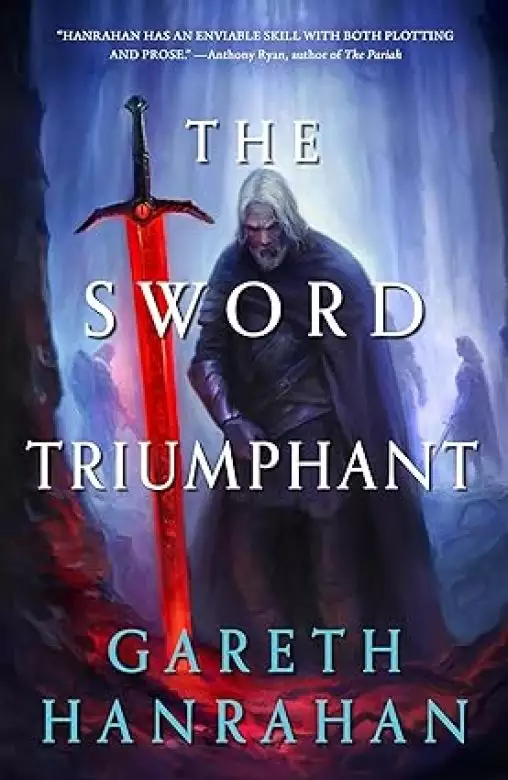
Gareth Hanrahan's acclaimed epic fantasy series of dark myth, daring warriors and bloodthirsty vengeance concludes with The Sword Triumphant.
"Tell the Lammergeier that Blaise has need of him for one last service. Tell him to bring his sword."
In his youth, Aelfric slew the Dark Lord and saved the world, only to find out, many years later that his heroic deeds had served only to preserve the corrupt rule of the Erlking. As keeper of the dread sword Spellbreaker, Aelfric was drawn into a desperate rebellion against the immortal elf who had been secretly manipulating humanity since the dawn of time.
When it was done, he left the sword and the title of hero behind and went home. His tale should have been over.
Decades have passed. But when a figure from his past brings a cryptic message from one of the Nine, it seems the Lammergier is needed again. Does the old hero have one last quest left in him? Can his broken sword be reforged - and at what cost?
Praise for The Sword Defiant:
"A treat for all fantasy fans . . . . It’s an absolute blast.” ― Justin Lee Anderson, author of The Lost War
"In the tradition of Tolkien and Eddings, with a richly detailed narrative, well-drawn characters, epic battles, and political and religious intrigues, Hanrahan's outstanding first outing in the Lands of the Firstborn series will thrill fantasy readers—who will anxiously await the next book." ― Booklist (starred review)
"This novel has the potential to become a fan-favorite among those who appreciate vast and eloquent epic fantasy. Readers will enjoy the unique twists, absorbing intrigue, and endearing characters." ― Library Journal
"I will buy any novel that Gareth Hanrahan ever writes." ― The Fantasy Inn
For more from Gareth Hanrahan, check out:
Lands of the Firstborn The Sword Defiant The Sword Unbound The Sword Triumphant
The Black Iron Legacy The Gutter Prayer The Shadow Saint The Broken God
Release date:
May 27, 2025
Publisher:
Orbit
Print pages:
560
* BingeBooks earns revenue from qualifying purchases as an Amazon Associate as well as from other retail partners.
Alf woke with a burning need to piss. He peeled back the blanket and stumbled across to the chamber pot. Pungent urine dribbled out of him. The dream dissolved like steam, leaving only snatches. He’d dreamed of Necrad, of things that had happened more than twenty years ago. Or more than forty. How long had it been since he and Berys climbed the Wailing Tower? Was it fifty years?
Berys was dead now by all accounts. Thurn was dead. And Gundan. Jan – she was gone like Peir. Jan had faded, and Peir had come back with Derwyn only to fade again. Blaise was dead, too – he’d helped Olva and Derwyn escape Necrad, all those years ago. They’d fled the wreckage of a dream gone sour.
Of the mortals, only Lath was left. Lath and Laerlyn.
Words from the dream floated through Alf’s brain, flotsam from a sinking ship. In gratitude for your words. He had warned Death, hadn’t he? He’d told her that the Erlking had made the spell that summoned her, and so he could unmake it. And only a few months later, Alf himself had stood before the Erlking as the old elf threatened to undo another spell – the spell that had conjured humans. Rule in my name, the Erlking had said, marry my daughter and be the king of Summerswell, or I will destroy the human race. And the Erlking was gone now, the Everwood destroyed. The sword’s doing. He’d put the blade down, but another hand had picked it up and brought ruin.
All things break.
But Laerlyn was still young, still immortal. She was still the same as when he’d first met her, a lifetime ago. Laerlyn still lived.
Lath is dead. But that was just a dream.
He groaned as he bent to pick up the chamber pot. His hand trembled under the weight. He opened the door of the farmhouse and threw the contents onto the dung heap. It was still dark, the stars like jewels, but the sky was brightening in the east over the treetops. No point in going back to bed now.
One of the pigs squealed in expectation of breakfast.
“She’s not back yet.”
The pig looked up and grunted.
“Maybe tomorrow,” said Alf, yawning.
He stretched, old joints cracking, then went back in to dress and start the day. There was work to be done, after all.
Alf had grown up a stone’s throw away from this spot. His father, Long Tom, had been a peasant farmer, paying his rent with labour on the big farm. Now it was his sister Olva who was the landlord, hers the big farm. Big for Ersfel, of course, didn’t mean much, but some deep-rooted instinct in Alf was impressed by it. The same instinct made him feel like he was trespassing, that at any moment someone might shout at him to get away from where he didn’t belong.
In Necrad he’d dwelt in a palace he’d taken from a living god by force of arms. But here he was still Long Tom’s son from the little cottage under the oak. On mornings like this, the early pale-gold light slanting through the mist, the croaking of crows up on the wooded hills, unhurried sheep grazing in the field, the years slipped away and he forgot the wars, the Nine, the sword, and he could almost believe Necrad and all the rest was but a dream. Ersfel had scarcely changed in the seventy or so years of his life. Ignore the new watchtower on the hilltop, and the new cottages on the east side, and it was just as it was when he’d gone on the Road with Gundan long, long ago.
Lath is dead. It was only a dream.
Thomad and his boy came by mid-morning to help Alf with the farm work. The storm of a few days ago had damaged one of the sheds. The whole roof needed fixing. They’d taken down the thatch the day before, so today’s job was replacing the broken rafters. Despite Thomad’s doubtful look and prophecies of doom, Alf climbed up on the ten-foot stone wall to rip out the damaged timbers. I scaled the Wailing Tower, he thought, I can handle a cowshed.
Alf wrenched the last of the broken rafters from its socket and threw it down. “Pass that up,” he told Thomad. The cotter and his boy lifted the heavy replacement up to Alf. What was the lad’s name? Something simple, wasn’t it? A good Mulladale name, plain and serviceable.
Strange how his brain remembered the heraldry of knights long dead, or the paths through the Pits, but couldn’t remember the boy’s name.
Thomad’s boy shot nervous glances towards another shed, the locked one where Olva was said to keep her witching things. The villagers told stories of cauldrons and talismans, of familiars in jars, chattering skulls and charmstones. Everyone in the Mulladales told tales of the Witch of Ersfel, the woman who’d once been an honest widow, but had gone away for a year and came back different. Olva was a Changeling now. Lath had initiated her atop Death’s grave at Daeroch Nal. The use of earth-magic had been forbidden in Summerswell for centuries, but Olva had thrown herself into the study of it, leaving Alf to tend the farm while she flew off in search of buried secrets.
Twenty years ago, the church would have sent exorcists to drive the earthpower out of Olva, or sent paladins to burn her if the exorcism didn’t take. But that was before everything changed. The little shrine on the hill was empty. Old Thala – gone fifteen years now – had been the last priestess to minister to the village. Empty thrones above, empty thrones below, people said. The Anarchy, the poets called this time. Provinces splintered into little kingdoms, and any man might call himself Lord with a good sword and a pack of brigands. Summerswell was broken, the old order overthrown. The law handed down by the Erlking to the first Lords was gone.
You let that happen.
The thought sounded like the sword.
I tried to stop it, Alf argued with himself. I tried to make peace – even though Berys was right, the Erlking was a monster. I tried putting the sword down, and someone else took it up. Maybe things didn’t turn out for the best, but I did what seemed right in the moment. That’s all you can do.
Lath is dead, whispered the memory of the sword, and its voice rang with malicious pleasure.
“Watch it!” cried Thomad. Alf snapped back to the present. He’d leaned out too far and unbalanced himself. The packed earthen floor of the shed seemed as far below him as the streets of Necrad from atop the tower. As he toppled, he caught himself on one of the new rafters. The timber creaked under his weight. Alf hung from the rafter for a moment, then dropped to the floor below. Thomad’s lad ran to his side to steady him.
“I’m all right,” said Alf. He rubbed his knee. “Let’s have something to eat.”
Thomad frowned. “You likely cracked that rafter when you put all your weight on it, you ox.”
Alf shrugged. “Likely it’d have broken in the next storm anyway, then.”
Afternoon brought weapons drill. The war rarely touched Ersfel, which lay tucked in an obscure corner of the Mulladales, but other villages had been raided. Olva’s reputation as the Witch helped, but still Alf trained the locals to defend themselves. Old men complained that such things were unknown when they were young, when the Lords guarded the roads and kept the peace. Maybe a stout spear could ward off the Anarchy that consumed the wider world, and maybe it couldn’t, but in these days of brigands and petty Lords it was best to be watchful. Everyone knew that Big Alf had been a mercenary and fought in the war – even if they were hazy on which war exactly.
They practised with spears and wooden swords on the village green, lads and lasses falling about, poking each other, making a game of it. Alf kept his temper in check, not waiting to spoil their innocence. He watched one girl – Quenna’s youngest, a spitfire named Cerlys, hair pinned back with a broken silver comb – sparring with another lad. The boy slipped, and she struck him hard in the belly. When he was done spewing, he protested that it didn’t count, that it was a lucky strike and a low blow. But Cerlys had already declared herself the winner, and added that she’d beat anyone in the village in a contest of archery to prove her victory wasn’t a matter of chance. With that, she loosed an arrow, and hit the mark a finger’s breadth from dead centre.
“Berys herself couldn’t have done better!” she shouted.
Somehow, that turned into a wager that whoever outshot Cerlys would earn a kiss from her, and now all the boys were scrambling up to the line, arrows falling wildly around the straw target. Alf chuckled at the chaos, and that made an old wound in his chest ache.
“Enough,” he called. “None of you are going to beat her.”
“I want another chance!” complained the lad, sour at his defeat and his vomit-stained breeches. He drew another arrow, but Alf grabbed the bow from his hand.
“It’s getting dark. I don’t want you putting an arrow through Genny Selcloth’s window.”
The boy scowled. “I can beat Cerlys. And Berys the Thief was a traitor anyway. My da says the Nine brought nothing but ruin.”
“They saved us all from Lord Bone up in Necrad,” said another, shoving his friend.
“Saved us, then ruined us. Like giving a gift with one hand and snatching it back with the other.”
“Ruined, are you?” said Alf. “And what fortune have you lost, lad? What great height have you fallen from?”
“What would you know?”
Anger filled Alf. He drew back the bow, nocked an arrow, and loosed it. Dead centre. “More than you, lad.”
He handed the bow back to the stunned boy and strode away across the green. His shoulder ached with the effort of the draw.
Cerlys froze as if Alf was an ogre coming to demand his prize. “You’re good, lass, and quick, but quick isn’t always enough. It’s one thing to strike the first blow, and another to strike the last one in a fight.” He snorted as he walked past her. “And then there’s the matter of the right blow, and the right battle. That’s a whole other riddle.”
“Was I not right?”
“Eh. Hit him a bit hard, maybe.”
She followed him, eagerly bouncing at his shoulder. “But it wasn’t a lucky blow.”
“Still brooding about that, are you?”
“It wasn’t luck.”
“He slipped. But there’s nothing wrong with getting lucky. Luck keeps you alive. What matters is what you do with the chances you get.” Alf thought that was a good bit of hard-won wisdom, but Cerlys had already moved on.
“There’s a tourney in Highfield in a month’s time.”
“Aye.”
“There’ll be an archery contest there.”
“Aye, most years.”
“But the prize for archery is only a third of what the winner of the sword gets.”
“And the tourney winner gets more than both of ’em.” He’d won his share of tourneys by battering the opposition down. Back then, he’d taken satisfaction in unhorsing all those nobles. Knights brought low by a nameless farm boy.
All those knights were dead now, in one war or another. Their children’s children fighting now – and not in tourneys, but real battles.
“The tourney doesn’t favour me,” said Cerlys. “It doesn’t reward skill or speed. But if I had a proper sword, I’d have a chance in the duelling ring.”
“Would you now?” Alf smiled at her audacity.
“Jon says you’ve got a shield and armour in the Widow’s house.”
“Which one’s Jon?”
She pointed at Thomad’s son, who was busy rolling the straw archery targets away – or pretending to do so while watching Cerlys. He blushed and looked away hastily.
Jon. That was the lad’s name.
“Have you got a proper sword, too?” she asked.
He stumbled, his knee twisting under him. He felt impossibly ancient.
“Go and help tidy up. And unstring your bow, girl. Take care of your weapon.”
He called into Genny Selcloth’s alehouse. “Need me?” Alf helped behind the counter sometimes, especially when there were strangers around. Tonight, there was a travelling pot-smith in town, a dwarf who’d come up the Road from Kettlebridge, so the parlour was crowded with those seeking news.
“Take your rest,” said Genny, and Alf settled into his usual seat by the fire. Genny squeezed his shoulder as she passed behind him.
“It’s bad, friends,” said the dwarf. “Buy me another drink, so I have the strength to tell the tale.” Another mug was duly produced. “A new warlord has arisen! Ironhand, they name him, and he is fearsome indeed. He swept out of the west, and the Riverlands fell before him! Arshoth has yielded to him, and he was anointed by the high archon. Good Lord Merik—”
Alf snorted at the “good lord” part. He’d met Merik once, briefly, back when he was just Sir Merik, a knight in Lord Brychan’s army. The man had not struck Alf as good or lordly. They’d crown anyone these days.
The dwarf glared at Alf’s interruption, then continued. “Good Lord Merik met Ironhand in battle near Harnshill, and alas! Fortune did not favour Merik. Treacherous knights of Ilaventur joined Ironhand’s host, and Merik was beset from all sides.”
Alf stopped paying attention halfway through. There’d always be another villain, another would-be dark lord. Heaven and earth both overthrown, and chaos loosed on all Summerswell. This Ironhand was just the latest. And if he came to Ersfel, young Cerlys would put an arrow in his eye. Saving the world was a job for the young, and Alf was content to be done with it. He’d had his time riding the wheel of fate, and he would roam no more.
Some days – most days, if he was being honest – he suspected he’d done more good fixing sheds and teaching children like Cerlys than all the rest of his days.
When the dwarf’s tale was done, Alf approached him.
“You don’t bear any letters, do you? My sister has a friend in the Dwarfholt.”
But there were no messages from the north.
Alf returned home. The hearth was cold, the house chill. Olva wasn’t back yet. Alf bent to set the fire, his knee protesting as he put weight on it.
What had that dream been about, again? It had seemed important this morning. So many things that once seemed important really weren’t, in the end. Tales of lords and knights and Good Lord Merik and Ironhand, the anger on that boy’s face, it’d all be forgotten in the morning, and that cracked rafter would still need fixing no matter what. He’d get an early night, he decided, because if Olva came home and the shed roof still wasn’t done, she’d have words for him.
And ever since his little sister learned magic, her words had real power.
The fire refused to light. The cold bit deeper than it used to. He’d once crossed the Clawlands in winter, travelling in the teeth of icy winds howling down off the Dwarfholt peaks, and still the farmhouse felt colder. What had he done today? A few chores, and he’d watched some children fight with sticks. When he was young, he’d have done all that work in an hour, and fought in a real battle. All things break.
A knock at the door. “Alf?” Kivan, one of the village men. “Is the Widow back?” He sounded shaken.
“Not yet,” said Alf. “What is it?”
“There’s a monster in the wood.”
It was dark and Alf no longer had the sword-sight. He hunted by smell. He’d never forget that foul blend of rotten eggs and something burned, mixed with a chill in the air. He’d lived with that smell for years, and he pushed through the trees until he found its source.
The dreadworm was mostly dead. Wings paper-thin and full of scorched holes – it had flown in sunlight, flown a long, long way. The eyeless head rose and hissed at him, baring the ring of teeth in its approximation of a mouth. Dreadworms weren’t living things, exactly – magic conjured them into being. There wasn’t much of a gullet beyond that mouth. Their hungers were an echo of what real animals felt.
No sign of a rider. Was it here by accident? Alf could imagine the monster being blown off course by winds, or getting lost and blindly wandering in the sunlight. His foot brushed against a branch. There were more broken branches – and they were cold and slick with worm-slime. The monster had not landed, but crashed out of the the sky.
No sign of a rider. But that didn’t mean a rider hadn’t survived the fall.
“What is it?” called Kivan. He and a half-dozen other villagers stood well back from the carcass of the worm.
“It’s no threat. Lend me that spear.”
He pushed the point into the yielding pseudo-flesh of the worm’s throat until the creature perished, falling apart into mush and ice. By morning, there’d be nothing left but a stain.
It was only a dreadworm. But it was the first thing he’d killed in a long, long time.
“Is it gone?” asked Kivan.
“Aye. But it might have had a rider. A Witch Elf. Maybe a scout.”
Kiven brought the light from his torch close to the ground. “I don’t see any tracks.”
Elves step lightly. “Let’s have a look about, to be sure.”
Up went the hue and cry. No one in the valley slept that night. Every house was roused with the warning that enemies might be close by. A torch kindled in every doorway. Dogs bayed, chickens squawked, children shrieked with excitement or burst into confused tears. The hunt went on until first light, but came to nought. No sign of an intruder.
Alf felt a weight lift from him. The worm had been blown off course by some storm. Its arrival was an accident, not a portent.
He went home again, his bed calling more loudly than the sword ever had. Off across the fields through the morning mist he could see Thomad weeding in the vegetable patch, and smoke rising from the cooking fires in the cottages. The pigs, oddly, were all huddled near the stump of the big oak. Something had spooked them.
The door of Olva’s house was ajar.
Alf’s grip tightened on the half of the borrowed spear. He pushed the door open with the tip.
A pale figure. Witch Elf.
Red eyes glimmered in the dark.
Witch Elf vampire.
“Sanctuary,” whispered the vampire. “Sanctuary, Aelfric Lammergeier.”
Alf did not recognise the elf at first. Most elves looked alike, preserved in the prime of life for eternity. They faded rather than aged. Even the truly ancient elves Alf had encountered – all save one – were untouched by the passing millennia. Nor did this intruder bear any symbols or tokens of his house; his ragged clothing offered no clue.
Then Alf saw the echo of the child in the face of the man.
“Ceremos?”
The vampire nodded, biting his lip. His teeth were very sharp. Alf closed the door to shut out the sunlight.
“Why are you here?”
“A message,” said Ceremos, thickly, his tongue stumbling over the human words, “from Necrad.” He backed away into a corner, long white fingers clinging to the wall. His red eyes flickered to Alf’s hand. There was a little smear of blood; a cut from a thorn in the woods. Ceremos pressed his head against the wall. “I thirst,” he whispered.
Alf warily stepped towards the vampire boy – and then saw a tangled mess of skin and blood at the back door. One of the piglets, torn to pieces.
“You did that?” snapped Alf.
“Forgive me,” said Ceremos. “I have come far, Lammergeier, in seeking you. I have not fed for so long, I—”
There came a knock at the door.
“Mister Alf? Da sent me over to help with the thatching.”
Ceremos lunged towards the door with a snarl. He was so fast, elven grace augmented with desperate hunger. Alf used the spear to trip Ceremos and caught the elf’s ankle with the edge of the blade. Ceremos came up scowling, red eyes ablaze, but Alf got the tip to the boy’s throat.
“Don’t move,” Alf hissed, “and stay quiet.” Ceremos quivered, all his instincts at war, then curled into a ball, pressing his hands into his face.
Alf raised his voice. “It’s all right, lad,” he called to Thomad’s boy. “I’ll attend to it tomorrow. Go home now.”
“All right.” The sound of Jon’s footsteps crunching on the path, and tuneless whistling. He’d never know how close he’d come to death.
Alf pulled Ceremos to his feet. The vampire’s head lolled as if he was drunk or exhausted beyond measure. “Blood,” he whispered, then a long litany of elvish. Alf caught the word agearath, which meant something like blood-giver. An elf vampire had to feed, or they’d fade, their body melting away and their immortal soul slipping into the wraith-world. Ceremos was only twenty-five or so; most elves lasted thousands of years before fading, but he’d been wounded as a child in Necrad.
Alf had mortally wounded the child. This was his responsibility.
“Come on,” snapped Alf. He dragged Ceremos across the kitchen to the little spare room under the stairs. It was crammed with old tools, old treasures, old junk. More of Olva’s magic paraphernalia, a few bits of furniture Alf had been meaning to fix for years. A stack of yellowing letters from Torun, all covered in tiny neat handwriting. A bed, too, somewhere beneath all that. Alf fumbled around, clearing space. The butt of his borrowed spear swept jars from a high shelf to shatter on the floor behind him.
“Lammergeier, hark! I bear—”
“Shut up,” he ordered. He pushed Ceremos into the little room. “Stay there. Stay quiet. I’ll be back.”
First things first. He fetched a shovel and buried what remained of the piglet. Then he ate, salvaging what he could from the jars he’d broken and piling the mess of jam and preserved meats onto slices of bread. He kept the spear within arm’s reach, kept staring at the door under the stair. But there was only silence.
Through the window, Alf saw a half-dozen youths from the village approaching the cottages across the field. He spotted Cerlys’ raven-black hair. The boys with her had spears. They searched for the dreadworm’s rider. If they found Ceremos, it would not end well for anyone.
He went outside. When Cerlys and her company started to cross the field, Alf waved at them, a cheery reassurance that all was well. They turned and headed up into the hill to search the holywood again.
Hunting for the Witch Elf.
Alf had killed a lot of Witch Elves in his time. The Witch Elf elders of Necrad had gone vampire, sustaining themselves on mortal blood. They’d enslaved the Wilder-tribes, convinced the mortals that the elves were gods and taken the blood as tribute. The Nine had put a stop to that. They’d killed most of the vampires, herded the rest along with the surviving Witch Elves into the prison quarter of the Liberties.
It was there that Alf had killed the child. He and Gundan had gone in on a fool’s errand. He’d had Spellbreaker summon a dreadworm. The sword had warned him that its magical control of the worm was slipping, that Alf had asked too much.
While Alf and Gundan were distracted, the worm broke free.
Alf remembered pressing his hand over the boy’s belly, holding Ceremos’ intestines in. Gundan pulling at him, shouting that they had to fall back, that they’d started a riot. Do these filthy elves know who we are? The dwarf’s voice echoing across the years. Then, later, the voice of Ceremos’ father. We shall lose him again. The hunger will consume him. And Alf had promised he’d help, he’d make things right. He’d let Ceremos feed from him again, to sustain the child as he healed. And he’d sent money so they could buy blood.
Better you had never come to Necrad at all.
He sat there in the kitchen, watching clouds scud across the sky. Birds took flight over the holywood, their fierce grace so different to the ungainly flailing of dreadworms. Where are you, Olva?
A message, Ceremos had said.
Alf opened the door and peered in. Ceremos scurried away to cower in the corner.
“Here,” said Alf, “I brought you blood.” He placed a bowl on the floor and pushed it towards Ceremos.
“It is not fresh,” he complained.
“It bloody well is,” said Alf. “I just fucking bled it.”
“It… it fades,” said Ceremos. “Better to have agearath. To drink from the spring.”
Alf leaned against the doorframe, lightheaded. “Aye, well. That’s not happening. This spring’s old and dry.”
Ceremos sniffed at the dregs with distaste. “I agree. You taste foul.”
“Ungrateful wretch.”
“But I feel better. The edge is gone.” He wiped his face. “I am myself again.”
“All right then. Talk.”
The young elf pushed the empty bowl away and sat cross-legged on the floor. “I have not used the mortal tongue in a long time, Lammergeier, but I shall tell the tale as best I can…”
Necrad. My Necrad.
It was my city, and mine alone. The other elves knew Necrad as it was in the dawn, when it was new, the city of sorcery. They knew Necrad as it was when we took it back from the usurpers. They dwelt there when Lord Bone came to the city gates as a beggar, and they watched him grow in power. They knew Necrad in its glory.
(Ceremos’ face flushed as the blood restored him. His voice grew eager as he told his tale.)
I knew the city in ruin. I grew up playing amid the rubble, Lammergeier. I was the only elf-child in the city, so my playmates were mortal children and Vatlings. To me the streets were always choked in rubble, the gates always watched by dwarf-guards. It was natural for me that a half-dozen elves dwelt in a single house, even as they shared memories of the palaces denied to them. All their songs were sad, but I knew nothing else, and so I was happy.
I do not remember the day you killed me, or the time just after. My father spoke of it often. He was greatly shamed he could not save me, so I know well what happened, but it is no more real to me than a dream. No, what I remember is the third time I drank of you. Do you remember? You were about to leave for the parley with the Wilder at Lake Bavduin. You came with Ildorae Ul’ashan Amerith, and you had the Spellbreaker. My mortal friends were amazed that so great a hero deigned to visit my sickbed.
When the siege came, they told me not to fear, because the Lammergeier was leading the defence of the city against Death’s host. I remember the heat of your blood in my belly, and thinking how lucky I was to have a share of your strength. And after the siege, I cheered the coming of the Uncrowned King, for he was your kinsman – and mine, too, I thought.
We were related by blood, after all.
The other elves rejoiced, too, seeing the strength of the Firstborn restored. They had the palaces and temples of the Sanction once more. You had gone away south by then, yes, but it was whispered in the Liberties that you had spoken in support of restoration, that you had made Ildorae the captain of your honour guard. I thought it was glorious – the best of elves and best of mortals united in common purpose, and I was at the heart of it. I dreamed that when I grew up I would join you on the battlefield. My mother told me tales of Acraist the Wraith-Knight, our kinsman, the Hand of Bone and first wielder of the Spellbreaker – and I thought I might be like him, only better, brighter. Your ally, not your foe.
Your sister, the Widow Queen, was kidnapped by Earl Idmaer and his followers, and there was war with the mortals of the New Provinces. Once again there—
(“That’s not what happened,” interrupted Alf. “Olva – Lord Bone’s shade was in Derwyn, and he killed Bessimer. Olva – she explained it to me. She wasn’t kidnapped, she went to Lath at Daeroch Nal…” But he tripped over the words and fell silent. The truth didn’t matter half so much as the story.)
Once again there were dreadknights in the skies. I watched my father put on his armour again. He brought home prisoners from the sack of Athar, and I feasted for the first time in my second life.
Ildorae freed your sister from captivity and brought her back to Necrad. What happened then, I do not know – but there was great strife atop the Wailing Tower, and lightning wracked the city. I remember hiding in my bedroom, listening to the crash of thunder, fearing I would perish and thinking how unfair it was that I alone of the elves should have so short a span.
But dawn came, and with it word that the Uncrowned King had fled and the city belonged to the elves again. Amerith, the Oracle who had led us since the Sundering, was gone, so the Skerrise claimed the throne.
There were no mortals left in Necrad. The Skerrise and the other elders still needed blood, of course, but they had ways to procure it. My mother went to the Palace of the White Deer and begged the Skerrise to provide for me, and for a time I was vouchsafed a little trickle of blood, the leavings of the great ones.
The Skerrise commanded that all elves return to Necrad. My father and other dreadknights flew south to the ruins of the Everwood, and gathered the wayward ahedrai – the Wood Elves, as you mortals called them. They sailed to join us in the north, as Amerith did long ago, and for a time it seemed a joyous reunion. But there was… dissent. The newcomers questioned the Skerrise’s right to be the sole leader in Necrad, they said we should not cut ourselves off so completely from the outside world, that the works of Lord Bone should be cast aside. The Skerrise said she would consider their counsel, and withdrew to the Wailing Tower.
Then… There was no moment of revelation, no sudden crisis – certainly, not one that I was privy to, but I was the youngest and least of the elves of the city. But from my rooftop perches I saw the little changes. A new breed of Vatlings appeared, ones loyal to the Skerrise alone. She called them guardians of the peace and set them to watch the city gates and the entrances to the Pits below. Later – for the safety of the newcomers, it was said – these Vatlings took charge of more and mo
We hope you are enjoying the book so far. To continue reading...

 Please log in to recommend or discuss...
