
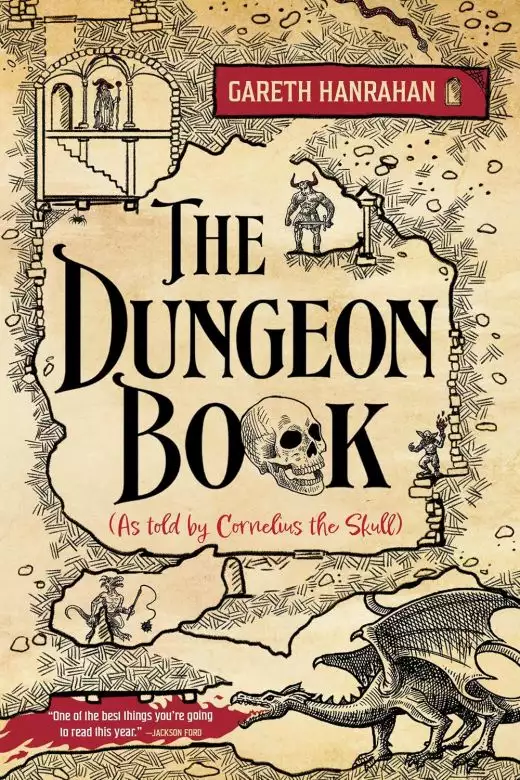
The Dungeon Book
- eBook
- Paperback
- Audiobook
- Book info
- Sample
- Media
- Author updates
- Lists
Synopsis
A young girl is left to die in a wizard's dungeon but finds a new home with the monsters around her in this humorous and heartfelt standalone epic fantasy from acclaimed author Gareth Hanrahan.
"Full of wit and adventure, twists and turns, wonderful monsters, and astonishing revelations. An absolute joy." – M. R. Carey, author of Infinity Gate
Enter a world of dungeons and dragons, magic and manticores, and goblins and gargoyles . . .
Bait doesn't remember a time before the dungeon. Before the dragon stole her from her cot. She doesn't know what her name was before she was handed over to the monstrous denizens of the dungeon beneath the sorcerer's tower. Luckily for Bait, they decided not to eat her. And so she grew up in the dark – the goblins her adopted family, a vengeful minotaur her protector, a sentient skull her tutor, and a blob of corridor slime her main source of nutrition.
But the labyrinthine dungeon, with its haunted halls, buried temples and forgotten magics, draws treasure hunters like moths to flame. And as the outside world starts to intrude, Bait will learn what it means to be monstrous and she will have to decide where she truly belongs.
"The Dungeon Book manages the difficult task of being epic and heartfelt both at once, and does it with style. I fell in love with Bait and her menagerie of friends immediately." – Django Wexler, author of How to Become the Dark Lord and Die Trying
"For a story set in the deepest, darkest dungeon, The Dungeon Book absolutely bursts with warmth, heart, and energy. One of the best things you're going to read this year." – Jackson Ford, author of The Bone Raiders
Release date: August 11, 2026
Publisher: Orbit
Print pages: 512
* BingeBooks earns revenue from qualifying purchases as an Amazon Associate as well as from other retail partners.
Reader buzz
 Please log in to recommend or discuss...
Author updates
The Dungeon Book
Gareth Hanrahan
In the nightless dark, at a time beyond knowing, in the place called the Underhalls of Yrn Kyos by scholars, the City of Wonders by the dead and the Dungeon by everyone else—
—it was then and there I noticed a crack in the plastered wall of my tomb.
A hairline fracture, one might say, though it was a long time since I had the hair to make that comparison. The crack snaked between ancient hieroglyphs and runes of power. It was no wider than the breadth of a fingernail – but again, that was a measure I was ill-equipped to judge.
I watched the crack grow. Not by much, but the plaster flaked as the Dungeon shook. Something was afoot.
“Afoot”: a third thing I lacked.
From my perspective, that was how you came to the Dungeon.
Nithscalpa’s assault was swift and one-sided. Castle walls built to keep out armies are useless against a flying foe. Arrows cannot pierce dragon scales. The keenest sword cannot avert the hurricane.
Thrice Nithscalpa circled round Castle Uthgard. He scoured the battlements with flame. Men could choose: burn at their posts, or fling themselves over the parapet to break on the rocks. On another occasion, Nithscalpa might have enjoyed that. Dragons are not merely cruel; they delight in demonstrating their superiority, like a cat saying to a mouse, I won’t eat you if you can jump from this chair to that one. Look how easy it is!
The cat leaps with lazy grace. The mouse falls short and perishes.
The one difference is that dragons set the mice on fire first.
But Nithscalpa was not there for sport. Far he’d flown from his lair, and he’d flown with purpose. He landed and clung to the wall of the keep, claws digging into the masonry as he crawled about, peering in the windows.
A storeroom. No.
A stairwell. No.
A room full of archers. No. Absently, he spat flame through the arrow-slit.
A study, the walls lined with scrolls and books. No. He burned that, too.
The books weren’t about him.
A nursery.
Yes.
Nithscalpa tore at the wall. In a few heartbeats, the gap was wide enough to admit his head. He smiled a smile five feet wide, mirthless and razor-sharp.
In a corner was a child’s bed.
In the bed was a child.
Flame rose in the dragon’s throat. He swallowed it back down. This meat was not for roasting – not yet. Instead, his jaws gently closed around the fragile cot with its fragile contents.
He was exceedingly pleased with himself in that moment.
Then – out of the corner of his right eye, he saw a woman rushing towards him. She had a long dagger in her hand, desperate courage in her face, and then Nithscalpa would never see anything ever again from that eye.
Deep went the dagger – but not deep enough.
The dragon ripped his head from the tower, the bed still clutched in his jaws. He spread his wings and dropped, swooping low over the courtyard, catching the thermals from the burning outbuildings. Awkwardly – even for a dragon, it’s hard to be graceful when you’ve just lost an eye – he juggled the bed from mouth to forelimbs. Every instinct in him, from his soot-stained snout all down his serpent-neck, all down his bristling back through the furnace of his belly to the tip of his lashing tail – all demanded that he gobble up the little scrap of sweet-meat.
But Nithscalpa resisted the urge – for now.
Instead, once the cradle was cradled in his claws, he circled around one last time and screamed out all his pain and frustration and anger.
The castle burned.
The people burned.
The mother burned.
The dragon flew away.
East he flew, outracing the wind. East, and terror followed like thunder after a lightning blast. The lands of men were orderly and calm, all neat hedgerows and patchwork fields, ruled by thick ledgers and books of law. Monsters had no place in this land. Scrawl “here there be dragons” at the edge of a map, and the implication is that all the rest – the bits with the neat roads and fields and pretty little castles – have an unwritten “here there be absolutely no dragons, thank you very much” banner.
Bright swords drove monsters to the margin and the Dungeon.
But the rulers of the lands of men mistook the Dungeon for a prison. It’s not – it’s the underworld. It’s the veins beneath the skin of existence, the place where secrets and treasures wait for the worthy, guarded by darkness and terror and things with teeth.
A prison gate is locked. The keys are in the hands of the gaoler. But the Dungeon Door opens to anyone with the courage to cross the threshold, from either side.
East the dragon flew. Pine trees on the heights bent under the wind of his passage. The mountains before him, then the mountains beneath him. Swift are the wings of dragons, mighty their claws, fierce their wrath, but greater than all these is their pride. I suspect Nithscalpa would have objected to any description that implied the mountains, however magnificent or perilous, might in any way compete with his glory. So, let us agree the mountains were unremarkable piles of dull rock flecked with snow that in no way blazed like fire in the rosy-gold dawn, and that they remained wholly unremarkable even as he wheeled down towards the tower that stood then and stands now on the edge of a crevasse.
“Give it to me,” hissed Nithscalpa. “The kill is mine.”
The tower of the wizard Orphir was narrower than the keep of Castle Uthgard. The dragon coiled around it like a monstrous corkscrew and glared through a window. A mix of blood and aqueous fluid ran from the ruin of his right socket.
“You have been paid already,” replied Orphir.
“It is not about recompense. It is about revenge.”
“You killed Aldebeth, and it was she who took your eye.” The wizard stroked his chin, and no doubt gave every impression that his mind was on some higher plane, cogitating on lofty matters.
Take it from me – wizards are liars.
Worse, we are con artists.
I mean, hark at how I pretend to be some sort of omniscient narrator, telling you what happened first at the castle, and now in the Master’s Tower. The conversation between Orphir and the dragon was relayed to me by an unimpeachable gargoyle, but I’m only guessing about how the attack on the castle played out. Maybe Aldebeth stood in front of her child’s bed, guarding it like a she-wolf. Maybe she flung herself out of the window and grabbed on to the dragon’s tail, stabbing him even as he tried to shake her off. Indeed, many years would pass before I even learned about the dragon’s attack on the castle, or who Aldebeth was. All I know is that Nithscalpa flew off with two eyes, and came back with one more infant and one fewer eye.
“I killed the mother,” said the dragon, “but she did not suffer.”
“For my purposes I hope you are wrong,” said Orphir. “But I acknowledge your right to the kill. Go and rest. I will send the dregs down to you when I am done.”
The dragon unwound itself from the tower and slithered into the crevasse, crawling through the caverns of the eastern levels down to his lair.
That I knew for a fact, for the whole Dungeon shook with the force of Nithscalpa’s passage.
The crack in my wall widened a little.
Orphir kept his word. Some days later, when he was done with the stolen child, he sent the dregs down to Nithscalpa.
His courier was Old Throte, the gargoyle guardian of the tower – old even by the standards of the Dungeon, which had its share of ghosts and ghasts and ageless horrors, not to mention a dragon. Throte had been there since there was ever a Dungeon under the mountain. So old was he that his stone skin had cracked, his stone fangs chipped, his stone wings grown immobile as, well, stone. They hadn’t worked as wings in centuries, but for a while he’d used them to keep the rain off his head. Now, they were too stiff even for that.
But he was still Throte, still guardian of the tower. Sworn to serve, sworn to keep the Rules.
“Take this,” said the wizard, “and bring it to Nithscalpa with my compliments.”
Throte did as he was told, as always. He brought the bundle of rags, still wet with blood, down through the endless winding stairs and corridors of the Dungeon.
It was a long walk. Denizens smelled the scent of human blood and crept from their lairs, but when they saw it was Old Throte carrying a squirming bloody bundle, most bowed their heads and slipped away. Only the very hungry or very foolish sought to block the gargoyle’s path, and they fled when Throte told them that this meat belonged to Nithscalpa.
At last, Throte came to the threshold of the dragon’s lair. All was dark. Throte did not need light to see, but the Rules say one must not enter a lair unbidden, and Throte was a stickler for the Rules. He would not trespass on the meanest kobold’s hovel, let alone the lair of a dragon – and not one in a foul mood.
So, he waited.
A golden-red light flared a burning eye in the dark. A second light followed, slow and painful and sticky.
A long, sulphurous yawn.
“You’re far from your perch, old stone. What do you bring me?”
“What remains of the child, as the Master commanded.”
Nithscalpa heaved himself off the gold that was his bed, sending cups and crowns clattering. He slithered to the mouth of the cave, drool smoking on the rocks, and bent his head to gobble the contents of the blanket.
It was empty.
Nithscalpa hissed. He tore the rags from the gargoyle’s hands, tossed them into the air and incinerated them with a flash of flame.
“What remains of the child,” repeated Throte, “when the Master was done with it. He did not specify how much would remain.”
“The kill is mine by right! Recompense for my eye. And you bring me nothing but bloody rags!”
“I have done as I was commanded,” said the gargoyle. “If you still have a complaint, you may take it up with the Master of the Dungeon. But I warn you, I am the guardian of the tower, and while Orphir resides there I am bound to protect him.” And with that, he raised his weathered head. Two obsidian eyes stared unflinching into the dragon’s one.
Nithscalpa was wounded. His fires were low. And there was no good eating in a stone gargoyle.
“I will not forget this insult. Or the one who delivered it.”
Throte brushed the ash from his wings, gave a stiff bow and stomped off down the corridor. With a sulphurous snort, Nithscalpa slithered back to his bed. He coiled up, laying his head on his tail, and twisted about until he found a position comfortable for his swollen and tender eye socket. The entire mountain shook as he tossed and turned.
Mighty beyond compare is the sulk of a dragon.
Slowly, he drifted towards sleep. When dragons sleep, they sleep for a long time, and brood upon their hoard. Sleep would heal his wounds.
He did not notice a single shape bobbing amid the sulphurous fumes and stalactites near the roof of his lair, and neither did Throte.
Many eyes watched the gargoyle’s departure.
I was busy contemplating the new crack in my wall when there came a knock at the door of my tomb. I would have frowned if frowning was an option.
“I can hardly get up to greet you so you might as well come in.”
The door only scraped open a fraction. I caught sight of glittering obsidian and stony snout.
“Mind this,” said Throte. “And say nothing.” He thrust something into my tomb and shut the door again.
The something was a human child, maybe two or three years old. She stood there, swaying on her chubby legs, then sat down heavily. She appeared infuriated by this, as if her legs were disobedient. Her face was – well, my first impression was that her face was fleshy, but that’s what I thought about all humans those days. Let me retroactively correct the observation, and say that her expression was intent, as if her whole being was focused on a point about six inches ahead, and that she would puzzle out all the secrets of that point no matter what. It was pitch dark in my tomb, but still she stared intently, and I almost wondered if she too could see in the dark.
She was bleeding from several small wounds, but they too did not discomfit her. They discomfited me – the smell of human blood attracts trouble in the Dungeon. Fortunately, Throte had closed my door solidly.
Presently, she clambered back to her unsteady feet and toddled around my tomb, feeling her way through the dark with outstretched hands. There was not much to disturb, other than my old bones. She disturbed them. Stubby little fingers went straight into my right eye socket.
“Stop that,” I said.
“No,” she said.
I couldn’t tell if she had not understood me, or if she was disobedient and wilful, or both.
“Stop that, or there will—”
“No.”
“I am the archmage Cornelius and I—”
“No.”
She was correct there, I must admit. I was the archmage.
“You—”
“No.”
Conversation continued in this fashion until Throte returned.
“A human child.”
“The dragon stole it and brought it to Master Orphir,” said Throte, “and then Master Orphir told me to bring it to the dragon.”
“There seems to be an unnecessary step in there between kidnapping and supper.”
Carven brow cannot furrow, but I could tell he was deep in thought. Throte was so old that for him to think a new thought required effort. “Orphir did something to the child first. He took blood from her.”
“There are countless arcane rituals that might use an innocent’s blood, none of them pleasant. But why did you bring the child here, instead of doing as commanded?” The child had, at this point, curled up to rest her head against Throte’s clawed foot.
“I do not know,” he admitted after a long time. “I am bound to serve the Master of the tower, whoever that might be. That command was graven into my heart when I was carved, and never have I disobeyed it until now. I am guardian of the tower. I have defended it against many intruders. But…” he curled his massive hands into fists. “They were all worthy foes. Each took their life and gambled it fairly. This human is… unworked stone. An infant. This… this is unfair.”
“I meant here, to my tomb, instead of anywhere else in the Dungeon.”
“You were human,” said the gargoyle slowly.
“What has that to do with anything?”
“You know how to…” he waved a stony claw at the child. “How to human.”
“Many begged to differ. Some differed with swords, if you recall.”
Throte nodded. “Where else can I take it?”
“Well, if you’re not giving it to the dragon, and you’re not going to let some wandering monster have it, I suppose you could bring it back to human lands.”
“I cannot stray so far from the tower.”
“Well, I can hardly take it. You’re sure you want to keep it alive?”
The gargoyle rumbled a growl, which surprised me.
“All right. Then… then bring it to the goblins. They might not eat it. Not immediately, anyway.”
Throte considered that proposal for what felt like a long time, then said, “I shall bring it to the trapsmiths.” He scooped the sleeping child up in his claws. “Then I must return to the tower.”
I considered that proposal for a much shorter period. “You can’t just drop a human child in front of the goblins and walk away! You’ll need…” I gritted my teeth, which was one of the few gestures still available to me. “Take me along. I’ll explain it to them.”
With me in one hand, and the sleeping child in the other, Throte hurried to the Trapsmiths’ Arcade. Every pebble of him wanted to return to the wizard’s tower atop the Dungeon. A gargoyle deprived of its perch is like a man who needs to relieve himself. He shuffles, he fidgets, he moves with haste.
The Trapsmiths’ Arcade… Imagine, if you will, a great vertical shaft like a well in the Dungeon’s depths. It’s hard to tell how deep it goes, even if you’re a Denizen who can see in the dark. A crossroads of the underworld – a dozen corridors and three levels meet here. Bridges – some of ancient stone, some of rickety timber or rope or yellowed bone – span the well to connect these subterranean roads. Stairs spiral along the walls, made slippery and treacherous by the snail-trail rivulets of water that trickle down the walls, tasting of mountain rock and soil and spilled blood. Damp air breeds eerie fog. There’s a little light here, shed by goblin torches that flicker greenly. A good spot for both lurking and looming.
Now, imagine that a tribe of industrious mice gnawed the walls of the well and the surrounding corridors for centuries, excavating dozens of little tunnels and hiding holes. The Dungeon Denizens – the monsters doing all the lurking and looming – are for the most part too big to enter these side tunnels. Certainly, a gargoyle like Throte would have struggled to fit his head into a goblin tunnel, let alone the rest of his body. My head’s smaller and I had already left my body behind – I am one of the few Denizens to have been inside the goblin warren, and I knew it to be warm and snug. Such things don’t matter to a skull, but they do to the living. I could think of few places in the whole Dungeon better suited to a human child than the Trapsmiths’ Arcade.
Apart from, of course, the trapsmiths.
Everyone in the Dungeon knows the goblins. They sprout from the scrapings of church bells and old door hinges, from rotting meat and fetid mushrooms. They have sharp teeth and clever hands, and a knack for making and fixing things, especially things that are also sharp and clever. Concealed spikes, hidden needles, secret doors, triggers for pit traps. Every Denizen wants a goblin trap or three to guard their lair.
The Arcade appeared deserted when we arrived, apart from a pair of trolls hurrying along an upper corridor. Throte squatted down, hunching his shoulders forward to hide the human child and me beneath his stone wings. The bigger troll sniffed, scenting the child’s blood on the air, but a glare from Throte hurried him along.
Throte clapped. Out came the goblins. Dozens upon dozens of them, and no two alike. On average they were three feet tall. On average they had two arms and legs, two ears and eyes, and a great many sharp teeth. Some carried trays laden with trinkets and petty treasures, or well-worn tools, or schematics for traps, or suspicious meats on sticks. They crowded around Throte, pawing and tugging at his stony knees. The gargoyle was a rare sight on this level of the Dungeon – and a human child, even rarer. They tried scrabbling up his legs to reach her, but Throte waded through the crowd and shook them off.
“Is it a present?” the goblins cried. “Is it a meat?”
“No,” said Throte. “It’s a human.”
“Humans are meat.”
“It’s not to be eaten.”
“Whyever not?” the goblins chorused.
This, I felt, was my moment to shine. Talking, after all, was one thing I could still do, and I had been preparing my speech while Throte carried us through the corridors. It was eloquent, compelling, calibrated to appeal to the goblin audience while still packed full of abstruse historical allusions. I was rather proud of it.
“Because,” I began, whereupon a daring goblin knocked me from Throte’s grasp and threw me into a corner. A concealed trapdoor popped open in the ceiling just above Throte, and clever hands snatched the child away from him.
She vanished into the darkness of the warren, where goblins waited with sharp teeth. Had I still breath, I would have held it, expecting the child to be devoured within seconds. Nothing would be wasted, not shard of bone or scrap of rag. Goblins are nothing if not efficient.
Instead, there came a squeak of pain from the trapdoor.
Throte lunged forward and stuck his long stony arm into the aperture. He pulled out the goblin chieftain, and firmly attached to the goblin’s ear was the human child.
Goblins weren’t the only things with sharp teeth.
The goblin chieftain towered over his kin, being nearly three and a half feet tall. His fingers were astoundingly long and excessively jointed. All manner of tools – again sharp and clever – hung from his jerkin. He was the master trap-maker of the warren. Clickglee by name.
Throte disentangled Clickglee’s ear from the human’s teeth. The chieftain ran an eight-fingered hand over the ragged wound.
Then he laughed. “It’s very fierce,” he said. “It might be useful. It can stay a while.”
“What do we call it?” asked the other goblins. Goblins, being creatures of chaos, place grave importance on names.
Clickglee considered the question.
“Bait.”
We left Bait with the goblins. Throte carried me back to my tomb in stony silence, broken infrequently by stony speech.
“I do not like that name,” he said.
“It’s not especially auspicious, no. But it won’t be hers for long. Either she’ll go back to the human lands, or something will eat her.” Nithscalpa might be sleeping, but there were many mouths in the Dungeon.
“I do not like that thought, either.”
“Why do you care what happens to the child?” It intrigued me that the gargoyle would take such an interest in a human. From his perch atop the tower, he’d seen centuries and the passing of many mortal lives.
“Do you not?”
“I was never full of love for my fellow human even when I was alive.”
Throte returned to Orphir’s tower. I would not see him again for several years.
More weeks passed. I spent them in long contemplation of the crack by my door. You make your own fun when you’re a skull. My reverie was interrupted when Orphir opened my door without so much as a by-your-leave. For anyone else it would have been a flagrant breach of the Rules, but my old colleague was a special case.
I suppose I should give him his proper title: Master of the Dungeon. He leaned heavily on a staff as if weary from some great effort.
It would be petty to point out that it had once been my staff.
And my title.
“I am leaving, my dear colleague,” he said. It irritated me that he still called me that. “I am done with this accursed Dungeon. I am done with foul air and dismal depths. I am done with damp and gloom and cold. I am done with the things that infest this place. I am done with having gold and nothing to spend it on, with having power and no way to profit from it. Yrn Kyos was mad. I shall leave this pit before I join him.”
“Don’t let me keep you.”
“I came to say farewell out of respect for our partnership.”
“It would have been more respectful not to have murdered me in the first place.”
“I do regret that, you know.” From a belt pouch he produced a dagger I knew uncomfortably well. It was still stained with rusty flakes of me. He contemplated it with what might have appeared to an outside observer to be genuine remorse, but I knew the man uncomfortably well, too. “The Rules of this place bind us all. Only one may command the tower.”
“And what have you done with it, eh? What great works have you accomplished?” Orphir was always a poor wizard, in my estimation.
“More than you!”
“I was cut down in my prime! What’s your excuse!”
His face flushed with anger. “I am going to do, Cornelius, what we set out to achieve when we were young. What we vowed to do before we came to this fetid prison. I’m going somewhere bright and warm, with women and wine and good food. I shall be a king instead of a master. A long-deserved promotion.”
He picked me up and contemplated me. “I was going to bring you along. You could have been, perhaps, an eye-catching desk ornament. But you never could shut up, could you? Always thinking you know best. Always thinking only of yourself. To hell with you, Cornelius Aurilex. Here you shall stay.”
With that, he hurled me into the darkness with all his strength. I bounced off a stone wall, ricocheted off a pillar and bounced again down a long, long stair with many steps. At last I came to rest in a puddle of mud in a forgotten corner in the uttermost depths of the Dungeon.
Might I add, face down.
There I lay for a long time.
But this isn’t my story.
The human girl – Bait, as the goblins named her – grew in the warren of tunnels and wormbores around the Trapsmiths’ Arcade. If she remembered the surface world beyond the Dungeon, she showed no sign of it. She ran with the goblins, crawled with them through the passages, scurried and hid and cackled with them. She learned to move in the lightless places, to distinguish one darkness from another in the same way a shepherd knows different sorts of rain. She could tell where she was by the cracks in the stone under her feet. She would brush her hand against a carven bas-relief and know exactly where she stood.
Bait had a cave in the warren where she slept in a nest of blankets. Clad in the same filth and rags as her adopted kinfolk, she could be mistaken for an unusually symmetrical goblin. And if a Denizen from the deeper levels scented that she was human, then she was small enough to wriggle into the labyrinth of side tunnels. The Trapsmiths’ Arcade was her refuge, and for the first year or so she did not go far beyond it.
Why, you might ask, did Bait not try to escape this terrifying dungeon? Why did she not return to the surface world she came from? Why did she not tell them her true name, or speak of the Castle Uthgard where she had lived before Nithscalpa stole her?
In truth, Bait was a strange child even before the dragon took her, and to her the Dungeon was not more terrifying or more incomprehensible than her former home. Goblins taught her to wriggle through tunnels or build concealed traps or lap rainwater that puddled in the cupped hands of a statue, and all that seemed just as sensible as the courtiers who had despaired of teaching her to sit quietly or to use a knife and fork, or to drink from golden goblets. Speech never came easily to her, though song did – she would recite verses she’d overheard in the castle in her piping voice. Of course, speech does not come naturally to goblins either – their speech is a magpie argot of stolen words and repurposed phrases, which suited Bait very well.
Goblins survive on very little, but growing human girls need to eat. Though there was rainwater, and mushrooms aplenty in the dank central well, and the occasional scrap of meat of which it is best to ask no questions – she needed more.
Corridor slimes sweep the Dungeon clean of corpses and other debris. These blobs of protoplasm mould themselves to the width of the passageways, oozing along at a snail’s pace and absorbing anything they can into their sticky core. Consult any good bestiary and you shall learn that their jelly-like flesh is mildly acidic, dissolving anything other than stone, metal or hard bone, and mildly paralytic, so that insects unlucky enough to land on their clear surfaces cannot escape.
But what no bestiary records is that the flesh of a corridor slime, sliced thin and lightly fried, is more than mildly delicious.
So, Clickglee lured one of these slimes up the stairs, teasing it with rats on sticks – and Bait beside him, giggling as she imitated him – until it slithered into a pit near the Trapsmiths’ Arcade. The goblins kept the slime there, feeding it regularly. The slime thrived in its new home, and would have grown to prodigious size if the goblins had not shaved off slices to feed Bait.
The fried jelly made Bait’s mouth tingle, and tasted sweet and burnt at the same time. At first, it brought back a memory from her life before the Dungeon, when there would be a silver bowl of candied nuts in the feast hall at Castle Uthgard, and she would climb up on the table to get them, and people would shout at her and tell her to stop, and she would not stop because she was hungry and did not understand what they were shouting about.
Goblins never shouted at her to stop.
In time, she forgot the silver bowl.
Clickglee named her Bait, and he put her to work as such. The goblins of the Arcade were not without enemies. Most Denizens left them in peace, either because they wanted the goblins’ expertise in trap-making, or because goblins were not worth eating. But sometimes creatures wandered up from the lower levels who saw the Trapsmiths’ Arcade as an ideal lair for the taking. Hagworms slithered into the tunnels; little kobolds and imps besieged them in pint-sized knife fights; blood-drinking stirge-birds nested there. The Rule of the Dungeon proclaims that each Denizen is keeper of their own lair, but rules bend in the Master’s absence, and there was war in the dark.
Goblins are as tough to uproot as old thorn briars. They have teeth and knives and spikes and traps, and even if a monster pushes past all that, goblins are as tasty as old thorn briars, too. But a human child, defenceless and tender – in the Dungeon that’s a treat rarer than any candied nut. So Clickglee would dangle his Bait in front of the intruders, literally – she would hang from his long arms from a trapdoor in the ceiling of the Arcade, screaming in somewhat feigned fear, until the monsters came snuffling and drooling at the scent of human prey.
Bait learned, in those grisly games, to distinguish one monster from another in the dark. The tapping of kobold claws, the rustle of stirge-birds, the muttering of the hagworm’s human faces and the slithering of their slimy bodies, the jabbering of imps. She learned when to signal to Clickglee to snatch her . . .
We hope you are enjoying the book so far. To continue reading...
