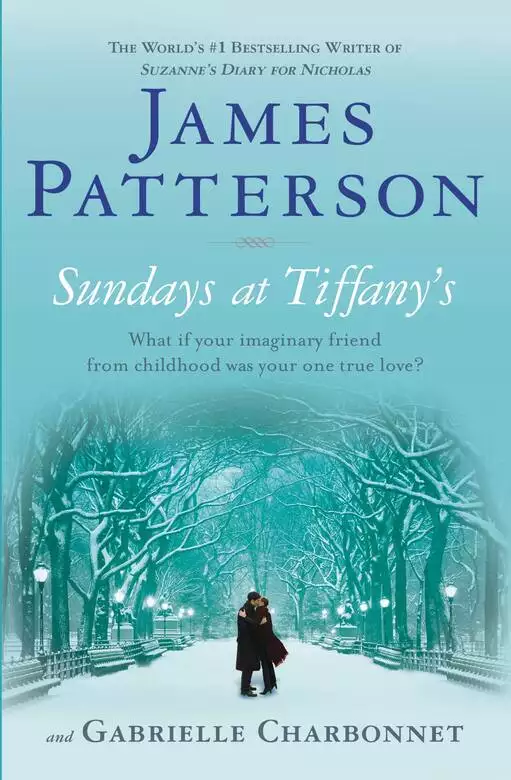
As a little girl, Jane has no one. Her mother Vivienne Margaux, the powerful head of a major New York theater company has no time for her. But she does have one friend--Michael--and no one can see him but her. But Michael can't stay with Jane forever, and on her eighth birthday, her imaginary friend must leave her.
When Jane is in her thirties, working for her mother's company, she is just as alone as she was as a child. Her boyfriend hardly knows she's there and is more interested in what Vivienne can do for his career. Her mother practically treats her as a slave in the office, despite the great success of Jane's first play, "Thank Heaven." Then she finds Michael--handsome, and just the same as she remembers him, only now he's not imaginary. For once in her life, Jane is happy--and has someone who loves her back. But not even Michael knows the reason behind why they've really been reunited.
Release date:
November 8, 2010
Publisher:
Little, Brown and Company
Print pages:
309
* BingeBooks earns revenue from qualifying purchases as an Amazon Associate as well as from other retail partners.
EVERY DETAIL of those Sunday afternoons is locked in my memory, but instead of explaining me and Michael right off, I’ll start with the
world’s best, most luscious, and possibly most sinful ice cream sundae, as served at the St. Regis Hotel in New York City.
It was always the same: two fist-sized scoops of coffee ice cream, swirled with a river of hot fudge sauce, the kind that
gets thicker, gooey and chewy, when it hits the ice cream. On top of that, real whipped cream. Even at eight years old, I could tell the difference between real whipped cream and the fake-o nondairy product
you squirt from a can.
Across from me at my table in the Astor Court was Michael: hands down the handsomest man I knew, or have ever known, for that matter. Also, the nicest, the kindest, and probably the wisest.
That day his bright green eyes watched me gaze at the sundae with undisguised delight as the white-coated waiter set it in
front of me with tantalizing slowness.
For Michael, a clear glass bowl of melon balls and lemon sherbet. His ability to deny himself the pleasure of a sundae was
something my child’s brain couldn’t wrap itself around.
“Thanks so much,” Michael said, adding extreme politeness to his list of enviable qualities.
To which the waiter said—not a word.
The Astor Court was the place to go for a fancy dessert at the St. Regis Hotel. That afternoon it was filled with important-looking
people having important-looking conversations. In the background, two symphony-worthy violinists fiddled away as if this were
Lincoln Center.
“Okay,” Michael said. “Time to play the Jane-and-Michael game.”
I clapped my hands together, my eyes lighting up.
Here’s how it worked: One of us pointed to a table, and the other had to make up stuff about the people sitting there. The
loser paid for dessert.
“Go,” he said, pointing. I looked at the three teenage girls dressed in nearly identical pale yellow linen dresses.
Without hesitation, I said, “Debutantes. First season. Just graduated from high school. Maybe in Connecticut. Possibly—probably—Greenwich.”
Michael tilted his head back and laughed. “You’re definitely spending too much time around adults. Very good, though, Jane.
Point for you.”
“Okay,” I said, gesturing toward another table. “That couple over there. The ones who look like the Cleavers in Leave It to Beaver. What’s their story?”
The man was wearing a gray-and-blue-checked suit; the woman, a bright pink jacket with a green pleated skirt.
“Husband and wife from North Carolina,” Michael rattled off easily. “Wealthy. Own a chain of tobacco shops. He’s here on business.
She came to do some shopping. Now he’s telling her that he wants a divorce.”
“Oh,” I said, looking down at the table. I let out a deep breath, then took another spoonful of sundae and let the rich flavors
unfold in my mouth. “Yeah, I guess everyone gets divorced.”
Michael bit his lip. “Oh. Wait, Jane. I got it all wrong. He’s not asking for a divorce. He’s telling her that he has a surprise—he’s made arrangements for them to go on a cruise. To Europe
on the QE2. It’s their second honeymoon.”
“That’s a much better story,” I said, smiling. “You get a point. Excellent.”
I looked down at my plate and saw that somehow my ice cream sundae had completely vanished. As it always did.
Michael looked around the room dramatically. “Here’s one you won’t get,” he said.
He pointed to a man and a woman just two tables away.
I looked over.
The woman was about forty years old, well dressed, and stunningly pretty. You might have taken her for a movie actress. She
wore a bright red designer dress and matching shoes and had a big black pocketbook. Everything about her said, Look at me!
The man she was with was younger, pale, and very thin. He was wearing a blue blazer and a patterned silk ascot, which I don’t
think anyone was wearing even back then. He waved his arms enthusiastically as he spoke.
“That’s not funny,” I said, but I couldn’t help grinning and rolling my eyes.
Because, of course, the couple was my mother, Vivienne Margaux, the famous Broadway producer, and that year’s celebrity hairdresser,
Jason. Jason, the hothouse flower, who didn’t have time for a last name.
I looked over at them again. One thing was for sure: My mom was beautiful enough to be an actress herself. Once, when I asked her why she hadn’t become one, she said, “Honey, I don’t want to ride the train. I want to drive the train.”
Every Sunday afternoon when Michael and I had dessert at the St. Regis, my mother and a friend had dessert and coffee there
too. That way she could gossip or complain or conduct business but still keep an eye on me, without actually having to be
with me.
After the St. Regis, we would cap off our Sundays at Tiffany’s. My mother loved diamonds, wore them everywhere, collected
them the way other people collect crystal unicorns, or those weird ceramic Japanese cats with the one paw in the air.
Of course I was okay, those Sundays, because I had Michael for company. Michael, who was my best friend in the world, maybe
my only friend, when I was eight years old.
My imaginary friend.
I SNUGGLED CLOSER to Michael at our table. “Want to know something?” I asked. “It’s kind of a bummer.”
“What?” he asked.
“I think I know what my mother and Jason are talking about. It’s Howard. I think Vivienne’s tired of him. Out with the old,
in with the new.”
Howard was my stepfather, my mother’s third husband. The third one I knew about, anyway.
Her first husband had been a tennis pro from Palm Beach. He’d lasted only a year.
Then had come Kenneth, my father. He’d done better than the tennis pro, lasting three years. He was really sweet, and I loved
him, but he traveled a lot for business. Sometimes I felt as if he forgot about me. I’d heard my mother tell Jason that he’d
been “spineless.” She didn’t know I’d overheard. She’d said, “He was a good-looking jellyfish of a man who will never amount to anything.”
Howard had been around for two years now. He never traveled on business and didn’t seem to have a job, other than helping
Vivienne. He massaged her feet when she was tired, checked that her food was salt-free, and made sure that our car and driver
were absolutely always on time.
“Why do you think that?” Michael asked.
“Little things,” I said. “Like Vivienne used to buy him stuff all the time. Fancy loafers from Paul Stuart and ties from Bergdorf
Goodman’s. But she hasn’t given him anything in ages. And, last night, she ate at home. Alone. With me. Howard wasn’t even
there.”
“Where was he?” Michael asked. I could see the sympathy and concern in his eyes.
“I don’t know. When I asked Vivienne, she just said, ‘Who knows and who cares?’ ” I imitated my mother’s voice, then shook
my head. “Okay,” I said. “New topic. Guess what day Tuesday is.”
Michael tapped his chin a few times. “No idea.”
“C’mon. You know perfectly well. You know, Michael. This isn’t funny.”
“Valentine’s Day?”
“Stop it!” I told him, kicking him gently under the table. He grinned. “You know what Tuesday is. You have to. It’s my birthday!”
“Oh, yeah. Wow, you’re getting old, Jane.”
I nodded. “I think my mother is having a party for me.”
“Hmm,” Michael said.
“Well, anyway, I don’t care about a party, really. What I really want is a real, live puppy.”
Michael nodded.
“Cat got your—” I started to say but then stopped in midsentence.
Out of the corner of my eye, I saw Vivienne signing the check. In a minute she and Jason would be standing over our table,
hustling me off. This Sunday at the St. Regis was coming to a close. It had been another wonderful afternoon for me and Michael.
“Here she comes, Michael,” I whispered. “Look invisible.”
VIVIENNE STRODE TOWARD our table as if she owned the St. Regis. Jason trailed along behind her. No one in the Astor Court would have believed that
this beautiful woman with the perfect makeup, the perfect skin, the perfect tan, was in any way related to the pudgy eight-year-old
with frizzy hair and smudges of fudge sauce on both cheeks.
But there we were. Mother and daughter.
Vivienne kissed me on the cheek and then got down to business. The business of me.
“Jane-Sweetie…” She almost always called me “Jane-Sweetie,” as if that were my actual name. “Must you always order two desserts?”
Jason the celebrity hairdresser tried to help. “Well, Vivienne, the second dessert was melon. That’s not too bad. Carbs, of
course, but—”
“Jane-Sweetie, we’ve talked about your weight—” my mother began.
“I’m only eight years old,” I said. “How about I promise to be anorexic later?”
Michael laughed so hard he nearly fell off his chair.
Even Jason smiled.
Vivienne didn’t move a facial muscle. She was always trying not to frown because she didn’t want to get wrinkles before her
time. Say, ninety or so.
“Don’t be precocious with me, Jane-Sweetie.” She turned to Jason. “She reads far too many books.” Yeah, I’m terrible that
way, I thought. Vivienne turned back to me. “We’ll discuss your eating habits at home. In private.”
“Anyway,” I told her, “that melon isn’t even mine. Michael ordered it.”
“Ah, yes,” said Vivienne, sounding bored, “Michael, the amazing, ever-present imaginary friend.” She addressed the chair next
to mine, which was empty. Michael was on my other side. “Hello, Michael. How are you today?”
“Hello, Vivienne,” said Michael, knowing she couldn’t see or hear him. “I’m just peachy, thanks.”
All of a sudden I felt Jason tugging at a handful of my hair.
“Hey!” I protested.
“Something must be done about this,” he said. “Vivienne, give me one hour with this hair. There’s no reason why anyone should
walk around like this. She’ll come out looking like a Vogue model.”
“That’s great,” Michael said. “Just what the world needs—an eight-year-old who looks like a Vogue model.”
I winced and pulled my hair away from Jason.
“Come, Jane-Sweetie,” said Vivienne. “There’s a full-cast rehearsal tonight, and I must look in on it.” Her latest huge Broadway
musical, The Problem with Kansas, was opening in days.
“But first we can drop by Tiffany’s, like we always do, dear. Our time together.”
“What about Jane’s hair?” Jason demanded. “When can I schedule her makeover?”
Michael shook his head. “You’re perfect the way you are, Jane. You don’t need a makeover. Never forget that.”
“I won’t,” I said.
“You won’t what?” asked Vivienne. She took a napkin, dipped it in my water glass, and wiped the fudge sauce from my cheeks.
“A makeover’s a great idea, Jane-Sweetie. There might be a big fancy party in your future.”
She remembered! A birthday party! I thought, and suddenly I forgave her for everything else.
“Come along now. I hear Tiffany’s calling.” Vivienne spun on her four-inch heels and headed for the exit, Jason close behind
her.
Michael and I both got up. He leaned down and kissed the top of my head, right on the frizzy hair that pained Jason so.
“See you tomorrow,” he said. “Miss you already.”
“Miss you already, too.”
I looked ahead and saw my mother’s slim, tan legs disappearing into the St. Regis’s revolving door. She glanced back. “Jane-Sweetie,
come! Tiffany’s.”
I ran to catch up.
I was always doing that.
POOR, POOR, POOR JANE! Poor, poor little girl! The next morning, Michael waited outside Jane’s fancy Park Avenue building, as he always did. It was a good thing he was
invisible: his wrinkled corduroys, faded yellow golf shirt, and docksiders wouldn’t cut it in this pricey neighborhood.
He was thinking about something pretty amazing that Jane had said when she was only four years old. Vivienne had been heading
off to Europe for a month. He’d been concerned about how Jane would cope. But Jane had shrugged it off and said, “Love means
you can never be apart.” Michael knew he would never forget that—out of a four-year-old’s mouth and brain, no less. But that
was Jane, wasn’t it? She was an incredible girl.
So what was he going to do with himself on this lovely day while Jane was locked away in school? Maybe a big breakfast over at the Olympia Diner—pancakes, sausage, eggs, keep the buttered rye toast coming. He might even
get together with a couple of other imaginary friends who worked in the neighborhood. What exactly were the duties of an imaginary friend? Pretty much just to make it easier for the child to fit into the world without feeling too alone or scared. Hours? Whatever it took. Benefits? The incredibly pure love between a kid and an imaginary friend. It didn’t get better than that. Where did h. . .
We hope you are enjoying the book so far. To continue reading...

 Please log in to recommend or discuss...
