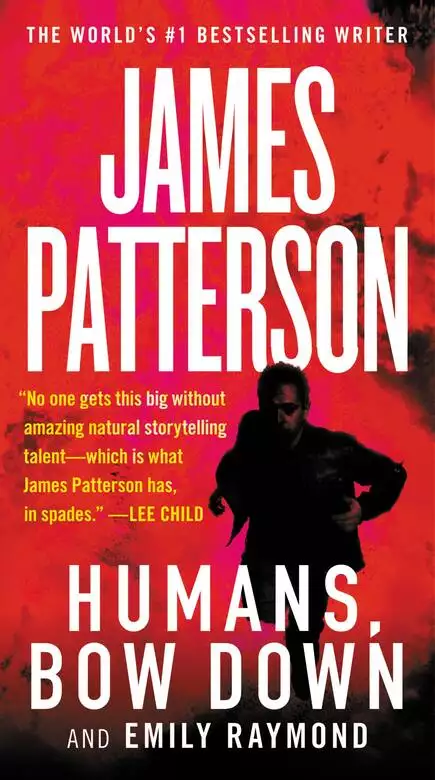
Random House present the unabridged, downloadable audiobook edition of Humans, Bow Down by James Patterson, read by Tara Sands.
Hu-bots - robots that humans created as perfect versions of themselves - now control the world. They seized power in a war that almost wiped humankind off the face of the earth. The humans that remain are forced to either work as servants or live in prison camps.
But one teenage girl, Six, has a device that could change everything. Her Q-comp, a computer onto which the memories of her murdered family have been downloaded, contains information that could save humankind.
Six is unaware of the power she holds, but the ruling hu-bots are not. Forced to flee from those sent to kill her, can Six discover the secret that could save her life, and the future of the human race?
Release date:
January 30, 2018
Publisher:
Little, Brown and Company
Print pages:
400
* BingeBooks earns revenue from qualifying purchases as an Amazon Associate as well as from other retail partners.
BE WARNED. YOU. Yes, I’m talking to you. Reading a treasonous book or digital tract like this one is punishable by hanging. That’s if you’re one of the few left who even knows how to read.
Can you read, friend? I know, I know, it’s a stupid question. Or maybe a test? Maybe a trap?
Listen very carefully. It’s fair to say that there’s not much hope anymore—not for you, and definitely not for a poor wretch from the Reserve like me.
The joke on the food lines at the Res is that they’re measuring us all for body bags. But that’s being way too cheery. It’ll be mass graves at best.
I’m just saying… look around, and what do you see?
Trash piled high as a Colorado snowdrift in January, smelling like mid-July in Bangkok, or Los Angeles, or Paris. A jagged junk heap of broken pallets and busted-up furniture: baby cribs and cradles, smashed door frames, windows and mirrors. A greasy, toothless hag—the former Mrs. Cullen—who captures stray cats (one of them mine) and boils them in soup.
Welcome to the Reserve, where the wind whistling up the mountain feels cold even in the summer. Where the sky’s the only clean thing there is.
There’s nothing to do up here. There aren’t any jobs, and there’s no good soil to farm. It’s like living in a giant, open-air, high-altitude prison.
Babies die in childbirth every day—some in the gutters, or in abandoned cars, or on filthy mattresses in dark and tiny rooms. The kids who do survive grow up hungry, bitter, and desperate. Most people croak before they’re fifty, and if they don’t, they wish they did.
There’s a rumor blowing in the foul winds that the government’s going to come out here and raze this mountain ghetto to the ground, exterminating every man, woman, and child.
I believe it. That’s the truth, not just a filthy rumor. Actually, I know it’s true. I know things that you don’t. Be patient. I’m going to tell you everything, all the sordid details.
But try walking around with the weight of that knowledge on your shoulders: Pretty soon, we’ll all be dead. Exterminated. Annihilated. Massacred.
And there’s not a thing we can do about it but wait.
Maybe that’s why I stole a motorcycle that night. Because what difference did it make?
Besides, I needed transportation. I was going to see my family, such as they are. Misfits. Jailbirds.
So power on, power up. Release the clutch slowly and gas it at the same time, easy, easy, not too much—now enjoy the ride!
I jerk forward, dizzy on gasoline fumes and hopped up on adrenaline, feeling the power of the bike rattling between my legs. I squeeze the clutch again, shift into second… and stall out.
My best friend in this hellhole’s on a Yamaha up the road, a good fifty yards ahead. Even from here, I can hear him groan and laugh at me.
“Girl, you’re on fire. You almost made it to second gear this time,” Double Eight (I call him Dubs) yells over his shoulder.
I flip him off, then bend down to adjust my headlight, which is sagging toward the ground. Our motorcycles are boneyard specials: mismatched rusted parts held together by bolts and luck. We’re supposed to be learning how to fix them in the Reserve Trade School.
Usually we just skip dumb-dumb school. But today… well, today we decided to steal the classroom materials.
But I’ve never driven anything more powerful than a bicycle before, because it’s against the law.
I kick piles of trash out of the way, trying to clear a smoother path for take-off. Dubs circles back and glides to a stop next to me.
“You gotta relaaaax,” he says. “Otherwise we’re going to have to put the training wheels back on.” Dubs grins like the lovable fool he is and revs the motor. “Ready or not, here goes nothing!” he yells.
Clutch, throttle, gas…
“The road to prison waits for no man,” he crows, “or woman.” He peels away first, leaving a fat black streak on the pavement, a puff of dark smoke in the air. “Yeeeeehaw!”
There’s Dubs for you. He could be the poster boy for everything the ruling Hu-Bots say is wrong with the human race. He looks like a born thug: dirty, scarred, missing about six teeth. His jokes are crude. And he’s about as wild and crazy as they come.
It wasn’t my idea to steal the bikes, is what I’m saying.
“Loosen up, Six,” I say to myself. We all just go by the first few numbers of our IDs, since they’re a bitch to remember. Once upon a time, I had a real name. No one calls me by it anymore.
Power on, power up. Clutch, shift, gas, clutch, shift…
You’re going to see your family today. Yahoo!
I hear the choking cough of the engine and I tense, but then I ease up and give that baby a little more gas. The bike bucks beneath me and roars to life, and suddenly I’m riding.
Second gear, then a smooth upshift to third. Fourth.
The wind whistles in my ears and brings actual tears to my eyes. The slums of the Reserve start to recede in my rearview.
The bike’s a Yamaha R6, a dinosaur compared with what they’ve got in the City—what used to be Denver, Colorado. But pushing 90, 120, 130, miles an hour down a winding mountain road, it feels like flying. And if it means I end up in prison or as smear on the highway, at least I’ll have had this moment.
I’ll know what it felt like to be alive.
At least, for one bright and shining morning, I’ll be able to say I was free.
AT THE EDGE of the mountain, just before the highway dips down and splinters into the smaller streets of the City, I skid to a stop next to Dubs.
Below us, the buildings shine and the lights glitter tantalizingly. I take a deep breath. Here—unlike on the Reserve—the air’s warm and clean.
“We’re gonna be early,” Dubs says.
I nod—I know. We’ve got places to go and my family to see, but I don’t want to think about that yet. Instead I think, What if we could live here, instead of high up on the mountain, in a stew of human filth? What would life be like in this city?
The Hu-Bots would never let that happen, of course. They think we’re hopeless savages. And, with our sunburned skin and our holey, dirty clothes—well, we look the part. I drag my fingers through my hair, but that can only take a girl so far.
“Whaddya say?” Dubs asks. “Wanna go stink the place up?”
I rev the engine. “Yeah,” I say. “Let’s get us some trouble.”
We roll into the City—not Denver now, never Denver anymore, because lowly humans named it that—and ditch the bikes on a back street before a robot cop can bust us for illegal operation and theft of a motor vehicle.
And to think: we humans created this world. We designed and built it all—including the robots that nearly destroyed us and want to finish the job soon.
On foot, we head toward the city center. Dubs gnaws on a bug bar, offers me a bite. “Some delicious, nutritious insect protein for you?” he asks.
“No, thanks.” Our rations include a half dozen bars a week, but I don’t eat food made from cricket flour unless I’m truly desperate.
Everything’s so perfect in the City that it’s creepy. You might call it inhuman.
As Dubs and I approach downtown, we start to hear it: the white noise, the hum of a city whose residents run on electric current. The Bot buzz: it makes the hairs on the back of my neck stand at attention.
Today the low drone seems more ominous than usual. Like maybe, if I listen hard enough, I’ll be able to make out whispered words, something like Diehumansdie.
I shake my head. I’ve got to stop thinking these morbid, depressing-as-hell thoughts.
Dubs breaks a branch off a tree and begins whacking the heads off rose bushes dotting a church lawn. Through a stained-glass window, I can see rows of Hu-Bots, their heads bowed, reciting the prayers of my ancestors.
Now that’s something I’ll never understand. My people used to pray to the gods they believed made them: Our Father, who art in Heaven, etc. But we made the Bots.
First we built regular Bots, with limited, programmable powers of reason. They could cook, clean, babysit, I guess. Simple, functionary stuff.
But that wasn’t enough for us. We wanted robots that could think for themselves. That were smarter, stronger, faster than we were. So we created the Hu-Bots.
And that was our fatal mistake.
Dubs bats a bright-pink rose so hard, it crashes against the window of the church. He lifts his arms up to the sky. “We built you! I am your god!” he bellows.
“Dubs!” I hiss. “Don’t.”
Thankfully, the “parishioners” are too devout to avert their eyes from the pulpit. That’s another thing I don’t think I’ll ever understand: the Hu-Bots loathe humans, and yet they imitate pretty much everything about our culture.
“I just don’t like this place,” I say. But what I mean is: We don’t belong here, and I hate that. Everywhere I look, I see the remnants of human creativity, of our ingenuity, of our past.
If only I could do something—anything—to make it different.
We round the corner and enter a busy avenue lined with expensive boutiques and five-star restaurants. Very glitzy.
Even if Dubs and I had a plateful of money, we couldn’t go into these places. They’re Bot only.
I grit my teeth as we pass a crowded bistro and the smell of seared meat rolls out the open door. I don’t care about being able to buy fancy clothes, but I’d kill to eat a steak sometime. I know I’ve had one before, but I can’t remember what it tastes like.
Tall, willowy Hu-Bots and shorter, stockier Bots stream by us on the sidewalk as we stand there, drooling. The Hu-Bots are all elegantly dressed, and their faces are too perfect looking—like high-end mannequins given the breath of life. With their large, clear eyes, high cheekbones, and flawlessly smooth bioskin, they look distantly related to each other.
Which, in a way, they are. I mean, synthetic polymer skeletons do all come from the same factory, right?
I peer through the steak house window. A Hu-Bot—a blue-eyed, silver-haired female sporting the metallic choker worn by all Hu-Bots—delicately chews her meat.
“I mean, she—it—doesn’t even need that protein,” Dubs moans.
He’s right. Sometime in the past few years, Hu-Bots engineered themselves to eat, simply for pleasure. (And yeah, that means they crap, too. I don’t understand the biomechanical details, and I don’t want to.) They make themselves out to be superior because their emotions aren’t messy and “savage,” like ours, but it’s apparently totally civilized for them to cram their gullets with lobster, pizza, and milk shakes just because they taste good.
Meanwhile we humans, who do not run on batteries or electric current or nanotechnology, survive on bug bars and mildewed bread and the gristly bones of wild turkeys.
“Maybe we should just go over to HCF,” I say, “where we belong.”
In the shadow of the gilt and glitter of the promenade is the HCF, or Human Charging Facility. It’s the only part of the City where we humans can actually enter a restaurant. Even the Reformed humans—the ones who live in the City and serve our robot masters—have to do their business in this biological ghetto.
It’s cramped and grungy over there, with big, ugly signs for H-RR (restrooms), H-L (lodging), and H-E (eats).
I keep staring at that juicy T-bone. “We’re going to go there with what money?” I pat my empty pockets.
“Humans!” I jump at the sudden electronic call of a Bot-cop. It’s hard not to be jittery when you’re basically breaking a law just by breathing.
“HUMANS!” IT SAYS again. It sounds like hoo-mons. “Papers.”
The Bot-cop is rolling toward us, holding out a gloved, robotic hand. What an ass. A hard-ass, right?
Papers are the key to the kingdom, a pass to get around the City. My papers list the nine-digit number I was assigned—easier than names for the Bots to track—and identify me as a Reserver, and no, I don’t have them on me. Why carry around something that identifies me as the lowest of the low?
Dubs finally wrenches his eyes away from the steak and turns to me. “Got yours?” he whispers.
“What do you think?” I mutter. “You?”
He grins. “Oh jeez, I used mine as toilet paper.”
And that’s all that needs to be said. Time to get scarce.
We run toward the market, which is always crawling with the Reformers—essentially human slaves—doing the weekly shopping for their robot overlords. Maybe we’ll be able to blend in, but I doubt it.
At the corner, Dubs and I split and run in opposite directions. It takes the Bot-cop a second to pick a target. When it looks like he’s going for Dubs, I slow a little.
“Yo, Sparky,” I taunt the Bot—because Dubs might be a year older, but I’m a whole lot faster.
The Bot-cop hesitates again. Then it switches course and motors after me. I dive into the crowd of Reformed humans, shoving my way past the dead-eyed workers of the City. I hunch my shoulders and turn my gait into a meek little shuffle, and suddenly the Bot can’t pick me out of the crowd.
The human slaves shoot me uneasy looks; they know I’m not one of them, and they don’t want to touch me. Honestly, I can’t totally blame them.
When I’m pretty sure I’ve lost the Bot-cops, I straighten up, weave through the stalls, and let out a loud, reckless whistle. Dubs doesn’t whistle back, but he’s got to be around here somewhere.
Then, in the distance, I hear the trumpeting blare of horns. I can’t hold back a shiver.
I clamp my mouth shut as the caravan rounds the corner. Ten black stretch limos inch forward slowly, ominously, their paint gleaming and their chrome blindingly bright. A rumor ripples through the crowd like a cold breeze: it’s MosesKhan, commander of the police and army. That pig.
When the limos stop in the center of the market square, my blood turns to ice. Just like on that first day of the Great War, I wait for the pop of gunfire. I wait for it to be my turn to die.
Instead, a loudspeaker from the lead limo announces, “HUMANS, BOW DOWN!”
A HUSH FALLS over the crowd. There’s always a pause when a Hu-Bot gives that order, a heavy, dangerous, messed-up silence. Following the order means humiliation. It’s beyond wrong—it’s an abomination. I want to cry out to all my fellow humans: Grab a brick from the street and pick it up. Don’t bow down—FIGHT!
But I’m no leader. I’m a Rezzie loser, and a girl at that. No one’s going to listen to me, right?
“HUMANS, BOW DOWN!”
I hear the rustle of clothing as people start to bend. My teeth are clenched, my fists balled at my sides, but if I stand much longer, there’s going to be a scene.
Not that Hu-Bots engage in such viciousness—they’re evolved! That’s what they program the Bot-cops for, and the market is now crawling with those dutiful, murderous little workers.
I finally drop down, one leg at a time, and join my species on the cobblestones. The white brick digs into my skin through the thin fabric of my pants. But I’m glad it hurts. It should hurt to grovel.
The Bot brigade surges forward to crack down on “dissenters”—in this case, a frail, white-haired woman who can’t seem to bend her knees. You don’t see many old-timers these days, maybe because their hearts aren’t strong enough to be repeatedly broken. She’s thin and trembling. Something about her makes me think of my own mother.
Maybe it’s the faded red purse she’s clutching to her chest. My mom had a purse like that. I think so.
The loudspeaker voice chants, “BOW DOWN, BOW DOWN, BOW DOWN,” in an increasingly urgent loop. The woman is struggling desperately, trying to bend her old bones down to the bricks.
I stare at the ground when I hear the first crack of their billy clubs. I hear her cry out. Bile rises in my throat.
The Bots aren’t advanced enough to understand pain—or mercy. They’re just rotely following orders. That’s what makes it maddening.
But what about the Hu-Bots in those shiny cars? The so-called intelligent machines, supposedly more ethical, moral, and sane? That’s who’s giving the cold-blooded orders.
Each time I hear the old woman moan, the white bricks blur in my vision. Don’t let this happen, Six! I tell myself I can tackle a Bot. Or throw myself between the old woman and the clubs. But fear holds me back, holds me down.
I am… so fucking ashamed of myself.
It’s him! The door to the first limo opens, and the Hu-Bot commander emerges. MosesKhan is close to seven feet tall, with eyes cold and black as outer space.
Those arrogant, merciless eyes sweep the crowd, and everyone bows so low, their tonsils practically rub the pavement.
“Humans.” He spits out a comment. “In the posture that befits their base nature.” Then, with one last withering look at the prostrate crowd, MosesKhan climbs back into his limousine.
When I finally rise, I find I’ve bitten almost all the way through my lip. The last of the limos is pulling away. The elderly woman lies motionless on the cobblestones. Her legs are twisted beneath her. Purple bruises have appeared on her arms and face. She’s weeping.
I hold my hand out to her, and when she reaches for it, her grip is firm and leathery.
“What are you doing?” It’s Dubs, appearing out of nowhere.
“Something,” I say.
He shakes his head. “Something idiotic.”
“My purth…,” the woman lisps through swollen lips. She spits a mouthful of blood—and a busted incisor. “Has my paperth.”
“We’ll find it,” I assure her, sweeping the ground with my eyes.
“Thank you, dear,” she whispers. “You’re brave.”
I cringe, knowing how much of a coward I am.
“Yo, Sixie,” Dubs says. “Time to split.” He points, and I see that the Bot-cop who hassled us earlier is back—along with two of his buddies.
I hesitate over the poor old woman, but Dubs grabs the collar of my shirt in one of his meaty fists. “Come on, I’m not letting you get us killed. Not today. Maybe next time.” He shoots a glance at the old woman. “Sorry, lady.”
WE’RE RUNNING AT top speed do. . .
We hope you are enjoying the book so far. To continue reading...

 Please log in to recommend or discuss...
