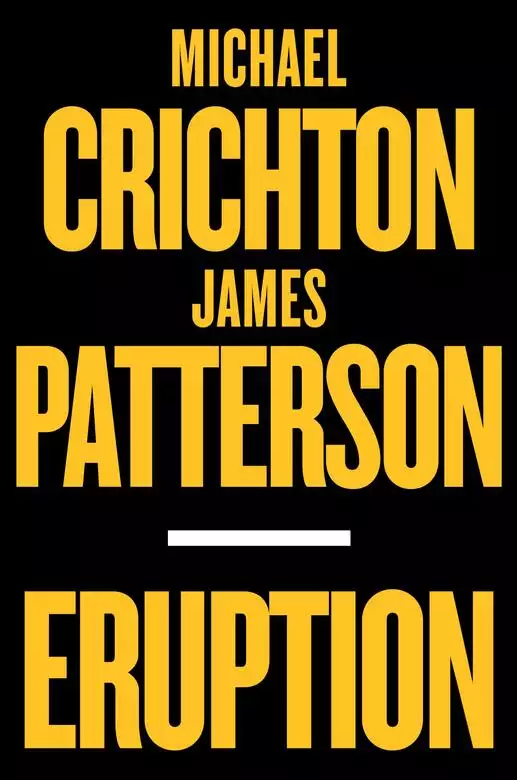
The biggest thriller of the year: A history-making eruption is about to destroy the Big Island of Hawaii. But a secret held for decades by the US military is far more terrifying than any volcano.
“The book is a classic summer beach read...Eruption will revive the art of speed-reading...told with a singular voice that is a compelling amalgam of the two writers.”—USA Today
“Eruption is an epic thriller…fast-paced and deeply considered…a cinematic story rooted in science and infused with plenty of heart, tackling big themes like love and loss.” –Time
The master of the techno-blockbuster joins forces with the master of the modern thriller to create the most anticipated mega bestseller in years.
Michael Crichton, creator of Jurassic Park, ER, Twister, and Westworld, had a passion project he’d been pursuing for years, ahead of his untimely passing in 2008. Knowing how special it was, his wife, Sherri Crichton, held back his notes and the partial manuscript until she found the right author to complete it: James Patterson, the world’s most popular storyteller.
“Red-hot storytelling... The action scenes will make readers’ eyes pop as the tension continues to build." –Kirkus, starred review
“Explosive…the summer’s ultimate literary mashup.” —Washington Post
"Takes readers on a thrilling journey." —BBC
"Beachbag-ready." —Boston Globe
“A seismic publishing event…all the elements of a summer blockbuster…it’s a thrill and the pages practically turn themselves.” —Associated Press
“Eruption is this summer’s literary version of a blockbuster action movie.” –Los Angeles Times
"Breakneck and plausible." —Publishers Weekly
Publisher:
Little, Brown and Company
Print pages:
400
* BingeBooks earns revenue from qualifying purchases as an Amazon Associate as well as from other retail partners.
Rachel Sherrill, thirty years old in a few days, master’s degree from Stanford in conservation biology, rising star in her world, still thought of herself as the smartest kid in the class. Just about any class.
But today at the Hilo Botanical Gardens, she was trying to be the cool substitute teacher for a restless, wide-eyed bunch of fifth-graders visiting from the mainland.
“Let’s face it, Rachel,” the general manager of the botanical gardens, Theo Nakamura, had said to her early that morning. “Taking these undersized tourists around is a way for you to put your immaturity to good use.”
“Are you saying I act like a ten-year-old?”
“On a good day,” Theo said.
Theo was the fearless academic who had hired her when the park opened last year. As young as Rachel was—and looked—she was very good at what she did, which was serve as the park’s chief plant biologist. It was a plum job, and she loved it.
And to be honest, one of her favorite parts of the job was conducting tours for kids.
That morning’s walk in the park was with some very lucky and well-heeled schoolkids who had traveled all the way here from Convent and Stuart Hall in San Francisco. Rachel was trying to entertain and educate the kids about the natural world surrounding them.
But as much as she wanted to lecture about what they were observing—orchid gardens; soaring bamboos; coconut palms; jackfruit trees; edible plants like breadfruit, kukui, and red pineapple; dueling hundred-foot-high waterfalls; hibiscus literally everywhere—Rachel had to compete for the children’s attention with the two closest of the five volcanoes on the Big Island: Mauna Loa, the largest active volcano in the world, and Mauna Kea, which hadn’t erupted in more than four thousand years.
These city kids clearly considered the twin peaks the highlight of their tour, the best sight they’d seen in the picture-postcard wonderland called Hawai‘i. What kid wouldn’t give anything to watch Mauna Loa erupt and spew out a stream of lava heated to over a thousand degrees?
Rachel was explaining that Hawai‘i’s volcanic soil was one of the reasons why there was so much natural beauty on the island, a PowerPoint example of the good that had come out of past eruptions, helping Hawai‘i grow beans that produced coffee as delicious as any in the world.
“But the volcanoes aren’t going to explode today, are they?” a little girl asked, her large brown eyes pinned to the twin peaks.
“If they even think about it,” Rachel said, “we’re going to build a dome over them like we do with those new football stadiums. We’ll see how they like that next time they try to blow off a little steam.”
No response. Crickets. Pacific field crickets, to be exact. Rachel smiled. Sometimes she couldn’t help herself.
“What kind of coffee comes from here?” another straight A–student type asked.
“Starbucks,” Rachel said.
This time they laughed. One in a row, Rachel thought. Don’t forget to tip your waiters.
But not all the kids were laughing.
“Why is this tree turning black, Ms. Sherrill?” an inquisitive boy with wire-rimmed glasses sliding down his nose called out.
Christopher had wandered away from the group and was standing in front of a small grove of banyan trees about thirty yards across the lawn.
In the next instant, they all heard the jolting crash of what sounded like distant thunder. Rachel wondered, the way newcomers to Hawai‘i always wondered, Is a big storm coming or is this the start of an eruption?
As most of the children stared up at the sky, Rachel hurried over to the studious, bespectacled boy who was looking at the banyan trees with a concerned expression on his face.
“Now, Christopher,” Rachel said when she got to him, “you know I promised to answer every last one of your questions—”
The rest of what she’d been about to say collapsed in her throat. She saw what Christopher was seeing—she just couldn’t believe her eyes.
It wasn’t just that the three banyan trees closest to her had turned black. Rachel could actually see inky, pimpled blackness spreading like an oil spill, some terrible stain, except that the darkness was climbing up the trees. It was like some sort of upside-down lava flow from one of the volcanoes, but the lava was defying gravity, not to mention everything Rachel Sherrill knew about plant and tree diseases.
Maybe she wasn’t the smartest kid in the class after all.
What the shit—” Rachel began, then stopped herself, realizing that a fragile ten-year-old was standing right next to her.
She bent low to the ground and saw suspicious dark spots leading up to the tree, like the tracks of some mythical round-footed animal. Rachel knelt down and felt the spots. The grass wasn’t moist. Actually, the blades felt like the bristles on a wire brush.
None of the blackness had been here yesterday.
She touched the bark of another infected tree. It flaked and turned to dust. She jerked her hand away and saw what looked like a black ink stain on her fingers.
“These trees must have gotten sick,” she said. It was the best she could offer young Christopher. She tried another joke. “I might have to send them all home from school today.”
The boy didn’t laugh.
Even though it was still technically morning, Rachel announced that they were breaking for lunch.
“But it’s too early for lunch,” the girl with big brown eyes said.
“Not on San Francisco time, it’s not,” Rachel said.
As she ushered the kids back to the main building, her mind raced to come up with possible explanations for what she’d just witnessed. But nothing made sense. Rachel had never seen or read about anything like this. It wasn’t the result of the vampire bugs that could eat away at banyan trees if left unchecked. Or of Roundup, the herbicide that the groundskeepers used overzealously on the thirty acres of park that stretched all the way to Hilo Bay. Rachel had always considered herbicides a necessary evil—like first dates.
This was something else. Something dark, maybe even dangerous, a mystery she had to solve.
When the children were in the cafeteria, Rachel ran to her office. She checked in with her boss, then made a phone call to Ted Murray, an ex-boyfriend at Stanford who had recommended her for this job and convinced her to take it and who now worked for the Army Corps of Engineers at the Military Reserve.
“We might have a thing here,” Rachel told him.
“A thing?” Murray said. “God, you scientists with your fancy words.”
She explained what she had seen, knowing she was talking too quickly, her words falling over each other as they came spilling out of her mouth.
“On it,” Murray said. “I’ll get some people out there as soon as I can. And don’t panic. I’m sure there’s a good reason for this… thing.”
“Ted, you know I don’t scare very easily.”
“Tell me about it,” Murray said. “I know from my own personal experience that you’re the one usually doing the scaring.”
She hung up, knowing she was scared, the worst fear of all for her: not knowing. While the children continued noisily eating lunch, she put on the running shoes she kept under her desk and ran all the way back to the banyan grove.
There were more blackened trees when she got there, the stain creeping up from distinctive aerial roots that stretched out like gnarled gray fingers.
Rachel Sherrill tentatively touched one of the trees. It felt like a hot stove. She checked her fingertips to make sure she hadn’t singed them.
Ted Murray had said he would send some of his people to investigate as soon as he could assemble a crew. Rachel ran back to the lunchroom and collected her group of fifth-graders from San Francisco. No need for anybody to panic. Not yet, anyway.
Their last stop was a miniature rainforest far from the banyan grove. The tour felt endless to her, but when it was finally over, Rachel said, “I hope you all come back someday.”
A thin reed of a girl asked, “Are you going to get a doctor for the sick trees?”
“I’m about to do that right now,” Rachel said.
She turned around and once again jogged back toward the banyan trees. She felt as if the entire day had exploded around her, like one of the volcanoes in the distance.
Honoli‘i Beach Park, Hilo, Hawai‘i
Thursday, April 24, 2025
Time to eruption: 116 hours, 12 minutes, 13 seconds
Dennis!” Standing on the beach, John MacGregor had to yell so the surfer would hear him over the sound of the waves. “How about you don’t go all kūkae on me, if that would be all right with you.”
The kids that John MacGregor was coaching had heard the expression from him before, and they knew full well that it wasn’t a compliment. Kūkae was a native Hawaiian word for “kook,” and when John MacGregor said it, it meant that someone in the water was acting as if he’d never been on a board before. Or was about to end up underneath one.
Mac was thirty-six years old and an accomplished surfer, or at least he had been when he was younger, before his knees started sounding like a marching band every time he got into a crouch on his board. Now his passion for the sport was channeled into these tough fourteen-, fifteen-, and sixteen-year-old kids from Hilo, half of whom had already dropped out of school.
They came to this beach just two miles from downtown Hilo four afternoons a week, and for a few hours they were part of what islanders called the postcard Hawai‘i, the one from the TV shows and the movies and the Chamber of Commerce brochures.
“What did I do wrong, Mac man?” fourteen-year-old Dennis said as he came out of the water.
“Well, to start with, that wasn’t even your wave, it was Mele’s,” Mac said.
The two of them stood at the end of the exposed reef beach. Honoli‘i was known as a good beach for local surfers, mostly because the strong currents kept swimmers away and the kids had the beach to themselves.
The last one out on the water was Lono.
Lono Akani, who had grown up without a father and whose mother was a housekeeper at the Hilo Hawaiian Hotel, was sixteen and Mac’s favorite. He possessed a natural talent for this sport that Mac only wished he’d had at his age.
He watched Lono, into his crouch now on one of the Thurso Surf lancers Mac had purchased for each of them. Even from here Mac could see him smiling. Surely someday this boy would find fear in the ocean. Or fear would find him. Just not today as he flawlessly rode the inside curve of the wave.
Lono paddled in, put his board under his arm, and walked to where Mac waited on the beach. “Thank you,” he said.
“For what?”
“For reminding me to always see the sets coming,” the boy said. “It’s why I was patient, ya, like you tell me to be, and waited for the wave I wanted.”
Mac patted him on the shoulder. “Keiki maika‘i.”
Good boy.
They heard the rumble from the sky then. Heard it and felt the beach shaking underneath them, making them both stagger.
The boy didn’t know whether to look up or down. But John MacGregor understood what had happened—he knew a volcanic tremor, often associated with degassing, when he felt one. He looked up at the sky around the Big Island. All the kids were doing the same. It made Mac remember something one of his college professors had said about volcanoes and “the beauty of danger.”
When the earth quieted, he felt the phone in his pocket buzzing. He answered and Jenny Kimura said, “Mac, thank God you picked up.”
Jenny knew that when he was coaching his surfers, he didn’t like to be disturbed with minor details from work. The press conference wasn’t starting for another hour, so if Jenny was calling him, it wasn’t about something minor.
“Jenny, what’s wrong?”
“We’ve got degassing,” she said.
No, not a minor detail at all.
“Hō‘o‘opa‘o‘opa,” he said, cursing like one of his surfer boys.
Mac’s eyes were drawn to the twin peaks again and again. They were like a magnet for people who lived here.
“Where?” he asked Jenny, feeling his chest tighten.
“At the summit.”
“On my way,” he said. He hung up and called out to the surfers, “Sorry, boys, gotta bounce.”
Dennis whooped. “Bounce?” he said. “Never say that again, Mac man.”
“Well,” Mac said, “I need to haul ass and get back to work—how’s that?”
“Rajah dat,” Dennis yelled back at Mac, grinning. “You go grind, brah.” All the boys occasionally slipped into pidgin; it was part of the teenage pose.
Mac walked toward his green truck, and Lono caught up to him, board still under his arm, wet hair slicked back. His eyes were serious, troubled.
“That wasn’t Kīlauea, was it?” Lono said, referring to the smallest volcano on the island, keeping his voice low.
“No,” MacGregor said. “How do you know that, Lono?”
“Kīlauea quakes—they’re all shivery and quick, ya? Like a set of waves, one after another, then dying off. That was the big one, wasn’t it?”
MacGregor nodded. “Yeah, kid,” Mac said, “what we just heard came from the big one.”
Lono leaned in and spoke in a low voice, even though no one was close enough to hear him: “Is there gonna be an eruption, Mac?”
MacGregor reached for the door of his truck. On it was a white circle with the letters HVO in the center and the words HAWAIIAN VOLCANO OBSERVATORY on the outside. But then he stopped. Lono looked up at him, eyes more troubled than before, a kid trying hard not to act scared but unable to carry it off. Lono said, “You can tell me if there is.”
Mac didn’t want to say anything that would scare him even more, but he didn’t want to lie to him either. “Come with me to my press conference,” he said, forcing a smile. “You might learn something.”
“Learning all the time from you, Mac man,” the boy said.
Of all the kids, Lono was the one Mac had most aggressively encouraged to become an intern at the observatory, recognizing from the start how fiercely bright this boy was despite average grades in school. He was always in search of approval from Mac that he’d never gotten from his father, who’d deserted him and his mother. It was why he’d done as much reading about volcanoes as he had and knew as much as he did.
But Lono glanced back at the other boys and shook his head. “Nah. You can call and tell me about it later. You gonna be here tomorrow?”
“Not sure right now.”
“This is bad, isn’t it?” Lono asked. “I can see you’re worried even if you’re not saying it.”
“You live here, you always worry about the big one,” Mac said, “whether it’s your job or not.”
MacGregor got in the truck, started the engine, and drove off toward the mountain, thinking about all the things he hadn’t said to Lono Akani, primarily how worried he actually was—and for good reason. Mauna Loa was just days away from its most violent eruption in a century, and John MacGregor, the geologist who headed the Hawaiian Volcano Observatory, knew that and was about to announce it to the press. He’d always known this day would come, probably sooner rather than later. Now here it was.
Mac drove fast.
Merrie Monarch Festival, Hilo, Hawai‘i
Beneath the ribbed ceiling of Hilo’s Edith Kanaka‘ole Stadium, the Tahitian drums pounded so loudly that the audience of three thousand felt the vibration in their seats. The announcer cried the traditional greeting: “Hookipa i nā malihini, hanohano wāhine e kāne, distinguished ladies and gentlemen, please welcome our first hālaus. From Wailuku… Tawaaa Nuuuuui!” A burst of wild applause as the first troupe of women shimmied onto the stage.
This was the Hula Kahiko event during the weeklong Merrie Monarch Festival, the most important hula competition in the Hawaiian Islands and a significant contributor to the local economy of Hilo.
As was his custom, Henry “Tako” Takayama, the stocky chief of Civil Defense in Hilo, stood at the back during the event ceremonies in his trademark aloha shirt and ready smile, shaking hands and welcoming people from all over the Big Island to the annual performance of ancient-style dances by Hawaiian hula schools. Even though his was not an elected job, he had the air of the campaigner about him, like a man who was always running for something.
His upbeat manner had served him well during his thirty years as Civil Defense chief. In that time, he had guided the community through multiple crises, among them a tsunami that wiped out a Boy Scout troop camped on a beach, the destructive hurricanes of 2014 and 2018, the lava flows from Mauna Loa and Kīlauea that took out roads and destroyed houses, and the 2021 eruption on Kīlauea that created a lava lake in a summit crater.
But few people glimpsed the tough, combative personality behind the smile. Tako was an ambitious and even ruthless civil servant with sharp elbows, fiercely protective of his position. Anyone, politician or not, trying to get something done on the east side of Hawai‘i had to go through him. No one could go around him.
In the stadium, Tako, chatting with state senator Ellen Kulani, felt the earthquake at once. So did Ellen. She looked at him and started to say something, but he cut her off with a grin and a wave of his hand.
“No big thing,” he said.
But the tremor continued, and a low murmur ran through the crowd. A lot of the people here today had come from other islands and weren’t used to Hilo’s earthquakes, certainly not three in a row like this. The drumming stopped. The dancers dropped their arms.
Tako Takayama had fully expected earthquakes all during the festival. A week before, he’d had lunch with MacGregor, the haole head of the volcano lab. MacGregor had taken him to the Ohana Grill, a nice place, and told him that a big eruption from Mauna Loa was coming, the first since 2022.
“Bigger than 1984,” MacGregor said. “Maybe the biggest in a hundred years.”
“You have my attention,” Tako said.
“HVO is constantly monitoring seismic imaging,” MacGregor said. “The latest shows increased activity, including a large volume of magma moving into the volcano.”
At that point it became Tako’s job to schedule a press conference, which he did, for later today. He’d done it reluctantly, though. Tako thought that an eruption on the north side of the volcano wouldn’t matter a damn to anybody in town. They’d have better sunsets for a while, the good life would go on, and all would once again be right in Tako’s world.
But he was a cautious man who considered every possibility, starting with the ones that affected him. He didn’t want this eruption to be a surprise or for people to think he had been caught off guard.
Eventually, being a practical man, Tako Takayama found a way to turn this situation to his advantage. He’d made a few calls.
But now he was in the middle of this awkward moment in the auditorium—drums silent, dancing stopped, audience restless. Tako nodded at Billy Malaki, the master of ceremonies, who was standing at the edge of the stage; Tako had already told him what to do.
Billy grabbed the microphone and said with a big laugh, “Heya, even Madame Pele gives her blessings to our festival! Her own hula! She got rhythm, ya!”
The audience laughed and burst into applause. Mentioning the Hawaiian goddess of volcanoes was exactly the right touch. The tremors subsided, and Tako relaxed and turned back with a smile to Ellen Kulani.
“So,” he said, “where were we?”
He was acting as if he himself had ordered the tremors to stop, as if even nature obeyed Henry Takayama.
Hawaiian Volcano Observatory, Hawai‘i
Time to eruption: 114 hours
In the men’s room, John MacGregor leaned over a sink, buttoned the collar of his blue work shirt, tugged up the black knit tie, and ran his fingers through his hair. Then he stepped back a few feet and looked at himself in the mirror. A dispirited face stared back at him. He tried to smile, but it looked painted on. John MacGregor sighed. He hated doing press conferences even more than he hated running budget meetings.
When he stepped out, he found Jenny Kimura waiting for him. “We’re ready, Mac.”
“They’re all here?”
“Honolulu crew just arrived.” Jenny was thirty-two, the scientist in charge of the lab. She was a Honolulu native with a PhD in earth and planetary sciences from Yale, well-spoken, very attractive. Extremely attractive, MacGregor thought. Ordinarily she did the press conferences, but she had flatly refused to do this one.
“Sounds like a Mac thing to me” was what she’d said.
“I’ll pay you to make it a Jenny thing.”
“You don’t have enough money,” she’d said.
Now MacGregor fiddled with the knot on his tie. “What do you think?” he asked her.
“I think you look like you’re on your way to the electric chair,” she said.
“That bad?”
“Worse.”
“Does the tie make me look like a wimp? Maybe I should take it off.”
“It’s fine,” Jenny said. “You just have to smile.”
“You’ll have to pay me,” he said.
She laughed, took him gently by the elbow, and steered him into the changing room. They passed rows of lockers and a line of green heat-resistant jumpsuits that hung from wall hooks, each with a name over it.
“These shoes hurt,” Mac said. He was wearing polished brown oxfords he’d thrown into the truck that morning. They squeaked as he walked, a shoe-store sound.
“You look very akamai for a kama‘āina,” she said. Sharp and with it—for someone who wasn’t a native. “I’ve put the big map on an easel for you to refer to,” she continued, back to business. “The rift zones are marked. The map’s been simplified so it’ll read clearly on TV.”
“Okay.”
“Will you want to use the seismic data?”
“Is it ready?”
“No, but I can get it for you in a blink. The past three months or all of last year?”
“Last year will be clearer.”
“Okay. And satellite images?”
“Just MODIS.”
“It’s on poster board.”
They came out of the changing room, crossed a hall, went down a corridor. Through the windows, Mac saw the other buildings of the Hawaiian Volcano Observatory, all connected by tin walkways. The HVO was built on the rim of the Kīlauea caldera, and even though no lava was flowing in the crater these days, there were always lots of tourists walking around, pointing down at the steam vents.
A fleet of TV trucks, most of them white with satellite dishes mounted on top, were in the parking lot. MacGregor sighed. It wasn’t a happy sound.
“It’ll be fine,” Jenny said. “Just remember to smile. You have a very nice smile.”
“Says who?”
“Says me, handsome.”
“Are you flirting with me?”
She smiled. “Sure, go with that.”
They walked through the data room, where computer techs were hunched over keyboards. He glanced up at the monitors suspended from the ceiling that showed views of various parts of the volcano. Sure enough, there was now steam coming out of the summit crater of Mauna Loa, proof that he’d been right, that he wasn’t being alarmist—the eruption was only days away. He felt as if a ticking clock had begun its countdown.
As they went through the room, a chorus of voices wished him luck. Rick Ozaki’s voice cut through the others: “Nice shoes, ya!”
Now Mac managed a real smile; he reached behind his back and flipped off his friend.
They went through another door and down the main hallway. In the room at the far end, he saw the podium and the map mounted on the easel. He heard the murmur of the waiting reporters.
“How many are there?” Mac asked just before they walked in.
“Everyone we expected,” Jenny said. “Now go be your best self.”
“I don’t have a best self,” he said.
Jenny moved to one side, and Mac stepped forward and felt the eyes of everyone in the room focus on him.
Tako Takayama had told him that when Mauna Loa erupted in December of 1935, George Patton, then a lieutenant colonel in the U.S. Army Air Corps, had been part of the effort to divert the lava flow. At this moment Mac felt like that kind of heat was rushing toward him.
Yeah, he told himself, that’s me, Old Blood and Guts MacGregor.
John MacGregor knew who he was and what his strengths were. Public speaking was not one of them. He cleared his throat and nervously tapped the microphone.
“Good afternoon. I’m John MacGregor, scientist in charge of the Hawaiian Volcano Observatory. Thank you all for coming today.”
He turned to the map. “As you know, this observatory monitors six volcanoes—the undersea volcano Kama‘ehuakanaloa, formerly Lō‘ihi; Haleakalā, on . . .
We hope you are enjoying the book so far. To continue reading...

 Please log in to recommend or discuss...
