
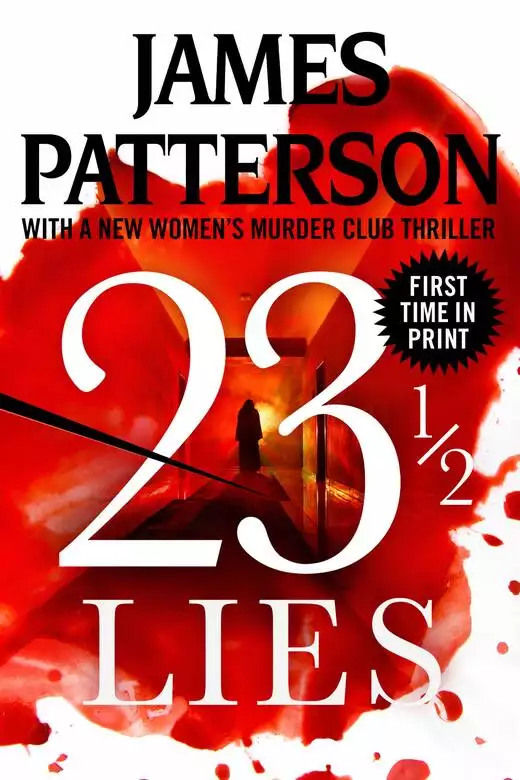
23 1/2 Lies
Available in:
- eBook
- Audiobook
- Book info
- Sample
- Media
- Author updates
- Lists
Synopsis
Enjoy three heart-racing thrillers from the New York Times bestselling master of suspense.
23 1/2 LIES: Lindsay Boxer's estranged father is gunned down execution-style, and her investigation uncovers life-altering truths. (with Maxine Paetro)FALLEN RANGER: To Rory Yates, being a Texas Ranger means absolute loyalty to the badge. But he’s put through the ultimate test when an armored car robbery suspect might be an ex-Ranger gone rogue. (with Andrew Bourelle)
WATCH YOUR BACK: When a starving artist is paid to expose his client's cheating wife, can he paint the picture that will save his own life? (with Loren D. Estleman)
Publisher: Grand Central Publishing
Print pages: 336
* BingeBooks earns revenue from qualifying purchases as an Amazon Associate as well as from other retail partners.
Reader buzz
 Please log in to recommend or discuss...
Author updates
Close
23 1/2 Lies
James Patterson
OVER THE LAST three months, the SFPD homicide squad had been swamped by nightmarish murders of all types. Robbery-homicides, murder-suicides, and a kidnapping where the victim was locked in a car trunk and the drugged-up abductor, the victim’s nephew, turned himself in. But he had no idea where he’d parked the car. The car was found, but too late for Uncle Dave.
I punched out of work at six on Friday and drove home to my family. Mercifully, the horrible week had been overwritten by a weekend of eat, play, love, and sleep.
Now, it was Monday morning.
My closet was the most organized part of my life. I opened the doors, ran my eyes across the neat row of blue trousers, button-down shirts in white, beige, pink, and blue-striped and at the end of the rod, five blue gabardine blazers hung in dry cleaner’s plastic bags. It was very satisfying to just grab and go.
I was dressing, listening to my husband, Joe, and our daughter, Julie, laughing in the large, open, loft-type room outside the bedroom door. I was also thinking of breakfast—a big bowl of granola, say, with strawberries—when I heard a loud crash followed by my daughter’s shrill screams and the barking of our elderly dog, Martha.
What the hell?
I cleared our bedroom in a second and, once inside the main room, focused on the chaos in the kitchen. Julie Ann Molinari, our nearly five-year-old, had her hands to her cheeks, eyes to the floor, screaming, screaming, taking a breath and screaming some more. Joe was admonishing our border collie.
“No, Martha, no. Stop that. Now.”
As Joe made a grab for Martha’s collar, Julie wailed, “Noooo, noooo, nooooo! Mommeeee, hellpppp!”
I hurried into the eye of the storm, shouting, “What’s happening, what?”
“Lindsay, don’t come over here in your bare feet.”
I braked and saw what had gone wrong. A glass globe that had held water, gravel, and two orange goldfish had somehow sailed from its place on the kitchen counter, dropped to the floor, and shattered. Mr. Bubbles and Fanny flopped among the shards and colored bits of fishbowl decor.
“They’re going to be fine,” I said to my daughter. “Don’t worry, but we have to work fast. Joe, can you take Julie?”
“You bet. Lift your arms, Bug. Hang on to me.”
There was a pitcher of distilled water near the sink that I used to top up the fishbowl. I picked up each of the flip-floppers by the tail, slipped them into the pitcher, and dropped in the aerator. Joe tossed a towel onto the floor and said, “Good job, Blondie. I’ll take it from here.”
He handed off our red-faced kiddo and I carried Julie to the couch in the living room. She was still crying as I checked her toes and soles, then mine, and then Martha’s paws. There were no injuries, but the tears continued.
I asked, “What happened, Jules? No, don’t cry. The fishes are fine. I just want to know.”
She gulped down a sob, then said, “I moved the bowl close so I could make fish mouths at them and I slipped…”
“And you grabbed the bowl. Okay. I understand, Julie. I’ll order an aquarium today. It’ll be bigger.”
“You’re not mad?”
“Accidents happen,” I said. I hugged Julie and ruffled Martha’s ears, then finished dressing for work. I planted kisses all around, geared up in the foyer with gun and badge and shouted, “See you all tonight!”
Then I was out the door and down the stairs into a beautiful San Francisco morning. My car was waiting on 12th Street where I’d parked it Friday night. I started her up, then turned my Explorer out onto Lake Street. I was anticipating a smooth fifteen-minute drive to work, an oasis between two points of chaos.
I couldn’t know that in a half hour, I would be faced with a murder that would change my life.
AT QUARTER TO eight, I pushed open the gate on the fourth floor of the Hall of Justice. Homicide’s day shift was logging in, hitting the break room for a stiff mug of leftover night-shift coffee and one of Cappy McNeil’s fresh peanut butter cookies before dropping into their desk chairs. Phones rang, tweetled, and tinkled out music. Cops shouted to each other across the small, gray squad room.
My partners, Rich Conklin and Sonia Alvarez, and I have arranged our desks in a square horseshoe at the front of the bullpen. My desk is in the center, my back to the wall, giving me a clear view of the entire squad room including Lieutenant Jackson Brady’s glassed-in office at the far opposite end of the room. He wasn’t in.
Conklin, my ride-or-die partner of many years, greeted me, as did Alvarez, our new teammate. She joked, “What time is it? I haven’t been home yet.”
I knew the feeling. “Can I top up your mug?”
“Thanks, no, Lindsay. I’m good to fly to the moon.”
I got myself a mug of highly sugared coffee and, passing on the cookies, returned to my desk.
“So, what’d I miss? Where’s Brady?”
As if summoned, the lieutenant burst through the gate—and he looked worried.
“Boxer. Conklin. I need you downstairs.”
Leaving Alvarez, we followed Brady down the fire stairs. Brady is six two, muscular, with white-blond hair banded in a short ponytail, wears denim everything. But more to the point, he’s a great leader. We three exited the building through the lobby’s back door, took the breezeway out to Harriet Street, which is where a lot of Hall of Justice workers take advantage of free parking under the overpass.
This morning, squad cars had formed a barrier that cordoned off the street to traffic. Sergeant Bob Nardone, was standing at the intersection of Harriet and our breezeway. Another couple of uniforms blocked my view.
Nardone broke from the huddle and approached us.
He said to Brady, “The victim is white, male, sixties to seventies. I was about to get into my car when I saw him lying facedown next to my vehicle. Bullet in the back of his head, looks like it was fired at close range. Lieutenant,” he said to Brady. “Will you take a look before the swarm moves in?”
It was too late to avoid that. Hall of Justice workers and passersby were crowding in for a look. There was no room for all of us, so Brady and Conklin joined Nardone while I called my closest friend, Dr. Claire Washburn.
“I’ll be there in a minute,” she said. And she meant that literally.
Claire is San Francisco’s chief ME. Her office is a hundred yards from where we stood on Harriet Street.
While I waited for Claire, I called the crime lab and got director Eugene Hallows on the phone. I said, “Gene, first homicide of the week is right here on Harriet Street between Bryant and Harrison Streets. You’ll see the cruisers.”
“I’ll send the van, ASAP.”
We clicked off and I went over to the squad car barricade hoping to get a closer look at the scene, but Conklin put his hand at my back and headed me away from it. No question about it, my cool-under-fire partner looked very troubled.
TIRES SQUEALED AS the coroner’s van rounded the corner of Bryant to Harriet. It came to a hard stop when the driver rolled up on the barricade that was now hemmed in by a gathering and restless crowd. Al Bunker, the ME tech at the wheel, climbed down from the van and began loudly “negotiating” with Officer Kieran Laughton to make room for the ME as was required.
But there was little Laughton could do.
Harriet is a side street; narrow, industrial, bounded by high chain-link fencing. Vehicles were parked on both sides of the fences and pedestrians used the gates in the chain link.
Nardone shouted to Bunker, “Al, back up. I’ll spit on the fender for ya’, awright?”
The van was in reverse when I heard Claire Washburn calling my name. I swung around to see her step off the curb, her expression a cross between Glad to see you, girlfriend, and what’s the holdup here?
“Suggest you bark at the uniforms until they make room for you,” I said to my BFF. “This is as close as I’ve gotten.”
“Follow me,” she said.
Claire is a big woman, but she squeezed between two cop cars and I followed. I nearly caught up with her as she closed in on the dead body and the uniforms barring the way. I took a seat on the hood of a cruiser. I only had a view of her back and the deep ring of surrounding uniforms as Claire stooped down and did a preliminary assessment of the victim in situ.
When she stood up, Claire called out to me over the heads of the uniforms, “From what I can see, he was shot execution style, one round through the back of his skull, no facial injury. He’s coming out of rigor. I’m saying he’s been here for ten to twelve hours. Make it eight to ten o’clock last night. Call me later for updates.”
Then she picked Conklin out of the crowd.
“Richie. Help me roll him.”
From my seat on the cruiser, I could just see that the body was lying between an SUV and a panel van and that it would be hard to flip the DB onto his back. The sum of what else I could see of him was a gray tweed jacket, dyed black hair, and blood at the back of his neck.
I’d had enough.
“Let me through,” I said to the uniforms in front of me. “I’m not kidding.”
I’d hopped off the car hood and was shoving the uniforms ineffectually when Conklin called out to me.
“Hang on, Lindsay. I’ll come to you.”
“What? Why?”
He edged through the thick blue line, and when he got to me I saw him holding a man’s bulging leather wallet. The victim hadn’t been robbed.
“Cash and cards in there?”
Conklin said, “Yes, and I gotta show you something. Meet you on the curb.”
I couldn’t go forward so I backed up and made my way to the sidelines as Conklin suggested. And the look on his face was scaring me.
I THINK OF Rich Conklin as the brother I never had.
I love him because he’s smart, honest, reliable, a great investigator, and literally, he has my back—and I have his.
In the years of riding together, we’d worked innumerable homicides. A few flashed through my mind. A firefight in a dark alley, with no cover, nowhere to hide. A shootout in a hotel corridor with a killer who’d already taken out an FBI agent standing beside me. A mass murderer who was aiming his semiauto at me when Rich came up from behind him and disarmed him like the pro he was.
We’d learned to pick up on each other’s cues during all-night interrogations and had taken turns giving mouth-to-mouth resuscitation to dying citizens. That we’re both alive speaks to our connection and that we can almost read each other’s minds.
But on this Monday morning, in the thick of a chaotic crime scene, I looked into Conklin’s eyes and couldn’t read him at all.
“Don’t make me beg, Rich.”
He put his arm around my shoulder and steered me away from the crowd. We kept walking until we found an empty patch of asphalt between the street and the chain-link fence.
“You’re scaring me, bud.”
He said, “Lindsay, you have to prepare yourself. This wallet was on the dead man. It belonged to a Marty Boxer.”
“What did you say?”
I reached for the billfold, but Rich snatched it away.
“Hold on,” he said.
“Jesus.”
I took a breath and Rich opened the wallet and pulled the driver’s license out from behind the yellowed glassine window inside the billfold. He held the license by the edges for me to see. I gripped Richie’s wrist and brought the picture closer. I focused on it.
My father’s eyes stared back at me from the DMV photo. My heart cartwheeled.
I said, “That’s my dad.”
A moment ago, morning rush traffic had been churning up exhaust fumes as it rumbled east and west on Bryant. There had been sirens and the crackle of static coming from squad car radios. But now, all the sound in the world faded. Snapshots of my father flickered through my mind and took me far away from Harriet Street.
But there was one problem: As far as I knew, Martin Boxer had passed away years ago. Heart attack, I’d been told.
So who was the man lying dead on Harriet Street?
Had someone been impersonating my father?
“Lindsay. Lindsay.”
I turned back to my partner. “Did you get his phone?”
“I did.” Conklin patted his jacket pocket. “And I took a picture of the DB with mine,” he said. “It’s cruddy. Shadows falling across his face. I know this is a strange thing to ask, but does this…? Does the DB look like your dad?”
“Hold it still,” I said, drilling in on the phone.
Was the face pictured on the screen really my father? The more I stared at the image on Richie’s phone, the more the dead man’s features, captured in profile, came together.
It was impossible, but…
I looked up.
Conklin said, “See this? It was right behind the license.”
He showed me a torn scrap of paper. Numbers had been written between the fold lines. The paper shifted in the breeze but I could read the handwriting. It was a phone number, mine, from my landline in the Potrero Hill house before I married and moved to Lake Street with Joe. I looked back at the just-snapped image of the dead man’s face.
My knees buckled. Richie caught me before I dropped and called out to a uni standing beside his marked car a few yards away.
“Thompstett. Open your back door for me, now.”
Officer Thompstett opened the car’s rear door and Rich led me to the seat. Instead of sitting, I steadied myself against the door frame. I took a few deep breaths and looked into Richie’s eyes.
I said, “I want to see him.”
“You sure?”
I nodded and my partner stepped back and got a bead on the crowd. He guided me past the edge of the cordon, ordering people to make way until I was through the break in the fencing, standing next to Claire, both of us staring down at the lifeless body lying face-up on the street.
MY FATHER TOOK off when I was thirteen and my sister, Cat, was seven. He left a note for Mom and booked, leaving his job and family behind, not even reappearing when my mom was dying of breast cancer a decade later. We weren’t shocked. Cancer was too heavy for Marty.
Marty was small comfort when he was around, and later, I’d decided that he was some sort of sociopath. I’d turned my back on him. He came to my mother’s funeral, but never stood up to speak a word for his wife of twenty years. He attended the ceremony the day I was sworn in as a cop, but we didn’t speak. Not too long before I met Joe, Marty had slid back into my life, full of regrets and promises that he wanted to make up for lost time—but then ran off to Mexico when his past started catching up to him and had barely been in touch since. He promised Cat he’d walk me down the aisle at my wedding, then ghosted me.
Later, my old boss, Warren Jacobi, told me that Marty hadn’t abandoned me—he’d died of a heart attack months earlier. Jacobi had gotten the news through some kind of administrative notification regarding my father’s police pension.
There was no body, no funeral, no nothing.
Now I stood looking down at the homicide victim on Harriet Street, confronted by yet another reality.
This was unquestionably my father.
Marty looked smaller in death than I remembered him, the vehicles flanking his body like the steep sides of an open grave. Police cleared onlookers from the scene as CSI moved in, set up lights to take pictures of my dead father where he’d been dropped. After a moment, I too was shooed off so CSI could work. After telling Rich that I was okay, I headed to the medical examiner’s office a block away.
I opened the door to the waiting room and took a seat at the end of an attached row of blue plastic chairs. “I’m waiting for Dr. Washburn,” I said to the receptionist.
“She’s out of the office. Do you want to wait?”
Realizing Claire must still be at the scene, I said yes and stretched out my legs, leaned back, and stared at the ceiling. Alone, under that plain white surface, I saw images of my father, mother, sister, and me.
My father had once also been a homicide cop. When I was young, he’d take me to cop bars, hoist me onto a barstool, buy me a Coke—and forget I was there. I heard many stories from my perch: of the ponies that brought in the money, of bars Marty “protected,” of bets made while a cuffed perp was in the back seat. I saw my father take rolls of cash from his trouser pocket and heard jokes that the dough came from crime scenes, from the pockets of the dead. I knew he was dirty before I knew what dirty was.
I had to wonder—had he faked his death years ago, or had Jacobi passed along bad information? What I knew for sure was that I hadn’t heard a word from or about him since before he missed my wedding… until about two months ago.
That day, two months ago, a group of my coworkers and I had gotten together for lunch at MacBain’s, the bar and grill a block from the Hall of Justice. After gorging on burgers and fries, we’d split the check and headed toward the exit. We were passing the bar that was banked with standing-room-only customers when I heard the name “Marty Boxer,” or thought I did. But who’d spoken it? And why here?
I’d looked around but saw only the backs of HOJ workers laughing and drinking beer. Our group was swept out the door along with an exiting crowd, but once outside, I’d looked back into the bar through the front windows. I didn’t see my dirty dog of a father, but I glimpsed a man in the crowd with big hair and a prominent nose, who looked a little like Bruce “Goose” Cavanaugh. Goose was a private investigator and reputed to be a high-level but unindicted contract killer.
Had I really seen the Goose at MacBain’s? Had he been the one who mentioned Marty Boxer’s name? He’d had a well-known dislike for my father, dating back to a number of clashes between them when Marty was on the force.
As a homicide cop, I’d caught more than one case where Goose Cavanaugh had been the number one suspect. He’d slipped the noose. Last I heard, Cavanaugh lived in Reno, Nevada.
My phone rang. Richie.
“The boss is asking for you,” he said.
“I’ll be right up.”
BRADY STOOD UP and opened his office door for me.
“Sit, Lindsay. You must be… How are you doing?”
I didn’t know. I said, “Too soon to tell, but I’m glad you were there this morning.”
He said, “If you need anything… You want some time off?”
“No, thanks. I have to work this case.”
He shook his head vigorously. No.
“You’re too close to this one. You can’t be neutral about your father’s murder, Lindsay. I don’t have to tell you that.”
I dug in. “I’m already working it.”
“Wait a minute. That’s my call, right? Make sense.”
The Cavanaugh connection had unlocked recollections I had about an old unsolved case with a similar MO. The pieces were still crystallizing in my head, but I stood up and opened the door, calling Cappy McNeil in to join us. He’d been lead on that unsolved case.
When Cappy made his way over, I told them about the day I’d heard my father’s name. “I was walking out of MacBain’s about two months ago and I heard someone say the name ‘Marty Boxer.’ I looked around and within the crowd at the bar, I swear I saw Goose Cavanaugh.”
“Who?” asked Brady.
“Bruce Cavanaugh,” said Cappy. “Also goes by Goose. He’s a PI, but a shady one.”
“Tell Brady about the Joanna Lake case,” I told Cappy.
Cappy didn’t need more encouragement. “Back in the day, Cavanaugh and his wife were going through a messy divorce, one Goose in no way wanted. He even threatened to kill his wife’s attorney, Joanna Lake, if she didn’t drop the case. Lake said Goose appeared out of nowhere one night as she was leaving work and told her, ‘Drop Jodi Cavanaugh’s case if you want to see forty.’ Joanna Lake wasn’t the type to back off. She filed the papers anyway.
“Not too much later, Lake leaves her office for the day. Next thing we know, she’s dead. Shot in the back of the head on Harriet Street. She was thirty-nine when she was shot. Nobody saw the shooter. No witnesses. No surveillance footage.”
Brady’s phone rang. He picked up and said, “I’ll get back to you in a few.” To Cappy, he said, “Go on.”
Cappy continued, “So, Joanna Lake’s death happened two blocks from here. Warren Jacobi and I were partners on it, and we worked the case hard. Our only real suspect was Cavanaugh. All we had were his threats against Lake, but we couldn’t place him at the scene. He had an alibi. The bullet didn’t match his gun. The DA said we couldn’t indict let alone convict. So the case went cold.”
Brady moved some objects on his desk. He’d already made up his mind, and I wasn’t going to accept “No.”
“Cold, but not dead,” I said. “My father’s murder reopens the Lake case.”
“Because?”
“The connection between Cavanaugh, Lake, and Marty Boxer. Both Marty and Lake were killed a block apart, same means and manner of death. I have to check it out.”
Brady was scrutinizing me and Cappy, who nodded. No doubt asking himself if I was even stable enough to have this conversation. He stopped staring at me and looked through his window at traffic on Interstate 80.
He said, “That’s all you’ve got?”
I pushed on. “Brady, I’ve got to do this. Maybe I’ll solve both cases.”
Brady’s expression had changed from doubt to sympathy.
“I’ll give you two weeks,” he said, “to make me a believer. Don’t make me regret this, Lindsay. You, Cappy, Conklin, and Alvarez work Marty Boxer’s murder. Don’t get hurt.”
“Thanks, boss. We’re on it.”
I got out of there before he changed his mind.
I RETURNED TO my desk to brief my team, but my phone kept ringing. I couldn’t chase down a single thought without interruption.
I said to my partners, “Let’s move.”
Interview Two was empty. I turned off all the mics and we three took seats at the table. By now, Marty’s clothes and gun were at the lab, but Rich put my father’s phone and wallet on the table.
He opened the wallet and spread out the contents. Alvarez made notes. I felt uncomfortable about invading my dead father’s privacy—which underscored Brady’s concerns that I couldn’t be neutral—but I got past it.
Rich snapped credit cards down on the table like playing cards, read the numbers to Alvarez, and I counted the cash. Marty hadn’t been killed for his money. There was seven hundred thirty dollars in large bills on his person when he died and an old betting slip on a horse that had lost weeks before.
Rich put a short stack of business cards in front of me. I dealt them out. There was one card each for JR’s Aces High Dry Cleaners, Sasha’s Hair Salon, Center BMW, and Bay Street 24/7 pharmacy, plus a dozen business cards for Spinogatti Private Investigations with my father’s name listed as partner.
I grabbed my phone and googled Spinogatti Private Investigations, then read the reviews. They averaged 4.2 stars. Not too bad. I opened our internal PI database. Yes, they were licensed and there were no black marks on their record.
I dialed the number, got Leo Spinogatti on the line, introduced myself. His voice was raspy and heartsick. He said he’d been expecting my call.
Told me he was sorry. That he and Marty were close. My dad had been following my career, Spinogatti said. I thanked him, without letting it soften me. I had no idea how Marty had felt about his business partner.
“I’d like to stop over,” I said.
“How about tomorrow afternoon?”
“Gotta move fast on this,” I said. “We’d need to come over now.”
After hanging up, I asked Alvarez, “Are you up for this?”
“Yes to the max, Sarge.”
Before the meeting broke up, I assigned Conklin to finding Marty’s car, getting it to the lab. I asked Alvarez to check in with the ME before we took off, to find out when Claire would have Marty’s autopsy report.
Now that my phone was on, I scrolled through the calls I had dodged during our meeting. One stood out like a blinking neon sign. My sister, Cat, had called. I pressed redial, listened to the ring tone and the please leave a message. I didn’t know what kind of message to leave. So I simply said, “Cat, please call me when you get this.”
I thought about calling Joe but didn’t know what to tell him, either. I texted him instead, letting him know I had a new case and would probably miss dinner.
Minutes later, I met up with Alvarez at the carpool in front of the Hall.
“Claire says she’ll call you at the end of the day. Do you want to drive?”
“Not really. You?”
She jingled the keys and we got into the unmarked car.
SPINOGATTI PRIVATE INVESTIGATIONS was located at 802 23rd Street in San Francisco’s Dogpatch neighborhood. The two-story, dun-colored stucco building was wedged between a shoe repair shop and a house that had survived the 1906 earthquake. I pressed the bell. An answering buzz sounded, and I said my name.
“Ground floor, rear,” said a woman’s voice. The door lock clicked open, and Alvarez and I entered a dim hallway that led to my late father’s place of business.
The wai. . .
I punched out of work at six on Friday and drove home to my family. Mercifully, the horrible week had been overwritten by a weekend of eat, play, love, and sleep.
Now, it was Monday morning.
My closet was the most organized part of my life. I opened the doors, ran my eyes across the neat row of blue trousers, button-down shirts in white, beige, pink, and blue-striped and at the end of the rod, five blue gabardine blazers hung in dry cleaner’s plastic bags. It was very satisfying to just grab and go.
I was dressing, listening to my husband, Joe, and our daughter, Julie, laughing in the large, open, loft-type room outside the bedroom door. I was also thinking of breakfast—a big bowl of granola, say, with strawberries—when I heard a loud crash followed by my daughter’s shrill screams and the barking of our elderly dog, Martha.
What the hell?
I cleared our bedroom in a second and, once inside the main room, focused on the chaos in the kitchen. Julie Ann Molinari, our nearly five-year-old, had her hands to her cheeks, eyes to the floor, screaming, screaming, taking a breath and screaming some more. Joe was admonishing our border collie.
“No, Martha, no. Stop that. Now.”
As Joe made a grab for Martha’s collar, Julie wailed, “Noooo, noooo, nooooo! Mommeeee, hellpppp!”
I hurried into the eye of the storm, shouting, “What’s happening, what?”
“Lindsay, don’t come over here in your bare feet.”
I braked and saw what had gone wrong. A glass globe that had held water, gravel, and two orange goldfish had somehow sailed from its place on the kitchen counter, dropped to the floor, and shattered. Mr. Bubbles and Fanny flopped among the shards and colored bits of fishbowl decor.
“They’re going to be fine,” I said to my daughter. “Don’t worry, but we have to work fast. Joe, can you take Julie?”
“You bet. Lift your arms, Bug. Hang on to me.”
There was a pitcher of distilled water near the sink that I used to top up the fishbowl. I picked up each of the flip-floppers by the tail, slipped them into the pitcher, and dropped in the aerator. Joe tossed a towel onto the floor and said, “Good job, Blondie. I’ll take it from here.”
He handed off our red-faced kiddo and I carried Julie to the couch in the living room. She was still crying as I checked her toes and soles, then mine, and then Martha’s paws. There were no injuries, but the tears continued.
I asked, “What happened, Jules? No, don’t cry. The fishes are fine. I just want to know.”
She gulped down a sob, then said, “I moved the bowl close so I could make fish mouths at them and I slipped…”
“And you grabbed the bowl. Okay. I understand, Julie. I’ll order an aquarium today. It’ll be bigger.”
“You’re not mad?”
“Accidents happen,” I said. I hugged Julie and ruffled Martha’s ears, then finished dressing for work. I planted kisses all around, geared up in the foyer with gun and badge and shouted, “See you all tonight!”
Then I was out the door and down the stairs into a beautiful San Francisco morning. My car was waiting on 12th Street where I’d parked it Friday night. I started her up, then turned my Explorer out onto Lake Street. I was anticipating a smooth fifteen-minute drive to work, an oasis between two points of chaos.
I couldn’t know that in a half hour, I would be faced with a murder that would change my life.
AT QUARTER TO eight, I pushed open the gate on the fourth floor of the Hall of Justice. Homicide’s day shift was logging in, hitting the break room for a stiff mug of leftover night-shift coffee and one of Cappy McNeil’s fresh peanut butter cookies before dropping into their desk chairs. Phones rang, tweetled, and tinkled out music. Cops shouted to each other across the small, gray squad room.
My partners, Rich Conklin and Sonia Alvarez, and I have arranged our desks in a square horseshoe at the front of the bullpen. My desk is in the center, my back to the wall, giving me a clear view of the entire squad room including Lieutenant Jackson Brady’s glassed-in office at the far opposite end of the room. He wasn’t in.
Conklin, my ride-or-die partner of many years, greeted me, as did Alvarez, our new teammate. She joked, “What time is it? I haven’t been home yet.”
I knew the feeling. “Can I top up your mug?”
“Thanks, no, Lindsay. I’m good to fly to the moon.”
I got myself a mug of highly sugared coffee and, passing on the cookies, returned to my desk.
“So, what’d I miss? Where’s Brady?”
As if summoned, the lieutenant burst through the gate—and he looked worried.
“Boxer. Conklin. I need you downstairs.”
Leaving Alvarez, we followed Brady down the fire stairs. Brady is six two, muscular, with white-blond hair banded in a short ponytail, wears denim everything. But more to the point, he’s a great leader. We three exited the building through the lobby’s back door, took the breezeway out to Harriet Street, which is where a lot of Hall of Justice workers take advantage of free parking under the overpass.
This morning, squad cars had formed a barrier that cordoned off the street to traffic. Sergeant Bob Nardone, was standing at the intersection of Harriet and our breezeway. Another couple of uniforms blocked my view.
Nardone broke from the huddle and approached us.
He said to Brady, “The victim is white, male, sixties to seventies. I was about to get into my car when I saw him lying facedown next to my vehicle. Bullet in the back of his head, looks like it was fired at close range. Lieutenant,” he said to Brady. “Will you take a look before the swarm moves in?”
It was too late to avoid that. Hall of Justice workers and passersby were crowding in for a look. There was no room for all of us, so Brady and Conklin joined Nardone while I called my closest friend, Dr. Claire Washburn.
“I’ll be there in a minute,” she said. And she meant that literally.
Claire is San Francisco’s chief ME. Her office is a hundred yards from where we stood on Harriet Street.
While I waited for Claire, I called the crime lab and got director Eugene Hallows on the phone. I said, “Gene, first homicide of the week is right here on Harriet Street between Bryant and Harrison Streets. You’ll see the cruisers.”
“I’ll send the van, ASAP.”
We clicked off and I went over to the squad car barricade hoping to get a closer look at the scene, but Conklin put his hand at my back and headed me away from it. No question about it, my cool-under-fire partner looked very troubled.
TIRES SQUEALED AS the coroner’s van rounded the corner of Bryant to Harriet. It came to a hard stop when the driver rolled up on the barricade that was now hemmed in by a gathering and restless crowd. Al Bunker, the ME tech at the wheel, climbed down from the van and began loudly “negotiating” with Officer Kieran Laughton to make room for the ME as was required.
But there was little Laughton could do.
Harriet is a side street; narrow, industrial, bounded by high chain-link fencing. Vehicles were parked on both sides of the fences and pedestrians used the gates in the chain link.
Nardone shouted to Bunker, “Al, back up. I’ll spit on the fender for ya’, awright?”
The van was in reverse when I heard Claire Washburn calling my name. I swung around to see her step off the curb, her expression a cross between Glad to see you, girlfriend, and what’s the holdup here?
“Suggest you bark at the uniforms until they make room for you,” I said to my BFF. “This is as close as I’ve gotten.”
“Follow me,” she said.
Claire is a big woman, but she squeezed between two cop cars and I followed. I nearly caught up with her as she closed in on the dead body and the uniforms barring the way. I took a seat on the hood of a cruiser. I only had a view of her back and the deep ring of surrounding uniforms as Claire stooped down and did a preliminary assessment of the victim in situ.
When she stood up, Claire called out to me over the heads of the uniforms, “From what I can see, he was shot execution style, one round through the back of his skull, no facial injury. He’s coming out of rigor. I’m saying he’s been here for ten to twelve hours. Make it eight to ten o’clock last night. Call me later for updates.”
Then she picked Conklin out of the crowd.
“Richie. Help me roll him.”
From my seat on the cruiser, I could just see that the body was lying between an SUV and a panel van and that it would be hard to flip the DB onto his back. The sum of what else I could see of him was a gray tweed jacket, dyed black hair, and blood at the back of his neck.
I’d had enough.
“Let me through,” I said to the uniforms in front of me. “I’m not kidding.”
I’d hopped off the car hood and was shoving the uniforms ineffectually when Conklin called out to me.
“Hang on, Lindsay. I’ll come to you.”
“What? Why?”
He edged through the thick blue line, and when he got to me I saw him holding a man’s bulging leather wallet. The victim hadn’t been robbed.
“Cash and cards in there?”
Conklin said, “Yes, and I gotta show you something. Meet you on the curb.”
I couldn’t go forward so I backed up and made my way to the sidelines as Conklin suggested. And the look on his face was scaring me.
I THINK OF Rich Conklin as the brother I never had.
I love him because he’s smart, honest, reliable, a great investigator, and literally, he has my back—and I have his.
In the years of riding together, we’d worked innumerable homicides. A few flashed through my mind. A firefight in a dark alley, with no cover, nowhere to hide. A shootout in a hotel corridor with a killer who’d already taken out an FBI agent standing beside me. A mass murderer who was aiming his semiauto at me when Rich came up from behind him and disarmed him like the pro he was.
We’d learned to pick up on each other’s cues during all-night interrogations and had taken turns giving mouth-to-mouth resuscitation to dying citizens. That we’re both alive speaks to our connection and that we can almost read each other’s minds.
But on this Monday morning, in the thick of a chaotic crime scene, I looked into Conklin’s eyes and couldn’t read him at all.
“Don’t make me beg, Rich.”
He put his arm around my shoulder and steered me away from the crowd. We kept walking until we found an empty patch of asphalt between the street and the chain-link fence.
“You’re scaring me, bud.”
He said, “Lindsay, you have to prepare yourself. This wallet was on the dead man. It belonged to a Marty Boxer.”
“What did you say?”
I reached for the billfold, but Rich snatched it away.
“Hold on,” he said.
“Jesus.”
I took a breath and Rich opened the wallet and pulled the driver’s license out from behind the yellowed glassine window inside the billfold. He held the license by the edges for me to see. I gripped Richie’s wrist and brought the picture closer. I focused on it.
My father’s eyes stared back at me from the DMV photo. My heart cartwheeled.
I said, “That’s my dad.”
A moment ago, morning rush traffic had been churning up exhaust fumes as it rumbled east and west on Bryant. There had been sirens and the crackle of static coming from squad car radios. But now, all the sound in the world faded. Snapshots of my father flickered through my mind and took me far away from Harriet Street.
But there was one problem: As far as I knew, Martin Boxer had passed away years ago. Heart attack, I’d been told.
So who was the man lying dead on Harriet Street?
Had someone been impersonating my father?
“Lindsay. Lindsay.”
I turned back to my partner. “Did you get his phone?”
“I did.” Conklin patted his jacket pocket. “And I took a picture of the DB with mine,” he said. “It’s cruddy. Shadows falling across his face. I know this is a strange thing to ask, but does this…? Does the DB look like your dad?”
“Hold it still,” I said, drilling in on the phone.
Was the face pictured on the screen really my father? The more I stared at the image on Richie’s phone, the more the dead man’s features, captured in profile, came together.
It was impossible, but…
I looked up.
Conklin said, “See this? It was right behind the license.”
He showed me a torn scrap of paper. Numbers had been written between the fold lines. The paper shifted in the breeze but I could read the handwriting. It was a phone number, mine, from my landline in the Potrero Hill house before I married and moved to Lake Street with Joe. I looked back at the just-snapped image of the dead man’s face.
My knees buckled. Richie caught me before I dropped and called out to a uni standing beside his marked car a few yards away.
“Thompstett. Open your back door for me, now.”
Officer Thompstett opened the car’s rear door and Rich led me to the seat. Instead of sitting, I steadied myself against the door frame. I took a few deep breaths and looked into Richie’s eyes.
I said, “I want to see him.”
“You sure?”
I nodded and my partner stepped back and got a bead on the crowd. He guided me past the edge of the cordon, ordering people to make way until I was through the break in the fencing, standing next to Claire, both of us staring down at the lifeless body lying face-up on the street.
MY FATHER TOOK off when I was thirteen and my sister, Cat, was seven. He left a note for Mom and booked, leaving his job and family behind, not even reappearing when my mom was dying of breast cancer a decade later. We weren’t shocked. Cancer was too heavy for Marty.
Marty was small comfort when he was around, and later, I’d decided that he was some sort of sociopath. I’d turned my back on him. He came to my mother’s funeral, but never stood up to speak a word for his wife of twenty years. He attended the ceremony the day I was sworn in as a cop, but we didn’t speak. Not too long before I met Joe, Marty had slid back into my life, full of regrets and promises that he wanted to make up for lost time—but then ran off to Mexico when his past started catching up to him and had barely been in touch since. He promised Cat he’d walk me down the aisle at my wedding, then ghosted me.
Later, my old boss, Warren Jacobi, told me that Marty hadn’t abandoned me—he’d died of a heart attack months earlier. Jacobi had gotten the news through some kind of administrative notification regarding my father’s police pension.
There was no body, no funeral, no nothing.
Now I stood looking down at the homicide victim on Harriet Street, confronted by yet another reality.
This was unquestionably my father.
Marty looked smaller in death than I remembered him, the vehicles flanking his body like the steep sides of an open grave. Police cleared onlookers from the scene as CSI moved in, set up lights to take pictures of my dead father where he’d been dropped. After a moment, I too was shooed off so CSI could work. After telling Rich that I was okay, I headed to the medical examiner’s office a block away.
I opened the door to the waiting room and took a seat at the end of an attached row of blue plastic chairs. “I’m waiting for Dr. Washburn,” I said to the receptionist.
“She’s out of the office. Do you want to wait?”
Realizing Claire must still be at the scene, I said yes and stretched out my legs, leaned back, and stared at the ceiling. Alone, under that plain white surface, I saw images of my father, mother, sister, and me.
My father had once also been a homicide cop. When I was young, he’d take me to cop bars, hoist me onto a barstool, buy me a Coke—and forget I was there. I heard many stories from my perch: of the ponies that brought in the money, of bars Marty “protected,” of bets made while a cuffed perp was in the back seat. I saw my father take rolls of cash from his trouser pocket and heard jokes that the dough came from crime scenes, from the pockets of the dead. I knew he was dirty before I knew what dirty was.
I had to wonder—had he faked his death years ago, or had Jacobi passed along bad information? What I knew for sure was that I hadn’t heard a word from or about him since before he missed my wedding… until about two months ago.
That day, two months ago, a group of my coworkers and I had gotten together for lunch at MacBain’s, the bar and grill a block from the Hall of Justice. After gorging on burgers and fries, we’d split the check and headed toward the exit. We were passing the bar that was banked with standing-room-only customers when I heard the name “Marty Boxer,” or thought I did. But who’d spoken it? And why here?
I’d looked around but saw only the backs of HOJ workers laughing and drinking beer. Our group was swept out the door along with an exiting crowd, but once outside, I’d looked back into the bar through the front windows. I didn’t see my dirty dog of a father, but I glimpsed a man in the crowd with big hair and a prominent nose, who looked a little like Bruce “Goose” Cavanaugh. Goose was a private investigator and reputed to be a high-level but unindicted contract killer.
Had I really seen the Goose at MacBain’s? Had he been the one who mentioned Marty Boxer’s name? He’d had a well-known dislike for my father, dating back to a number of clashes between them when Marty was on the force.
As a homicide cop, I’d caught more than one case where Goose Cavanaugh had been the number one suspect. He’d slipped the noose. Last I heard, Cavanaugh lived in Reno, Nevada.
My phone rang. Richie.
“The boss is asking for you,” he said.
“I’ll be right up.”
BRADY STOOD UP and opened his office door for me.
“Sit, Lindsay. You must be… How are you doing?”
I didn’t know. I said, “Too soon to tell, but I’m glad you were there this morning.”
He said, “If you need anything… You want some time off?”
“No, thanks. I have to work this case.”
He shook his head vigorously. No.
“You’re too close to this one. You can’t be neutral about your father’s murder, Lindsay. I don’t have to tell you that.”
I dug in. “I’m already working it.”
“Wait a minute. That’s my call, right? Make sense.”
The Cavanaugh connection had unlocked recollections I had about an old unsolved case with a similar MO. The pieces were still crystallizing in my head, but I stood up and opened the door, calling Cappy McNeil in to join us. He’d been lead on that unsolved case.
When Cappy made his way over, I told them about the day I’d heard my father’s name. “I was walking out of MacBain’s about two months ago and I heard someone say the name ‘Marty Boxer.’ I looked around and within the crowd at the bar, I swear I saw Goose Cavanaugh.”
“Who?” asked Brady.
“Bruce Cavanaugh,” said Cappy. “Also goes by Goose. He’s a PI, but a shady one.”
“Tell Brady about the Joanna Lake case,” I told Cappy.
Cappy didn’t need more encouragement. “Back in the day, Cavanaugh and his wife were going through a messy divorce, one Goose in no way wanted. He even threatened to kill his wife’s attorney, Joanna Lake, if she didn’t drop the case. Lake said Goose appeared out of nowhere one night as she was leaving work and told her, ‘Drop Jodi Cavanaugh’s case if you want to see forty.’ Joanna Lake wasn’t the type to back off. She filed the papers anyway.
“Not too much later, Lake leaves her office for the day. Next thing we know, she’s dead. Shot in the back of the head on Harriet Street. She was thirty-nine when she was shot. Nobody saw the shooter. No witnesses. No surveillance footage.”
Brady’s phone rang. He picked up and said, “I’ll get back to you in a few.” To Cappy, he said, “Go on.”
Cappy continued, “So, Joanna Lake’s death happened two blocks from here. Warren Jacobi and I were partners on it, and we worked the case hard. Our only real suspect was Cavanaugh. All we had were his threats against Lake, but we couldn’t place him at the scene. He had an alibi. The bullet didn’t match his gun. The DA said we couldn’t indict let alone convict. So the case went cold.”
Brady moved some objects on his desk. He’d already made up his mind, and I wasn’t going to accept “No.”
“Cold, but not dead,” I said. “My father’s murder reopens the Lake case.”
“Because?”
“The connection between Cavanaugh, Lake, and Marty Boxer. Both Marty and Lake were killed a block apart, same means and manner of death. I have to check it out.”
Brady was scrutinizing me and Cappy, who nodded. No doubt asking himself if I was even stable enough to have this conversation. He stopped staring at me and looked through his window at traffic on Interstate 80.
He said, “That’s all you’ve got?”
I pushed on. “Brady, I’ve got to do this. Maybe I’ll solve both cases.”
Brady’s expression had changed from doubt to sympathy.
“I’ll give you two weeks,” he said, “to make me a believer. Don’t make me regret this, Lindsay. You, Cappy, Conklin, and Alvarez work Marty Boxer’s murder. Don’t get hurt.”
“Thanks, boss. We’re on it.”
I got out of there before he changed his mind.
I RETURNED TO my desk to brief my team, but my phone kept ringing. I couldn’t chase down a single thought without interruption.
I said to my partners, “Let’s move.”
Interview Two was empty. I turned off all the mics and we three took seats at the table. By now, Marty’s clothes and gun were at the lab, but Rich put my father’s phone and wallet on the table.
He opened the wallet and spread out the contents. Alvarez made notes. I felt uncomfortable about invading my dead father’s privacy—which underscored Brady’s concerns that I couldn’t be neutral—but I got past it.
Rich snapped credit cards down on the table like playing cards, read the numbers to Alvarez, and I counted the cash. Marty hadn’t been killed for his money. There was seven hundred thirty dollars in large bills on his person when he died and an old betting slip on a horse that had lost weeks before.
Rich put a short stack of business cards in front of me. I dealt them out. There was one card each for JR’s Aces High Dry Cleaners, Sasha’s Hair Salon, Center BMW, and Bay Street 24/7 pharmacy, plus a dozen business cards for Spinogatti Private Investigations with my father’s name listed as partner.
I grabbed my phone and googled Spinogatti Private Investigations, then read the reviews. They averaged 4.2 stars. Not too bad. I opened our internal PI database. Yes, they were licensed and there were no black marks on their record.
I dialed the number, got Leo Spinogatti on the line, introduced myself. His voice was raspy and heartsick. He said he’d been expecting my call.
Told me he was sorry. That he and Marty were close. My dad had been following my career, Spinogatti said. I thanked him, without letting it soften me. I had no idea how Marty had felt about his business partner.
“I’d like to stop over,” I said.
“How about tomorrow afternoon?”
“Gotta move fast on this,” I said. “We’d need to come over now.”
After hanging up, I asked Alvarez, “Are you up for this?”
“Yes to the max, Sarge.”
Before the meeting broke up, I assigned Conklin to finding Marty’s car, getting it to the lab. I asked Alvarez to check in with the ME before we took off, to find out when Claire would have Marty’s autopsy report.
Now that my phone was on, I scrolled through the calls I had dodged during our meeting. One stood out like a blinking neon sign. My sister, Cat, had called. I pressed redial, listened to the ring tone and the please leave a message. I didn’t know what kind of message to leave. So I simply said, “Cat, please call me when you get this.”
I thought about calling Joe but didn’t know what to tell him, either. I texted him instead, letting him know I had a new case and would probably miss dinner.
Minutes later, I met up with Alvarez at the carpool in front of the Hall.
“Claire says she’ll call you at the end of the day. Do you want to drive?”
“Not really. You?”
She jingled the keys and we got into the unmarked car.
SPINOGATTI PRIVATE INVESTIGATIONS was located at 802 23rd Street in San Francisco’s Dogpatch neighborhood. The two-story, dun-colored stucco building was wedged between a shoe repair shop and a house that had survived the 1906 earthquake. I pressed the bell. An answering buzz sounded, and I said my name.
“Ground floor, rear,” said a woman’s voice. The door lock clicked open, and Alvarez and I entered a dim hallway that led to my late father’s place of business.
The wai. . .
We hope you are enjoying the book so far. To continue reading...
Copyright © 2025 All Rights Reserved
