
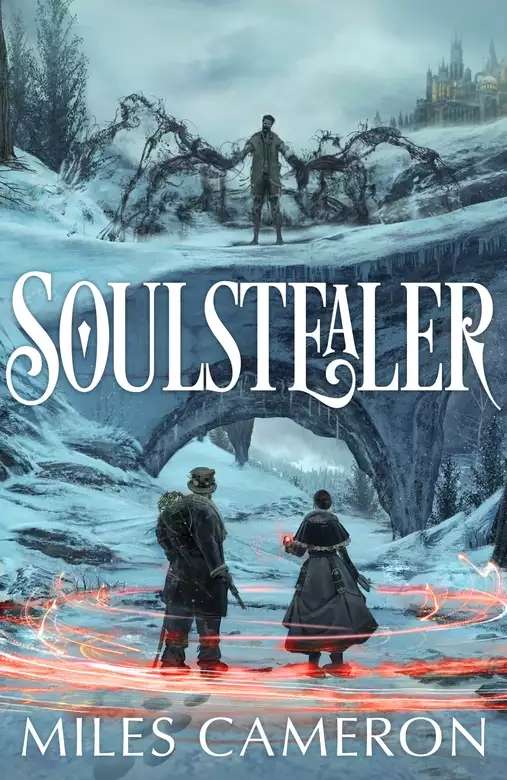
Soulstealer
- eBook
- Book info
- Sample
- Media
- Author updates
- Lists
Synopsis
Bekka Trevelyan is an arcanist, and the first woman to be made a Gentleman Scholar of Arcany at the University of Kabakak. Her graduate work was in refining a device to measure the potency of the winds of magic. Over her Yule holidays from teaching, she travels east on a field trip to test her theory about the Winds in the true Wyld. Instead, she finds herself swept up in the investigation of a kidnapping of an indigenous woman and her child by a demon that has possessed the body of a tracker.
Tam Warden was a war hero, and then a sort of government enforcer. He gave up rank and fame to marry across class lines. But government isn't done with him yet. He's called back to action to investigate Bekka's claims - discreetly. This is delicate work, because the truth could unbalance the nation.
Essa Bateman is a mercenary spy, a hard woman with no attachments and very few ethics. Few, it turns out, is more than 'none.' She sees the ripples of unrest from the underbelly of society, but deciding what to do about them is a different beast entirely.
In a world where gunpowder is manufactured from the souls of executed criminals, and the ultra-rich seek immortality at any price, where children labour in factories and the desperate poor turn to vampirism, where slavery is rampant and gangs rule the streets...
A few people are about to be heroes. They just don't know it yet.
But maybe, just maybe, the Revolution is coming.
Release date: September 3, 2026
Publisher: Orion
Print pages: 320
* BingeBooks earns revenue from qualifying purchases as an Amazon Associate as well as from other retail partners.
Reader buzz
 Please log in to recommend or discuss...
Author updates
Soulstealer
Miles Cameron
The flying cloud, the frosty light:
The year is dying in the night;
Ring out, wild bells, and let him die.
Alfred, Lord Tennyson,
In Memoriam A.H.H., 1850
I was looking forward to a holiday. Perhaps not the holiday my compatriots had planned, with roast turkey and mistletoe. Nonetheless, I left the Senior Common Room of the university, pausing, as I always did, to look out the mullioned windows five hundred feet above the Kabakak River as it flowed over the last cataract before the sea far below. The view was (and is) breathtaking, and a full year as a Gentleman Scholar had not tired me of it. Nor could I hide a smile at the sign over the entrance that specified ‘Gentlemen Scholars and Masters only’, as I held the rank but was most certainly not a gentleman.
I was only the third woman ever admitted to that room, which made the pleasure of the view all the sharper.
As I left the main gates of the university the bells were ringing on the clock tower and the Cathedral of Junius, ringing the end of term and start of the holiday in brazen tones. I was cheered to see a young man spinning sugar, blowing crystal shapes like a glass-blower, selling the finished candy ornaments to passers-by; just past him, on the square at the top of the cliff, there was a heavily brindled Brocc woman selling chestnuts that smelled of spice and celebration, another with a basket of candied nuts, and a dozen more between me and Government House, all freedpeople doing their best to earn a few coins. A girl hawked newspapers, her cry loud and high: ‘Soulstealer strikes again in Lower Town!’ I could hear the strident capitals in her call. I knew the case – everyone did: someone was preying on the Rigog workers and the poor, leaving their bodies empty of spirit or volition, technically alive, for the churches and volunteers to care for and mourn – or allow to starve. There’d been some backlash against practitioners, too. The ignorant think we’re all necromancers.
I had a long walk to the train station, along the walls, and a heavy bag to carry, but my sense of holiday overcame the effort and the dreary crowds of beggars. I ignored the newsgirl, put my luggage down in the slush, and bought some chestnuts before hauling my kit along the ancient walls that overlooked the Lower Town and the long ramp down to Almoners’ Square and the railroad station. I might have taken a cab – certainly, a dozen passed me, splashing me with slush – but I felt strong and I wanted very much to be outside – out in the world, out of the academic walls.
The station itself was another riot of street sellers and holiday buyers and travelers. Here, a newsboy shouted ‘Callvier threatens war!’, which was yesterday’s news. Tens of thousands of potential dead in Callvier and Vartstadt balanced a few Rigog workers here at home. I remember having that cynical thought as I climbed the steps into the station.
Train stations are interesting places; to someone like me, the endless bustle and the sheer number of people hurrying through can affect the temporal flow, and the massive expenditure of vitrinite is thought to release arcane energy as well as physical heat.
This is the very heart of some of my research. I tend to pay close attention in train stations, and so I noticed, after glancing at my petalon to see if the weak waves of the Phenomenological Force were fluctuating, that there was a very wealthy man waiting at one end of the opposite platform. I could read his wealth in his clothes, from the ankle-length semi-military coat that fell from his shoulders to show a hint of the sable lining, to the fur hat on his head. I could also see that he had an automaton at his feet, something shaped like a dog but made entirely of metal, its head surrounded by a nimbus of heat-distortion that blurred its features to my sight. Even as I watched, it raised its head exactly like a dog looking up at its master, except for the burning eyes that revealed an elaborate phenomenological engine and the most expensive arcane cryogenics to keep the heat the thing generated down to a reasonable amount.
Before I tore my eyes away, a servant approached, beckoning, and the man’s private car pulled away to the waiting train yard – a magnificent car of polished maroon and gold with damask-curtained windows. Just under the eaves, gilt lettering proclaimed ‘J.M. Pieranast’ in forbidding Gothic letters. A name I knew and a coat of arms I didn’t recognize: a recently ennobled peer who owned most of our newspapers. The heraldry was loud and decorated the midpoint of the car, just exactly between the windows. The needle on my petalon bounced, just a little, when he glanced at me, and I felt a ripple of presentiment. I mention this only in light of what followed; as a practitioner, I now acknowledge this was a temporal foreshadowing, something as yet poorly understood …
I digress.
Perhaps it was distance, or my hurry, but I didn’t notice his famous nose or the floridity of his face. Perhaps these features are exaggerated by his enemies. In time, I’d find other things far more objectionable.
I should say, I am trained as a tempomancer. That is to say, I examine events in the past, the influence of the apparent flow of time on our world, our lives – and what people call ‘magic’. The art is much exaggerated in the press, and the reality is that for the few of us with the talent, we are as dependent on our research assistants and prop managers as any academic or stage professional. Often, when I wish to reach back into the distant past, my art requires months of preparation, only to find that at the moment of casting the bubble of temporal flux simply collapses. Inevitably this means that some assumption of my preparation was so flawed that I cannot even see the moment of the past that I require. And yet, there are places where the bubble of temporal flux seems omnipresent, and sometimes we can work our temporal magic without props and aids; the main station at Kabakak is one such. And, as best as I could tell, this man – this one man – caused a tiny movement in the Phenomenological Force when our eyes met. A fellow practitioner, then, and one with whom I had some level of entanglement, which seemed odd, as I’d never met him.
He glanced toward me again. He was perhaps twenty yards and two tracks away, but our eyes met; he seemed to recognize me. That was interesting, but it didn’t slow my hurry to catch my own train. Nothing about some rich lord was as interesting to me as the research I’d completed and my rare chance to look at one of the original key nodes.
In the weeks before Solstice, I had been in the university library studying a particular event from the Dai–Shan Wars over a thousand years before – or more particularly, an attempt to make peace in the midst of them – when it became obvious to me that I would need to view the actual ground; better yet, stand on it, to make my casting into the rivers of time. I had a small grant from the Khedive, and a cautious nod of official interest from Government House; after all, our borders in the Wyld were still based on the outcome of the Dai–Shan conflict, around eight hundred years ago, although both the Dai and the Shan are gone now. The head of my department, Professor Maynard, and the Syrdar’s military secretary both agreed to let me go; indeed, and to my surprise, Professor Maynard encouraged me. He even paid me a patronizing compliment, which might have put me on my guard, but, I regret to say, did not.
The Syrdar’s military secretary also seemed to encourage me. I should have been suspicious. Instead, I was delighted. Tempomancers are sometimes controlled or censored by the government, and our travel is often limited; early in my studies I’d been told by a fellow student that tempomancers were usually forbidden to travel west of Cagshaw Falls. And yet suddenly everything was easy, and I missed every clue.
I had four weeks at Solstice with no classes to teach; I had just shed an unresponsive lover and had no one to miss me, and I’d just been paid for my first successful private investigation – a surprisingly complex problem involving the loss of a key to a financial agent’s warehouse vault in Kabakak. Pragmatic stuff, but financially rewarding. I had money, time and permission to travel. I’d just finished my courses … Ah, you don’t want such details? But to a woman traveling in the Wyld, that’s an essential fact. I had four clear weeks.
I probably smiled all the way to the platform.
Again, I digress, as is too often the case.
I was at leisure, and I knew that to make any progress at all, I would need to travel up-country to the Borders and hire a Guide. Because my work was quasi-official, I asked a friend in the Colonial Office if she might recommend a Guide, and she spoke to a military officer, a Captain Huythe of the famous Rangers, who in turn sent a runner to my apartments with a recommendation for a man in Ironworks with the somewhat outlandish Rigog name of Nes Revans. I paid a telepagrapher eight soldi to contact his ‘friend’ in Thendura and get a message to this man, Revans. I might have done it myself, but it’s not my best talent and I find it exhausting at the longer ranges, and I’ve never bothered to get a license.
Then I was ready to leave a note for my landlady, pack a bag, choose my best winter boots and head for the train. I’m not a complete novice to the Wyld; I wore stout wool breeches and waistcoat with a heavy overskirt, a good traveling cloak, and I packed a blanket coat, a fur hat and various pairs of mittens and gloves. I took the train up to the border country, struck, as I left the soot-stained grey of the city for the primal snow of the countryside, that I had scarcely noticed the onset of winter in my library. I was about to experience winter in a way that I had never done before. The train passed out of the station, under the walls of the city, and through the industrial tangle of the western Lower Town, past the new iron foundry belching smoke, past the mills churning along the chasm of the Kirle River that flowed down from the far north, ice-cold and milk-white with foam to turn our mills, past the routine horrors of half a dozen abattoirs, and finally, by some sense of industrial irony, past the soulflake crematorium. I wrinkled my nose, but it was my phenomenological senses that could detect the stench of horror and death.
There was death on the train as well: workers, probably bound for Cagshaw Falls, coughing blood from the Tubes; the disease was just starting to bite down on us then. A dozen Broccs – or ‘bausonds’, as the Callvieri and some old Kabackers say – were gathered at the stove in the third-class car, smoking their clay pipes regardless of gender, and many of them coughing blood into their handkerchiefs. They were clearly miners going up to Cagshaw Falls, curiously uniform with their white hair and dark skin and enormous, powerful shoulders and arms. Two of them had their claws intact.
I admit that I was scared of them. It’s not fair. They were perfectly well behaved, even courteous. And of course they are short. I was so ignorant then – I only knew they had a reputation for violence. And most of them were freed slaves or runaways from New Callvier.
I sat by myself, ignoring them, making notes for my studies.
If you have never traveled up-country from Kabakak to the Borders, you probably don’t know – as I did not – that you have to change trains to the other track at Meglin, where the tracks separate for all the branches; much less that I’d have to change again at Cagshaw Falls to the narrow gauge. These days, at Cagshaw Falls, one station allows easy access to both tracks, but back then, the two stations were located either side of the river, and while I enjoyed the sight of the great bridge across the face of the mighty falls, I didn’t enjoy the freezing temperature, the lack of a cab and two warm horses to pull it, or the walk across the bridge. If I was of a more romantic persuasion, I might imagine that in crossing over the Cagshaw Falls, I left the civilized world for the Wyld. Certainly, as a Talent, I felt the transition to a degree that I had never felt it before, and I wanted to pause and ponder the changes in the force of the phenomena at the midpoint of the bridge, and measure them, but it was too damned cold and I lacked any instrument more precise than my petalon, which was going mad on my chest.
Any romantic notions of the bleak beauty of the place were driven from my head by the ugly spectacle of a vitrinite yard on the far side, furnishing as it did all the vitrinite for both of the narrow gauges into the mountains of the Wyld. Just beyond, a pair of incongruous stone posts and a muddy road led to the mansion of the mighty Klaasen clan, the industrialists who own the mines and foundries of Cagshaw Falls and a dozen other places in the Empire. I wasn’t sightseeing, and riches depress me, so I went straight to the narrow gauge, where I had to wait on the open platform in blowing snow. I think it is worth noting here, given what happened, that I was surprised by the bustle of Cagshaw Falls and the sheer number of miners and workmen there: Rigogs and Bannocks and Broccs all mixed together. I expected to find a sleepy forest town and instead I discovered a tar-shack metropolis. There were a dozen other passengers waiting for the narrow gauge to Ironworks, most of them lumberjacks and forestry people. All their talk was of lumbering the nearby forests for building wood, or of hermatite, which they claimed had just been discovered in the ancient mine works under the escarpment. While I do not think of myself as a prude, I didn’t care to mix with people who killed the trees of the Wyld for profit, and so I stood by myself. The locomotive, when it came, seemed almost a toy, it was so small, and the narrow-gauge cars were cramped.
There followed six hours of the most unpleasant rail journey I think I’ve ever made. I’d never been to Ironworks before; I’d never taken the narrow gauge into the Wyld. I should possibly have taken a room at Cagshaw Falls, but despite recent changes, getting a room as an unaccompanied woman is not as easy as it ought to be, and I decided to go straight through. The dark hemlock forests were beautiful in the deep snow: a silent, eerie beauty that suggested something waiting just outside the train. No vitrinite stoves were allowed on board, for safety reasons, and the cars themselves were cold, and I was unprepared. Most travelers had several heavy wool blankets to throw over their laps, as if we were farmers going to market on hay wagons, but my blanket coat was with my luggage, and I merely endured, drinking the hot coffee provided by a child vendor and smoking too much. When we were headed west, the icy wind off the snows of the Wyld brought the engine’s smoke straight down the line of the train and we all coughed.
I shared my compartment with a dull fellow from the forestry service who annoyed me by finding it astounding that a woman was engaging to go into the Wyld in winter. He mentioned his amazement to me a little too often, and I picked up my haversack and went to another compartment.
But at last, I made it to Ironworks – or, to be precise, Thendura, the end of the narrow-gauge line and the foot of the chain of lakes that allows us to navigate the Borders and the Wyld. Certainly, there are other paths into the Wyld, but the chain of lakes from Ironworks is probably the best traveled. Again, I might have stopped, as I’d been traveling for seventeen hours. But Ironworks is only a short boat ride up First Lake, and although the steamer had already been docked for the winter, I paid handsomely for a broad-shouldered girl to row me up to Ironworks and land me at Gignon’s Hotel. That boat ride was my introduction to the Wyld in winter: silence, except for the crack of trees in the cold; the dark water, and the snow-laden trees.
Today, postcards from Ironworks gild the past with a wreath of ivy and a frosting of snow, and I suspect tourists imagine Old Ironworks as a beautiful place with neat buildings, a little Jack-Frosted glass, and perhaps candles in every window.
My first impression was more of something from one of those novels whose entire purpose is to stir your anxieties at every page: first, snow everywhere, and deeper than I’d ever seen; then a dilapidated building somewhere between a barn and a warehouse, vertical boards that had once borne a coat of red paint and windows sporting only the remnants of their glass like a vampire’s teeth; a street more mud and animal dung than picturesque snow; and Gignon’s, a surprisingly small building, but whose neat white paint was touched up with soot, and which had shutters sagging on their hinges and painted a dusty and unbecoming black. My boatwoman helped me with my luggage, asked no questions, and received a well-deserved tip. She didn’t linger, but rowed away down the black lake, leaving me shivering on the dock. I carried my own bags to Gignon’s. Any hesitation I had from its outward appearance was instantly improved on the opening of the door.
I was a trifle surprised that my Guide did not meet me at the dock, and I asked after him from the owner, Monsieur Gignon, who was waiting for me in a civilized sitting room with an open hearth full of fire, a big table set for six guests, and a Yule tree decorated in cranberries and popped corn. The candles weren’t lit, but were laid by on a sideboard. This was more what I’d been hoping for in the Borders. Gignon was a big, cheerful man, Kabacker to the core: florid of face, easy of manner without the least disrespect.
‘Nes Revans?’ Gignon asked with a heavy up-country accent. ‘Likely in his cabin.’
‘Would you send for him?’ I asked.
Gignon smiled, showing bad teeth but good humour. ‘Mam’selle, I could send for him, but he wouldn’t come. Not the ca-pi-tan’s way. I think you will have to go up there an’ make an introduction, eh?’
‘I sent him a telepagraph!’ I said.
Gignon’s smile widened. ‘Mam’selle, I can find you another Guide in a day or two. But le bon capitaine will not guide for everyone, and he will not come when called.’
I thought perhaps I understood. I’m not to the manner born myself; if not for my talent, I’d be some shopkeeper’s housewife, and the only tempomancy I’d see was predicting the times of the meals I was called on to provide. I didn’t like being summoned or dismissed by the Eugenios – the well-born, the gentry, call them what you will. I could imagine that a specialist like Revans might resent such people. My guess in this respect was correct, as you will see.
‘I’ll go see him,’ I said.
‘Excellent. ’Ere’s my girl to take you. You’ll want raquettes. And the main meal is at seven, if you please.’ He pointed to the table.
Gignon provided me with his daughter: a red-haired, sullen child of eleven in a thick wool capote, a bright red wool cap, and a pair of raquettes, as they call them in the Borders – bent wood frames laced with rawhide, which you strap on to your boots so that you can walk atop the snow. The snow was everywhere, bar perhaps a few paces from the dock to the hotel, and it was several feet deep. I don’t think I’d ever seen so much. I grew up in the countryside of Kabakak and we thought we had the deepest snow in the world. I looked at the dozen feet of snow with a sense of awe.
Fifteen minutes’ walk out into the silent woods and my grumbling companion pointed at smoke rising from a stone chimney. ‘Cap’n Revans,’ she said. ‘Can mam’selle find her own way back?’
I chose not to mention that ours were the only tracks coming up the path to the cabin. I merely smiled. ‘Yes,’ I said. ‘Would a silver soldo cheer you up, child?’
She shrugged. ‘Not a child, neither,’ she said. ‘Mais oui. Much appreciated.’
I handed over the coin and she tucked it inside her big beaver-hide mitten. ‘Enchanté,’ she managed, and then she was tearing away back south toward town – if six buildings, an abandoned barn and a frozen dock can be called a town.
I knocked, and heard something inside which I took as permission, and opened the door.
Inside, I saw an old Rigog man bent over something on a table by the light of two vitrinite-oil lamps.
‘Shut it,’ he said. His voice was crisp. He was holding something in each hand.
‘Pardon?’ I asked.
‘Kindly shut the door,’ he said, enunciating each word as if I was slightly deaf, or perhaps a fool.
I stepped in and shut the heavy door.
I am not without perception; indeed, my art requires a sharp eye and a certain amount of reason. The door was not just heavy. The moment I shut it, a bar of wood came out of a small runnel and worked its way across until it locked into a hole on the far side – an arcane working. Perfectly legal, but odd – as anyone might own a good iron lock, but an arcane bar?
Nor did I need my petalon to detect the Phenomenological Force in this cabin. The PF was almost palpable.
Revans saw my interest and favoured me with a small smile. ‘It responds to my voice,’ he said. ‘Very useful when I have an armload of firewood.’ He paused, looked me over and said, ‘Ah! Ye’re a Talent, then.’ His accent, like his clothes, was different from that of Monsieur Gignon. Gignon might have been the host of an inn in the city, but Revans was like a character from an old tale of the Wyld, in wool and skins, albeit well-tailored skins. His wool shirt was from the army; his breeches were of some sort of hide, and he wore tall moccasins laced high.
I suspect I started. Nettled, I shook my head. ‘You haven’t received my message?’ I asked.
I might have sounded a little short. Please, don’t imagine I’m so used to being served. What I’m used to is men ignoring me unless it suits their needs, which I admit has the tendency to annoy.
Revans was back to whatever he was doing with his hands on the table. ‘Message? Ah, ye’re Professor Trevelyan?’
I nodded. ‘I am.’
‘Best get your raquettes off, then,’ he said, agreeably. He chuckled. ‘Not what I expected, I admit, but then, assumptions are the Grim, eh?’ He got up, and I saw that he’d been hand-loading cartridges for a wheel-gun. I was interested; they were a recent development. We’d never seen them in the militia.
I’d heard of them, of course, but I’d never seen one up close: a single barrel like the air weapons the gentry use for duels, but a turning drum with five or six slots for cartridges. He had a vial of soulflake on the table, and I wrinkled my nose at the sulphur and cinnamon smell.
Behind him over the fireplace, was a rifle. I’d seen one – once; a priest of Junius, a so-called ‘monster-hunter’, had it. But I’d never seen one so close: an intricate mechanism attached to a long barrel, and a beautiful wooden stock to fit against the shoulder.
He threw a green baize cloth over the process on the table. ‘I don’t generally guide in winter,’ he said. He caught my look at the rifle. He smiled, as if encouraging me.
I had been afraid of that, or of an attempt to gouge a substantial fee on that basis. ‘I can pay,’ I began carefully. I didn’t understand how this lowly woodsman came to own the deadliest weapon our civilization produces, nor to have brass cartridges, nor soulflake, all of which are controlled by the Syrdar. But I was quick enough to understand that he was a person of consequence, not a wilderness servant.
He interpreted my look. ‘People die this time of year, miss … that is, Professor. The lakes ain’t frozen yet fer ice travel, and if’n I roll a boat …’ He shrugged and made a motion with his hand, as if to indicate how bad rolling a boat might be. ‘Maybe we make it to shore and I git a fire goin’, and maybe we just get sleepy and die.’ He looked up at the heavy arbalest that hung from a big iron hook by the door. ‘And there are a mort o’ things out there that can kill ye.’
‘Captain Huythe of the Rangers said you were the man for this,’ I said.
‘Very kind of him, I’m sure. He’s never been out in the Wyld in the week afore Solstice and Yule.’ He took a piece of paper from under one of the lamps. ‘I read this and hoped ye wouldn’t come. And the Breakers is a fair way – eight lakes and six portages. Almost two hundred leagues. We’d be out at least fifteen days.’
He didn’t sound as if he was absolutely set on refusing me. ‘Is it a matter of money?’ I asked.
‘I’m not dead-set against money, an’ that’s a fact,’ he said. ‘But there’s not enough in the world to repay me for being dead – or for the embarrassment of killing you.’
‘Embarrassment?’ I asked. I was beginning to warm to the man. He was an original.
‘We Guides have our pride,’ he said. ‘We try an’ avoid killing customers.’ His wry smile was the first suggestion of humour, and I was happy to see it. He had seemed at first a very old man, long past his prime. Now he seemed younger, somehow.
‘It’s very important to me,’ I said. ‘It may be important to … well, to government.’
‘If’n it’s government,’ he huffed, ‘Huythe could hae gi’n ye my friend Lebrun. He’s a fine Guide, an’ he’s government.’
Huythe hadn’t mentioned any such thing. ‘You were particularly recommended,’ I said. ‘It could prove important,’ I said again, with a bit of desperation.
He nodded. ‘Important how?’ he asked. He hooked a chair with his foot and pushed it to me – quite a graceful act, as he was leaning against his worktable the whole time. I sat gratefully; snow-shoeing used muscles I didn’t think I had.
‘I’m investigating something from the Dai–Shan Wars,’ I said.
He nodded.
‘A Love Day. A truce …’ Love Day was an unscholarly name for truce days during the ancient wars.
He nodded again. ‘Yes. They weren’t so very uncommon in t’early days of the war.’
‘You are an historian?’ I asked. I noticed his curious diction, alternating between the Borders patois and a more educated tone. I wondered if he’d been in the military.
He shrugged and lifted a corner of the cloth covering his loading activities, as if the subject bored him. Perhaps I bored him. I’d rather expected someone else: a laborer, or the sort of person who is a master craftsperson. Focussed on a single task.
‘If you live in the Wyld, there’s things it pays to ken,’ he said. ‘A professor came through here, some time back. He called it’ – and here Revans’s voice took on the cultured sound of an Old World academic – ‘“The unexpected consequences of a thousand years of sorcerous warfare.” That’s what’s all around us in the Wyld.’
I should have thought of that myself, and I was chagrined. ‘Even so …’ I began, and he raised a hand.
‘Someone’s coming,’ he said.
After a barely perceptible pause, there was a firm knock.
‘Cap’n?’ someone called.
‘Door,’ he said.
The bar flew across. The door opened; snow blew in, and I had the urge to say, ‘Shut it.’
It was the girl from the hotel.
‘Cap’n?’ she asked, standing in the doorway. She wasn’t happy to be there, I could tell at a glance.
‘Gilley?’ he said.
‘There’s a Quare down in t’village,’ she said. ‘Papa asks you come.’
Revans raised an eyebrow. ‘How old? How dressed?’
‘Pater says male, not very old. Good green cloth. Saw ’em myself.’
Revans relaxed. ‘I’ll come directly. Professor, there is—’
‘An aboriginal,’ I said.
He glanced at me, amused at my academic name for the savages of the mountains. ‘If you like,’ he said. ‘I must go. You’re welcome to make tea …’
‘I’ll come,’ I said.
Ten minutes saw us in front of Gignon’s Hotel. Revans was much faster on raquettes than I; I had to almost run to keep up, but I copied his gait and found the movement easier, casting my feet out a little like a woman seeking to make her hips sway.
There was a long figure standing in the slush and manure. He was tall – taller than a man. He had lean features, a broad nose like a cat’s, deep golden-green eyes, sightly pointed ears placed higher on his head than is our norm. He wore a long green mantle of good wool from back Home in Anzand thrown casually over his left shoulder. His right shoulder was bare. In the snow. I think that is what struck me most.
Of course, they have fur. It was scarcely visible, as jet-black as the skin beneath. They are not all of them black, or so I’ve since observed, but this one was, and still is, I hope.
I had never seen one of the Mountain People alive and up close. Stuffed, and in a museum, yes. Not breathing great gusts of steam like a resting locomotive.
Revans strode up on his raquettes and extended an arm. ‘Peace,’ he said, and opened his hand. ‘Kursj.’
The dark creature said, ‘Kursj,’ which I guessed to be his people’s word for peace.
Revans spoke to him, and he responded. Monsieur Gignon came out of his hotel, wearing a long coat and carrying a heavy crossbow. The creature didn’t even spare him a glance.
‘What’s it want?’ Gignon called out.
‘He says that his people are missing a mother and a child,’ Revans said.
‘Good riddance,’ Gignon said. ‘And they’re not here, are they? Eh?’ he added with heavy sarcasm. ‘Stayin’ in my hotel.’
I listened to the next exchange. The newspapers always referred to the speech of the Mountain People as ‘guttural’, whereas,
We hope you are enjoying the book so far. To continue reading...
