- Book info
- Sample
- Media
- Author updates
- Lists
Synopsis
"That thing in Tiltspire, it keeps Cahan like a trophy. It says to us, here is your strongest and I have killed him."
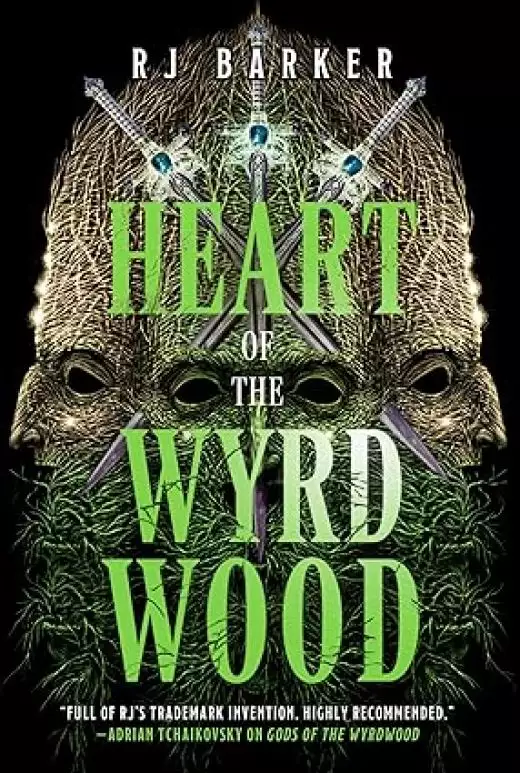
Cahan Du Nahare is lost, taken by a dark god whose tendrils reach throughout the world, intent on its destruction. Those who followed Cahan are spread across the land, desperate and lost now fate has turned against them. The Reborn warriors are toys for the enemy, the warrior Dassit, forestal Ania and monk Ont are drawn to the dangerous north but do not know why. Udinny is forced into the company of a woman who desires nothing more than her death and the Rai, Sorha, leads a dwindling band on a mission even she believes is doomed to failure. Only the trion Venn remains hopeful, slowly growing in power and trusting in the path of their god.
But maybe all is not lost. The great Wyrdwoods of Crua may be ancient and slow to act, but something in them is waking.
Wyrdwood is coming.
The Wounded Kingdom
Age of Assassins
Blood of Assassins
King of Assassins
The Tide Child Trilogy
The Bone Ships
Call of the Bone Ships
The Bone Ship's Wake
Release date: June 24, 2025
Publisher: Orbit
Print pages: 512
* BingeBooks earns revenue from qualifying purchases as an Amazon Associate as well as from other retail partners.
Reader buzz
 Please log in to recommend or discuss...
Author updates
Heart of the Wyrdwood
RJ Barker
The villagers reach Wyrdwood safely and ally with the Forestals. Cahan agrees to assist them partly to get away from Venn, who suspects something is wrong with him. Before he leaves, his burgeoning love affair with Furin, the Leoric of Harn, is consummated. However, when he leaves, he is unaware that the damaged Rai, Sorha, bent on revenge, has followed them. His cowl is unable to sense her, thus she has managed to avoid being found.
In New Harn the villagers rediscover themselves, chiefly the former butcher Ont who dedicates his life to Ranya, the God brought to them by monk Udinny who sacrificed herself to save the people of the village. As well as his new calling, he forges a surprising friendship with the Forestal Ania.
Udinny, monk of Ranya, is not as dead as everyone presumes. She is surprised to find herself reborn in the land of death where she is gifted weapons by her god. Before her is a broken land and she is tasked with fixing it; she does her best but it is a huge undertaking and one she is not sure she is up to.
An enemy trunk commander, Dassit, has found herself on the wrong side of her Rai and is sent on a suicide mission to defend an indefensible town. In the prison there she finds a Forestal, Tanhir, and a strange old man, Fandrai, who the Forestal says is a priest of murder. Their presence is a mystery, and one Dassit uses to distract herself from the oncoming army sure to swamp her forces.
While Cahan is away, Sorha leads the Rai in an attack on an unprepared New Harn in Wyrdwood. At the same time Dassit and her forces are overrun and Cahan and the Forestals in the Wyrdwood find themselves ambushed. Though all seems lost, each group is saved when the Forestals reveal they have access, through the taffistones dotted all over Crua, to a network that allows instantaneous travel across the land and all are brought back to Woodhome, the Forestal city high up in the branches of a cloudtree in the southern Wyrdwood. There Cahan learns that Sorha has taken Furin prisoner and intends to execute her in the Slowlands, a place where death can take centuries. The enemy have agreed to exchange Furin for Cahan. Against the advice of Tall Sera, the Forestal leader, Cahan plans a rescue.
They manage to rescue Furin but pay a terrible price. The monk Ont is burned and loses his sight and senses, Fandrai is returned to Woodhome in a coma and Cahan’s undying warriors, the Reborn, are taken by the enemy. Worse, Cahan is overtaken by something terrible and almost kills everyone. Only the Rai Sorha stops him, when her cowl-blocking aura interferes though she is still bent on vengeance. Cahan and Sorha fight on a bridge but both fall into the depths of Crua when Saradis, Priestess of the new God, is told by her god to destroy the bridge. They are presumed lost.
Udinny moves through the unlife world of Crua trying to understand how it works, and though she is doing her best to fix the damage done it is becoming apparent that the task is too demanding. Also, she discovers she is not alone. Something is hunting her.
Back in Woodhome the Forestal Ania slowly helps Ont find a purpose despite his terrible wounds, while the warrior Dassit and her second, Vir, wonder about their place in this new world. The trion Venn is taken under the care of the Lens, the trions of the Forestals, to learn more about who and what they are. All the while Furin mourns both the loss of Cahan and her son, Issofur, who was called to the forest a long time ago and is gradually becoming less and less human.
In the depths of Crua, Cahan and Sorha are forced to work together. He needs her as she blocks the power of his cowl and the thing that is trying to take him over. She needs him as she has been terribly hurt in the fall. Together they find a hidden world and a massive, ruined city. There they encounter something terrible, a huge tentacled creature, and it is hunting Cahan. Only Sorha’s power hides him from it.
Udinny, unseen in the otherworld, does her best to interface with the city and lead Cahan and Sorha to safety but they ignore her subtle warning and instead go in the opposite direction.
Sorha and Cahan encounter the feared Osere, the demons of the below world. However, these blind underground dwellers are not monsters at all and have been guarding what they call the “gods” in their underground land of Osereud for generations. But one of these “gods” has been corrupting their people with bluevein, and now it has escaped.
The Osere wish to teach Cahan and Sorha about the “gods” and their journey to learn more becomes a running battle in which Cahan, Sorha and the Osere become more firmly bonded. Despite this, they are not yet strong enough to fight a god and the creature takes Cahan, using his strength to raise a temple from Osereud into the land above where Saradis waits, sure she has won and sure all Crua will burn for her god.
However, all is not lost. Wyrdwood is waking. Ont, Ania and Dassit are drawn north by a voice they cannot deny, though Dassit is betrayed by her second, Vir, who defects to the forces of the new god. Udinny is returned to life in the body of Fandrai, and Venn, the cowled trion, is waking to their power while Sorha, together with the Osere, is rising to the lands above, determined to free Cahan from the clutches of a dark and corrupted god.
I am with you.
He had been fighting the battle as long as he could remember. There was nothing left but the fight – the battle was his life and would continue to exist as long as he did.
The walls of Harn were strong, they surrounded him and provided an illusion of safety. A subtle green glow marked their outlines and where there had been breaks they had been filled and patched. In places fire had scorched them and newer, wetter wood laid down to stop them being so easily burned again. The people had worked hard, and remembering how they had come together made him smile. It had been a hard path to cut, there had been trials, fights and disagreements. They had struggled but in the end they had come together. That had made them strong and with that strength they held the enemy at bay.
But the people’s strength was not eternal; the battles wore them away just as they wore him away. At the end of each fight the dead were taken back to longhouses and roundhouses. Cahan never followed them in. Someone had to stand guard. Someone had to be here, alert at all times because the Rai attacked without warning and without mercy.
And the central longhouse, Furin’s longhouse, it frightened him because something waited in there. A gift, but the thought of it was too terrible to approach.
Miracles were worked in the longhouse, wounds that should have killed did not. Cahan watched villagers dragged away on the point of death, and yet they returned after time in the longhouse of Harn.
Until they did, he would stand watch.
He was alone for so long he could barely even remember their faces when they were not in front of him. Furin: that name burned. He missed Furin so much, her warmth and her cleverness.
But she was here.
But he missed her.
Sometimes his thoughts were clouded, fuzzy, and he could not stay with them for long, his attention sliding off them.
He longed for the next battle, to be among the people again, to see his friends, and even though he knew it would bring them fear and pain and terror, at least he would not be alone. He grunted, tried to push that thought aside, that selfishness, to be ready to sacrifice others so he felt a little better was a poor way to be. But he could not stop the feeling; this loneliness was like ice within him, moving slowly through the core of his body and outwards, slowing his feet and hands, a lethal thing. Cahan closed his eyes, shutting out the green glow of Harn, though he could never truly block it.
He needed to be doing, to be keeping his mind busy until the next attack. He walked through the square, past wavering stalls empty of anything to sell, past the shrine to Ranya, the only thing free of the green shimmer, a gilding of yellow gold upon the eight-pointed star of Iftal above it. He walked past the longhouse and ascended the wall, looking out over the clearing to the vast trees of Harnwood. The nearest were green, in full leaf, and he could smell the loam and petrichor, the clean scents of the wood, and as he watched he felt Segur nestle in around his shoulders.
“Hello, old friend,” he said softly, “we hold them at bay still.” As if in answer Segur pushed closer into his neck. A brief moment of respite, of happiness in the closeness of the garaur but it could not last. The line of trees, in the leaf of the least season, was thinner than it had been. He could see where Harsh was biting, the cold blue glow of the cold blue months to come had stripped the trees bare. There the Rai waited, there they amassed for the next attack. As if they could hear his thoughts he heard the chanting start. Words in the language of the Rai, one that Cahan could no longer understand, ugly words, twisted and unpleasant on the ear. “They are coming,” he said and felt Segur begin to fade, heard the pushing aside of doors, the swish of curtains, the creak of armour as the people of Harn began to amass before the walls. The enemy would attack here, they always attacked here. They used no clever tactics, made no attempt to come at him from the rear but they had no need to, they had the numbers.
Soon comes the fire.
Waiting, watching, the feeling in his stomach as if a terrible hunger came upon him – when had he last eaten? A pain in his chest as though he were pierced by a spear.
Fire, the blue glow out of it in the forest, a great ball rising soundlessly into the air, reaching its apogee and falling towards the village. Cahan watched, felt no fear as he knew what would happen. The same as always happened. The Rai’s fire met the village shield made by the Forestals, splashing over a dome far above, cold blue of harsh meeting the warm green of least. He did not remember them putting it there, but he remembered it was a thing they could do. He turned; in the village he saw the Forestals arranged in a wedge shape, touching one another. The camouflage of their clothes gave their bodies fuzzy edges, made their faces hard to make out. He raised a hand to them, and the leader returned his salute.
He gave the forest his attention once more.
The Rai broke through the treeline, striding ahead of their troops in armour that writhed on their bodies, grew long tentacles to hold weapons. Behind marched their troops, blank-eyed conscripts who fought unthinkingly, with no concern for their own safety, thrusting mindlessly with their spears in such a way that they were easy to cut down. Behind him he heard the bows being drawn and he pulled on his own, without memory of stringing it or nocking an arrow; these things came automatically to him.
“Loose!”
Arrows, streaks across the sky, falling on the Rai army, felling soldier after soldier, cutting down Rai. The screaming of the wounded filled his ears, a sound more of anger than pain. Arrows flew again and again but the Rai’s forces kept coming. They would not retreat and Cahan knew it: they would make the walls. The fight would be on the walls.
“Loose!”
He watched the Rai, not the soldiers, watched their writhing armour because with every flight of arrows it writhed less, the tentacles grew smaller or vanished entirely, as if the loss of troops diminished them.
“Loose!”
Let them diminish.
More troops staggered and fell, and a few of the Rai even went down. Then they were at the wall and Cahan stood with the defenders. He did not remember calling them, but they had done this enough times that they did not need to be called. They fought through memory. Beside Cahan stood a huge man, on his other side was Furin and they wore the same clothing as the Forestals, all blurred outlines – even their faces could not be made out. Troops crawling over the wall, the way they moved wrong, upsetting, as if they had no bones. His axes rising and falling, killing. Sword and shields up and out on either side of him. Udinny! Hacking at the enemy.
But Udinny was…
“Leave the Rai to me!” he shouted and launched himself at the first one to breach the wall. It swayed and moved, quick as water, blue fire dancing across its weapons. The arrows in its body slowed it a little, as did the loss of its troops. It hissed at him, its tongue long and black, eyes ice-blue. Cahan buried an axe in its head and it fell, dissolving into nothing. The next came at him, throwing fire, and Cahan ran through the flames untouched to behead it, his axes barely stopped by its flesh.
The people of Harn screamed and died around him as they had so many times before. The Rai came on and the fight lasted for ever, it lasted hardly a moment. Then the Rai and their forces were gone and he was tired. So very tired and, despite the villagers around him, cheering once more at their victory he felt so very, very alone. He jumped from the wall. The villagers were either dragging wounded to the longhouse or beginning to fade, to vanish into the houses which glowed a faint green. It was over, but it was never over. Not long until once more they put themselves in front of the magic and the spears of the Rai’s forces, to be cut down and rise again, and Cahan found himself overcome.
“Why do you do this,” he asked, a sob in his voice, “why do you do this for me?”
As if they all heard his voice, as if they all felt his despair, they turned to him. Furin, face as muddied as all the others, but he was sure it was her. The Leoric reached out a hand to touch his shoulder, a brief moment of comfort, echoed by every villager in the square, a ghost movement. She spoke and when she did it was with the voice of every one of these faded and worn people.
You need me.
I am Udinny Mac-Hereward, monk of Ranya and chosen of my god, sent from death to life to re-weave the golden web, to resurrect the lands of Crua as I was resurrected myself.
And I am in a spot of bother.
Truthfully, there are things going on in my life that you would scarcely believe were you not me, and living through them. Even though I am me and I am living through them, I am not sure I believe them myself. I am a man now, for a start, an old man, which is less comfortable than I would like. Bits move that should not, and bits that should do not. I very much miss the body I was never sure I really had when I was dead. It did not ache and was quick to obey my every thought.
Still, I did not have time for complaint, more immediately pressing was the woman who was trying to kill me.
I had seen her before, while I had regained my strength, or at least the strength of this body. In the healing room she had been a dark presence in the shadows, behind Issofur, Furin’s boy, who was as much rootling as boy now. Her eyes never left me, whereas Issofur was very easily distracted. I was left with the definite feeling this woman wanted to talk to me, needed to talk to me. That I was somehow important to her in a way I could not fathom. More than once I tried to speak to her, of her, but the Forestals who tended me would tell me nothing. In fact, they would tell me nothing of anything. I know the body I inhabited was once a man called Fandrai, and that there was something of him they did not like. Rather than answer me they had me drink teas and take herbs for my health that fogged my memory. Within it was something I found disturbing and could not quite touch. My mind was constantly distracted either by drugs or by being forced to exercise in the longhouse I was kept in. Endless hours of walking up and down to strengthen muscles weakened by my time asleep.
The Forestal woman was patient: she waited and waited until finally even Issofur left my side and the healing room was empty. I was asleep when she came. She woke me with a gentle shake of my shoulder.
“Fandrai,” she said. I did not wake immediately, I was in a golden dream where towers rose from barren grasslands and armies of grass marched against armies of gasmaws. It was not a comforting dream, but it was close to being back in the world of Ranya and I enjoyed that. “Fandrai”, eyes slowly opening to see the Forestal woman above me, a knife in her hand. “I wanted you to see me before you died. To know it was me.” There was something haunted in the woman’s eyes, some old ghost that she clearly thought she could banish with my death, or his death.
“I am not this Fandrai. I am Udinny, monk of Ranya.”
“A fine fiction,” she said, “but you fool no one.” With that she lifted the knife… and was hit from the side by a bleating crownhead, knocked off the bed. I rolled the other way. Pushing myself up on aching legs and looking for something to defend myself with. The woman was back up in moments, cursing the crownhead, which had vanished into the shadows.
“I am not who you seek,” I told her, and all I could find to defend myself with was a wide bowl that had once held sweet-smelling herbs.
“You look like him.” She advanced on me, pushing long hair out of her face, “You sound like him.”
“I am not even sure I am a him.”
“You are going to die.” She came on, knife in her hand and its dark wood drank up my attention.
“Is this a good idea? Your people have been nursing me,” I said, raising the wooden bowl before me like a shield.
“Tall Sera has denied me long enough and I can fall little further in his grace.” She smiled, but it was not a friendly smile. “I will be avenged.”
The name Tall Sera was one I knew, though my memory of it was vague, I knew it from Udinny before and many things from that time I saw as if through smoke. A Forestal? A Forestal leader, was that where I was? The woman intent on my next death was definitely one of them, from the green cloak and clothes to dappled face make-up, all these were Forestal things.
“I am in the Forestal city,” I said. Now that I had said it, well, it was obvious from the way the building I was in was constructed from living wood; who else could make such buildings? “I did not expect it to be so warm.” The woman faltered, as if wrong-footed by words. Then she advanced once more.
“Just because your wits are a little addled, Fandrai, does not mean I will let my family’s vengeance lie forgotten in a clearing.”
“I genuinely do not—” It hit me, a memory. I knew who this woman was. Tanhir. She had led a crusade against my grove, against my people. I felt aggrieved, but I also understood. I saw her cut down those I knew. I felt her nearness as I ran throughout Crua to escape her. No, not only to escape her. To right some terrible wrong I knew was in the world. Death was a sickening. Cahan!
Back in the living, growing hut I felt my foot hit something, felt myself falling backwards. I hit my head, falling through the pain into another memory, hazy and strange, me and not me. Surrounded by my acolytes, following bandits through the Jinnwood, they had taken and killed those at a small farm. They were ripe for harvest, a gift to Hirsal Who-Is-In-The-Shadows. Their bows would not save them. My people also had bows, smaller, made of horn, and though they lacked range my people did not need range. It was not our way. We stalked, we surrounded, we clothed ourselves in darkness and the thick black mud of the places that saw little light. Places where pools of water were thick with rotting vegetation and acted as dark mirrors where you could see your soul reflected back at you.
Waiting, waiting until they crossed out of the darkness of the forest into the light of a clearing, their laughter filling the gaps between the trees. Stepping out before them, my arms raised.
“Welcome, friends.” The group stopping, eight of them, bows unstrung, a couple putting their hands to the blades and axes they carried but they sensed no threat in this one old man. Somewhere, a gasmaw hummed. The scent of bruised grasses filled the air. “I am Fandrai, follower of Hirsal Who-Is-In-The-Shadows, and I welcome you as you have entered the shadow of my god.”
“We recognise only the Boughry, may they look away from us, now leave, old man.” Laughter.
“Hirsal calls you to him.” My hands fell. The arrows sang in the air. This close none could escape and the small group fell. Going among the groaning bodies, watching the shadows of Hirsal as they cut throats. No need to let them suffer, that was not the way of Hirsal. Wrapping bodies in floatvine and taking them through Jinnwood to the swarden grounds. Offering each body to the grasses with a blessing, closing their eyes and wishing them peace and forgiveness through serving the Wyrdwood.
In the room, the woman on top of me, my hand on her wrist, trying to stop her pushing her blade into my chest.
“You were not there,” the words gasped from my mouth as I struggled with her. “You were not there.”
“So you admit you were!” She renewed her efforts to drive down the knife. “I was behind them,” I heard so much pain in her voice, “in the rearguard. I saw it all but could do nothing.” An emotional agony, “I raised them, I raised them and you made them monsters.”
“You murdered,” I said, a clear image, a half-built house in a clearing, the screams of those living there as arrows came from the wood. No chance to defend themselves.
“Incomers,” she hissed, “with no right to the forest.” She pulled her hand loose. Raised the knife and at the moment it would have come down something hit her. Not the crownhead this time. Something small and furred, Segur! Following it more bodies, rootlings, or at least one rootling. The other Issofur, who was not quite rootling, not yet.
Tanhir jumped to her feet, back to the door. The garaur and the rootlings between her and me. I could see she did not care; she would fight them all to reach me. She raised her knife.
Then arms around her. A man’s voice.
“You will not do this, Tanhir.”
The woman screamed, a sound half-frustration and half-pain. She struggled against the man holding her, trying to fight him off but he was big, found no difficulty in disarming her, in taking the blade and then pushing her away so she sprawled across the floor. Behind the man was another woman, hidden in shadow. “Again and again, Tanhir, you have defied me. You brought outcomers here, and they have shown our enemy the taffistones at the worst possible time. And now, when we are presented with something indescribable, something that could well be the will of the Boughry, you defy me again.”
“Tall Sera,” she was sobbing, begging, “he is a murderer, he took from me, he took who knows how many of our people and…”
“Silence!” it was a roar. “Take her,” he said, “I will deal with her later.” Two Forestals came in behind and pulled Tanhir up. She was sobbing. I felt for her. Her pain naked on her face, but I was also very glad she had not been allowed to kill me. Tall Sera looked down on me. “She is right,” he said, “you took many of ours, or Fandrai did. Now you claim to be this Udinny, who I know not only to be a young woman, but also dead. Though the account given of her death is strange indeed.”
“Not as strange as it was to be dead,” I told him. Did he smile? I was not sure. He did not really look like the smiling type.
“You could be a message from the forest gods, or you could be a very clever lie, and I have no real way of telling which.”
“Well…”
“Fortunately,” he said, “she does.” He pointed behind him and a woman stepped from the shadows. My heart leaped with joy.
“Furin!” I said, “I see Issofur is…” I struggled for the right word, I wanted to say well, but the child was quite plainly changed, “… healthy. Even if the forest has changed him, Cahan said it might. All that time ago.” I nodded at the growling child and she looked his way but she did not smile.
“I do not know how, Tall Sera,” she said, “but I think that is definitely the monk Udinny. No one else I have ever met talks so much when they should be silent.”
Tilt was hers.
No, not hers, it was Zorir’s, but she ruled for her god.
Saradis walked down the great hall, flags hung but they were in need of replacement, drifts of dust and dirt gathered in the corners of the great hall. The statues of the balancing men of Tarl-an-Gig had fallen, no need for that fiction now, and the wickerwork of the stars of Iftal was coming undone, like all would be undone. Saradis did not care, she barely even saw it. No one would judge her for this, no one dared. No, that was not true; maybe they did, those who still could but they were not important to her. None of this was important to her, it would all burn so what use was there in taking care of it? Let it fester and decay.
She no longer wore the clothes of a Skua-Rai, no restricting bodices of twigs, no layers of fabric to show her wealth and power, no complicated braids in her hair. She needed to impress no one, she was the chosen of a god and none would question that now.
Rai still stood an honour guard along the great hall; no, they were no longer Rai. They were the collared now, her servants, loyal only to her and to her god. She had never commanded they stand guard in the great hall, they simply did so. Maybe it was some residual memory of what they had been, or felt they should do. She would ask Laha, though whether the answer would make sense would be a coin toss. Laha was the channel of Zorir, a way for her to communicate directly with her god. She still communed in her own way, was still rewarded by the all-encompassing pleasure of Zorir’s presence – if anything it was stronger now. But day to day it was easier to go through Laha. She wondered where he was − probably with the bodies of the Reborn; they fascinated him. He liked to kill them and wait for them to rise again, then kill them once more.
She did not question it; he worked for Zorir just as she did.
Saradis walked up to the nearest collared, her armour was dull and the blue growths in the flesh of her neck were bright. Thick filaments pulsed as the collard’s heart beat, growing out from the collar and vanishing below the armour.
“Report to me on the preparations in Seerstem.” The collared shuddered and when they spoke they did at one remove from being interested, the voice dead and flat. She knew from experience that the lips of the collared nearest them would also move, mimicking whatever was said by this one.
“The army gathers in Seerstem. The southern armies move to counter us, but they do not have enough troops.” Saradis nodded. She knew this already but the novelty of being able to communicate across vast distances instantaneously was still fresh. How great Zorir was. Not long now until the last push. Mydalspire had fallen to them, Seerspire would probably surrender. Only Jinneng and Jinnspire remained. Them and the forest bandits.
She left the collared, its message delivered but its mouth still moving as though there was more to say. In the beginning she had wondered if some remnant of the Rai’s personality was left once the collar went on, but she had soon stopped caring. After all, did it really matter?
At the doors to the courtyard waited Vir, the man who had once served the red, once been in the Forestal city. She had not collared the soldier, despite he was from the south. He hated and she recognised it. He had brought her important information and shared it freely – out of a need for vengeance. Again, something she understood. Besides, she had learned quickly that it did not do to collar everyone. The collared were good at taking direction and fearless against the enemies of Zorir, but not so good at thinking. They were soldiers, not leaders. Some very particular Rai she had kept uncollared, some soldiers she had promoted.
All feared her.
She liked that.
As she approached Vir he stood straighter, awaiting her attention. His armour was glossy, black heartwood with willwood thorns that crawled across the breastplate. A gift from her. Its last owner would not miss it.
“Tree Commander,” she said. She had invented the rank for him. He was resourceful, fearless and experienced, not the only one in her army by any means, but the only one who absolutely owed her his life. And the only one filled with such a need for revenge. He looked a little taller when she spoke to him. “How go our plans to deal with Forestals?”
“Not great,” he said. She still struggled with the familiarity he often showed, but hid her frustration. After all, she would not have to put up with it for too long and then she would be reborn in a more perfect world, and have no need to cope. “Your Rai can’t get into the taffistone network.” She walked on and he walked with her. Before her rose the great taffistone of Tilt, in front of that the sacrifice stones, each of them ringed by a thick, blue root that ran back to the great temple, though the great taffistone remained free of them. “I’ve had stonemasons from the town trying to crack the big one,” Vir pointed at the great stone, “so we can force in some slivers, see if that weakens the rest and lets us in. But no luck so far.”
“Do the Rai think thi
We hope you are enjoying the book so far. To continue reading...