
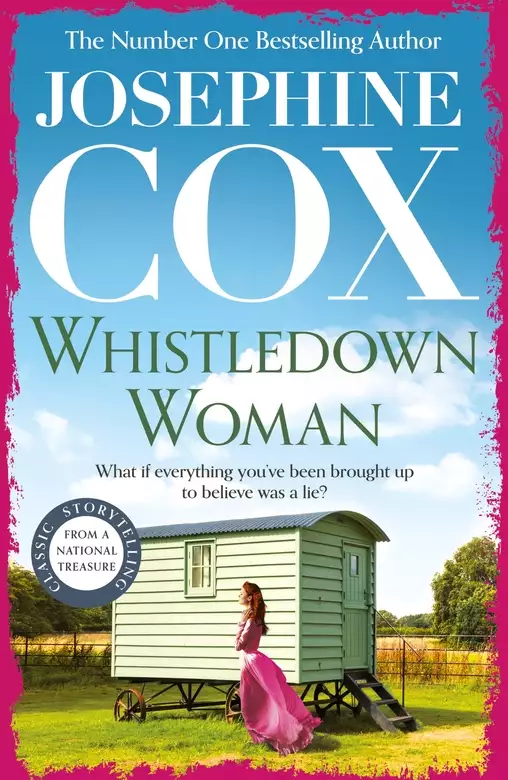
Whistledown Woman
- eBook
- Paperback
- Audiobook
- Hardcover
- Book info
- Sample
- Media
- Author updates
- Lists
Synopsis
What if everything you've been brought up to believe was a lie?
Whistledown Woman is the moving story of a beautiful girl growing up unaware of her true inheritance, from bestselling author Josephine Cox. Perfect for fans of Kitty Neale and Lindsey Hutchinson.
On a moonlit night in 1898, Kathleen Wyman lies in labour at Bessington Hall. Her husband, Edward, is sure that she has been unfaithful to him. In his blind, jealous rage he later gives away the baby to gypsy Rona Parrish, summoned to help with the delivery. Kathleen, frenzied with grief, is soon after locked away in an asylum.
Rejected by her father, the little girl begins her new life with only a valuable brooch pinned to her shawl as a clue to her true origins. Named after Rona's own mother, the lovely raven-haired Starlena grows up in ignorance of her true parentage and vast inheritance, believing her birthplace to be the beautiful Whistledown Valley. And Rona, always afraid, stays watchful over the years for any sign that someone might track Starlena down - someone who wishes her harm...
What readers are saying about Whistledown Woman:
'A brilliant novel by Josephine Cox. Gripping and romantic combined with subterfuge. A very unusual storyline makes this a different story'
'Couldn't put this book down, had everything: romance, sadness, suspense'
'I loved the story, lots of twists and turns - such a realistic, descriptive style which transported me into the story'
Release date: January 19, 2012
Publisher: Headline
Print pages: 417
* BingeBooks earns revenue from qualifying purchases as an Amazon Associate as well as from other retail partners.
Reader buzz
 Please log in to recommend or discuss...
Author updates
Whistledown Woman
Josephine Cox
sentence down on you, my beauty!’ At which, Freya Judd had been taken from the court. But her grim warning was not so easily removed. It hung in the air with dark menace, striking fear into Starlena’s heart.
During these past six months, since that bright autumn morning when the police had taken her into custody on a charge of murder, Starlena had thought on many things: loves and passions; hatred and fear. Into her choked and weary mind had come all manner of recollections, some pleasant and soothing, others of a very different nature and with which even now she could not come to terms, for they had shaken her to the very core of her being. So many things had happened, so much had come about to turn her life upside-down, that at times in the darkness of her prison cell, the uncanny stillness of the night gave her to wonder whether the whole thing had not been a dream – a nightmare from which at any moment she might be awakened.
But it was no dream! A nightmare, yes – but not one from which she could escape, for Starlena now knew without doubt that even before her wretched mother had birthed her, the shape and direction of her destiny was so strongly defined that in order to have changed it, heaven and hell would have needed to merge! And yet in all truth, had not that very phenomenon taken place through the enactment of her life?
‘Come on! Come on! Look sharpish, there!’ The uniformed escort leading the way, twisted her neck to look behind and address the others following. At once, Starlena felt the prod of stiff fingers in her shoulder blades as the officer immediately behind urged her on. ‘Pick your feet up!’ came the curt instruction. So with one impatient representative of the law in front, the other close on her heels and no place to go but forward along the narrow stone-floored corridor, Starlena pushed ahead. And as her feet carried her on in all urgency to the place where her fate must be decided, she thought again on Freya Judd’s warning and an involuntary shiver ran through her. Would
she be found guilty and executed? And back came the answer to her own question: yes! It was likely!
A look of resignation settled in Starlena’s dark eyes. If today her own life became forfeit, then in all truth it would be a fitting justice, for she would not deny that she was guilty of many things, and, were it not for her, at least one innocent soul would not now be lying in the churchyard.
Time and time again in that place where the final chapter of her life was being played out, Starlena had listened passively during the revelations which had made the jury gasp and had written a look of desperation on the face of the man defending her. She had witnessed also the smile of triumph on the faces of her enemies. And in that moment, Starlena was ready to meet the consequences of her actions, however terrifying they might be. Her only regrets were for the pain she had caused those who loved and prayed for her.
Throughout every minute of this long tortuous trial, Starlena had felt their despair, and in spite of the fact that she could have drawn a measure of comfort from their darling familiar faces, she had stopped herself from looking towards where they were seated, lest she might see the pain in their eyes, choosing instead to focus her attention on the young, unfortunate barrister who had for many wearying hours put forward her case, a case which, he claimed, ‘in all humanity demands the mercy and leniency of this court!’
Of a sudden, the corridor narrowed and darkened, and the little party drew to a halt at the foot of a steep flight of wooden steps. In minutes, the hatch above was flung open and the two enclosing doors swung back to reveal the grand carved ceiling of the courtroom, where, high on the wooden-panelled wall above the elevated judiciary bench, was mounted a magnificent bird, its great body encrusted with patches of iridescent colours and the awesome spread of its mighty wings seeming to envelop all below.
Starlena felt herself propelled forward. Going now onwards then upwards, she emerged into the courtroom, where as before she walked briskly across the enclosed area to place herself by the small wooden chair, this flanked by two fresh-faced officers and facing the vast interior of the room which Starlena thought was cold and forbidding, and which somehow put her in mind of Freya Judd, a thing without a heart.
Since the start of this trial, countless thousands throughout Lancashire and beyond had been fired with curiosity at the nature of Starlena’s crime, and at the unfolding of her story. And in those months following her arrest great numbers of people had crowded into the Manchester courtroom so as to follow the proceedings on a more intimate level.
Today was of special importance, for now the trial was drawing to its close. The presentation of both defence and prosecution would be concluded, the summing-up would take place, after which the jury would be directed on the law and called upon to retire for the finding of a verdict.
The silence throughout the courtroom was ominous, as all concerned waited for that moment when proceedings would begin. All eyes were on the proud bewitching figure of the woman known as Starlena; for it was in her and the uniqueness of her story that every man and woman here – every onlooker, loved one and enemy alike – found fascination. And now, as one and all gazed upon her, they were made to recall the words of the man defending her, for what he had said directly to the jury, and in tones of reverence was this:
‘I want you, all
of you, to look long and deeply at this woman. Upon the evidence you have heard you must now decide whether in her you see a cold and calculating fiend – or a woman of remarkable warmth and courage, an innocent victim of such curious circumstances as to be unparalleled in your experience.’
Throughout, not once had Starlena betrayed any sign of her inner turmoil. And even now, as she stood, chin high and gaze unwavering, not a soul there could tell what was on her mind. The dark prison garb took nothing away from the slim youthful strength of her frame which, together with the rich dark eyes and hair shining blue-black as a raven’s wings, gave her the charisma of a magnificently beautiful woman! She had a pride about her that was startling, and a confidence that took hold of the heart.
But for all that, the woman Starlena had offered nothing in the way of her own defence, seeming to have already carved an end to her extraordinary life.
So, the outcome seemed inevitable. The sentence would be extreme – of that no-one had any doubt.
In no time at all, the judge drew to an end of his summing-up, the jury retired to chambers, and the prisoner was ordered back to cells to await recall on the jury’s return.
Leaving the railed enclosure, Starlena would again have averted her eyes from the gaze of her loved ones. But now, in this final hour, she could not. In that swift moment before she was turned away, her gaze lifted to embrace those who were ever in her heart, alive in her every thought, waking or sleeping. They were all here, those darling people, whose aching hearts reached out to console her. And only now, when her pained gaze fell on those stalwart and precious friends did her eyes sadden and begin to swim with tears so long suppressed. In their faces she saw the joy and laughter of times gone by and now so vital in her memory. Oh, how she loved them all, these dear ones who were intricately woven into her life, etched on her soul for all time. Briefly now, Starlena looked on them, her gaze moving lovingly from one to the other.
There, in the nearest row, was the oldest and wisest of them all, a small wizened figure wrapped head to toe in a dark fringed shawl, with only the gnarled brown hands visible on her lap, and a roguish lock of stark grey hair struggling out from the edge of the shawl which was draped about her face and shoulders in that comforting and familiar manner which had always distinguished her. The eyes alone were the live essence of her wise old soul, being darkly brilliant, and holding as they did a wealth of life’s experience. They held also, as they gazed on the prisoner, the greatest love one woman could ever have for another.
To Starlena, this wonderful woman, now physically hampered by the onset of arthritis and worn down by life’s cruel adversities, was the mountain peak of her own existence – for this was her beloved Rona, once gypsy of the road and teller of fortunes, and the warmest, boldest friend a body could ever hope to have on this earth.
Beside the old woman was seated Celia, the gypsy queen, still in her younger flush of womanhood and who, with her brown plaited hair, hazel eyes and ordinary features, could not be described as beautiful. But there was about her a handsome, eye-catching arrogance and, in those defiant amber eyes, more than a hint of deep resentment towards Starlena.
The boy she had grown up with was also here – Anselo had been here for every punishing moment of Starlena’s trial, his rich dark eyes gleaning her face for something – a smile, a look. Starlena knew not what. She knew only that through his desperate eyes there shone a deep abiding love which sought to give her comfort, but which, by its very nature, could not. Starlena had fought to keep her gaze from meeting his. Yet, of a sudden, a great loneliness came over her, and it took every ounce of her control to draw her gaze along, until it came at last to rest on him. Anselo! The very name was like a song, like a sure-footed gazelle wending its way through the bracken, like the wind whistling through the treetops or the warmth of a summer sun on her upturned face. Anselo was wildly magnificent, with his shoulder-length black hair and dark passionate eyes.
Hardly daring to look at him, Starlena’s thoughts were drawn back to when she was little more than a child, and Anselo just a man. Paramount in her memory was a night of illicit love, when passions had blossomed beneath a star-studded sky on a beautiful and sultry evening when, in Anselo’s tender arms, she had become a woman.
He was no longer the impressionable young man she had once given her deepest heart to, for so many years had come between. Yet, the passage of time had been kind to him, and now he was a proud and strapping figure of a man, his black eyes afire with passion, his dark and handsome appearance accentuated by the familiar deep-scarlet jacket which had been Starlena’s favourite.
Now a renewed boldness flooded into her heart, as she returned the intensity of his gaze. As they looked, each into the other, the same forceful emotion shook their hearts and both were saddened by it.
Looking beyond the familiar faces, Starlena’s gaze came to rest on a man much older – a man whose image had the effect of freezing her to the core. An uncommonly offending fellow he was, with stiff unyielding features – one dead eye-socket covered by a crimson patch which could not disguise the jagged scars which ran from beneath it. The one good eye was of the most startling royal blue, whose probing glare could deeply unnerve a body, as it attempted to do now, with Starlena. His sandy-coloured hair was thick and undisciplined, his entire manner arrogant and threatening.
In all his forty years and more, this man had never known the joy of giving – had never once been moved to gladly share his possessions, or himself. He was a fiend, corrupted by an insatiable appetite for power and damned by his crippling greed. As far as Starlena herself had been concerned, this man above all others had wreaked on her the devil’s own mischief. His name was amongst those most revered and respected throughout the whole of Lancashire, for the Wymans were immensely rich and for generations had been part of a tradition which gave them the right to rule like lords in their own little kingdom. But this particular Wyman was not liked. He was feared and held in contempt by many. His name was Redford. Redford Wyman – brother of Starlena! And, as sure as the earth turned on its axis, he was here to see her hang.
Beside him, and equally vindictive, was Freya Judd. A harsh-faced woman with light brown hair drawn severely back and piercing green eyes which never once left Starlena’s face, she also was determined that Starlena should lose her life.
These two, Redford Wyman and Freya Judd, stayed close one to the other. There were never spawned two more ungodly creatures than these!
Yet, if those two were the devil’s own advocates, the two seated behind them were like a ray of sunshine in Starlena’s troubled world. Her dark trembling gaze came now to meet that of a man, an American whom she had known for only a short while, but who meant so very much to her. Instantly, Starlena’s heart was moved with a great surge of warmth and love for this man, Jackson Grand, for if Anselo had stirred memories of illicit passions and forbidden emotions, this man touched her heart more deeply. Theirs also had been a love which had brought pain in its wake, a love which was not theirs to take – yet it had been a love so compelling that it would not be denied. They were drawn together now, just as they had been in the past. And now, as then, it would seem that Fate was against them. Yet, as they gazed at each other, there grew between them a uniquely silent understanding – a belief in God and in that eternal hope which surely was their right. In the magnificent beauty of Jackson’s dark green gaze, there shone for Starlena a wonderful strength, and such aching love that made her want to run to him and fling herself into his arms. But such comfort was not to be. Not at this moment in time, and maybe never.
As Starlena looked upon the gentle features of Elizabeth Judd, she would not have been surprised to see there a look of loathing. Instead, the soft blue eyes smiled reassuringly and, knowing how cruelly this woman had been treated with Starlena believing that she herself was not entirely blameless, it was then she had to turn away, the tears filling her dark eyes, her heart sore within her.
Now, after sweeping one last glance over the old woman, Rona, whose lingering gaze needed no words to convey the love in her heart, Starlena was led away to follow the familiar route back to the confines of her cell; where for a while she would welcome the enforced solitude and employ the time reflecting on her fate.
‘I’ll see you’re brought some food!’ The officer had secured her prisoner, then, after turning the key in the lock, she had showed her face at the grill, adding, ‘. . . there’s no telling how long the jury are likely to be out.’
Starlena made no reply, for there was need of none. She knew in her bones that the jury would not take too long, for they had little choice but to find her guilty of murder as charged. How could there possibly be any other verdict?
Of a sudden she felt the trauma of these last months, and as though pressed downwards by the weight of the devastating events which had brought her here, her body sank wearily onto the stiff narrow bed, her shoulders upright against the wall, its damp coldness striking with a shock against the back of her head. With a great sigh of relief that, come what may, it was now almost over, Starlena closed her eyes. As she did so, a surging emotion akin to glory swelled her heart and lifted her faith. Gone was the uncertainty, the fear and the darkness which had cloaked themselves about her like a mantle. The darling face of the old gypsy came into her mind, bringing with it memories of summer days, open fields and running brooks teeming with fish – of wild horses, proud black stallions and newborn foals still wet from birthing. The song of a bird and the sharp dry smell of an open charcoal fire. She could feel again that special joy when holding a tiny helpless babe in her arms – and even now, after all that had happened, there murmured deep in her loins that trembling warm urgency of a passion which could not be denied, for she was only a woman, with the heart and emotions of a woman – both of which might soon be silenced forever.
She thought of her darling girl-child, Ronalda, at this moment in the care of others, and her heart was pained. Had the child been either Anselo’s or Jackson’s, she would at least have had a father to love her. But Ronalda would have no-one to watch out for her – other than beloved Rona, the gypsy woman.
Deliberately Starlena dwelt on all things comforting, forcing out of her mind those thoughts which saddened and frightened her – and as God was her witness, there had been too many of those. Far too many!
Paramount in her recollections was Rona, not as she was now, slow and aged, but as she had been, a handsome young woman with the strength of a bull and a heart as big as the open countryside she had once called home. This was how Starlena remembered her, the woman she had always believed to be her own flesh and blood; and who in every way had encouraged Starlena, first as a child, then as girl and woman, to believe that she too was of the dark gypsy blood, and that Rona was her own true mother. In all those eventful years, there had been no call for Starlena to think otherwise.
Life had been wonderful, an exciting adventure that could never end. Until the truth of Starlena’s birth and background became a threat to her very life. At this point, the free spirit became the hunted, and the nightmare began.
Starlena thought on the story revealed to her only in the final moments of inevitable tragedy. And even though Rona had deceived her for a lifetime, she must still think of her as her own mother, for the love between them had been forged stronger than any blood-ties. Now, as she was drawn into a strange restless sleep, Starlena recalled how Rona had explained the untoward circumstances which had led to a lone gypsy-woman taking Starlena the newborn child to raise as her own.
In remembering how it had been, and the events which followed it, it was to Rona that her heart went out.
Pausing in his labours the fat man nodded towards the lean brown-haired man with dark intense eyes, the man called Leum. Then, smiling warmly at the olive-skinned woman attired in a long flowing dress of dark material, her black hair tucked into a gypsy-type blue linen square and her whole manner showing her impatience to be off, he said in his light-hearted way, ‘There’s yer secret, Leum, wouldn’t you say? Sitting up on yon cart – that magnificent wife o’ yourn. By! What a woman to ’ave working alongside you, eh? Better than any man when it comes to tilling the ground an’ persuading the earth to give of its best – an’ there’s nary a soul to touch ’er when it comes to horses! Knows their ways like the back of ’er hand, she does. An’ wi’ folks going to no other when they’re in need o’ buying a new horse or pairing off a mare – why, I reckon you’ve got a bloody goldmine in yon woman!’ Smiling into the woman’s eyes, he said in a quieter voice, ‘You’re a grand eye-catching creature, Rona Parrish – an’ no mistake!’
‘An’ you’re a man wi’ too much of a roving eye for the women, fat Joe!’ the woman retorted with a twinkling smile. ‘’Appen I should let yer wife know of yer randy ways, eh? Yer a for’ard bugger, that ye are!’ On the last word she broke into a soft laugh and shaking her dark head plied her attention to the old cob up front, who was beginning to fret from the waiting.
‘All the same, Leum’s a fortunate man, an’ if I didn’t know that the rascal treated both you and the bairn like the jewels you are – well, I’d ’ave the pair of you away, you can reckon on that!’ the fat man insisted.
‘Oh aye! Happen so, but it’d need to be over my dead body, you old sod!’ Leum called out with equal good nature. Then, climbing onto the cart beside his wife, he looked away from the men who, quietly laughing, had already returned their attention to loading up their unsold wares.
For a long moment Leum Parrish sat quiet, looking into his wife’s smiling face and taking stock of her. She was not beautiful, for her face was too large and her lips too thin. Her dark skin was too weathered by the elements they both must needs fight, and her clothes were not fanciful or flattering – for how could fine garments be suited to drawing out a living from the earth, or breaking in a filly possessed with the spirit of a mountain lion! No, his Rona was not of the beauty such men might seek; although there was indeed a handsomeness about her that struck the heart, her teeth being even and startlingly white, and her large dark eyes having depths that seemed to magnetize a body. Strange also, how those eyes had that same effect on the horses she handled. Yes, there was a degree of magic about his woman, and he loved her fiercely!
Stirring beneath her husband’s loving gaze, Rona was moved to reach out her hand, clasping long strong fingers over his work-worn fist. She too loved with a fierceness which sometimes frightened her, for to love so immensely and with all of one’s being, was a dangerous thing! It swelled up inside you, sucking in every other emotion until there was nothing left but this consuming and wonderful love, without which there would be nothing left but a great empty void.
For now, though, Rona’s life was complete. It was a hard life, yes – but while she had Leum; and now a beautiful girl-child of such tender age that she had not yet been given a name, Rona wanted nothing more.
Without words, the two of them kept their gaze locked each into the other, the love which moved them alight in their eyes. Bending to kiss her, Leum would have lingered, but Rona spoke now, saying, ‘Will you take the reins, Leum? I’ll check the bairn afore we move off.’
As he did so, she slid down from the high seat on the front of the cart, and in a moment was on her knees beside a small wooden cradle, this securely wedged behind the flat panel situated beneath the seat. With great tenderness, Rona reached her hand into the cradle and with careful fingers lifted the cover from the sleeping child’s face. The girl-child was beautiful! Although only a few weeks old, already her black hair was inches long, and when for a fleeting moment she opened her eyes, they were of the same dark colouring as her mother’s.
‘Ssh, my bairn,’ whispered Rona, waiting to see the eyes closed again in sleep before softly replacing the cover. Then she climbed into her place and with Leum keeping the rein they started the old grey cob away from the Blackburn market and out upon the long tiring journey which would take them home. The familiar route would lead them through the district of Church, then on over the hills to the outer fringes of Shillington Hamlet, where stood the smallholding of twenty acres which they had rented these past fifteen years, ever since Rona had turned her back on a gypsy culture she had passionately loved. And all for a gorgio, a man who knew nothing of the gypsy way of life. But if Rona had a passion for the wandering ways of her ancestors, it was as nothing compared to the intensity of her adoration of this man. She had come to him as an innocent young girl and for fifteen years had toiled beside him, giving him everything a man could ask – loyalty, comradeship, comfort and love. Yet the one thing needed to make their joy in each other complete was ever elusive, until in the summer of her thirtieth year Rona had conceived the child they both longed for. And when in this year of Our Lord 1898, on a blustery bitter day in February, the little miracle had come into the world screaming her protest, Rona knew that whatever happened for the rest of her life, nothing
would compare with the magnitude of emotion which had rushed through her – and which to this day she could not recall without the greatest feeling of humility.
Somewhere in the distance a clock struck five, prompting Leum to say, ‘I should wrap that there blanket about yer legs, my beauty. It’ll be late afore we get ’ome – an’ this March wind’s striking a bit chilly!’ He gripped both reins into one hand as with the other he collected a rough grey blanket from the floor between his legs. Gathering it onto her lap, he instructed, ‘Tuck it well over, lass. Don’t want you catching pneumonia!’
Rona did as he bade, for she knew only too well that they would feel the bitter cold winds once they were headed out of Blackburn and onto the exposed open road. And as she wrapped the blanket around her own legs, so she covered Leum’s; after which she drew herself up tight to him. Now so close to him that the warmth of their bodies merged, she laid her head on his shoulder and hoped they might get safely home before the dark set in.
It was over an hour later, as Leum drove the old cob on over the moors, that the black, fancy brougham came speeding towards him from round a blind narrow bend, the large bay horse pushed hard and flaring at the nostrils, forcing Leum up and into the bank.
Rona cursed, and would have turned to shake her fist at the high-born lady inside. But Leum chided her, shook his head and remarked, ‘They’re gentry, my beauty. ’Appen down from the rush o’ London an’ don’t know no better!’ Then, slapping the reins gently against the old cob’s rump to drive him on, he added with a chuckle, ‘Let’s be thankful it weren’t one o’ them new-fangled motor-car contraptions! Old Treach from the market was telling me a while back that they’ve done away wi’ the red flag, an’ raised the speed limit to fourteen miles an hour! Can you credit that, my beauty? Fourteen miles an hour! Won’t be long afore nobody’s
safe on the roads, I’m tellin’ yer!’
Rona made no acknowledgement, being too incensed at the incident. Now, after quickly checking that the child was safe, she gave an angry toss of her dark head and made a sharp retort.
‘Ach! You’re too easy, Leum Parrish! Allus ready to turn the other cheek!’ Her temper, however, was swiftly subdued by the patient smile on his kindly face, and laughing aloud she snuggled herself back into the warmth of his body. ‘Aye! Too easy altogether, my
We hope you are enjoying the book so far. To continue reading...
