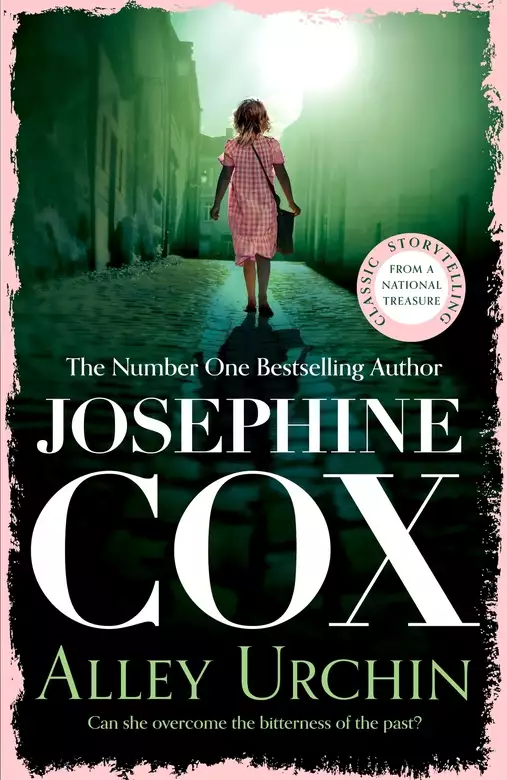
To return to those she loves, she must also return to the past... In the second instalment of her Emma Grady trilogy, bestselling author Josephine Cox brings us Alley Urchin, a gripping saga of a woman determined to overcome the brutality of life as a convict to return to the man she loves. Perfect for fans of Kitty Neale and Rosie Goodwin.
By 1870 Emma Grady has spent seven years of servitude as a convict in Australia. Emma lives for the day when she will return to England, to face those who cheated and betrayed her. And to Marlow Tanner, the man she loves - and whose tragic child she had borne and then lost.
Emma struggles to make something of her life in Australia despite the sinister presence of her employer's evil son, Foster. His determination to 'have' Emma leads to dark and terrifying consequences. As Emma battles against adversity, she is unaware that in England the child she has given up for dead is being lovingly raised by Marlow's sister Old Sal, who teaches Emma's daughter Molly to be an expert pickpocket.
Will Emma ever be reunited with Marlow? Even if she finds him, will he still love her? And what of the child lost to both of them? Emma is plagued with fears but her love for Marlow never weakens - and can never be forgotten...
What readers are saying about Alley Urchin:
'Josephine Cox has the unique talent of writing books which provoke every emotion in the reader. This book in the Emma Grady trilogy has all this - and more. We feel for the characters as if we know them and, as with all Josephine Cox books, it is very hard to put down the book once started... You will find yourself impatient to get to the end!'
'Another great, thrilling book which keeps you guessing till the end. The story is well written with some great twists'
'Totally absorbing. Unputdownable!'
Release date:
January 19, 2012
Publisher:
Headline
Print pages:
240
* BingeBooks earns revenue from qualifying purchases as an Amazon Associate as well as from other retail partners.
‘Love you!’ Emma’s stout heart was fearful, yet her grey eyes glinted like hardened steel as they bore defiantly into the leering face above her. Even though she would have denied it to the world, Emma could not deny to herself that she was afraid. Ever since that fateful day some seven years before when, along with other like wretches she had stumbled from the convict ship, Emma’s every instinct had been disturbed by the covetous manner in which Foster Thomas had brought his gaze to rest on her.
As always, Emma put on a brave front. Drawing her trim form upright and squaring her small, straight shoulders, she told him, ‘I could never love you, Foster Thomas. Never! The only emotion you raise in me is one of disgust.’ Yes, of repugnance and loathing too, thought Emma, being painfully aware of his close proximity as he stood his ground, determined that she should not pass. She saw him as everything vile in a man. Oh, it was true that he had about him the compelling quality that might easily turn a woman’s head. He was a fine figure of a man – tall and lean, with wayward sun-bleached hair atop a bronzed handsome face. There was a certain attraction in the coarseness of his manner, yet when the occasion suited him, he carried an air of elegance and devastating charm. But those eyes: only the eyes betrayed the truth of his nature. Small they were, and calculating; murky-blue in colour as the ocean, yet more deep and dangerous, and ever watchful, like the quick, darting glance of a lizard.
For what seemed an age, he made no move. Instead, his smile grew more devious, then, raising his hand, he made as if to stroke Emma’s long chestnut hair. But, being somewhat startled by a sudden intrusion, he angrily lowered his arm and swung round to face the intruder. ‘You!’ he snapped, glowering hard at the homely young woman silhouetted in the barn doorway. ‘Haven’t you got work to do?’
‘Course I ’ave!’ came the chirpy reply, as the irrepressible Nelly strode into the barn, quickly dropping the wooden bucket from her arm to the floor. ‘Yer surely don’t think I’ve been sitting on me arse all morning, d’yer?’ Then, before he could lay the yardbroom across her shoulders, as she knew he would, she added quickly, ‘Old Mr Thomas sent me ter fetch yer. He said yer was ter come straight away, on account of it being most urgent.’ She manipulated her plain, kindly features into an expression of alarm. ‘The poor old thing were having a real fit about some’at,’ she said, nodding her head so frantically that her frilly cap tumbled into the dust at her feet. By the time she bent to retrieve it, Foster Thomas was gone, after first asking, ‘You say my father wants me right now . . . this very minute?’ To which she replied with suitable anxiety, ‘Ooh yes, Mr Thomas, sir. This very minute!’
‘You little wretch,’ laughed Emma, as she and Nelly watched him stride away, both knowing full well that he was being sent on a fool’s errand. That rascal Nelly, thought Emma, as she lovingly put an arm about her friend’s shoulders; she knew every trick in the book. Brought up in the East End of London, she was a Cockney through and through. Since an early age, Nelly had been forced by circumstances to fend for herself, and she was a past master at it. It wasn’t the first time she had made a timely intervention on Emma’s behalf. Though Emma knew only too well that Nelly could take care of herself, she was constantly afraid that, one of these days, Foster Thomas might take it into his head to get rid of Nelly once and for all.
Emma knew it would be an easy thing, because all that was necessary was for the Governor to receive a formal complaint against the prisoner Nelly, and she would be punished, assigned elsewhere, or both. So far, Emma had stalled such a move by appealing to old Mr Thomas, Foster’s father, who was after all the employer to whom both she and Nelly had been entrusted since being brought to these shores. With his wife in ailing health, Mr Thomas senior had been thankful for the labour supplied by the two female convicts, and was never too mean to say so – both to them, and in his regular reports to the Governor.
Emma respected and liked him. He was a hard-working and shrewd man of business, having built up his trading post from selling the few items he brought with him when he first arrived in Western Australia as an early settler many years before. He was a good man, and his wife a good woman. Emma thought they deserved a better son than Foster Thomas.
‘Oh, Nelly . . . I wish you’d be more careful.’ Emma hoped this little episode wouldn’t bring trouble down on their heads. ‘You know what a vicious temper he has, yet you will keep going out of your way to infuriate him.’ Much as she understood Nelly’s unselfish motive and her first instinct was to thank her, Emma thought that better purpose would be served by showing her disapproval: ‘I’m quite capable of looking after myself, you know.’
‘Yer bleedin’ well ain’t!’ came the indignant retort. ‘I saw him . . . with his filthy paws all over yer. What! The bugger’s lucky I didn’t clap him on the back o’ the neck wi’ a shovel!’ Her angry brown eyes twinkled at the thought. ‘Randy bleeder,’ she went on, at the same time retrieving her wooden bucket and leading the way to the inner recesses of the big barn, where she proceeded to gather up the numerous eggs which had been laid here and there. When Emma pointed out that Foster Thomas was her problem and said, ‘He’s sure to cause trouble for you, when he finds you sent him on a wild goose chase,’ Nelly was quick to assure the concerned Emma. ‘Old Mr Thomas’ll cover up fer me. He’s done it afore.’
Exasperated, Emma shook her head, rolled her lovely grey eyes heavenward and laughed out loud. ‘What will I do with you, Nelly?’ she chuckled. Whereupon, Nelly laughed heartily, ‘Send me back ter England.’ She added with some gusto, ‘The sun don’t cook yer brains there, and there’s more bleeding pockets ter pick.’
Quickly now their laughter subsided, when a shadow came between them and, looking up, they saw the large, ungainly figure of Mr Thomas. His face was unusually stern and, as he stood unmoving with his two large hands spread one over each hip, Emma saw the frustration in his dark, round eyes which were usually kind and smiling.
For a long, awkward moment, no one spoke. Feeling uncomfortable beneath his accusing glare, Nelly cast her eyes downward. Emma however met his gaze with an equally forthright one, until, seeing that there was no immediate explanation forthcoming and that, as always, he was hopelessly outnumbered two to one, Roland Thomas took his hands from his hips, plunged them deep into his pockets and allowed the whisper of a smile to creep over his craggy, kindly features.
‘What a pair of baggages you are,’ he said goodhumouredly. Then, to Nelly, who had raised her merry brown eyes to smile at him, ‘You’ve got that bloody son of mine running round in circles . . . me as well!’ Of a sudden the smile slipped from his face and his voice held a warning: ‘You’re playing with fire, though. Be careful, Nelly, because though I say it as shouldn’t . . . that son of mine is a bad lot!’ His eyes were now on Emma, as though willing her to convince Nelly that she was putting herself in danger, ‘Be warned. Don’t antagonise him.’
‘But he were pestering Emma again!’ protested Nelly, afterwards falling quiet when Roland Thomas stepped forward, his concerned eyes never leaving Emma’s face.
‘Don’t worry about me, Mr Thomas,’ Emma promptly assured him, ‘I can look after myself.’
‘Look here, Emma’ – his voice was quiet now, and on his face a look of anxiety as he told her – ‘I’m no fool and I’m not blind.’ His gaze lingered on her face for a moment. ‘Stay out of his way as best you can. Keep a good distance between you.’ Having said that, he turned away to leave them to their duties.
It was a moment before both Emma and Nelly recovered from the seriousness of the warning they had just been given. The first to speak was Nelly who said, in little more than a whisper, ‘Well, I’m buggered! I ain’t never seen old Mr Thomas so harsh.’
Neither had Emma, and her every instinct had been aroused. Was there something going on that neither she nor Nelly was aware of? An idea wormed itself into her troubled mind, and swiftly, Emma thrust it out. No. Surely to God, it couldn’t be that Mr Thomas was about to turn over the business to his son! No, he would never do that . . . would he? Oh, it was true that Violet Thomas’s health had gone steadily downhill these past months, and it had been a source of much anxiety to her husband. But knowing his great passion for the trading business he had nurtured all these years, Emma couldn’t believe that Mr Thomas was about to let go of the reins. And certainly not to his son Foster . . . who had never shown an ounce of interest in the business; except, of course, in the money it provided him with, to waste on grog and gambling. Yet there was something . . . definitely something: she was sure of it.
‘I’d best get these eggs inside . . . afore the buggers are cooked!’ Nelly remarked, at the same time slapping Emma heartily on the back as she passed. ‘Roll on three o’clock, Emma . . . and we can put our feet up, eh?’ Then, turning just once before she went from the shadows of the barn into the baking heat outside, she added, ‘The buggers don’t worry me, dearie, and they shouldn’t worry you.’ Emma smiled to herself. She admired Nelly for her fearlessness, yet she also saw it as being foolhardy. When the two of them had been exiled from their homeland, Nelly’s sentence had been less severe than her own. Now, seven years on, their roles were reversed and, while Emma had earned her ticket-of-leave through good conduct, Nelly’s rebellious attitude had put back the day of her freedom even further. Yet even though she was her own worst enemy, Nelly was a warm, loyal and steadfast friend, whom Emma loved like a sister. And, though the Governor had told Emma that her ticket-of-leave gave her at least the freedom to choose her own employer and place of work, Emma remained alongside Nelly in the Thomas trading post. While her friend was forced to stay, then so would she. Emma shook her head and chuckled softly, ‘The way she’s going on though . . . we’ll both be old and grey before we get the chance to make our way in the world.’ Afterwards she sighed, and turning her attention to the task in hand, at the same time subconsciously noted that the stock of small oil lamps would need replenishing.
Emma loved her work here, and she took a great pride in all of her duties. Mr Thomas himself had remarked on more than one occasion, ‘You’re a born trader, Emma . . . you’ve got a real knack for it.’ Emma was grateful that she had been assigned to the trading post, for she did feel so much at home, serving the customers, making up the orders and keeping the books for Mr Thomas. It wasn’t so very different from being a clerk at her father’s cotton mill in Lancashire. Sometimes, when the sun had beaten down mercilessly all day and the stream of customers continued from early morning to closing, when Emma’s feet ached and her back felt as stiff and uncomfortable as the ladder she might have to run up and down a dozen times a day, Emma was glad to crawl back to the small room she and Nelly shared, at the back of the stables. It was a hard life, with each day as demanding as the one before. But Emma poured herself heart and soul into her work. Mr Thomas was a good employer and lately, he had been shifting a good deal of the more confidential duties on to Emma’s shoulders, so that, besides keeping the stock-book up to date, she was often responsible for the accounts ledger, and even for cashing up and securing the takings.
One particular evening, Emma had overheard a raging row between Mr Thomas and his son Foster who, she knew, bitterly resented his father’s increasing dependency on her. Afterwards, she had respectfully pointed out to Mr Thomas, ‘I don’t want to be the cause of bad blood between you and your son.’ His immediate reply was to inform her of two things. Firstly, that he was obliged to spend as much time as possible with Mrs Thomas, who ‘is a delicate and refined creature who unfortunately does not enjoy good health’, and secondly, ‘if she had been able to bear me another son . . . or even a daughter of your calibre, I might be fortunate enough to lean on them. As it is, Emma . . . I have a worthless son who thinks it more natural to take rather than to give.’ Here, the weariness melted from his craggy features, and in its place was a great tenderness. ‘Then, I have you, Emma. And though the hand of fate was so cruel as to condemn you to this land a convict . . . I can only bless my own fate, for having deigned that you should be assigned to me.’ On this last word, he had turned away before Emma could see how deeply he had been affected by the vehement row with his son, and the added burden that Emma might decide to seek employment elsewhere, which, having earned her ticket-of-leave, she had every right to do. Some time later, her heart filled with compassion at this good man’s dilemma, Emma made it her business to explain to him that she would not desert him. He spoke not a word, but touched her gently on the shoulder and when he turned away, it was with a brighter, more contented light in his dark eyes.
Thinking about it all, Emma later reflected on her assurance to him, which amounted to a promise. She thought also about her determination not to desert Nelly. As she dwelt on it more deeply, it became apparent that she was enveloped in a prison other than the one to which Her Majesty’s Government had despatched her. It was a prison within a prison, made by her own hand, and one which by its very nature would thwart her plans towards absolute freedom and her eventual return to England. This above all else burned fiercely in Emma’s heart. She knew with every breath in her body that her day would come. That wonderful exhilarating moment when she would embark on the ship which was destined to carry her over the oceans to the other side of the world. To England! To the ‘friends’ who had cheated and betrayed her. And, with God’s help, to Marlow Tanner . . . the man whose child she had borne and tragically lost. The man she had loved then, and whom she had loved every waking moment since. Oh yes, that day would surely come. Until then, she must count the hours and be frugal with every penny she earned. Above all, she must thank God for the love and devotion of a dear, dear friend, and count herself fortunate to have the confidence, loyalty and trust of another. She wouldn’t let them down. Not even in the face of a no-good like Foster Thomas.
Some two hours later, Emma had completed the laborious task of taking account of all stock, both in the general store and in the huge outer barn, which doubled as a warehouse. Afterwards, when coming back into the small office at the rear of the store, she put the heavy ledger on to the bureau and commented to Mr Thomas, ‘That consignment of goods from England is overdue. Another twenty-four hours and we’ll likely be sold out of candles, boots and general harness. And another thing, Mr Thomas . . .’ Emma quickly finished her final entries into the ‘Urgent’ page of the ledger, before emerging through the office doorway and into the store. There she assured herself that Mr Thomas was attentive to what she was about to say. Then, taking off her dusty pinnie, she replaced it with a freshly laundered one from beneath the counter and continued, ‘I do wish you would think about what I said some time back . . . about taking up a lease on one of the more substantial warehouses on Cliff Street. That old barn isn’t secure, as well you know it, Mr Thomas, and there’s a lot of money tied up in the goods stored there.’
‘Oh, Emma!’ Mr Thomas raised his finger and thumb to tickle his mutton-chop whiskers absent-mindedly; it was a peculiar habit of his whenever he seemed slightly amused. ‘Do you think we’re about to be robbed?’ He chuckled aloud and, bending his back, he grasped the comers of a box of carbolic soaps with his two hands. He swung the box upwards, before bringing it down in a flurry of dust, on to a shelf he had just cleared. ‘Or mebbe you’ve got a notion that some rascal creeping about at night has the intention of putting a match to it, eh?’ He chuckled again. ‘You’re a little scaremonger, that’s what you are,’ he declared with a broad and confident smile.
Emma was not amused. Nor would she be dissuaded from pointing out the errors of continuing to store valuable goods and equipment in such an insecure and vulnerable place. ‘There are “rascals” enough who might well put a match to anything, if it suited their purpose!’ she reminded him. ‘You know as well as I do that there are certain unsavoury characters in Fremantle who wouldn’t think twice about razing that barn to the ground, after helping themselves to a good deal first.’ When Emma saw that, at last, she had his serious attention, she went on quietly, ‘Oh, Mr Thomas . . . I’m not saying as they would, but you’ve seen the strangers about of late . . . diggers and bushmen . . . some new to the area, and some looking even rougher than the worst convicts sent to break stones on the road. Wouldn’t it make sense to house your more valuable goods at least, in a small secure lock-up on Cliff Street?’
Pausing a moment longer in his work of setting out the blocks of soap in a fetching grey display, Mr Thomas played one lip over the other, biting first at the top, then at the bottom, while he quietly pondered Emma’s suggestion. Wasn’t she right after all, when the goods were hard come by, and cost a fortune to ship out from England? Then, once out on the high seas they were at the mercy of every wild storm and natural disaster that a ship might encounter on its long voyage. She was right! Emma was right. Some of the stuff . . . shovels, pickaxes, and good working tools were going out as fast as he could get them in. There had been guarded murmurs about little pockets of gold being found here and there, and that was no doubt the explanation. All the same, merchandise was an increasingly valuable commodity hereabouts, and a person could never be too careful.
‘You do see why I’m so concerned?’ asked Emma, her shrewd business instinct telling her exactly the thoughts going through her employer’s mind. ‘I can arrange it . . . if you’ll trust me to do the job right,’ she offered, knowing only too well that his mind was lately taken up with his wife’s unfortunate illness. Emma felt sorry for Mrs Thomas, who had never gone out of her way to make friends, was a very private person and, unlike Mr Thomas, kept both Emma and Nelly at a distance. The only person who enjoyed her confidence, other than Mr Thomas himself, was the blacksmith’s spinster daughter, Rita Hughes. Rita pampered her every whim and saw to her every need, for the small weekly payment of a few shillings. Emma suspected that Nelly was right in her observation that ‘Rita Hughes has one eye on Mrs Thomas . . . and the other firmly fixed on Foster Thomas’! Adding, to Emma’s disapproval, ‘Though if yer ask me, she’s well past it and gone sour.’ When Emma protested that that was a cruel thing to say, Nelly was quick to point out, ‘Huh! T’would be even more cruel if he took a fancy to her! What . . . a fella the likes o’ Foster Thomas would mek her life a bleedin’ misery.’ Emma had to agree.
Emma was convinced that poor Mrs Thomas had withdrawn into herself on account of her husband and son forever being at loggerheads. At one time she had doted on her only son. Now he showed little interest in his mother, and she showed none in him. All the same, Emma suspected that her heart was quietly breaking.
‘I tell you what’ – Mr Thomas’s voice cut into Emma’s thoughts – ‘leave it with me, Emma. I’ll bear in mind what you’ve said.’ Beyond that he would not be drawn. Except to promise that the shop takings would not in future be kept upstairs in his room for up to a week at a time, as had become the habit of late. Emma did not agree with his belief that such large sums of money must always be to hand. ‘The captains of the pearl-luggers want always to be in and out in a hurry, and, if I’m to keep up with the competition to buy the best pearl-shell in, then I need to have cash to hand at any given minute.’ It worried Emma. But this was his trading post, not hers, and she mustn’t forget her place.
Neither Emma nor Mr Thomas could have known how tragically Emma’s fears were about to be realised, before the hands of the clock had turned full circle!
‘Away with you!’ laughed Emma, who was patiently waiting for her turn with the bowl. ‘If you intend walking along the jetty with me, you’d best curb your urges for a “fella”. The way you’re going on, my girl, you’ll be marched to the top of the hill, where you’ll be clapped in irons and thrown in a prison cell, so every poor “fella” will be safe from your clutches.’ When, mockingly holding her wrists together and limping as though shackled, Nelly started towards her, at the same time making an eerie wailing sound, Emma grabbed up a towel, held it out before her and, amidst much laughter, launched herself at Nelly. In a minute the two of them were rolling about the floor helpless with laughter. Then a kick from Emma’s leg sent the cane-bottomed chair into such a violent swaying fit that the water in the bowl slopped first over one side, then the other. Convulsed by new fits of giggling, Nelly and Emma made to grab the chair, causing it to overbalance completely as the bowl shot forward to empty its entire contents, drenching them both. ‘Bleedin’ Nora!’ shouted Nelly, scrambling to her feet and proceeding to shake herself like a dog. ‘I’m bloody soaked!’
Subdued by the initial shock, Emma got to her knees and looked up at Nelly, all the while coughing and spluttering, her long chestnut hair hanging limp and bedraggled over her shoulders. When she saw Nelly’s outrage and witnessed her frantically shaking her long skirt while at the same time swearing and cursing enough to frighten hardened criminals, Emma thought of her own ludicrous position and an old saying sprang to mind – ‘Oh dear God, the gift to gi’ us, to see ourselves as others see us.’ In a minute she had fallen back to the ground and was laughing out loud.
‘Yer silly cow!’ yelled Nelly, throwing the damp flannel at her. ‘I only wanted a cat-lick . . . not a bleedin’ bath!’ Whereupon she too began roaring with laughter. It was quite some time before they had regained their composure sufficiently to clean up and refill the bowl with fresh water for Emma’s wash. Unlike Nelly, Emma preferred to strip down to her camisoles for a thorough scrubbing and, having rolled about the floor, then been doused with dirty water, Emma took longer than usual at her daily ritual.
Some time later the two of them emerged from the stables. Having discarded her grey work-frock with its over-pinnie, Emma looked delightful in a plain blue dress with a small bustle on the skirt and crisp white frills about the cuffs and neck. Her thick chestnut hair was well brushed and drawn into a shining, most fetching coil at the nape of her neck. Her face was bright and lovely and her strong grey eyes brimmed with the steadfast confidence that set her apart from others.
Nelly, however, did not present such a striking picture. Oh, it was true that her thin brown hair had also been brushed with vigour. But, being under closer scrutiny of the prison authorities, and on more than one occasion having earned the punishment that dictated her locks be shorn, her hair did not enjoy the length that might cause it to lie smoothly against her head. Instead, it stood up and out in little wispy bunches which gave her the odd appearance of having just received a fright. Not being one for dainty things and ‘feminine fripperies’, Nelly was therefore proud of her heavy buttoned boots which came up to her calf. At one time, when Emma had pointed out that there was no need to wear such clumsy, uncomfortable things in the heat of the summer sun, Nelly had been adamant that she would wear nothing else. ‘I’d wear an even longer pair if I could get me hands on ’em,’ she retorted; ‘I ain’t having no bloody snakes nor spiders running up my legs!’ However, she did gratefully accept a brown calico dress which had, until recently, been Emma’s best one. It was of the very same style that Emma was wearing now, except the frills at the cuffs and neck were black instead o. . .
We hope you are enjoying the book so far. To continue reading...

 Please log in to recommend or discuss...
