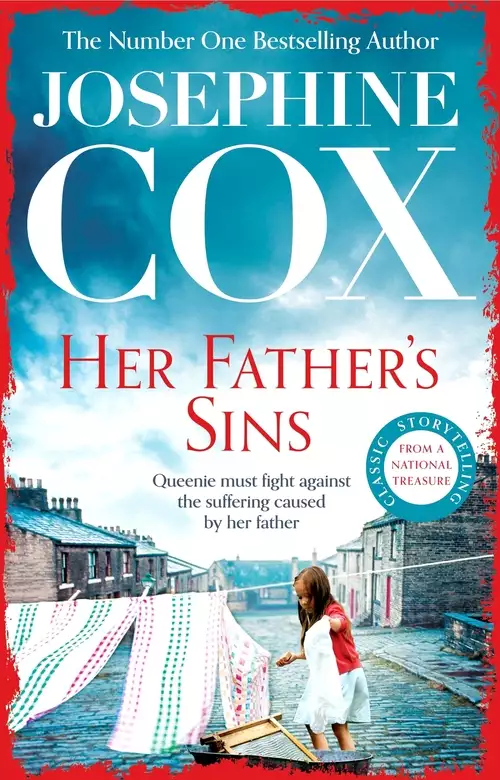
Does Queenie have the strength to overcome her father's sins and grasp love and happiness? Josephine Cox brings us the first instalment of Queenie's story in Her Father's Sins, the unforgettable saga of a young woman's refusal to settle for second best. Perfect for fans of Dilly Court and Sheila Newberry.
Queenie seemed born to suffer. Her mam died giving birth to her, her drunken father George Kenney ignored her unless he was cursing her, and only beloved Auntie Biddy provided an anchor for the little girl. Growing up in post-war Blackburn, life could be tough when Biddy had to take in washing to make ends meet - at a time when the washing machine began to gain popularity. After Auntie Biddy's death there was only Queenie to care for the home and to earn money, and no one to protect her from the father who blamed his daughter for her mother's death.
But Queenie is resilient. And in spite of hardship, she grows up tall and strikingly beautiful with her deep grey eyes and her abundant honey-coloured hair. Love, in the shape of Rick Marsden, might have released her from the burden of the drink-sodden George. But the sins of the fathers cannot be easily forgotten...
What readers are saying about Her Father's Sins:
'A well written book and one that I found I couldn't put down until I had read it from cover to cover in one go!'
'This is an excellent story with the various strands all marvellously coming together at the end'
'I loved every word of the book - five stars'
Release date:
January 19, 2012
Publisher:
Headline
Print pages:
259
* BingeBooks earns revenue from qualifying purchases as an Amazon Associate as well as from other retail partners.
As Biddy’s words permeated the drunkenness of his befuddled mind, George Kenney rose from his seat with slow, threatening deliberation. His thick towering frame blocked the sun’s rays from the window behind him, throwing the whole room into a darkness as evil as the hatred on his face.
The watery blue eyes glittered with a bright liquid reflection of the constant intake of booze which flowed through his blood, washing away any remnant of decency or self-respect. The thick lank hair tumbled about his heavy features like brown matted straw, and his wide bottom lip momentarily hung open. Now, it quickly tightened as he bellowed with rage, ‘Do as I bloody tell you, woman! Get the brat out of ’ere!’ At once, the jug he was holding left his hand in a propulsion of fury, to hit the wall just right of the woman and child. Its stinking contents splattered over Biddy and the child Queenie, soaking them in its sticky boozy odour.
Small of stature but not of heart, Biddy took a bold defiant step forward and drew the child closer to her as she addressed her brother in a strong determined voice. ‘There’ll come a day, George Kenney, when you’ll rue the divilish way you treat this child.’ She paused momentarily looking at the creature before her; remembering the man who had returned from battle some seven short years before. Though the physical similarities were still evident, the change in his character was not easy for her to accept. Yet, if she was to admit it to herself, the signs might well have been inherent in her brother’s make-up these many years – only in her love for him she had chosen not to see them. Now she waited for a sign of remorse. When none was forthcoming she held his eyes with hard directness, concluding, ‘I’m thankful our Mam’s not here to see this day. These past seven years since the Lord took Kathy, you’ve made this child’s life a misery! And you with the weight of sin dragging you down!’
She raised a staying hand as George Kenney manoeuvred his great cumbersome body around the table towards her, his face hideously twisted as he hissed, ‘Whatever sins I carry, woman! I’ll be the one to answer for. So shut your mouth and take care . . . or face the consequences!’
The sight of Biddy’s raised hand and the deliberate challenge in her slitted blue eyes seemed to hold him just a split second in caution. ‘Your wicked tempers and blasphemous ways don’t frighten me, George Kenney! You’ve sunk as low as any man could, and as far as I’m concerned, you’re beyond the saving.’
With a growl, George Kenney lurched forward with intent to grab the cowering Queenie. ‘She’s the one as took my Kathy,’ he cried. Then when Biddy yanked the girl from his reach his roaring fell into a sob of ‘Kathy . . . oh, Kathy.’
‘’Taint “Kathy” as won’t let you rest, George Kenney! ’Appen it’s your own conscience, eh?’
‘Evil bloody witch!’ His narrowed eyes threatened tears as they raked Biddy’s face, and all of a sudden he sank to the floor in a drunken stupor, deliberately bashing his head against the heavy table leg with repeated force until the skin split and the congealing blood stuck to his unkempt hair.
The scene was familiar to little Queenie. This was the father she had known since as far back as she could remember. There was nothing strange about seeing George Kenney crying like a baby, filled with self-pity, and raining blasphemy and damnation on her head.
Queenie was a frail seven-year-old and unnaturally subdued by her father’s bullying. She’d long ago accepted the blame for her Mam’s untimely death. Hadn’t her father always insisted that it was so? It must be true! Because she had no mam to love her; only her Auntie Biddy. Queenie’s tiny hand felt its way into the comforting strength of Biddy’s fist, as she squashed closer into the brown calico skirt which always smelled of second-hand snuff and dolly-blue. Auntie Biddy was a hidey-hole; her one and only store of affection. And Queenie loved her passionately.
‘Come on, lass!’ Auntie Biddy propelled the child before her, ‘I can’t be doing with his snivelling threats!’
As Queenie’s little legs hurried to keep abreast of Auntie Biddy’s angry departure, she turned her head to glance back at her father. George Kenney’s bloodshot eyes bored into hers with chilling dedication and the naked hatred in them caused the child to shudder deep within herself.
Auntie Biddy lifted the child easily, setting her against the big old pot sink in the back scullery, where she proceeded to wash the stale smell of booze from Queenie’s clothes and face. Then, with the same urgency, she cleansed herself.
‘Disgusting filthy stuff!’ she muttered, pulling a tight sour expression. ‘Don’t know what’s going to become of George Kenney.’ She rubbed Queenie’s face briskly with the wet flannel, her mutterings falling so low Queenie could hardly make them out. ‘And that Marsden woman’s interest in charity affairs fetching her in an’ out o’ Blackburn after all these years. Still an’ all, I expect we should be thankful she confines her visits to church-bazaars an’ the like.’
Assembling a sparse selection of vegetables ready for their evening meal, Auntie Biddy continued to mumble beneath her breath. ‘My God, lass. I don’t know! I just don’t know!’ She turned her full attention to Queenie. ‘Look at you child! You weigh nowt but a feather! and the Lord knows I try.’ She darted a scathing glance towards the cramped parlour where George Kenney sat slumped in a horse-hair chair muttering about this and that; his wandering mind too steeped in the past and booze to be sensible or coherent. A long deep sigh escaped her. ‘Things is getting from bad to worse. And I gets less and less money to manage on. Just look at you! Poor scrawny thing you be.’
‘I’m not scrawny!’ Queenie’s protest had immediate effect on Auntie Biddy, whose gaze grew tender.
‘’Course you’re not, love,’ she murmured, reaching out to tidy the light brown plaits across the child’s head. ‘I didn’t mean to say owt to hurt you,’ she assured her, adding: ‘All the same, you could do wi’ fattening up a bit!’ She squashed the child to her bosom. ‘If only thi’ Mam were here, lass. Oh, if only thi’ Mam were here.’
Queenie sensed the sorrow in Auntie Biddy’s voice as she threw her small arms around the slight pinafored figure to hug her comfortingly.
The little woman surreptitiously wiped the tears from her eyes and laughed. ‘You’re a grand lass, Queenie, a right grand little lass! Now come on then! I’m mekkin’ a nice hot-pot from yesterday’s leftovers – and just look here!’ She picked up a small dollop of sad-looking meat. ‘Yon blue-eyed Jack from the butcher’s gave me this. By the ’eck lass, that’ll add a bit o’ taste.’
At this last remark. Queenie gave herself up to thoughts of Auntie Biddy’s hot-pot, the best in Lancashire, according to some. Visions of squashy suet dumplings and all manner of diced vegetables bubbling in rich brown gravy swimming with little pockets of fat came into her mind. In the promise of that full, rich aroma permeating the air and filling her nose till the music in her stomach grew to a growl, Queenie could almost taste it, ‘Ooh, Auntie Biddy,’ she drooled, ‘let me help, eh?’
And when the little woman thrust a small carrot and a knife into her hand, saying, ‘Go on, then, get that scraped!’ Queenie was happy beyond words. This special time when she was allowed to help was the best of all. Auntie Biddy would tell her made-up stories about dwarfs and goblins, and there’d be plenty of laughter at the unbelievable antics of these imaginary creatures. But even though Queenie tried to shut her father’s face out of her mind it seeped into her subconscious, dulling the edge of her enjoyment.
Mealtimes themselves were a misery. If Queenie had any appetite before they sat down at the big old table, it quickly disappeared beneath the blatant hostility of George Kenney’s glare.
It had never occurred to Queenie to ask questions. Her world was a small one, moulded by the need to survive and painted with resentment and hatred which she couldn’t begin to understand. Yet she was not a discontented child, and her natural curiosity brought her a degree of happiness. Like Auntie Biddy, Queenie delighted in the busy life of Blackburn town. She had listened well to the stories which Auntie Biddy loved to relate with such vigour of the different people who lived in Blackburn; of the old ways that were fast disappearing, like the barge people who lived on the canal, and the muffin-men who plied their vanishing trade.
And oh, what a treat it was when she and Auntie Biddy took the walk into town on a market day! Happen they’d be carrying a pair of Auntie Biddy’s boots which needed the holes mending. Old Dubber Butterfield would sit on his threelegged stool amidst the hundreds of boots, shoes and clogs which hung from walls and ceilings, then with the great iron hobbling-foot between his knees and with a practised flick of his wrist he’d fit the boots onto it, shape a fresh-smelling piece of leather over the holes and, taking the little nails one at a time from between his teeth, he’d tap-tap and shape until the worn holey leather on Auntie Biddy’s boots became a brand new sole.
Just occasionally, the two of them would go into Nan Draper’s where every wall was piled high with shelves upon shelves of different sorts of cloth. Brown tweed; herringbone; flannel; winceyette, worsted . . . oh, there was no end to it. And here, Auntie Biddy would purchase her darning wool and thimbles, together with various sized needles. Queenie could remember the purchase of a measure of heavy brown cotton-material only once. Auntie Biddy explained that this rare luxury was necessary in the name of decency, as she was obliged to keep the two of them from ‘falling into rags’. As far as Queenie was concerned, she was right glad Auntie Biddy had prevented such a thing. The idea of ‘falling into rags’ sounded a frightening prospect.
A dilly-dallying walk round the market, though, was something of a magic time for Queenie. Now and then they would stop at the liquorice stall and buy a threepenny bag of liquorice sticks and coltsfoot rock; then perhaps another time they might linger at Jud’s corner stall, where amidst the colour and the shouting, the smells of roasting chestnuts and baking tatties, they would enjoy a glass of Jud’s black frothy sarsaparilla. It all fascinated Queenie. And she had come to love Blackburn as fervently as did her Auntie Biddy.
Biddy’s beloved Blackburn could never be described as a picturesque, green and fertile land. Too many deep scars of underground pits and towering gloomy Victorian cotton mills shadowed its natural beauty. No different from any other Lancashire town, its character was firmly stamped in the narrow alleyways and tightly packed terraced houses, familiar corner grocers and grubby pawn shops, which burst at the seams with paraphernalia of all kinds.
The sounds of Blackburn filled the air from early dawn to gas-lamp lighting. The sharp 5 a.m. rat-a-tat of the knocker-up’s stick against the windows tumbled the bleary-eyed workers from their beds, and the persistent beckoning screech of the factory-hooters brought them out of their narrow doorways in droves of blue overalls, flat caps and khaki demob-coats, with billy-cans a rattling and snap-tins shaping their deep pockets into grotesque proportions.
Every day started the same noisy, predictable way. And every evening, after a long back-breaking day, these same workers would laugh and sing in the pubs which held pride of place in every lamp-lined cobbled street.
It was an undisputed fact – which any real red-blooded Lancastrian would relate with chest-bursting pride – that there were more pubs, under the colourful names of Bells, Brown Cows, Navigations, and Jug and Bottles, than there were shops.
Next in order of importance came the betting-shops, picture-houses and slipper-baths; although it should be stated from the outset that rather than waste sixpence on a tub of hot water at the slipper-baths, the man of the house would much rather spend it ‘wisely’ on a swig of healthy ale. After all, there was always the good old tin bath hanging on its nail in the backyard.
The women of Lancashire were a race unto themselves. They experienced few luxuries, accepting hard work and domineering husbands as part of their unenviable lot. It was the men who claimed the upper hand and, when they converged in the Brown Cow or the Navigation, their women would abide unquestioningly by the unwritten rule: No respectable lass would ever be seen in a pub; unless rightly invited. And even then, they would know their place. So the women often preferred to stay at home and darn their mens’ socks, bathe their countless offspring and count the dwindling brass which they skilfully hid from the ‘old man’ with his appetite for boozing.
This was the old Lancashire, steeped in a tradition of cotton and ale; a Lancashire unwelcoming and unresponsive to the gentle nudging wind of change which ominously murmured from the new generation of town-hall whizz-kids. The change would come, of that there could be no doubt. The old narrow houses with their steep unhygienic backyards, pot-sinks and outside lavvies, they wouldn’t escape the cold relentless march of progress. But for now, Auntie Biddy’s Blackburn remained relatively intact and contented and fiercely defended by every man, woman and child, who had never experienced any other way. They delighted in the open-topped rattling trams; the muffin-man’s familiar shout as he pushed his deep wicker basket along the uneven cobbles, and the screech of the cotton-mill siren, starting another day. As long as one and all were left alone to make their own way, they bothered nobody and asked no favours. The children spilled out to all the streets, played with their skipping-ropes, hula-hoops and spinning-tops, their laughter no less spontaneous because of inherent poverty.
Auntie Biddy lay at the centre of everything little Queenie experienced and without question Queenie accepted the sparse existence they led. With each passing week George Kenney retreated more and more into his own twilight world of drink and memories and as he grew more pathetic and sullen, so Queenie grew strong and lovely beneath the protective wing of dear Auntie Biddy.
Auntie Biddy spent her days coping with the blubbering self-pity of her demented brother, whose financial contribution to the little household diminished rapidly in favour of his constant boozing; so much so that Auntie Biddy had resorted to taking in washing and ironing, in order to stave off the poverty and hunger that dogged them. Never once did her fierce loyalty to Queenie falter. Never again in Queenie’s hearing did she refer to George Kenney’s ‘sinful ways’. Or his bastard child Richard born to Rita Marsden and by all accounts living in comfort in nearby Wigan. Biddy prayed the lad would lead a good useful life and never know the man who had spawned him. She was thankful that George Kenney had shown no inclination to seek out Rita Marsden. Often, Biddy spared a thought for Rita’s husband and she wondered whether he knew he was not the boy’s father. For if he did know then the burden of bringing up a boy conceived by his wife from another man was indeed a cross to bear.
Today, Friday, 12 September 1953, had spent itself like any other day. Queenie had attended St Mary’s School, delivered to the door under the eye of Auntie Biddy, who had taken to seeing Queenie inside the gate because when faced with an alternative day of wandering Blackburn’s canals and ginnels or helping Auntie Biddy with the laundry and mangling, Queenie never failed to opt for the latter. But there were laws, as Auntie Biddy quickly reminded her. Laws, such as ‘The Eddycation Act’ and creatures to uphold them, like ‘yon sharp-eyed Truant Officer’.
Today, under distinct duress and displaying a heavy frown, Queenie had to suffer Miss Jackson, or Snake-Tongue as she was better known. Her tight weasel-face and sneck mouth drove the children into themselves, producing mountainous resentment and squashing any desire to learn. Miss Snake-Tongue Jackson hadn’t a friend in the world. She was a pain, a moan, a blind mouth that spouted nothing but horrors. Queenie hated her, and when hometime bell clattered she was off to the safe and comfortable company of Auntie Biddy. Today, after having a warm all-over wash in the tin bath before the fire, and gulping down a bowl filled with dumpling stew, Queenie had helped to fold the day’s considerable pile of washing. Auntie Biddy had watched her yawning. ‘Sleepy are you, lass?’ she’d asked gently. Queenie told her with fervent conviction that it was only that rotten school and Snake-Tongue as made her tired. Even so, she didn’t put up too much of an argument when Auntie Biddy quietly but firmly ushered her up to bed.
It was well into the night when something jolted Queenie from her sleep. For a while she just lay there, a small still figure, lost in the span of Auntie Biddy’s huge bed, which rendered her an insignificant speck in the deep folds of the chequered eiderdown. From above the line between the eiderdown and the head-bolster, two grey wide-awake eyes travelled the confines of the tiny room, taking in every detail and searching for the cause of her abrupt awakening.
The room echoed Auntie Biddy’s strong Lancastrian character. There was a degree of warmth and splendid reliability in the stalwart green distemper, which reflected the half-light from the gas-lamp beneath the window. The big square wardrobe stood to attention in its disciplined uprightness, as it towered protectively over a short wooden-knobbed chest of drawers.
A small ripple of pleasure bathed the knot of fear in Queenie’s stomach as her gaze rested on the kidney-shaped dresser. The shadowy dancing fingers of light crept in through the window where the dark brocade curtains hung open. There in the half-light were all the familiar things of Auntie Biddy’s. A deep glass bowl filled with all manner of paraphernalia, hair-slides and bars, clips and fine mesh hairnets, all tangled together. Atop a pretty central lace doily stood a tall brass crucifix, which had belonged to Auntie Biddy’s mother, Queenie’s long-dead grandmother.
Standing in a silver frame, the cameo photograph of Auntie Biddy as a much younger woman smiled reassuringly. Queenie hoisted herself up to the height of the bolster in order to focus her direct gaze on the picture; in doing so, she wondered if the noise that had awakened her was Auntie Biddy. Had she gone downstairs to the outside lavvy? As she moved herself to settle down in the bed more comfortably Queenie’s eyes alighted on the second, accompanying photograph. It was a wedding picture of George Kenney and his lost wife, Kathy.
Queenie had often sat on the wooden stand-chair in front of the picture, trying hard to come to terms with the confused whisperings inside her. Her fingers would travel an involuntary path along the contours of her dead mother’s face; a hauntingly beautiful face, which brought about a great feeling of sadness in Queenie. But there was pleasure, too, in sitting by the dresser and comparing her mother’s face with her own. The large dove-grey eyes were the same, as was the sensual mouth and attractive lean contours of feature, but while her mother’s hair had been black as night Queenie’s was of her father’s colouring, light-brown with hints of fiery gold.
Lying in the half-dark, Queenie found it hard to settle. She sensed something was wrong. But what? After a while she dismissed the notion, and turned over to warm Auntie Biddy’s side of the bed. But the uneasiness within her persisted. And slipping out from underneath the persuasive warmth of the eiderdown, she crossed to the window. For a change Parkinson Street was all quiet, save for the pitiful mewing of a frustrated tomcat, and the occasional dustbin-lid clattering to the flagstones beneath some scampering cat’s feet.
Queenie looked along the higgledy-piggledy Victorian sky-line. The irregular pattern of chimneys reaching up like the fingers of a deformed hand traced a weird but comfortingly familiar silhouette against the moonlit sky. Lifting the window up against the sash, Queenie leaned out so she had an unobstructed view of the street below. Parkinson Street was home: No. 2, Parkinson Street, and Auntie Biddy, they were hers, her comforting world into which she could retreat when things became complicated and painful.
The street was long, but straight like the lines of a railway track, lit by the tall blue-framed gas-lamps, which winked and sparkled at regular intervals on either side. From No. 2, which was right at the neck of the street, a body could look along the continuous row of tightly packed houses and experience the same sensation as if standing at the mouth of a long meandering tunnel.
There were one hundred and four houses in Parkinson Steet – Queenie had counted them all with loving precision. And there were one thousand and forty flagstones; Queenie had hopscotched every single one. She hadn’t finished counting the road-cobbles yet, but up to Widow Hargreaves at No. 16, there were nine hundred and ten; that was counting across the road to the opposite houses. When she’d finished them, she would start on the stained glasses in the fanlight above the doors. Queenie meant to learn all there was to know about Parkinson Street, because the more she knew, the more it was hers.
Stretching her neck, now, Queenie attempted to identify the dark figure approaching against the flickering gas-lamps. The tottering speck grew and grew, until it shaped itself into the towering frame of George Kenney. On recognizing it, Queenie involuntarily backed away from the window. As she quietly slithered the windowframe back into place she could hear his voice low and mumbling, rising occasionally in abuse of his ‘bad fortune’. Peeking from behind the curtain, Queenie followed his ungainly progress until he entered the little house where Auntie Biddy was waiting to greet him with a few chosen words.
‘Shut thi’ bloody moithering, woman! Get off to bed!’ he retaliated.
Biddy brushed his ill-mannered response aside, ‘I’ll get off to bed when I’ve had my say, George Kenney! And not afore!’
Queenie knew they were standing in the passage at the foot of the stairs where Auntie Biddy had waylaid him, and from the ensuing scuffling and protesting she reckoned they were negotiating their way into the back parlour.
The door closed to the tune of Auntie Biddy telling George Kenney to ‘Keep your noise down . . . Yon lass is asleep.’
Creeping across the narrow landing, Queenie quietly made her way downstairs until she stopped to seat herself on the narrow stairtread near the bottom. Here she could easily distinguish the voices of George Kenney and Auntie Biddy, raised in anger the like of which she had not heard before. Hardly daring to breathe, Queenie found no shame in listening.
‘You’ve got to come to your senses, George Kenney.’ Auntie Biddy’s voice sounded strange to Queenie. The hard commanding authority which always characterized the chastising of her brother’s cowardly behaviour had been replaced by a soft, almost pleading tone. ‘Things are bad. I mean really bad. The few shillings I make at washing and ironing won’t keep body and soul together. I’m telling you George, if you don’t stop your drinking and wasting, we’ll all end up on charity.’
Queenie could hear no response and assumed that George Kenney must be in a drunken stupor. It hurt her to hear Auntie Biddy saying these things. ‘On charity’ were words she’d only associated with poor folk, really poor folk who’d lost their man in the war. Could it be true that they were that poor now? A knot of anger fisted itself inside her chest. George Kenney, her father! He’d done this to her Auntie Biddy! It was him who’d made her take other folk’s clothes in to wash and press, until her hands had grown swollen and red from the hard scrubbing and foul-smelling carbolic.
‘George! Get up. You’ve got to listen to me for God’s sake!’ Tears filled Queenie’s eyes at the anguish in Auntie Biddy’s voice. ‘George Kenney! I’ll damn you in Hell if owt happens to that poor lass. Get up, I say!’
The scraping muffled sound which followed suggested that George Kenney was struggling to his feet. His voice, dulled by drink, grated loud and angry. ‘I’ve told you afore, woman! I don’t give a damn what happens to that little swine!’ His voice was so filled with hatred it was almost incoherent, but to the listening child it was cruelly slicing.
‘She’s your daughter, George. You can at least do right by this child.’
George Kenney’s protesting roar brought Queenie to her feet. ‘Never! She’s not mine! I don’t want ’er. Do you understand that?’ The shouting was intermingled with hurried clumsy movement and chairs being tumbled about. Then came the shout: ‘Get out of my way!’
In her short life Queenie had known what it was to be frightened, but the sounds of violence which now filled the air struck terror into her. As the high-pitched scream emanated from the parlour she ran down the stairs to the parlour door and flung it open.
‘Good Lord, child!’ Auntie Biddy quickly brought her hand to her face, but not quickly enough. Queenie had seen the bright red weal which George Kenney’s fist had drawn. And her heart grew cold at the sight of his body hovering menacingly over her Auntie Biddy, who in an instant was concerned only that Queenie should witness such a thing. She lost no time in ushering Queenie out of the room and back up the stairs to her bed.
Sleep came hard to Queenie that night. Long after Auntie Biddy had deserted George Kenney to his drunken ramblings, Queenie lay wide awake, nestled in the loving arms of her protector. Her course of action was . . .
We hope you are enjoying the book so far. To continue reading...

 Please log in to recommend or discuss...
