
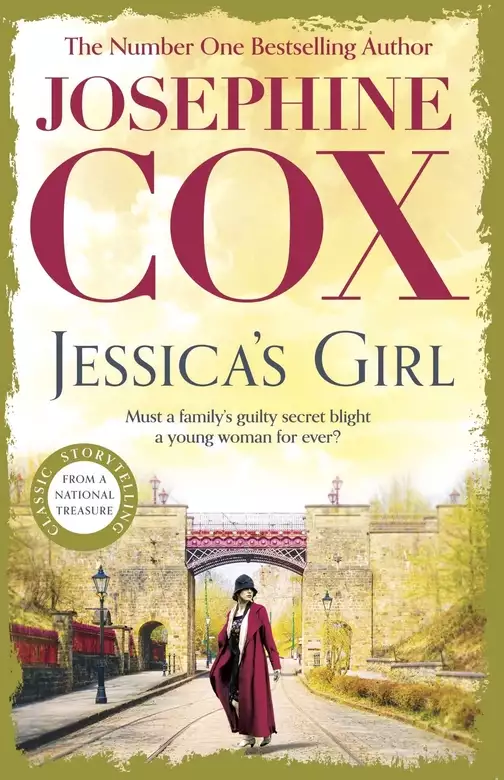
Jessica's Girl
- eBook
- Paperback
- Audiobook
- Hardcover
- Book info
- Sample
- Media
- Author updates
- Lists
Synopsis
She must endure horror and heartache, but can she dare to hope for happiness?
In a tale of secrets and intrigue, Josephine Cox writes a gritty family saga in Jessica's Girl. Perfect for fans of Kitty Neale and Rosie Goodwin.
Despite a deathbed warning from her beloved mother, Phoebe Mulligan has no choice but to throw herself on the mercy of her uncle, Edward. Wrenched from all she holds dear, the tragic young girl is delivered to Blackburn town, where she must live in a household terrorised by the cold, forbidding presence of her mother's brother.
Phoebe cannot understand why she is treated so harshly by Edward Dickens. She is not to know the guilty secret that lies in his past, a secret that casts a sinister shadow over his feelings for his lovely niece...
What readers are saying about Jessica's Girl:
'A very good read, keeps you guessing until the end. Found it hard to put down'
'Great story like always - [Josephine Cox] takes me to another world'
'[Josephine Cox's] books never fail to keep me interested and intrigued as to the outcome. Really enjoyable'
Release date: January 19, 2012
Publisher: Headline
Print pages: 366
* BingeBooks earns revenue from qualifying purchases as an Amazon Associate as well as from other retail partners.
Reader buzz
 Please log in to recommend or discuss...
Author updates
Jessica's Girl
Josephine Cox
Phoebe had come softly into the room, hoping that at long last her mother might be sleeping. She was both astonished and anxious to see her wide awake. She seated herself on the bed, entwining her long strong fingers around the thin pale hand, willing her own warmth into it. ‘Mam, you know what the doctor said,’ she gently chided. ‘You must rest. How can you expect to get well if you don’t do what he tells you?’ She shook her head and sighed aloud. ‘What will I do with you, eh?’ she demanded with a forced smile; her love was plain to see in her brown eyes as they roved that small familiar face and her heart cried out at the injustice. ‘Will you rest now, sweetheart,’ she implored. ‘Please, Mam. For me, eh?’
Sorry that Phoebe had heard her fearful whisper, and choosing not to mind the girl’s plea, Jessica told her, ‘You’ve been such a joy to me, child.’ She made a small sound that might have been a chuckle but to the watching girl sounded more like a sob.
‘Oh, Mam!’ Phoebe was remembering the times when she had caused her mother a deal of heartache. ‘I’m so sorry.’ Her voice broke with emotion as she dipped her head in shame. ‘I wish I could have been a better daughter,’ she said regretfully.
‘No, child.’ The woman smiled, a warm loving smile that betrayed her deep love for the girl. Reaching up, she stroked the rich auburn tresses that cascaded over Phoebe’s shoulders. ‘We might each have our regrets, but thank God we’ve always had each other.’ She rested her loving gaze on the girl. She wished she could have given so much more, but when Phoebe’s father had died it was often a struggle just to survive. If she’d had the means she would have dressed this lovely child in the finest clothes. Instead Phoebe’s wardrobe consisted of two good dresses — one was a pretty cream thing which Jessica had made for her daughter some time ago, and the other the one she had on now, a brown shapeless shift with a high neck and three-quarter sleeves. It wasn’t much but Phoebe never complained. She made the best of what was given her, and her effervescent beauty shone through.
‘Look at me, Phoebe,’ Jessica said now. When she looked up her mother said, ‘I won’t deny there have been times when you’ve driven me to distraction, but I don’t blame you, child. And you mustn’t blame yourself.’
Jessica fell silent then, looking into those intense brown eyes and remembering how it had been. Her daughter was her reason for living. Oh, it was true that Phoebe had caused her a deal of heartache, that she’d drifted from one place to another since leaving school . . . a sweeper in the mill, assistant to the parish clerk, and now this last position behind the counter at the local paper shop. Only two weeks ago she’d been asked to leave because of a dispute with a customer. There were times when Phoebe was difficult. But the fault wasn’t hers because she was a good girl at heart, kind and warm, if headstrong and impossible at times. Jessica laid the blame for Phoebe’s restless spirit at the door of her late husband. He had provided for them all those years, it was true, but he couldn’t forget how Jessica had come to him. And after his sons died, he could never forgive. It seemed like only yesterday that Jessica had fled from Blackburn, from the man she truly loved. Oh, she had also come to love the man she married, but he had been guilty of one unforgivable thing and that was his resentment of Phoebe.
‘It isn’t you who should be sorry,’ Jessica murmured now as she affectionately pressed the girl’s hand to her face, ‘Believe me, sweetheart, you’ve nothing to be sorry for.’ Shifting her glance to the windows, she whispered, ‘Open the curtains, child. Let the sunlight fill the room.’ She tightened her two hands over Phoebe’s arm and held it in a vice-like grip, her eyes hardening. ‘There’s something I must tell you,’ she said harshly, glancing furtively towards the door as though afraid she might be overheard. ‘Something I should have told you long ago.’
Exhausted by the emotion that surged through her, she relaxed her hold on the girl. Suddenly her face was lit with the most wonderful of smiles; at last she would be rid of her burden, rid of this dreadful thing that had haunted her for too long. The smile faded when she reminded herself that she was only passing the burden on to Phoebe. Suddenly she was torn with doubts. Did she have the right to shift her guilt on to this child who had filled her life with delight? She gazed a moment longer on the girl’s lovely face, a face that had always been especially beautiful with its small perfect features and bold fiery eyes that were the golden brown colour of autumn. Whenever Jessica thought of Phoebe, she always thought of those handsome laughing eyes. But they were not laughing now. Not now nor at any time during these past weeks.
‘Open the curtains, sweetheart,’ Jessica urged again. ‘So I can see your eyes brightened by the sunshine.’ She smiled, and there was so much love there the girl’s heart broke to see it. When Phoebe stayed a moment longer, searching her mother’s gaze with anxious eyes and wondering with bitterness why things could not have been different, Jessica knew in her heart that she could never tell her. Suddenly she felt her time was close. ‘Hurry,’ she said, at the same time drawing her hand from Phoebe’s and casting her eyes once more towards the window. ‘The daylight will be gone so quickly.’
The girl rose from the bed and walked to the window, her mother following her every move. When suddenly the daylight spilled into the room, Jessica sighed deep within herself. She prayed that Phoebe would find her way on the rough road ahead. Yet she dared not hope for too much because only she and the good Lord knew how evil her brother was. ‘I love you,’ she murmured, her arms reaching out. She felt wonderfully elated, free at last.
A sensation of glory. An eerie silence. And then only the desperate sound of a girl crying for the one she had loved above all others. Yet all her tears could not bring her mother back.
The young woman with the plain face and bobbed fair hair shook her head in frustration. After a moment she stretched her short fat legs and touched the floor with her toes, bringing the wooden rocking-chair to a halt. Widening her eyes until they resembled round blue marbles, she stared at Phoebe, but there was genuine affection in her voice when she attempted to allay her friend’s fears.
‘There was nothing so mysterious about what were playing on yer mam’s mind,’ she said reassuringly. ‘You only have to read the letter to see what were troubling the poor soul.’
Clambering out of the chair, she reached up to the mantelpiece and picked up the long brown envelope which Phoebe had earlier propped against a metal statuette of a prancing horse. Returning to her chair, she perched herself on the edge, keeping her feet firmly on the ground so as to stop the rockers from tipping backwards.
‘We’d best read the letter again,’ she said, at the same time withdrawing it from the envelope and carefully unfolding it. Holding the opened document at arm’s length, she screwed up her eyes so tightly that they almost disappeared in the fleshy folds of her face.
By the time you read this letter I will have left you. That is my greatest regret for I have no fear of dying, only of leaving you behind. But I want you to know that you are not alone in the world. I pray you will forgive me for depriving you of the truth all these years. So many times I have begun to confide in you, and each time my courage has failed me. Even now, I find it so very hard.
I have an older brother, your Uncle Edward. Unfortunately he is not the most generous of men, nor the most understanding. Edward Dickens is formidable but he has a powerful sense of duty and there are those who say he is a man of conscience. I have no choice but to leave you in his charge and to ask God that you will somehow find contentment.
Enclosed is his recent reply to my letter. In it you will find his address, together with certain instructions. Deliver yourself into his hands as soon as you are able. He will be expecting you.
I hesitate to say this but I must or I will not rest. Don’t let him break you, child. He will try, I know. But, thank God, you are strong in heart and have a spirit as determined as his.
God go with you, my darling, and have faith. Love is a powerful and wonderful thing, but it can bring its own heartache. No sacrifice is ever too great. Remember that always. And in spite of what you may discover, remember too that my love for you never wavered.
‘And you think that was all?’ she asked in a small broken voice. ‘You really think that was what my mother meant to confide in me? She just wanted to tell me about the letters? To explain about this man, this Edward Dickens?’ She deliberately kept her gaze averted.
‘Your uncle,’ Dora corrected. ‘Well, o’ course that were all! Don’t you see, Phoebe? Your mam were feeling guilty because she never told you about your uncle or his family. Happen she thought you might not forgive such a thing. You told me yourself how your mam asked, “Could you ever forgive me?” Like I said, Phoebe, it were playing on her mind. All these years you thought you didn’t have another soul in the whole world, and now suddenly you find out you’ve got an uncle. And who knows? Maybe this uncle of yours has got children too . . . cousins you never knew about. You could have played and grown up with them. When I first came to live in this street, I remember you telling me how lonely you were.’
‘But why didn’t she tell me?’ Phoebe’s heart was heavy. ‘Not that I ain’t forgiven her, Dora, because I have. I know me mam must have had her reasons.’ She had tried so hard to understand.
‘There might be any number of reasons why she didn’t tell you,’ Dora said wisely. ‘Sometimes a family fall out among themselves and the bitterness stays for years. Sometimes it keeps them apart forever. Whatever happened all them years ago was between your mam and your Uncle Edward. There’s no use worrying over it, is there, eh? Your uncle’s accepted you back into the fold, and that at least is something to be thankful for. Your mam and this brother made their peace before it was too late, and now you’re not alone any more. That’s all that matters, isn’t it?’ Dora was eager to reassure her. Although she was a few years older, she had been Phoebe’s one and only friend.
None of the other children in the street had been allowed to play with Phoebe on account of her father being an assistant at the workhouse mortuary. ‘He smells of death,’ the parents would say, their two great fears in life being first the workhouse and then the mortuary. And so, until Widower Little came to live next-door with his daughter, Dora, Phoebe had never known what it was to have a friend of her own age. Her mother though had always been especially close to Phoebe; she adored the girl. Her father was a private, often morose man who rarely spoke and showed neither emotion nor affection.
Phoebe’s mother always defended him: ‘Your father never got over the loss of his two sons.’ One boy was stillborn and the other was taken by pneumonia when he was only an infant. She never confessed to her daughter how Mr Mulligan would secretly have preferred Phoebe to have died rather than be robbed of his sons. His bitterness was complete when Mrs Mulligan failed to bear him any more children. But he was a good man at heart and had faithfully provided for his family as a man should. His wife understood his sorrow and forgave him. But there was always a distance between them. And an even greater distance between him and Phoebe.
‘Oh, Dora, you’re such a friend.’ Phoebe’s brown eyes were bright with tears. Both her parents were gone and but for Dora she had no one. This man who was her uncle was just a stranger. Far from giving her comfort, her mother’s letter had only made her uneasy. She had no one to turn to but Dora and thanked God for that kindly creature. Phoebe looked at her friend now, her heart warmed by the sight of that plain homely face and the affection there. ‘Whatever would I do without you?’ she asked softly, reaching out to hold a plump dimpled hand. She and Dora had grown up together. Through that time they had shared each other’s most secret thoughts and Phoebe had come to love her neighbour as she might a sister.
‘Away with you!’ Dora laughed, slapping her podgy hand over Phoebe’s slim fingers before falling backwards in the chair and beginning to rock herself in some agitation. ‘You’ll do well enough without me, Phoebe Mulligan,’ she declared. ‘And you’ll cope just fine with your new life. What!’ She chuckled and winked at Phoebe. ‘That uncle of yours won’t know what’s hit him. “Formidable” or not, he’ll bless the day you came into his house. How could he help but love you, eh?’
Dora sincerely hoped that she was proved right and Phoebe would win her uncle’s affection. Lord only knew how desperately the girl had craved the love of her father. But when that love wasn’t given, she had grown bold and defiant, pretending it didn’t matter. Only Phoebe’s mother and Dora suspected how the girl’s proud wilful ways disguised deeper, more heartfelt feelings.
Seven years ago when she was only ten years old, her father had been trampled beneath a carriage and four. Now, at the tender age of eighteen, she was an orphan. Dora looked at her, thinking again how beautiful Phoebe was, a slim vibrant creature full of life and brimming with love. Yet for all that she seemed destined to suffer a turbulent life. Like Jessica Dora hoped that Phoebe would find a place in her uncle’s household, but knew only too well that if she was in her friend’s place she would be suffering nightmares. All the same, knowing that Phoebe was looking to her for reassurance, she felt obliged to hide her real feelings. There was nothing else she could do; nothing else Phoebe could do, except to follow her mother’s instructions. She had no other living relative, no money and soon the men would be here with the cart to empty the house. The landlord would arrive for the house keys and Phoebe would be sent on her way from her familiar and beloved home in Bury to a place that might as well be on the other side of the world. To the fainthearted Dora, the prospect of living with an unknown relative was daunting and terrifying. She had been secretly frightened by Jessica Mulligan’s warning to her daughter: ‘Don’t let him break you, child . . . for I know he will try.’
Suddenly, and partly to reassure herself as well as Phoebe, Dora blurted out, ‘You’re not to worry, d’you hear, Phoebe Mulligan? Things will turn out for the best, I’m sure.’
Phoebe raised her face to the ceiling, her white even teeth biting nervously into her bottom lip as she stared trancelike at the dark smoky patches on the wall above the fireplace. After a while she lowered her gaze, her striking brown eyes searching deep into Dora’s. She had detected that note of nervousness in her friend’s voice and felt compelled to ask, ‘Edward Dickens will be expecting to make a lady of me, won’t he, Dora? It’s no use him trying to make me something I ain’t!’
She sighed deep inside herself; there was so much anger in her, so much frustration that often found outlet in wild, wilful behaviour. And judging by Edward Dickens’ reply to her mother’s letter, he had been told of his niece’s lack of self-discipline. Phoebe had been surprised that her mother should have betrayed her in that way but, on reflection, had come to realise that it was done in good faith. It was only right that this man, this stranger, should know what he was letting himself in for. Either he wanted her or he didn’t. And if he didn’t, then it was best all round if she knew now. However, the fact that he did want her told Phoebe two things . . . firstly, Edward Dickens was indeed ‘a man with a powerful sense of duty’ who saw his niece as a responsibility he must accept. Secondly, and much worse in Phoebe’s thinking, he had a mind to mend her of her rebellious nature, to mould her into the kind of young lady he would permit to reside under his roof. It was this supposition that gave her sleepless nights. More than once in these past two weeks she had thought about running away, but then she realised how futile that would be for she had nowhere to run to, and besides, her uncle sounded like the sort of man who would hunt her down.
‘You mustn’t talk like that, Phoebe,’ Dora reprimanded. ‘You’re as much a lady as anyone else.’ She suddenly laughed, saying, ‘All the same, I reckon they won’t know what’s hit ’em!’
Though Dora believed that Phoebe’s good honest character must win her uncle over in time, she reflected again on Edward Dickens’ message, a cold unfeeling letter which to her mind, betrayed too much of the man himself. ‘I wish it were possible for you to come here and live,’ she told her friend. ‘There’s nothing I’d like better, you know that, don’t you? But there’s no room, what with Judd having to sleep in the front parlour, and me and our Dad taking the only two bedrooms.’ She sighed and suddenly looked old though she was not yet twenty-one. ‘I have to be on hand for our Dad in case he calls out in the night,’ she explained. ‘So I can’t have you here, gal, more’s the pity.’
Phoebe was stricken with guilt, quick to assure her, ‘You’re not to worry about me. I ain’t your problem, and besides you’ve got your hands full what with your dad being bedridden an’ all. I’ll be all right, you’ll see.’
‘Don’t forget I’ve got our Judd to help me, although more often than not he’s all worked out when he gets home from the mines. By the time he’s had his meal and a strip wash, I’ve already seen to our Dad and there’s nothing Judd can do anyway . . . apart from spending part of his evening with the old fella, which he allus does,’ she said warmly. ‘I’m lucky to have such a fine brother.’ She eyed Phoebe curiously. ‘Our Judd’s allus had a soft spot for you, you know that, don’t you?’
When Phoebe went a soft shade of pink and seemed uncomfortable beneath her gaze, Dora laughed. ‘Oh, tek no notice! What am I thinking of?’ Her mood became serious as she added, ‘All the same, Phoebe, if there was a way we could take you in with us, you’d be more than welcome.’
‘Bless you for that.’ Phoebe knew what a heavy burden Dora suffered; her mam had run off some years before when Dora’s dad had been struck down with a crippling affliction. He was a short-tempered, demanding fellow who gave her little peace. And, as she had pointed out, although her older brother Judd was a great comfort to her, his main task was providing for the family; a responsibility which he shouldered admirably.
‘I’d best be off.’ Dora clambered out of the rocking-chair. ‘He’ll be awake soon and wanting his food.’ She hurried across the parlour, pausing just once to tell Phoebe, ‘I’ll be back soon as ever I can.’ When Phoebe nodded she gave a small satisfied grunt and then was gone.
The silence was unbearable. Phoebe leaned back in the chair that had been her father’s, her mind filled with memories of her mother: of the way she sang as she went about her work, of the manner in which she would sit opposite Phoebe at the big oak table when they would talk long into the night — women’s talk, aimless chatter that was a delight to them both. Never once had Jessica Mulligan revealed the existence of her brother Edward, and all of Phoebe’s questions concerning her mother’s family were never really answered.
‘Why?’ Phoebe murmured. She could see her mother as clearly as if she was here now. ‘Why didn’t you tell me about him? Was he so awful that you wanted to keep him out of our lives?’
Her gaze strayed to the envelope which Dora had left on the hearth. Her mother’s letter was placed on top but there was another letter inside . . . Edward Dickens’ letter. For a seemingly endless time Phoebe continued to stare at the envelope. She knew the contents of that letter by heart. She had read it countless times, and each time had grown more apprehensive. Her mother had sent her down a road that would lead into the unknown, setting something into motion over which Phoebe had no control. It was that which frightened her more than anything. And yet, because of her very nature, she could not help but rise to the challenge.
‘Happen Dora’s right after all,’ she murmured, her gaze never leaving that brown envelope. ‘Happen my uncle will come to love me.’ She hoped so. Oh, how she hoped so!
Stooping to collect the envelope from the hearth, she opened it with trembling fingers. Taking out the letter she unfolded it and laid it on her lap, wanting to read it yet not wanting to. She looked away, searching the room as though to find an escape. There was none. Reluctantly she returned her gaze to the letter then began to read again with deliberation, as though measuring every word.
I trust you have raised the girl in the strictest discipline, and that she is a responsible and God-fearing creature. She must also be hard-working and mindful of her superiors.
Of course she must be provided with certain items which I am not of a mind to supply: namely a narrow bed, an upright chair, one pair of boots in good repair, and in addition a Sunday best pair.
She will also be required to bring other items which a girl of her years might be in need of, together with a suitable if meagre supply of clothing and personal artefacts although there is neither room nor need for useless paraphernalia.
While I am generously allowing the girl into my household, you must understand that I am under no obligation to provide for her. To this end she will be found a position suitable to her talents. Also, while I accept that you are not a wealthy woman, I will expect that any item of value you do possess will of course accompany the girl. These items will be sold to further her upkeep until she is paired with a responsible suitor who will eventually take the burden from me.
May God in His great mercy cleanse your soul.
Replacing the letters in the envelope Phoebe clutched it in her fist. Heaving a deep sigh, she stood before the mantelpiece thoughtfully peering into the mirror above. ‘There’s no use fighting it,’ she told the face looking back at her. ‘These are the cards you’ve been dealt, Phoebe Mulligan. Play them with the courage your mother gave you. And don’t ever shame her.’
The strong classic features stared back, proud and determined. For one fleeting moment the almond brown eyes grew darker, still scarred with grief. All around her the house was unbearably empty, curiously still and bitterly cold. She shivered, hugging her slender arms around her and leaning forward to touch her forehead against the mantelpiece.
‘Oh, Mam! Mam!’ Her voice broke on a sob. She had tried so hard not to cry but she missed the busy familiar figure who had been the heart and soul of her existence. She craved the sound of that gentle voice, and knowing that she would never hear it again was almost more than she could bear. ‘I won’t let you down, Mam,’ she quavered, ‘I promise . . . I’ll make you proud of me.’
Opening her fist, she glanced down at the envelope. In her mind’s eye she could see the address — Dickens House, Preston New Road, Blackburn — and not for the first time wondered at how near to them her uncle had been. ‘Barely an hour’s journey away,’ she murmured, shaking her head in disbelief. Phoebe had only once been to Blackburn and that was many years ago when her mam had taken her to Corporation Park. Looking back now, she recalled her mother’s strange restless mood all the while they walked through that beautiful park and then afterwards on the tram home. She wondered now whether it had been her mother’s intention to call on her brother Edward but, for some reason, she had lost her nerve at the last minute . . .
‘Anybody there?’ The man’s voice carried along the outer passageway, jolting Phoebe out of her reverie. ‘It’s Jolly’s wagon . . . come ter collect the furniture.’ The shout was accompanied by the sound of heavy footsteps approaching the parlour, followed by a loud insistent knocking on the door and ‘Hello. Are yer there, Miss?’
Dabbing the tears from her eyes, she regained her composure just as the door was inching open. ‘It’s all right, Mr Jolly,’ she told the red-faced fellow as he poked his head into the room. ‘I’ve been expecting you.’
‘I’ll get to it right away then,’ he replied dubiously. He knew how the girl had been orphaned and was about to be shipped off to some unknown uncle. Such gossip didn’t stay secret long, not in Bury it didn’t. Phoebe Mulligan was a strong-minded lass who would likely know how to take care of herself, but she was only a lass and it couldn’t be easy for her. It wasn’t easy for him either. It was never easy emptying a house when the heart was gone from it. Venturing further into the room, he snatched a piece of paper from his waistcoat pocket and held it out for her to take. ‘You’d best check the list first, though,’ he said gruffly. ‘I wouldn’t want to tek what weren’t mine.’
He thought how exceptionally handsome she was with that long fiery hair and wideawake eyes that suddenly smiled at him. He didn’t envy her what she was going through, losing first her da and now her mam. He hoped this uncle of hers would treat her tender.
Phoebe took the list from him and glanced through it. It was all in order. As agreed between herself and Mick Jolly she was to receive the sum of fourteen shillings and sixpence for certain items of furniture and bric-a-brac; things which her mammy had cherished, things which had always been around from the first day she could remember. She was aware that her uncle had insisted that anything of value was to go with her, but there was nothing of any real value. Not in monetary terms anyway, she thought sadly. All of these things were of sentimental value, precious things that were now destined to grace some stranger’s house. The rest would be going with her to another stranger’s house . . . her own bed and eiderdown; a small cupboard in which she kept her few personal things; the chair which her mammy had sat on when she said Grace before meals, and a small quantity of clothing, together with her one pair of boots which might or might not be considered suitable for walking to Church in. All of these things Judd had kindly gathered together for her, carefully placing them in the tiny front parlour and advising her to, ‘Make sure you keep this door closed, and don’t let the fella from Jolly’s go anywhere near it. Make certain he knows he’s to touch nothing in this room.’
Now, as Phoebe remembered Judd’s words, her heart gave a curious little leap. She had not realised how much she would miss having him near. ‘It’s all here,’ she told the red-faced man. ‘But you’re not to go anywhere near the front parlour. There’s nothing in there for you . . . only the things that I have to take with me.’ She gave the note back, her warm smile belying the ache in her heart.
Taking the note from her, the man nodded. ‘Thank you, Miss,’ he said kindly, ‘we’ll be quick as we can. I know how bad you must be feeling.’ He had a daughter much the same age and it would break his heart to see such a dreadful thing happen to her.
Phoebe gave no answer except to nod her head and look quickly away. The tears were threatening and she felt ashamed. When the door was quietly closed she raised her head, straightened her long grey cardigan and tidied the folds of the dark calf-length shift which had been her mam’s. Then, flicking the stray hairs away from her face, she lifted her chin high in a gesture of defiance. ‘Don’t fall apart now, Phoebe Mulligan!’ she chided herself. ‘Remember what your mam told you . . . “Strong of heart”, that’s what she said you were, and that’s what you have to be. Whatever happens to you from now on, Phoebe, you must always remember that.’
It was a moment before she realised that Dora had returned and was standing in the parlour doorway, a smile on her round face as she told her, ‘They’ll put you away for chattering to yourself, my girl! And it won’t be in no Dickens House neither . . . more likely they’ll throw you in the Asylum where you’ll never be found again.’
‘Dora!’
We hope you are enjoying the book so far. To continue reading...
