
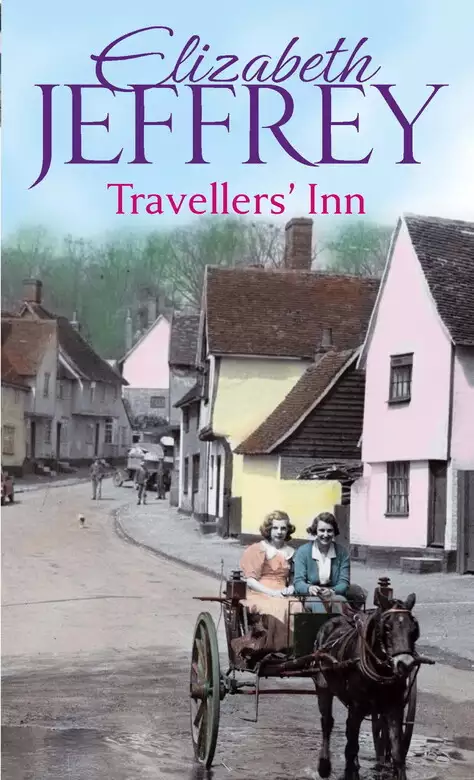
Travellers' Inn
- eBook
- Paperback
- Hardcover
- Book info
- Sample
- Media
- Author updates
- Lists
Synopsis
Bethany and her mother are left destitute following the scandalous death of her father. Forced to leave their beloved home with little more than the clothes they are wearing, their last hope is to prevail upon their only living relative, Bethany's Great Aunt Sarah, who runs a coaching inn and reluctantly agrees to let them stay. Bethany impresses Sarah with her attitude to hard work and soon manages to convince her to build up the business again. As trade at the inn improves, their future begins to look secure. But trouble lies ahead, not only in the rumours of a planned railway, but also in the form of Zachary Brown, and itinerant labourer who takes a shine to Bethany, but who is not all he seems . . .
Release date: August 7, 2014
Publisher: Piatkus
Print pages: 369
* BingeBooks earns revenue from qualifying purchases as an Amazon Associate as well as from other retail partners.
Reader buzz
 Please log in to recommend or discuss...
Author updates
Travellers' Inn
Elizabeth Jeffrey
‘But they are mine. They belonged to my grandmother,’ Emily said, her eyes filling with the tears that for the past dreadful weeks had never been far from the surface.
‘Mama, nothing is yours,’ Bethany explained for the twentieth time. ‘You know perfectly well that the law said all your possessions became Papa’s when you married him. Now the law says everything he owns must be sold to pay his creditors. Including, I’m afraid, your candelabra.’
‘Perhaps we could buy them back,’ Emily said doubtfully.
‘We could if we had any money. Which, of course, we haven’t, except for the few pounds we were allowed to keep.’ Bethany sat down on the sofa and pulled her mother down beside her. ‘Now, Mama, we’ve been over this a hundred times. Papa embezzled all that money so that he could continue to give us the lifestyle we’re used to.’ She caught her mother’s hands and gave them a little shake. ‘What you must always remember is that he did it because he loved us; because he wanted the best for us. He always intended to pay it back, I’m sure of it.’ It was the right thing to say to her mother but Bethany suspected there was more to it than that. She was sure that her father had hoped a good win on the horses would take care of his debts, instead of which, continued losses only increased them.
‘Well, committing suicide was hardly the best thing for us,’ Emily said bitterly. ‘I shall never get over the shame of the funeral! No plumed horses, no purple-draped funeral carriage; nothing but a hole-in-the-corner burial early in the morning in an unconsecrated part of the churchyard. How shall I ever face Lady Armstrong and her set again? I’m sure we’re the talk of society.’ She freed her hands and dabbed her eyes with a black-edged handkerchief.
‘Since we shan’t be here in London to face anybody, let alone Lady Armstrong and her set, that’s the least of our worries,’ Bethany said, getting to her feet. She looked round the elegant drawing room, with its duck-egg-blue walls and spindly furniture. ‘Mr Jones said we could stay one last night in this house and that we should leave everything as it is; tomorrow he will send in the men to clear it, then everything will be sold to pay off at least some of Papa’s debts.’
‘He’s very trusting,’ Emily said, her voice heavy with sarcasm. ‘How does he know we won’t steal the spoons?’
‘Because an inventory has already been taken. Everything is listed, down to the last inkwell. Don’t you remember? Two men came last week to do it.’
Emily nodded, then suddenly, she crumpled. ‘Oh, Seymour,’ she sobbed, ‘how could you do this to me? How could you go and leave me in this horrible, horrible mess? We’ve always been so happy …’
Bethany bit her lip against her own threatening tears, but she knew one of them had to be strong, so she swallowed hard and said briskly, ‘Now, is everything packed? We must be up early in the morning because the cab is coming at seven to take us to The Bell to catch the coach.’ She managed a watery smile. ‘Come mother, it’s not that bad. We were allowed enough money to buy decent mourning clothes and we are to be allowed to keep the rest of our wardrobe, so that’s something.’
Emily made a noise that was something between a snort and a sob but said nothing, so Bethany continued, ‘I’m really looking forward to meeting Aunt Sarah and Uncle John; you’ve told me so much about them, Mama. And I’ve never been to the country before so I’m really quite excited. I’m so glad you wrote and asked if we could go and stay with them.’
‘Well, we’ve no other relatives,’ Emily said gloomily.
‘It’s a little strange that you’ve had no reply,’ Bethany said with a frown.
‘Oh, I expect it will be all right. They live in an inn, so there’s sure to be plenty of room for us. And it’s out in the country where nobody will know our shame.’ Emily gave a shudder. ‘The wife and daughter of a man who committed suicide can hardly expect to be welcomed into polite society, can they. We’ll have to think up a plausible story …’
Bethany waved her hand dismissively. ‘Oh, I’m sure we shall think of something. Now, I’ll go to the kitchen and make us both a hot drink and then we must retire. We have to make an early start in the morning and Lovatt isn’t here now to call us and bring us breakfast in bed.’
‘No, everything’s changed,’ Emily said woefully. ‘All the servants have gone. Oh, Seymour, what have you brought us to!’ She dabbed her eyes again, a short, rather plump woman in her mid-forties – a well-preserved mid-forties until the trauma of her husband’s untimely death early in March 1840 and the desperate position he had left her and Bethany in had drained the colour out of her cheeks and sharpened her features. Under the widow’s cap she was only now becoming adjusted to wearing her fair hair parted in the middle and neatly coiled over her ears. It was the last task Lovatt had performed for her before tearfully taking her leave that morning.
Bethany left her mother to wallow in her misery and went down to the kitchen. She was not at all like Emily, being tall and willowy, with copper-coloured hair that refused to be tamed into any of the fashionable hairstyles of the day but hung in riotous curls round her shoulders. Her features, too were gentler than her mother’s, grey eyes under neatly arched brows, a slightly tip-tilted nose and a wide mouth that appeared permanently on the verge of breaking into laughter. Unlike her mother, too, she had never mastered the art of being lady-like and at eighteen rather resembled an unbroken colt, and was uncomfortable, not to say impatient, with tinkling teacups and polite conversation. Sometimes Emily despaired of her but in recent days she had been glad of her daughter’s matter-of-fact approach to life and her strength of character.
Emily looked up as Bethany returned. ‘The kitchen range has gone out and although I can speak to it in French and German I don’t know how to light it,’ Bethany said flatly. ‘You could have some cold milk, that’s what I’m having. Or water. There’s nothing else, except half a loaf of bread and we shall need that for breakfast.’
Emily shuddered. ‘No, thank you, dear.’
They went to their separate rooms, Emily to weep herself to sleep at the cruel blow fate and her husband had dealt her, Bethany to go over in her mind the circumstances that had led to them being turned out of the elegant London home where she had been born and had lived for the whole of her life.
She had led a pampered life, she realised that. Music lessons, art classes, dancing lessons, French and German as well as the three Rs under a private governess. There had even been talk of a finishing school in France although that hadn’t come to anything. Lately, her mother had begun taking her along when she paid her afternoon calls, which Bethany had considered a complete waste of time.
Then, out of the blue, had come the dreadful news that her father had been found dead in his office at the bank. Hanged. She had had nightmares picturing the scene. It appeared he had run up debts and used clients’ money to pay them – always, of course, meaning to set the record straight when funds improved. As he explained in a letter, he had never meant to steal the money, only to borrow it until such time as his fortunes improved. He was an incurable optimist, an optimism sadly misplaced as far as his affair with Lady Luck was concerned, because he was an inveterate gambler; cards, horses, anything that moved was worthy of a wager. Bethany’s mouth twisted wryly. Ultimately he had gambled his family’s well-being.
And lost.
After the first, terrible, shock had come the realisation that she and her mother were virtually penniless and without a home, since everything, including the roof over their heads, would have to be sold to pay off Seymour’s debts. Mr Jones, their solicitor, had been very kind, allowing them to stay there until they could make ‘other arrangements’. In effect, until they could find someone to take them in.
It had been Bethany who had thought of Aunt Sarah and Uncle John. Emily had told her so many stories of the wonderful times she had spent in the Essex countryside with her aunt and uncle as a child that Bethany had persuaded her to write and ask if they could pay them a visit. It would, at least, give them a breathing space whilst they decided what to do next. The fact that there had been no reply was understandable; the posts were notoriously unreliable and slow.
The next morning, in spite of bright, early April sunshine, the two women got up to a cold house, since there were now no servants to light the fires. They helped each other with their numerous petticoats and laced each other’s stays, Bethany in fits of giggles and Emily even managing a wan smile from time to time. Then, after Bethany had done the best she could with her mother’s hair, which fell far short of Lovatt’s expertise, much to Emily’s irritation, they went downstairs to the kitchen and a miserable breakfast of bread and butter and cheese, washed down with water.
They were both relieved when the cab arrived to take them to The Bell, so that they could leave behind the house full of memories of happier times that was no longer their home.
The Bell yard was full of hustle and bustle, with ostlers attending to the horses, servants running hither and yon at the beck and call of travellers and grubby, underclad and underfed urchins getting under everyone’s feet trying to earn a copper carrying bags or messages or holding the horses’ heads. Bethany managed to find a young lad to transfer their luggage from the place where the cab driver had dumped it when he saw the meagre tip, to the coach. It consisted of two small trunks, containing everything they owned in the world.
The young lad obviously felt sorry for the two ladies dressed all in mourning black, their faces covered by veils, and made them as comfortable as he could inside the coach.
‘Thank you for your help,’ Bethany said, handing him a penny.
He touched his forelock. ‘Thank you, Miss. Won’t be long now an’ you’ll be orf.’
The coach swayed alarmingly as luggage was loaded and the passengers travelling outside climbed up to their seats. A woman with a squawking hen in a basket and a man in a stovepipe hat squeezed inside the coach opposite Bethany and her mother, obviously annoyed at the amount of space taken up by their voluminous black skirts. Then with a blast on the horn the coach began to move.
The first stage took them to the outskirts of the city, then, after a change of horses, it was on to Brentwood and another stop before going on to Chelmsford, where there was time for a hot toddy and a bun before resuming their journey again, this time with two elderly, card-playing men as their companions.
‘Tell me about the place we’re going to, Mama,’ Bethany said, to relieve her mother’s constant complaints about the state of the roads and the discomfort of the coach.
Emily gave a cry as the coach lurched over a particularly deep rut before answering, ‘It’s out in the country – on the road to Harwich – between two villages, Mistley and Bradfield. It used to be a coaching inn years ago, like the one we’ve just left, but gradually the inn at Manningtree, on the other side of Mistley, became more popular. All the same, people travelling along the road could always be sure of a welcome. Aunt Sarah’s ale was quite famous in the district, I remember. And so were her mutton pies.’
‘What did you do when you stayed there?’ Bethany asked, anxious to keep her mother talking so that she shouldn’t begin complaining again. ‘Was there dancing? And visiting?’
Emily gave a little mirthless laugh. ‘Oh, bless you, no. Aunt and Uncle worked all the time. They were always busy with the comings and goings at the inn. But I was never bored. I played in the fields and down by the river with the farm workers’ children. It didn’t matter to me that they were poor and had no shoes; we were simply children playing together and Uncle and Aunt encouraged it.’ She paused. ‘Understandably, my mother was quite shocked when she found out, but of course it’s different in the country. At least it seemed so to me.’
‘How long is it since you saw Aunt and Uncle?’
‘I last went there just before Seymour and I were married. About twenty years ago.’
‘Are you sure they’ll still be there?’ Bethany asked anxiously.
‘Oh, yes. They would never move from such a lovely spot.’
Emily sounded so confident that Bethany didn’t remind her that there had been no reply to her letter, a fact that was becoming more and more worrying the nearer they got to their destination.
Eventually, they reached the King’s Head at Colchester, tired and hungry.
‘This coach goes on to Ipswich,’ Bethany told her mother as she helped her down, stiff and aching from the jolting. ‘The Harwich coach leaves in an hour. That gives us time for a meal.’
They left the trunks in the care of a stable lad and tried to find their way through the jostling crowd to reach the dining room of the inn.
‘Who d’you think you’re a-shovin’ of?’ a tipsy, rat-faced man shouted, spilling porter down Emily’s dress.
‘Aye, where d’you think you’re orf to?’ his companion added as they tried to edge past to look for the dining room.
‘I – we’re looking for somewhere where we can get a meal,’ Emily said, nervously looking round for Bethany.
‘Well you’re goin’ the wrong way. This is the way to the public,’ a third man pushed his way forward.
‘Then perhaps you’ll be good enough to tell us which direction we should be going in,’ Bethany said, stepping in front of her mother and very conscious that they were now almost surrounded by quite a crowd of rough-looking men.
‘P’raps you’ll be good enough,’ another man mimicked. He thrust his face near to Bethany’s so that she could smell his beery breath. ‘An’ why should we do that? Are you gonna make it worth our while?’ He caught her arm and another man got hold of Emily.
‘Let go!’ Bethany said between clenched teeth. She was too angry to be frightened. ‘Or I shall call …’
‘Who will you call? Ain’t nobody here’ll take any notice,’ they jeered. ‘They’re all too busy lookin’ after theirselves. Now, come on, two well-britched widders like you must hev a bit to spare. Give us …’
Suddenly, there was the crack of a whip on the cobbles and a voice shouted, ‘Be off with you! Leave these two defenceless ladies alone or I’ll call the constable! You can see they are in mourning.’ A whip pointed at a tall, gangling youth. ‘Beckwith, I’d have thought better of you. You should be ashamed of yourself.’
Almost before he had finished speaking the assailants – and there were more of them than Bethany had realised – had melted away into the crowd and she found herself standing with her mother and looking up at a distinguished-looking man in a top hat and long frock coat.
He doffed his hat, revealing a shock of dark brown hair. Then he smiled, a smile that lit up his face and crinkled the corners of his eyes and Bethany realised he was younger than she had first thought, probably in his late twenties. ‘Did I hear you say you were looking for food?’ he asked.
‘Yes, we left ho … London quite early this morning and we’ve hardly eaten since,’ Bethany answered. ‘And we have to wait an hour for the Harwich coach so there’s plenty of time.’
‘Then allow me to find you a room where you can eat without further fear of being molested.’
Before they could protest he led them into the inn and through several passages to a small room at the end where there were two settles, one each side of a bright fire and with a table between them. ‘There, you should be quite comfortable here,’ he said, looking round. ‘And quite private. I’ll make sure you are attended to without delay.’
‘You are very kind, sir,’ Bethany said. ‘It was quite alarming, suddenly finding ourselves surrounded by those men.’
‘Yes, I’m sure it must have been. I assure you they won’t trouble you again, ladies.’ He doffed his hat once more. ‘Now, I wish you good day and a safe journey to Harwich.’
‘Oh, we’re not going as far as Harwich,’ Emily said quickly. ‘Our destination is just the other side of Mistley.’
He frowned, then raised his eyebrows. ‘Really? I wasn’t aware …’ Then he smiled again. ‘But you’re waiting for your meal. Excuse me, ladies, I’ll have something sent to you directly.’
He was as good as his word and five minutes later two steaming plates of stew and dumplings and two mugs of mulled ale were brought by a fresh-faced girl, whose gingham dress was cut a little too low in the bodice for Emily’s approval.
‘This is not at all what we’re used to, Bethany,’ she complained, picking up the cheap knife and fork and pointing to the rather battered pewter plates. She looked round at the comfortable but by no means luxurious panelled room and sighed. ‘I can hardly believe it’s less than two months since we were sitting on Mrs Jackson’s balcony, watching our dear Queen’s wedding procession drive by and hearing the church bells pealing all over the city. Oh, it was such a wonderful occasion. And the dinner the Jacksons held afterwards! Twenty courses before I lost count!’ She pushed a dumpling round distastefully.
‘You’d better eat it, Mama,’ Bethany said, her mouth full. ‘It’s really a very tasty lamb stew and we don’t know when we shall get another meal.’
Emily looked up, her fork halfway to her mouth. ‘What do you mean, you don’t know when we shall get another meal? My Aunt Sarah always keeps a good board and we haven’t got much further to go, have we?’
‘About twelve miles, I believe. We should reach Travellers’ Inn soon after six, I should think.’
‘Oh, thank goodness for that. I’m very tired and I believe every bone in my body has been shaken up in that coach. I hope the next one will be a little more comfortable.’
They finished their meal, which even Emily had to admit was delicious and Bethany went to find the landlord to settle up.
‘It had already been paid for,’ she told her mother when she returned. ‘That kind man must have paid for it. I looked for him but he’s gone, so I can’t thank him, and we shall probably never see him again.’
‘I daresay he could afford it,’ Emily said comfortably. ‘He was quite well dressed, although of course my Seymour would never have worn a coat of that cut.’
‘Mama, you really are a terrible snob,’ Bethany chastised, giving her arm a little shake.
‘Well, dear, there are standards,’ Emily said unrepentantly. ‘Ah, look, is that our coach? It says Colchester to Harwich but it looks rather crowded.’
‘I’m sure there’ll be room for us,’ Bethany said.
It was not, as Emily had hoped it would be, a comfortable ride. The coach was old and crowded with people anxious to catch the boat from Harwich to the continent and the road, unlike the turnpike roads, was rutted and rough. They did manage to find seats inside but only because two men gave up theirs and rode outside beside the driver. The prospect of heaving Emily up on to the top of the coach had made Bethany smile quietly to herself but she was glad it hadn’t come to that. All the time, as they watched their luggage being stowed and before they boarded the coach, she looked out for the dark stranger who had bought their meal for them but he was nowhere to be seen.
It was nearly six o’clock when they stopped to change horses at Manningtree.
‘Oh, dear, we’ve still got another three miles or so to go, if I remember rightly,’ her mother said. ‘We shall know the inn when we see it because the sign is brightly coloured. In any case, it’s the only house along that stretch of the road. The coachman said he knew the place so he’ll know where to stop.’ She heaved a sigh. ‘Oh, I ache in every bone from this journey, Bethany. I shall be so glad of a comfortable bed tonight. That’s one thing I remember about Aunt Sarah’s feather beds, they are filled with goose feathers and so soft you can sink right into them.’
The coachman blew his horn and they lurched off again into a misty April dusk.
They left the town and the coach creaked and trundled its way along a lonely road, bordered mostly by blackthorn hedges studded at intervals with tall elms or gnarled oaks. Over to the left the mist hanging in the river valley spread its tentacles up over the fields and wisped round the coach windows like ghostly fingers.
Suddenly, there was a shout from the coachman and the coach stopped.
He climbed down from his perch and opened the door. ‘Here y’are, ladies,’ he said. ‘The Travellers’ Inn. On’y that don’t look much of a inn and from what I hear there ain’t many travellers.’ He didn’t wait for them to alight but busied himself with their trunks. By the time they had helped each other down and were standing on the grass verge beside their belongings he was back up on his seat and with a quick flick of the reins the coach was on its way again and fast disappearing into the gathering gloom. The whole procedure had taken less than five minutes.
Frowning at the coachman’s words, Bethany turned and looked at the house behind her. It stood at the roadside, a square, greyish building with a tiled roof and a heavy domed porch over the front door. To each side of the door, six on one side, five on the other, were windows of varying sizes, which all seemed to be set at different levels so it was difficult to gauge with any certainty which were on the upper and which were on the lower floor. Above the door, which was badly in need of a coat of paint, swung a sign, so weather-worn that it was impossible to read what was written on it. There was no sign of life to be seen anywhere.
She turned to her mother. ‘Are you quite sure this is the right place?’ she asked doubtfully.
Emily nodded. ‘Oh, yes. This is definitely the place. I remember it well.’ She lifted her black veil so that she could see more clearly and peered, frowning in the gathering darkness. ‘But it wasn’t at all like this when I used to visit. There were always people about. It was always busy …’ her voice trailed off.
‘But that was over twenty years ago, Mama,’ Bethany reminded her, trying to keep the irritation she felt out of her voice. She sat down on her trunk. ‘Oh, I knew I was right. We should never have come until we heard from Aunt and Uncle. Obviously, they’re both dead and the place is derelict.’
Emily sat down beside her. ‘I’m afraid you may be right, Bethany,’ she said in a small voice. ‘Oh, dear, as if we haven’t trouble enough! Now what shall we do?’
‘Well, I suppose we’ll just have to walk back to the village and find a bed for the night. How far did you say it was? Three miles? Although I must say it seemed like more in that rattly old coach.’
‘Oh, I couldn’t possibly walk that far, Bethany. Not after that dreadful journey. And what about our things?’
‘Ah, yes.’ Bethany gave a sigh. ‘Very well, you’d better stay here with them while I walk to the village and get someone to come and fetch you.’
‘No, you can’t do that. You can’t leave me here alone, Bethany. Not in this lonely, godforsaken spot.’ Emily hugged herself, shivering. ‘Think of the robbers; the highwaymen …’
‘I thought you said it was a marvellous place, where you had such a wonderful time when you were a child,’ Bethany said, tiredness and disappointment making her waspish. ‘All right, then. What are you going to do, stay here by yourself or walk back to the village with me? You’ll have to do one thing or the other.’
‘I’ll walk back with you,’ Emily said.
‘Then let’s go and have a look round the back and see if we can find somewhere safe to leave these trunks while we’re gone. We can pick them up in the morning, when we’ve decided what to do next. We’re too tired to make any decisions tonight.’
‘I wish now I hadn’t let you persuade me to come here,’ Emily said petulantly, getting to her feet.
‘And I wish you hadn’t painted the place in such glowing colours,’ Bethany snapped back. ‘However, we’re here now, Mama, so we must make the best of it, for tonight, anyway. Come on, let’s have a look round and see if we can find a way into the place. I suppose we might even be able to stay here for the night.’
‘Oh, no, Bethany, I could never stay in an empty house with no beds.’ Emily gave a shudder.
‘Well, we shan’t find a bed anywhere if we don’t make a move.’ Bethany led the way down the cobbled yard by the side of the house and round to the back, dragging the trunks behind her. Now she could see that the house was in fact L shaped, the short arm of the L a single storey at right angles to the main building. Beyond this wing and separated from it by the slightly sloping cobbled yard was the shadowy bulk of a stable block and outhouses.
Suddenly, Emily caught Bethany’s arm. ‘Look, I can see a light,’ she said, pointing to a window. ‘That’s where the kitchen is … was. See? In that window at the end, near the stable block?’
Bethany let out a long breath. ‘That means somebody’s here,’ she said, ‘even if it isn’t Aunt Sarah. I’ll go and knock at the door.’
‘No, wait. Supposing it’s a thief. Or a burglar,’ Emily tightened her grip.
‘Well, we haven’t got a lot for anyone to steal apart from a few clothes, so I don’t think that’s much cause for worry,’ Bethany said cheerfully, shaking her off.
‘We could be murdered.’
‘That’s true.’ She looked round and noticed a rusty old pitchfork propped against the wall. ‘I’ll take this with me,’ she said, getting hold of it, whereupon the prongs fell away from the handle. She picked them up. ‘Never mind, it’s still a useful weapon.’ She went forward, holding the remains of the pitchfork before her like a talisman.
‘You’d better knock,’ Emily said nervously from behind her. ‘It’s only polite.’
‘What, to warn whoever might be inside that I’m going to spear him with a pitchfork?’ Bethany said over her shoulder. ‘Oh, very well.’ She rapped on the door with her knuckles, then stood back. From what she could see in the gathering darkness the door had several pieces of wood nailed on at odd angles to stop it falling to pieces and another piece of wood was pushed into the hole to form the latch.
After several minutes this makeshift latch moved and the door opened a crack.
‘Who is it?’ A woman’s voice asked. ‘What do you want?’
‘Oh, Aunt Sarah! Thank goodness you’re here,’ Emily said, stepping forward eagerly. ‘It’s me. Emily. Your niece. And my daughter Bethany.’
‘What do you want?’ Aunt Sarah repeated, not opening the door any further.
‘We’d like to come in, please, Great Aunt. We need a bed for the night,’ Bethany said.
‘I’ve got no spare beds,’ Aunt Sarah said shortly. ‘Anyway, what have you come to me for? I haven’t seen hide nor hair of you for the past twenty years.’
‘We’ve come to you because we’ve nowhere else to go,’ Emily pleaded. ‘I thought you’d be pleased to see us. Please, Aunt Sarah, let us in.’
With obvious reluctance Aunt Sarah opened the door far enough to let them through. Bethany followed her mother, leaving their luggage just inside the door.
Sarah eyed it up and down with obvious distaste, then resumed her seat at the end of the long, scrubbed table in the middle of the room. It was a large kitchen, with a huge dresser filling the wall opposite the window, a large kitchen range at the end of the room where Aunt Sarah had her chair and a single bed covered with a patchwork quilt at the other. Various chairs and small items of furniture filled any remaining space and everywhere was cluttered with books and papers, coats, boots, and heaps of clothing, whilst the table – which needed a good scrub – held the remains of her meal, plus a lump of cheese, half a loaf of bread and a jug of milk. All this Bethany took in by the flickering light from a rusty looking candelabra with one arm missing that was standing in the middle of the table.
She threw down her hat, peeled off her gloves and ran her fingers through her unruly, copper-coloured hair. ‘It’s so nice to meet you, Great Aunt Sarah,’ she said, smiling at her and ignoring the icy atmosphere. ‘Mama has told me so much about you that I already feel I know you.’
Sarah stared at her coldly but said nothing. She was a tall woman without an ounce of spare flesh on her bones. High cheekbones and the curve of her jaw spoke of beauty in the past, a beauty that even now would be apparent if she were to smile and if her thick, iron-grey hair, dragged into a tight bun on the top of her head, were to be allowed to have its way and wave gently like the stray tendril that had escaped capture and fallen across her forehead.
‘Do you think Mama might sit down?’ Bethany’s courage was beginning to fade in the face of this formidable woman but she tried to keep her vo
We hope you are enjoying the book so far. To continue reading...
