
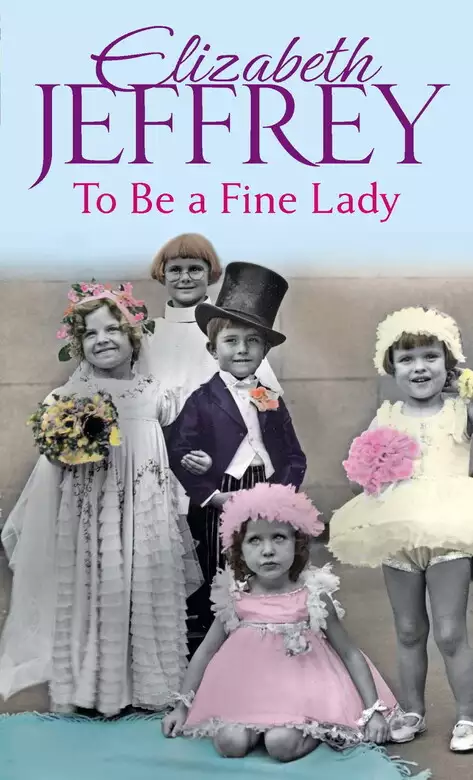
To Be A Fine Lady
- eBook
- Paperback
- Hardcover
- Book info
- Sample
- Media
- Author updates
- Lists
Synopsis
Abandoned as a baby, Joanna was brought up by the cruel farmer who found her and put to work on his land as soon as she could walk. Despite such hardship, Jo still keeps her spirits up, strengthened by the knowledge that she was discovered in a luxurious blue velvet cloak - evidence that her true mother must have been a fine lady. When successful factory owner Abraham Silkin decides that she has the potential to make him a good wife, Jo believes that her dreams of living in splendour are finally coming true. But she hasn't bargained on her forbidden attraction to Abraham's godson. Nor does she realise that the truth about her family lurks just around the corner - and is getting ready to reveal itself on the most important day of her life . . .
Release date: August 7, 2014
Publisher: Piatkus
Print pages: 336
* BingeBooks earns revenue from qualifying purchases as an Amazon Associate as well as from other retail partners.
Reader buzz
 Please log in to recommend or discuss...
Author updates
To Be A Fine Lady
Elizabeth Jeffrey
‘Here, let me do it, Jo.’ Suddenly, she found herself elbowed out of the way by a young man in a tattered shirt and trousers, spattered with yellow swarf thrown up from the grindstone where he worked. He began to turn the handle vigorously.
She shook his arm. ‘Not too fast, Tom. If it’s over-churned it’ll spoil and I’ll get another beating from t’Mester,’ she said anxiously.
He slowed down and looked at her. ‘Saul Bradshaw’s a cruel pig, treating you the way he does. And his sons, too. They’re no better. They ought to be ashamed, and you no more than a bit of a lass.’ The handle began to turn faster again as his temper rose and once again she laid a restraining hand on his arm.
‘It’s all right, Tom, really it is. Martha looks out for me.’ She grinned at him. ‘At least she sees to it I get enough to eat. Not like you, any road, half starved all the time.’ She went over and fetched him a dipper of milk from a basin on the shelf.
‘Thanks, Jo.’ He drank it down gratefully and went back to his churning.
The door opened, letting in a shaft of sunlight, and they both turned, starting guiltily. But it was only Martha, Saul’s wife, a small, wiry woman whose tiny frame belied her strength. In her early fifties, her face was wizened, furrowed with deep lines; wisps of thin grey hair escaped from under her cap. She was carrying a large basket with a cloth spread over its base.
‘Is t’butter done, lass?’ she asked briskly as she came in. ‘Aye, I can hear it is. Stop that, Tom lad, or it’ll be spoiled.’ She looked him up and down. ‘No work today, lad?’
‘It’s Monday, Missus. Mester never works on Mondays. I’m supposed to clear up the hull and put fresh water ready for the trow, but I can do that later when there’s nobody about.’
‘You mean when my man has done for the day,’ Martha said with a grim smile. ‘That’ll not be till the light’s gone. He’d work all night if he could see to do it. Sundays, too, if it weren’t the Lord’s Day. And he’d have his sons doing t’same if they weren’t working their own stones now. Not that he ever spends owt,’ she added with more than a trace of bitterness. She smiled at Tom. ‘You’re a good lad to come and gie t’lass a hand. I hope she’s gi’en you a sup o’ milk for your pains.’
He grinned back at her. ‘Aye, Mrs Bradshaw. She has.’
‘Good.’ She looked round the neat dairy and nodded. ‘Well, I can finish up in here now,’ she said to Joanna. ‘While you go and fetch me some blackberries from the wood.’
Joanna looked doubtful. ‘T’Mester said I’d to dig up the rest of the tatties this afternoon.’
‘Caleb can do that. He’s a lazy lout.’ She held out the basket. ‘Never you mind digging tatties, you do as I say and go and pick blackberries for me. It’ll be cool in t’wood, and Tom can help you if he’s nowt better to do.’ She winked at them. ‘I want plenty, mind, so I shan’t expect you back for a while. Blackberries make lovely jelly but it teks a lot of fruit for a gill of juice. Go on now, lass, be gone in case Saul decides to come back early.’
‘Thanks, Martha.’ Joanna flung her arms round Martha’s neck. ‘You’re good to me.’
‘Go on, away with you,’ Martha shooed them out of the door, but she was pleased. Nobody else showed her any affection.
She stood at the door of the dairy, shading her eyes, watching them take the path along by the narrow but fast-flowing River Porter towards the wood.
They were a strange pair. Tom, a tall, gangling youth of some sixteen or seventeen years – nobody was exactly sure how old he was – with a shock of black hair that made his pale face look even paler under its grime, and Joanna, small and slight with tangled fair curls and a peaches and cream complexion that no amount of weathering could spoil. Martha’s gaze softened as she watched her tripping along beside the boy and she realised with something of a shock that it was over fifteen years now since that bitterly cold March morning when she’d found her. It had been on a morning when frost had turned everything into a white fairyland and traced such thick icy patterns on the windows that she’d somehow known something magical was about to happen as she’d wrapped herself up in a blanket and gone out to milk the cows. And she’d been right, because there in the cowshed she had seen, by the light of the lantern, this tiny bundle lying in the feeding trough among the hay. Not crying, not sleeping, just lying there, looking, its blue eyes wide and trusting. Just like the Baby Jesus, the thought had come unbidden to her mind. Only the Baby Jesus hadn’t been wrapped in a blue velvet cloak like this baby.
And this baby wasn’t a boy, it was a girl, the daughter she had always longed for after bearing two strapping boys, Jacob, who by that time was nineteen, already married and a father himself, and Caleb, who was five years younger.
Saul had been furious when she carried the child into the house. He had warned her to get rid of it, he was having no squalling brat in his house, taking up time she should be spending on other things. When she refused he’d even tried to wrest it from her and throw it in the river; worse, he’d threatened to feed it to the pigs.
Martha smiled grimly to herself at the memory of that day. It was not often that she stood up to her husband, the consequences were too painful. But in this she had refused to give in. The child had been put there, she’d argued, just as the Holy Child had been laid in a manger. Therefore it was their Christian duty to care for it. It was a Sign. Thinking about it afterwards she was convinced that it was only this comparison that had swayed him. He was not a particularly religious man but he was afraid of the wrath of God. He didn’t consider his life was blessed with good fortune as it was, but a Sign was a Sign and he was not prepared to risk God’s anger descending on him further. Grudgingly, he’d agreed it could remain, as long as she kept it out of his way.
Martha was not concerned with his motives, she simply thanked the Good Lord that the child hadn’t been left in the dairy.
Tom and Joanna reached Hangingwater Lane, the road that crossed the stone bridge over the river and led down into the town. It was little more than a wide tree-lined track at this point, but further along it widened and joined other roads leading down into the busy town of Sheffield. They crossed over and plunged into the cool green wood, avoiding by common consent the cart track used by the strange-looking charcoal burner who lived in the wood with his daughter, keeping instead to the small path beside the rushing, tumbling river. Here the blackberries hung shiny and succulent. Tom cut a stick with which to hold down the high brambles where the biggest berries hung and it wasn’t long before the basket was full and their arms stained with a mixture of blackberry juice and blood from the bramble thorns. Satisfied with their efforts they hid the basket under the bushes and went and sat by the river to eat the packet of bread and cheese that Martha had concealed under the cloth that lined it.
They munched slowly, savouring every mouthful. When every last crumb had gone they ate their fill of blackberries, then scrambled down the bank and washed their faces and hands in the cold, clear, swiftly running water of the river.
‘That was a feast fit for a king,’ Tom declared, lying back contentedly and squinting up through the trees at the sky.
Joanna stayed crouched by the water’s edge, letting the cool water trickle through her fingers.
‘This could be the exact spot where they found my mother,’ she mused. She turned her head to look at Tom. ‘I told you, didn’t I, Tom? She was found drowned in this river, caught up in the roots of a tree by her long fair hair.’
‘Yes, Jo, you’ve told me,’ he said quietly, sitting up. ‘Many times,’ he added under his breath.
‘Look, there are gnarled roots reaching right down into the water over there on the other side.’ She pointed across the river, then turned back to him. ‘I reckon this was the very spot, don’t you, Tom?’
He nodded. ‘Could be.’ He sighed. ‘You’re lucky, Jo. At least you know who your mother was. All I know about my mother is that she died when I was born. In the workhouse. That’s a terrible place, Jo.’ He shuddered. ‘I was glad when Zack Wenlock took me on as his apprentice.’
She went and sat beside him. ‘But he’s horrible to you, Tom. How can you say that?’ she said, frowning.
He shuddered again. ‘You don’t know what it was like in that workhouse. Anything’s better than that,’ he said vehemently. He stared into the water for several minutes, then shrugged. ‘I don’t blame Zack for the way he treats me. He didn’t want me in the first place. But the workhouse people said he’d got to take a boy in, so he chose me. I suppose I looked as if I might die so he thought he wouldn’t have to keep me for too long.’ He chuckled. ‘But I didn’t die, did I? I’ve been with him for nearly eight years now. Only another four and I’ll be out of my time and I can leave him and go down into the town and earn my own living.’ He turned his head to smile at her, a smile that lit up his pale face and gave a hint of the handsome man he could become. ‘And when I’ve made my way in the world I shall come back and take you away from all this, Jo. We’ll be married and live in a fine house. What do you think of that?’
She threw her head back and gave a peal of laughter. ‘Oh, Tom, I’m not going to marry a grinder.’
He flushed with annoyance. ‘I’m not a grinder, I’m a penknife maker. At least, I will be when I’m out of my time. Any road, you’d be better off with me than living with Saul Bradshaw and his sons,’ he said huffily. ‘They treat you worse than a servant. You get all the rough work to do. You’re nothing but a slave in that house. And it’ll never be any different.’
‘Yes, it will, because I’ll not stay there for ever,’ Joanna said firmly. ‘When I find my mother’s family they’ll take me away to live with them. They’re very well-to-do, you know,’ she said in a prim voice.
‘Aye, so you’ve said.’ Unimpressed, Tom picked a blade of grass and began to chew it. ‘Although you’re only saying that because you were wrapped in a blue velvet cloak when Martha found you. That doesn’t mean owt. It certainly doesn’t mean your family’s well-to-do.’
‘Yes, it does,’ Joanna said crossly. ‘It’s a very good quality cloak, Martha says. She’s folded it up and put it away carefully till I’m grown up.’ She leaned towards him. ‘And it’s not only the material that’s quality. It’s got a silver clasp. Well, half of it’s not there but the bit that’s left is silver. Real silver. Martha hid it away so t’mester shouldn’t see it and want to sell it, but she showed it me once.’ She leaned back to see what impression her words had made on him.
To her disappointment Tom’s expression didn’t change. He continued to chew glumly on the blade of grass. ‘If you come from such a well-to-do family why doesn’t Saul Bradshaw treat you better?’ he said at last. ‘Why didn’t he try and find out where your mother came from?’
‘I dunno,’ she said impatiently. ‘Well, perhaps he did. Perhaps my mother came from a long way off. I don’t know, do I?’ Her expression went dreamy. ‘But Martha said she was a very pretty girl. They found her in the river a few days after they’d found me but nobody knew where she’d come from. Martha says I look a bit like her.’ She turned to him. ‘Anyway, one day I shall find out for myself. I shall make enquiries.’ She’d heard Martha use those words but she wasn’t entirely sure what they meant, except that it was something to do with finding her family. She sighed. ‘I expect I really belong in one of those big houses up Endcliffe way.’
Tom got to his feet. ‘Well, at the moment you belong at Bradshaw’s Farm and if you don’t get back there soon you’ll feel the weight of Saul Bradshaw’s strap across your back,’ he said cruelly. He had loved Joanna for as long as he could remember and it was his ambition to marry and cherish her. To hear her talk of her wealthy family made him feel jealous and inadequate and to lash out with his tongue was the only way he could give vent to his feelings.
She turned to him, aware that he was in some way upset. ‘Don’t worry, Tom,’ she said kindly. ‘When I get back to my rightful family I shan’t forget you. I’ll never forget you, Tom.’ She laid her hand on his arm. ‘You’re my friend and you shall come and work in the stables at my house. You’ll be my favourite groom.’
He shook her hand off. ‘I don’t know anything about horses,’ he muttered, refusing to be patronised.
‘Well, I’m sure I’ll be able to find something for you to do.’ She looked up into his face. ‘I mean it, Tom. I shan’t forget you. I promise.’
Suddenly, they heard the muffled sound of horse’s hoofs coming along the cart track on the other side of the bramble hedge.
‘It’s the old charcoal burner and his daughter!’ Tom whispered. ‘Nobody else comes along here. Let’s watch, but keep quiet so they don’t see us and give us the evil eye.’
They peered through the thicket of bushes just as the cart, carrying poles from trees that had been coppiced further down the valley, came into view. It was pulled by a tired old nag and walking beside it were two people, the charcoal burner, a tall figure in a smoke-blackened coat that reached below his knees and an old stove-pipe hat, and his daughter, almost as tall as her father, wearing a tattered dress that had once been yellow and a shawl that showed shadowy remnants of a paisley pattern. On her head was a black straw hat with limp-looking greyish flowers round the brim. Both were black from the charcoal and smoke, and neither looked to left nor right as they walked. But it was the man that held a fearful fascination for the couple watching. Because almost the whole of one side of his face was missing, leaving nothing but a long, purple, puckered scar from where his eye had been to the corner of his mouth. To add to his bizarre appearance, he wore a black patch over the missing eye. It was said he had stopped a musket ball whilst fighting with Wellington at the Battle of Waterloo, but nobody knew whether or not this was true because he was not a man to question. He went quietly about his business of collecting the wood from the coppiced trees, bringing it back to his hut in the woods to burn, then delivering the charcoal to the industrial furnaces in the town. It was common knowledge that charcoal fires made the best steel and Jack Ingram, even if he did only have one eye and only half a jaw, made the best charcoal.
Rumour had it that his daughter Liddy was a witch and with her strange dark eyes and wild, unkempt appearance most folk believed this. Indeed, Joanna and Tom had sometimes seen her at a distance in the woods gathering herbs and berries for the potions she brewed on the fire outside the hut where she lived with her father. Which was another very good reason for leaving the strange pair alone.
When the little cavalcade had gone past the two watching solemnly touched their noses and then spat on the ground because they’d seen a witch. Then they retrieved the basket of blackberries and hurried back to the farm.
Tom left Joanna to take the blackberries in to Martha while he carried on past the farmhouse and crossed the river by the rather rickety footbridge that connected the farm to the two low stone buildings opposite. In these buildings were housed ten small grinding workshops, or ‘hulls’ as they were known. Here Saul Bradshaw and his two sons Jacob and Caleb, Tom’s master Zack Wenlock and six other grinders worked in filthy, cramped conditions, grinding table knives, razors, or pocket knives, each according to his trade. The buildings were known as ‘Bradshaw’s Wheel’, taking their name from the ancestor of Saul’s who had originally owned the property and the wheel that powered the grindstones.
But Saul’s grandfather had been a gambler and he had gambled and lost Bradshaw’s Wheel at the card tables, leaving his family with nothing but the rather unproductive farm. Since that time Bradshaw’s Wheel had passed through several hands and was now owned by local industrialist Abraham Silkin, who lived in a big house on the hill overlooking the valley. The men working the grindstones, including Saul himself, although self-employed up to a point, paid rent to Abraham Silkin and were ultimately reliant on him for their livelihood.
This was a source of great bitterness to Saul and his dearest wish was to buy back the property that had once belonged to his family. It was a wish unlikely to be fulfilled, even though he worked hard and spent little, because most of the money he earned from grinding went towards propping up the failing farm. The land was poor, it cropped badly and was not even good grazing. And Abraham Silkin stubbornly refused to sell him the field further up the hill where the land was less waterlogged and the grazing better.
Tom fetched a bucket of water and stood it beside his master’s grindstone ready to tip into the trow the next day when Zack came back to work. He knew it was important not to leave water in the trough – or ‘trow’ – when the grindstone wasn’t running because the part of the stone left hanging in the water would soak up the moisture and the whole thing become unbalanced, with the risk of bursting when it revolved up to speed.
Saul Bradshaw’s hull was at the far end of the building. He was there now, crouched over his stone, putting the edge on table knives. As he worked he was sprayed with the water put in the trow to cool the revolving stone. Yellow swarf it was called because it became thick and yellow with sandstone dust and grit from the stone. He was the only grinder working that day; everybody else took Monday off, ‘Grinder’s Monday’ they called it.
He paused in his work when he heard Tom.
‘Is it tha, Caleb?’ he called, peering into the gloom.
‘Nay, it’s me, Mester. Tom Cartwright.’
‘Hast tha seen Caleb?’
‘No. I’ve not.’
‘Lazy young bugger. I sent him down into t’town hours ago. He should have been back by now. I shall be waiting on t’knives he’s gone to fetch when I’ve finished these.’ He threw down one knife and picked up another. ‘Time’s money and wasted time’s wasted money,’ he muttered as he resumed work.
Tom finished what he had come to do and made his way home to the row of grinders’ cottages some half a mile down Hangingwater Lane, where Zack Wenlock and his wife gave him grudging board. On his way he met Caleb Bradshaw, who had just left his brother Jacob’s cottage, which was next door to Zack’s.
‘Your dad’s yelling for you,’ Tom warned as he drew level with Caleb.
Caleb snorted. ‘Me dad’s allus yelling. And he can yell a bit longer. I’ll not be at his beck and call all t’time. He seems to forget I’ve me own hull and me own living to make now. I’ll not have him ordering me about like he did once-over.’
‘He said he sent you down into the town hours ago,’ Tom reminded him. He didn’t much care for Caleb, not least because of the way he treated Joanna.
‘He never sent me anywhere,’ Caleb said with another snort. ‘I was going down t’town and he asked me if I’d fetch his order. Well, I’ve fetched it.’ He hitched up the bag on his shoulder. ‘But he’ll have to wait while I’m ready to tek it to him. I’ve been to beer shop with me brother, if he wants to know.’ He continued on his way a trifle unsteadily, pausing only to shout over his shoulder. ‘An’ now I’m going home for a bit o’ bread and cheese.’
Tom stopped for a word with Jacob’s children, playing in the dirt, then went on into the cottage where he’d lived for the past eight years. Zack was sitting in his wooden armchair by the empty grate, snoring, and his wife sat opposite, knitting. She didn’t look up when Tom entered; he hadn’t expected her to. Ever since the day Zack took him in she had tried to pretend he wasn’t there, apart from mealtimes, when she watched every meagre mouthful he took and complained to Zack that ‘t’work’us brat’ was eating them out of house and home. But Tom accepted her attitude stoically. Living with Zack Wenlock was better than living in the workhouse and he was learning a trade. Once he was out of his time he would be off, into the town, to set up for himself. Until then he made sure that Mrs Zack’s coal bucket was never empty and that he didn’t offend her with his presence any more than was strictly necessary. That he was usually hungry and often cold he accepted as a fact of life. He went up to his attic under the eaves and flung himself down on his straw mattress where he could dream undisturbed of the day he would rescue Joanna and take her for his wife.
Leaving Tom, Joanna took the basket of blackberries into the farmhouse and helped Martha to pick over the fruit before it was set in a pan over the fire to boil. Then she went and put the basket away in the cupboard under the stairs. When she came back into the kitchen Caleb was there, helping himself to a hunk of bread and a slab of cheese.
‘I’d be glad if you’d go and dig the rest of the tatties up on t’field, Caleb,’ his mother was saying, reaching for the bread before he mutilated it further. ‘Your dad wants that field cleared before nightfall and Joanna’s been giving me a hand so she’s not had time to do it.’
‘Well, she’s time now, hasn’t she?’ He jabbed his knife in Joanna’s direction. ‘She’s standing there doing nowt. Me, I’ve just walked back from town wi’ a heavy pack, I’m not going out into no field digging tatties.’ He crammed more bread into his mouth. ‘Any road, it’s her job, me dad told her to do it, so she can get on wi’ it.’
‘There’s only the top corner left to do. It’d not tek you long, Caleb,’ Martha said encouragingly.
He speared a lump of cheese and looked up. ‘Then it’ll not tek her long, neither, will it?’ he said as he shoved it into his mouth.
‘Oh, Caleb. It’s hard work for a young lass. You’d get it done in half the time,’ Martha pleaded.
‘It’s no use you going on at me, Ma.’ He leaned back in his chair and belched loudly. ‘I’m not doing it and that’s flat. And if she doesn’t shape herself and get up there and get on wi’ it I shall tell me dad and he’ll tek his strap to her. Then she’ll move. By ’eck she will.’
A flash of fear crossed Joanna’s face. ‘I’d better go and do it, Martha,’ she said quickly. She sidled past Caleb on her way to the door but even so he managed to catch her arm with one hand and flick it with the finger and thumb of the other. Over the years he had practised this and other tricks down to a fine and painful art. She wrenched free and hurried outside where she pulled on a pair of old boots before dragging the big old barrow up to the top of the field. Martha was right, there was only the top corner to do, Joanna had done the rest over the past weeks, often with Tom’s help, but even after the hot, dry weather it was hard work, the fork was heavy to lift when it was full of claggy soil and picking up the potatoes was back-breaking work.
She pushed the fork into the ground and jumped on it to make it go deeper. It wouldn’t always be like this, she told herself as she forced the handle down as far as she could and then stood on it to lift the soil. She shook the fork as best she could and then began to gather the potatoes as they turned up. One day she would find – or be found by – her rightful family. She put the potatoes into the bucket and emptied it into the barrow and then began the whole process again. Over the years she had found that thinking about her lost family, daydreaming about them, who they were, where they lived, helped even the worst tasks to become bearable. She was certain she came from wealthy stock, the velvet cloak she had been wrapped in when Martha found her left no doubt about that; but what possible disaster could have caused the daughter of some great house to run away and leave her newborn child in a cowshed on the edge of Whitely Woods and then take her own life? She must have been desperate to have done such a thing. Even in her worst moments of despair Joanna had never for a moment considered taking such a step. She smiled a little to herself as she pushed a strand of hair back, leaving a muddy mark down the side of her face. Oh, wouldn’t her Family be overjoyed to discover that she was still alive? Her Family – she always thought about them possessively and with a capital letter. She straightened her back and rubbed it.
But who were her Family? The only large house nearby was Cliffe House, which stood near the top of the hill overlooking the farm. Abraham Silkin lived there with his godson and she often saw the old man walking in the fields when she was going about her work. Sometimes she even fancied he was watching her and the thought had crossed her mind that he might even know something about her, indeed could even be her long-lost grandfather! But in her heart she knew this was not possible, as far as anyone knew the old man had never been married, so could never have possessed a runaway daughter.
It was more likely that she belonged further away, up at Endcliffe perhaps, where there were several enormous houses. They mostly belonged to the big Sheffield industrialists, rich men who could afford an army of servants and several carriages. Once or twice she and Tom had crept up and looked at these houses, speculating over which one might be her rightful home, but they had never plucked up the courage to go and ask if anyone might be missing from the family. But one day she was determined that she would do just that. When she was older. Perhaps she might even go into service in one of those houses and then reveal that she was really the long-lost grandchild. What a surprise that would give them! They would be so overjoyed at finding her that they would dress her in beautiful clothes and let her ride in the carriage. A beautiful blue dress, all shiny satin and lace …
Suddenly, a blow on the back of her head pitched her into the dirt.
‘Get on wi’ it. I don’t feed and house tha to spend tha time daydreaming. Look, tha’s missed half a dozen over there.’ It was Saul. She hadn’t heard him come up the field. She scrabbled up the last of the potatoes and tipped them into the barrow.
He watched, then nodded. ‘Tha can tek the barra back to t’yard now.’
She tried to push it. It wouldn’t move. ‘I can’t budge it, Saul,’ she cried. ‘It’s too heavy.’
‘Bah, tha’s nowt but a mealy-mouthed little pipsqueak.’ He gave the barrow a shove to help it on its way and strode off, leaving her to haul it as best she might the rest of the way. Back in the yard she put the potatoes in the barn with the rest and then kicked off the boots. There were broken blisters on her heels under the dirt and the tops of the boots had rubbed her legs raw. She went inside.
‘Ee, look at you. Come near t’fire, lass, and let me bathe them feet.’ Martha bustled about fetching a bowl and cloth. She smiled as she saw Joanna’s look of alarm. ‘There’s nowt to fret over, we’ll not be caught. Saul’s gone down to t’beer house for once.’
Joanna put her feet gratefully into the warm, soothing water and Martha rubbed them gently. ‘Lady’s feet,’ she mused. ‘Not feet for them great boots. No wonder your feet’s blistered,’ she said absentmindedly. She looked up at Joanna. ‘Saul thinks Caleb’s up to summat. That’s why he’s followed him tonight. But the lad’s nearly thirty. If he’s got a lass somewhere I don’t see Saul’s any right to interfere. It’s high time he was wed, any road.’
‘If Caleb was wed and had a wife to keep Saul would have to pay him more for the work he does on the farm,’ Joanna said sagely. ‘He’d not like that. Look how he complains when he has to pay Jacob to help.’
Martha began to dry her feet gently with a cloth. ‘Aye, you’re right, lass, Saul ’ud not like that. He’s not one to spend a ha’penny if a farthing’ll do.’ She frowned. ‘But if that’s what the lad’s bent on Saul’ll not be stopping him, that’s for sure.’
Joanna hoped Martha was right and that Caleb would soon take himself a wife. She had never liked him, he had always been cruel and unkind to her and lately, since she had shown signs of budding womanhood he had begun looking at her and even touching her in a way she didn’t like at all. She considered confiding in Martha but she suspected that Martha wouldn’t be sympathetic because she cherished the vain hope that one day Caleb and Joanna would marry. So she kept her own counsel and made sure to put a wooden wedge in the latch of her bedroom door each night. Just in case.
The days shortened, and there was a nip in the air that heralded autumn. One afternoon Joanna went into the w
We hope you are enjoying the book so far. To continue reading...
