
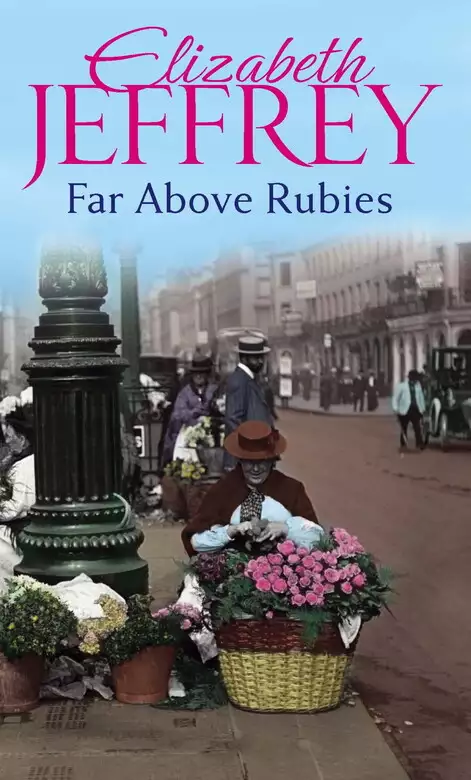
Far Above Rubies
- eBook
- Paperback
- Hardcover
- Book info
- Sample
- Media
- Author updates
- Lists
Synopsis
When lovely Laura Chapman wakes up to find herself destitute in a London workhouse with all her belongings stolen, she cannot imagine how she will ever get over the shame. An orphan newly arrived from India, Laura is at the mercy of Jack Plant, the workhouse overseer, whose intentions are far from honourable. Distraught and penniless, Laura is taken in by the poor by kindly Taylor family and, determined to pay her way, becomes a factory girl at Beresford's Silk Mill where she comes to the attention of Alex Beresford, the talented engineer son of the factory owner. It begins to seem as if love and happiness are still possible for a girl whose life has been blighted by sorrow. Until the day Jack Plant appears to threaten her new-found security by revealing the secret she has tried so hard to keep.
Release date: August 7, 2014
Publisher: Piatkus
Print pages: 401
* BingeBooks earns revenue from qualifying purchases as an Amazon Associate as well as from other retail partners.
Reader buzz
 Please log in to recommend or discuss...
Author updates
Far Above Rubies
Elizabeth Jeffrey
‘Won’t be long now. God knows she’s suffered enough, poor crittur.’ A cool, faintly sour-smelling cloth wiped the perspiration from her face.
‘D’you think she’ll live?’ Another voice, the words spoken with complete indifference.
‘Nah, she’ll be gone by morning.’
She heard nothing more as the pain tore her in half. She was dying and she was glad. She couldn’t stand it any longer. With one last agonised scream she arched her back and then sank back, utterly exhausted. The baby was born and she knew, without being told, that it was dead. Now she could die, too. A blessed blackness engulfed her.
A long time later she came to, shivering with cold under the thin blanket that covered her. It was a cold that she could smell as well as feel; damp, dank and thick with the stench of boiled cabbage, excrement and unwashed bodies. She opened her eyes.
‘Oh, look, she ain’t dead, after all,’ she heard a voice say without enthusiasm. ‘Better git ’er a basin o’ gruel, I ’spect.’
‘Nah. If we don’t feed ’er she soon will be dead, then there’ll be more for us,’ another voice said, hopefully.
‘No, we can’t do that. ’T’ain’t Christian.’ She felt an arm round her, lifting her till she was able to prop herself on to one elbow. When everything stopped spinning round she saw that she was in a long, lofty room, with three rows of rough cots down its length. The room was lit by small windows set too high in the wall to give more than a hint that a bright autumn sun was shining outside. She saw that most of the cots were occupied by women who were either too old or too weak to get up and other women, filthy and ill-clad, seemed to be administering to them as best they could. The smell was appalling.
‘Oh, God, what have I come to? What is this place?’ she said, as much to herself as to anyone else. ‘What’s happened to me?’
‘Gawd, she’s a toff!’ someone said.
‘I told you she was. You could tell by ’er clo’se – what we saw of ’em afore she took ’em.’
‘Shut up, you two,’ a woman of indeterminate age said over her shoulder as she bent towards her, pushing back lank and greasy once-fair hair. ‘You’re in the work’us, dear,’ she said, not unkindly, and Laura recognised her as the one who had helped her to sit up. ‘They brung you ’ere when you c’lapsed at the railway station.’
Laura digested this with difficulty. She moved on the cot and felt her stomach. It was blessedly flat. ‘The baby? Where’s the baby? I did have a baby, didn’t I? Did it die?’ She frowned as she spoke. She was feeling dizzy now and weak, too weak to be sure she hadn’t been dreaming.
‘Yes. An’ a good thing, too, if you ask me, poor little bastard.’ The woman, whose name was Elsie, sat down on the side of the cot and took a basin of almost transparent gruel from the hand of a woman standing beside her. ‘ ’Ere, take some o’ this. ’T’ain’t all that special but it’s all there is.’
Laura took a spoonful of the unappetising mess. It tasted like thick water that had gone bad, and at first it made her gag, but she forced it down. The fact that there wasn’t to be a baby after all was nearly as difficult to digest as the gruel she was being fed. But not nearly as unpleasant. It was as if a great weight had been lifted from her, leaving her almost light-headed. She realised, with a pang of guilt, just how much she had hated the thing that had been growing inside her for the past eight months and she felt no pity for the poor innocent little wretch who had never even lived to draw breath. Because she knew she could never have loved a child that was a constant reminder of that dreadful man.
She forced down a little more gruel. Somehow she had to find out why she had been brought to this place and then take steps to get out of it and she wouldn’t be able to do that if she starved herself. ‘Why did they bring me here?’ she asked. ‘Why wasn’t I taken to a proper hospital?’
‘ ’Cause you was destitute, o’ course,’ the woman called Martha said bluntly.
‘But that’s ridiculous. I haven’t much money, but I’m not destitute.’ She looked down at the ragged shift she was wearing. ‘Where are my clothes? And my trunk . .? And I have jewellery. My mother’s jewellery. It was in a leather bag. I kept it safe on my wrist …’ Laura held up her wrist. There was nothing but a red weal where the bag had been wrenched from it. Fear rose in her throat and threatened to choke her as she looked round for her possessions.
Martha and Elsie regarded her with pity in their eyes. It was always a matter of amazement to them just how naive the ‘quality’ could be. And this one didn’t look much more than a child, although she must be going on for twenty.
‘Don’t you remember anything?’ Elsie asked.
Laura frowned. ‘I remember being at a railway station … I had just come from the boat …’
‘What boat?’
‘The boat from India.’
‘She’s ravin’,’ somebody said scathingly.
‘No, I’m not.’ Laura was indignant. ‘I tell you I’d come from India; from the garrison at Mudkipur, near Lucknow.’
This meant nothing to the women clustered round the bed. ‘Is that where your ’usband is? This muddy paw place?’ Elsie nodded towards the wedding ring on Laura’s finger.
‘What?’ Laura looked at her hand. ‘Oh, er-yes, that’s right.’
‘Well, all I can say is, ’e should never ’ave let you travel on yer own. When you fainted at the railway station your trunk would be gone afore anybody could say knife, whipped away by some light-fingered Johnny,’ Martha said. ‘And as for waluables, well, I wonder they ’adn’t bin cut orf your wrist long enough afore you dropped.’
Laura’s eyes widened. ‘Do you mean stolen? Everything I possess, stolen? But what about my clothes?’
‘Oh, you won’t see them no more. The matron’ll see to that.’
‘So everything I had is gone?’
‘That’s about the size of it,’ Elsie nodded. ‘This is the on’y thing we found belongin’ to you. It was tucked in your glove.’ She held up a train ticket. ‘If it’s any good to you you’d better keep it safe.’
Laura took it gratefully and looked at it. It was to Colchester in Essex, the home of grandparents she had never met. Her mouth twisted wryly at the irony of a Fate that had allowed her to make a journey of some five thousand miles across the world safely and then to strike when she was within fifty miles of her destination. But when it struck it did so with a vengeance, she thought bitterly, leaving her with nothing in the world but this train ticket and her dead mother’s wedding ring, which she had worn to give herself an air of respectability for the journey. She lay back on the grimy pillow, trying to come to terms with her desperate situation and cursing the man who had been responsible for driving her to such depths.
Gradually, through youthful resilience rather than good food and care she regained her strength. Even so, she was forced to stay at the workhouse for nearly a fortnight, during which time her one thought was how to get out of the place. The two women who had befriended her and who, she learned later, had delivered her of the stillborn child, continued to care for her and shield her as best they could from the worst horrors of Victorian workhouse life, tending and feeding her until she was strong enough to leave the uncomfortable pallet that was her bed and could take her turn in helping the other sick women.
‘If anybody come in, you git yerself back into bed,’ Elsie warned, the first day she managed to stay on her feet. ‘They’ll on’y ’ave to see you up and about and you’ll be down in the cellar pickin’ oakum with the rest. And you don’t want that! Not with ’ands like you’ve got.’ She compared Laura’s soft, white hands with her own cracked and chapped paws.
‘An’ ’ang on to your belongin’s,’ Martha said. ‘People ’ere’d pinch the milk outa your tea – if there was any in it to pinch,’ she added grimly.
But Laura had no belongings except her train ticket, which she kept firmly tucked into her bodice and her mother’s wedding ring, which she still wore, relieved to find that her fingers had swelled enough to make it a snug fit.
‘Why are you here?’ she asked Elsie one day.
‘ ’Cause I ain’t go nowhere else to go,’ Elsie said. ‘My ole man died and there was me and five kids. I struggled on as best I could but I had to give up in the end. I reckoned it was better to come here than see me littl’uns starve.’ She gave a grim laugh. ‘I wouldn’t have come if I’d knowed, though.’
‘Why not? Where are your children?’
‘Thass just it. They’re somewhere here, in the children’s ward, but I dunno whether they’re alive or dead, ’cause I never get to see the poor little beggars.’ She sighed. ‘I might as well have kept ’em with me and we’d all ’ave starved together, instead of them starvin’ where they are and me starvin’ ’ere. Anyways …’
‘Git back into bed. Here’s the matron,’ a voice from near the door warned.
Laura sank down on to her pallet and pulled the filthy blanket up round her chin, just as the matron came in with a short, thick-set man with a bull neck and dundreary whiskers. He had a florid face and little pig eyes that seemed to miss nothing. ‘He’s the overseer,’ Elsie whispered, bending over in pretence of tucking her in. ‘He’s a reg’lar tartar.’
Matron fussed down the ward behind the strutting overseer, Jack Plant. He stopped beside Laura’s bed. ‘You’re new,’ he said. ‘What brought you here?’
‘She’s just been brought to bed with a stillborn babe,’ Elsie answered for her. ‘She was picked up at the railway station.’
‘What’s your name? And where’ve you come from?’ he asked, with a view to sending her back there at the earliest possible moment. Vagrants were an expense to the parish and the usual practice was to send them back from whence they had come at the first opportunity.
Laura looked up at him, her big violet-blue eyes wary. ‘My name is … Mrs Bruce. And I’ve just come back from India,’ she said.
Jack Plant raised his eyebrows. In those few words he recognised that this was not one of the usual class of vagrant. He didn’t believe her story but he was too interested in the slim, long-legged form he could detect under the grimy blanket to care whether what she said was true or not. ‘This woman shouldn’t be here. This is no place for the likes of her,’ he said to the matron. ‘Anybody can see she’s a cut above this lot.’ He waved his arm at the other patients in the infirmary.
‘Well, Mr Plant, we had to put ’er hin with the rest. We reely ’aven’t got, I mean, we’ve honly got the one ’ospital ward for women,’ the matron said, wringing her hands.
‘Then let her have a room to herself. There’s a little room at the top of the stairs. It’s only got boxes and things in it. Have it cleared and she can go there. I shall be back next week. See it’s done by then.’
‘Cor, ain’t you the lucky one,’ Elsie said enviously when the overseer had left with the matron. ‘A room all to yerself. I wish I ’ad your luck.’
But Laura didn’t see it like that. She had seen the look Jack Plant had given her, lingering and lecherous, and she was afraid.
Nevertheless, when the room was made ready for her she had no choice but to move to it, entreating both Elsie and Martha not to leave her alone there and begging them to help her to escape.
‘But you ain’t fit. Thass ain’t two weeks since you was brung here and brought to bed,’ Martha said.
‘I can’t help that. Don’t you understand what that man has got in his mind?’
Understanding dawned on Elsie’s face. ‘Ah, yes. O’ course. We shoulda realised. Well, don’t you worry. We’ll do what we can, dear. But thass a sure thing you can’t leave till you’ve got suthin’ different to wear. You can’t walk the streets in your shift.’
So Laura had no choice but to wait, and while she waited Jack Plant came to see that his orders had been carried out. He came into the room, leaving the matron to go about her other business and stood looking down at her, his eyes feasting greedily on her form beneath the thin blanket. Then he sat down on the bed and gave her what passed as a smile, showing a full set of bad teeth.
‘Now, my dear, if you play your cards right you’ll never want for another thing,’ he said, and his hand crept under the blanket to caress her leg.
She sat up quickly in the corner of the bed and hugged her knees, as far out of his reach as she could get. ‘Get out,’ she spat.
He shook his head and his little pig eyes narrowed. ‘Nobody speaks to Jack Plant like that, my girl,’ he said. ‘Don’t forget I’m overseer here. You’ll do as I say.’ Then his tone became conciliatory, ‘But I shan’t have to order you, shall I? You’ll be sensible when I tell you I’ve got a nice little room lined up for you a few streets away. You’ll have your own front door, plenty to eat, all the clothes you want. And all you have to do,’ he leaned over and she could smell his fetid breath, ‘is be nice to me.’ Unable to reach a more interesting part of her he began to stroke her arm.
She brushed him off as if he was a fly. ‘Leave me alone,’ she said through gritted teeth. ‘I’d rather pick oakum than let you lay a finger on me.’
He laughed. ‘You’ll soon change your tune, madam, when you’ve seen what I got to offer you,’ and he stood up and began to unbutton his trousers.
Quick as a flash she leapt out of bed and gave him a push, catching him off-balance so that he fell on to the bed. She rushed out of the door, nearly knocking over the matron, who had been busy at the keyhole and ran down the stairs and into the ward.
‘Quick, where can I hide, away from that man?’ she cried, trying to crawl under Elsie’s bed. ‘He wants to set me up in a house. I’ll die first. He’s nothing more than an animal.’
‘Here, git in this cupboard,’ Martha held open the door. She turned to Elsie. ‘Can’t unnerstand it, meself. If Jack Plant offered to set me up in a little room an’ see me all warm an’ comfortable, I’d put up wiv all the poker ’e give me. God, when all’s said an’ done, there ain’t much else to look forward to in this life, is there! An’ you hev to get it where you can. Thass right, dear, you’ll be safe enough there.’ She shut the door and Laura heard the lock turn.
She sat for what seemed like hours in the dark cupboard hugging her knees and shivering. She couldn’t believe that she had escaped from the clutches of Randolph Grey in Mudkipur only to fall into the hands of this horrible little pig-eyed man. She listened as Jack Plant and the matron came through the ward, ostensibly inspecting it, but in reality searching for her, and she held her breath when they demanded to look in the cupboard.
‘Cupboard? Wot cupboard? Oh, that one! Ain’t never looked in it, ’ave you, Elsie?’ She heard Martha lie.
‘No. There ain’t no key, far as I know. Leastways, I never seen one.’
The voices moved on down the ward, Elsie and Martha protesting that they hadn’t see the jumped-up little madam but they’d be only too jolly glad to hand her over to the matron if they did. At last the footsteps receded and Elsie came and let her out.
‘That was a near one,’ she said with a grin.
‘Yes, it was. Too near.’ Laura walked up and down the ward, willing strength back into her cramped legs. ‘I must get away,’ she kept saying. ‘I must get away from this place. I refuse to stay here for the amusement of that dreadful man.’
‘All right, dear. But you’ll hev to wait till we can find you suthin’ to wear. Like we said, you can’t tramp the streets in your shift, now, can you?’ Elsie said.
So she had to wait, hiding in the cupboard and sharing their meagre food, for a full twenty-four hours, while on Jack Plant’s orders the workhouse was searched from top to bottom. Fortunately for Laura it was a half-hearted search, because the matron was not anxious to be supplanted in the overseer’s affections by a younger and much prettier woman.
Ignorant of this, Elsie and Martha planned her escape carefully. Elsie had daringly stolen some clothes out of a cupboard in the matron’s room, where garments that had been given by benefactors were stored. There was quite a smart dark blue dress that was only just beginning to go under the arms and a crinoline to go with it, a pair of shoes that almost fitted and a jaunty green hat. There was also a slightly moth-eaten green pelise.
By the time she had cleaned herself up, using precious water and carbolic soap to bathe and wash her hair in, and brushing it with the scrubbing brush because nobody possessed a hair brush – Laura looked quite respectable.
‘Now, what you’ve gotta do is this,’ Elsie said. ‘Today’s the day the nobs come to look over the poor house. They bring cake an’ stuff and their cast-off clothes, like what you’ve got on. It don’t do us no good but it make them feel better. The matron eats the cake ’erself an’ keeps the clothes in the cupboard an’ sells ’em off, a few at a time. Keeps ‘er in brandy, anyway.’
‘Never mind that,’ Martha said impatiently. ‘Tell ’er what we’ve planned.’ She looked round at the women lying in their beds. Most of them were past caring what was going on but one or two were showing a beady-eyed interest in this smartly dressed stranger. ‘An’ you lot, keep your mouths shut, or you get no stew tonight. Not that you’ll miss much,’ she added under her breath.
Elsie caught her arm. ‘Listen. When the nobs come round you tag on behind ’em. This is always the last place they visit, so all you’ve gotta do is walk along wiv ’em and out through the gate. You can get a ’Ansome there to take you to the station.’
‘But I’ve got no money.’
Martha thrust a purse into her hand. ‘There’s a few coppers in there. Should be enough. It’s all there was in Matron’s drawer.’
Laura took it doubtfully. ‘Won’t you get into awful trouble?’
They laughed. ‘Nah, why should we? We ollus knew that posh bitch was a thief.’ Elsie planted a kiss on Laura’s cheek. ‘Now git back in the cupboard. We’ll let you out when the time’s right.’
Laura waited in the cupboard, trembling and clutching the little umbrella that Martha had discovered and which matched her hat. She hoped she wouldn’t collapse with fright.
Before long there was the murmur of voices and soon after that the cupboard was unlocked. ‘Quick, they’ve just gone,’ Elsie whispered. ‘Goodbye, Laura. And good luck!’
Laura took a deep breath and hurried after the group of about a dozen women. ‘Terrible conditions. Something really should be done,’ a grey-haired woman remarked, holding her handkerchief to her nose.
‘Yes, I’ve never seen the like in all my life,’ Laura answered, restraining herself with difficulty from breaking into a run as they walked along what seemed like miles of corridor before reaching the main door.
‘Good afternoon, ladies,’ the matron stood in the doorway, smiling obsequiously, and Laura walked out with the crowd, inclining her head in gracious acknowledgement as the doorkeeper touched his cap to them. The others dispersed in twos and threes to their own carriages or to one of the Hansom cabs waiting hopefully at the gate and Laura had no trouble in hailing one for herself. She was still trembling when she gave the cabbie every last penny from the purse and hurried on to the station. She kept looking behind, terrified that someone might have recognised and followed her and she didn’t feel safe until she was on the train and rattling her way to her destination.
Then she relaxed, the first hurdle over. But as the train rattled along towards Colchester she realised her troubles were not yet quite at an end, since with all her possessions gone it might be difficult to convince her mother’s parents that she was indeed their granddaughter. And even if they believed her would they welcome the child of the daughter they had disowned when she ran away with a penniless army surgeon? There had been no contact with them over the years, and whilst she was at boarding school all Laura’s holidays had been spent either under sufferance with her father’s sister, Aunt Miriam, or alone at school. There had never been any suggestion that she might write to her grandparents in the hope that they would offer her shelter. But now she had no choice, her parents were dead and buried in a grave for cholera victims in far-off India, Aunt Miriam was also dead and she was alone in the world. She couldn’t believe her grandparents would turn her away.
The railway station at Colchester was a ramshackle affair of wooden sheds that looked more and more likely to fall apart with every train that shook and rattled its way into it. The ticket collector directed Laura to North Hill.
‘Jes’ keep right on up the road, over the river, an’ you’ll come to it. Thass a tidy step, mind yew.’ He looked doubtfully at the ashen-faced girl in front of him. ‘Are yew sure yew can manage it, dearie? Hev yew got …?’
‘Oh, yes,’ Laura said through bloodless lips, anxious to be on her way, ‘I’m going to visit my grandparents.’
‘Well, at least you ain’t burdened with luggage, dearie.’ The ticket collector watched her walk slowly away, shaking his head anxiously.
It was, as he had said, a tidy step. The railway station had been placed on the outskirts of the town because it was both noisy and dirty and local hotels did a nice trade in providing carriages for their clients. But there was no carriage to take Laura and she was forced to walk the long, unmade road, muddy from recent rains. She plodded on, in shoes that didn’t quite fit, past fields and cottages till she reached the bridge over the river. She stopped and looked down into the shallow muddy water. It was hardly more than a stream compared with the great rivers she had travelled on in India. She eased her feet in the ill-fitting shoes and carried on.
The road began to slope upwards now and she was very tired because she was still weak from the difficult birth of the child. She leaned for a moment against a post by the side of the road and watched the carts and wagons trundling by. People, too, hurried about their business, taking no notice of her. Some of them were unkempt and shabbily dressed but nowhere did she see the abject squalor she had witnessed in the city of Lucknow. There were no beggars with festering sores, no heaps of rags by the side of the road, the only sign of life the brown clutching claw outstretched for alms. And the houses all had neat, iron-railed steps leading up to brightly painted front doors that weren’t peeling and blistered from the heat. She dragged herself on. This, at last, was North Hill. Soon she would reach the haven of her grandparents’ house. She sent up a swift prayer that they would welcome their only daughter’s child.
Number seventeen had five steps leading up to a dark blue front door with a pretty fanlight. She banged on the door hopefully, nearly at the end of her strength.
A young maidservant opened the door. ‘I’ve come to see Mr and Mrs Farthing,’ Laura said, her hand on the door post for support.
The girl frowned. ‘Albert,’ she called over her shoulder, ‘there’s a strange woman ’ere. Say she want Mr and Mrs Farthing. Don’t know nobody by that name, do you?’
Albert, an elderly retainer came shuffling along the hall. ‘Mr and Mrs Farthing. Yes, thass the old couple who lived here afore Doctor an’ the missus come. One died and the other worn’t long after.’
Laura looked from one to the other, stunned. ‘You mean my grandparents are dead? Both of them?’
‘If their name was Farthing, yes, thass egsackly what I do mean. I mind it well,’ Albert said. ‘The ole lady died first an’ he followed in a matter o’ weeks. Doctor Shaw and ’is good lady live here now, and hev done for the past two years.’
‘I see. Thank you very much.’ Laura turned away, all her hopes and aspirations smashed by those few words.
Utterly devastated, Laura dragged herself to the top of the hill and sat down by the well, taking a drink of cool, clear water from the cup that hung on a chain nearby. It was not very pure but it tasted like nectar after the filth she had been given to drink in the workhouse. She put her head in her hands. She couldn’t believe that this was happening to her. All her hopes, all her faith had been pinned on finding her grandparents. She had been so sure she could win them round to give her a home. It had never once occurred to her that they might no longer be alive.
What was she to do now? She was in a strange town, with no money at all, and nowhere to go, except another workhouse. And she wouldn’t go there. She would die, fling herself into the river she had crossed on her way from the railway station rather than suffer the humiliation of another of those dreadful places.
She sat in the late afternoon sunshine of early October, shivering, partly from the cool breeze of a climate that froze her after the heat of India, and partly from fear. It was unbelievable that not much more than six months ago she had been living a life of ease and luxury with Annabel, the girl who had befriended her in India. Filling the days with nothing more taxing than teaching Annabel’s little son Peregrine his letters, an early morning ride across the plain or a trip to the bazaar, where they would idly spend a few rupees on trinkets they could have done without. And now she was destitute. She hadn’t a penny. She sat twisting her mother’s wedding ring round and round on her finger. Then, slowly, she turned her hand and looked at it. She had this left. She pulled it off her finger and laid it in the palm of her hand. It was all she had in the world.
She felt a light touch on her shoulder and cringed away, closing her hand protectively over the ring. Then she looked up, into the face of a man of about forty, shabbily dressed but clean and with a kind face. ‘Are you in any trouble, dearie?’ he asked.
She drew herself up, her innate pride coming to her rescue. ‘No, thank you, I was just resting for a few minutes.’ She got to her feet, giving him what she hoped was a bright smile, and tottered a few steps before utter hopelessness forced her to collapse back on to the bench, sobbing as if her heart would break.
Fred Taylor stood beside her, patting her shoulder and saying, ‘There, there, dear, whatever it is there’s surely no need to take on so,’ over and over again, embarrassed by the stares of passers by, but reluctant to leave her, until her tears began to subside.
‘I’m sorry,’ she hiccupped, after a while. ‘I didn’t mean to cry like that. But I’m so alone. And so frightened. So dreadfully frightened.’ And she began to cry again.
‘Thass all right, dearie. Now, what you got to be frightened of? Do you want to tell me what’s wrong?’ Fred looked at her and saw a girl who was, as he put it himself, a cut above the ordinary, although she was none too tidily dressed and her thick, dark hair was screwed up any old how under that funny little green hat. But her face was fine-featured, with a wide, generous mouth and the most beautiful violet-blue eyes Fred had ever seen, red-rimmed though they were. He watched her for a few more minutes, not quite sure what to do about her, then he said, ‘Tell you what. You come home with me and I’ll get my missus to give you a cuppa tea. You’ll feel better then, and you can tell us all your troubles. If you want to, that is,’ he added awkwardly. He took her arm and helped her to her feet.
He seemed a nice, kind man so Laura was grateful to accept his offer and together they went along the High Street and turned into Stockwell Street and a little house in Ball Alley.
Fred’s cottage was one of half a dozen, but unlike the others it was neat and clean, the step scrubbed and a geranium at the door. He took her inside and five pairs of almost identical grey eyes turned to look at her.
‘Don’t all stand there gawpin’,’ Fred said affectionately. ‘Jest because we don’t often hev a visitor. Kate, get the young lady a chair. Dot, pull the kettle forward for a cuppa tea.’ He rubbed his hands together and turned to his wife. ‘I dessay we can manage enough supper for an extra mouth, Muther, can’t we?’
Laura had sat down on the chair provided, but now she struggled to her feet. ‘Oh, no, I couldn’t possibly …’
‘Of course you could, my dear.’ Nellie Taylor was a small stern-looking woman, without an ounce of spare flesh on her, and her hair was scragged back into her cap, giving her face, with its sharp nose, a pointed, bird-like look. Yet when she smiled she was transformed and her voice was full of kindness. ‘Now, sit ye down, there’s broth and to spare for you if you’re willing to accept our humble hospitality.’
Nellie ladled broth into eight dishes and the oldest girl, Dot, cut a chunk of thick bread to go with each. ‘Here, Kate,’ she said to her sister of about twelve, ‘take this upstairs to Ebbie, an’ if he says he can’t eat it you’re to stay until he does.’ Dot turned to Laura. ‘Ebbie’s our brother Ebe
We hope you are enjoying the book so far. To continue reading...
