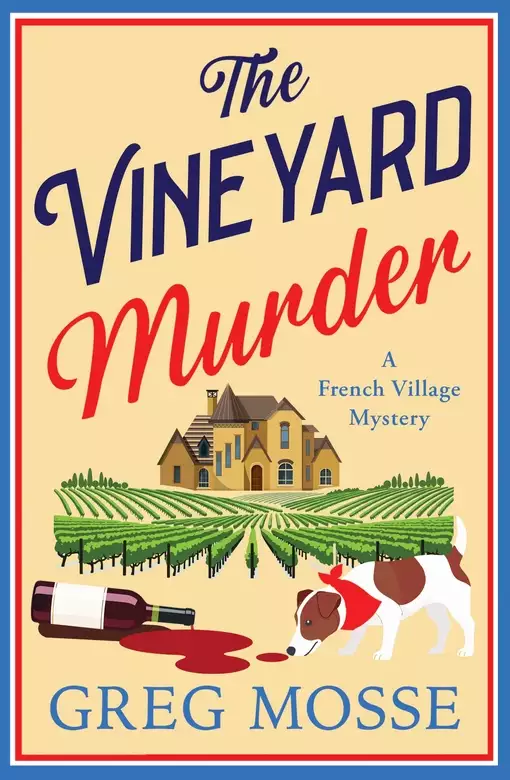
🍷Can't wait for Zoe Pascal to solve another mystery? The next instalment in the French Village Mystery Series, The Vineyard Murder, is available to pre-order now!🍷
Readers love The French Village Mystery series: 'A delightful, original and cleverly plotted murder mystery with a rich sense of place that made me feel I had been transported to the quaint charm of Southern France' A.A. Chaudhuri
'A delight from start to finish' Reader review ⭐⭐⭐⭐⭐
'A murder mystery that is heartwarming, cosy and delightfully bookish' Jamie West
'With memorable characters and a rich sense of place, this book is perfect for fans of cosy whodunits' Reader review ⭐⭐⭐⭐⭐
'Combines the charm of a Provençal setting with a cleverly plotted puzzle that will keep readers guessing until the final page' Tim Stretton
'Utterly enjoyable' Reader review ⭐⭐⭐⭐⭐
'Colourful characters, a beautifully drawn location and a mystery within a mystery make this an eminently satisfying cosy' Neil Daws
Release date:
September 17, 2026
Publisher:
Hodder & Stoughton
Print pages:
352
* BingeBooks earns revenue from qualifying purchases as an Amazon Associate as well as from other retail partners.
In the soft, green hills around the delightful southern French hill town of Sainte-Catherine, nestled in beautiful Provence, accompanied by her adopted stray, Russell the Jack Russell, Zoe Pascal felt stiff and tired – but happy.
This place really is a kind of paradise.
She had agreed to help her friend Marcel Maurice bring in the grape harvest, knowing it would be back-breaking work. She was not alone. As was traditional each autumn, many of her friends and neighbours also joined in, including the austere local priest, Father Julien Calmet.
At the end of a row, at the end of the day, with the sun casting long shadows, Julien gently cradled a ripe bunch of Carignan grapes in his long-fingered hands and asked her: ‘Did it surprise you to discover that so many locals put their busy lives on hold to participate in the harvest?’
‘It did,’ Zoe told him. ‘At first. Then I realised how deeply connected you all feel to the land.’
‘We do,’ said Julien. ‘It’s a rather wonderful thing.’
‘And there are outsiders, too, staying in the yurts Marcel has had installed.’
‘There are,’ he replied, with a slight frown. She wondered if he was going to ask her opinion of the ‘outsiders’, then he enquired: ‘Who is minding the Bookshop of My Dreams?’
Julien was referring to her stone-built shop, once the village school. For twelve months, since the previous September, it had been the centre of her new life in the south of France. Despite becoming involved in three murder investigations, one after another, Zoe woke each morning thrilled with her new life.
‘La Librairie de Mes Rêves is in good hands,’ Zoe told him. ‘Cécilie Guillaume is on duty. She’s been very helpful, stepping in now and then, giving me the chance to pop out to the shops or have something other than a sandwich for lunch. And, because she’s six months pregnant, she’s much better with me than she was on the till at the Total service station where she’s stuck in one place for hours on end and can’t move about.’
‘And she’s entirely trustworthy?’ asked Julien quietly. ‘She will lock up and cash up and all the rest of it at the end of the day?’
Zoe asked herself if it was possible that Julien was aware of some detail of Cécilie’s life that he couldn’t share.
Could he have learned something in the secret of the confessional? Have I ever seen Cécilie in church?
‘I believe she is,’ she replied, equally low. ‘Unless you know something I don’t?’
‘No, I have no special knowledge,’ he told her. ‘It’s just that I’m aware of how important the bookshop is to you, in this new life you’ve chosen. And we are all very grateful for your presence. I, personally, would hate for anything bad to happen.’
‘Stop it,’ said Zoe, blushing and smiling.
For a few minutes, they didn’t speak. They had turned for ‘home’, meaning the courtyard between Marcel Maurice’s farmhouse and his wine cellars. Once their wheeled wicker basket was full, they were headed for a magnificent al fresco feast to be shared among all the labourers.
But not quite yet. For a little while longer, Zoe and Julien needed to reach and stoop and bend and contort their bodies to get at the fruit, each wielding a pair of sharp secateurs to snip off the exceptional crop in gorgeous bunches, placing them carefully on top of one another.
After three more plants, Zoe realised that she had missed a couple of clusters because the sun was low in the west, the leaves and the fruit beginning to merge in the shadows.
‘I think we’ve done our duty,’ she said.
‘I think so, too,’ agreed Julien.
Because the ground between the rows of vines was parched and hard, the little wheels on their capacious wicker basket caught and juddered. They joined forces to lift it slightly so that their precious crop shouldn’t be bounced out.
Approaching the yard, other shadowy teams were also converging: the father and son from Paris; the mother and daughter from the same family; two young men who, each time they took off their shirts, revealed exceptionally lean physiques and well-defined muscles; the three professional women in their thirties who didn’t seem especially productive but who appeared to be having a wonderful time, treating the grape harvest as a kind of ‘time out’ from their busy lives; half a dozen others including Cécilie’s mother – the plant and flower specialist, Elise Guillaume.
In the yard, Marcel’s vineyard manager, Odile Charpentier, took charge of their burden and Zoe and Julien were able to sit down at the long rough table, laid for two dozen. The chairs came from a folding set that usually lived in the tiled area at the entrance to the semi-underground cellar where tastings and demonstrations were conducted. Zoe noticed a pale moon, floating into view.
This is so lovely.
Marcel came by in a blue work jacket and matching trousers. He exchanged a grateful word with each ‘harvester’ in turn, offering red wine from a dark-green magnum, pouring with his only hand because some years before – Zoe didn’t know exactly when – he had lost an arm in a farm accident. His nephew, Thierry, followed with two enormous glass jugs in which white and rosé wines had been poured over ice. Once every glass was charged, Marcel proposed a toast.
‘To the Roman soldiers who, we are told, first planted vines in Provence – and to Mistress Moon who guides us.’
Everyone raised their glasses with a variation of ‘to the Roman soldiers and Mistress Moon’. Marcel and Thierry, their receptacles now empty, disappeared indoors.
Zoe’s experience over a week’s harvesting was that the food each lunchtime and evening was wholesome and copious, locally sourced and delicious. Before the meal could begin, though, with steaming bowls of deep-orange butternut squash soup, ladled from a vast tureen, Odile – the vineyard manager – asked Julien if he would like to say grace.
‘Of course, if I can stand back up. I’ve never been so sore.’
Odile laughed. She was a small woman with short brown hair who always dressed the same way, in a dirty blue boiler suit, smudged with oil stains. She had been working at the Maurice vineyard for only three years but Zoe knew that Marcel was very pleased with her. Although independent-minded, Odile seemed to be in tune with his ideas around biodynamic planting and harvesting.
Julien got to his feet, leaning his narrow hands on the edge of the rustic table. The grace he chose was his own, one that Zoe had heard before. In her head, she translated as he spoke.
‘God, who loves us and all His creatures, and clothes the countryside in His bounty, bless us, we pray, and this meal in which we are about to share, giving thanks that, each day, we have health and strength for our labours and nourishment to restore them. In the name of Jesus Christ, our saviour. Amen.’
Though she was not a believer, Zoe murmured her own ‘Amen’ in response and was interested to glance around, seeing who else conformed – either as a matter of routine or with conviction – but the moment passed too quickly.
‘You’ve all done very well today,’ said Odile. ‘Let’s tuck in.’
The butternut squash soup was delicious, flavoured with onion, nutmeg, sour cream and tiny chunks of barely ripe apple, served with yards of French bread. It was demolished incredibly quickly, then Thierry came back out to refill glasses and clear. A brief pause ensued during which multiple conversations grew more animated and merrier. Zoe got drawn into several shouted chats across the table, mostly with local people, because she hadn’t formed any close relationships with the newcomers due to the fact that the work scattered them all across the fields.
There’s quite a complicated web of relationships between this accidental community of people. I’d like to know more about who everyone is and why they’re here.
Before she could pursue this idea, Marcel, Thierry and Odile combined forces to serve the main course: seared magret de canard – duck breast – well seasoned with salt and white pepper, accompanied by an extraordinary chutney made with cherries, shallots, tomatoes, rosemary and lemon juice, all apparently harvested that same day. The chutney seemed to go equally well with the goat’s cheese tart offered as an alternative for the vegetarians.
It was washed down by more and more wine from Marcel’s own cellars, lubricating tired muscles and loosening tongues. Zoe loved both the starter and the main. Conversation grew louder, meaning that Zoe and Julien could talk almost privately, leaning in close to one another.
‘Have you spoken to Sandra Languet recently?’ he asked.
Sandra Languet was a commissaire de police, a senior officer based in the nearest large town, Aix-en-Provence. She and Zoe had become friendly back in May, in the aftermath of what people had taken to calling ‘the French market murder’.
‘Not recently, no. Why do you ask?’
‘I met her at a dinner with some mutual friends. Aware that I live and work in Sainte-Catherine, she asked after you.’
‘I hope she was discreet. I would rather not become known as a busybody who can’t mind her own business.’
‘You needn’t worry about that. She was highly complimentary.’ He frowned. ‘Though she did ask one or two probing questions about “the French bookshop murder”.’
Julien was referring to the first drama Zoe had become involved with, soon after her arrival in Sainte-Catherine, twelve months earlier.
‘She did?’ asked Zoe, disconcerted.
‘For example, she asked if I knew the victim – which of course I did.’
Zoe felt relieved. ‘Julien, how glad I am that all that is behind me.’
‘And the drama at Château Palotte?’ he wondered, quietly, referring to another investigation, one she had conducted alone.
‘You have no idea how ready I am for a boring, uneventful life.’ She raised her glass. ‘To dull routine.’
Julien followed her lead, but he didn’t look convinced.
‘Are you sure? Isn’t it rather your vocation?’
‘What?’
‘To untangle knots and mysteries of human behaviour? Why fight it?’
‘That’s easy for you to say. You’ve found a proper vocation. You unequivocally do good in the world.’
‘More and more, I feel, the path chose me,’ the priest told her. ‘Rather than the other way round.’
Oh, I hope he’s not having a crisis of faith.
‘I could say the same about my bookshop,’ she told him, smiling. ‘I never wanted to spend my spare time solving murders.’
Around the merry table, there was an odd pause. Zoe’s words had fallen in a gap in the conversations, a moment of relative quiet. She glanced round, discovering that several of the strangers were looking at her, their eyes betraying curiosity and . . .
What else? Wariness, perhaps?
Two
‘Lines of Deep Shadow’
Zoe’s quick mind assessed the impact her remark about ‘solving murders’ had made.
All four members of the Parisian family glanced at me, as did the three professional women in their thirties. Also, the two ‘body-beautiful’ lads in their skimpy singlets. And what about those two tongue-tied teenage boys?
Odile announced dessert, a praline cake made with salted almonds, served with a choice of crème fraiche or Chantilly – sour cream or sweet whipped cream. One of the buff young men chose that moment to lean across the table and ask her: ‘Is it true that you’ve solved two murders?’
‘Whoever told you that?’ replied Zoe, lightly. Then, because she didn’t want to get drawn in and wasn’t, in any case, a big fan of puddings or sweets, Zoe told her friend: ‘Julien, I’m seizing up. I think I’ll walk back down through the vines and home.’
‘Would you like me to accompany you?’ asked Julien, his eye on the cake.
‘No need,’ said Zoe. She stood up with a wince. ‘Odile, have you seen Russell?’
‘He’s under the table, begging for scraps.’
‘Of course he is,’ said Zoe.
Russell the Jack Russell was an enthusiastic white-and-tan terrier, a stray that Zoe had taken in at the end of the previous summer. In the course of her murder investigations, he had faced danger but also provided key clues.
She called his name and mentioned the W-word: ‘walk’. He came scuttling out to prance round her ankles in delight.
The path home followed a farm track downhill through the vines, ending at a ditch before the narrow main road. Zoe hopped over with Russell in her arms and her pocket torch illuminated to make sure that passing traffic could see them. In any case, the road was clear. The moment she put Russell down, he dashed across the tarmac into the field of tall sunflowers on the far side.
Zoe followed more sedately, wondering to herself where the two buff young men might originally be from.
They speak excellent French and I have an idea they’re at university somewhere not too far away. But there is a noticeable accent. I hope it’s not journalism they’re studying.
After ‘the French market murder’, several people had looked into Zoe’s life in an intrusive, probing fashion.
I hope that’s not them, too.
Through the sunflowers, it was a short walk to the weir at the delightful confluence of the River Rigolet and the canal, then past the municipal tennis court where – before Cécilie’s pregnancy made it less fun – Zoe liked to play with her and her mother, Elise.
One day we must find a fourth instead of swapping two from three.
Passing through the little suburb of pleasant bungalows just outside the walls of the hill town, she exchanged a few words with the elderly vet, Firmin Séchan. He was out of doors, minutely pruning his magnificent bougainvillea by the light of his living-room window.
‘Will this autumn be my last?’ he asked.
‘You’re indestructible, Firmin,’ she told him. ‘You’ll outlive us all.’
She climbed up through the narrow, cobbled streets of Sainte-Catherine itself, with Russell re-marking his territory at the base of every drainpipe, each with an embossed design of vines and grapes on its spout. The Bookshop of My Dreams was at the eastern end of the square at the top of the town. Zoe unlocked and found everything in order, her laptop and point-of-sale equipment and cash box all tidied away in her safe, the ground-floor doors locked but the upstairs windows open a crack for fresh air.
She eased her aching shoulders with a hot shower then, just before getting out, switched to cold so she wouldn’t be overheated in bed. Russell jumped up onto the far corner of her super king double and sleep came quickly.
*
The following morning, Zoe was up and dressed well before the sun – an old faded denim shirt from Gap, light cotton cargo trousers from the market, disreputable trainers. Looking out of her bedroom window, she found that the sky was a beautiful dark blue and the moon a sharp, silver-white disc among a powdering of stars. The overnight temperature had dipped, but once the sun was up she knew she wouldn’t need a jumper.
She did some gentle stretching to ease her stiff muscles, then she and Russell each ate their simple breakfast in her upstairs kitchen: kibble for him and half a litre of cold water and a bowl of overnight oats for Zoe. Then they went downstairs and she opened the front door of the bookshop onto the lovely cobbled square, lined with lime trees in full leaf – but ghostly against the pre-dawn sky.
Really, I am so very lucky. Why have I employed Cécilie to mind the shop?
The answer was obvious.
So that I can join in with the harvest – a shared experience that has shaped the rhythm of life in Provence for two thousand years.
She thought about Marcel’s motivation – welcoming locals and outsiders to the vineyard.
He needs extra labour for these few weeks – but, also, he loves to share his own deep connection to the land.
All was quiet. Zoe locked up and she and Russell set off, down through the hill town and out into the little new-build suburb, past the elderly vet’s bungalow, then through the sunflower field and quickly across the main road. The sky began to brighten, with a deep-orange glow on the eastern horizon, behind them. Without her help, Russell made a skittering jump across the dry ditch on his little legs. With one long stride she did the same, but feeling a twinge in her hip.
When the harvest is over, I’m going to be aching for a week.
To her surprise, Russell suddenly stiffened, as he did when he ‘smelt a rat’, as the saying went. Then he dashed away under the trunks of the vines, pursuing his prey. At the same time, Zoe realised that she could hear an unknown angry noise, a sort of frustrated whirring, coming from a little further up the field, in the heart of the miniature forest.
She followed the footpath uphill, listening for its direction, then pushed her way into one of the rows, the gap almost closed by copious leaves. She had to ease the flexible but scratchy twigs gently apart.
Despite the gloom, halfway along the alleyway, in the heart of the field, Zoe found the source of the angry noise – Marcel’s autonomous weeding machine, a sophisticated contraption about the size of a large suitcase, recognisable as an off-white blob. A tender-hearted man, Marcel had given the machine a name: Rosalie the Robot.
Guided by sensors and GPS, the machine’s job was to grub out any unwanted plants that would otherwise compete with the valuable vines for nutrients and water. Right now, it was struggling and whining, moving back and forth and from side to side, grinding its tracks into the dusty soil.
Something’s wrong here. Rosalie must be blocked by an obstruction just ahead.
Somewhere out of sight, beneath the vines, Russell was growling. The sun was half up, with horizontal rays spearing in from behind Zoe in the east. She glanced back towards it and was dazzled. Turning back to peer round the robot, all she could make out was a hard-to-distinguish patchwork of bright and dark.
Maybe Rosalie is caught on a root or perhaps a length of fallen timber, some of last year’s prunings?
Zoe slithered past the weeding machine, pushing herself deep into the bushy vines, easing aside whippy branches from which the grapes had already been harvested, on which the leaves were just beginning to turn. She was worried because there was only just enough room to avoid Rosalie running over her toes in her disreputable trainers.
Then her heart sank and she froze, prey to a feeling of dread.
Oh no.
Despite the poor light, she began to make out details of what it was that had prevented Rosalie from completing her work. The image, though, was incomplete. The glare of the bright eastern sky was still on her retinas.
Okay, be patient. Don’t jump to conclusions.
Despite this sound advice, her eyes darted anxiously left and right, while her heart thumped in her chest. Finally, as her pupils widened, her conscious mind grasped, with shock, what she and Russell had found that had stopped Rosalie the Robot dead in her tracks.
Is it happening again?
Those slanted rays of orange sun were illuminating a huddled corpse, wrapped in what looked like a tarpaulin or a plastic-backed blanket, its face a ghastly mask, contorted in death, painted in warm colours by the dawn, but disfigured with lines of deep shadow.
Three
‘Have I Made A Mistake?’
Zoe took a step back. She could just about make out the awful face, obscured – made almost inhuman – by the horizontal beams of orange sunlight and bars of dark shadow. Rosalie was still edging pointlessly forward and back and from side to side, not touching or nudging the body because its sensors prevented it from coming too close.
Zoe snapped at Russell to come to heel. The last time she and her dog had discovered a body, Zoe felt that he had disgraced himself, lapping at human blood on the dusty floorboards of a dilapidated and unoccupied house, behind her bookshop.
That had happened four months before, around the May 1st bank holiday, as the first step in the mysterious sequence of events that had become, in her head and in others’ conversation, ‘the French market murder’. The unoccupied house had since been sold and renovated. Simultaneously, justice had taken its course and the criminal repercussions from the ‘capital crime’ had recently been settled, with news in the media of a trial and a conviction.
Zoe was glad that the conclusion of the remedial building work had wiped away all trace of the ‘locus’ – a police expression she had learned from a brilliant Ian Rankin novel.
Like the focal point of an earthquake, the epicentre of the crime.
Zoe dragged herself from her memories and squatted, looking for a way to shut the machine down. She knew the controls must be wireless, connected to Marcel’s computer or phone.
It must be possible, though . . .
She slid her hands round the surface of the machine and found an unobtrusive hinged flap, lifting it to dimly reveal a red cut-out switch. She pressed it and the angry whirring ceased.
That’s a relief.
As the quiet of the countryside returned, she found she couldn’t bring herself to take a second glance at her awful discovery, abruptly aware of the appalling contrast between the beauty of the landscape and dreadful ugliness of the spectre of death.
No, it’s not a ‘spectre’. It’s an actual person whose life has ended.
She stood up.
‘Russell, come. Viens.’
She retraced her steps along the row to the rising farm track at the end, then trekked uphill to the edge of the field, not far from the farm buildings, where a galvanised iron tap stood on a weary pipe, like a kind of odd metal flower. She ran it for thirty seconds, allowing the precious water to soak away into the parched ground until the stream was properly cold. Then she splashed several handfuls on her appalled face before straightening, running wet fingers through her short grey hair.
That’s better.
A little further on to her left was the prefabricated dwelling occupied by Odile Charpentier – built for her, in fact, as was Marcel’s responsibility in employing her as vineyard manager, providing the modest accommodation as part of her remuneration. Straight ahead was the courtyard and, beyond it, the farmhouse, a three-hundred-year-old two-storey building in biscuit-coloured stone that faced due south. Marcel had recently added a substantial extension, housing a ground-floor bathroom, a utilities and drying room, and an outdoor kitchen. He had also renewed the plumbing and climate control, taking advantage of – he had told her – ‘a generous government grant’ for an air-source heat pump.
In the centre of the courtyard, the long rustic table where they had eaten dinner the previous evening had been cleared of all evidence of their meal. To the right, the land fell away slightly where the superstructure of two modern warehouses had been built over the top of a pair of three-hundred-year-old wine cellars, meaning much of their volume was below ground where the temperature never climbed above twelve or thirteen degrees centigrade, even in the height of the Provençal summer.
No one else seemed to be out of doors. She crossed the yard to get a better view of the pasture behind the farmhouse that had been set aside for the tented ‘glamping’ accommodation provided by Marcel for the grape pickers: a camper with an awning pinned to the side of the vehicle; two large yurts and one medium-sized one; a more modest two-person nylon tent with someone sleeping outside. In front of each accommodation unit was a small metal barbecue with a roll-over lid to prevent sparks escaping into the tinder-dry hills.
Suddenly, the Parisian mother and son emerged from their family-sized yurt, both wearing comfortable supermarket tracksuits, chatting to one another as they crossed the wiry grass on their way to the bathroom and kitchen extension.
They’re early risers. I feel like there’s an air of everyone having been up late last night and that it ended up a particularly riotous evening meal. But perhaps that family doesn’t drink? No, I’m pretty sure they do. Especially the father.
During the grape harvest, Zoe had got into the habit of not carrying her mobile phone. There was no need for it. Cécilie was totally capable of keeping the wheels of commerce turning at the shop and Zoe had no other responsibilities – such as elderly relatives living nearby – or any desire to keep up with rolling news. Not having her mobile always to hand had given her a sense of rediscovered freedom.
Plus, the world can just be so depressing and the temptation to scroll through an infinite list of the worst things happening anywhere on the planet on any given day is weirdly hard to resist.
She shook her head.
Just now, though, I need it and wish I had it with me.
Marcel’s nephew Thierry emerged from the farmhouse wearing shorts and a T-shirt emblazoned with the name and the face of a French pop star, Damien Saez. She raised a hand in greeting but he didn’t see an. . .
We hope you are enjoying the book so far. To continue reading...

 Please log in to recommend or discuss...
