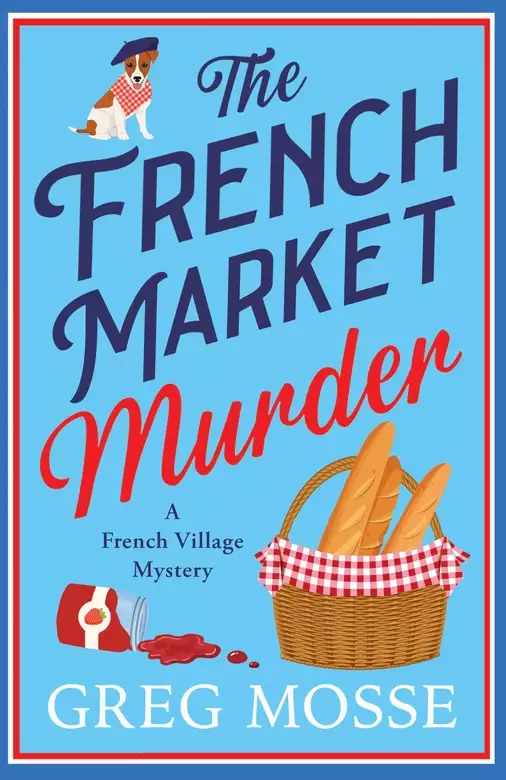
Want to know what mystery Zoe Pascal has to solve next? Don't miss The French Market Murder, the next book in the French Village Mystery series, available to pre-order now!
Sacré bleu! As the local village market is in full swing, get ready to stock up on the best products the south of France has to offer, from mouth-watering pastries, to fragrant lavender soap, and second-hand books ... and another mystery for amateur sleuth Zoe Pascal to solve!
The delightful town of Sainte-Catherine, nestled in the heart of Provence, is preparing for the May bank holiday. The cobbled village square will be packed with stalls of the French market, selling wines, cheese, and other local products. Zoe Pascal, who runs the bookshop, is ready for a busy weekend recommending books to tourists and locals alike.
But the festivities have barely begun before Zoe and her loyal companion, Russell the dog, discover a body in an abandoned house behind her bookshop.
The police are quick to decide that they're investigating a murder. And as they're unable to identify the body, they recruit Zoe to help solve the case.
Is there a killer lurking in the bustling streets of Sainte-Catherine? Who in the village is hiding something? It's up to Zoe to find out, before time runs out...
Readers love The French Village Mystery series: 'A delightful, original and cleverly plotted murder mystery with a rich sense of place that made me feel I had been transported to the quaint charm of Southern France' A.A. Chaudhuri
'A delight from start to finish' Reader review ⭐⭐⭐⭐⭐
'A murder mystery that is heartwarming, cosy and delightfully bookish' Jamie West
'With memorable characters and a rich sense of place, this book is perfect for fans of cosy whodunits' Reader review ⭐⭐⭐⭐⭐
'Combines the charm of a Provençal setting with a cleverly plotted puzzle that will keep readers guessing until the final page' Tim Stretton
'Utterly enjoyable' Reader review ⭐⭐⭐⭐⭐
'Colourful characters, a beautifully drawn location and a mystery within a mystery make this an eminently satisfying cosy' Neil Daws
Release date:
June 4, 2026
Publisher:
Hodder & Stoughton
Print pages:
368
* BingeBooks earns revenue from qualifying purchases as an Amazon Associate as well as from other retail partners.
Russell the Jack Russell was an attractive, enthusiastic terrier with a white body and a tan face. He knew every nook and cranny of the hill town of Sainte-Catherine, having lived there for almost a year.
Life with Russell’s first owner had been hard. Of course, as a dog, he had known no better. The deprivations of living with a band of rootless wanderers were all he had ever experienced – irregular meals, cold nights outside their tents, infrequent affection or even attention. Then the gang had moved on without a backward glance, leaving him behind to fend for himself in the narrow, cobbled streets.
Summer had ended and life as a stray had become harder still.
Then, though, his luck had turned. A new human took him in and washed the red bandana that served as his collar.
His second and current owner was as different from his first as could be imagined. As a dog, he didn’t know her name – Zoe Pascal – but he knew that she spoke kindly to him, fed him regularly, allowed him to sleep on a corner of her large bed, took him for walks. She even – though this was not something that Russell appreciated from his canine point of view – took him to see Firmin Séchan, the elderly vet, for check-ups and inoculations.
On this particular day, Russell felt pleased with life. He was well fed, because the previous day had welcomed a big party in the square, and there had been all manner of scraps and illicit gifts beneath the tables.
He was out of doors, tracking his indulgent mistress through the narrow backstreets. It wasn’t an official ‘walk’. Russell was merely following, sniffing at drainpipes, verifying his well-marked canine territory, catching her up just as she disappeared beyond the sliding glass doors of the supermarket.
Russell didn’t know precisely what happened inside that particular building. The supermarket was a mysterious place inside which he had never been allowed to tread. But he did know that his mistress would emerge with heavy bags full of interesting food.
Satisfied that he was not required, Russell pitter-pattered back up through the town, his claws making little scratchy sounds on the rounded stones.
Back in the main square, Place Sainte-Catherine, he wove between the market stalls, making a beeline for a place where he had once come across a roast-chicken carcass discarded on the ground. On arrival, he was disappointed to discover that the miracle had not repeated itself.
He made for the door of his home. Inside, he knew, another human was waiting – one who also liked him and who often invited him to curl up warm on her lap. But he didn’t go inside because something much more exciting caught his attention. He froze, spotting the unmistakable shape of a brown rat creeping along the gulley by the plinth at the foot of the wall. It scuttled into the alley that led round behind the bookshop.
Russell gave chase, his little legs a blur of energetic motion. The rat came into view. Russell was almost upon it and—
It was gone, disappeared through a ragged hole at the foot of a damaged door.
Russell pushed his pointy face into the gap, struggling to get through, but his muscular shoulders were too wide. Infuriatingly, he could see, despite the gloom within, the twin twinkles of the rat’s eyes, watching and waiting, believing itself safe.
Russell pulled himself out of the ragged hole in the timbers, barely noticing a sharp splinter cutting a scratch, all the way through his fur into his skin. He opened his strong jaws and began chewing at the wood, softened by sun and rain and time.
Single-minded determination meant that Russell was soon successful, able to tear away a portion of the weakened panel, widening the gap. Once within the shadowy interior, he recognised from the dirt and dust and damp that it was a place no human inhabited.
Excitedly, he raced around the ground floor, eventually identifying the rat’s hiding place – a broken pipe that gave access to the drains.
Russell knew that was a place he couldn’t follow. Even his sharp teeth were not enough to break clay and stone.
That was when he caught another scent.
Tentatively, because he wasn’t sure exactly what he would find, Russell climbed the cold staircase of terracotta tiles to a gloomy landing. Following an unmistakable and enticing odour, he entered a small square room where, to his surprise, a human lay crumpled and untidy on the bare boards, as if thrown there by some giant, careless hand.
Even from a distance, Russell could tell from the body’s lack of movement and warmth that the human was dead.
One
‘A New and Daring Idea’
Two weeks earlier
In Aix-en-Provence, the ‘city of a thousand fountains’, a man with a ready smile, a charming manner and an apparently inexhaustible willingness to help was looking at a magazine rack on a newsagent’s kiosk.
Because he was a student of character and of human behaviour, the magazines that most interested him were the popular science ones, in particular those with a focus on psychology – because the uses and abuses of psychology were fundamental to how he had resolved to live his life.
He picked up one with a garish headline that suggested that sex was ‘la guerre’ – a kind of warfare – but soon put it back.
That’s a foolish idea.
He found another that was more up his street, whose main article was about the curation of people’s online presences, separate from their true lives.
As the virtual self takes over, the real self disappears
Because he was someone who took great pains not to be known too well – either IRL, in real life, or online – he thought: But that, surely, is the point?
He paid for the magazine and also bought a packet of Marlboro Light cigarettes – not because he was addicted to nicotine, but because he had found that some women liked to see a man smoking.
Walking away from the kiosk, he almost found himself caught up in a selfie – two young women wearing what he thought might have been taken for underwear when he had been young, but which today seemed common daywear.
To avoid being photographed, he offered to take the shot himself. The young women posed on the fountain’s edge, puckering up their lips and leaning their heads back to accentuate their firm young jawlines. He suggested they flick the water into the air – ‘so that the droplets catch the sunlight’ – and they were delighted with the results. The man deployed his ready smile and charming manner, gracefully accepted their thanks and walked away, certain they would soon forget him.
Middle age is invisible to the young.
In his light-grey summer suit, he swiftly merged with the crowds. He was heading for a restaurant that he had read about on Google Maps, recommended in a review from a woman who lived not far away, in a hill town called Sainte-Catherine in the Verdon nature park. Navigating a labyrinth of narrow streets in the old town, he soon found the place. The review even itemised what the woman and her friend had eaten.
La Table Provençale is a perfect little establishment by a pretty fountain in a lovely square, with a terrace that’s sheltered from the wind by olive trees in huge planters. I had the pâté with exquisitely vinegary cornichons and thin triangles of toast, plus a dish of green vegetables, parboiled then tossed in butter and pepper. My friend had steak tartare, a mound of uncooked minced beef with a raw egg on top, dressed with tabasco sauce. Of course, we shared a portion of double-cooked chips on the side :-)
After the smiley, the price of the meal was listed, including wine, with a comment that it was ‘excellent value’. That opinion gave the smiling and apparently sympathetic man a glimpse of the financial resources available to the reviewer.
Which is always good to know – that, in making her a target, I would not, in fact, be wasting my time.
He sat down at an empty table in a quiet corner, partly concealed by one of the ‘huge planters’ mentioned in the review. He knew it might take a while for the waitress to find him.
But that’s the point of choosing a table in the shadows. If she doesn’t easily notice me, no one else will, either.
He was in no hurry and passed the time reading his psychology magazine. The lead article asked:
Do we need a fantasy self so that other people don’t know who we really are?
His answer was a definite: ‘Yes’.
How many endless hours do we waste, curating a self-image to present to others online, not forgetting that others are doing the same?
He didn’t believe that time was wasted.
The waitress finally came and he placed his order, mimicking the one the Google Maps reviewer had mentioned.
‘Très bien, monsieur.’
He watched her slide away, youthful and sinuous.
Not my type.
A shaft of sunlight dazzled him, through the olive-tree leaves. He shut his eyes, wondering if, in truth, the reviewer might be a potential new target.
The fact that she made the effort to reward the restaurant with a good write-up is a hint as to her character – someone generous and open. I don’t think this woman is curating a separate online self. She is who she appears to be. And that’s good. That makes her a strong candidate.
He found himself contemplating a different conundrum.
But I already have a target in play. Do I have time to lay the groundwork for another hunt?
Waiting for his food to come, he shifted his chair slightly into deeper shade and used his very modern phone, connected to the internet through a VPN, a virtual private network, for privacy. He tracked the reviewer online, finding posts about her everyday life. He learned that she was in business for herself – which was another good sign – running an attractive stone-built bookshop on a beautiful cobbled square. He read posts about her perky dog, a white-and-tan Jack Russell.
She is tender-hearted. That’s even better.
Extending his search, he discovered that she was English by birth and Provençale only by adoption. Then he found out, with surprise, that she had been central to a celebrated murder investigation – not merely as a witness, but as someone who had seen connections and motivations and solutions hidden to the police. She had exhibited resourcefulness, intelligence and courage.
On reflection, then, not a suitable victim.
His meal arrived. He ate with satisfaction, unhurried and solitary. After a while, he ordered a second large glass of an excellent Carignan-grape wine from the local Maurice vineyard.
‘And some extra toast and butter to go with this generous portion of pâté, if you wouldn’t mind?’
The smiling waitress was happy to oblige. She had no idea who he was or how he lived. She assumed that he was what he appeared.
The extra toast arrived very quickly, diverted from another table who would have to wait a little longer. The man beamed his thanks. The waitress seemed to feel rewarded, seen.
Left alone, he set about finishing his meal. The sun was warm through the spindly branches and the narrow grey-green leaves. Soon, his second glass was almost empty, too.
Perhaps because of this slight intoxication, the charming and charismatic stranger began smiling to himself between his last mouthfuls, pleased with a new and daring way of looking at things – a thought that he would take care never, under any circumstances, to express aloud, IRL.
Other things being equal, I think I might enjoy the challenge of taking down the universally admired Zoe Pascal.
Two
‘A Sense of Renewal’
Ten days later
In the delightful southern French hill town of Sainte-Catherine, nestled in beautiful Provence, Zoe Pascal was enjoying life. Her relocation from the noise and bustle of London eight months before had turned out a success – even though she had been drawn into two perplexing criminal mysteries.
The first had become known in the media as ‘the French bookshop murder’. The second she thought of as ‘the château murder’.
Though, in the end, we managed to keep the details private.
In both, Zoe had survived unexpected physical peril and emerged with honour.
More to the point, despite the winter fall-off in visitors, my bookshop has remained profitable.
It was coming up to the weekend of May 1st and Zoe was looking forward to a long and financially rewarding tourist season, working all hours, selling – as she told her friend, Brigadier Antoine Grenelle, the local municipal police officer, seldom seen without a glass in his hand – ‘bucketloads of summer reads, guide books, hiking maps, romantasy, true crime, murder mysteries and thrillers’.
In France, the May 1st bank holiday gave a sense of renewal. It was not just a celebration of the start of five or even six months of fabulous good weather – for which Provence was rightly famed. It was also the Fête du Travail, the ‘feast of labour’, commemorating more than two centuries of combat for employees’ rights.
A hard worker herself, Zoe’s bookshop was at the top of the lovely hill town, at the eastern end of Place Sainte-Catherine, a large cobbled square, spread out beneath lime trees in bright new leaf. From her front door, she could see the market traders setting up outside.
Marcel Maurice, with his one good arm, was helping his nephew, Thierry, erect their stall, offering delicious wines direct from their own vineyard.
Elise Guillaume, assisted by her daughter Cécilie, was dressing her trestle tables with beautiful pot plants and cut flowers from her own garden and greenhouses. Elise was a good friend and Zoe was fond of both mother and daughter. Several times over the winter, when the weather had been fine, they had played tennis together, rotating two from three.
Though that has dropped off recently. And Elise and Cécilie seem to be arguing. I wonder what that’s about?
Robert Petit, the butcher – who had taken a heavy-handed fancy to Zoe – was bouncing his chicken rotisserie over the uneven stones, trailing its power cable, keen for the delicious fragrance of his barbecued free-range meat to draw the crowds. He gave her a wave and she nodded politely in reply, not wanting to encourage him.
Napoléon Etienne, the sour-faced and suspicious second-hand book merchant, also seemed to have her in his sights.
He’d like to see my business fail and leave all the book-selling to him.
Though Zoe was a habitual early riser, the market traders always began setting up well before she started welcoming customers into La Librairie de Mes Rêves – the Bookshop of My Dreams – purchased with her life savings the previous summer. That meant that she had time, on this fine morning, with the chilly overnight air still fresh and clean, to sit and read a book on an ageing dining chair with a rush seat, dragged outside into the sunshine between the cherished oleanders that stood sentinel either side of her front door.
She was not alone for long. Soon Marcel was asking: ‘Is it too early for British ladies to take a glass of Carignan?’
‘It’s only just gone eight,’ Zoe replied, affecting a scandalised tone at the offer of a robust local red.
‘White wine then?’ he asked her with a twinkle.
‘Not even,’ she told him.
Marcel retreated, laughing. After two or three minutes more, Robert Petit came wondering if he should reserve a chicken for ‘la belle Zoé’.
‘Not today, thank you, Robert. I’ll probably get something to take away from the Auberge.’
Frowning, he told her: ‘I suppose we must all share our spending in these hard times.’
He sloped away and Zoe thought: He does look rather harassed. I hope he’s not serious. It would be a huge loss if the butcher’s shop closed down. The Hyper-U supermarket down on the ring road just isn’t the same.
For fifteen glorious minutes, she was allowed to read in peace, discovering that the new Vaseem Khan novel about India’s first female police detective was just as good as the online reviews suggested.
The voice was hesitant, polite, ‘old-school’. Zoe looked up and smiled.
‘Bonjour, Firmin. How are you?’
The elderly vet was dressed, as usual, in a flannel shirt and shapeless cardigan.
‘Still struggling on, you know. It does no good to complain.’
‘I agree,’ said Zoe. ‘How can I help you? Do you need something from the shop? I haven’t turned on my computer yet.’
‘I, er, that is to say . . .’
Firmin looked as if he was changing his mind or had perhaps forgotten what he wanted.
He must be eighty if he’s a day.
‘Go on,’ she encouraged him.
‘I hope you don’t mind,’ he began again, ‘but I wonder if I might make an importunate request?’
He gestured, clumsily, with an enormous leather portfolio that he needed both hands to carry.
‘What kind of importunate request?’ asked Zoe, intrigued.
‘Not to be indiscreet, and I realise this is not, in truth, a decorous question to address to a lady, a very beautiful lady, as your many admirers have recognised. But, if I may, is it not so, I believe you sleep in the rear room, on the first floor above the Librairie?’
Because Zoe’s bookshop had, many years before, been the village school, she was not surprised that he was aware of the layout.
‘That’s right, I do. Why?’
‘If you would permit me, I thought it might be amusing, unless I would be in the way, to create, as it were, a work of, not to say art, but a pictorial record, taking advantage of the excellent viewpoint . . .’
Firmin seemed to lose the thread of his complicated sub-clauses and gestured again with his leather portfolio, this time towards the first-floor window above the front door.
‘You mean,’ said Zoe, ‘that you would like to set up in my spare bedroom and paint a view of Place Sainte-Catherine on the day of the village fête, with everyone smiling and joyful, looking forward to a prosperous summer?’
‘How clever you are,’ he told her.
‘But, of course. It’s a lovely idea.’
‘Really? I am so pleased.’
Firmin glanced around. Zoe did, too, noticing that their conversation was being overlooked with interest by her neighbours.
He suggested: ‘Perhaps I ought to come back at a more seemly hour . . . ?’
‘You’re here now. Will you need a table or anything?’
‘I have all I need in my portfolio, including a collapsible easel. I assume there might be a chair I can use?’
‘There’s another like the one I’m sitting on between the bookshelves. I’ll bring it up for you.’
‘Please don’t trouble. I have already imposed enough.’
*
That was how it began. Quite soon, though she did not yet know it, Firmin’s sketching and painting would furnish a central clue to an unexplained appearance – and disappearance – leading Zoe into an investigation that she would, at first, have to conduct alone.
Because no one else would realise that there had even been a ‘French market murder’.
Three
‘Is It a Joyful Scene, Though?’
Zoe left Firmin to his preparations and strolled away through the market, interested to come across a new trader whose table was spread with bunches of deliciously fragrant lavender, plus lavender-scented honey, tinctures, moisturising creams, and organza bags of aromatic buds for use in laundry cupboards and linen chests.
The woman tending the stall, laying everything out with graceful precision, appeared to be Zoe’s own age, with long, naturally blonde hair, styled in a chunky plait, just on the verge of showing grey.
‘Good morning, my name’s Zoe Pascal. I run the bookshop. I don’t think we’ve met?’
The woman met Zoe’s gaze with a generous smile, holding out a rough and calloused hand.
‘Virginie La Source.’
‘What a lovely name.’ Zoe dredged up some local knowledge, the name of a nearby town famous for its lavender festival, and asked: ‘Are you from Valon?’
‘Not far from there. Is your shop doing well?’
‘Quite well,’ said Zoe, noticing for the first time that Virginie La Source had bags under her eyes and deep worry lines carved into the weary skin of her face. She wondered if her new acquaintance’s hands were rough from work because she couldn’t afford help in the fields. ‘I hope you have an excellent day,’ Zoe told her. ‘We’re expecting good crowds in Sainte-Catherine for the May Day weekend.’
‘I hope so too,’ said Virginie, with what looked like a forced smile.
Zoe continued through the square and out the other side, past the octagonal Templar church that had played such an important role in the French bookshop murder, then down the narrow street to Place Saint-Bertrand, where the everyday café, the Auberge Sainte-Catherine, sat in friendly rivalry with the refined gastronomic excellence of the high-class restaurant, Le Gourmand.
Under the orange umbrellas of the Auberge, Zoe found her appealing but wilful adopted stray, Russell the Jack Russell, assiduously making friends with Brigadier Antoine Grenelle. Dressed in his pale-blue police uniform, Antoine was having breakfast, including a sweet white wine – a Muscat – in a tiny glass. Zoe’s dog was trying to entice from him scraps of his croissant and pain au chocolat.
‘Russell, viens ici. Come here.’
Russell understood commands in both English and French but knew that, when his mistress used both languages, she meant business. He scuttled over and she crouched to straighten the red bandana he wore round his neck with her name and phone number stitched into the hem. Then she set off back up the hill.
Russell walked at heel for all of ten strides, before darting away on another doggy errand.
Zoe’s friend Denis Allard emerged from the guest house, Chez Denis & Davide, impeccably clean-shaven and perfumed, his dyed-black hair still damp from his shower.
‘Madame Pascal, I’m so pleased to see you. It’s happening at last. What fun! I thought we’d advertised it too late. To think we only had two bookings a fortnight ago and now we’re full up!’
Denis was talking about Zoe’s enterprising plan to bring reading groups to Sainte-Catherine, putting them up at Chez Denis & Davide, and offering a variety of literature-themed activities out of the Bookshop of My Dreams.
‘I have high hopes,’ she told him.
‘Davide is sorry he can’t be here to help.’
Zoe knew that Denis’s partner was in Paris, helping out an old friend who had fallen and broken both wrists.
‘I’m sure we’ll cope,’ she told him. ‘Don’t worry.’
‘It’s not just this group, though. We’ve five booked for the second bank holiday.’
She nodded. Denis was referring to May 8th, commemorating the World War II ‘victory in Europe’.
‘Yes, I’m so glad.’
‘And four already for Ascension Day later in the month.’ His face expressed anxiety but also excitement. ‘What a brilliant wheeze you had. It’s such a relief to see the place full. It’s so hard to make ends meet.’
‘I expect it is,’ said Zoe, thinking that complaints about business were becoming quite a thing this morning. ‘Do they look like a jolly crowd?’
‘I don’t know about jolly, but they’re all eating a massive breakfast. I’m off to the market because I need more pastries. Would you like to come in and say hello, Madame Pascal?’
‘Later, please, Denis. We’ll keep to the schedule and let them settle in and enjoy their free days first. And do remember to call me Zoe,’ she said, with a smile. ‘I’m not a f. . .
We hope you are enjoying the book so far. To continue reading...

 Please log in to recommend or discuss...
