
- Book info
- Sample
- Media
- Author updates
- Lists
Synopsis
Don't miss the next utterly gripping and escapist cosy crime mystery in the French Village Mystery series - The Chateau Murder is available for pre-order now!
Release date: January 15, 2026
Publisher: Hodder & Stoughton
Print pages: 320
* BingeBooks earns revenue from qualifying purchases as an Amazon Associate as well as from other retail partners.
Reader buzz
 Please log in to recommend or discuss...
Author updates
Close
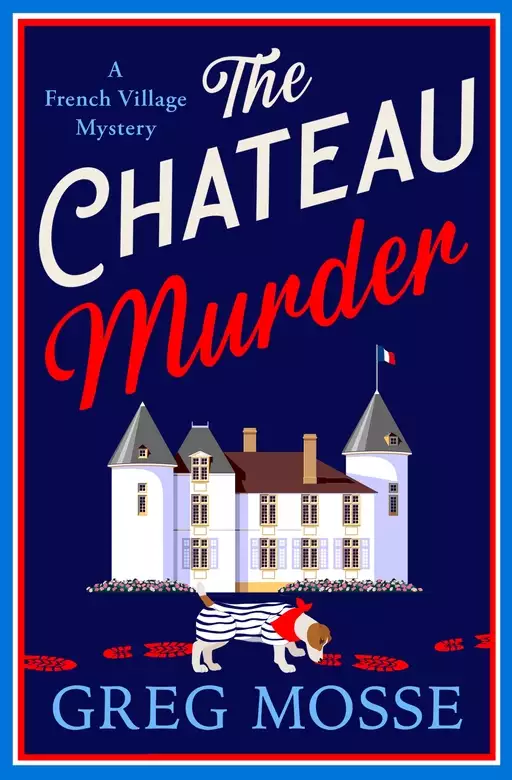
The Chateau Murder
Greg Mosse
Contents
Praise for The French Village Mystery Series
About the Author
Also by Greg Mosse
Title Page
Copyright
Dedication
Zoe’s sketch of Russell on the ice
Patrick’s quick family tree
Cast of Characters
Prologue
I: The Very Dead of Winter
One: ‘I Can’t Talk About It’
Two: ‘I Wish I Could See Further Ahead’
Three: ‘You’re a Brave Little Dog, Russell’
Four: ‘Russell!’
Five: ‘I Wish I’d Never Come’
Six: ‘That Terrible Business at the Theatre’
Seven: ‘This Awful Mausoleum’
Eight: ‘To Kill Poor Russell?’
Nine: ‘Is He Dead?’
Ten: ‘Business As Usual’
Eleven: ‘Surprisingly Alone’
II: Accident or Murder?
Twelve: ‘I Didn’t Do Anything’
Thirteen: ‘An Unexplained Death’
Fourteen: ‘That May Be the Martinis Talking’
Fifteen: ‘An Evil Will’
Sixteen: ‘How Soulless and Sad’
Seventeen: ‘Old Guilt Is Still Guilt’
Eighteen: ‘A Kind of Psychopath’
Nineteen: ‘Is That Sobbing?’
Twenty: ‘You’re Stuck With Us’
III: A Deeper Mystery
Twenty-One: ‘It’s Over’
Twenty-Two: ‘Old Age Is a Shipwreck’
Twenty-Three: ‘Does Adélaïde Have Friends?’
Twenty-Four: ‘One Is Not the Equal of the Other’
Twenty-Five: ‘It Smells of Luxury’
Twenty-Six: ‘To Kill Me and Resurrect Me’
Twenty-Seven: ‘They Are Very Different People’
Twenty-Eight: ‘I’m Sure it Was an Accident’
Twenty-Nine: ‘A Picture of Despair’
Thirty: ‘She’s Not Quite Herself’
IV: Snowbound
Thirty-One: ‘I Wish I Was a Good Boy’
Thirty-Two: ‘That’s Rather Terrifying’
Thirty-Three: ‘An Almost-Imperceptible Flaw’
Thirty-Four: ‘How Ill Actually Are They?’
Thirty-Five: ‘Like a Trap’
Thirty-Six: ‘I Don’t Think I Can Cope’
Thirty-Seven: ‘Thank Heavens’
Thirty-Eight: ‘Don’t Bother Your Father’
Thirty-Nine: ‘Is this Another Murder?’
Forty: ‘Is She Deliberately Misunderstanding?’
V: Motive and Opportunity
Forty-One: ‘A Matter of Life and Death’
Forty-Two: ‘Might I Have Met His Murderer?’
Forty-Three: ‘We Understand One Another’
Forty-Four: ‘We Are Terrible People’
Forty-Five: ‘The Boy Isn’t a Psychopath’
Forty-Six: ‘Don’t Pretend to be Obtuse’
Forty-Seven: ‘No Comment’
Forty-Eight: ‘The Stag in the Moonlight’
Forty-Nine: ‘The Dramas of the Final Act’
Fifty: ‘No, That Doesn’t Make Sense’
Fifty-One: ‘This Needn’t Be the End’
Epilogue
Acknowledgements
Prologue
It was a bitter January morning, the first Monday of the cold new year. At Château Palotte, half an hour north of the beautiful Provençal hill town of Sainte-Catherine, the decorative artificial lake was frozen over, three inches thick. Boris Junior – an unhappy and neglected ten-year-old, born to parents of wildly dissimilar ages – was clumsily skittering stones across the ice.
I don’t know what to do.
He left the lake, pulling his tartan scarf – a present from his kind Uncle Primo, not his distant father, Boris Senior – tighter around his throat.
I’ll go and see the stags.
To reach the woods in which the deer were penned, he had to cross the impressive lawn and take the path round the side of the château, through a five-bar gate that he took care to close.
Or I’ll be in trouble again.
Boris Junior didn’t like being in trouble, but it did at least mean people were paying attention to him.
The woods were deep and shadowy, even though the oak and the beech had lost their leaves. The dark-green needles of the conifers still provided a partial canopy. Protected from the chill wind, he spent twenty minutes exploring, without coming in sight of either the old stag or his harem of does. He did, however, catch a glimpse of the younger stag, prowling unaccompanied, his noble antlers erect – but looking friendless and lonely.
What did Papa say? He said: ‘One day, Junior, you will have to replace me. Perhaps sooner than you think.’
Boris Junior knew that his father – after whom he had been named, though everyone called him simply ‘Junior’ – was unwell. Sometimes Boris Senior had to stop halfway up the awkward stairs of Château Palotte to catch his breath. Now and then, his father’s chin sank to his chest and he could barely speak.
And Uncle Primo is the same. Why won’t anyone tell me what’s wrong with them?
Junior pushed his small white hands into the pockets of his quilted anorak, a garment too thin for the frigid weather, but he had grown out of what his mother called his ‘good coat’ and no one had found time to go into Aix, the nearest city, to buy him a new one.
He kicked at the blackened leaf litter around the base of an oak where the dull winter light was brighter. To his surprise he uncovered a shiny, ash-grey slow worm, about the length of his forearm, writhing in surprise at having been brought out into the open. From his lessons at school, he knew that slow worms were common in Italy and south-eastern France, and that they were, in reality, neither worms nor snakes.
They are lizards with no legs.
He followed the creature, pushing more leaves aside to prevent it from going back into hiding. At the same time, he glanced round for a weapon, a stone, perhaps, or a fallen branch to use as a club.
There was a length of oak just two paces away. He hurried to pick it up, the slimy surface of the bark unpleasant under his fingers. A woodlouse scampered over the back of his pale hand like a tiny tank. He brushed it off with a shudder, then turned quickly back to where he had last seen the sinuous, writhing slow worm.
It’s gone.
Junior sighed with frustration, feeling he had just missed an important opportunity.
I need to know what it feels like to kill.
One
‘I Can’t Talk About It’
Zoe Pascal, an attractive and intelligent woman in her fifties, was the owner of La Librairie de Mes Rêves – ‘The Bookshop of My Dreams’. It was located in a stone building that had once been the village school in Sainte-Catherine, a beautiful hill town in a gorgeous location in the Verdon nature park, itself a ravishing corner of magnificent Provence, in the warm and fragrant south of France.
But it was neither warm nor fragrant today.
Zoe was on the first floor. She lived above the shop, overlooking the town square. It was a picture-postcard scene made up of biscuit-coloured buildings, curved clay tiles and cobblestones. But her neighbours’ geraniums had all been scorched by frost. The bare lime trees were groping the damp chill air with twiggy, skeletal fingers.
She saw Patrick Lagrasse, joint owner of the friendly café, Auberge Sainte-Catherine. One of Zoe’s many new friends in the town, he was delivering coffees to the early market traders, including charming Elise Guillaume, who looked after Zoe’s courtyard rockery and front-door oleanders, and Robert Petit, the overattentive rotisserie chicken man.
After all the drama and excitement and, yes, fear, I still have no regrets about turning my whole life upside down.
In the involved and intriguing drama known in the popular press as ‘the French bookshop murder’, Zoe had had to use all her courage, intelligence and intuition. Her field of action had ranged from the narrow streets of Sainte-Catherine and its octagonal Templar church, out into the fields of lavender and sunflowers and grapes, across the gorgeous countryside where clues were hidden far apart from one another in space and – trickier still – in time.
But that was back when the autumn sun still shone and my life seemed easier.
Zoe had been successful in solving the village mystery. Its conclusion had been, on balance, a happy one.
Except for the poor victim, of course.
She went downstairs, made herself coffee from the shop-floor filter machine, lit her wood-burning stove and sat down, watching the flames, musing on the coincidence of having ‘assisted the police’ back in Sussex in her youth.
Was it an accident that I was, finally, able to solve ‘the French bookshop murder’? In other circumstances, might I be able to do the same again?
Although she did not yet know it, Zoe was about to embark on a new adventure in which things would play out very differently. The cast of characters would be smaller, the terrain much tighter and, in theory, more manageable, trapped in a snowbound château in the very dead of winter.
And, for Zoe, being close to murder would also bring her close to danger.
*
That, however, was all in the future. In Sainte-Catherine, the Christmas holiday season was still in full swing and the Feast of the Kings was imminent, an important festival that took place on the sixth of January, the date on which the Magi – the Three Wise Men – were supposed to have arrived at the nativity, having followed the magical star.
Until this year, newly resident in Provence, Zoe hadn’t known that, for some people, Twelfth Night was bigger than Christmas Day itself. Every shop in Sainte-Catherine made an enormous effort with displays and decorations, adding carefully kept figurines of the Magi to their nativity scenes, alongside donkeys, sheep, pigs, shepherds, Marys and Josephs and innocent babes.
Although the Feast of the Kings fell mid-week, the celebrations continued right through to the weekend, with many of the townspeople receiving visits – relatives and friends from across Provence and from further afield. To Zoe’s delight, it gave a boost to everyone’s commerce.
In the cold late autumn and early winter, the open-air market on Place Sainte-Catherine had been reduced to intermittent and dismal sessions on just Wednesday, Saturday and Sunday mornings, packing up early as the light began to fail. But, for the period spanning Christmas, New Year and Twelfth Night, the stallholders were present every day of the week. Among the most popular was the one belonging to Zoe’s friend, the vineyard owner and winemaker Marcel Maurice. Marcel had surprised and delighted Zoe by selling glühwein – hot mulled wine – made from his own red grape vintages, embellished with his own secret recipe of Provençal herbs and spices.
In addition to its swollen local population of family members, many winter tourists visited Sainte-Catherine, obliged to park in the large car park in front of the mairie because the narrow, cobbled streets didn’t allow vehicle access. The guest house run by Denis Allard and Davide Quillan had apparently been booked up since the previous year. Zoe’s friend Bernard Dupin was kept busy, too, bringing his minibus visitors on private tours of the region, always including a stopover at ‘The Bookshop of My Dreams’ – where, he knew, coffee and tea and pastries were always available, between the shelves.
So, it was a busy week and, by the time Sunday evening rolled around once more, Zoe felt in need of a proper break.
Surely I can afford to take a few days of holiday?
She opened her laptop to find that the internet was awash with last-minute options. She considered grabbing her passport, packing a bag and driving, on the spur of the moment, to Marseille airport in order to make the short hop by plane across the Mediterranean in search of North African warmth. She opened a weather app and found that Marrakesh was a pleasant eighteen degrees.
Distracted, she served her last customers. They drifted out the door, allowing in a gust of bitter wind, carrying with it a few flakes of snow; then the phone rang.
It was a raucous noise, one that Zoe didn’t enjoy, but she hadn’t got around to changing the tone. Tearing herself regretfully from the vision of bargain-basement holiday deals in southern Morocco, she picked up.
‘Oui, âllo?’
‘C’est moi,’ came the gnomic reply, meaning ‘it’s me’.
Zoe recognised the voice of her old friend Adélaïde Amour, a successful actress ten years Zoe’s senior who had, in a way, been her mentor. They had met in 1972 when Adélaïde – a youthful, sometimes semi-clothed ‘starlet’ – was witness to a murder on-stage at Chichester Theatre.
‘How lovely to hear from you. Are you coming to visit Sainte-Catherine again?’
‘No, I can’t. Not just now. How are you? Not too busy, I hope?’
Adélaïde’s warm contralto voice contained an unaccustomed element of tension. And there was a buzzing on the line, not loud enough to obscure what she was saying, but intrusive all the same.
‘Pretty manic, actually,’ said Zoe.
‘I’ve been in California,’ Adélaïde blurted.
Zoe knew that her friend’s career had recently been on an upward trajectory.
‘How exciting. Something good?’
‘Time will tell,’ said Adélaïde with a hint of frustration.
‘Is it a new part in a film?’
‘I can’t talk about it.’
‘Because you don’t want to jinx it?’
‘Because I had to sign an NDA. You know what one of those is?’
Zoe laughed and told her friend: ‘Sometimes I get the impression you think I’m still sixteen years old. Yes, I know about non-disclosure agreements. I imagine they want you to play a famous person, or the story is based on facts from the real world and there are lawyers involved.’
‘Something like that. Anyway, you must come.’
‘To California?’
‘No, to my home, to Château Palotte. Last time I came to see you, you let slip that you were intending to take time off at the end of the holiday season.’
‘I did, yes,’ said Zoe, warily.
‘That’s now, isn’t it?’
‘I suppose so,’ said Zoe with a yearning glance at the cafés and minarets of Marrakesh on her laptop.
This is not what I was planning.
‘So, you can come?’
‘Do you mean now?’ she asked weakly.
‘It’s my husband Primo’s seventieth birthday midweek – and his brother’s, too, obviously, as they’re twins. It’s about time you met them. Plus, there will be guests and parties all week.’
‘I see.’
That sounds exhausting and, really, I think I’d prefer a nice holiday.
Zoe racked her brain for a reason to refuse. She had never met Primo or his twin and, though she didn’t know why, something in Adélaïde’s tone made her wary of doing so.
‘Please say you will?’ Adélaïde insisted.
Mentally asking forgiveness of her friendly Jack Russell rescue dog, she said: ‘You wouldn’t want me to bring Russell to a week of celebrations. He’ll be in the way.’
‘Don’t be silly. I loved meeting Russell at your lovely bookshop. Then maybe we can talk about the secret thingy . . .’ Adélaïde’s voice faded, the background buzz taking over. Zoe asked her to speak up. ‘I’m trying to be discreet,’ Adélaïde told her. ‘I’m on the phone in the kitchen and I don’t want anyone to hear. I was just saying that it’s a story from my life.’
‘You mean the project with the NDA?’
‘Actually, forget I said that,’ Adélaïde retorted, sounding annoyed with herself. ‘Please tell me you’re coming and that you will arrive imminently?’
Zoe pondered.
Is this really what I want to do with my few days off?
She clicked the weather app on her laptop to reveal the forecast for the Verdon nature park where Château Palotte was located: snow and bitter winds, temperatures at or below zero.
‘And your whole family will be there?’
‘Every last peculiar one. I need you, Zoe. They outnumber me.’
She sounds odd. I think she’s serious.
‘What’s really happening, Adélaïde?’
Her friend’s voice changed. ‘Oh, hello there. I didn’t see you come in.’ It changed again. ‘Zoe, I have to go. There will be a place laid at dinner. Please, please, please?’
If I go, I’ll have to take all my warmest clothes and a hot water bottle.
‘All right.’
‘You will? I knew you would.’
‘You’re asking for my help and, apart from Maisie, you’re the only person left alive who knows me from those days, when I was just a child. And you did give me my first big break at the Avignon Festival and . . .’
Zoe stopped speaking, realising that Adélaïde was no longer there, that the annoying buzz had become a dial tone.
She hung up and frowned.
I’d like to know who it was who came in and interrupted. I hope Adélaïde’s all right. Her ideas seemed all of a jumble. Is it just professional stress that made her thoughts bounce around like that? Or is there something else going on that I will only find out about when I get there?
Two
‘I Wish I Could See Further Ahead’
Zoe got her things together, packing enough for three nights in her small wheelie suitcase, including her hot water bottle. Because she was going to a kind of stately home, Zoe decided she ought to take her posh camel-hair coat – the one that draped down to mid-calf – and a long wool dress in pale blue that was suitable as evening wear. Then she removed half of the contents in order to accommodate her compact blower heater.
I won’t stay a full week. I’ll stay for Adélaïde’s husband’s birthday, then make my excuses and leave.
Her quilted gilet and ski jacket from Decathlon were utilitarian at best. That meant, however, that she could stuff them into the crevices round the heater.
I’m going to need my rucksack, too. That will make it look like I’ve come for a long stay, but I really don’t think I can cope without all these extra bits and pieces.
She contemplated her lovely wood-burning stove, installed by the local handyman, Gato Merino, in the heart of the shop. It was quite safe to leave it to burn out. The apartment above was equipped with electric convector heaters, which she set to a trickle in order that the place should not become damp and icy while she was away.
Because she was in the habit of buying fresh food each day, there wasn’t much in the fridge and most of what there was would keep because it was preserved in either vinegar or oil. There was, however, a loaf of rye bread wrapped in a tea towel that she decided to take with her, along with a small block of Emmenthal cheese, half a saucisson and her Swiss Army knife. She put them all in the side pockets of her rucksack then lugged everything downstairs.
As it happened, her eye was caught by something on her shop counter. It was a little pile of advertising leaflets, shoddily printed and inadequately proofread, that Adélaïde had brought over: ‘For display so that your multitude of customers, who come to revel in the glory of the woman who solved “the French bookshop murder”, get it in their heads to come and visit us here at Château Palotte. God knows, the money would come in handy.’
She picked the top one up. It told visitors – who were allowed to visit on Tuesdays and Thursdays between ten and twelve o’clock – that, in the early Christian era, the village of Saint-Paul-de-Palotte had been a modest settlement on the plain, clustered along the banks of the River Rigolet. Successive incursions by marauding Goths persuaded the locals to take the important defensive step of moving their homes – lock, stock and barrel – to higher ground. The inconvenience of being further from the ready water supply was, Zoe presumed, compensated by the security of a strong, circular wall of stone houses creating a bastion against attack, with narrow streets and a tiny church.
Zoe put the leaflet in her pocket and dragged her wheelie suitcase outside, perching her rucksack on one of the square granite bollards that lined Place Sainte-Catherine. Rain and snow were falling together from the lifeless sky. She locked up with Russell skittering around her ankles, displaying his usual limitless doggy enthusiasm for whatever life had to offer.
‘I’m sorry to tell you, we’re going out in the car,’ she told him.
He caught the tone of her voice and calmed down. Zoe pondered the fact that she was in the habit of speaking aloud to Russell in both English and French.
He’s so clever, though, it doesn’t matter which.
‘You make up your own mind as to what you choose to understand, don’t you?’
Encumbered by her long coat, tightly packed rucksack and the little wheels of her suitcase bouncing on the cobbles, Zoe made awkward progress across the square. Though it was late, she could see people inside Ambroise Caille’s estate agency – a middle-aged couple with two teenage daughters. Zoe assumed they were tourists, looking for a second home in the exquisite Verdon nature park.
She continued down through the narrow streets and saw, with a tinge of regret, that a Sunday evensong service was underway in the octagonal Templar church. Many of her neighbours and friends would be there. She wasn’t a believer herself, but the routine of the liturgy had recently become a gratifying habit.
On Place Saint-Bertrand, the Auberge Sainte-Catherine was serving its final two customers, bundled up against the cold under its orange umbrellas. Patrick Lagrasse, in his tight white shirt and traditional black apron, was gliding balletically towards them with the card machine.
Down at the car park in front of the mairie, the town hall, she saw a sad-looking French tricolore flag, flapping listlessly in the cold breeze. Her narrow lock-up garage was one of several, cut into the hillside. She unlocked her combination padlock using 0511, the fifth of November, her birthday – or rather the day on which she had been abandoned as a foundling at St Richard’s Hospital in Chichester in south-west Sussex.
She slithered in, with only just enough room to part-open the driver’s door of her elderly van, known both to her and to the mechanics at the Total garage as ‘Renée the Renault’, named after ‘Good King René’ who first brought Muscat grapes to Provence. Russell jumped onto her lap and tried to take possession of the driver’s seat.
‘Get on your own side, hound.’
He did so without complaint and stood up on his hind legs with his front paws on the dashboard while she eased Renée forward, stopped, got back out and went through the rigmarole of locking up again, her mind on other things. She had been trying to remember a distinctive – perhaps unique – Provençal word that would be perfect for describing the dismal weather.
Simultaneous rain and snow.
Zoe pulled away and Renée the Renault’s wheels briefly spun in the freezing slush, but the road ran gently downhill so she was soon on her way. Russell did his best to maintain his precarious position until they left the circuit of street lamps on the ring road and found themselves in the darkly featureless countryside, only illuminated by the short throw of the headlamps. Then he gave up.
Oh, I know: aiganèu.
Through the spattered windscreen, she saw that the clever word was becoming redundant. Snow was definitively taking over, beginning to lie on the tarmac, collecting in the furrows of the ploughed-over sunflower field. With Russell now curled up on the passenger seat, unaware of their destination, Zoe had her first premonition of what was to come.
Adélaïde sounded very jittery. Why was the invitation so last minute? Is the noble Palotte family – with its ancient, grandiose château and landscaped gardens – perhaps short of money? The prospect of a big new Hollywood project with a self-important NDA doesn’t seem to be making Adélaïde happy, either. I’m beginning to feel uneasy. I wish I could see further ahead.
The steering twitched on a patch of ice.
And I don’t just mean my headlamps on the road.
Three
‘You’re a Brave Little Dog, Russell’
Zoe didn’t enjoy driving at night and, the closer she came to her destination, the deeper the snow lay at each verge. In twenty minutes, she passed only half a dozen cars going in the opposite direction. Then, for the first time, someone came up behind her, far too close, as was the French habit.
She decelerated in order to allow them to zoom by. Unfortunately, there were too many twists and turns, so she spent several uncomfortable kilometres dazzled by their headlamps in her wing mirrors.
At last, on a brief straight, the car – a silver Audi – overtook. As it came alongside, she was surprised to recognise the passenger, illuminated by the phone screen he was consulting. It was Patrick Lagrasse, waiter and joint owner of the Auberge Sainte-Catherine. An unseen companion was beyond him in the driver’s seat.
Is that his twin sister? I wonder where they’re going?
Zoe had met Patrick back in September, on arrival in Sainte-Catherine, and had taken to him immediately. He was perhaps thirty years old as was his sister, Minette – who Zoe hadn’t met – who worked long days in the Auberge Sainte-Catherine kitchen. After the summer season, they shut up shop to holiday for eight weeks in a secluded village in a hard-to-find cove on the Italian Riviera. They then returned for the period of Christmas, New Year and Twelfth Night, before closing up again, awaiting the spring.
The other car disappeared up the road, travelling at impetuous speed. Zoe wondered if perhaps they were on their way north towards one or other of the nearby ski resorts.
That’s one of the wonderful things about living in Provence. Going to the mountains or to the seaside or across the border into Italy can be a spur-of-the-moment decision. I imagine they’re in a hurry to get there before the mountain roads are closed by snowfall. That trip would be beyond you, Renée.
She was following the river, the Rigolet, glimpsed now and then by Renée’s headlamps reflecting off the water. There was thick ice at the banks.
She entered an area of oppressively thick woods, so dark that they made Zoe feel those headlamps must be failing. Then she emerged from the tunnel of trees to see a huge pile of felled timber at the side of the road and, a few kilometres ahead, a conica. . .
Praise for The French Village Mystery Series
About the Author
Also by Greg Mosse
Title Page
Copyright
Dedication
Zoe’s sketch of Russell on the ice
Patrick’s quick family tree
Cast of Characters
Prologue
I: The Very Dead of Winter
One: ‘I Can’t Talk About It’
Two: ‘I Wish I Could See Further Ahead’
Three: ‘You’re a Brave Little Dog, Russell’
Four: ‘Russell!’
Five: ‘I Wish I’d Never Come’
Six: ‘That Terrible Business at the Theatre’
Seven: ‘This Awful Mausoleum’
Eight: ‘To Kill Poor Russell?’
Nine: ‘Is He Dead?’
Ten: ‘Business As Usual’
Eleven: ‘Surprisingly Alone’
II: Accident or Murder?
Twelve: ‘I Didn’t Do Anything’
Thirteen: ‘An Unexplained Death’
Fourteen: ‘That May Be the Martinis Talking’
Fifteen: ‘An Evil Will’
Sixteen: ‘How Soulless and Sad’
Seventeen: ‘Old Guilt Is Still Guilt’
Eighteen: ‘A Kind of Psychopath’
Nineteen: ‘Is That Sobbing?’
Twenty: ‘You’re Stuck With Us’
III: A Deeper Mystery
Twenty-One: ‘It’s Over’
Twenty-Two: ‘Old Age Is a Shipwreck’
Twenty-Three: ‘Does Adélaïde Have Friends?’
Twenty-Four: ‘One Is Not the Equal of the Other’
Twenty-Five: ‘It Smells of Luxury’
Twenty-Six: ‘To Kill Me and Resurrect Me’
Twenty-Seven: ‘They Are Very Different People’
Twenty-Eight: ‘I’m Sure it Was an Accident’
Twenty-Nine: ‘A Picture of Despair’
Thirty: ‘She’s Not Quite Herself’
IV: Snowbound
Thirty-One: ‘I Wish I Was a Good Boy’
Thirty-Two: ‘That’s Rather Terrifying’
Thirty-Three: ‘An Almost-Imperceptible Flaw’
Thirty-Four: ‘How Ill Actually Are They?’
Thirty-Five: ‘Like a Trap’
Thirty-Six: ‘I Don’t Think I Can Cope’
Thirty-Seven: ‘Thank Heavens’
Thirty-Eight: ‘Don’t Bother Your Father’
Thirty-Nine: ‘Is this Another Murder?’
Forty: ‘Is She Deliberately Misunderstanding?’
V: Motive and Opportunity
Forty-One: ‘A Matter of Life and Death’
Forty-Two: ‘Might I Have Met His Murderer?’
Forty-Three: ‘We Understand One Another’
Forty-Four: ‘We Are Terrible People’
Forty-Five: ‘The Boy Isn’t a Psychopath’
Forty-Six: ‘Don’t Pretend to be Obtuse’
Forty-Seven: ‘No Comment’
Forty-Eight: ‘The Stag in the Moonlight’
Forty-Nine: ‘The Dramas of the Final Act’
Fifty: ‘No, That Doesn’t Make Sense’
Fifty-One: ‘This Needn’t Be the End’
Epilogue
Acknowledgements
Prologue
It was a bitter January morning, the first Monday of the cold new year. At Château Palotte, half an hour north of the beautiful Provençal hill town of Sainte-Catherine, the decorative artificial lake was frozen over, three inches thick. Boris Junior – an unhappy and neglected ten-year-old, born to parents of wildly dissimilar ages – was clumsily skittering stones across the ice.
I don’t know what to do.
He left the lake, pulling his tartan scarf – a present from his kind Uncle Primo, not his distant father, Boris Senior – tighter around his throat.
I’ll go and see the stags.
To reach the woods in which the deer were penned, he had to cross the impressive lawn and take the path round the side of the château, through a five-bar gate that he took care to close.
Or I’ll be in trouble again.
Boris Junior didn’t like being in trouble, but it did at least mean people were paying attention to him.
The woods were deep and shadowy, even though the oak and the beech had lost their leaves. The dark-green needles of the conifers still provided a partial canopy. Protected from the chill wind, he spent twenty minutes exploring, without coming in sight of either the old stag or his harem of does. He did, however, catch a glimpse of the younger stag, prowling unaccompanied, his noble antlers erect – but looking friendless and lonely.
What did Papa say? He said: ‘One day, Junior, you will have to replace me. Perhaps sooner than you think.’
Boris Junior knew that his father – after whom he had been named, though everyone called him simply ‘Junior’ – was unwell. Sometimes Boris Senior had to stop halfway up the awkward stairs of Château Palotte to catch his breath. Now and then, his father’s chin sank to his chest and he could barely speak.
And Uncle Primo is the same. Why won’t anyone tell me what’s wrong with them?
Junior pushed his small white hands into the pockets of his quilted anorak, a garment too thin for the frigid weather, but he had grown out of what his mother called his ‘good coat’ and no one had found time to go into Aix, the nearest city, to buy him a new one.
He kicked at the blackened leaf litter around the base of an oak where the dull winter light was brighter. To his surprise he uncovered a shiny, ash-grey slow worm, about the length of his forearm, writhing in surprise at having been brought out into the open. From his lessons at school, he knew that slow worms were common in Italy and south-eastern France, and that they were, in reality, neither worms nor snakes.
They are lizards with no legs.
He followed the creature, pushing more leaves aside to prevent it from going back into hiding. At the same time, he glanced round for a weapon, a stone, perhaps, or a fallen branch to use as a club.
There was a length of oak just two paces away. He hurried to pick it up, the slimy surface of the bark unpleasant under his fingers. A woodlouse scampered over the back of his pale hand like a tiny tank. He brushed it off with a shudder, then turned quickly back to where he had last seen the sinuous, writhing slow worm.
It’s gone.
Junior sighed with frustration, feeling he had just missed an important opportunity.
I need to know what it feels like to kill.
One
‘I Can’t Talk About It’
Zoe Pascal, an attractive and intelligent woman in her fifties, was the owner of La Librairie de Mes Rêves – ‘The Bookshop of My Dreams’. It was located in a stone building that had once been the village school in Sainte-Catherine, a beautiful hill town in a gorgeous location in the Verdon nature park, itself a ravishing corner of magnificent Provence, in the warm and fragrant south of France.
But it was neither warm nor fragrant today.
Zoe was on the first floor. She lived above the shop, overlooking the town square. It was a picture-postcard scene made up of biscuit-coloured buildings, curved clay tiles and cobblestones. But her neighbours’ geraniums had all been scorched by frost. The bare lime trees were groping the damp chill air with twiggy, skeletal fingers.
She saw Patrick Lagrasse, joint owner of the friendly café, Auberge Sainte-Catherine. One of Zoe’s many new friends in the town, he was delivering coffees to the early market traders, including charming Elise Guillaume, who looked after Zoe’s courtyard rockery and front-door oleanders, and Robert Petit, the overattentive rotisserie chicken man.
After all the drama and excitement and, yes, fear, I still have no regrets about turning my whole life upside down.
In the involved and intriguing drama known in the popular press as ‘the French bookshop murder’, Zoe had had to use all her courage, intelligence and intuition. Her field of action had ranged from the narrow streets of Sainte-Catherine and its octagonal Templar church, out into the fields of lavender and sunflowers and grapes, across the gorgeous countryside where clues were hidden far apart from one another in space and – trickier still – in time.
But that was back when the autumn sun still shone and my life seemed easier.
Zoe had been successful in solving the village mystery. Its conclusion had been, on balance, a happy one.
Except for the poor victim, of course.
She went downstairs, made herself coffee from the shop-floor filter machine, lit her wood-burning stove and sat down, watching the flames, musing on the coincidence of having ‘assisted the police’ back in Sussex in her youth.
Was it an accident that I was, finally, able to solve ‘the French bookshop murder’? In other circumstances, might I be able to do the same again?
Although she did not yet know it, Zoe was about to embark on a new adventure in which things would play out very differently. The cast of characters would be smaller, the terrain much tighter and, in theory, more manageable, trapped in a snowbound château in the very dead of winter.
And, for Zoe, being close to murder would also bring her close to danger.
*
That, however, was all in the future. In Sainte-Catherine, the Christmas holiday season was still in full swing and the Feast of the Kings was imminent, an important festival that took place on the sixth of January, the date on which the Magi – the Three Wise Men – were supposed to have arrived at the nativity, having followed the magical star.
Until this year, newly resident in Provence, Zoe hadn’t known that, for some people, Twelfth Night was bigger than Christmas Day itself. Every shop in Sainte-Catherine made an enormous effort with displays and decorations, adding carefully kept figurines of the Magi to their nativity scenes, alongside donkeys, sheep, pigs, shepherds, Marys and Josephs and innocent babes.
Although the Feast of the Kings fell mid-week, the celebrations continued right through to the weekend, with many of the townspeople receiving visits – relatives and friends from across Provence and from further afield. To Zoe’s delight, it gave a boost to everyone’s commerce.
In the cold late autumn and early winter, the open-air market on Place Sainte-Catherine had been reduced to intermittent and dismal sessions on just Wednesday, Saturday and Sunday mornings, packing up early as the light began to fail. But, for the period spanning Christmas, New Year and Twelfth Night, the stallholders were present every day of the week. Among the most popular was the one belonging to Zoe’s friend, the vineyard owner and winemaker Marcel Maurice. Marcel had surprised and delighted Zoe by selling glühwein – hot mulled wine – made from his own red grape vintages, embellished with his own secret recipe of Provençal herbs and spices.
In addition to its swollen local population of family members, many winter tourists visited Sainte-Catherine, obliged to park in the large car park in front of the mairie because the narrow, cobbled streets didn’t allow vehicle access. The guest house run by Denis Allard and Davide Quillan had apparently been booked up since the previous year. Zoe’s friend Bernard Dupin was kept busy, too, bringing his minibus visitors on private tours of the region, always including a stopover at ‘The Bookshop of My Dreams’ – where, he knew, coffee and tea and pastries were always available, between the shelves.
So, it was a busy week and, by the time Sunday evening rolled around once more, Zoe felt in need of a proper break.
Surely I can afford to take a few days of holiday?
She opened her laptop to find that the internet was awash with last-minute options. She considered grabbing her passport, packing a bag and driving, on the spur of the moment, to Marseille airport in order to make the short hop by plane across the Mediterranean in search of North African warmth. She opened a weather app and found that Marrakesh was a pleasant eighteen degrees.
Distracted, she served her last customers. They drifted out the door, allowing in a gust of bitter wind, carrying with it a few flakes of snow; then the phone rang.
It was a raucous noise, one that Zoe didn’t enjoy, but she hadn’t got around to changing the tone. Tearing herself regretfully from the vision of bargain-basement holiday deals in southern Morocco, she picked up.
‘Oui, âllo?’
‘C’est moi,’ came the gnomic reply, meaning ‘it’s me’.
Zoe recognised the voice of her old friend Adélaïde Amour, a successful actress ten years Zoe’s senior who had, in a way, been her mentor. They had met in 1972 when Adélaïde – a youthful, sometimes semi-clothed ‘starlet’ – was witness to a murder on-stage at Chichester Theatre.
‘How lovely to hear from you. Are you coming to visit Sainte-Catherine again?’
‘No, I can’t. Not just now. How are you? Not too busy, I hope?’
Adélaïde’s warm contralto voice contained an unaccustomed element of tension. And there was a buzzing on the line, not loud enough to obscure what she was saying, but intrusive all the same.
‘Pretty manic, actually,’ said Zoe.
‘I’ve been in California,’ Adélaïde blurted.
Zoe knew that her friend’s career had recently been on an upward trajectory.
‘How exciting. Something good?’
‘Time will tell,’ said Adélaïde with a hint of frustration.
‘Is it a new part in a film?’
‘I can’t talk about it.’
‘Because you don’t want to jinx it?’
‘Because I had to sign an NDA. You know what one of those is?’
Zoe laughed and told her friend: ‘Sometimes I get the impression you think I’m still sixteen years old. Yes, I know about non-disclosure agreements. I imagine they want you to play a famous person, or the story is based on facts from the real world and there are lawyers involved.’
‘Something like that. Anyway, you must come.’
‘To California?’
‘No, to my home, to Château Palotte. Last time I came to see you, you let slip that you were intending to take time off at the end of the holiday season.’
‘I did, yes,’ said Zoe, warily.
‘That’s now, isn’t it?’
‘I suppose so,’ said Zoe with a yearning glance at the cafés and minarets of Marrakesh on her laptop.
This is not what I was planning.
‘So, you can come?’
‘Do you mean now?’ she asked weakly.
‘It’s my husband Primo’s seventieth birthday midweek – and his brother’s, too, obviously, as they’re twins. It’s about time you met them. Plus, there will be guests and parties all week.’
‘I see.’
That sounds exhausting and, really, I think I’d prefer a nice holiday.
Zoe racked her brain for a reason to refuse. She had never met Primo or his twin and, though she didn’t know why, something in Adélaïde’s tone made her wary of doing so.
‘Please say you will?’ Adélaïde insisted.
Mentally asking forgiveness of her friendly Jack Russell rescue dog, she said: ‘You wouldn’t want me to bring Russell to a week of celebrations. He’ll be in the way.’
‘Don’t be silly. I loved meeting Russell at your lovely bookshop. Then maybe we can talk about the secret thingy . . .’ Adélaïde’s voice faded, the background buzz taking over. Zoe asked her to speak up. ‘I’m trying to be discreet,’ Adélaïde told her. ‘I’m on the phone in the kitchen and I don’t want anyone to hear. I was just saying that it’s a story from my life.’
‘You mean the project with the NDA?’
‘Actually, forget I said that,’ Adélaïde retorted, sounding annoyed with herself. ‘Please tell me you’re coming and that you will arrive imminently?’
Zoe pondered.
Is this really what I want to do with my few days off?
She clicked the weather app on her laptop to reveal the forecast for the Verdon nature park where Château Palotte was located: snow and bitter winds, temperatures at or below zero.
‘And your whole family will be there?’
‘Every last peculiar one. I need you, Zoe. They outnumber me.’
She sounds odd. I think she’s serious.
‘What’s really happening, Adélaïde?’
Her friend’s voice changed. ‘Oh, hello there. I didn’t see you come in.’ It changed again. ‘Zoe, I have to go. There will be a place laid at dinner. Please, please, please?’
If I go, I’ll have to take all my warmest clothes and a hot water bottle.
‘All right.’
‘You will? I knew you would.’
‘You’re asking for my help and, apart from Maisie, you’re the only person left alive who knows me from those days, when I was just a child. And you did give me my first big break at the Avignon Festival and . . .’
Zoe stopped speaking, realising that Adélaïde was no longer there, that the annoying buzz had become a dial tone.
She hung up and frowned.
I’d like to know who it was who came in and interrupted. I hope Adélaïde’s all right. Her ideas seemed all of a jumble. Is it just professional stress that made her thoughts bounce around like that? Or is there something else going on that I will only find out about when I get there?
Two
‘I Wish I Could See Further Ahead’
Zoe got her things together, packing enough for three nights in her small wheelie suitcase, including her hot water bottle. Because she was going to a kind of stately home, Zoe decided she ought to take her posh camel-hair coat – the one that draped down to mid-calf – and a long wool dress in pale blue that was suitable as evening wear. Then she removed half of the contents in order to accommodate her compact blower heater.
I won’t stay a full week. I’ll stay for Adélaïde’s husband’s birthday, then make my excuses and leave.
Her quilted gilet and ski jacket from Decathlon were utilitarian at best. That meant, however, that she could stuff them into the crevices round the heater.
I’m going to need my rucksack, too. That will make it look like I’ve come for a long stay, but I really don’t think I can cope without all these extra bits and pieces.
She contemplated her lovely wood-burning stove, installed by the local handyman, Gato Merino, in the heart of the shop. It was quite safe to leave it to burn out. The apartment above was equipped with electric convector heaters, which she set to a trickle in order that the place should not become damp and icy while she was away.
Because she was in the habit of buying fresh food each day, there wasn’t much in the fridge and most of what there was would keep because it was preserved in either vinegar or oil. There was, however, a loaf of rye bread wrapped in a tea towel that she decided to take with her, along with a small block of Emmenthal cheese, half a saucisson and her Swiss Army knife. She put them all in the side pockets of her rucksack then lugged everything downstairs.
As it happened, her eye was caught by something on her shop counter. It was a little pile of advertising leaflets, shoddily printed and inadequately proofread, that Adélaïde had brought over: ‘For display so that your multitude of customers, who come to revel in the glory of the woman who solved “the French bookshop murder”, get it in their heads to come and visit us here at Château Palotte. God knows, the money would come in handy.’
She picked the top one up. It told visitors – who were allowed to visit on Tuesdays and Thursdays between ten and twelve o’clock – that, in the early Christian era, the village of Saint-Paul-de-Palotte had been a modest settlement on the plain, clustered along the banks of the River Rigolet. Successive incursions by marauding Goths persuaded the locals to take the important defensive step of moving their homes – lock, stock and barrel – to higher ground. The inconvenience of being further from the ready water supply was, Zoe presumed, compensated by the security of a strong, circular wall of stone houses creating a bastion against attack, with narrow streets and a tiny church.
Zoe put the leaflet in her pocket and dragged her wheelie suitcase outside, perching her rucksack on one of the square granite bollards that lined Place Sainte-Catherine. Rain and snow were falling together from the lifeless sky. She locked up with Russell skittering around her ankles, displaying his usual limitless doggy enthusiasm for whatever life had to offer.
‘I’m sorry to tell you, we’re going out in the car,’ she told him.
He caught the tone of her voice and calmed down. Zoe pondered the fact that she was in the habit of speaking aloud to Russell in both English and French.
He’s so clever, though, it doesn’t matter which.
‘You make up your own mind as to what you choose to understand, don’t you?’
Encumbered by her long coat, tightly packed rucksack and the little wheels of her suitcase bouncing on the cobbles, Zoe made awkward progress across the square. Though it was late, she could see people inside Ambroise Caille’s estate agency – a middle-aged couple with two teenage daughters. Zoe assumed they were tourists, looking for a second home in the exquisite Verdon nature park.
She continued down through the narrow streets and saw, with a tinge of regret, that a Sunday evensong service was underway in the octagonal Templar church. Many of her neighbours and friends would be there. She wasn’t a believer herself, but the routine of the liturgy had recently become a gratifying habit.
On Place Saint-Bertrand, the Auberge Sainte-Catherine was serving its final two customers, bundled up against the cold under its orange umbrellas. Patrick Lagrasse, in his tight white shirt and traditional black apron, was gliding balletically towards them with the card machine.
Down at the car park in front of the mairie, the town hall, she saw a sad-looking French tricolore flag, flapping listlessly in the cold breeze. Her narrow lock-up garage was one of several, cut into the hillside. She unlocked her combination padlock using 0511, the fifth of November, her birthday – or rather the day on which she had been abandoned as a foundling at St Richard’s Hospital in Chichester in south-west Sussex.
She slithered in, with only just enough room to part-open the driver’s door of her elderly van, known both to her and to the mechanics at the Total garage as ‘Renée the Renault’, named after ‘Good King René’ who first brought Muscat grapes to Provence. Russell jumped onto her lap and tried to take possession of the driver’s seat.
‘Get on your own side, hound.’
He did so without complaint and stood up on his hind legs with his front paws on the dashboard while she eased Renée forward, stopped, got back out and went through the rigmarole of locking up again, her mind on other things. She had been trying to remember a distinctive – perhaps unique – Provençal word that would be perfect for describing the dismal weather.
Simultaneous rain and snow.
Zoe pulled away and Renée the Renault’s wheels briefly spun in the freezing slush, but the road ran gently downhill so she was soon on her way. Russell did his best to maintain his precarious position until they left the circuit of street lamps on the ring road and found themselves in the darkly featureless countryside, only illuminated by the short throw of the headlamps. Then he gave up.
Oh, I know: aiganèu.
Through the spattered windscreen, she saw that the clever word was becoming redundant. Snow was definitively taking over, beginning to lie on the tarmac, collecting in the furrows of the ploughed-over sunflower field. With Russell now curled up on the passenger seat, unaware of their destination, Zoe had her first premonition of what was to come.
Adélaïde sounded very jittery. Why was the invitation so last minute? Is the noble Palotte family – with its ancient, grandiose château and landscaped gardens – perhaps short of money? The prospect of a big new Hollywood project with a self-important NDA doesn’t seem to be making Adélaïde happy, either. I’m beginning to feel uneasy. I wish I could see further ahead.
The steering twitched on a patch of ice.
And I don’t just mean my headlamps on the road.
Three
‘You’re a Brave Little Dog, Russell’
Zoe didn’t enjoy driving at night and, the closer she came to her destination, the deeper the snow lay at each verge. In twenty minutes, she passed only half a dozen cars going in the opposite direction. Then, for the first time, someone came up behind her, far too close, as was the French habit.
She decelerated in order to allow them to zoom by. Unfortunately, there were too many twists and turns, so she spent several uncomfortable kilometres dazzled by their headlamps in her wing mirrors.
At last, on a brief straight, the car – a silver Audi – overtook. As it came alongside, she was surprised to recognise the passenger, illuminated by the phone screen he was consulting. It was Patrick Lagrasse, waiter and joint owner of the Auberge Sainte-Catherine. An unseen companion was beyond him in the driver’s seat.
Is that his twin sister? I wonder where they’re going?
Zoe had met Patrick back in September, on arrival in Sainte-Catherine, and had taken to him immediately. He was perhaps thirty years old as was his sister, Minette – who Zoe hadn’t met – who worked long days in the Auberge Sainte-Catherine kitchen. After the summer season, they shut up shop to holiday for eight weeks in a secluded village in a hard-to-find cove on the Italian Riviera. They then returned for the period of Christmas, New Year and Twelfth Night, before closing up again, awaiting the spring.
The other car disappeared up the road, travelling at impetuous speed. Zoe wondered if perhaps they were on their way north towards one or other of the nearby ski resorts.
That’s one of the wonderful things about living in Provence. Going to the mountains or to the seaside or across the border into Italy can be a spur-of-the-moment decision. I imagine they’re in a hurry to get there before the mountain roads are closed by snowfall. That trip would be beyond you, Renée.
She was following the river, the Rigolet, glimpsed now and then by Renée’s headlamps reflecting off the water. There was thick ice at the banks.
She entered an area of oppressively thick woods, so dark that they made Zoe feel those headlamps must be failing. Then she emerged from the tunnel of trees to see a huge pile of felled timber at the side of the road and, a few kilometres ahead, a conica. . .
We hope you are enjoying the book so far. To continue reading...
Copyright © 2026 All Rights Reserved
