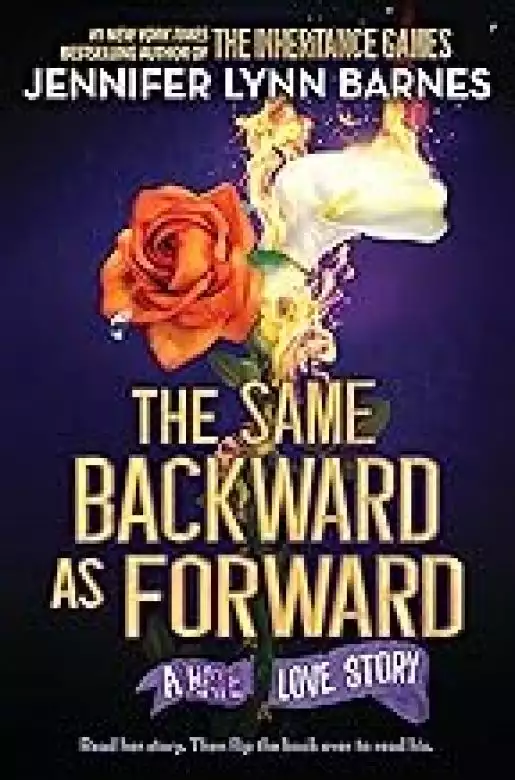
#1 New York Times bestselling author Jennifer Lynn Barnes delivers a star-crossed, enemies-to-lovers, tragic love story like no other! Read her side of the story, then flip the book over to experience their love anew through his eyes in this lushly designed deluxe novel that you can read backward or forward.
Hannah Rooney knows how to be invisible. At twenty, she keeps her head down and her eyes open, and so far, she’s managed to avoid being pulled into the dealings of her notorious criminal family. Hannah lives her life in countdown mode, biding her time in nursing school as she waits for her beloved sister, Kaylie, to turn eighteen so Hannah can get them both far, far away from Rockaway Watch and start a new life.
Tobias Hawthorne II acts every inch the entitled heir that he is. As the only son of one of the country's richest men, there isn't a door that isn't open to him. Yet behind his razor sharp cheekbones and devil-may-care attitude, Toby is guarding a nest of deadly secrets and a fiery anger fierce enough to burn everything in his path.
Their lives collide in one tragic, stormy night, where an act of arson and nature leave Kaylie and two others dead and Toby just barely alive—with no memory of who he is. The fisherman who pulls him from the ocean enlists Hannah to help save the very person who she knows took away her sister. Fueled by her hatred, Hannah is determined to deny Toby's death wish by keeping him alive. He is the last person that she should ever develop feelings for, and she is the first thing he ever remembers seeing.
Some things cannot happen—and some things cannot be stopped.
*Hannah’s side of the story was previously published as a novella in Games Untold
*Reading them all? The ideal reading order is: The Inheritance Games, The Hawthorne Legacy, The Final Gambit, The Brothers Hawthorne, Games Untold, The Grandest Game, and Glorious Rivals. *Looking for more unputdownable reads from Jennifer Lynn Barnes? Check out The Naturals series (The Naturals, Killer Instinct, All In, Bad Blood, and the enovella, Twelve), The Debutantes duet (Little White Lies, Deadly Little Scandals), and The Lovely and the Lost.
Release date:
November 11, 2025
Publisher:
Little, Brown Books for Young Readers
Print pages:
352
* BingeBooks earns revenue from qualifying purchases as an Amazon Associate as well as from other retail partners.
There was an art to being invisible. In this town, with my last name, it took effort to be nobody, to make people look right through me. I was quiet. I never wore makeup. I kept my hair just long enough to pull back into a nondescript ponytail. When I wore it down, its sole purpose was falling into my face. But the real key to being the right kind of invisible, the thing that mattered far more than making myself quiet and nondescript, was keeping the world at arm’s length.
I was a master at being alone—but not lonely. Loneliness would have been a vulnerability, and I was Rooney enough to know how that would end. Weakness of any kind was nothing but blood for the sharks. At twenty, I’d survived by keeping my head down and my eyes open. I’d made it out of the house—and out of the family in every way that mattered.
Except for one.
“Kaylie.” I didn’t raise my voice as I called out to my sister, who was currently dancing rather enthusiastically on top of a pool table. She shouldn’t have even been able to hear me over the dull roar of small-town drunks on a mission to get drunker, but Kaylie and I had always had a sixth sense for each other.
“Hannah!” My sister kept right on dancing, as delighted to see me as she’d been when she was three and I was six and I’d been her favorite person in the world. “Dance with me, you beautiful bitch.”
Kaylie was an optimist. For example, she thought there was a chance in hell that I was joining her on top of that pool table. My sister’s knack for misplaced optimism was half the reason she had a rap sheet. The other half was that, no matter how good I was at fading into the background, I’d never been able to shield her, too. Kaylie had been born dancing on tables and shouting her joy to the moon—and sometimes her fury, too. Her fearlessness suited our mother.
Some of the time.
“I’ll have to take a rain check,” I told my still-dancing sister.
“Your loss, you glorious thing, you.” Kaylie twirled in a circle, adeptly avoiding the half-dozen balls scattered over the table’s surface. The trio of guys holding pool cues, whose game she had presumably interrupted, didn’t seem to mind.
Collared shirts. Expensive shoes. Prep-school looks. Those three weren’t locals. In this bar, that spelled trouble.
“I’ll race you home.” I tried to tempt Kaylie off the table. She had a competitive streak.
“Last I checked, it’s not your home anymore, O Serious One.” Kaylie walked along the edge of the pool table, her arms held to the sides, her long hair streaming down her back. When she reached the end, she bent at the waist to place a hand on the shoulder of one of the pool-cue-holding boys.
“My sister,” Kaylie confided in him in a stage whisper, “is faster than she looks.”
Faster. Stronger. Smarter. I was a lot of things that Kaylie didn’t need to be advertising. Luckily, the guy on the receiving end of her attention, who didn’t look older than eighteen or nineteen himself, couldn’t have glanced away from her leather-clad torso if he’d tried. As for his friends, one of them was relishing the view of Kaylie from behind, and the other one…
The other one shifted his gaze languidly toward me.
His hair was a dark, almost reddish brown and long enough to hang over his eyes, which did absolutely nothing to mask the way they roved over my body. I could feel him taking in my faded blue scrubs, my dishwater blonde hair, the exact set of my mouth.
“I have to ask,” he said with the air of a person to whom everything was a very dark joke, “exactly how fast are you, Hannah?”
My instincts, honed from years of watching and trying not to be seen, told me two things: first, that he was drunk or high or both, and second, that, even inebriated, he missed nothing.
I gave him no visible response. My quiet was the kind of quiet that didn’t blink. Didn’t flinch.
Dark green eyes, shining with the light of bad ideas and worse ones, locked on to mine. “It’s nice to meet you, too,” he said dryly.
We hadn’t met, and we weren’t going to. “You’re not from around here,” I commented. That was a warning. He didn’t heed it.
Instead, he picked up a piece of pool chalk and spun it through his fingers, one after another. “What gave me away?” he asked mockingly.
That was a rhetorical question, but my brain generated an automatic response. Your tan is too even. Your hands aren’t calloused. You’re wearing a button-up shirt. The top three buttons were undone, his collar more rumpled than popped. Smirking, he leaned against the pool table, as casual as a demigod who found some amusement in sizing up little mortals. There was a canny looseness to the way he moved, not even a hint of tension visible anywhere in his body. It was all too easy for me to imagine him as an ancient royal sprawled across a litter, being carried around by servants.
Or soldiers, I thought. Something in me whispered that he was spoiling for a fight. And in this bar, as an outsider, he was likely enough to find one.
Not my problem.
“Kaylie,” I called. To everyone else in the bar, my voice probably sounded exactly the same as it had before, but my sister heard the difference. The two of us had been forged in a different kind of heat. She hopped off the pool table and sauntered around to my side, slowing as she passed the guy who’d zeroed in on me.
“Maybe I’ll see you around.” Kaylie’s smile was trouble.
“You won’t.” I directed those words at the outsider.
“Will I not?” Eyes on me, he set his whiskey glass on the edge of the pool table, partially overhanging the edge, just daring gravity to make itself known.
The glass stayed exactly where he’d placed it.
“And what about you, palindrome girl?” The stranger’s hair still hung in his face, casting his razor-sharp cheekbones in shadow. “H-A-N-N-A-H. Will I see you around? We could have a little fun, set the world on fire.” He held a hand to his heart and lowered his voice. “If you’re a Hanna without the h on the end, I don’t want to know.”
I was a Hannah with two H’s, and I was supposed to be invisible. The two of us definitely wouldn’t be seeing each other again. We wouldn’t be setting the world on fire.
He never should have seen me at all.
Fifteen minutes later, Kaylie was walking along the rocky shore the same way she’d glided over the edge of the pool table, like she lived life on the high wire. As I walked behind her, she looked up at the night sky, not even bothering to watch where she was stepping. There was an energy to my sister, an unspoken something that was a little frenetic and utterly full of life.
“You took their wallets, didn’t you?” I said, resigned to the answer before she even gave it.
Kaylie glanced back and smiled. “Only one.”
I didn’t have to ask which one. She’d slowed as she’d passed him on the way out, the two of them a study in contrasts—his darkness, her light; razor-sharp angles versus full, teasing lips.
“Do you want to know his name?” Kaylie’s grin deepened, bringing out twin dimples as she brandished the stolen wallet between two fingers.
“No,” I said immediately.
“Liar.” She smiled again, wickedly this time. Based on past experience, I had about a hundred reasons not to trust that smile.
“You need to be careful,” I told her quietly. “You have a record now.”
I needed her to keep her hands clean for another year. That was all. By the time I finished nursing school, Kaylie would be eighteen, and I was going to get her out. We’d move far, far away, to a place where no one had ever heard of Rockaway Watch or the Rooney family.
She just needed to keep her head down until then.
“Honestly, Hannah? I’m not the one who needs to be careful. You don’t have a record.” Kaylie did a little one-footed spin to face me. In the moonlight, I could see the thick kohl rimming her cornflower-blue eyes, the dark lipstick she’d somehow managed not to smear. “You should go before we get much closer to the house,” she said. “You don’t want anyone to see you. Out of sight, out of mind.”
Kaylie was the one chink in my armor. She always had been. I’d given in to the impulse to check up on her tonight, but we both knew that I was never more visible than when I stood in range of her glow.
“Be careful, Kaylie,” I repeated, and this time, I wasn’t just talking about stealing wallets or dancing on top of tables. I was talking about the rest of it. The family business.
With a roll of her eyes, my optimistic little sister tilted her face skyward once more, brave and brash and invincible, always, until she wasn’t. I couldn’t help thinking that maybe I should have left her at the bar, dancing and free and beckoning trouble toward her for the hell of it. But even if Kaylie had made it through the night without incident, even if she’d walked away soaked in adrenaline and unscathed, word of her night out would have gotten back. It always did.
And Kaylie being wild and free only served my mother’s interests—the Rooney family’s interests—to a point.
My apartment honestly wasn’t much of one. I could reach the kitchen counter from the bed. My three measly kitchen cabinets held more books than pans. On good nights, I read until I fell asleep, wrapping myself in fantasy worlds like they were blankets. Tonight, I fell back on an older habit instead. Ripping a blank page out of one of my clinicals notebooks, I folded the top right corner of the paper down—and then I just kept folding.
Growing up, there had been times when having my nose in a book would have made me a target. I’d had to find other ways of being elsewhere, tricks for daydreaming without ever losing track of the here and now. I’d taken to carrying scraps of paper in my pockets—a focus, something to occupy my hands.
Even now, alone in the apartment where I’d lived for the last two and a half years, there was something steadying to me about the familiar motion of folding a piece of paper in on itself again and again and again in different ways. The end result this time was an odd, jagged little shape.
I threw it away when I was done—and went to sleep.
In the dead of night, a voice jerked me back to consciousness like ice-cold water tossed over my prone form. “Get up.”
The voice was gravelly. This is not a dream. I had no recollection whatsoever of opening my eyes, but suddenly, they were open. My kitchen lights had been turned on. My mother was standing over me, and she wasn’t alone.
“You.” Her voice hardened. “Get up.” Eden Rooney wasn’t in the habit of asking anyone to do anything twice, so I took that as the warning it was and slipped out of bed, putting space between us and taking in the person standing in my mother’s shadow.
My cousin Rory was scowling—and bleeding.
“Fix him.” My mother didn’t make requests.
I eyed Rory’s injuries, but all I could think was that it had been two and a half years since I’d moved out. I hadn’t asked for my mother’s permission to leave. She hadn’t come after me. She’d let me get comfortable, and now…
Fix him. I kept my heart rate even and my face carefully blank. The worst of Rory’s injuries—that I could see—was a deep cut on his cheekbone, maybe two inches long. It wasn’t the type of injury that people in my mother’s line of work typically concerned themselves with. I’d seen one of my uncles dig a bullet out of a guy’s shoulder with a spoon.
This was clearly a test.
I was a nursing student, but I was deep into my clinical hours, and I’d buried myself in internships almost from the moment I’d started. What my mother wanted was within my capabilities, but the test wasn’t what I could do. The test was whether I would push back, and the one thing I knew for certain was that if I did, I’d never be invisible to Eden Rooney—or the Rooney family—again.
“Supplies?” My voice was muted, unemotional. I knew how to make myself disappear even when she was staring right at me. No weakness. No rebellion. No emotion at all.
Wordlessly, my mother dropped a black pouch on my bed. I unrolled it. Inside, there was a rudimentary surgery kit—scissors, scalpel, forceps, needle, suture thread.
“I suggest you make yourself useful, Hannah.”
I heard what my mother didn’t say: I let you go because it suited my purposes to do so, but you’re still mine, body and soul. You always were.
All I said out loud was: “There’s no anesthetic.”
“He doesn’t need it.” My mother’s diamond-hard gaze traveled from me to Rory. “Just like I didn’t need this little asshole getting himself injured in a bar fight tonight of all nights.”
Bar fight. My mind went immediately to a preppy boy with a dark aura, to green eyes and sharp cheekbones cast in shadow, to a glass placed precariously on a pool table’s edge.
“I need to wash my hands.” I bought myself some time going to the kitchen sink—but not much, just enough to focus on the fact that my mother apparently wasn’t doing this just to teach me a lesson. She was using me to teach Rory one.
He had five years and at least a hundred pounds on me, but he would sit there while I dug a needle into his face over and over again without anesthetic, because the alternative was doubtlessly worse.
I turned off the faucet and made my way back. I didn’t want to do this. If anyone found out, I’d get kicked out of my program. And, possibly worse, I would be complicit in whatever the family had going on right now that made Rory’s choice to get into a fight tonight of all nights that much more objectionable to my mother.
But if I didn’t do this, she might, and that would be so much worse for Rory. My cousin looked like he wanted to spit on me and vomit, in that order.
“Sit,” I told him. I had to hope that if I could do this without faltering, without showing a hint of weakness or rebellion, that might pacify her into forgetting me again—or, if not forgetting precisely, at least putting me on the back burner for a while.
Long enough for me to finish school. Long enough for me to find a way to get Kaylie out.
Rory sat. I tilted his chin back. Buying myself one last reprieve, I went into the bathroom and grabbed some antiseptic. I applied it, then opened the needle and the thread. At least they were pre-sterilized.
“Get on with it.” My mother took a single step toward me.
Do it, I told myself, but getting started was made harder by the lengths Rory was going to not to flinch. Lifting the needle, I didn’t bother telling him to relax and opted for distraction instead.
“Which one?” I said.
“Huh?” Rory was not, by any measure, the smartest of my cousins.
“The rich boys slumming it at the bar tonight,” I clarified. “Which of the three of them did this?” The question commandeered enough of his attention that I was able to start.
The needle was just a needle. Skin was just skin. My hands were steady.
“Doesn’t matter.” Rory spoke in a low voice, his face barely moving. “I’m gonna kill all three of the little bastards.”
In my family, statements like that weren’t always just for show.
“Hannah? Stop.” My mother’s voice ricocheted through the room like a bullet. But all I could think was: Do no harm. I finished the stitch, and then I stopped.
My mother bent until her eyes were even with Rory’s. She pressed her thumb into the flesh of his cheek, right below the partial line of stitches. “Do you have any idea who those boys are?” When Rory didn’t answer, my mother snorted. “Didn’t think so.”
She pressed her thumb into his face a little harder, then slid her gaze to mine.
“Let’s see if Hannah here can work it out. Rich boys in Rockaway Watch. Heads up their asses and looking to commission a boat in the morning. Who are they?” The last stitch I’d done popped, tearing through Rory’s skin.
I forced myself to focus. A boat. There was only one place close enough to serve as a destination from Rockaway Watch, a private island owned by a billionaire. Hawthorne Island.
Who are they? I answered my mother’s question. “Hawthornes.”
“At least she has a brain.” My mother swiveled her gaze back to Rory. “One Hawthorne, two friends, and the Hawthorne in question would be Tobias Hawthorne the Second. Toby. The only son of one of the country’s richest men. Little bastard might have a death wish, but we won’t be the ones granting it. Will we, Rory?”
“No,” Rory gritted out.
My mother dropped her hand from his face. “You’ll want to fix that last stitch,” she told me, her voice utterly devoid of feeling.
I swallowed back bile as I finished the job. To keep myself steady, I retreated elsewhere in my mind. Tobias Hawthorne the Second. Toby. I thought about the boy with the reddish-brown hair and his emperor-lounging-on-a-litter looseness. He was the Hawthorne of the group, I was sure of it, and apparently, I had his overprivileged, trouble-starting ass to thank for tonight, too.
I finished the last stitch. My mother didn’t linger. On her way out, Rory following like a dog on her heels, she paused in the doorway and looked back at me. “You have a steady hand,” she said.
That didn’t sound like a compliment. It sounded like a promise. She would be back.
I didn’t sleep the rest of the night and left my apartment at sunrise. It was my day off, but I had to do something. I needed to clear my head, so I went to the grocery store and then headed to the outskirts of town—farther, even, than my own apartment. I couldn’t afford rent in any of the towns closer to the community college or hospital than Rockaway Watch, but I’d chosen to stick to the very edges. The only thing farther out was an abandoned lighthouse and terrain so inhospitable that no person in their right mind would have tried to live there.
Which is not to say that no one did.
I knew better than to approach Jackson’s shack, so I left the groceries I’d bought on the steps of the lighthouse, which had been built sometime in the eighteen hundreds and looked like it had been battered by saltwater and storm-force gales every day since. The roof had, at one point, been blue, the tower some shade of white, but the whole thing was faded and overgrown now. The beacon hadn’t worked for decades. The stone walls were literally crumbling.
It was my favorite place in Rockaway Watch.
Lighthouses had always felt like something out of a fairy tale to me—a warning not to come closer, a liminal space between here and there. This one wasn’t easy to get to, but I made the climb every two weeks, groceries in hand.
“I oughtta shoot you.”
I turned to face the gruff, copiously bearded fisherman who’d just spoken those words. “Please don’t,” I said calmly.
Jackson Currie wasn’t technically a shut-in. He left his house to go out on his boat and interacted with others when necessary to dispatch his fishing haul, but he loathed people—all people, myself included.
He scowled at the bag I’d left on the lighthouse steps. “I told you to stop doing that.”
“How’s your arthritis?” I asked. He couldn’t have been older than forty or forty-five, but a lifetime of fishing had wreaked havoc on his hands and wrists.
“None of your damn business.”
“About the same, then,” I said as I reached out and took his right hand in mine, gently prodding the joints at the base of his fingers, lightly flexing his wrist, rubbing my thumb over it, then up the adjacent bone. “Do you need any more cream?” I read his answer to that question in his expression: None of my damn business.
I checked his other hand. When I finished, I expected him to storm off—with the groceries—but he didn’t. He didn’t curse at me or threaten to shoot me again, either.
“Storm’s coming.” Jackson turned toward the ocean. The sky was clear, stretching down to meet the gently rolling blue-green waters of the Pacific. “Gonna be a big one.”
Something in his tone made it hard for me to doubt him, no matter how blue the sky was. “If there’s a storm coming, I’m assuming you’re in for the day?” I said. “Or that you’ll be going out and coming back in before it hits?”
Jackson snorted. He was the type of person who would have arm-wrestled a lightning bolt if he could have. He turned his head to look at me, his brown eyes executing a grid search of my features. “What’s wrong with you today?” he demanded.
Bringing Jackson Currie groceries had never felt like letting the world in, specifically because he hated people, myself included, so much. His question was gruff, but the fact that he’d asked it at all hit me hard.
“Nothing,” I said. If I didn’t think about what had happened the night before, maybe I could pretend it away—for a few hours, at least.
Jackson gave a little nod. “None of my damn business,” he concluded.
Hours later, I drove two towns over to the hospital, even though it was my day off, and even though I’d told myself I wasn’t going to. If I’d been certified, I might have been able to pick up a shift, but instead, I headed to the cafeteria.
Hospitals were an easy place to disappear. Everyone had something else to worry about.
By late afternoon, the sky outside had turned—not just purple but black. It hadn’t started raining yet, but the wind was a feral creature. The hospital was far enough into the mainland that I couldn’t see the ocean, but in my mind’s eyes, I conjured an image of dark waters. Lightning tore across the sky.
Surely Jackson wasn’t out in this. Surely.
I stood and grabbed my tray, and it was only by chance that I was still looking out the window when lightning struck again in the distance and what looked like a massive fireball shot up into the sky.
An explosion? It had come from the direction of Rockaway Watch. I broke into a run, my heart pounding in my throat with every step. I made it to my beat-up old car in record time and drove until I made it back to town, then kept driving until I could see ocean. A fire raged in the distance, out on the water, like a mansion-sized torch in the dark.
Hawthorne Island.
Jackson showed up on my doorstep eighty minutes later, soaked to the bone. The second I opened the door, he spoke. “Hannah.”
He’d never said my name before, had never sought me out—never sought anyone out, as far as I knew.
“You need to come with me.” The recluse’s voice was raspier than normal. He didn’t appear inclined to explain his demand.
I didn’t ask.
It wasn’t until we were halfway to the lighthouse that Jackson spoke again. “I should have most of what you need,” he gritted out.
I had to push myself to keep up with him. “Most of what I need for what?”
“Boy’s half-dead.” Jackson picked up speed, his stride and his words both erratically paced. “Head injury. Burned. Nearly drowned.”
Burned. Drowned. Boy. My mouth got there before my brain did: “Hawthorne Island?”
“Explosion threw him from the cliff,” Jackson practically growled. “I fished him out of the water.”
One of the outsiders. In my mind, I could see a boy whose dark green eyes shined with bad ideas and worse ones. I could hear a dry voice inviting me to have a little fun—to set the world on fire.
“It’s a damn miracle the kid survived.” Jackson’s voice grew hoarse. “Fishing’s good on that side of the island, especially during a storm, so I was close. The way that the mansion blew when the lightning struck—there was nothing natural about it.”
“What are you saying?” I came to a halt. “Jackson, when you find someone half-dead, you take them to a hospital!” Why hadn’t I ever bought a cell phone? The money hadn’t seemed worth it, but… “We need to turn back and call nine-one-one.”
“Can’t.” That one word was as harsh as a blow.
“Why the hell not?” I demanded, and for onc. . .
We hope you are enjoying the book so far. To continue reading...

 Please log in to recommend or discuss...
