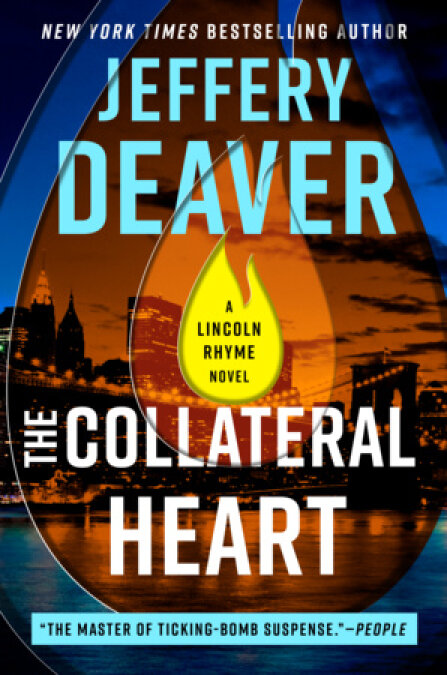
New York Times bestselling author Jeffery Deaver returns with a propulsive new thriller featuring forensic criminalist Lincoln Rhyme and detective Amelia Sachs (from The Bone Collector) as they investigate a series of arsons in New York City.
When a harrowing arson in Manhattan burns a building to the ground, Rhyme and Sachs are called to investigate, only to discover in the rubble a package of clues that teases where the perp will strike next. Rhyme and Sachs work feverishly to unravel the mystery, turning to an unlikely source for help: one of the nation's most popular history podcasters. Along the way they cross paths with Desdemona Vale, a determined detective from Long Island who is in search of the killer of a young woman from her neighborhood.
As Rhyme's team digs into both cases, it becomes increasingly clear that their suspect's plot might be more complicated than they initially thought. But can Rhyme and Sachs unpack his vile scheme, and stop the carnage in time?
Release date:
November 17, 2026
Publisher:
G.P. Putnam's Sons
Print pages:
416
* BingeBooks earns revenue from qualifying purchases as an Amazon Associate as well as from other retail partners.
CAUTION: This email originated from outside of Penguin Random House. Please be extra cautious when opening file attachments or clicking on links.
1
Wouldn't you know it? The risk that finally caught up with him wasn't the one he was expecting.
Oh, he knew his life was constantly in danger.
Daily.
Hourly.
Billy Welsh could be moving from car to car during a red light in the middle of Broadway, armed with his squeegee, enduring the wrath of drivers while he hoped for the one, just one, who might nod thanks for the spotless windshield and hand over a single or, man, five dollars . . . when, wham, a texting driver would take him out. Driving at thirty or forty could be plenty lethal.
He could be drawing very bad chalk pictures of cats and superheroes on the sidewalk (that usually got him coins). And some psycho dude would gut him because God had declared Billy was a "Satan-izer." A term a man had actually used during such an encounter on 57th Street.
He could get cut or earn a beatdown simply for selling stuff. The Senegalese bosses could snap because Billy's selling pencils and kitchenware and shoelaces somehow competed with knockoff Kate Spade purses and fake Tommy Bahama shirts. Billy was skinny and had a tricky heart, which could probably be beaten to silence by a few firm blows.
All risks.
And there were others too.
But, stretching, waking up in this deserted building in Spanish Harlem-east-Billy had to take the chance.
Rent didn't pay for itself.
A funny expression he used a lot. Funny, since he was homeless.
On this day, already proving hot, he needed money and not for rent.
Something real.
Something important.
Something for which the risk was worth it.
And that meant leaving the security of his home.
The Abernathy and Ca Building.
The old manufacturing place, where the last letters of the second owner's name, or whatever it might be, had worn away.
Campbell. Canton. California. Carter . . . Cadaver . . . Ha.
Billy liked it here. The crews didn't come around much, at least not to the second floor, up the narrow stairway. The crazies either.
He could stay in bed, unimpeded, and dwell on his finances and his brief marriage that had been doomed to end from the moment it had begun. But also happier memories like his childhood cat, a TV show where he was almost an extra and his two Employee of the Month stars.
Gretta, of course, his ex, showed up in the second category sometimes.
Will always did.
And he wondered yet again how his mind had kind of deflated.
The wiring, some doctor had called it. The diagnosis seemed . . . What was the word? Flipper. Flipping. Flippant. That was it. The city hospital ER medico had sent him to Psych, whispering to the nurse, "He'll be okay, just some fucked-up wiring."
He decided to risk the Senegalese today and infringe on their territory and stake out his claim at the Walmart on 125th Street.
Risk . . .
He peed in his bucket. Washed his hands and brushed his teeth with park water from a bottle. Real toothpaste. Then began gathering the merchandise. Statues, a food scale, a set of baby utensils in the shape of SpongeBob (only the unopened ones sold), books, shoe polish, dishes with cartoon characters, dishes with rainbows, dishes with unicorns . . . About twenty-five pounds of merch.
Into the shopping bag they went. Including the gray blanket he had owned for twenty-two years, which he would spread out as his showroom floor.
How much could he make?
His goal was twenty-nine dollars.
Which is what the present cost. The present for his son, whose sixth birthday was on Saturday.
Will lived with his mother. A woman who had not lost her job. And had not gone bankrupt by taking out payday loans. Who had not been evicted in some funky legal maneuver because somebody wanted a five-million-story high-rise on the site of his basement studio.
A pretty woman Gretta was, and one now married to a man with fully functioning wiring.
Ah, his life would change.
Things would change.
He knew it.
He'd fought his way up before and he would do so again.
But first, priorities: a Disney toy purchased from the real Disney Store in Times Square, not dusty and smeared and bought from a guy like himself, off a two-decade-old, gray blanket spread on the sidewalk. A new toy in a new box.
Billy Welsh, who had been valedictorian in a Midwest middle school, where class ranking didn't count, and in the bottom third in high school, where it did, picked up the shopping bag and started toward the stairs.
When the unexpected risk caught up to him.
Not crazies, not crews, not bosses-I got Bahama, I got Dolce, I got Spade . . .
But smoke.
Billy lived up here, higher in the building because it was safer.
But that also meant it would take a few minutes longer to escape.
If there were, for instance, a fire.
He felt heat and saw sparks in the stairwell nearest him.
No!
He grabbed the bag with his money. He grabbed his drawing chalk and his squeegee but left the sales inventory shopping bag and hurried to the stairwell. And blanket? Goodbye!
Smoke was everywhere now.
Out, get out.
Coughing.
Sparks and heat, rising fast.
Fire in his beloved Abernathy and Ca home was not supposed to be a risk.
This was not the way he would die . . .
A cut throat, yeah, or a pounded heart, or the wiring just giving out because it was too much work for his poor, badly wired brain.
But not fire.
Where were the exits?
Only the back door, the one chained but with a gap big enough for an emaciated frame like his to fit through. The front was nailed shut, like the fire exits. One never needed to worry about escaping from a building that no one was supposed to be in, in the first place.
Weird. The smoke didn't move; it was simply just there, filling the hallway and growing thicker and thicker.
Choking hard.
He glanced out a window. The ground-floor ones were boarded over. But here, the second floor? It would mean a thirty-foot jump onto rubble from which rebar rods poked high into the air.
Skewers.
No, he had to get out another way.
Coughing and spitting smoke crud from his mouth. There were flecks of something suspended in the dark cloud. Bits of rubber or plastic. That would be what was burning, he guessed. Some crap on the floor that Mr. Abernathy and Mr. Ca illegally-by today's standards-had constructed their otherwise fine factory with.
He startled as something hit his foot.
Glancing down. A huge rat was fleeing too.
Think, he told himself.
Which was so hard.
Add burning to death to bum wiring, and his brain began to spin wildly. It wanted to shut down.
Control it!
For a moment, at least he did.
Sirens. So people were on their way.
But they wouldn't know anyone was here. Maybe, since it was abandoned, they would just let it burn. Let the flames do the work that was going to get done anyway-the A and C building wouldn't last forever. Time to move on.
Get to the roof!
Yes, fire travels upward, but at least there, there would be some fresh air to gulp. They'd see him. And while he'd be fifty feet in the air, those fire people had hooks and ladders or cranes. And they would lift him and his chalk and present-money and squeegee to safety.
Into the stairwell, coughing, choking, spitting . . .
The smoke was not as thick here and he could see above him the door.
Roof Access
Billy staggered up. And gripped the knob. He pulled.
It was locked. He tugged hard. Didn't budge. He tried again and his sweating hand slipped off the knob. He stumbled and his chalk fell. His bag of money too, mostly coins. They danced and spun down the stairs . . .
No!
His money . . . Will's Disney money . . .
Billy Welsh gripped the only tool he had-the squeegee-and brought it down on the knob.
Nothing happened.
Risk . . .
He began pounding once more.
2
"How'd it go? I let myself in."
"I assumed," Lincoln Rhyme said to Lon Sellitto. "Since voilà. Here you are. How did it go? It went."
Amelia Sachs, ever less abrupt than her husband, offered, "Went well, Lon. Very well. She's one of the top neuro specialists in the world." The tall, lean redhead tugged off her jacket and hung it on a hook. The Glock snapped from the Blackhawk OWB, outside-the-waistband, holster and went onto a shelf. People, she had told Rhyme, just didn't appreciate how uncomfortable it was to tote around a six-gun. Or, in this case, a seventeen-gun. Rhyme took her word for it, not having carried a weapon on belt or under arm in decades.
Rhyme wheeled his elaborate chair farther into the parlor in the front of his Central Park West town house, a structure dating to Victorian times, a convenient reference point though the queen had little if anything to do with boisterous New York City back in the day.
While Sachs was in work clothes-black slacks and a white blouse, accessorized by the now-empty holster, Rhyme was in what he usually wore. Sweatpants and a pullover black sweater. It had a high collar and his aide, Thom Reston, knowledgeable about fashion as with so many other things, had said he resembled a beatnik.
A frown in response. "A what?"
"Beatnik. A cool guy from the fifties? Poetry, pot, protest. The beat movement? Jack Kerouac and Allen Ginsberg?"
"Ah," Rhyme said, overly unenthusiastic. "A cultural reference. Therefore why would I know or care?" His philosophy working as a criminalist or, well, his philosophy about everything, was that if a fact did not relate to an immediate problem he was solving, it was as pointless as a spring breeze. The example he cited: he had once deduced that a drummer for a quasi-popular rock group had lied about his whereabouts when his girlfriend had vanished because Rhyme had found that the man's snare drum's tension rods had not been tightened, though he claimed he'd been home practicing; one does not play a drum at any time, concert, rehearsal or practice, without tightening the rods.
This was an acceptable application of culture.
Thom had accompanied Rhyme and Sachs, married some years now, to the doctor's appointment at the superb Langone medical center in Midtown Manhattan. He remained unresponsive to the inquiry by Sellitto, who was presently helping himself to what Rhyme guessed was his second, or third, cup of coffee from the carafe Thom had left out. A cookie too. Rhyme heard the aide's pastries were superb. He enjoyed the man's cooking but with no sweet tooth he couldn't comment on the dolce.
"Lincoln's a good candidate for procedures. They ran a Britannica's worth of tests."
Rhyme grumbled, "It was exhausting."
His resting state always bordered on curmudgeonly, but he was in fact pleased, if not elated, at what had transpired during the appointment. Handsome by many accounts with a full head of dark hair and prominent nose, Rhyme was a quadriplegic, injured at a crime scene some years ago. Though the injury was classified as "incomplete," he was still largely paralyzed from the neck down. Twenty-first-century America saw spinal cord injuries galore from military service, automobiles and bicycles and construction work and rock climbing and skateboards and dozens of other sources. Nearly twenty thousand occurred each year. Presently a quarter million people had serious SCIs. The medical community was forever working hard to improve their patients' condition. While there was no fix yet to allow those with serious conditions like Rhyme's to walk, advancements were constantly being announced: efforts to rewire nerves and incorporate prosthetics that could be controlled by the patients themselves-either through movement of muscles connected to surviving nerves or, astonishingly, through "thinking" the limbs and appendages into moving, just like those without a disability. Rhyme had regained use of his right arm and hand (joining his left ring finger, which, for some reason, had retained mobility from the beginning).
It was even possible to do what had long been considered way out of reach: restore sensation to parts of the body. Ninety percent of Lincoln Rhyme had been numb since the accident. The advantage was the absence of pain, of course, but anyone craving the pleasure and comfort and contentment of touch will tell you that this was no advantage at all.
Sachs continued, explaining to Sellitto that Dr. Yang used brain-computer interfacing, spinal cord stimulation and the complex process of what she wryly dubbed "nerve stealing," actually rerouting nerves to make the nonfunctioning portions of the body work. "She'll go through the results and let us know."
Sellitto was nodding. "That's good, Linc. I'll keep my fingers crossed."
The detective was a large man, forever battling his weight. Rhyme wasn't sure why he bothered unless it was a health matter. Then, there was the issue of garments. It seemed he bought clothing that was resistant to an iron's touch-he was constantly disheveled.
The two men used to be partners, in the days before Rhyme ascended to run the NYPD's crime scene operation and he sometimes wondered if Sellitto's look was intentional, calculated to put suspects at ease, give them a sense of confidence and superiority-lowering their defenses, so that he could lunge like a fencer, destroy their phony stories and skewer them into confessing.
Today the rumpled attire was gray-a slightly too large suit, maybe indicia of him dropping a few pounds. The shade was light. Wouldn't darker be aesthetically safer with wrinkles? A white shirt. He wore a tie too and Rhyme knew it would be a clip-on. His street-fighting days were largely over, but he still followed the practice of some gold shields who wore fake ties so a perp couldn't grab attached neckwear in a fight.
Thom, slim and dressed in opposition to Sellitto, was in a perfectly pressed pair of Italian slacks and powder-blue dress shirt, smooth as Sheetrock-and a real tie. He poured coffee for the couple. Rhyme could manage holding a mug, but drinking was easier with a straw and tumbler in the cupholder, and he was tired from the battery of tests. He thanked the aide and then turned back to his former partner.
"To what do I owe, et cetera, et cetera," Rhyme began, in fact quite pleased to see the man. Sellitto was not known for social calls (unpleasant creatures, in Rhyme's thinking), so the detective's presence meant a case was in the offing.
We hope you are enjoying the book so far. To continue reading...

 Please log in to recommend or discuss...
