- Book info
- Sample
- Media
- Author updates
- Lists
Synopsis
THE GREATEST CONFLICT IN OUR SHARED HISTORY.
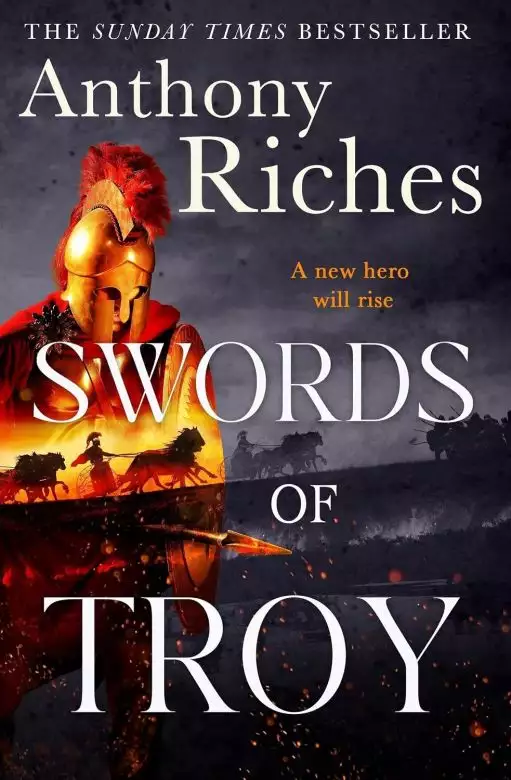
FROM AMONGST THE RANKS OF LEGENDARY HEROES, A NEW ONE WILL RISE.
For Leonteus, bastard son of the former king of Argos, the hegemon of King Diomedes' bodyguard, his half-brother, is what he has trained for his entire life.
But the stability of the land of the Achaeans is suddenly rent in two by the abduction of King Menelaus's queen, Helen, by a prince of Troy.
Agamemnon, Menelaus's brother, calls on all the foremost men who, as Helen's suitors, swore allegiance to defend the man who won her hand a decade before. Honourable Diomedes answers that summons.
The hundred-thousand-man army of the Achaeans sail for war amidst ill-fated omens, destined either to reduce Troy's great walls to rubble, or die far from home in the pursuit of gold and glory.
And Leonteus, brother of a warrior king, comrade to the wily Odysseus, peerless but troubled Achilles and the grasping, self-centred Agamemnon, will find himself at the heart of the deadliest war ever fought.
From Sunday Times bestseller and legend of historical adventure Anthony Riches comes a sensational new vision of the Trojan War.
Release date: July 16, 2026
Publisher: Hodder & Stoughton
Print pages: 320
* BingeBooks earns revenue from qualifying purchases as an Amazon Associate as well as from other retail partners.
Reader buzz
 Please log in to recommend or discuss...
Author updates
Swords of Troy
Anthony Riches
The characters of the Iliad, and the other now lost epics that tell the story of the war between the Achaeans and the Trojans, are well known to us. And we refer to them by the names that ‘Homer’ (whoever ‘they’ were) gave them in the eighth century bce, when the oral histories told by bards over a period of some hundreds of years were finally written down as a series of epic tales, including the Iliad. But these names are not simply those recorded as having belonged to – we like to think – the warriors whose deeds the original bards witnessed. They are also revealing as to how these characters were portrayed in the original history, for they tend to have meanings that illuminate their nature, role in the plot or just their ways of fighting.
For example, and as highlighted in the story, Achilles is a name that in the original would have meant something like ‘woe to the armies’, from achos (distress, pain, sorrow, grief) and laos (people, soldiers, nation) and the resulting proto-form akhi-lauos. Leaving aside the deeper academic thinking around just this one name, perhaps it becomes clearer that the names used in the epics were either a reflection on the way that Bronze Age people were named or just the way that ‘Homer’ (in this case the people who originally orally composed the epics more or less contemporaneously with the events, and centuries before they were recorded in writing), wanted to portray them in name form, for the sake of their narrative. A case of ‘the names have been changed to make them memorable’, perhaps.
At an early stage in writing these books I pondered whether to use these hidden names behind the ones we know so well, and quickly decided not to burden the reader with having to keep track of how they relate to each character. I didn’t think that your patience would be quite that infinite, as mine certainly isn’t. But I did decide that it would at least be of interest for these hidden names to be provided here, to allow the reader to at least be aware of them. And so here, in the usual list of characters, and in the order of their appearance, are the meanings that we are told they have.
The warriors and peoples of the Achaeans
Leonteus: lion-like, bastard brother of Diomedes, commander of his household guard and the narrator of this story.
Diomedes: god-like counsel, an Achaean hero who plays a significant role in the war.
Deipyle: door breaker, mother of Diomedes.
Galene: serene, mother of Leonteus.
Alcmaeon: mighty warrior, the leader of the Epigoni, the sons of the ‘Seven Against Thebes’ who died attempting to remove a usurper from the Theban throne.
Polynices: manifold strife, deposed king of Thebes and one of the Seven Against Thebes who died trying to retake his throne, killed by his brother Eotocles.
Eteocles: true glory, brother of Polynices, usurper, died at Polynices’s hand on the battlefield while killing him in the same moment.
Tydeus: to strike, father of Diomedes and Leonteus, one of the Seven Against Thebes.
Adrastus: inescapable fate, grandfather of Diomedes through his daughter – the only one of the Seven to survive the first battle for Thebes.
Thersander: bold man, son of Polynices, one of the Epigoni, king of Thebes, killed by Telephus at Mysia.
Aegialeus: sea shore, son of Adrastus, one of the Epigoni.
Laodamas: man tamer, son of Eteocles and king of Troy, defeated and killed by Alcmaeon after killing Aegialeus.
Alexandros: protector of the people, guardsman in Diomedes’s hetairoi guard and deputy to Leonteus.
Oenus: wine, grandfather to Diomedes through Tydeus, king of Calydon, usurped by his brother Agrius and Agrius’ sons.
Agrius: savage, brother to Oenus, usurped the throne of Calydon.
Thersites: bold harrier, son of Agrius and instigator of Oenus’s usurpation.
Eurybates: wide striding, herald of the Anax Agamemnon.
Agamemnon: resolute and mighty, the powerful king of Mycenae, Anax of the wider Argos and leader of the Greek forces during the Trojan War.
Tyndareus: good son of Tyndaros, father of daughters Helen of Troy and Clytemnestra and sons Castor and Polydeuces.
Clytemnestra: famed for her cunning, Clytemnestra was the wife of Agamemnon.
Castor: beaver, a son of Tyndareus, known for his skill in taming horses.
Polydeuces: much wine, the divine twin brother of Castor, known for his boxing skills.
Menelaus: strength of the people, the brother of Agamemnon and husband of Helen of Troy.
Odysseus: he who angers men, king of Ithaca, renowned for his intelligence and endurance.
Lykos: wolf, commander of Agamemnon’s household guard.
Telamon: broad leather strap, king of Salamis and father of Ajax the Great and Teucer.
Ajax (the Great): eagle, prince and son of Telamon of Salamis, known for his size, strength and valour.
Teucer: far shooter, prince and son of Telamon of Salamis, known for his skill with the bow.
Nestor: traveller, king of Pylos and an aged counsellor of the Achaeans.
Antilochus: against the battle cry, prince and son of Nestor of Pylos.
Peleus: clay, king of Phthia and father of Achilles.
Patroclus: glory of the father, exiled from Opuntian Locris and companion of Achilles.
Atreus: fearless, former king of Mycenae and father of Agamemnon and Menelaus.
Thyestes: admired, brother of Atreus and father of his brother’s killer Aegisthus.
Aegisthus: fat from goats, son of Thyestes and killer of Atreus.
Simonedes: son of Simon, member of Agamemnon’s companion guard.
Palamedes: decisive counsel, prince of Euboea.
Penelope: weaver, wife of Odysseus, famed for her cleverness.
Acamas: unyielding, king of Thrace.
Chiron: hand, tutor to the young Ligyron whose name was changed to Achilles.
Calchas: bronze, Agamemnon’s seer whose prophecies played a significant role in the events of the Trojan War.
Thetis: establisher, mother of Achilles.
Lycomedes: wolf son, king of Skyros who harbours the young Achilles.
Neoptolemus: new war, son of Achilles born on Skyros.
Oneiros: dream, son of Achilles born on Skyros.
Peneleos: toiling peoples, king of Boeotia.
Ascalaphus: darkness, king of Aspledon.
Idomeneus: powerful mind, king of Crete.
Eurypylus: broad city, king of Ormenius.
Cinyras: pour forth, king of Cyprus.
Andros: manly, shipmaster of Diomedes’s flagship Storm Raven.
Deidamia: dreadful in combat, wife of Achilles and mother of Neoptolemus.
Iphigenia: strong-born, daughter of Agamemnon and Clytemnestra.
Philoctetes: beloved neighbour, prince of Meliboea.
Iolaus: violet dawn, prince of Phylace, the first man to die in front of Troy and renamed as Protesilaus: first among the people.
Hypatos: superior, a captive of Leonteus who becomes his slave.
The warriors and people of Troy
Helen: shining light, the queen of Sparta whose abduction by Paris sparked the Trojan War.
Paris: wrestler, prince of Troy, whose abduction of Helen triggered the Trojan War.
Priam: redeemed, king of Troy during the war, and father of Hector and Paris.
Telephus: far shining, king of Mysia captured by Achilles.
Cycnus: swan like, king of Kolonai, a Trojan ally in the Troad.
Hector: defender, the senior prince of Troy, known for his bravery and loyalty.
Briseis: daughter of Briseus, a captive of Achilles during the war.
Chryseis: daughter of gold, a captive of Achilles during the war.
Aeneas: praised, a Trojan prince.
Jocasta: silver moon, a captive of the Achaean army.
Prologue
To the end of my days I will continue to ponder the question whether, given my time again, it would have been preferable to have entered this life as my brother rather than the man I am. With so little time separating the moments of our births, and with our childhoods so very much intertwined, it seemed for the length of our early years – until the moment that I realised that while he was born to be a basileus, a king, I was not – that we were almost the same person. We cried in the same cot as infants, cut our teeth together and played together when we had learned to walk. As we grew into boyhood we learned our numbers and letters together, squabbled together, and were given our earliest lessons in living as men should – together.
We were inseparable for the most part, and raised with exactly the same training in the art and the butchery of war, making us almost – so very much, but just not quite – identical in our thoughts and our ways. For there was always one key difference between us. Not that I have ever regretted this feature of my life, for it has been rich, and full of sensation. I have been blessed with pleasurable moments, of kind words and soft touches. I have rampaged through an enemy army in battle, lost to the savage joy of a sword’s brutal song in the madness of the fray. And I have savoured the weary satisfaction of living to see another sunset, after sending others to awaken in the afterlife with coins in their mouths. I do not deny that I have lived well, and as a warrior should.
I have gone into battle beside my brother when the odds have been stacked against us, reckless in the blood rage of the moment and never once doubting the outcome. I have arrayed my shield at his shoulder and protected him from the spears and arrows of our enemies, just as he in turn has protected me from theirs. Great champions, the ‘foremost men’, named for their place on the battlefield as they stalk forward at the head of their followers, literally looking for a fight, are followed by lesser men, competent but lacking the spark of greatness. And whenever Diomedes fought those legends of the enemy army, for whose deaths he would become famous, I was always there to rage through their acolytes. I was a champion of my kind, if never to be as exalted as the men he defeated or as he in turn became as his reward for their deaths. In my abilities I was always a fraction less than him in all respects, but, equally so, more talented and with greater andreia, the measure of a man’s martial worth, than any of the men I faced. And so I made sure that there could be no rude interruption by lesser mortals, while he was busy at the task of making his own name live forever.
I killed them by the unnoticed dozen in the shade of his shining brilliance, over the years, my bronze blasted black with their blood and the air rent by the cries of their dying. And when the killing was done, when all men looked at him with the admiration due to his magnificence in combat and his defeat of his latest storied opponent, I stayed in the shadow of his achievements. For I was content that his nod of respect and thanks was a fitting reward for my efforts. I knew that while our father’s martial inheritance to us both gave me the ability to defeat any number of our enemies’ armies in the crucible of single combat, my brother was the more gifted of us. He was of a subtle but unmistakably different class with sword and spear and shield, truly a king among men in both rank and deed. And he will be numbered among the heroes whose names will live forever in the legends of our time. Whereas I was simply a supremely talented executioner of the also-rans: skilled, and deadly enough with sword, or spear, or bow, but lacking that spark of gods-inspired greatness that elevated him to such glory.
But I digress.
I have indeed lived well. Both in those long spaces of time between the moments of bloodshed and chaos on the battlefield and, even more so, in the short moments of glorious madness through which I strode, untouched by any man’s blade and dealing out the fate determined by the gods to those who come to receive it from me. And yet, even if mine has been a life well lived and with valour enough for ten other men, it has nevertheless been a life spent in the shadow of my brother’s incandescent talent. So, to return to that question: would I have preferred to enter this life as my brother, and not myself, given his fame and the glory. Do I ever dream of it being my name, rather than his, echoing down through the histories that the bards sing to us in the firelit halls of winter for the rest of time? The short answer is this: no.
No, you might protest? How could I not have yearned for my brother’s fame, his wealth and his magnificent andreia, named strongest at the war cry and beloved of the gods? Stay those protests, because the full answer will satisfy your initial disbelief in an instant, when I have laid it out. Although it will likely not be what you expect.
For one thing, and it is the least of three reasons, I am less a warrior than he. Where I have used my gods-blessed talents to rampage through the lesser men who fought beside their masters, he was always the one to go face-to-face with the great named enemies. It was he who felled a score of men and more whose names were known to us all, killing them singly or sometimes two or three in short succession, as they took up arms against him. They came with the intention of burnishing their reputations with his name, but instead gifted him theirs, along with their blood and whatever prizes he chose to pick from their panoply. Nobody writes poems about us, the men who do the casual butchery that enables such heroism to play out without unwanted interruptions by lesser men. We only appear in those stories by association and chance, because we can never equal the magnificence of the foremost men.
So, what else? For another thing, I was always his bondsman, sworn to service. His chariot driver, archer, spearman, his sword and, more so than anything else, his shield. He is my master, for all the familiarity between us, closer than that between him and his wife and children, the result of so much blood spilled and so many enemies sent to commune with their ancestors. And I have always been clear in my mind that, given the differences between us, so small and yet of such consequence, this was the right order of things.
I sense your dissatisfaction, and that you still impatiently wonder what it is that prevents me from wishing that, if I had the power to do so, I might reverse our places and take his place on the throne of a great city. And so I will let you into the final truth of this matter, a truth known to all and no kind of secret. The final and most compelling reason why I believe that I could never hope to make a success of his life if put in his place. And here’s the truth of it. You most likely believe, from my story so far, that we are twins, two babies from the same womb with only the order of our entry to life to differentiate us. Whereas in fact, and while we shared a father, our mothers were two very different people.
And now you see it. His mother Deipyle was regal and wise, a daughter of nobility. And mine, Galene, was the daughter of a peasant family who was lucky enough to find a place in the royal household, albeit a menial one. Our father’s princely heritage to us was a noble if flawed birthright: his martial prowess and eagerness – over-eagerness, many would say – to raise a fist or a sword to any man if he saw the need, without fear or hesitation. And perhaps even without thought, it seems. It was our mothers who made us the different men that we grew to be, channelling that inherited need for violence and chaos in subtly different ways. And, whether they knew it or not, forging the two halves of a partnership that was to endure and triumph so many times that the bards ran out of room for it all in their tales.
It is that shared urge to fight, run rampant across the Trojan plain on the other side of the dark and stormy Helle Sea, that is at the root of the story that I will tell you here. It is a story of a lust for conquest grown so twisted as to become both meaningless and the root of a deep and abiding ruin for all that it encompassed. Of pride so poisonously fierce that it overshadowed the achievements of the greatest warrior that ever lived, and very nearly resulted in a catastrophic defeat. And of a love that, if it ever really existed, was long burned out by the time its consequences arrived to bring death and despair to the people of the city in question.
It is the story of my brother, the Basileus Diomedes of Argos. Diomedes, a name that means ‘the gods’ wisdom’. It is the story of his loyalty to the ultimate king, his master, and the way that loyalty resulted in his exile from his own kingdom in the bitter end. The story of his master the Anax Agamemnon, our overlord and called the King of Men by his vassals. Of Agamemnon’s brother Menaleus, basileus of Sparta, and of his wife Helen and her lover and abductor Paris, and of the doomed trio of Achilles, Hector and Patroclus. Of Odysseus, Ajax, Achilles and a host of other heroes. And it is my story too, that of Leonteus of Argos. The story of one king’s bastard and another’s companion bodyguard, a great warrior and in the making of that greatness a witness to the bloodiest war of all time, and thereby narrator to the greatest story you will ever hear. But most of all, while I will recount it through the prism of my brother’s feats of valour and heroism, it is the story of a city, and its decade-long stand in the face of the greatest army the world has ever seen to the ruination of both.
It is the story of Troy.
Chapter One
‘Spears!’
That moment will never leave my memory. The instant when our five thousand men swung their weapons down from the vertical through an arc of winking metal to point at the oncoming enemy army. The exact moment at which I knew that the battle was actually going to happen, and that there was no chance of avoiding the fight that was striding across the battlefield towards us in the form of the army of Thebes. It was a savage realisation, the span of a heartbeat that burned away what little of the child remained in my fifteenth summer. And it was the instant in which I truly became a man. A moment in which my hope, nurtured the whole length of the march from Argos to Thebes, that our expedition might end in some kind of agreement not to fight, was extinguished by one simple word.
They were a smaller army than ours, with perhaps two men in ten fewer than we, but they were clearly better trained, and the men of a single kingdom, of one mind and one training. Whereas the armies forming such a hasty alliance as ours were inevitably of wildly different abilities. They had no more than five hegemons, the phalange leaders whose decisions in a battle often make the difference between victory and defeat, whereas we had more than fifteen all told. And given the way we fight wars and battles, a smaller number of influential men to have an opinion is necessarily an advantage. In our armies the various hegemons lead their own groups of family and followers, deciding between themselves the best approach to ground and circumstances – who will lead, who will follow and how the battle should be conducted. They do so under the leadership – but not necessarily the orders – of their senior member, the strategoi, and the fewer hegemons he has to deal with the better for all involved. Too many opinions on the field of battle are like too many cooks in the kitchen, turning the components of a good meal into something far less appetising. And on the battlefield that bitter taste might easily be the taste of a warrior’s own blood.
The Thebans were better equipped too, every man wearing a helmet and carrying a bronze-faced shield, where our raiment for battle varied from lavish to lacking, depending on whose contingent one was considering. For myself, as a royal hetairoi, a companion guardsman of Argos, armour was not a problem. There were bronze facings on the thick leather of my shield and breastplate, and my bronze helmet was fitted with long cheekpieces that swept around my face with only enough room for my nose. I did not like wearing such headgear, as restricted hearing and vision were the price to be paid for such protection, but wear it I did, for it was not my place to eschew such costly gear when all the guardsmen around me were equipped the same.
Even in our army of Argos, however, the largest contingent of the Epigoni, there were men without even the most rudimentary of shields, and nothing more deadly than a soft iron-tipped spear, hidden at the back of their phalanges ready to pick up the bronze of the dead and wounded. The Arcadians on our right were perhaps a little better equipped than we were, the men of Corinth on our left somewhat worse, and the Messenians and Megarans on the army’s wings were equally variable. So if the men of Thebes were akin a pack of hunting dogs, lean and sharp toothed, we were more like the assorted mangy curs that lurk around butchers’ slaughter yards hoping to steal scraps. We knew it well enough, and the Thebans could see it with their own eyes.
The thicket of the enemy’s spears, not yet levelled to point at us, bristled above their heads like wheat at the end of summer, and their shield line shone like the sea at sunset in the afternoon’s glare. Worst of all, they were coming towards us at a slow trot, as fast as a formed body of men can run without becoming disordered, knowing that their best tactic was to hit us quickly and with all their strength. They would seek to break our line and scatter us like thistledown, the older men in our ranks warned us. Having put our army to flight they would hunt us like fleeing deer as we threw our weapons aside to run faster than they. And they would kill any man they could catch with wounds of dishonour, stabbing into our backs and legs, and with no mercy shown to the slow and the lame. The majority of us would escape, but our will to fight would be lost along with our weapons, and the war would be decided in Thebes’ favour for the second time in ten years.
Some among us were already wavering, and everyone could hear it. Why else would our leader Alcmaeon have ordered us to level our spear points so early, other than to stop the rattle of terrified men’s shafts jostling against each other as their hands shook in mortal fear? He was known as a clever man, Alcmaeon, my brother Diomedes’s first cousin, or such was his reputation, which gave me a ray of hope as the enemy steadily closed in on us, and the cold wind from the dark, narrow sea that separated Argos from shining Lesbos and the Troad beyond it pulled at our long hair as we waited for their onslaught. My hope was a simple one, and the only one I had left, now it was clear that Thebes intended to fight – that Alcmaeon had a plan to negate their obvious advantage, and avert the risk of their simply overrunning our army of the Epigoni.
Epigoni. Literally ‘the offspring’. Our leaders were the sons of the seven foremost men of Argos, who had accompanied Polynices of Thebes to this same spot ten years before, allies in his quest to take back the throne from which he had been banished by his brother Eteocles. Polynices, married to one of the king of Argos’s daughters, had been determined to go to war with another king’s army to win back Thebes. And Tydeus, father to Diomedes and me and married to another daughter, was motivated by his own experience of usurpation to join him. But if the generosity of their father-in-law Adrastus had suited them both very nicely it had had disastrous results for our city of the same name.
The Thebans were closer now. Not yet so close that we could see their eyes, but the shouts and curses of their hegemons were audible, and the tremulous among us began looking about themselves as if hoping for a way out of the coming fight – as men often do when sharp metal and hard faces are presented to them for the first time. And while I was not among their number, neither was I one with those men who were staring out at the oncoming enemy eagerly, straining at their leashes with the urge to kill. Indeed my overriding thought was an irrational concern for the young crop that was being stamped into the ground by the Theban advance across the farmland, immature ears of wheat that would never be harvested. That the same could be said for the deaths of young men not yet seasoned, quite possibly including myself, who would be reaped by sharp bronze across both armies did not cross my mind.
As it was, not having fought in battle before, I had a foot in both camps, those of the eager and the tremulous, and yet also in neither. I was almost entirely ignorant of what was to come, despite my training and the stories of the scarred greybeards who had delivered it. As were many of us, to be fair. And, as it turned out to their cost, the Thebans were too.
Our army of the Epigoni had marched on Thebes a week before, with Diomedes and I young and as yet unblooded warriors, ten years after our fathers had been killed in front of its walls pursuing Polynices’s lost cause. The ‘Seven Against Thebes’ was the title they had collectively gloried in, that first doomed expedition, my father Tydeus among them. Magnificently equipped and trained, and eager for a battle to liberate a kingdom that they had believed the gods must surely favour, they marched, they believed, to certain victory. And yet the gods in their wisdom had decided otherwise. Five of the six foremost men of Argos who had rallied to Polynices’s cause had been killed in a single afternoon along with Polynices himself, killed in the act of killing his brother.
Only Adrastus had managed to escape, on an especially fast horse – not something that we considered with any pride, save that he alone of the Seven had had the sense to return alive to rule his kingdom. A double-edged achievement, since it was combined with a shame that could never be openly admitted to of having abandoned his followers and run from a fight. When Polynices’s son Thersander had called together the Epigoni to have their revenge on Thebes, there had been no choice for my brother Diomedes but to obey that call, even though he had been only four when Adrastus had bidden him to take the oath. It was either that or be forever an oathbreaker, more shameful still than a matricide. But where others among the army spoke of glory, and of restoring Argos’s pride by glorious deeds of arms, Diomedes had sensibly kept his own counsel. I saw the older men around him nod knowingly at his quiet confidence, and my pride in him shone brightly even if I followed his example and kept it to myself.
By stark contrast we had spent the entire march from Argos, through fields and woods lush with the spring meltwater from high in the mountains to the south, listening to Diomedes’s uncle Aegialeus, Adrastus’s son and heir to the throne, working himself up into a state of near rage. He swore to the gods that he would be the one to have revenge for the death of his sister’s husband – our father Tydeus having married into the royal family scant years before his death. Although Diomedes and I, knowing his martial skills well enough from years of watching him on the training field, were not as sure of his ability to exact that revenge as he seemed to be.
The Thebans slowed from their trot at the shouted commands of their officers, taking a moment to gather their breath and re-order their ranks in readiness for battle. And I caught Diomedes’s eye, as he turned away from the sight of Aegialeus in deep discussion with his cousin Alcmaeon. The. . .
We hope you are enjoying the book so far. To continue reading...