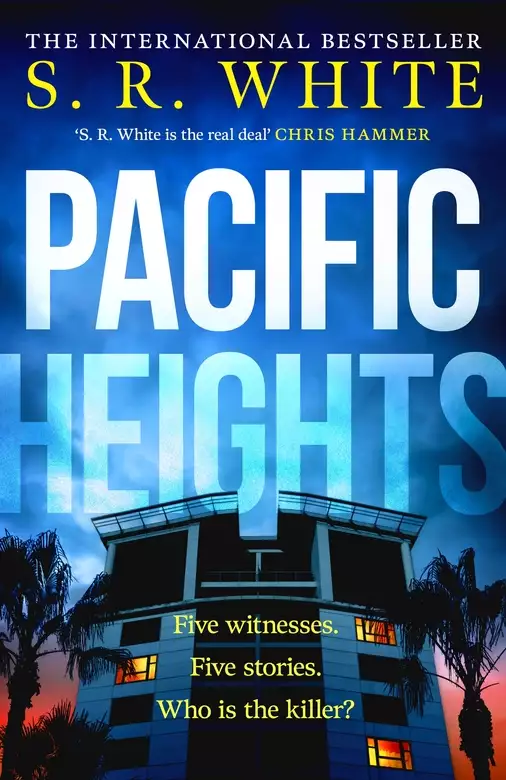
FIVE WITNESSES. FIVE DIFFERENT STORIES. WHO IS THE KILLER?
'A rising star of Australian crime fiction' SUNDAY TIMES 'S. R. White is the real deal' CHRIS HAMMER
In the courtyard of the Pacific Heights building, a local waitress is found dead. Five apartments overlook the murder scene. Five people witnessed a crime take place. Finding the killer should be simple.
Except none of the witnesses' stories match. They all saw something - from a different angle, at a different time. None of them saw everything. Anyone could be the killer.
Detectives Carl "Bluey" Blueson and Lachlan Dyson, each with their own careers in peril, must solve what others assume is a straightforward case. But to unmask a killer they must unpick a complex puzzle - where the motivations of the witnesses are as mystifying as the crime itself.
How can you solve a crime if anyone could be lying?
Praise for S. R. White:
'A taut, beautifully observed slow-burner with an explosive finish' PETER MAY 'Original, compelling and highly recommended' CHRIS HAMMER 'Gripping' THE GUARDIAN 'A fascinating case' SUNDAY TIMES 'It draws you in - and rewards with a truly powerful ending' HEAT 'This slow-burn novel catches light' THE SUN 'The story takes place over less than 48 hours but the pace is slow-burn, relying on considerable psychological depth...the denouement hits like a knockout punch' WEEKEND AUSTRALIAN 'A dark and compulsive read' WOMAN & HOME
Release date:
March 27, 2025
Publisher:
Headline
Print pages:
288
* BingeBooks earns revenue from qualifying purchases as an Amazon Associate as well as from other retail partners.
Buildings are supposed to endure. They are built to withstand the vicissitudes of everyday life, the vagaries of heat and drenching rain, the basic carelessness of humans. If they’re lucky they are cared for, as a mark of the symbiotic nature of the relationship – shelter in return for respect. They become cherished, appreciated. More often, they are seen by the occupants as simply a giant appliance; a generic set of boxes to be used and abused as people see fit. Those buildings look pained – you can see their anguish in the decay of wood and stone, the untreated blemishes of paint and plaster. You can tell, in fact, what people think of a building by the condition it’s in. One glance would prove that the apartment block of Pacific Heights was in sad, mournful decline.
The district of Windoo was just scraping into upper-middle class; the coffee shops were independents or higher-end franchises, boutiques ‘neglected’ to carry price tags on their wares, courtesy electric chargers stood sentinel for locals to top up the Tesla. The trees were trimmed before delivery trucks and street-washing vehicles could give them a clout. People aspired to live here at some point in their lives, for a few years, but not for too long. It was a suburb that existed as a life phase for singles and couples; they who would later move on to districts with more greenery and less street art, gardens not courtyards, garages not bike racks. Many recalled it simply as a place that they used to live in; back then they were okay with shared houses, mattresses on milk crates, splitting the electric bill and not owning a car. Scuffles outside the Lebanese takeaway hadn’t been a cause to dial triple-zero; they’d been a colourful and vivid part of urban life. Windoo had moved up but they’d moved on.
Human traffic tailed off here after midnight, when the last of the cafés and restaurants along Longman Street packed it in. Taxis didn’t bother to forage and the council dimmed the streetlights to save the planet. Windoo looked in slumber because it was: too late to be kicked out of a bar, too early to be jogging. The only lights glowing on Longman were from the night baker, who stole a smoko every thirty minutes as a legitimate perk, and the Night Owl, where the cashier fell asleep over engineering textbooks. Occasional distant sirens from the nearby expressway crackled in small snaps of sound between the buildings. Possums scuttled across rooftops and bats flitted through the looping electric wires: thieves coursing through the district’s exoskeleton.
It was not a night for murder. Some nights were – steaming, humid nights where the air fizzed with tension and expectation, when every minor dispute seemed to raise itself beyond threat and bluster. But not this night; it was calm, placid and safe.
Until it wasn’t.
City West Police Station. Thursday, 0351hrs
They sat on opposite sides of the office while the superintendent’s assistant clacked the keyboard and tried not to smirk. If she was fed up with night shifts like this, she hid it behind a fastidiously elegant appearance. Lachie adjusted his collar yet again, feeling the fetid air; Bluey exhibited a Zen-like calm, tracing the patterns in the carpet. Jasmine had seen ’em come and go: lambs to the slaughter, human sacrifices. These offices were for the ritual disembowelling of careers, spilled blood to appease gods of media and moving on. At last a scratchy bark escaped from the superintendent’s inner sanctum and Jasmine gave a quiet nod. Bluey smiled and politely let Lachie through the door first.
Superintendent Laxton sat ramrod-straight in his chair, a blotter in front of him. No one needed a blotter these days; it was somewhere to rest the coffee that wouldn’t leave rings on the desk surface. He glared at each of them in turn.
‘You’re up for that murder on the west side. Windoo. Know why you’re on the case?’
‘Next cab off the rank?’ Lachie had surreptitiously lip-read as the two detectives stood sentinel, awaiting official instruction. Now he offered a view that he knew would be strafed. He could smell furniture polish in the air. Cops who did military service first – everything spick and span; perpendicular corners, starchy collars and manners. Outside, it was still dark. Desk-lamp reflections in the black window caught his eye.
Laxton frowned.
‘Last cab, more like it. We’ve had another drive-by overnight, up at Mission Plains this time. Two dead, including some poor bastard selling hot dogs, for Christ’s sake. Plus a teenager who’s on life support because he chose that exact half a second to pass a restaurant.’
He sighed, as though the two detectives were personally responsible for organised crime’s recent dickhead-on-dickhead rampages. The new deaths made nine in three weeks – all gang-related in some way, adding another layer of feverish fear on to a population already wearying of it. Collateral damage – innocent people dead – was energising the media.
‘Commissioner’s screaming, papers are whinging, socials are off the charts. Everyone I rate highly is on those gangland killings because it’s all out of control.’
Bluey swallowed, anticipating. It was never nice to know exactly how far down the pecking order you were.
Laxton gave a meaningful glare. ‘So I don’t have time to be fussy about who deals with this other homicide and I don’t have time to be a bloody childminder, either. You, Bluey’ – he pointed to Carl Blewson – ‘are on this because you have twenty-five years as a detective and you can’t have forgotten everything yet. You, Lachie’ – he pointed to Lachlan Dyson – ‘are on this because Bluey isn’t allowed a gun. One brain and one pair of hands should be enough. I mean, there are eyewitnesses, boys. More than one. Don’t screw it up and don’t make me chase you.’
Laxton leaned in, as though he needed to shoulder-charge the message.
‘I don’t like the phrase “last-chance saloon” but, bugger me, if the cap fits, eh? Bluey, you know what grazing in pasture feels like. Expect to go back there if you’re not an investigative asset. People tell me you’re off the pace, mate. Prove ’em wrong. Prove me wrong. And as for you’ – he glared at Lachie – ‘well, you had to pay a prosecutor’s laundry bill, didn’t ya? Organisations don’t like runaway horses or people who don’t know how to shut up. HR knows how to deal with problems like you.’
Lachie gave a subtle nod.
Laxton sighed. ‘Alrighty, you can bog off now.’
His fuming belligerence ushered them out of the door. They were in the corridor before they glanced at each other.
‘Charm school should have given him a refund,’ muttered Bluey.
Lachie smiled at the floor. ‘Would it make you feel better to know he has a fine singing voice?’
‘Not really. We should do the formals, I guess. Carl Blewson. Bluey.’
They shook hands as they walked.
‘Lachlan Dyson. Lachie. Good briefing that, eh? Chock-full of data.’
Bluey nodded. Lachlan Dyson. Die-in-a-ditch Dyson. Bluey had been told no one wanted to work with Lachie because the young detective had a high-and-mighty approach to ethics: no wiggle room and no common sense, recently suspended because he wouldn’t back down. Oh, and he was deaf as a post, apparently. Wore a hearing aid. Correction; a cochlear implant. Which implied that he only got in the force because his dad is an assistant commissioner. Bluey had heard all that as soon as he mentioned he was paired up with Lachie. Brilliant. Bound to be a politics-free zone, then.
Bluey Blewson, thought Lachie. Fifty-something; apparently out in never-never land until his pension kicks in and he can officially take up golf. They took firearms off anyone over fifty-five these days: some uni in Melbourne did a study and it turned out the old mates’ reflexes were too slow to be safe. Still, Lachie could have done worse. No one had actually slagged off Bluey – which was practically unheard of in City West – and he’d seemingly done well last month in a case for another district.
The tortoise and the harebrained. They made one good detective between them. Maybe.
‘Apparently the body’s still in situ,’ offered Lachie. ‘Medical examiner’s stuck out at Mission Plains.’
The gangland killings were being laid squarely at the force’s door. For years the public had heard little from the assorted gangs that once dominated the city – organised crime had been sufficiently disorganised. Then the drive-by shootings began: a shopping mall, a KFC, a kids’ footie game. Now everyone knew the names of the leaders, who held which neighbourhood, and how much those gangs made from drugs, vice, illicit gambling, tobacco and vaping. In truth, the state government had rolled back restrictions on gang members associating and this had driven their renaissance. But nuance, not truth, was the first casualty of war.
‘Good,’ replied Bluey, pressing the lift button. ‘I prefer to see the scene as fresh as possible, don’t you?’
Not really, thought Lachie, though he kept silent. He considered visiting the scene to be largely a waste of time, except to direct uniform so they didn’t miss anything obvious. Most constables these days had enough forensic awareness not to actually screw up the scene. Witnesses could be made to come to them; in fact, that often intimated them into further information. He thought it was all a bit of an ego trip; the almighty detective showing up and bustling in, stopping everyone mid-tracks, then crouching by the victim and ostentatiously glancing about. The optics fed the ego, but also carried an implication that uniform needed to be in a crèche.
Bluey waved a desultory hand at Lachie’s iPad. ‘How’s about you drive that and tell me what we have, and I’ll drive the car?’
Lachie had heard that Bluey was a petrolhead and thought it a reasonable division of labour. Even so he had a pop, out of a sense of obligation. ‘Technology a bit tricky for your generation, Gramps?’
Bluey eye-rolled. ‘My generation built this country. Your generation just live in it.’
The crime scene lay a few clicks to the west of the station in the older suburb of Windoo. At four in the morning traffic was just starting up – the earliest of early tradies and the last of some night shifts. The tradies were gunning it in utes while the shifters were crawling home in battered sedans. Bluey took them past two servos where the cashier looked either completely asleep or a fentanyl victim, then past a crew just beginning to section off a road for some crane work. Normally Bluey liked driving this early in the day – it felt vaguely special, as though you were part of a small, select club who were up that early. But he already had a sinking feeling that this murder investigation wasn’t easy. Though, he reflected, everyone clearly thought it was; they’d be on his hammer if it wasn’t cleared quickly.
Lachie pecked and swiped until he was sure of his ground.
‘So . . . yeah, okay. The victim is Tahlia Moore. Twenty-seven, waitress at What’s Brewin’, a coffee shop about two hundred metres from her unit. Discovered at 3.21 this morning in the courtyard of her apartment block on Reed Street. Early indications: no signs of a struggle, one stab wound to the chest, potential bruising on the skull, maybe hit her head on the way down. Tahlia lives alone – there’s a sister, but apparently she’s off doing a gap year.’
‘Who found the body?’
There was an ominous pause. Then: ‘Oh, Jesus.’
Bluey risked a glance across. ‘He found it? How? Is he back again?’
‘Haha. Yeah, it’s just –’ Lachie shuffled in his seat. ‘Mate, it’s Reuben Pearce.’
Bluey gave a quiet whistle. ‘Please tell me it’s another Reuben Pearce who’s a totally nice bloke.’
Lachie shook his head. ‘Nah. It’s that one.’
Ah. Bluey swallowed and gave the revelation its due. Reuben Pearce. Undoubtedly more of an issue for Lachie than for him, but even so. Word would pinball around and the optics of how they played this would be reported – more or less accurately – in every police canteen and station in the state.
‘Weren’t you suspended for . . .’ Bluey let the words hang.
‘Yeah, yeah I was. We had a meeting with the prosecutors, going over evidence for discovery, that sort of thing. I might have expressed a strong opinion.’
‘Which was?’
‘That dear Reuben should go to prison for a long time for what he did. For the effect it has on others. I misread the room though, didn’t I? All those people who agreed with me in private: they just shut up when the moment came and left me swingin’. Prosecution was preparing to soft-pedal the whole thing to make it go away – the minister was embarrassed by his first hot take and it’s getting near election time. I was, uh, probably a bit strong with how I said it.’
Not to mention where, thought Bluey. Lachie was, so the rumour factory told it, about thirty centimetres from the prosecutor’s face when he gave it all the hairdryer treatment. Spittle-on-the-suit close.
‘I’m going to suggest that I deal with Reuben, when it comes to it,’ said Bluey.
Lachie nodded. ‘Fair enough. So yeah, Reuben found Tahlia in the courtyard. By the time he called it in we’d already had a triple-zero from someone else in the building. Lady by the name of Bryony Price. Then a couple more calls came in about the same thing, but uniform and paramedics were already up and about.’
Bluey shrugged. ‘Our charming boss did mention witnesses.’
‘Yeah, uniform started canvassing the locals soon after.’
Bluey negotiated a mini-roundabout before a burbling 70s Ford got there. ‘You’d be lucky to get five people awake at three in the morning. How many live in the whole block?’
‘Uh, fifty-six apartments, so I’m guessing a hundred-plus. Some of them would be kids, though.’
‘Still, as Laxton said, eyewitnesses. How can we go wrong with that, Lachie?’
Lachie grunted. ‘You’ve got some experience with Laxton, have you?’
‘A bit. Back when I was part of the team.’ Bluey stifled an urge to talk about his departure: it still felt wrong. ‘Laxton was army first, for a while, then about fifteen years across the border before he transferred here, so he came from interstate. You know what Laxton’s nickname was, when he first arrived? Thrombo. As in, a slow-moving clot.’
Lachie sniggered. ‘Is he any faster now?’
‘Not really. He’s all right, I suppose, but media pressure gets him in a panic. That’s why he’s frothing now. Okay with any other sort of pressure, but he hates seeing his name associated with bad news. He’s obsessed with socials like he’s twelve years old. So it’s probably best if we can keep this case off everyone’s radar. Ah, here we go.’
The apartment block – Pacific Heights – was a long way from the ocean and a long way past its best. Built in the 80s with a breezy aesthetic and a sense that three palm trees made anything ‘tropical’, its cladding panels had faded from dazzling orange to dust-flecked tan. A small orchard of satellite dishes on the flat roof were rusted and forlorn. The ground-floor windows were coated in various forms of powdery disdain – exhaust soot, construction dust, fallen slivers of plaster – and the ground strewn with fast-food wrappers and discarded bottles. The complex was all organised in a crude doughnut – perhaps elliptical, thought Bluey as they parked outside – around a large courtyard.
They entered the building into a hallway that ran through to the open space beyond. It needed painting and, Bluey observed, someone to care enough to scrape the spiderwebs off the ceiling. Scratched walls implied that deliveries bulldozed through, ricocheting off the plasterboard. A notice carried a smeared message about an upcoming fire drill. Pizza-delivery leaflets hung from the mailboxes like the tongues of thirsty dogs. A trolley for carrying large items to and fro sat, battered and bruised, below the stairs. The lighting was harsh and it flickered.
Into the courtyard and the view changed. The complex stretched up four or five storeys, the roofline framing the night sky. To the left was a small kidney-shaped swimming pool surrounded by black metal fencing of legal height; the sort of half-arsed pool that was there because the developer felt obliged. A couple of palm fronds and a cockroach shimmered on the surface in the breeze. Four bushy trees, around five metres tall, clung to each other near the shallow end. Next to that was a children’s play area, seemingly underpinned by that spongy surface they made from recycled sports shoes. The sandpit held a lonesome Steeden someone had kicked there and a kid’s plastic spade. Five concrete mushrooms, each the height of a decent dog, formed a circle. A swing, a slide, a small roundabout and a couple of metal structures that Bluey initially thought was a bike rack but then realised was an ‘outdoor gym’: not his area of expertise.
On the other side of the courtyard was a barbecue area with some white plastic furniture; some of the chairs were tipped on their side. The brickwork around the barbie was chipped, as if people were perennially striking it with a shovel. The palm trees looked as though someone had slapped them: unkempt fronds clung tenaciously. The key area was taped off and a white tent erected to shield the body. Lachie took a 360 and saw plenty of lights on; some residents were sitting on their balcony now, wrapped in a snuggly onesie or a blanket, sipping a coffee and pointing their phones. Someone’s tragic death was everyone else’s direct messaging.
Lachie called over a uniformed constable carrying a clipboard. The clasp glinted from an arc light to his left, creating a glare that was metallic and intrusive. The constable was short and slightly dumpy, a frizz of ginger hair over clumps of freckles and a frown.
‘Are you the detectives?’ he asked.
Lachie waved a badge. Bluey had drifted back towards the entrance.
The constable scribbled with a pen and then checked his watch. ‘Formal handover to SIO, 4.09 a.m. Can you sign here, please, sir?’
Lachie signed, his left hand scrunching into a horrible crab position that made the constable wince. Lachie noted the name: Constable Tyson Richards.
‘Someone on to the next of kin yet?’
Tyson nodded. ‘Officer from City West informed the mother ten minutes ago – she’ll have to come in to do the full ID. Father’s deceased, apparently.’
‘Okay, Tyson, talk me through what I’ve missed.’
The wording was deliberate. Tyson could merely go through the motions, or he could prove he had a bit of spark and demonstrate some initiative. The choice would help Lachie to calibrate how much use the bloke was going to be.
‘First call at 3.21 on the triple-zero. Bryony Price. Old lady lives on the top floor to the right, there.’
Lachie swivelled and saw a muted light from the centre of the top floor. The sky beyond remained jet black: it wasn’t near enough to dawn to see a purple tinge in the east. ‘That’s . . . north, right?’
Tyson frowned. ‘Not sure, sir. I’ll get a map of where each apartment is, shall I?’
‘Yeah, consider that job number one.’ At first glance, Bryony Price’s view of the dead body would be partly obscured by the roof of the barbie area, though she’d have a clear sight of each doorway on to the courtyard. ‘Sorry, I interrupted you, mate.’
Tyson swallowed and resumed. ‘Two minutes later, a second call about the dead body, from Reuben Pearce. He’s . . .’
‘Yeah, that one. I know. Where’s he live?’
Tyson aimed his pen at a ground-floor apartment; a small terrace dominated by three large potted palms and a clothes line that was drying some beach towels. Two figures sat on metal chairs on the terrace.
‘There. He rang from, well, the middle, here. Said the woman was in his arms and she wasn’t breathing. They said he should try mouth-to-mouth.’
The two figures were too distant to make out in this light; Lachie felt Reuben’s presence by instinct. He tried to suppress it, but his cynical side burst through. Of course he’d do that, if he’d killed her. Make sure there was a legitimate reason for her blood all over him, for her fibres to be on his clothes. ’Course he would.
‘There’s an officer with him, right?’
‘Yes, sir. Constable Radcliffe. With him at all times.’
‘Yeah, okay. Good. Who else called?’
‘Jody Marks. Second floor, on the left, there, with the red lamp in the window.’
And those four bushy trees between him and the victim, thought Lachie, who was already trying to calculate logistics and angles.
‘Oh, and last one: old mate on the ground floor behind you. Martyn Brooks. He wasn’t sure what he’d seen.’
No; the swings, roundabout and half a mushroom saw to that, Lachie reflected.
‘All right. Paramedics still around?’
‘I asked them to wait. They’re just outside on the parkland side, through there.’ Tyson wielded the pen again, aiming at the other doorway to the courtyard. Lachie could see the blue pulses from the ambulance reflected on the stucco wall of the entrance. Tyson wasn’t half bad, it seemed.
‘Please tell me there’s CCTV on this place.’
Tyson shook his head. ‘Yes and no. There’s a camera over each entrance, pointed in at the courtyard. One of those convex jobbies that takes in a complete 180. But the wiring’s floatin’ in the wind so maybe they’re not recording. Was the first thing I asked. I’ve got a call in to Ivory Security, but nothing back yet.’
Their lack of response to an emergency situation probably reflected their brilliance in general maintenance. Bloody hell, thought Lachie: those cameras would have seen everything. Tyson tried to soften the blow.
‘I’ve got the caretaker here; she might know about the cameras. Name’s . . . ah, here, Sally Harris. Over there, on the mushroom.’
They both looked to one of the five psychedelically decorated mushrooms next to the playground. Sally Harris had a shock of coloured hair – maybe blue, hard to see in the half-light – and wore some kind of overall or jumpsuit. She sat, elbows on knees, wiping angrily at her eyes with a sleeve.
Lachie could see Bluey strolling towards them. He turned to Tyson.
‘Okay. We’re probably going to talk to the eyewitnesses first. Go and tell Sally she’ll have to wait a bit longer. See if there’s a scale plan of this place – would save us making our own. Then wait for us; we’ll be needing you to navigate around a bit. Okay?’
‘Sir.’ Tyson was crisp, and Lachie was happy with him already.
Bluey took a deep breath as he joined Lachie. ‘Thank God a sensible constable turned up and controlled the scene.’ They were variable, he knew.
‘Paramedics first?’ offered Lachie.
‘Just spoken to ’em. Thought I’d work outside-in, as it were. Nothing too amazing. They got a call of a woman collapsed and unconscious – nothing much more than that. They were updated en route that she wasn’t breathing and had an injury. Had to wait to get through the outer door: no one likes intrusions into their apartment building in the dead of night. Eleven minutes from first call to touching the victim, so 3.32 when they got to her. Tahlia was on the ground, no pulse, no breathing. Reuben was standing next to her. Blood on him – front of his clothes, mainly. He’d tried mouth-to-mouth. Nothing worked on Tahlia, obviously. Reuben seemed shaken but aware; gave good details, offered to help.’
Lachie tried to picture the scene unravelling. ‘Was Reuben ever out of their sight?’
Bluey nodded, liking Lachie’s direction of travel and his speed.
‘Yeah, I wanted to know that. Apparently, when the two paramedics were working on Tahlia, Reuben went and wedged the doors open between the courtyard and the ambulance. They can’t swear it was only a minute; might have been longer.’
Both detectives were thinking about a man disposing of a bloody knife. Drains were popular, as was an almighty throw into the nearest set of bushes. They were thinking search perimeter; both calculated at least two hundred metres.
Bluey added fifty for luck. ‘Two hundred and fifty metres, to be on the safe side?’
‘Yeah,’ replied Lachie. ‘Although, he could have got rid of the weapon before anyone made a call. In which case, wherever.’
‘Assuming Reuben’s not just a good Samaritan who did the right thing.’
Lachie blinked twice. ‘Yeah. Assuming that.’
Bluey was sure that Lachie was aware of the danger of leaping to conclusions: they hadn’t even sighted the body yet, or talked to any witnesses. And yet . . . what Reuben Pearce had done – what he was notorious for – swept that caution away. Reuben was a proven liar. Famous for it. Known to be an unreliable narrator of anything that happened around him. It was hard to ignore that; Lachie wasn’t trying.
Tyson came back from speaking to Sally Harris.
‘She’s got some scale plans in the switch room, she thinks; she can get us a copy once we’ve spoken to her.’
Bluey offered a hand. ‘Carl Blewson. Call me Bluey, like the dog.’
Tyson shook hands and nodded. Bluey regarded the caretaker, whose foot tapped anxiously on the ground. ‘Did Sally there know the victim?’
‘I think so, si—Bluey. She’s pretty shaken, anyway.’
Both detectives pondered for a second, whether to push Sally up the list. Bluey shook his head.
‘Nah, let’s give her a few minutes to compose herself, eh?’
Lachie turned to Tyson. ‘I fancy meeting that bloke fr. . .
We hope you are enjoying the book so far. To continue reading...

 Please log in to recommend or discuss...
