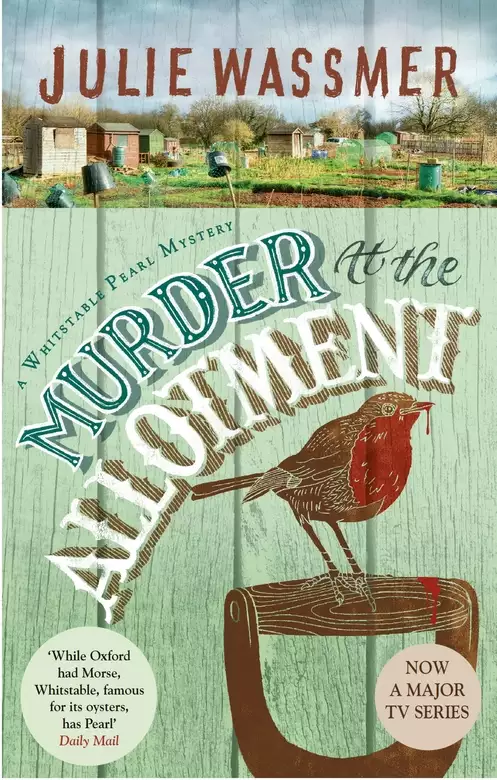
Murder At The Allotment is the tenth book in Julie Wassmer's popular crime series - now a major Acorn TV drama, Whitstable Pearl, starring Kerry Godliman as private detective and restaurateur, Pearl Nolan
'While Oxford had Morse, Whitstable, famous for its oysters, has Pearl' Daily Mail
Pearl's tiny garden of Eden is transformed into a battlefield when the out of towners come to Whitstable...
Pearl Nolan's coastal allotment has always been a quiet haven - somewhere for her to relax and cultivate special ingredients for her restaurant, The Whitstable Pearl. But a sudden clamour for allotments by the DFLs - Down From Londoners - causes tension in the local community when the council decides to accommodate them by dividing existing plots into smaller parcels. The harmony that once existed between holders of land previously blighted only by slugs and caterpillars, soon transforms into a bitter turf war as a pushy DFL tries to take over by forming an Allotment Association - with herself as its chair.
When anonymous complaints are submitted to the council about each of the local allotment holders -- apart from the DFLs --Pearl's services as private detective are called upon to discover the complainant but before she can do so, what began as a tiff among the turnips soon becomes a hunt for a killer when gardening tools are put to murderous use...
Praise for Julie Wassmer's Whitstable Pearl Mysteries...
'One of the best episodes in Wassmer's longrunning Whitstable saga' Daily Mail
'As light as a Mary Berry Victoria sponge, this Middle-England romp is packed with vivid characters' Myles McWeeney, Irish Independent
'All of the thrills without any of the gore' The Sun
'Wassmer tells a rattling good tale with a lineup of oddball characters who keep us guessing' Daily Mail
'This is a quality title...a very entertaining read' The Puzzle Doctor
'A wonderful way to explore Whitstable . . . if you love cosy mysteries, then get acquainted with Pearl (and her mum and her cats!) and enjoy a trip to Whitstable through the eyes of this very convincing author' Trip Fiction
'Proves she's mistress of her craft' John McGhie, author of White Highlands
'Good, solid whodunits, without gruesome details or gratuitous violence, Murder on Sea may be just your cup of tea' Bec Stafford
Praise for the TV series...
'Scandi noir meets the English seaside in Whitstable Pearl, a murder mystery series based on Julie Wassmer's novels...' Drama Quarterly
'...explores all the murder and debauchery in the seemingly perfect English seaside town of Whitstable...' Washington Post
'...you never know what might turn up, either on the menu or alongside an oyster boat.' Wall Street Journal
Release date:
May 14, 2024
Publisher:
Little, Brown Book Group
Print pages:
65000
* BingeBooks earns revenue from qualifying purchases as an Amazon Associate as well as from other retail partners.
If anyone had been up that Saturday morning, shortly before nine a.m., taking a walk near Prospect Field in Whitstable, they might well have assumed that the tall, dark-haired woman wearing a vintage summer dress, who was approaching from her parked Fiat with a pannier across her shoulder, might have been heading to some public benches that overlooked the shore. Perched high on the railway embankment, they afforded a fine view of the Swale estuary, while providing a suitable resting place for any dog walkers who preferred to avoid the beach and the crowds who flocked to it during the summer months.
Prospect Field was the name given to an area of almost four acres of scrub and grassland between Whitstable’s railway line on the north side and the residential road of Joy Lane to the south. Preserved by a group of volunteers, it offered a much-needed safe habitat for local flora and fauna, especially as a proliferation of new building projects had left few wildlife corridors in the area ‒ apart from the golf course and the railway embankment. It was a peaceful spot, not just for local walkers but for a variety of creatures, including hedgehogs, woodpeckers, grass snakes and lizards – as well as the rabbits that were often seen scampering down the embankment.
As the bells of St Alfred’s Church began to ring the hour, Pearl Nolan was quickly reminded that she had little time before another busy day would begin for her at the restaurant that bore her name – The Whitstable Pearl. The popular high-street establishment had supported Pearl and her family for the past twenty years, and as a ‘people person’, she always did her best to ensure her customers enjoyed their time with her, locals and visitors alike. At one time, The Whitstable Pearl had presented a huge challenge for a young single mother with only the support of her mother, Dolly, but now, some twenty years on and in her early forties, Pearl found the business ticked over nicely with the help of a talented young chef and a few trusted members of staff.
Taking a deep breath and a set of keys from her pocket, Pearl quickly crossed a path that led to a local allotment site where a rusting gate creaked open beneath her hand, signalling that someone else was already there. The ground was still damp from a heavy downpour the night before, but as Pearl gazed up at the sky, she could see the sun trying to break through the morning haze.
The Nolan allotment had been passed down through generations of Pearl’s family to her mother, though it was Pearl who generally tended the produce grown there, with some help from her son, Charlie. Dolly preferred to potter in the plot’s wooden cabin, particularly when she had some messy artwork to complete. Her usual signature pieces were small canvases inspired by the local coastline and embellished with various objets trouvés she picked up on her beachcombing walks: dried seaweed, shells and fragments of glass polished by the tide until they resembled jewels.
As Dolly had long surrendered most of her own garden to a new extension that enabled her to accommodate holiday guests in the first-floor flat she had named Dolly’s Attic, the allotment provided some welcome open space, as it did also for Pearl: her garden at Seaspray Cottage, though attractive and with a sea-facing view, had shrunk with the inclusion of a beach hut on her lawn, which she now used as an office. The allotment also offered Pearl a valuable location on which she could grow not only her own fruit and vegetables but flowers too – like the seemingly unending supply of sweet peas she used throughout the summer to decorate her restaurant tables.
Although a few neighbouring plots had changed hands after their holders had given up on them, shocked by the hard work that was required ‒ as opposed to the idealised allotment life displayed in TV shows and colour supplements ‒ Pearl had held on to the Nolan plot. She respected her family roots and appreciated a wider sense of history: she had read of how early allotments had grown out of the theft, for want of a better word, of common land that had been lost to the enclosures. At school, Pearl had learned that the concept of allotting to poor labourers a piece of land on which they could grow their own food had evolved during the Enlightenment. Then the ruling classes had deemed it safer for peasants to be planting root crops than pursuing more wayward habits.
Once the Industrial Revolution had forced people off the land into mills and factories, it became clear that a large proportion of the population could no longer feed itself; the allocation of ‘allotments’ of land represented some insurance against starvation. Following the First World War, this provision had been extended to returning soldiers, with local authorities providing land according to demand. As Dolly’s grandmother had always said, ‘As long as you have a piece of land to put a spade into, you’ll never go hungry.’
Pearl had no fear of starvation, merely a firm intention to make good use of the plot while taking time to relax from the demands of The Whitstable Pearl. These days, her presence wasn’t always needed in the restaurant as her small group of capable staff could manage quite well without her. But no matter how busy Pearl became, she always found time for some allotment planting in spring, even though the resulting crops were not always a success. What was important to her, as with her cooking, was to experiment and discover new ways of achieving good results. The allotment also allowed her to feel connected to the earth. By turning it, feeding it and making use of it in a positive way, stillness seemed to fall, as though the earth itself was giving thanks.
In spite of the peaceful environment, in recent months the allotments had become the setting for a battle with the local council, which had not only sold off half of the site but voted to reduce the size of existing plots. Considerable strips had been lost from each to create more council revenue while satisfying increasing demands from an influx of newcomers – the DFLs, or Down From Londoners, as local people tended to describe them. The term had become increasingly pejorative, particularly since one new resident, in particular, had succeeded in pressuring the local newspaper, the Chronicle, to feature her views in several front-page stories. She had claimed it was easier to find a burial plot in Whitstable than a space on a local allotment – a point she had later pressed home in a powerful speech at a rowdy council meeting.
It was no secret that Caroline Lanzi was particularly well versed in the art of public relations. In fact, it was widely known that she owned a successful London-based company, Lanzi Communications, which specialised in generating good publicity for clients – including some minor celebrities. Once the new DFL had bought a house in Whitstable’s Joy Lane, close to the allotments, it had soon become clear that she was using her professional skills to obtain exactly what she wanted – even if other plot holders, like Pearl and Dolly, were to lose out on allotment territory.
Pearl glanced across the site, relieved that neither Caroline Lanzi nor her husband, Franco, was anywhere to be seen. In fact, no one appeared to be working on the plots, in spite of the unlocked gate. The neighbouring allotment to Pearl’s belonged to Marty Smith, owner of Cornucopia, the local fruit and vegetable shop ‒ or, rather, emporium, as Marty preferred to call it. At that hour, he would still be supervising deliveries for his best customers – including Pearl at the restaurant – before enjoying a busy day providing exotic fruit smoothies for tourists and fresh produce for locals.
Marty’s plot sat beside that of local wood carver Joe Fuller and his partner, Florence Brightling. A gentle nonconformist couple in their early thirties, their plot was filled with an abundance of well-tended runner beans, strawberries, tomato plants and squash of various colours, shapes and sizes.
The next belonged to local teacher Michael Stopes. In recent weeks, Pearl had noticed how well Michael had seemed to be getting on with his own plot neighbour, Vanessa Hobbs, a teaching assistant at the local nursery who kept three hens on her patch, named Faith, Hope and Charity. Across the fence from a coop that kept the birds safe from marauding foxes lay a plot acquired by Caroline Lanzi’s friends, Victor and Natasha Bessant ‒ owners of two shops in Harbour Street, which had recently been renovated to create a spacious new art gallery – The Front. Dolly maintained that the name was entirely appropriate not only due to the gallery’s enormous show window but the high rates of commission she claimed were shamefully charged for sales of work created by impoverished local artists.
Dolly’s old friend Madge Tolliday had custody of the next plot, while Caroline and Franco Lanzi held land on the other side. Bordering the Lanzis’ plot, Ted Rowden, an octogenarian, was the local expert on all things horticultural. It was perfectly possible, thought Pearl, that beyond the cloches, cold frames and bamboo wigwams, the grandfather of Joy Lane’s allotments might be ensconced in his shed, busily sowing seeds or perhaps enjoying a flask of tea to fuel him for a morning’s weeding. There again, thought Pearl, he might also be contemplating how to deal with the bindweed that was fast encroaching across the fence of the final plot, from which Ted’s neighbour, David Chappell, had been noticeably absent for some considerable time.
As far as Pearl was aware, no one on the allotments had tackled David about the state of his plot, because it was common knowledge he had been experiencing problems. Everyone seemed to know that his wife, Cindy, had left him for local roofer and scaffolder Russ Parker, nicknamed Russell the Muscle due to his highly toned physique. Russ Parker’s bronzed ‘abs’ seemed always on display on the rooftops of Whitstable – which Pearl knew would have added to David’s distress. Although his wife and her lover had recently left town, David had seemingly descended into an even greater downward spiral, convincing Pearl that he must have been holding on to some hope that Cindy might tire of a T-shirt full of muscles and return to him.
Dolly had heard, through her own local jungle telegraph, that David had suffered a breakdown but had chosen to ignore suggestions to seek help from his GP. Thinking about this now, Pearl considered the bindweed spreading out from David’s plot and realised that, with all that he had had to deal with lately, the allotment must surely have been the last thing on his mind. No one expected David Chappell to return to it until he recovered.
In contrast, Pearl’s family plot remained well tended and easily identified by the large decorative panel that was attached to the side of its cabin. All Dolly’s work, it featured an oyster and a totem pole with a burnished sun shining down on a burgeoning crop. A snazzily dressed scarecrow, wearing an old striped blazer and a Panama hat, stood guard among beds of colourful sweet peas and summer vegetables. Pearl smiled at her crop and quickly hurried across to the cabin, outside which marguerites in terracotta pots swayed in the breeze as if greeting her arrival.
Pearl searched for the cabin’s key in her pannier, then slipped it into the lock and entered. As she pushed back a pair of striped curtains at the window, daylight filled the dusty interior, falling upon a small French wood-burning stove with an art-nouveau motif on its grille. Dolly had bought it from a junk shop long ago and it had often been put to good use in the winter months, though it would remain redundant today.
Taking a flask from her bag, Pearl reached for an enamel mug from a kitchen cabinet that had somehow survived the Blitz and poured herself some strong tea. Scooping up her long dark hair she secured it with a comb from her pocket before taking her phone from her bag and dialling a number.
The reply came quickly. ‘Pearl?’
‘How are you feeling today?’ she asked, as she sat down in a rocking chair.
At the other end of the line, DCI Mike McGuire stared ruefully down at his left leg, the lower part of which was encased in blue plaster. ‘Hot,’ he replied tersely.
‘Well,’ Pearl began, ‘that’s a given if you’re having to wear a cast at this time of year. Hopefully you’ll feel more comfortable after your check-up today.’
‘They’re not taking it off, Pearl,’ McGuire explained, ‘just checking the angle of my foot.’
There was no mistaking the frustration in his tone. Lately there seemed no placating McGuire, which was unsurprising as his severed Achilles tendon was preventing him from doing all the things he enjoyed most – including his work at Canterbury CID.
‘How about I come to the hospital with you?’ suggested Pearl.
‘You’ve got too much to do. And I don’t want you to waste your day.’
‘It won’t be wasted,’ Pearl argued. ‘I’ll be with you.’ She paused. Then: ‘It’s the least I can do if you won’t let me take proper care of you.’
McGuire heaved a troubled sigh. ‘I told you,’ he began, ‘I’m a bad patient, Pearl, and I don’t want “looking after”.’
She ventured: ‘In sickness and in health?’
‘We’re not married.’
‘Yet,’ said Pearl, quickly, ‘but we could be.’
‘We will be,’ said McGuire, ‘but I’m not hobbling down an aisle any time soon.’
He pulled down his trouser leg to cover the wretched cast. He hadn’t acquired the injury while pursuing a dangerous criminal but instead during an innocuous game of squash – about which his colleagues on the force had continued to rib him.
‘Heard anything from Charlie?’ he asked, in an effort to change the subject. Pearl’s son had disappeared to spend time with a Welsh girlfriend on the Gower Peninsula.
‘We FaceTimed the other night,’ said Pearl. ‘He’d just been surfing on Rhossili Beach. It looked heavenly, and Cerys is very pretty too – his new girlfriend.’
‘Lucky Charlie,’ said McGuire, pleased for him.
‘Let me drive you to your appointment,’ said Pearl, unwilling to be distracted.
‘I’ve already ordered a cab. Pearl, I’m fine.’
‘You’re not. You’re a cranky invalid.’
‘You’re right,’ said McGuire, giving up. ‘Just keep reminding me of that.’
With that, he grabbed the crutches that had been loaned to him by the physio department at the local hospital and caught sight of himself in his wardrobe mirror. ‘Long John Silver had nothing on me.’
‘Apart from a parrot,’ said Pearl.
A car’s horn sounded sharply from the street outside and McGuire glanced from his window to see a cab waiting patiently outside. ‘I’ve got to go.’
‘Wait!’ Pearl organised her thoughts, knowing she had little time to tell him how sorry she was that this accident, and his attitude towards it, should be keeping them apart. Instead she said only: ‘Tell them to take good care of you or . . .’
‘Or?’
‘They’ll have me to deal with.’
McGuire finally allowed himself to smile then ended the call.
Now Pearl took a deep breath. She felt conflicted, relieved that McGuire’s injury hadn’t sabotaged any existing wedding plans, but confident she didn’t need a marriage certificate to prove what she felt for him. Things weren’t straightforward. Coming from a man who was so married to his work, McGuire’s proposal had been a complete surprise – perhaps so much so that she had accepted it without fully acknowledging what marriage to the detective might actually mean: the relinquishing of her independence, and perhaps even her job – not at the restaurant but the side hustle through which she had first met McGuire, in her role as a local private investigator.
After she’d started up Nolan’s Detective Agency, it had never occurred to Pearl that her work might extend beyond the cases she felt more than adequately equipped to solve: tracing missing persons and pets, stalking errant spouses and recovering stolen vehicles – missions entrusted to her by members of her own close-knit community. What she hadn’t counted on was that the agency would bring her into contact with McGuire – and murder.
That had prompted her to call upon the police training she had chosen to abandon more than twenty years ago on discovering herself to be pregnant with Charlie. Pearl had ended a potential career with the police, only to find herself returning to a life of crime – this time outside the force. A series of events had thrust her together with McGuire, convincing her that she was back on the path for which she had always felt destined. Somehow, like the ‘volunteer’ hollyhocks that had appeared along the inhospitable stony path leading to the allotment, Pearl had found the setting in which she not only belonged but could thrive.
With that in mind, she now set about achieving what she had come to the allotment to do: to check on the condition of a crop of purslane, the leafy, frost-tender plant she loved to use as a herb and a salad vegetable. Today she would toss it into a simmering pot of clams to ensure some lemony accents in the dish she planned to prepare. Its tangy taste was always strongest when harvested early in the day so she finished her tea and screwed the top back on to her flask. She was about to move outside when she was halted by several loud bangs beyond the cabin – followed by a desperate cry.
Rushing outside, Pearl stared across the plots to see a figure facing away from her, holding a rake high in the air, the. . .
We hope you are enjoying the book so far. To continue reading...

 Please log in to recommend or discuss...
