
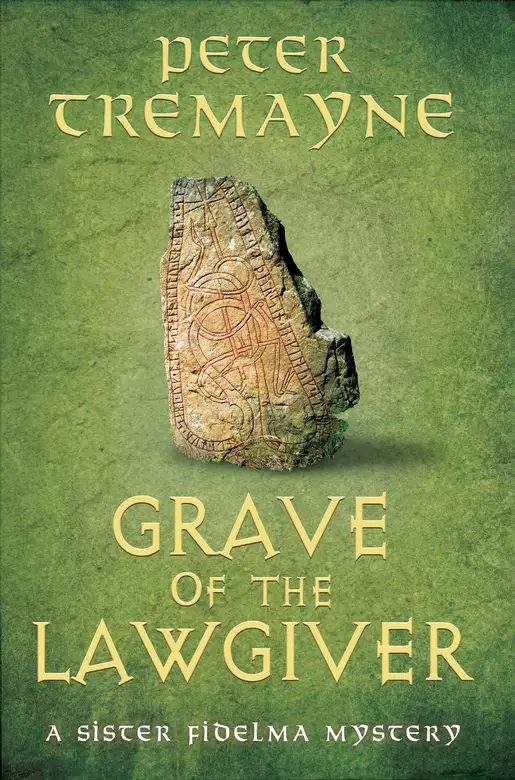
Grave of the Lawgiver
Available in:
- eBook
- Hardcover
- Book info
- Sample
- Media
- Author updates
- Lists
Synopsis
The thirty-sixth mystery in Peter Tremayne's long-standing and much-loved series, featuring 7th-century Irish super-sleuth Sister Fidelma.
The year is AD 673. Fidelma accompanies Eadulf to his hometown, Seaxmund's Ham in the Kingdom of the East Angles, to be greeted with the shocking news that Eadulf's uncle, Athelnoth, the lawgiver, has been murdered and his house burnt down. And Eadulf's younger sister is missing.
The locals accuse Fidelma and Eadulf of the crimes, and Fidelma's safety is threatened by the first council of the bishops and kings of the Angles and Saxons, who wish to expel all Hibernian missionaries and teachers from the kingdoms.
Against this opposition, Fidelma and Eadulf must unite to solve one of their most complex mysteries yet.
Praise for the Sister Fidelma mysteries:
'The background detail is brilliantly defined . . . wonderfully evocative' The Times
'A challenging and unusual but deeply satisfying and enjoyable historical thriller' Booklist
'Tremayne expertly incorporates historical and legal details of the time into the suspenseful plot. This impressive volume bodes well for future series entries' Publishers Weekly
Release date: October 7, 2025
Publisher: Headline
Print pages: 368
* BingeBooks earns revenue from qualifying purchases as an Amazon Associate as well as from other retail partners.
Reader buzz
 Please log in to recommend or discuss...
Author updates
Close
Grave of the Lawgiver
Peter Tremayne
The shouting had been growing louder until it became a resounding cacophony of voices at the gates of the Great Hall of Beornwulf, Thane of Seaxmund’s Ham. Then a harsh voice rose above the noise and ordered silence.
Inside the main room of the Hall, a man, seated at a table before a blazing log fire, had been disturbed by the crescendo and sudden silence. He paused, his cut of cheese, balanced on his knife, halfway to his lips.
‘By Thunor’s Hammer!’ he growled. ‘What is this unmelodiousness that disturbs the breaking of my fast so early in the morning? It is barely beyond first light.’
His question, to the woman standing nearby with hands clasped nervously in front of her, was a snarl of anger.
‘It sounds as if Crída has control of them, whatever they want,’ she replied calmly.
‘Go and see what this means, Ardith. If there is no good reason for this disturbance, then I promise that the culprits will be taught a sharp lesson in respect for their thane.’
Ardith, with hands still clasped in front of her, turned and hurried towards the main door of the Hall. Just before she reached it there was a thunderous knocking, suggesting an urgency of purpose. She opened the door to a weather-beaten-looking man, short and heavily built, with an authoritative air. From behind him came the sound of several people still with anxious voices raised, but more subdued than before.
The woman returned to the thane, accompanied by the man, and Beornwulf abandoned his breakfast and rose to meet him. He was a tall man whose tousled fair hair matched the colour of his large, shaggy beard. He was broad shouldered and muscular, bearing the carriage of a warrior. Beneath the shaggy hair was the face of a young man, no more than three decades old. His facial features were drawn together, half in anger, half in concern. His hand had automatically gone to the knife handle protruding from the sheath at his belt.
‘What is this?’ Beornwulf demanded of the visitor. ‘Speak, Crída!’
‘My lord, I have to report there is a house burning at the top end of the township,’ the man responded. ‘It is almost destroyed. The people are anxious and sent to alert us.’
‘A house burning?’ Beornwulf was surprised. ‘Why am I vexed with this news? Is it so unusual?’
‘It is a house up by the Gull’s Stream,’ confirmed the bringer of the news. ‘The flames were fought, but to little avail.’
‘Are the flames now contained?’ Beornwulf demanded. ‘Is there any danger of the fire spreading to other houses in the township?’
‘The flames are isolated, my lord,’ confirmed the man. ‘There is no threat to other houses.’
Beornwulf exhaled noisily, letting his irritation show.
‘Then why is there all this tumult, as if the entire township is threatened by some conflagration? Why am I pestered by this news? Are the Northumbrians raiding across our borders or have the Mercians threatened to march against us? What is all the commotion about? I have seen enough peasant houses burn down because these folk do not know how to tend their hearths properly.’
Crída shifted his weight uneasily from one leg to the other.
‘My lord, those who brought the message say that the burnt house belonged to Athelnoth.’
At the name, Beornwulf’s eyes widened.
‘Athelnoth’s house? The house of my gerefa?’ he echoed in surprise.
‘My lord, the word is that the lawgiver has perished in the conflagration, together with his servant Osric.’
The thane stared aghast at Crída, who was his druhting, his chief retainer, in charge of overseeing his estate.
‘How can such a thing be?’
‘It was Wiglaf the farmer who brought the news, accompanied by some concerned townsfolk. Rumours are already spreading about Northumbrian raids.’
‘We must put a stop to that,’ Beornwulf grunted. ‘Panic is more destructive than reality.’
‘Wiglaf was among the first to notice the fire and try to extinguish it, but the flames were strong,’ Crída explained. ‘By the time they intervened it was too late to do anything more than dampen the inferno. But Wiglaf felt he should report the alarming news to you. He told me that there was some mystery and malice in this deed.’
Beornwulf stood silently for a few moments. Then he ordered that Crída fetch his horse from the stable while he turned to the woman, Ardith, who, guessing his intention, handed him the signs of his rank: his sword and buckler, a small round shield carried on the forearm. The thane was conscious of his rank and privileges, and he knew that those he governed expected to see him attired befittingly. A sharp eye might notice there was something of an intimacy with the way Ardith helped Beornwulf adjust his appearance. As she was Beornwulf’s stewardess, in control of his household servants, this was accepted.
‘Mystery and malice?’ she softly echoed Crída, clearly disturbed.
‘Don’t worry,’ Beornwulf assured her. ‘I have to be back shortly for I must ride to the King’s Southern Fort this afternoon. Don’t forget I am commanded by the king to attend his Witan, his personal council.’
Although Athelnoth’s house was situated in the north of the township, just by the Gull’s Stream, a small tributary of the river Frome, on whose banks the township was built, it was no great distance from the centre, where Beornwulf’s own courtly Hall stood.
Beornwulf mounted his warhorse and, followed by Crída, he turned to the uneasy group that had gathered about the gates and, without pausing, assured them that all would be fine. Then he nudged the animal into a faster walking pace along the north track leading to the house of the gerefa.
It did not take Beornwulf and Crída long to reach the smouldering blackened ruins of the lawgiver’s house, which had been built on its own plot of land. Several people were gathered there: men, women and children. They fell into respectful silence as Beornwulf and Crída halted their horses. Crída dismounted to inspect the smoking, acrid-smelling remains. The thane sat surveying the scene in the dawn’s early light.
There was little to be done. The flames had almost completely levelled the wooden building, leaving only a few strong upright posts, and some beams that the fire had not been strong enough to demolish. Only by these supports could the outline of the once tall building be recognised.
‘You say Athelnoth was unable to escape death by the flames?’ Beornwulf addressed Crída while he looked around for a body.
‘Athelnoth was overcome by the flames, my lord, as was his servant Osric. You would get clearer evidence from the witnesses,’ Crída replied.
‘Where are these witnesses?’ Beornwulf demanded as he dismounted, and turned to the crowd that had gathered.
‘Two men were leaders of those who tried to douse the flames,’ replied Crída. ‘There was Wiglaf the farmer, and Stuf the geburas.’
‘Where are they?’
‘Wiglaf came to the Hall to inform us of the news and he has been following us back on foot. He has not caught up with us as yet, but Stuf is here.’ Crída turned to the group of people. ‘Stuf, come forward and tell your lord what you know.’
There was a nervous silence and then a lean, emaciated-looking individual, dressed more like a beggar than any of his neighbours, came forward, bowing almost in a cringing attitude to mark his gesture of deference to his master.
A geburas was a position that was hardly more than a slave. In order to retain a degree of freedom, the geburas had to work for a number of days on his thane’s estate for no remuneration. After working the appointed days, the geburas was allowed to do other work for pay. Stuf made an income from fishing and actually owned and lived on a small river craft.
‘So, speak, man!’ Beornwulf urged, as the man couldn’t seem to find the courage to address him. Beornwulf knew the man well and had little liking for him.
‘I was asleep in my boat, my lord. I meant to make an early start fishing today. I was going down to the Alde to fish for—’
‘Get to the story of the fire!’ Beornwulf snapped impatiently.
Stuf hesitated nervously before continuing. ‘I was awakened in the darkness in my little boat, just before dawn. There were flickering lights and it was some time before I realised they were flames. The flames were from Athelnoth’s house. I immediately crossed the river to moor on this side before I went to help.’
He paused as if inviting a question, but Beornwulf merely grunted in irritation, which Stuf took as encouragement to continue.
‘By the time I reached here, several people had formed a line to the stream to fill buckets of water, but it was of little use. Wiglaf the farmer had already organised them. I later found out that Athelnoth and his manservant were both dead.’
‘I was told that there was mystery and malice about this fire. What is meant by that?’ Beornwulf glanced sharply at Crída.
‘Wiglaf has just arrived back. He was the one who said that,’ Crída replied, seemingly with relief. ‘Come forward, Wiglaf. What did you mean by “mystery and malice”?’
A stockily built, muscular, dark-brown-haired countryman came forward. He stood uncomfortably before the thane, head bowed in obeisance.
‘My cabin is nearby, as you may know, lord. I was awakened by my wife, who heard the crackle of burning wood and, seeing the flames, aroused me. We summoned neighbours and did our best to douse the fire.’
‘You have not answered the question. “Mystery and malice”? Is that what you said?’ Beornwulf demanded.
‘Athelnoth, the lawgiver, was dead, but not by the flames,’ the farmer declared.
‘What do you mean?’ the thane pressed.
‘He was dead before the inferno,’ the man replied quietly.
‘Tell your lord what you found that gives you cause to make this deduction,’ Crída said impatiently.
Wiglaf hesitated before explaining, ‘We found the lawgiver with a dagger in his back. It was as if the body had been pushed back into the fiery building after that. The flames were not strong enough to incinerate him beyond recognition, as they had been with Osric. We could see that Athelnoth had been stabbed to death and thus, clearly, he did not die in the fire.’
Beornwulf was staring thoughtfully at the man. ‘Are you telling me that an assassin came here, slew our lawgiver and his servant, then set fire to the house so that the bodies would be consumed in the flames?’
‘It is not my place to decipher the meaning of such matters, lord,’ Wiglaf replied. ‘I am only a freeman and a farmer. I am just recounting what we found. If you go to the back of what was the lawgiver’s house, you will find his body and see the dagger still protruding from it. The other body is unrecognisable because of the flames. But I suspect that Osric suffered the same death as his master.’
Beornwulf tightened his mouth in a grimace for a moment and then relaxed. He turned to his druhting. ‘Crída, go and extract that dagger and bring it to me.’
Crída was back in a moment holding a dagger, which he handed to the thane.
Beornwulf took the blade between finger and thumb with a distasteful expression. There was still blood on it.
‘This is not a warrior’s weapon,’ he observed immediately. Although thin and sharp, it was the sort of knife ladies might carry to the feasting table to enable them to cut their portion of meat or other offerings. He turned it over a few times. ‘Good quality, a metal in one piece – the handle of wood, carved with a symbol on it,’ he said quietly. Then he held it up to eye level. ‘Curious. It is a fish symbol. What would that mean?’
Crída had the answer. ‘Our priest, Brother Boso, once told me the fish symbol is used by members of the New Faith,’ he offered. ‘It is a secret sign of their allegiance.’
Beornwulf relapsed into thought for a moment before answering. ‘So, what we know thus far is that Athelnoth’s house was set on fire some time before dawn. That he was stabbed to death – and possibly his manservant was too – beforehand rather than that he perished in the flames. The fire was not noticed until Wiglaf’s wife saw it and raised her husband and the neighbours. They helped douse the flames but were too late to save the building. Do I have the gist of the story so far?’
‘That would seem to be what happened, lord,’ Crída acknowledged.
Beornwulf had been peering about and his features became moulded with concern.
‘What of Wulfrun? Where is Athelnoth’s young niece, who lived with him?’
The crowd around him fell silent, some shuffling their feet and looking awkward.
Beornwulf’s features hardened. ‘Why has no one mentioned her before? Did anyone remember seeing her? Shame! As soon as the ashes cool, I need volunteers to search the ruins to find her body.’
‘You expect the body to be found inside the ruins, lord?’ Crída asked sceptically. ‘Only the bodies of Athelnoth and his servant were found. Maybe she was away from the house when this happened? She would often carry messages for her uncle.’
‘Have a search organised and make sure the bodies are clearly identified. If her body is not in the ruins, then inquiries must be made so that she is found. Someone killed Athelnoth and his servant. Therefore it is logical that they would kill his niece as well. Find her.’
They all knew that Wulfrun was the sixteen-year-old ward of Athelnoth. She was the younger sister of his nephew, who had left Seaxmund’s Ham years before to follow the New Faith in other lands.
Beornwulf turned back to his horse with Crída at his heels.
‘I am due to attend the king’s Witan this afternoon,’ he said. ‘I have to leave before the sun reaches its zenith. I shall appoint you in charge while I am gone. I shall take a couple of estate workers who can serve as my personal bodyguard. Probably I shall not return until tomorrow about nightfall.’
He was about to remount his horse when there was a small disturbance in the crowd. A man came forward, almost propelling a woman.
‘My lord, begging your pardon, here is the Widow Eadgifu. She has something to say.’
Beornwulf turned to examine the woman. He vaguely recognised her. He recalled that her husband had once been a good bowman who had marched with the late King Athelhere’s army against Oswy of Northumbria. He had been killed in battle alongside King Athelhere. Widow Eadgifu was elderly now and the thane had heard it said that her mind was lacking its former vigour.
Now he noticed that the old woman had a vacant look about her, and he tried to sound gentle and encouraging. ‘Have you something to say about this matter?’
‘It’s not time for the dancing,’ she mumbled, looking about her in bewilderment.
Another woman appeared alongside her.
‘Forgive her, my lord. I am taking care of her. She is elderly and often her mind wanders.’
Beornwulf knew this woman, Mother Elfrida, as a wise healer in the township.
‘I thank you, Mother Elfrida. Do you think she has anything that she can relate that is helpful in identifying the culprits?’
‘Impossible to say, lord. From disjointed thoughts sometimes truths may emerge.’
Just then Widow Eadgifu started moaning softly, almost to herself, her pale eyes raised and fixed on the thane.
‘My mind is not lost among the nine worlds, young lord. Not lost yet. I will speak. When the sun lay below the eastern horizon, there were signs of the lamentations of Tiw, who throws the symbols of the ése, the sacred ones, across the canopy of our sky in order to warn us of grief to come.’ Her quavering voice rose in a spellbinding rhythm.
Mother Elfrida turned and whispered an apology to the thane.
‘She is one who does not abandon the Old Faith, lord. I must look after her. You will understand, lord.’
Beornwulf looked kindly on the old woman and bent down to her, his voice encouraging.
‘Tell me, old one, after seeing these signs of Tiw, the sky goddess, which offered foreboding . . . what then? What did you see?’
‘I saw the warning that the Nicors, the water spirits, would be needed before the morning grew older. I was up to look after my chickens when I saw the flames of Athelnoth’s house. I was hurrying towards it then I saw two strangers coming down the lane on horses. They came from Athelnoth’s house. The flames were behind them. Something made me take shelter behind a tree because I feared strangers on that night.’
‘You saw that they were strangers? Why did you fear them?’
‘They were of the religious, the New Faith. Worse than that, they rode black warhorses.’
‘Religious of the New Faith on horseback? On warhorses?’ Beornwulf was surprised. Apart from the bishops, the episcopus of the religion, as they called them, most religious of the New Faith, did not travel by horse, let alone own such breeds as could be described as warhorses. The bishops often made it a point of walking or riding on asses.
‘They were on horseback like mounted demons,’ confirmed the woman.
‘But you recognised them as religious? How did you know that?’
‘One had his cowl off, but I saw his robes, and the symbol hanging from his neck was such as worn by those foreign folk.’
‘Foreign folk?’
‘Those of Ierne.’
‘She means Hibernians, lord,’ Crída explained. ‘I am told that they still dwell in a religious house in the old, ruined fortress by the sea just north of here.’
‘You mean that they were of those who came here and were the first to start preaching the New Faith in this kingdom?’ Beornwulf frowned. ‘They came from Hibernia in my father’s time. It was old King Sigeberht who gave them the ruins of the Roman fortress on the banks of the gravel river. That was thirty years ago or more.’
The old woman shuddered and gave a sigh. ‘I was a young woman then. I saw them when they came to talk about this new god who had been killed by men. They had funny names and spoke in strange tongues with curious manners.’
‘Are you sure they were Hibernians? It was not yet fully light when you saw them.’
‘It was light enough, my lord. I saw them as they passed. Neither of them saw me. They were heading north along the river. Then I heard the alarm cries as my neighbours awoke and realised there was a fire at the gerefa’s house. I went to see what was amiss. They were trying to douse the flames but the fire was too strong.’
Beornwulf’s eyes were narrowed. ‘Hibernian religious, mounted on warhorses and riding north, you say? That could take them to Cnobheres Burg, the community where they live. Widow Eadgifu, you have our thanks. This is most helpful information.’
He turned to Mother Elfrida, who was standing by her companion. ‘Guard her well, Mother Elfrida, my faithful weofodthegn. Ensure no harm comes to her.’
He turned his horse and mounted, looking down at his druhting.
‘You have your orders, Crída. If you discover word of the whereabouts of Athelnoth’s niece, let me know before I ride south to the Witan at midday.’
‘I will endeavour to come with news, either good or bad, before you depart, my lord,’ his druhting replied.
Beornwulf returned to his Hall with grim thoughts. Now he had no lawgiver to guide him. He uttered a silent curse as he recalled that he should have told Crída to send word to the hamlet of Ceol’s Halh, where Brother Boso had his chapel. Custom dictated that the bodies should be buried immediately, usually at midnight on the day of death. Brother Boso was the Christian religieux who had authority to conduct such rites.
Beornwulf was uneasy. If he had not been summoned to King Ealdwulf’s Witan, he would probably have raised his fyrd, or local bodyguard, to descend on the Hibernian religious house at Cnobheres Burg to seek answers and retribution. He had no doubt that the old woman spoke the truth. There was much suspicion about the Hibernians in the kingdom these days, especially since their defeat at the great council debate at Abbess Hilda’s abbey in Streoneshalh in Northumbria. Yet he did not want to act without the authority of the local ealdorman – a leading noble – or some senior member of the Witan.
At the Hall Beornwulf found Ardith was waiting with mead to wash the taste of the acrid smoke from his mouth. He sprawled moodily in front of the fire. He did not need to interpret the question on her face.
‘Athelnoth has been murdered, along with his servant Osric. His house was burnt down and there is no sign of his niece Wulfrun. Old Widow Eadgifu claims that she saw two Hibernian religious riding away on warhorses at the time of the fire.’
Ardith raised her brows. ‘Hibernian religious riding warhorses? That doesn’t sound right. They don’t usually travel by ponies, let alone warhorses.’
‘Maybe not, but curious things happen these days, especially with the rumours about the council at The Stag’s Ford,’ Beornwulf muttered.
‘When do you depart for the king’s Witan?’
‘At midday. You had best let the master of the stables know to have horses for me and two of my men as we ride forth for Suth Tun Hoo.’
The southern fort on a spur of land towards the southern border to the kingdom was King Ealdwulf’s favourite residence.
Beornwulf was beginning to fret at the swift passage of the sun, showing the approaching zenith, when Crída returned to the Hall and was shown straight to his impatient lord.
‘Well?’ Beornwulf demanded before Crída could form a preamble. ‘Speak plainly, man.’
‘There is no sign of the girl’s body in the ruins,’ Crída replied. ‘Nor has anyone seen her since just before the fire was noticed.’
‘No sign?’ repeated the thane grimly.
‘We went through the burnt ruins carefully. I will swear by the light of Bealdor that she was not in the house when it was set ablaze.’
The thane sniffed disparagingly. ‘Better these days to take oath by a stronger deity than one who was banished for ever to take his mystic light to rule in the dark vaults of Hélham,’ he reflected.
‘I have already sent to Brother Boso, at his chapel in Ceol’s Halh,’ continued Crída. ‘I’ve asked him to come and say whatever words are necessary for the burial of Athelnoth and his servant. That should be done tonight or by the morning light tomorrow. I know that you say that you will not return until nightfall tomorrow. But the condition of the bodies is such . . .’
He did not have to explain further.
‘That is good,’ Beornwulf sighed. ‘When our former kings converted to the New Faith, they declared that we must all convert. Such changes are taking a time. King Ealdwulf seems to support the new rules from Rome, brought to us by the Greek Theodoros.’
‘Leave it in my hands, my lord. We will not offend the new High Bishop.’
Beornwulf rose suddenly from his chair. For some moments he stood, hands on hips, gazing down at the flickering wood fire.
‘This day has not started well,’ he mused softly. ‘I like not such mysteries. Perhaps old Widow Eadgifu was right. It is not a day blessed by our gods.’ He hesitated and smiled grimly at Crída. ‘Nor is it blessed by any god.’
He dismissed Crída with a gesture of his hand before calling to Ardith. When she appeared, he instructed her to send for his master of the stables.
‘My escort and I will ride at once.’ Beornwulf sounded tired. He paused and added: ‘I wonder why I have been summoned to the king’s Witan.’
‘Perhaps to learn of the decisions from The Stag’s Ford,’ Ardith suggested, but she was not happy either. ‘Perhaps it is to learn what further evils can now afflict us.’
Fidelma felt a curious mixture of anxiety and sadness as she watched the changing expression on the face of her husband Eadulf as he moved to the ship’s rail to stare at the approaching shoreline. The harbour, with its stone quayside and several wooden jetties, was now clearly visible through the sea mist. She could see large sea-going vessels were moored. Watching Eadulf’s face, she saw it was animated with something other than normal excitement. It seemed that he was almost on the verge of tears. His lips appeared to quiver slightly and yet there was no denying that the overall expression was one of happy anticipation. It was an expression of pleasure that he was trying hard to restrain. His forward-leaning stance reminded her of a dog that had recognised its master in the distance. It occurred to her that he wanted to leap across the bow of the slow-manoeuvring vessel and fly over the waves towards the land.
Then Eadulf glanced round, met Fidelma’s gaze and smiled broadly.
‘Home!’ he shouted. ‘Home, after seven years!’
Fidelma was thankful that he immediately turned back to look at the approaching harbour, so that he missed what she knew must be apparent on her face: a mask of irritation dissolving into sadness.
Home? She had always thought that home was not the place where one had been born but where one was happy. Her home was in the fortress of her brother Colgú, king of Muman, the largest and most south-westerly of the five kingdoms of Éireann. Yet, in spite of the long years that Eadulf had spent happily married to her, in her homeland he always seemed to regard himself as a foreigner.
Although King Colgú had made him a fine thacair, one adopted under law into the Eóghanacht family, which extended the rights and protection of the royal dynasty to him, Eadulf was not happy. He often referred to himself as a murchairde, one thrown up by the sea upon a strange shore. He had taken to long periods of brooding. In his mind he remained Eadulf of Seaxmund’s Ham, in the country of the South Folk of the Kingdom of the East Angles. He was the son of a gerefa, or lawgiver, and of no princely rank.
Home, after seven years! Fidelma felt a strange foreboding at his words. What did they imply for their relationship, and their young son Alchú? It was during the winter months, seven years ago, when Fidelma had last accompanied Eadulf to this kingdom in answer to a request for help from his friend Brother Botulf of Aldred’s abbey, that she had told Eadulf that she wanted to return to Cashel so their baby could be born there. Now she was glad that they had left Alchú behind in Cashel in the hands of his nurse Muirgen, and under the caring eye of her brother Colgú. She had had many doubts and forebodings before she had agreed to accompany Eadulf on this journey back to his place of birth; to the land and culture that he had been raised in. Yet she knew it had to be done otherwise the future of their relationship would be darkened by clouds of remorse and unhappiness. She no longer wanted to live with an ‘if’ dominating their thoughts.
Now, as they neared the shore, she realised that soon their positions would be reversed. She would be the foreigner cast upon a strange shore and stripped of her rights and status. She had first been sent to these strange kingdoms as a legal delegate to the council at Streoneshalh, at Hilda’s abbey, where the Northumbrian King Oswy had decided his kingdom should follow the rules and rites of the Roman Church. It was at that council of Streoneshalh that she had met Eadulf, who had then been advising the opposite side in the great debate.
After King Oswy’s decision to follow Rome, she had heard that many had not embraced the reforms as advocated by Bishop Wilfrid. Many Hibernian missionaries and teachers were no longer welcome in Northumbria. They had left to seek converts in the other kingdoms of the Angles and Saxons. She had even heard that many of her countrymen had been badly treated in spite of entering these kingdoms years before to teach the New Faith, as well as literacy and learning. Some Angles and Saxons had left to follow the New Faith to Hibernia rather than remain among their own people. Now she felt nervous, wondering how she would be treated. She had long ago left the religious to become her brother’s dálaigh, or legal adviser. Did that allow her legal status to be recognised among her husband’s people? Her mind swam with questions but, above all, she was faced with a sense of foreboding.
She realised that she had to shake off this feeling, if only to be able to survive this visit to Eadulf’s homeland.
‘So this port is where your home is?’ she asked, trying to force her thoughts to conversation. She had not travelled this coast before because on the last visit the journey had been overland from Dyfed.
Eadulf turned again with an expression of pride.
‘This is the closer to my home of two deep-water harbours in our kingdom. It is called Domnoc-wic, which means “the harbour of deep water”. The other is called Gipeswic, just south of here.’
‘There seem to be many merchant vessels in this harbour,’ Fidelma observed, glancing round and trying to ignore his reference to ‘our’ kingdom. ‘I presume a lot of trade is done here.’
‘It has become a busy port since my almost namesake, Ealdwulf, became king,’ Eadulf agreed.
‘Then is your birthplace, Seaxmund’s Ham, near?’
‘Once ashore it will be a short ride, mainly to the south-east of here.’
‘Remind me, who is this Seaxmund and what is his ham?’ She tried to remember.
It was Eadulf’s turn to hide his irritation because he had explained the background of his township to Fidelma several times.
‘A ham is an enclosure usually by a river, or a meadow, which has grown into a settlement and permanent township. We are told that Seaxmund was our ancestor, a warrior, who settled at the place with his followers. The name means “hand of vi
Inside the main room of the Hall, a man, seated at a table before a blazing log fire, had been disturbed by the crescendo and sudden silence. He paused, his cut of cheese, balanced on his knife, halfway to his lips.
‘By Thunor’s Hammer!’ he growled. ‘What is this unmelodiousness that disturbs the breaking of my fast so early in the morning? It is barely beyond first light.’
His question, to the woman standing nearby with hands clasped nervously in front of her, was a snarl of anger.
‘It sounds as if Crída has control of them, whatever they want,’ she replied calmly.
‘Go and see what this means, Ardith. If there is no good reason for this disturbance, then I promise that the culprits will be taught a sharp lesson in respect for their thane.’
Ardith, with hands still clasped in front of her, turned and hurried towards the main door of the Hall. Just before she reached it there was a thunderous knocking, suggesting an urgency of purpose. She opened the door to a weather-beaten-looking man, short and heavily built, with an authoritative air. From behind him came the sound of several people still with anxious voices raised, but more subdued than before.
The woman returned to the thane, accompanied by the man, and Beornwulf abandoned his breakfast and rose to meet him. He was a tall man whose tousled fair hair matched the colour of his large, shaggy beard. He was broad shouldered and muscular, bearing the carriage of a warrior. Beneath the shaggy hair was the face of a young man, no more than three decades old. His facial features were drawn together, half in anger, half in concern. His hand had automatically gone to the knife handle protruding from the sheath at his belt.
‘What is this?’ Beornwulf demanded of the visitor. ‘Speak, Crída!’
‘My lord, I have to report there is a house burning at the top end of the township,’ the man responded. ‘It is almost destroyed. The people are anxious and sent to alert us.’
‘A house burning?’ Beornwulf was surprised. ‘Why am I vexed with this news? Is it so unusual?’
‘It is a house up by the Gull’s Stream,’ confirmed the bringer of the news. ‘The flames were fought, but to little avail.’
‘Are the flames now contained?’ Beornwulf demanded. ‘Is there any danger of the fire spreading to other houses in the township?’
‘The flames are isolated, my lord,’ confirmed the man. ‘There is no threat to other houses.’
Beornwulf exhaled noisily, letting his irritation show.
‘Then why is there all this tumult, as if the entire township is threatened by some conflagration? Why am I pestered by this news? Are the Northumbrians raiding across our borders or have the Mercians threatened to march against us? What is all the commotion about? I have seen enough peasant houses burn down because these folk do not know how to tend their hearths properly.’
Crída shifted his weight uneasily from one leg to the other.
‘My lord, those who brought the message say that the burnt house belonged to Athelnoth.’
At the name, Beornwulf’s eyes widened.
‘Athelnoth’s house? The house of my gerefa?’ he echoed in surprise.
‘My lord, the word is that the lawgiver has perished in the conflagration, together with his servant Osric.’
The thane stared aghast at Crída, who was his druhting, his chief retainer, in charge of overseeing his estate.
‘How can such a thing be?’
‘It was Wiglaf the farmer who brought the news, accompanied by some concerned townsfolk. Rumours are already spreading about Northumbrian raids.’
‘We must put a stop to that,’ Beornwulf grunted. ‘Panic is more destructive than reality.’
‘Wiglaf was among the first to notice the fire and try to extinguish it, but the flames were strong,’ Crída explained. ‘By the time they intervened it was too late to do anything more than dampen the inferno. But Wiglaf felt he should report the alarming news to you. He told me that there was some mystery and malice in this deed.’
Beornwulf stood silently for a few moments. Then he ordered that Crída fetch his horse from the stable while he turned to the woman, Ardith, who, guessing his intention, handed him the signs of his rank: his sword and buckler, a small round shield carried on the forearm. The thane was conscious of his rank and privileges, and he knew that those he governed expected to see him attired befittingly. A sharp eye might notice there was something of an intimacy with the way Ardith helped Beornwulf adjust his appearance. As she was Beornwulf’s stewardess, in control of his household servants, this was accepted.
‘Mystery and malice?’ she softly echoed Crída, clearly disturbed.
‘Don’t worry,’ Beornwulf assured her. ‘I have to be back shortly for I must ride to the King’s Southern Fort this afternoon. Don’t forget I am commanded by the king to attend his Witan, his personal council.’
Although Athelnoth’s house was situated in the north of the township, just by the Gull’s Stream, a small tributary of the river Frome, on whose banks the township was built, it was no great distance from the centre, where Beornwulf’s own courtly Hall stood.
Beornwulf mounted his warhorse and, followed by Crída, he turned to the uneasy group that had gathered about the gates and, without pausing, assured them that all would be fine. Then he nudged the animal into a faster walking pace along the north track leading to the house of the gerefa.
It did not take Beornwulf and Crída long to reach the smouldering blackened ruins of the lawgiver’s house, which had been built on its own plot of land. Several people were gathered there: men, women and children. They fell into respectful silence as Beornwulf and Crída halted their horses. Crída dismounted to inspect the smoking, acrid-smelling remains. The thane sat surveying the scene in the dawn’s early light.
There was little to be done. The flames had almost completely levelled the wooden building, leaving only a few strong upright posts, and some beams that the fire had not been strong enough to demolish. Only by these supports could the outline of the once tall building be recognised.
‘You say Athelnoth was unable to escape death by the flames?’ Beornwulf addressed Crída while he looked around for a body.
‘Athelnoth was overcome by the flames, my lord, as was his servant Osric. You would get clearer evidence from the witnesses,’ Crída replied.
‘Where are these witnesses?’ Beornwulf demanded as he dismounted, and turned to the crowd that had gathered.
‘Two men were leaders of those who tried to douse the flames,’ replied Crída. ‘There was Wiglaf the farmer, and Stuf the geburas.’
‘Where are they?’
‘Wiglaf came to the Hall to inform us of the news and he has been following us back on foot. He has not caught up with us as yet, but Stuf is here.’ Crída turned to the group of people. ‘Stuf, come forward and tell your lord what you know.’
There was a nervous silence and then a lean, emaciated-looking individual, dressed more like a beggar than any of his neighbours, came forward, bowing almost in a cringing attitude to mark his gesture of deference to his master.
A geburas was a position that was hardly more than a slave. In order to retain a degree of freedom, the geburas had to work for a number of days on his thane’s estate for no remuneration. After working the appointed days, the geburas was allowed to do other work for pay. Stuf made an income from fishing and actually owned and lived on a small river craft.
‘So, speak, man!’ Beornwulf urged, as the man couldn’t seem to find the courage to address him. Beornwulf knew the man well and had little liking for him.
‘I was asleep in my boat, my lord. I meant to make an early start fishing today. I was going down to the Alde to fish for—’
‘Get to the story of the fire!’ Beornwulf snapped impatiently.
Stuf hesitated nervously before continuing. ‘I was awakened in the darkness in my little boat, just before dawn. There were flickering lights and it was some time before I realised they were flames. The flames were from Athelnoth’s house. I immediately crossed the river to moor on this side before I went to help.’
He paused as if inviting a question, but Beornwulf merely grunted in irritation, which Stuf took as encouragement to continue.
‘By the time I reached here, several people had formed a line to the stream to fill buckets of water, but it was of little use. Wiglaf the farmer had already organised them. I later found out that Athelnoth and his manservant were both dead.’
‘I was told that there was mystery and malice about this fire. What is meant by that?’ Beornwulf glanced sharply at Crída.
‘Wiglaf has just arrived back. He was the one who said that,’ Crída replied, seemingly with relief. ‘Come forward, Wiglaf. What did you mean by “mystery and malice”?’
A stockily built, muscular, dark-brown-haired countryman came forward. He stood uncomfortably before the thane, head bowed in obeisance.
‘My cabin is nearby, as you may know, lord. I was awakened by my wife, who heard the crackle of burning wood and, seeing the flames, aroused me. We summoned neighbours and did our best to douse the fire.’
‘You have not answered the question. “Mystery and malice”? Is that what you said?’ Beornwulf demanded.
‘Athelnoth, the lawgiver, was dead, but not by the flames,’ the farmer declared.
‘What do you mean?’ the thane pressed.
‘He was dead before the inferno,’ the man replied quietly.
‘Tell your lord what you found that gives you cause to make this deduction,’ Crída said impatiently.
Wiglaf hesitated before explaining, ‘We found the lawgiver with a dagger in his back. It was as if the body had been pushed back into the fiery building after that. The flames were not strong enough to incinerate him beyond recognition, as they had been with Osric. We could see that Athelnoth had been stabbed to death and thus, clearly, he did not die in the fire.’
Beornwulf was staring thoughtfully at the man. ‘Are you telling me that an assassin came here, slew our lawgiver and his servant, then set fire to the house so that the bodies would be consumed in the flames?’
‘It is not my place to decipher the meaning of such matters, lord,’ Wiglaf replied. ‘I am only a freeman and a farmer. I am just recounting what we found. If you go to the back of what was the lawgiver’s house, you will find his body and see the dagger still protruding from it. The other body is unrecognisable because of the flames. But I suspect that Osric suffered the same death as his master.’
Beornwulf tightened his mouth in a grimace for a moment and then relaxed. He turned to his druhting. ‘Crída, go and extract that dagger and bring it to me.’
Crída was back in a moment holding a dagger, which he handed to the thane.
Beornwulf took the blade between finger and thumb with a distasteful expression. There was still blood on it.
‘This is not a warrior’s weapon,’ he observed immediately. Although thin and sharp, it was the sort of knife ladies might carry to the feasting table to enable them to cut their portion of meat or other offerings. He turned it over a few times. ‘Good quality, a metal in one piece – the handle of wood, carved with a symbol on it,’ he said quietly. Then he held it up to eye level. ‘Curious. It is a fish symbol. What would that mean?’
Crída had the answer. ‘Our priest, Brother Boso, once told me the fish symbol is used by members of the New Faith,’ he offered. ‘It is a secret sign of their allegiance.’
Beornwulf relapsed into thought for a moment before answering. ‘So, what we know thus far is that Athelnoth’s house was set on fire some time before dawn. That he was stabbed to death – and possibly his manservant was too – beforehand rather than that he perished in the flames. The fire was not noticed until Wiglaf’s wife saw it and raised her husband and the neighbours. They helped douse the flames but were too late to save the building. Do I have the gist of the story so far?’
‘That would seem to be what happened, lord,’ Crída acknowledged.
Beornwulf had been peering about and his features became moulded with concern.
‘What of Wulfrun? Where is Athelnoth’s young niece, who lived with him?’
The crowd around him fell silent, some shuffling their feet and looking awkward.
Beornwulf’s features hardened. ‘Why has no one mentioned her before? Did anyone remember seeing her? Shame! As soon as the ashes cool, I need volunteers to search the ruins to find her body.’
‘You expect the body to be found inside the ruins, lord?’ Crída asked sceptically. ‘Only the bodies of Athelnoth and his servant were found. Maybe she was away from the house when this happened? She would often carry messages for her uncle.’
‘Have a search organised and make sure the bodies are clearly identified. If her body is not in the ruins, then inquiries must be made so that she is found. Someone killed Athelnoth and his servant. Therefore it is logical that they would kill his niece as well. Find her.’
They all knew that Wulfrun was the sixteen-year-old ward of Athelnoth. She was the younger sister of his nephew, who had left Seaxmund’s Ham years before to follow the New Faith in other lands.
Beornwulf turned back to his horse with Crída at his heels.
‘I am due to attend the king’s Witan this afternoon,’ he said. ‘I have to leave before the sun reaches its zenith. I shall appoint you in charge while I am gone. I shall take a couple of estate workers who can serve as my personal bodyguard. Probably I shall not return until tomorrow about nightfall.’
He was about to remount his horse when there was a small disturbance in the crowd. A man came forward, almost propelling a woman.
‘My lord, begging your pardon, here is the Widow Eadgifu. She has something to say.’
Beornwulf turned to examine the woman. He vaguely recognised her. He recalled that her husband had once been a good bowman who had marched with the late King Athelhere’s army against Oswy of Northumbria. He had been killed in battle alongside King Athelhere. Widow Eadgifu was elderly now and the thane had heard it said that her mind was lacking its former vigour.
Now he noticed that the old woman had a vacant look about her, and he tried to sound gentle and encouraging. ‘Have you something to say about this matter?’
‘It’s not time for the dancing,’ she mumbled, looking about her in bewilderment.
Another woman appeared alongside her.
‘Forgive her, my lord. I am taking care of her. She is elderly and often her mind wanders.’
Beornwulf knew this woman, Mother Elfrida, as a wise healer in the township.
‘I thank you, Mother Elfrida. Do you think she has anything that she can relate that is helpful in identifying the culprits?’
‘Impossible to say, lord. From disjointed thoughts sometimes truths may emerge.’
Just then Widow Eadgifu started moaning softly, almost to herself, her pale eyes raised and fixed on the thane.
‘My mind is not lost among the nine worlds, young lord. Not lost yet. I will speak. When the sun lay below the eastern horizon, there were signs of the lamentations of Tiw, who throws the symbols of the ése, the sacred ones, across the canopy of our sky in order to warn us of grief to come.’ Her quavering voice rose in a spellbinding rhythm.
Mother Elfrida turned and whispered an apology to the thane.
‘She is one who does not abandon the Old Faith, lord. I must look after her. You will understand, lord.’
Beornwulf looked kindly on the old woman and bent down to her, his voice encouraging.
‘Tell me, old one, after seeing these signs of Tiw, the sky goddess, which offered foreboding . . . what then? What did you see?’
‘I saw the warning that the Nicors, the water spirits, would be needed before the morning grew older. I was up to look after my chickens when I saw the flames of Athelnoth’s house. I was hurrying towards it then I saw two strangers coming down the lane on horses. They came from Athelnoth’s house. The flames were behind them. Something made me take shelter behind a tree because I feared strangers on that night.’
‘You saw that they were strangers? Why did you fear them?’
‘They were of the religious, the New Faith. Worse than that, they rode black warhorses.’
‘Religious of the New Faith on horseback? On warhorses?’ Beornwulf was surprised. Apart from the bishops, the episcopus of the religion, as they called them, most religious of the New Faith, did not travel by horse, let alone own such breeds as could be described as warhorses. The bishops often made it a point of walking or riding on asses.
‘They were on horseback like mounted demons,’ confirmed the woman.
‘But you recognised them as religious? How did you know that?’
‘One had his cowl off, but I saw his robes, and the symbol hanging from his neck was such as worn by those foreign folk.’
‘Foreign folk?’
‘Those of Ierne.’
‘She means Hibernians, lord,’ Crída explained. ‘I am told that they still dwell in a religious house in the old, ruined fortress by the sea just north of here.’
‘You mean that they were of those who came here and were the first to start preaching the New Faith in this kingdom?’ Beornwulf frowned. ‘They came from Hibernia in my father’s time. It was old King Sigeberht who gave them the ruins of the Roman fortress on the banks of the gravel river. That was thirty years ago or more.’
The old woman shuddered and gave a sigh. ‘I was a young woman then. I saw them when they came to talk about this new god who had been killed by men. They had funny names and spoke in strange tongues with curious manners.’
‘Are you sure they were Hibernians? It was not yet fully light when you saw them.’
‘It was light enough, my lord. I saw them as they passed. Neither of them saw me. They were heading north along the river. Then I heard the alarm cries as my neighbours awoke and realised there was a fire at the gerefa’s house. I went to see what was amiss. They were trying to douse the flames but the fire was too strong.’
Beornwulf’s eyes were narrowed. ‘Hibernian religious, mounted on warhorses and riding north, you say? That could take them to Cnobheres Burg, the community where they live. Widow Eadgifu, you have our thanks. This is most helpful information.’
He turned to Mother Elfrida, who was standing by her companion. ‘Guard her well, Mother Elfrida, my faithful weofodthegn. Ensure no harm comes to her.’
He turned his horse and mounted, looking down at his druhting.
‘You have your orders, Crída. If you discover word of the whereabouts of Athelnoth’s niece, let me know before I ride south to the Witan at midday.’
‘I will endeavour to come with news, either good or bad, before you depart, my lord,’ his druhting replied.
Beornwulf returned to his Hall with grim thoughts. Now he had no lawgiver to guide him. He uttered a silent curse as he recalled that he should have told Crída to send word to the hamlet of Ceol’s Halh, where Brother Boso had his chapel. Custom dictated that the bodies should be buried immediately, usually at midnight on the day of death. Brother Boso was the Christian religieux who had authority to conduct such rites.
Beornwulf was uneasy. If he had not been summoned to King Ealdwulf’s Witan, he would probably have raised his fyrd, or local bodyguard, to descend on the Hibernian religious house at Cnobheres Burg to seek answers and retribution. He had no doubt that the old woman spoke the truth. There was much suspicion about the Hibernians in the kingdom these days, especially since their defeat at the great council debate at Abbess Hilda’s abbey in Streoneshalh in Northumbria. Yet he did not want to act without the authority of the local ealdorman – a leading noble – or some senior member of the Witan.
At the Hall Beornwulf found Ardith was waiting with mead to wash the taste of the acrid smoke from his mouth. He sprawled moodily in front of the fire. He did not need to interpret the question on her face.
‘Athelnoth has been murdered, along with his servant Osric. His house was burnt down and there is no sign of his niece Wulfrun. Old Widow Eadgifu claims that she saw two Hibernian religious riding away on warhorses at the time of the fire.’
Ardith raised her brows. ‘Hibernian religious riding warhorses? That doesn’t sound right. They don’t usually travel by ponies, let alone warhorses.’
‘Maybe not, but curious things happen these days, especially with the rumours about the council at The Stag’s Ford,’ Beornwulf muttered.
‘When do you depart for the king’s Witan?’
‘At midday. You had best let the master of the stables know to have horses for me and two of my men as we ride forth for Suth Tun Hoo.’
The southern fort on a spur of land towards the southern border to the kingdom was King Ealdwulf’s favourite residence.
Beornwulf was beginning to fret at the swift passage of the sun, showing the approaching zenith, when Crída returned to the Hall and was shown straight to his impatient lord.
‘Well?’ Beornwulf demanded before Crída could form a preamble. ‘Speak plainly, man.’
‘There is no sign of the girl’s body in the ruins,’ Crída replied. ‘Nor has anyone seen her since just before the fire was noticed.’
‘No sign?’ repeated the thane grimly.
‘We went through the burnt ruins carefully. I will swear by the light of Bealdor that she was not in the house when it was set ablaze.’
The thane sniffed disparagingly. ‘Better these days to take oath by a stronger deity than one who was banished for ever to take his mystic light to rule in the dark vaults of Hélham,’ he reflected.
‘I have already sent to Brother Boso, at his chapel in Ceol’s Halh,’ continued Crída. ‘I’ve asked him to come and say whatever words are necessary for the burial of Athelnoth and his servant. That should be done tonight or by the morning light tomorrow. I know that you say that you will not return until nightfall tomorrow. But the condition of the bodies is such . . .’
He did not have to explain further.
‘That is good,’ Beornwulf sighed. ‘When our former kings converted to the New Faith, they declared that we must all convert. Such changes are taking a time. King Ealdwulf seems to support the new rules from Rome, brought to us by the Greek Theodoros.’
‘Leave it in my hands, my lord. We will not offend the new High Bishop.’
Beornwulf rose suddenly from his chair. For some moments he stood, hands on hips, gazing down at the flickering wood fire.
‘This day has not started well,’ he mused softly. ‘I like not such mysteries. Perhaps old Widow Eadgifu was right. It is not a day blessed by our gods.’ He hesitated and smiled grimly at Crída. ‘Nor is it blessed by any god.’
He dismissed Crída with a gesture of his hand before calling to Ardith. When she appeared, he instructed her to send for his master of the stables.
‘My escort and I will ride at once.’ Beornwulf sounded tired. He paused and added: ‘I wonder why I have been summoned to the king’s Witan.’
‘Perhaps to learn of the decisions from The Stag’s Ford,’ Ardith suggested, but she was not happy either. ‘Perhaps it is to learn what further evils can now afflict us.’
Fidelma felt a curious mixture of anxiety and sadness as she watched the changing expression on the face of her husband Eadulf as he moved to the ship’s rail to stare at the approaching shoreline. The harbour, with its stone quayside and several wooden jetties, was now clearly visible through the sea mist. She could see large sea-going vessels were moored. Watching Eadulf’s face, she saw it was animated with something other than normal excitement. It seemed that he was almost on the verge of tears. His lips appeared to quiver slightly and yet there was no denying that the overall expression was one of happy anticipation. It was an expression of pleasure that he was trying hard to restrain. His forward-leaning stance reminded her of a dog that had recognised its master in the distance. It occurred to her that he wanted to leap across the bow of the slow-manoeuvring vessel and fly over the waves towards the land.
Then Eadulf glanced round, met Fidelma’s gaze and smiled broadly.
‘Home!’ he shouted. ‘Home, after seven years!’
Fidelma was thankful that he immediately turned back to look at the approaching harbour, so that he missed what she knew must be apparent on her face: a mask of irritation dissolving into sadness.
Home? She had always thought that home was not the place where one had been born but where one was happy. Her home was in the fortress of her brother Colgú, king of Muman, the largest and most south-westerly of the five kingdoms of Éireann. Yet, in spite of the long years that Eadulf had spent happily married to her, in her homeland he always seemed to regard himself as a foreigner.
Although King Colgú had made him a fine thacair, one adopted under law into the Eóghanacht family, which extended the rights and protection of the royal dynasty to him, Eadulf was not happy. He often referred to himself as a murchairde, one thrown up by the sea upon a strange shore. He had taken to long periods of brooding. In his mind he remained Eadulf of Seaxmund’s Ham, in the country of the South Folk of the Kingdom of the East Angles. He was the son of a gerefa, or lawgiver, and of no princely rank.
Home, after seven years! Fidelma felt a strange foreboding at his words. What did they imply for their relationship, and their young son Alchú? It was during the winter months, seven years ago, when Fidelma had last accompanied Eadulf to this kingdom in answer to a request for help from his friend Brother Botulf of Aldred’s abbey, that she had told Eadulf that she wanted to return to Cashel so their baby could be born there. Now she was glad that they had left Alchú behind in Cashel in the hands of his nurse Muirgen, and under the caring eye of her brother Colgú. She had had many doubts and forebodings before she had agreed to accompany Eadulf on this journey back to his place of birth; to the land and culture that he had been raised in. Yet she knew it had to be done otherwise the future of their relationship would be darkened by clouds of remorse and unhappiness. She no longer wanted to live with an ‘if’ dominating their thoughts.
Now, as they neared the shore, she realised that soon their positions would be reversed. She would be the foreigner cast upon a strange shore and stripped of her rights and status. She had first been sent to these strange kingdoms as a legal delegate to the council at Streoneshalh, at Hilda’s abbey, where the Northumbrian King Oswy had decided his kingdom should follow the rules and rites of the Roman Church. It was at that council of Streoneshalh that she had met Eadulf, who had then been advising the opposite side in the great debate.
After King Oswy’s decision to follow Rome, she had heard that many had not embraced the reforms as advocated by Bishop Wilfrid. Many Hibernian missionaries and teachers were no longer welcome in Northumbria. They had left to seek converts in the other kingdoms of the Angles and Saxons. She had even heard that many of her countrymen had been badly treated in spite of entering these kingdoms years before to teach the New Faith, as well as literacy and learning. Some Angles and Saxons had left to follow the New Faith to Hibernia rather than remain among their own people. Now she felt nervous, wondering how she would be treated. She had long ago left the religious to become her brother’s dálaigh, or legal adviser. Did that allow her legal status to be recognised among her husband’s people? Her mind swam with questions but, above all, she was faced with a sense of foreboding.
She realised that she had to shake off this feeling, if only to be able to survive this visit to Eadulf’s homeland.
‘So this port is where your home is?’ she asked, trying to force her thoughts to conversation. She had not travelled this coast before because on the last visit the journey had been overland from Dyfed.
Eadulf turned again with an expression of pride.
‘This is the closer to my home of two deep-water harbours in our kingdom. It is called Domnoc-wic, which means “the harbour of deep water”. The other is called Gipeswic, just south of here.’
‘There seem to be many merchant vessels in this harbour,’ Fidelma observed, glancing round and trying to ignore his reference to ‘our’ kingdom. ‘I presume a lot of trade is done here.’
‘It has become a busy port since my almost namesake, Ealdwulf, became king,’ Eadulf agreed.
‘Then is your birthplace, Seaxmund’s Ham, near?’
‘Once ashore it will be a short ride, mainly to the south-east of here.’
‘Remind me, who is this Seaxmund and what is his ham?’ She tried to remember.
It was Eadulf’s turn to hide his irritation because he had explained the background of his township to Fidelma several times.
‘A ham is an enclosure usually by a river, or a meadow, which has grown into a settlement and permanent township. We are told that Seaxmund was our ancestor, a warrior, who settled at the place with his followers. The name means “hand of vi
We hope you are enjoying the book so far. To continue reading...
Grave of the Lawgiver
Peter Tremayne
Copyright © 2026 All Rights Reserved
