I am sure that what I remember is not necessarily what actually happened, but I can only write what I remember.
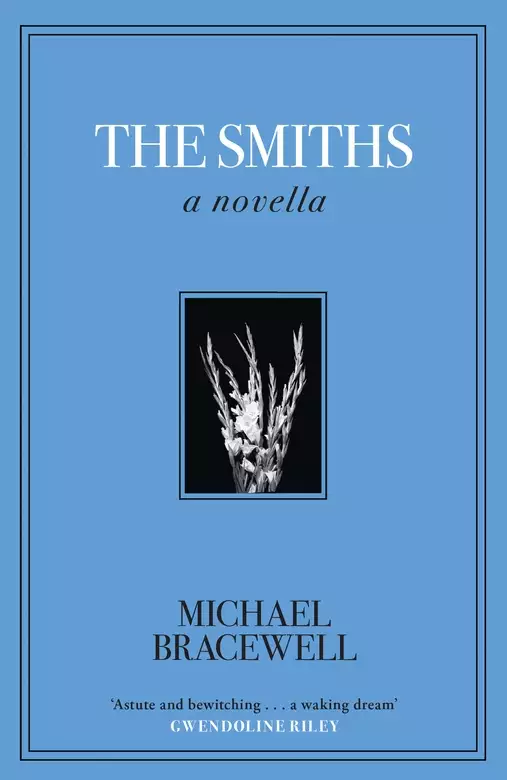
Wildly inventive and magnificently surreal, The Smiths: A Novella recounts the impact of an unconventional pop group from Manchester on one man's life. Taking the form of a flâneuring journey through the landscape of memory, our anonymous protagonist is accompanied by the iconic French actress Carole Bouquet, who becomes his guide and interlocutor, asking about his life during the years The Smiths were together and the profound effect of their music upon him.
As the unlikely couple perambulate from the old Selfridge Hotel to West Hollywood by way of a park bench in Cavendish Square, their conversation interrogates and celebrates the joys of outlandish pop genius, the zealous dedication of fans and the cult of outsider disaffection given uproarious voice. As such, this is not a book about The Smiths but one that emerges from their music, their emotional register and their literary resonance.
Michael Bracewell's novella-cum-fairy tale is at once deeply romantic and laced with comedy - not unlike the band themselves - and perhaps (in fictional form) the most astute and celebratory portrait of The Smiths to date.
Release date:
June 11, 2026
Publisher:
Orion
Print pages:
128
* BingeBooks earns revenue from qualifying purchases as an Amazon Associate as well as from other retail partners.
Not so long ago I imagined meeting Carole Bouquet – co-star of Luis Buñuel’s film masterpiece, That Obscure Object of Desire – at the Oxford Street end of Davies Street in the West End of London.
Our rendezvous was outside a pub, unpleasantly named the Hog in the Pound.
Time was complicated in this imagining. It seemed to be around 2009 or 2010. A sunny afternoon in late September.
Carole looked exactly as she did in 1977, the year Buñuel’s film was released.
She had time-travelled a little over three decades to meet me, but given no more thought to the journey than you or I might give to catching a bus. It was like we had met once before and agreed to meet again.
She must have been around twenty years old, at a quick calculation. But she moved and spoke with the assurance of someone much older. She had silver-blue eyes that were slightly wide-set, a flawless complexion and finely angled eyebrows. Her long dark hair had a glossy sheen. She was wearing pale-red lipstick. That afternoon she was dressed in jeans, a white T-shirt and a short grey jacket. Burgundy leather sandals with a high heel. She carried a matching shoulder bag.
Actors, of course, are not the characters they play. So while she could dip her chin, fix you with a stare and give you that Elvis-like half-smile, flirtatiously mocking, she was really quite reserved.
She was not, I think, the actual Carole Bouquet – more some kind of transmission.
To break the ice she opened her bag and took out her cigarettes, frowning as she lit one. I hadn’t smoked for years. Carole didn’t say anything. She just looked at me, then at the pack of cigarettes, then at me again, one eyebrow slightly raised. I took one, and with her own cigarette hanging coolly from the corner of her mouth, she cupped her lighter against the breeze and lit it.
Cautiously, I took a drag.
She put her head to one side and pushed her hair back over her shoulder. Then she regarded me expectantly.
‘I loved the Buñuel film,’ I said, ‘like everyone.’
It was a favourite of mine, strangely talismanic.
‘What can I say? He was a genius.’
There was a pause, a beat of awkwardness, and then her face relaxed.
‘The devilishly laced corset!’ she said, laughing. ‘The bucket of water on the train – the bomb in the arcade!’
‘Anarchy, illogicality …’ I added, perhaps a little too enthusiastically, ‘It just carries you along.’
‘A comedy about manipulation, mystery and desire – about love.’
We talked of other films, too, standing on that little strip of pavement at the back of Browns. (You may remember the place – a high-fashion emporium, very chic, more like a series of adjoining reception rooms.)
I was thrilled when Carole mentioned Jacques Rivette’s movie, Céline and Julie Go Boating.
‘Another magical film,’ I said.
‘Totally. Céline and Julie are so cool. The way they adjudicate their situation. That mix of childish excitement and inscrutable reserve.’
I recalled the wet weekday afternoon I had sought the film out in a small repertory cinema in north London. The screen was reached down a dim corridor. The ancient woodchip was painted purple. There was a narrow strip of sticky carpet. This was in the early nineties.
The woman who took the tickets was known to be a witch. She had long black hair, centre-parted, and wore small black-framed glasses. There was something about her that made you not want to linger. Her body was youthful but her face was old. On the stool beside her was a dog-eared copy of Marina Tsvetaeva’s Moscow Diaries. I glimpsed the weary poet’s face on its cover, looking up from a small grey photograph. Her blank expression held my glance momentarily.
There were five of us in the audience and we had all come on our own. Unified in sudden darkness we watched the three hours and thirteen minutes of the film in a state of transfixed bafflement. Thus it wove its spell.
Only later did I ponder the theories, albeit briefly. ‘Céline and Julie and Time and Narrative in Alice in Wonderland and Proust’. Slick comparisons to Buster Keaton and the early films of John Waters.
More immediately I felt a need – hard to fulfil, as it turned out – to watch the whole thing again. To try to catch the light, as it were, of that winning, insouciant charm that was also unnerving. Just as you began to feel safe and sunny, chasing around a summery Paris with these two clever, capricious, exhausting, infuriating young women.
‘Well, it’s circular, of course,’ said Carole. ‘The structure subverts the notion of an absolute beginning. The whole film is a beginning subject to continual new beginnings.’
‘Did Rivette know Eric Rohmer?’ I was genuinely interested.
‘In the early days, I’m sure. But they differ politically – Rivette’s a Marxist. And all those guys are very highly strung.’
‘I love the party scene in Full Moon in Paris,’ I said. ‘The new wave dancing to Elli et Jacno.’
Just the thought of it made me smile, simultaneously enchanted and aghast. The chest-height finger-clicking; the rob. . .
We hope you are enjoying the book so far. To continue reading...

 Please log in to recommend or discuss...
