
- Book info
- Sample
- Media
- Author updates
- Lists
Synopsis
AN ADRENALINE-CHARGED NEW WILDE & CHASE ADVENTURE FROM THE INTERNATIONAL BESTSELLING AUTHOR
Release date: July 31, 2025
Publisher: Headline
Print pages: 384
* BingeBooks earns revenue from qualifying purchases as an Amazon Associate as well as from other retail partners.
Reader buzz
 Please log in to recommend or discuss...
Author updates
Close
The Shroud Of Hades
Andy McDermott
The Shetland Islands
In early winter, the Shetlands, far to the north of Scotland, are a harsh place to be on the best of days. This year, following a summer of record-breaking heat across the Northern Hemisphere, nature had with an ironic smile flicked the switch to an unseasonal cold. Frost coated the ground, and a stiff wind sliced across the rolling lowlands, seeking targets to cut with its icy edge.
One small island on the archipelago’s eastern periphery would not normally present the wind with any victims. From the sea it appeared unremarkable and inhospitable, a treeless swathe of grass-topped rock some four hundred metres long. The only evidence that humans had ever set foot on the desolate land was a single structure, a low concrete blockhouse poking up from a hillock near its southern shore. It had the utilitarian, weathered look of something built in haste during wartime, which was indeed the case; it had been constructed in 1943 to house facilities for Britain’s secretive Special Operations Executive.
Now, ninety years later, it served an equally clandestine purpose for another intelligence agency: MI6.
The blockhouse’s door slid open, stark light beyond silhouetting a man in a heavy coat. Stuart Collins drew in a breath as the wind hit him. It was past dawn, but heavy clouds reduced the daylight to a mournful grey. Even so, he was glad of the sight despite the cold and gloom. Any break from the unrelenting fluorescent glare below ground was welcome.
There was another reason he had chosen to brave the elements. Even the most trusted guards at the United Kingdom’s highest-security prison had their addictions. He lowered his head to shield his face from the wind, then lit a cigarette. A deep draw, the cigarette’s tip blazing as he brought the reassuring warmth of the smoke into his lungs, then he ascended the few concrete steps and emerged into the open.
Christ, it was cold! Still, there were others who had it worse. A boat, a small trawler or some similar working vessel, rocked on the slate sea about a mile offshore. With the wind kicking up whitecaps, he was happy to remain on land, however bleak.
He ambled away from the entrance, booted feet crunching the tough, frosted grass as he climbed a shallow slope. The view from the summit was far from inspiring, but he still turned to take in the panorama. From here he could see most of the island, for all it was worth. Nothing but scrubby vegetation and scattered boulders, surrounded by unwelcoming waters. His home for two months on, one month off. If only it were the other way round, he thought with a mental sigh. Still, it was good money, and being a prison guard was much easier when the prisoners were never allowed to leave their cells.
He turned his back to the wind and took another drag on his cigarette. The boat was still there in the distance. It didn’t seem to have moved since he first saw it.
On the boat, someone was watching Collins.
The Russian, smoking a cigarette of his own, was called Ossovich. His country had trained him as a soldier, but he had no remaining loyalty to that corrupt, collapsing nation. He now worked as a mercenary for the highest bidder. And nobody could bid higher than his current employer. He briefly looked away from his powerful telescope to pick up a radio handset. ‘Someone’s outside,’ he reported.
‘Have you identified them?’ came the reply over the radio. The man speaking had a German accent.
‘Yes. Collins.’ The gyro-stabilised telescope had an attachment on its eyepiece that fed the image to a laptop. Facial recognition software had already done its work.
‘Where is he?’
‘On the rise west of the entrance. About fifty metres from you.’
‘Facing?’
‘Towards the boat. He’s smoking.’ A tiny red dot glowed in the muted greys of the magnified view.
‘A bad habit. For him.’ It could have been a joke, but there was no humour behind the words. ‘Are we clear to move in?’
Ossovich stared intently at the figure on the island. Collins took one last look around, then started down the slope, wind whipping away the smoke as he exhaled. ‘Yes. He’s going back to the door.’
‘Okay. Then we are go.’
On land, six figures rose from behind boulders and rapidly closed on Collins.
They had arrived in the dead of night, dropping from the boat wearing drysuits and scuba tanks and swimming underwater to the isolated island’s northern end. From there, they had patiently crawled the length of the barren landscape, following a path that avoided the prison’s surveillance systems. A tower bearing cameras or a radar would have given away that the blockhouse was not as abandoned as it appeared, but it was still far from blind. Its electronic eyes were focused upon the surrounding sea, though; this close, the intruders could finally move freely.
The leader of the team was called Steinitz. He gave silent hand signals, telling his companions to spread out. Whichever path Collins took to return to the blockhouse, at least one of them would be able to intercept him. But the guard was following the easiest route, retracing his steps. With the wind whistling in his ears, he didn’t hear the approaching men until they were almost upon him. He hesitated, turned—
And was tackled to the ground.
The man who had brought him down was a tall, beaky-nosed Austrian named Duger, his lank blond hair skittering in the wind. He delivered a brutal kidney-punch to Collins, making him convulse, then rolled him onto his back and pressed an elbow against his throat with crushing force. Steinitz stood behind him, looking down at his prisoner. ‘Mr Collins,’ said the German. He was older than the other mercenaries, hair greying, skin weathered by conflict. Even through his pain, Collins reacted with surprise at being addressed by name. Steinitz held up a tablet. ‘We have your sister. If you do not cooperate, we will kill her.’
A tap, and the device’s screen came to life. Surprise became shock as Collins saw his sister gagged and bound to a chair, a man wearing a balaclava mask holding a large knife to her throat. The trapped woman squirmed; the video was a live feed.
Or so it appeared. In fact, it was an AI-generated fake. There was one for every guard on the island, an appropriate family member – wife, child, parent, sibling – under threat. But Collins would not have time to examine it for the telltale discrepancies of synthesised video. Steinitz gave him just long enough for recognition and fear to cross his face, then the tablet was withdrawn. ‘You are going to get us into the prison. Do as you are told, and you will live. Do not, and you will die, and so will your sister. Do you understand?’
Collins managed to nod. Steinitz had expected nothing else. No matter how loyal to their country someone professed to be, in his experience prioritising it over the life of a loved one was the preserve of the sociopathic or stupid. ‘Good. Now, stand.’
The other mercenaries had by now joined him. All held guns. Collins saw the weapons and involuntarily sagged in defeat. Duger withdrew, and the guard struggled upright, gasping for breath. Steinitz gestured with his own sidearm towards the nearby concrete structure. ‘Go to the door,’ he ordered. ‘I will be right behind you. If you make any attempt to warn the men inside, I will kill you. Move.’
Duger shoved Collins down the slope. Steinitz took up position behind him, gun aimed at his back. The guard reached the bunker, glancing around nervously. ‘Move!’ Steinitz repeated, jabbing him with his weapon.
Collins helplessly walked on as ordered. A camera on the top of the blockhouse overlooked the beach, but from its position could not see anything directly below. There was another camera by the metal door at the bottom of the steps, but Steinitz was prepared for it. He dropped low, using Collins to shield himself from view as the guard reached the entrance.
Security was lax, the German saw. There should have been a challenge, a confirmation of identity required before entrance was permitted. But the door opened almost immediately. The guards inside recognised Collins, letting him in at once. As far as they knew there was nobody else on the island, no threat.
They were wrong.
‘Go in,’ Steinitz growled. Collins stepped through the doorway. He tensed, ready to warn of the danger—
But Steinitz had expected it. He leapt up and grabbed the other man with his free hand, forcefully shoving him forwards to use as a human shield. Duger and two other mercenaries were already rushing up behind him. ‘Trigger!’ Steinitz barked into his throat mic.
The command was not for his companions, but Ossovich on the boat. He was still watching through the telescope. In one hand he held a remote-control unit, thumb poised over a red button.
He pressed it.
He was not the only mercenary on the boat. Two other men, Craine and Vikram, had dived down into the chill waters. An undersea cable linked the MI6 facility to the telecommunications network on the Shetland mainland; again, a visible radio mast would have drawn unwanted attention. But the cable was the only direct link to the outside world. If it were damaged, the secret prison would be completely cut off.
The fibre optics at the cable’s core were shielded by multiple layers of plastic and steel wire. They were no protection against almost a kilogram of high explosive. The cable was severed in a millisecond by the underwater blast.
The guards on the island were now on their own.
Steinitz looked past Collins as he forced the other man deeper into the room. It was a blank-walled, claustrophobic hall, lit by stark overhead fluorescent tubes. A windowed booth stood against a wall to one side, a startled man within looking up at the unexpected flurry of action. Two more guards were in the main space, one seated at a desk, the other standing. The latter was the first to react, grabbing for his holstered sidearm—
Steinitz was faster. He fired over the shoulder of Collins, who screamed as the noise of the gunshot blew out his eardrum. A ragged bullet wound exploded in the standing guard’s upper chest. He fell. Steinitz changed direction, driving Collins with him to block the second guard’s firing angle as he too drew his weapon.
Duger, following Steinitz, had him covered. The guard was only halfway out of his chair as bullets punched into his chest and neck. He toppled backwards as blood and gobbets of shredded flesh splattered the desk.
The man in the booth slammed his hand down on a control panel. An alarm wailed. Steinitz didn’t fire at him. There was no point; the booth’s windows were bulletproof. Instead he sought new targets. He spotted them where the walls met the low ceiling. CCTV cameras. A door at the booth’s rear led to another section of the prison: the guardhouse. Living areas, storage – and a security station.
His gun cracked, darting between targets with mechanical accuracy. The cameras shattered. Behind him, two more mercenaries entered. The first, Bakst, a heavy-set Belarussian, held a sub-machine gun. Palancio, the second, carried an assault rifle – with a grenade launcher beneath its barrel.
Collins had completed his purpose. Steinitz fired a round through his heart, then quickly backed away from the booth. Bakst and Duger did the same, retreating to the cover of the desk as Palancio readied his secondary weapon. The man in the booth saw him and frantically ducked. With the security cameras destroyed, the other guards now had no idea what was happening in the lobby. Someone would be trying – and failing – to call the mainland for help, while their comrades grabbed weapons to defend the facility—
The door in the booth opened. Steinitz saw armed figures beyond. They were well trained, reacting quickly. But the guards would need a split-second to take in the scene, locate their attackers, take up positions . . .
Palancio didn’t give them that moment. The Italian fired. The grenade exploded on impact, mere bulletproofing unable to withstand the blast. The booth disintegrated in a storm of wood and metal. One guard was flung from its side to crash against the lobby’s rear wall, clothes and skin shredded. Another flew backwards through the open door.
Debris and shrapnel showered across the room. Steinitz waited a moment for the storm to cease, then rose. The booth was a smoking ruin, pieces of at least two corpses amongst the wreckage. The German glanced back as the last three mercenaries ran in. ‘Clean up,’ he ordered, indicating the door. ‘There should only be five guards left. Find them and kill them.’
His team hurried to the door, preparing for the next stage of their assault. A flashbang grenade was tossed into the guardhouse. ‘Flash out!’ a bearded American named Flagg warned. Everyone covered their ears. A moment later came a piercing detonation and a dazzling burst of light, then the two remaining men, a Frenchman called Lannard and the Iranian Hassani, rushed in with guns clattering savagely. Screams echoed through the concrete rooms.
Steinitz ignored them. He marched to the remains of the booth. The control panel inside had been destroyed. No matter: there was a backup. ‘Someone go to the security room,’ he ordered over the intermittent gunfire. ‘Open the door to the cells.’
He and Duger crossed to the lobby’s rear. A heavy metal door awaited them. It had no handle. They stood at it for several seconds as more shots rang from the guardhouse – then a harsh buzzer sounded and the door opened.
Steinitz and Duger went through. A bleak concrete corridor was beyond, doors on each side. ‘Number six,’ said Duger.
‘I know.’ Steinitz stopped at the third door on the left. ‘Open it.’
Dugan placed a shaped explosive charge on the lock mechanism, then retreated, winding out a length of wire. Steinitz banged a balled fist on the door. ‘I would recommend you take cover,’ he called out to the cell’s occupant, before following Duger to a safe distance. ‘Three, two, one – fire!’
Duger flicked a switch. There was a sharp retort, and shattered metal fragments pelted the opposite wall like a shotgun blast. As soon as the echoes faded, the two men returned to the door. A fist-sized hole had been punched through it. Duger pushed the door. It slowly swung open. They entered the cell.
At first, there was no sign of its occupant. Then a mattress that had been hastily pulled into the corner behind the steel toilet bowl moved. A figure slowly rose from behind it.
John Brice had once been an officer of MI6. Now, he was one of its prisoners, a man who was officially dead in a facility that did not officially exist. He had attempted a coup on his own government, toppling the clock tower housing Big Ben onto the Commons chamber in the Houses of Parliament. Over a third of the country’s politicians had been killed in the attack. Since his capture and incarceration, he had never left this cell.
He had not been idle, though. Always tall and athletic, he was now a hulk of a man, nothing else to do but work out until exhaustion took him, recover, then work out some more. He wore a plain pale grey shirt and dark blue trousers, muscles bulging visibly beneath the garments.
Brice regarded his visitors. A hint of madness swirled in his eyes. Both his rescuers subtly shifted to show they were ready for any dangerous moves he might make. He stood straighter, rising to his full height. The movement revealed his throat. It was scarred, once torn open by a bullet. During its repair a slotted metal disc had been surgically implanted – a mechanical larynx, replacing his ruined voice box. The reason for its permanence was simple: the more common external type could potentially have been used by him as a weapon or escape tool.
He spoke. ‘So, to what do I owe the pleasure?’ His voice was a flat, robotic buzz.
‘You are John Brice,’ said Steinitz. Not a question; he knew his face from files that had been covertly hacked from MI6’s records. ‘My employer wants to hire you.’
‘And who might that be?’
‘Nobody you would have heard of before coming here.’
Brice narrowed his eyes. ‘What’s the date?’
‘The second of November.’
‘What year?’
‘Twenty thirty-three.’
The mad eyes widened in disbelief. ‘Twenty thir—’ His fists clenched, every muscle in his body tightening. ‘Thirteen years. I’ve been here for thirteen years?’ He looked around at the cell that had been his world for all that time. ‘I thought nine, perhaps ten. Thirteen years!’
‘You are now a free man,’ said Steinitz, unmoved. ‘If you accept my employer’s offer.’
Brice stepped forward to loom before the two mercenaries. Duger’s hand tightened around his gun. Brice noticed the movement. He halted. ‘I’d like to meet your employer.’
‘You can’t.’
‘Why not?’
‘He’s dead.’
Brice’s eyebrows rose. Steinitz handed him the tablet. ‘Watch this. It will explain everything.’ The big man tapped play.
The video he watched was only a few minutes long. Brice took in every word with rapt attention. At certain points his body tightened again with barely contained anger, but he remained fixated on the person on the screen. At last, it ended.
Steinitz regarded him warily, putting his own hand on his sidearm. ‘Well?’ he asked. ‘What is your decision?’
Brice smiled. It was not a reassuring sight, rage and insanity behind his stretched lips. ‘Count me in.’
New York City
Two Weeks Later
Eddie Chase paused at the door of his daughter’s room and sighed.
The sound was not loud, but in her nearby study, his wife heard it. ‘What’s wrong?’ asked Nina Wilde.
The bald Englishman came to her open doorway. ‘It’s finally sinking in, I suppose. Macy’s gone.’
Nina looked up from her laptop. ‘It’s not as if she won’t come back.’
‘Only to visit. She doesn’t live here any more.’ He glanced back at the other door. Their now-adult daughter’s bedroom contained the same furniture it always had, and on the surface seemed unchanged from how it had looked that summer. But there were small but significant gaps where items of importance, whether practical or sentimental, were absent. ‘It’s weird. I keep expecting her to come out of there.’
‘Or for us to go in and tell her to turn her music down.’
He snorted. ‘That bell-end downstairs took over that job.’ A new neighbour had moved into the apartment building a couple of months earlier, and his habit of demonstrating his expensive sound system at late hours had led to friction. ‘Bloody typical, isn’t it? I go part-deaf from all the gunshots and explosions I’ve been close to, but I can still hear his bass speaker perfectly.’
‘He did turn it down after you went and threatened him.’
‘I didn’t threaten him. Just used . . . forceful language, that’s all.’ Eddie seemed about to speak again, but instead stood silently, deep in thought.
Nina gave him a quizzical look. ‘Is something wrong? It seems like something’s bothering you.’
Eddie shook his head. ‘No, no,’ he said. ‘I’m fine. Just at a bit of a loose end.’ He gestured at Nina’s laptop and the various papers beside it. ‘I need to do what you’ve done and find something to keep myself busy.’
The redhead tapped on a stack of folders. ‘If you want to help me out by going through these photocopies Macy sent and highlighting mythological places or artefacts that the Knights of Atlantis thought were real . . .’
He raised his hands. ‘I’m good, thanks. It’s not my idea of holiday fun.’
‘I’m on sabbatical, not vacation,’ Nina insisted. ‘That’s the great thing about having tenure at the university, I can take time out for research. And I think this research is more important right now than teaching.’
‘It’s the IHA’s job,’ said Eddie. ‘Let them handle it.’ The International Heritage Agency was their former employer, Nina once the director of the United Nations-funded organisation dedicated to locating and securing potentially dangerous historical artefacts.
It was Nina’s turn to snort. ‘I can’t trust them any more,’ she said bluntly. ‘Not after what John Hoffman said in Portugal.’ Hoffman was the IHA’s current director, and not a man Nina held in high regard. ‘He was absolutely open about the IHA’s primary function now being exploitation and even weaponisation of the discoveries they’re meant to be protecting. I’m totally opposed to that.’
‘So are the Knights of Atlantis.’ The secret society had sought to recruit Macy earlier that year; its members were direct descendants of the lost civilisation’s high priestesses. ‘Let Macy and her new mates take care of this stuff, then. They’re the ones who have the power to use it, after all.’ Nina said nothing, but after twenty-five years together Eddie knew when his wife’s silence said as much as her words. ‘Wait, you’ve still got a problem with them?’
‘I don’t like the idea of some self-appointed group laying claim to every Atlantean relic they find,’ she said carefully. ‘The artefacts they already have are dangerous – you’ve seen what they can do. They have weapons, they have armour – they can fly, for God’s sake.’
Eddie nodded, a half-smile on his lips. ‘That was pretty cool, I have to admit. Our daughter, the superhero.’
‘It’s not Macy I’m worried about. What if the artefacts they’re protecting,’ she didn’t quite add air-quotes, but her intonation was clear enough, ‘fall into the wrong hands? Or the Knights become the wrong hands? That almost happened already!’
‘The guy who tried it’s dead. And Macy’s in charge now. I mean, she’s given you all this stuff.’ He indicated the piled folders. ‘Between the Knights and the Brotherhood, you should have enough info to find out if these things really exist.’
‘At least the Brotherhood email me their information,’ said Nina. The Brotherhood of Selasphoros was another secret society with a very long history, one that a quarter of a century earlier had tried to kill her to stop her from locating the remains of Atlantis. Once she did so despite the organisation’s best efforts, time – and heavy pressure from the IHA and international law enforcement – had brought it around to begrudging cooperation. ‘The Knights’ archives are still entirely physical. It’s a pain in the ass. Macy can’t even take phone pictures of what I need and email those to me in case someone intercepts them and uses them to find the Knights’ new headquarters.’
Not knowing to where the Knights of Atlantis had relocated meant also not knowing where their daughter was. The thought darkened Eddie’s mood. ‘But have you found anything?’ he asked, trying to divert his mind from that particular subject.
‘I’ve found out plenty,’ she replied, with a hint of exasperation. ‘But that’s not the same as physically finding anything. There’s a whole slew of supposedly mythological things that both the Knights and the Brotherhood make reference to as if they’re historically real. The Sword of Goliath, Pandora’s Jar—’
Eddie cocked his head. ‘Don’t you mean Pandora’s Box?’
‘“Box” is a Renaissance mistranslation, it drives me nuts. But that, the Shroud of Hades, the underground city of Agartha . . . those are just the ones I’ve been researching the last few days. There are plenty more. And we know that if both the Knights and the Brotherhood say something in their records is real, there’s a good chance it actually is.’
‘Like the Iron Palace.’ They had located the vast underground redoubt of the Turanian king Afrasiab in the depths of Turkmenistan’s Karakum desert earlier that year. ‘So you haven’t actually figured out where any of these things are?’
‘Not yet.’ She frowned, taking off her reading glasses. ‘Depending who wrote it and when, the records contradict each other far too often. Like the Sword of Goliath – is it four feet long, or six, or ten? Or the Shroud of Hades, which supposedly makes the wearer invisible – the Knights’ records clearly call it a shroud. But the Brotherhood describe it as a piece of armour, which fits Greek mythology, but even then it can be a cap, or a helmet. Again, every account has its own take.’
‘I’d rather fight wearing a helmet than a cap,’ said Eddie. ‘But they can’t all be true.’
‘Exactly. But we both know from experience that even myths which seem contradictory can be real. And if they are real, and powerful enough to become part of legend, then I don’t want the IHA to get hold of them.’
‘Or the Brotherhood.’ Eddie waited until Nina nodded in reply, then added, slightly pointedly, ‘Or the Knights?’
This time, she did not respond at all. ‘You don’t trust your own daughter?’ he went on.
‘Of course I do!’ she exclaimed, affronted – and to Eddie’s mind, over-defensively. ‘But apart from Rain and MacDuff, we don’t know any of the other members, or the new people they’ve started recruiting. Until I can be sure I can trust them all, I’d rather be safe than sorry.’
Eddie conceded the point with a nod of his own. But he wasn’t finished. ‘Does Macy know you’re dealing with the Brotherhood as well?’
‘I’m keeping anything that might give away information about the Knights secure, if that’s what you’re asking. The Brotherhood doesn’t know I’m cross-referencing their records with the Knights’.’
‘That wasn’t what I was asking.’
His wife gave him a brief, guarded look. ‘Anyway, what time are we meeting Holly?’
It was a blunt attempt to change the subject. Eddie sighed inwardly, then said, ‘Quarter to one. She said she’ll meet us by the Alice in Wonderland statue.’
She checked her laptop’s clock. ‘Okay, give me fifteen minutes.’ She donned her glasses and turned back to her work.
‘All right.’ There was a time when the Yorkshireman would have taken some degree of offence at what seemed like a curt dismissal, but he was long used to her eccentricities. Once Professor Nina Wilde became focused on her archaeological work, he reflected, that was it: everything else faded into the background. Macy had sometimes been infuriated by her mother’s obsessive nature, and probably justifiably so, but to him it was simply the price of love. His wife was . . . how best to put it? Unique.
Amused, he left her alone and went to the living room. To kill time, he turned on the television and stretched out on an armchair with his feet on the coffee table. The current topic on a news channel was what he’d expected. ‘And with less than an hour before the space station of the late trillionaire Rafael Loost burns up in the atmosphere,’ said the perky blonde presenter, ‘people are gathering to watch the spectacle.’
The picture cut to Central Park. A scattered crowd was braving the unseasonal chill, some observers carrying binoculars for a better view. Another cut, this to a beaming young man holding a stack of cheap yellow plastic helmets labelled Official Space Station Shield. A sign showed he was selling each for twenty dollars. ‘Some enterprising people may be offering protection,’ the presenter continued chirpily, ‘but the experts at NASA assure us there’s no danger of being hit by debris. The space station will pass directly over New York City at an altitude of forty miles, and any pieces large enough not to burn up will splash down in the Atlantic Ocean.’
‘The twat deserves to splash down in a fucking cesspit,’ Eddie muttered. His personal dislike of the world’s richest man had only intensified after actually dealing with Loost some months prior, and he was actively pleased that he was dead. In fact, he had assisted in his demise.
Brief interviews with people in the park followed, expressing varying degrees of regret at the loss of the ‘tech visionary’. One young man in particular seemed genuinely upset. ‘He was going to save the Earth, then take us to the stars,’ he proclaimed. ‘Who’s going to replace him? There’s nobody else like him!’
Eddie shook his head. For all Loost’s claims to the contrary, ultimately he had wanted the same as every other ultra-wealthy person in history – more money and more power for himself at the expense of everyone else. Even his private space station, supposedly a new frontier of exploration, was in the end a means of dodging tax. Yet here were his followers weeping and wailing like cult members. ‘Bloody morons.’
‘But not everyone held Rafael Loost in such high regard,’ said the presenter. ‘One of his former nurses has very strong feelings against him.’
Another cut, this to a woman in her early thirties. Her hair was brown with blonde streaks, slightly untidy as it grew out of what had been a short cut. A caption read Natalie Bachand: Rafael Loost’s nurse, but Eddie already knew who she was. She had been doing the media rounds quite extensively in advance of the station’s splashdown.
‘Everyone thinks of Rafael as this genius who was going to save the planet,’ she said, her accent softly French-Canadian. The screen showed a photo of a smiling Natalie floating in zero gravity aboard the orbiting habitat, wearing a sleek white catsuit-style uniform. ‘But to me, he’s the man who got me pregnant and then left me with nothing, even though he knew I was having his baby. He—’ The interview returned, a twinge of anger crossing her face. ‘He doesn’t deserve anyone’s love. All he cared about was money, not pe
In early winter, the Shetlands, far to the north of Scotland, are a harsh place to be on the best of days. This year, following a summer of record-breaking heat across the Northern Hemisphere, nature had with an ironic smile flicked the switch to an unseasonal cold. Frost coated the ground, and a stiff wind sliced across the rolling lowlands, seeking targets to cut with its icy edge.
One small island on the archipelago’s eastern periphery would not normally present the wind with any victims. From the sea it appeared unremarkable and inhospitable, a treeless swathe of grass-topped rock some four hundred metres long. The only evidence that humans had ever set foot on the desolate land was a single structure, a low concrete blockhouse poking up from a hillock near its southern shore. It had the utilitarian, weathered look of something built in haste during wartime, which was indeed the case; it had been constructed in 1943 to house facilities for Britain’s secretive Special Operations Executive.
Now, ninety years later, it served an equally clandestine purpose for another intelligence agency: MI6.
The blockhouse’s door slid open, stark light beyond silhouetting a man in a heavy coat. Stuart Collins drew in a breath as the wind hit him. It was past dawn, but heavy clouds reduced the daylight to a mournful grey. Even so, he was glad of the sight despite the cold and gloom. Any break from the unrelenting fluorescent glare below ground was welcome.
There was another reason he had chosen to brave the elements. Even the most trusted guards at the United Kingdom’s highest-security prison had their addictions. He lowered his head to shield his face from the wind, then lit a cigarette. A deep draw, the cigarette’s tip blazing as he brought the reassuring warmth of the smoke into his lungs, then he ascended the few concrete steps and emerged into the open.
Christ, it was cold! Still, there were others who had it worse. A boat, a small trawler or some similar working vessel, rocked on the slate sea about a mile offshore. With the wind kicking up whitecaps, he was happy to remain on land, however bleak.
He ambled away from the entrance, booted feet crunching the tough, frosted grass as he climbed a shallow slope. The view from the summit was far from inspiring, but he still turned to take in the panorama. From here he could see most of the island, for all it was worth. Nothing but scrubby vegetation and scattered boulders, surrounded by unwelcoming waters. His home for two months on, one month off. If only it were the other way round, he thought with a mental sigh. Still, it was good money, and being a prison guard was much easier when the prisoners were never allowed to leave their cells.
He turned his back to the wind and took another drag on his cigarette. The boat was still there in the distance. It didn’t seem to have moved since he first saw it.
On the boat, someone was watching Collins.
The Russian, smoking a cigarette of his own, was called Ossovich. His country had trained him as a soldier, but he had no remaining loyalty to that corrupt, collapsing nation. He now worked as a mercenary for the highest bidder. And nobody could bid higher than his current employer. He briefly looked away from his powerful telescope to pick up a radio handset. ‘Someone’s outside,’ he reported.
‘Have you identified them?’ came the reply over the radio. The man speaking had a German accent.
‘Yes. Collins.’ The gyro-stabilised telescope had an attachment on its eyepiece that fed the image to a laptop. Facial recognition software had already done its work.
‘Where is he?’
‘On the rise west of the entrance. About fifty metres from you.’
‘Facing?’
‘Towards the boat. He’s smoking.’ A tiny red dot glowed in the muted greys of the magnified view.
‘A bad habit. For him.’ It could have been a joke, but there was no humour behind the words. ‘Are we clear to move in?’
Ossovich stared intently at the figure on the island. Collins took one last look around, then started down the slope, wind whipping away the smoke as he exhaled. ‘Yes. He’s going back to the door.’
‘Okay. Then we are go.’
On land, six figures rose from behind boulders and rapidly closed on Collins.
They had arrived in the dead of night, dropping from the boat wearing drysuits and scuba tanks and swimming underwater to the isolated island’s northern end. From there, they had patiently crawled the length of the barren landscape, following a path that avoided the prison’s surveillance systems. A tower bearing cameras or a radar would have given away that the blockhouse was not as abandoned as it appeared, but it was still far from blind. Its electronic eyes were focused upon the surrounding sea, though; this close, the intruders could finally move freely.
The leader of the team was called Steinitz. He gave silent hand signals, telling his companions to spread out. Whichever path Collins took to return to the blockhouse, at least one of them would be able to intercept him. But the guard was following the easiest route, retracing his steps. With the wind whistling in his ears, he didn’t hear the approaching men until they were almost upon him. He hesitated, turned—
And was tackled to the ground.
The man who had brought him down was a tall, beaky-nosed Austrian named Duger, his lank blond hair skittering in the wind. He delivered a brutal kidney-punch to Collins, making him convulse, then rolled him onto his back and pressed an elbow against his throat with crushing force. Steinitz stood behind him, looking down at his prisoner. ‘Mr Collins,’ said the German. He was older than the other mercenaries, hair greying, skin weathered by conflict. Even through his pain, Collins reacted with surprise at being addressed by name. Steinitz held up a tablet. ‘We have your sister. If you do not cooperate, we will kill her.’
A tap, and the device’s screen came to life. Surprise became shock as Collins saw his sister gagged and bound to a chair, a man wearing a balaclava mask holding a large knife to her throat. The trapped woman squirmed; the video was a live feed.
Or so it appeared. In fact, it was an AI-generated fake. There was one for every guard on the island, an appropriate family member – wife, child, parent, sibling – under threat. But Collins would not have time to examine it for the telltale discrepancies of synthesised video. Steinitz gave him just long enough for recognition and fear to cross his face, then the tablet was withdrawn. ‘You are going to get us into the prison. Do as you are told, and you will live. Do not, and you will die, and so will your sister. Do you understand?’
Collins managed to nod. Steinitz had expected nothing else. No matter how loyal to their country someone professed to be, in his experience prioritising it over the life of a loved one was the preserve of the sociopathic or stupid. ‘Good. Now, stand.’
The other mercenaries had by now joined him. All held guns. Collins saw the weapons and involuntarily sagged in defeat. Duger withdrew, and the guard struggled upright, gasping for breath. Steinitz gestured with his own sidearm towards the nearby concrete structure. ‘Go to the door,’ he ordered. ‘I will be right behind you. If you make any attempt to warn the men inside, I will kill you. Move.’
Duger shoved Collins down the slope. Steinitz took up position behind him, gun aimed at his back. The guard reached the bunker, glancing around nervously. ‘Move!’ Steinitz repeated, jabbing him with his weapon.
Collins helplessly walked on as ordered. A camera on the top of the blockhouse overlooked the beach, but from its position could not see anything directly below. There was another camera by the metal door at the bottom of the steps, but Steinitz was prepared for it. He dropped low, using Collins to shield himself from view as the guard reached the entrance.
Security was lax, the German saw. There should have been a challenge, a confirmation of identity required before entrance was permitted. But the door opened almost immediately. The guards inside recognised Collins, letting him in at once. As far as they knew there was nobody else on the island, no threat.
They were wrong.
‘Go in,’ Steinitz growled. Collins stepped through the doorway. He tensed, ready to warn of the danger—
But Steinitz had expected it. He leapt up and grabbed the other man with his free hand, forcefully shoving him forwards to use as a human shield. Duger and two other mercenaries were already rushing up behind him. ‘Trigger!’ Steinitz barked into his throat mic.
The command was not for his companions, but Ossovich on the boat. He was still watching through the telescope. In one hand he held a remote-control unit, thumb poised over a red button.
He pressed it.
He was not the only mercenary on the boat. Two other men, Craine and Vikram, had dived down into the chill waters. An undersea cable linked the MI6 facility to the telecommunications network on the Shetland mainland; again, a visible radio mast would have drawn unwanted attention. But the cable was the only direct link to the outside world. If it were damaged, the secret prison would be completely cut off.
The fibre optics at the cable’s core were shielded by multiple layers of plastic and steel wire. They were no protection against almost a kilogram of high explosive. The cable was severed in a millisecond by the underwater blast.
The guards on the island were now on their own.
Steinitz looked past Collins as he forced the other man deeper into the room. It was a blank-walled, claustrophobic hall, lit by stark overhead fluorescent tubes. A windowed booth stood against a wall to one side, a startled man within looking up at the unexpected flurry of action. Two more guards were in the main space, one seated at a desk, the other standing. The latter was the first to react, grabbing for his holstered sidearm—
Steinitz was faster. He fired over the shoulder of Collins, who screamed as the noise of the gunshot blew out his eardrum. A ragged bullet wound exploded in the standing guard’s upper chest. He fell. Steinitz changed direction, driving Collins with him to block the second guard’s firing angle as he too drew his weapon.
Duger, following Steinitz, had him covered. The guard was only halfway out of his chair as bullets punched into his chest and neck. He toppled backwards as blood and gobbets of shredded flesh splattered the desk.
The man in the booth slammed his hand down on a control panel. An alarm wailed. Steinitz didn’t fire at him. There was no point; the booth’s windows were bulletproof. Instead he sought new targets. He spotted them where the walls met the low ceiling. CCTV cameras. A door at the booth’s rear led to another section of the prison: the guardhouse. Living areas, storage – and a security station.
His gun cracked, darting between targets with mechanical accuracy. The cameras shattered. Behind him, two more mercenaries entered. The first, Bakst, a heavy-set Belarussian, held a sub-machine gun. Palancio, the second, carried an assault rifle – with a grenade launcher beneath its barrel.
Collins had completed his purpose. Steinitz fired a round through his heart, then quickly backed away from the booth. Bakst and Duger did the same, retreating to the cover of the desk as Palancio readied his secondary weapon. The man in the booth saw him and frantically ducked. With the security cameras destroyed, the other guards now had no idea what was happening in the lobby. Someone would be trying – and failing – to call the mainland for help, while their comrades grabbed weapons to defend the facility—
The door in the booth opened. Steinitz saw armed figures beyond. They were well trained, reacting quickly. But the guards would need a split-second to take in the scene, locate their attackers, take up positions . . .
Palancio didn’t give them that moment. The Italian fired. The grenade exploded on impact, mere bulletproofing unable to withstand the blast. The booth disintegrated in a storm of wood and metal. One guard was flung from its side to crash against the lobby’s rear wall, clothes and skin shredded. Another flew backwards through the open door.
Debris and shrapnel showered across the room. Steinitz waited a moment for the storm to cease, then rose. The booth was a smoking ruin, pieces of at least two corpses amongst the wreckage. The German glanced back as the last three mercenaries ran in. ‘Clean up,’ he ordered, indicating the door. ‘There should only be five guards left. Find them and kill them.’
His team hurried to the door, preparing for the next stage of their assault. A flashbang grenade was tossed into the guardhouse. ‘Flash out!’ a bearded American named Flagg warned. Everyone covered their ears. A moment later came a piercing detonation and a dazzling burst of light, then the two remaining men, a Frenchman called Lannard and the Iranian Hassani, rushed in with guns clattering savagely. Screams echoed through the concrete rooms.
Steinitz ignored them. He marched to the remains of the booth. The control panel inside had been destroyed. No matter: there was a backup. ‘Someone go to the security room,’ he ordered over the intermittent gunfire. ‘Open the door to the cells.’
He and Duger crossed to the lobby’s rear. A heavy metal door awaited them. It had no handle. They stood at it for several seconds as more shots rang from the guardhouse – then a harsh buzzer sounded and the door opened.
Steinitz and Duger went through. A bleak concrete corridor was beyond, doors on each side. ‘Number six,’ said Duger.
‘I know.’ Steinitz stopped at the third door on the left. ‘Open it.’
Dugan placed a shaped explosive charge on the lock mechanism, then retreated, winding out a length of wire. Steinitz banged a balled fist on the door. ‘I would recommend you take cover,’ he called out to the cell’s occupant, before following Duger to a safe distance. ‘Three, two, one – fire!’
Duger flicked a switch. There was a sharp retort, and shattered metal fragments pelted the opposite wall like a shotgun blast. As soon as the echoes faded, the two men returned to the door. A fist-sized hole had been punched through it. Duger pushed the door. It slowly swung open. They entered the cell.
At first, there was no sign of its occupant. Then a mattress that had been hastily pulled into the corner behind the steel toilet bowl moved. A figure slowly rose from behind it.
John Brice had once been an officer of MI6. Now, he was one of its prisoners, a man who was officially dead in a facility that did not officially exist. He had attempted a coup on his own government, toppling the clock tower housing Big Ben onto the Commons chamber in the Houses of Parliament. Over a third of the country’s politicians had been killed in the attack. Since his capture and incarceration, he had never left this cell.
He had not been idle, though. Always tall and athletic, he was now a hulk of a man, nothing else to do but work out until exhaustion took him, recover, then work out some more. He wore a plain pale grey shirt and dark blue trousers, muscles bulging visibly beneath the garments.
Brice regarded his visitors. A hint of madness swirled in his eyes. Both his rescuers subtly shifted to show they were ready for any dangerous moves he might make. He stood straighter, rising to his full height. The movement revealed his throat. It was scarred, once torn open by a bullet. During its repair a slotted metal disc had been surgically implanted – a mechanical larynx, replacing his ruined voice box. The reason for its permanence was simple: the more common external type could potentially have been used by him as a weapon or escape tool.
He spoke. ‘So, to what do I owe the pleasure?’ His voice was a flat, robotic buzz.
‘You are John Brice,’ said Steinitz. Not a question; he knew his face from files that had been covertly hacked from MI6’s records. ‘My employer wants to hire you.’
‘And who might that be?’
‘Nobody you would have heard of before coming here.’
Brice narrowed his eyes. ‘What’s the date?’
‘The second of November.’
‘What year?’
‘Twenty thirty-three.’
The mad eyes widened in disbelief. ‘Twenty thir—’ His fists clenched, every muscle in his body tightening. ‘Thirteen years. I’ve been here for thirteen years?’ He looked around at the cell that had been his world for all that time. ‘I thought nine, perhaps ten. Thirteen years!’
‘You are now a free man,’ said Steinitz, unmoved. ‘If you accept my employer’s offer.’
Brice stepped forward to loom before the two mercenaries. Duger’s hand tightened around his gun. Brice noticed the movement. He halted. ‘I’d like to meet your employer.’
‘You can’t.’
‘Why not?’
‘He’s dead.’
Brice’s eyebrows rose. Steinitz handed him the tablet. ‘Watch this. It will explain everything.’ The big man tapped play.
The video he watched was only a few minutes long. Brice took in every word with rapt attention. At certain points his body tightened again with barely contained anger, but he remained fixated on the person on the screen. At last, it ended.
Steinitz regarded him warily, putting his own hand on his sidearm. ‘Well?’ he asked. ‘What is your decision?’
Brice smiled. It was not a reassuring sight, rage and insanity behind his stretched lips. ‘Count me in.’
New York City
Two Weeks Later
Eddie Chase paused at the door of his daughter’s room and sighed.
The sound was not loud, but in her nearby study, his wife heard it. ‘What’s wrong?’ asked Nina Wilde.
The bald Englishman came to her open doorway. ‘It’s finally sinking in, I suppose. Macy’s gone.’
Nina looked up from her laptop. ‘It’s not as if she won’t come back.’
‘Only to visit. She doesn’t live here any more.’ He glanced back at the other door. Their now-adult daughter’s bedroom contained the same furniture it always had, and on the surface seemed unchanged from how it had looked that summer. But there were small but significant gaps where items of importance, whether practical or sentimental, were absent. ‘It’s weird. I keep expecting her to come out of there.’
‘Or for us to go in and tell her to turn her music down.’
He snorted. ‘That bell-end downstairs took over that job.’ A new neighbour had moved into the apartment building a couple of months earlier, and his habit of demonstrating his expensive sound system at late hours had led to friction. ‘Bloody typical, isn’t it? I go part-deaf from all the gunshots and explosions I’ve been close to, but I can still hear his bass speaker perfectly.’
‘He did turn it down after you went and threatened him.’
‘I didn’t threaten him. Just used . . . forceful language, that’s all.’ Eddie seemed about to speak again, but instead stood silently, deep in thought.
Nina gave him a quizzical look. ‘Is something wrong? It seems like something’s bothering you.’
Eddie shook his head. ‘No, no,’ he said. ‘I’m fine. Just at a bit of a loose end.’ He gestured at Nina’s laptop and the various papers beside it. ‘I need to do what you’ve done and find something to keep myself busy.’
The redhead tapped on a stack of folders. ‘If you want to help me out by going through these photocopies Macy sent and highlighting mythological places or artefacts that the Knights of Atlantis thought were real . . .’
He raised his hands. ‘I’m good, thanks. It’s not my idea of holiday fun.’
‘I’m on sabbatical, not vacation,’ Nina insisted. ‘That’s the great thing about having tenure at the university, I can take time out for research. And I think this research is more important right now than teaching.’
‘It’s the IHA’s job,’ said Eddie. ‘Let them handle it.’ The International Heritage Agency was their former employer, Nina once the director of the United Nations-funded organisation dedicated to locating and securing potentially dangerous historical artefacts.
It was Nina’s turn to snort. ‘I can’t trust them any more,’ she said bluntly. ‘Not after what John Hoffman said in Portugal.’ Hoffman was the IHA’s current director, and not a man Nina held in high regard. ‘He was absolutely open about the IHA’s primary function now being exploitation and even weaponisation of the discoveries they’re meant to be protecting. I’m totally opposed to that.’
‘So are the Knights of Atlantis.’ The secret society had sought to recruit Macy earlier that year; its members were direct descendants of the lost civilisation’s high priestesses. ‘Let Macy and her new mates take care of this stuff, then. They’re the ones who have the power to use it, after all.’ Nina said nothing, but after twenty-five years together Eddie knew when his wife’s silence said as much as her words. ‘Wait, you’ve still got a problem with them?’
‘I don’t like the idea of some self-appointed group laying claim to every Atlantean relic they find,’ she said carefully. ‘The artefacts they already have are dangerous – you’ve seen what they can do. They have weapons, they have armour – they can fly, for God’s sake.’
Eddie nodded, a half-smile on his lips. ‘That was pretty cool, I have to admit. Our daughter, the superhero.’
‘It’s not Macy I’m worried about. What if the artefacts they’re protecting,’ she didn’t quite add air-quotes, but her intonation was clear enough, ‘fall into the wrong hands? Or the Knights become the wrong hands? That almost happened already!’
‘The guy who tried it’s dead. And Macy’s in charge now. I mean, she’s given you all this stuff.’ He indicated the piled folders. ‘Between the Knights and the Brotherhood, you should have enough info to find out if these things really exist.’
‘At least the Brotherhood email me their information,’ said Nina. The Brotherhood of Selasphoros was another secret society with a very long history, one that a quarter of a century earlier had tried to kill her to stop her from locating the remains of Atlantis. Once she did so despite the organisation’s best efforts, time – and heavy pressure from the IHA and international law enforcement – had brought it around to begrudging cooperation. ‘The Knights’ archives are still entirely physical. It’s a pain in the ass. Macy can’t even take phone pictures of what I need and email those to me in case someone intercepts them and uses them to find the Knights’ new headquarters.’
Not knowing to where the Knights of Atlantis had relocated meant also not knowing where their daughter was. The thought darkened Eddie’s mood. ‘But have you found anything?’ he asked, trying to divert his mind from that particular subject.
‘I’ve found out plenty,’ she replied, with a hint of exasperation. ‘But that’s not the same as physically finding anything. There’s a whole slew of supposedly mythological things that both the Knights and the Brotherhood make reference to as if they’re historically real. The Sword of Goliath, Pandora’s Jar—’
Eddie cocked his head. ‘Don’t you mean Pandora’s Box?’
‘“Box” is a Renaissance mistranslation, it drives me nuts. But that, the Shroud of Hades, the underground city of Agartha . . . those are just the ones I’ve been researching the last few days. There are plenty more. And we know that if both the Knights and the Brotherhood say something in their records is real, there’s a good chance it actually is.’
‘Like the Iron Palace.’ They had located the vast underground redoubt of the Turanian king Afrasiab in the depths of Turkmenistan’s Karakum desert earlier that year. ‘So you haven’t actually figured out where any of these things are?’
‘Not yet.’ She frowned, taking off her reading glasses. ‘Depending who wrote it and when, the records contradict each other far too often. Like the Sword of Goliath – is it four feet long, or six, or ten? Or the Shroud of Hades, which supposedly makes the wearer invisible – the Knights’ records clearly call it a shroud. But the Brotherhood describe it as a piece of armour, which fits Greek mythology, but even then it can be a cap, or a helmet. Again, every account has its own take.’
‘I’d rather fight wearing a helmet than a cap,’ said Eddie. ‘But they can’t all be true.’
‘Exactly. But we both know from experience that even myths which seem contradictory can be real. And if they are real, and powerful enough to become part of legend, then I don’t want the IHA to get hold of them.’
‘Or the Brotherhood.’ Eddie waited until Nina nodded in reply, then added, slightly pointedly, ‘Or the Knights?’
This time, she did not respond at all. ‘You don’t trust your own daughter?’ he went on.
‘Of course I do!’ she exclaimed, affronted – and to Eddie’s mind, over-defensively. ‘But apart from Rain and MacDuff, we don’t know any of the other members, or the new people they’ve started recruiting. Until I can be sure I can trust them all, I’d rather be safe than sorry.’
Eddie conceded the point with a nod of his own. But he wasn’t finished. ‘Does Macy know you’re dealing with the Brotherhood as well?’
‘I’m keeping anything that might give away information about the Knights secure, if that’s what you’re asking. The Brotherhood doesn’t know I’m cross-referencing their records with the Knights’.’
‘That wasn’t what I was asking.’
His wife gave him a brief, guarded look. ‘Anyway, what time are we meeting Holly?’
It was a blunt attempt to change the subject. Eddie sighed inwardly, then said, ‘Quarter to one. She said she’ll meet us by the Alice in Wonderland statue.’
She checked her laptop’s clock. ‘Okay, give me fifteen minutes.’ She donned her glasses and turned back to her work.
‘All right.’ There was a time when the Yorkshireman would have taken some degree of offence at what seemed like a curt dismissal, but he was long used to her eccentricities. Once Professor Nina Wilde became focused on her archaeological work, he reflected, that was it: everything else faded into the background. Macy had sometimes been infuriated by her mother’s obsessive nature, and probably justifiably so, but to him it was simply the price of love. His wife was . . . how best to put it? Unique.
Amused, he left her alone and went to the living room. To kill time, he turned on the television and stretched out on an armchair with his feet on the coffee table. The current topic on a news channel was what he’d expected. ‘And with less than an hour before the space station of the late trillionaire Rafael Loost burns up in the atmosphere,’ said the perky blonde presenter, ‘people are gathering to watch the spectacle.’
The picture cut to Central Park. A scattered crowd was braving the unseasonal chill, some observers carrying binoculars for a better view. Another cut, this to a beaming young man holding a stack of cheap yellow plastic helmets labelled Official Space Station Shield. A sign showed he was selling each for twenty dollars. ‘Some enterprising people may be offering protection,’ the presenter continued chirpily, ‘but the experts at NASA assure us there’s no danger of being hit by debris. The space station will pass directly over New York City at an altitude of forty miles, and any pieces large enough not to burn up will splash down in the Atlantic Ocean.’
‘The twat deserves to splash down in a fucking cesspit,’ Eddie muttered. His personal dislike of the world’s richest man had only intensified after actually dealing with Loost some months prior, and he was actively pleased that he was dead. In fact, he had assisted in his demise.
Brief interviews with people in the park followed, expressing varying degrees of regret at the loss of the ‘tech visionary’. One young man in particular seemed genuinely upset. ‘He was going to save the Earth, then take us to the stars,’ he proclaimed. ‘Who’s going to replace him? There’s nobody else like him!’
Eddie shook his head. For all Loost’s claims to the contrary, ultimately he had wanted the same as every other ultra-wealthy person in history – more money and more power for himself at the expense of everyone else. Even his private space station, supposedly a new frontier of exploration, was in the end a means of dodging tax. Yet here were his followers weeping and wailing like cult members. ‘Bloody morons.’
‘But not everyone held Rafael Loost in such high regard,’ said the presenter. ‘One of his former nurses has very strong feelings against him.’
Another cut, this to a woman in her early thirties. Her hair was brown with blonde streaks, slightly untidy as it grew out of what had been a short cut. A caption read Natalie Bachand: Rafael Loost’s nurse, but Eddie already knew who she was. She had been doing the media rounds quite extensively in advance of the station’s splashdown.
‘Everyone thinks of Rafael as this genius who was going to save the planet,’ she said, her accent softly French-Canadian. The screen showed a photo of a smiling Natalie floating in zero gravity aboard the orbiting habitat, wearing a sleek white catsuit-style uniform. ‘But to me, he’s the man who got me pregnant and then left me with nothing, even though he knew I was having his baby. He—’ The interview returned, a twinge of anger crossing her face. ‘He doesn’t deserve anyone’s love. All he cared about was money, not pe
We hope you are enjoying the book so far. To continue reading...
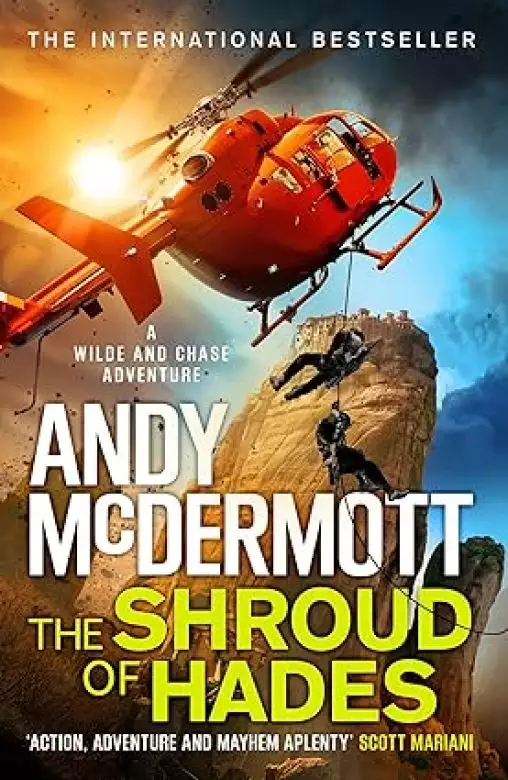
The Shroud Of Hades
Andy McDermott
Copyright © 2026 All Rights Reserved
