Héšenovéhe
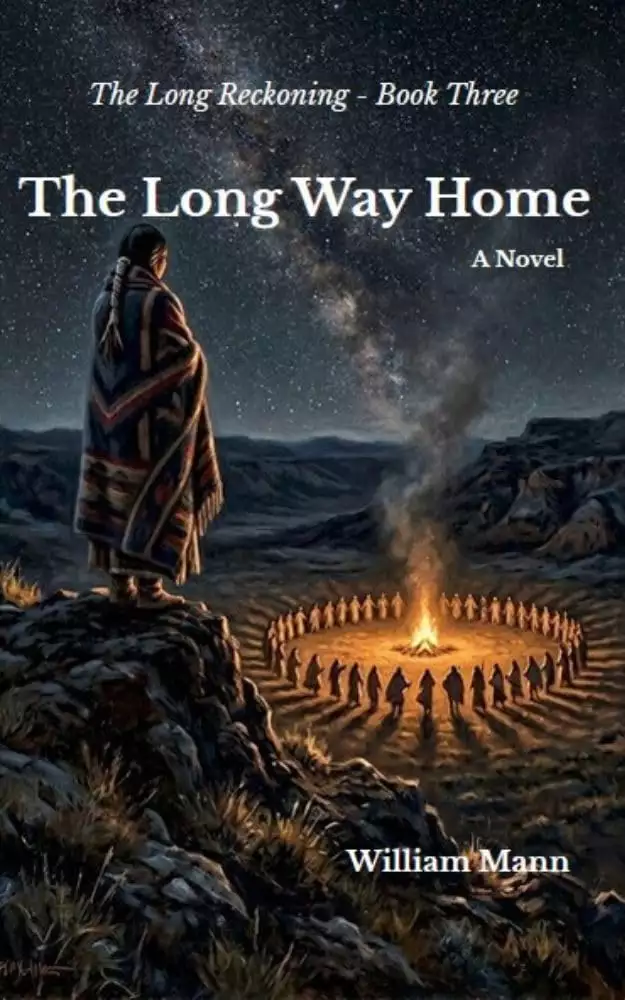
The ridge wasn’t much, a rise in the broken country, just enough to see the valley without being seen if he kept still and kept his horse still and did not let the last of the afternoon light catch the metal of anything he carried.
Watches Twice had been still for a long time.
Below him, the village moved the way villages moved at the end of a day. Women working at fires that had just been coaxed to life, the smoke rising thin and pale against the darkening tree line along the creek. Children doing what children do, chasing, falling, being called back. A man moving between the horses, checking legs, running his hand along a shoulder. The ordinary work of people who had survived another day and were now preparing to survive the night.
He had seen this before. Not this village. Not these people. But this.
He shifted in the saddle, and the cold moved with him, finding the gap between his collar and his neck, settling there. The dampness had been in everything since morning, in his blanket when he rose, in the ground under his horse’s feet, in the air itself, which carried the smell of wet earth and new grass and the distant smoke from those fires below. Fall in this country came without apology. The grass had gone pale and dry, and the cold had an edge to it that arrived early and stayed.
He would not have a fire tonight.
He thought about that, the cold camp waiting for him somewhere behind this ridge, away from any line of sight to the valley. The jerky that had been in his pouch too long. Water from a creek that tasted of snowmelt and clay. He had slept in worse conditions and would sleep in worse again, and thinking about it would not improve any of it, so he stopped thinking about it and looked back down at the valley.
A woman was speaking to a child. He could not hear the words at this distance, but he could see the shape of it, the way she bent toward the child, the child’s face turning up toward hers. His mother had bent toward him that way once. He did not remember her face clearly anymore. He remembered the bending. He remembered the quality of its attention, the way it made a small person feel like the only thing in the world worth looking at.
He did not let himself stay with that.
The fires were building now as the light continued to fail. More women moving. The faint, uncertain smell of something cooking reached him on the air, and his stomach acknowledged it before he could stop it. He had not eaten since morning.
Below him were people who were hungry. He understood this the way he understood the cold; not as an idea but as a thing present in the body. They had been walking since the previous September. They had fought the Army in Kansas and Nebraska, and they had buried their dead along the way and kept walking. What was in that valley was what was left.
He should go back.
The column was three hours behind him, maybe four. The captain was waiting for his report. The man had a particular way of waiting that made the air around him feel pressurized, and Watches Twice had learned to move quickly to avoid prolonged exposure. He had found the village. That was his job. He had done it. He should go back and say what he had found and let the Army decide what the Army decided.
He gathered the reins.
Then from below, carried up on the cold air, a sound, a man’s voice, low and unhurried, speaking to a horse. A low murmur, the kind a horse leaned toward. The same sounds his father made. The same patience in it.
He did not go back.
The last light was almost gone now. The fires below were the brightest things in the valley, and the shapes of people moved between them, and the horses had settled, and somewhere in the village a child was crying. Not from any specific pain but from the accumulated weight of being alive and tired and small.
He had made that sound once. He barely remembered making it. He remembered the silence that came after his father’s hand found the back of his head, the warmth of it, the steadiness.
His father’s hands.
He sat with that for a moment and then put it away in the place where he kept things that could not be looked at directly, and he looked instead at the fires, and at the people moving between the fires, and at the horses standing quiet at the edge of the firelight, and he felt the cold working into him from the saddle and from the air and from the ground his horse stood on.
These were Cheyenne.
He had known this before he rode out this morning. He had known it for months, since the Army came to the reservation looking for men who could track and read country and keep their mouths shut. He had known it the way he knew his own name, as a fact that sat at the center of everything and did not require thinking about because it was always already there.
These were Cheyenne.
And in that village below, moving between those fires, were women who had fed boys who had grown into men who had ridden into a Crow camp on a cold morning and done what men did when they came to kill, and one of those men had held a seven-year-old child by the arms and made him watch, and the watching had taken something out of the boy that the man had never gotten back.
Watches Twice sat on his horse on the ridge in the cold and the dark, coming down, and he did not go back to the column.
Not yet.
Watches Twice
The morning his mother died, she had braided his hair.
He did not remember much from that time, he was three years old, and the world was still mostly sensation, mostly warmth and smell and the particular quality of voices, but he remembered that. Her hands were working through his hair with the patience she brought to everything, the slight pressure of her fingers against his scalp, the sound of her humming something low and without words while the camp moved around them in the early light.
Iiláxxe Baa. Kind-Hearted Woman. That was what people called her, and it was what she was. Not as a performance, not as something she worked at, but simply as her nature, as elemental as cold water and warm fire. He would not understand this until he was much older, until he had met enough people to know that her particular quality of attention, her gift for making whoever she was speaking to feel like the most important person in the camp, was not common. He would not understand it until it had been gone long enough that he could feel its shape by its absence.
That morning, she finished his braid and turned him around to look at him and said something he could not later remember, something that made him laugh, and then she sent him to find his father.
Bíawakshish, Red Bear, was at the edge of the camp where the horses were kept, doing what he did every morning, moving among them with the unhurried attention of a man who understood animals and did not need to perform that understanding for anyone. He was a large man, broad through the chest, with hands that seemed too big for the careful work they did, checking a leg here, smoothing a palm along a neck there, speaking low words that the horses leaned into.
The boy ran to him across the wet grass. Red Bear caught him without looking up from the horse he was tending, one arm swinging out and scooping the boy against his side, the gesture of a man who had always known exactly where the boy was.
This was spring. The grass was new. The air smelled of mud, the creek running fast with snowmelt, and somewhere behind the camp, a meadowlark was doing what meadowlarks did in the morning as if it were the most important work in the world.
There were butterflies.
Not many, it was still early in the season for them, but enough. Yellow ones, small and uncertain in the cool air, lifting from the grass and settling again. The boy saw them, pulled away from his father’s side, and went after them, without plan or hope of success, running through the wet grass with his arms out.
Red Bear watched him.
He stood with his hand still resting on the horse’s neck and he watched his son chase butterflies across the meadow in the early light, and his face had the expression it sometimes had when he did not know anyone was looking, open, unguarded, the love in it so plainly present that Búuwatisshish, passing at the edge of the camp with his medicine bundle over his shoulder, paused to look at it.
The old medicine man stood and watched Red Bear watching his son, and said nothing, and moved on.
Iiláxxe Baa went into labor that afternoon.
The boy knew something was happening because the women came, two, then three, then four of them moving in and out of the lodge with the particular purposefulness that meant adults were managing something children did not need to see. He was put outside with a piece of dried meat and told to stay near the fire.
He stayed near the fire.
Red Bear stood outside the lodge. Not pacing, Red Bear did not pace. He stood as he did with the horses, very still, his weight settled, his hands at his sides. But his hands were not right. The boy watched his father’s hands and knew something was wrong before he knew anything else.
The sounds from inside the lodge were not right either.
He did not know what right sounded like, having never been present for a birth, but he understood wrongness the way children understood things. Not through reasoning but through the body, through the sudden cold that had nothing to do with the air temperature, through the way the women’s voices had changed from purposeful to urgent.
He went to his father and stood beside him, and Red Bear put his hand on the back of the boy’s head and held it there.
They stood together outside the lodge while the light failed, the fire burned down, and the sounds inside changed again, this time not to urgency but to something worse than urgency. A particular quality of silence, not the absence of sound but the presence of something that had no sound.
One of the women came out.
She looked at Red Bear, and Red Bear’s hand tightened briefly on the back of the boy’s head, and then he went inside.
The boy stood alone by the dead fire.
Búuwatisshish came and sat beside him. The old man did not speak. He put his hand on the boy’s shoulder, and they sat together in the dark, and the boy did not cry because he did not yet fully understand what had happened, only that his father was inside the lodge and his mother was not going to come out and braid his hair again in the morning.
The baby did not come out either.
Four years is a long time when you are young, and it is the only time you know.
The boy grew up in his father’s shadow, as plants grew toward light, not by deciding to, but because that was where the warmth was. Red Bear was not a man who spoke much, but when he did, the boy listened, and when he did not, the silence between them was comfortable and full of things that did not need saying.
Red Bear taught him to ride before he could walk well. Taught him to read the ground, to look at what grass said about what had passed over it, to understand the difference between a trail made by men moving fast and men moving slow. He taught him the names of things. Not just the Crow words but the meanings beneath the words, why the hawk was called what it was called, why the river had its name, why a man’s name was not given to him but grown into him through what he did and what he saw and who he was in the world.
The boy was good at watching.
Red Bear noticed this early, the stillness in his son that most children didn’t have, and how he looked at things with a completeness that suggested he was not just seeing but understanding. He would watch a spider build its web for an hour without moving. He would sit at the edge of the creek and watch the water run over rocks until Red Bear called him twice before he heard.
Búuwatisshish noticed it too.
The old medicine man had watched the boy since the night his mother died. Not intrusively, Old Hawk was not a man who intruded, but with the patient attention of someone who had seen something and was waiting to understand what it meant. He would find reasons to be where the boy was. Would sometimes stop and speak with Red Bear while the boy played nearby, his old eyes moving between the father and the son with an expression no one thought to read because Old Hawk’s expressions were not easy to read.
The boy turned seven in the spring.
The Cheyenne came on a morning in early summer when the grass was tall, and the camp was not expecting trouble.
They came fast and from the east, where the light was still low and difficult, and the first warning was the horses. That particular sound horses made when something was wrong, a sound every person in the camp knew and responded to before they were fully awake. Then shouting. Then the sound that was not shouting.
Red Bear had his weapons in his hands before the boy understood what was happening.
What happened next, the boy would spend the rest of his life not thinking about directly, approaching it only sideways, as you approached something that would blind you if you looked at it straight. He remembered it in pieces that did not always come in order. His father’s voice telling him to run, the ground under his feet, a hand catching his arm from behind, the smell of horse and sweat, the sounds of the fight moving through the camp.
The man who held him was not interested in the boy. He held him facing forward with one arm across his chest and a knife at his side, where the boy could feel it, and what was in front of him was his father.
Red Bear fought as he did everything, without waste, without performance, with complete attention to what was in front of him. He was not a young man, but he was not old either, and he fought well and for a long time, and the boy watched every moment of it with the terrible clarity of a child who has no choice but to see.
His father was winning.
The boy understood this even at seven, that Red Bear was better than the men around him, that the fight was going one way and not the other, that the Cheyenne had not expected this particular man to be this difficult to kill. There was a moment when the boy felt something close to relief move through him, something that said, my father, my father is going to be all right.
Then the man holding him tightened his grip and said something in a language the boy did not speak, and one of the other Cheyenne turned to look at the boy, then at Red Bear.
Red Bear looked at his son.
The boy watched his father understand what was happening. Watched him take it in, the arm across his son’s chest, the knife at his son’s side, the meaning of it. Watched Red Bear’s face do something it had never done before in the boy’s presence, something that was not fear exactly, but was the thing that lived next to fear when the thing you feared was not for yourself.
Red Bear’s tomahawk was in his hand.
He looked at his son for a long moment. The fight had gone still around him. That brief held breath before a fire went out.
Then Red Bear lowered the tomahawk.
He did not drop it in surrender. He lowered it slowly, deliberately, with the same care he brought to everything, and he stood straight, and he looked at his son, and his face was open as it was only when Red Bear thought no one was watching, the love in it so plainly present that it was almost unbearable to see.
The boy understood what his father was doing.
He did not have words for it at seven years old. He would not have words for it for a long time. But his body understood it before his mind caught up, a comprehension that started in the chest and moved outward, like falling and being caught at the same time.
Don’t, the boy tried to say. Nothing came out.
The Cheyenne moved.
Red Bear did not look away from his son. Through all of it, through everything the Cheyenne did in the next few moments, Red Bear looked at his son. His eyes did not leave the boy’s face. Even at the end, even when the boy wanted to look away and could not, his father’s eyes were steady and present and full of the thing that had no name.
The man holding the boy released him.
The boy did not move. He stood where he was and looked at his father on the ground, and the world had gone very quiet, a quiet that was not peaceful but was the shape left by something that had been there and was not there anymore.
He had been seen. In the last moment of his father’s life, he had been the only thing Red Bear looked at. He did not know yet whether that was a gift or a weight. He would spend a long time not knowing.
He walked to his father and sat down beside him in the grass and put his hand on his father’s chest as his father had put his hand on the back of his head outside the lodge four years ago, and he sat there while the camp came back to life around him, while the women moved and the men accounted for the living and the dead, while the smoke from two burning lodges rose into the summer sky.
Búuwatisshish found him there.
The old man sat down beside him in the grass without speaking and they sat together as they had sat together outside a lodge four years ago and the boy understood that Old Hawk had been here before with him, in this particular country of loss, and that the old man was not going to try to move him from it or tell him it would be all right because Old Hawk did not say things that were not true.
They sat together until the boy was ready to stand.
In the weeks that followed, Old Hawk watched him.
The boy moved through the camp present, continuous, going about what needed to be done without complaint or visible grief. He ate when food was given. He slept. He did the things boys did. But there was something in him that had changed, some quality of stillness that had deepened past what was ordinary for him, past what was ordinary for anyone.
He did not talk about his father.
He did not talk about his mother either, but that had always been true. Iiláxxe Baa was a presence in the camp that everyone felt and no one mentioned directly, as you did not mention a wound that had healed clean but left a scar.
Old Hawk watched and waited and said nothing.
It was late summer when the boy found the wolf den.
He had been out past the edge of the camp, farther than he was supposed to go alone, following the creek east through the cottonwoods to where it bent south toward the open ground. He found the den in a cutbank above the creek, a hole in the earth under the roots of a fallen cottonwood, and from it came sounds that stopped him where he stood.
He crouched in the grass and watched.
There were four of them. Maybe five, it was hard to count because they moved over and around each other without stopping, tumbling, biting, and making the small urgent sounds of animals that had not yet learned what the world required of them. Their eyes were open but uncertain. They smelled of earth and milk and something wild underneath.
He watched them for a long time.
He did not hear Old Hawk come up behind him. The old man moved quietly for a man of his age, another thing about him that people noticed and did not comment on.
Old Hawk crouched beside him, looked at the pups, then at the boy, and said quietly, “The mother will come back. She will kill you if she finds you here.”
The boy looked at him.
“Come,” Old Hawk said.
The boy went.
Two days later, Old Hawk did not see the boy in the camp.
He was not alarmed; the boy often moved at the edges of things, just inside the boundary of where he was supposed to be. But something made the old man walk east along the creek through the cottonwoods to where it bent south toward the open ground.
The boy was there.
Crouched in the same place, in the same stillness, watching the den.
Old Hawk stood behind him for a long moment without speaking. The pups were there, moving, tumbling, making their small sounds. The boy was watching them with the complete attention he brought to everything he decided was worth watching, which was most things, which was everything.
Old Hawk looked at the boy’s face.
He saw what he had always seen there, the watchfulness, the stillness, the quality of attention that was not ordinary. He saw the boy who had stood at the edge of a lodge at three years old while his mother died inside it and had not looked away. He saw the boy who had been held by a Cheyenne warrior on a summer morning and made to watch his father fall, and had not closed his eyes.
He saw a boy who went back.
Who always went back.
Who looked at the hard thing once and then looked at it again because once was never enough to understand it fully.
Come, Old Hawk said again.
The boy rose from his crouch and came without argument, and they walked back through the cottonwoods together toward the camp. Old Hawk did not speak on the way back, and the boy did not speak, and the creek ran beside them, and the cottonwood leaves moved in the late summer air.
Old Hawk called the band together three days later.
He did not explain what he was doing, Old Hawk rarely explained. He simply said there was a naming to be done, and the people came because when Old Hawk said there was a naming to be done, you came.
The boy stood in front of the band, did not fidget, and did not look at his feet. He looked at the faces of the people around him with the steady attention that was already his most recognizable quality, already the thing people noticed first about him and remembered longest.
Old Hawk stood before him.
The old man looked at the boy for a long moment, long enough that some of the people shifted, long enough that a child younger than this boy might have looked away. The boy did not look away.
Then Old Hawk spoke.
He told the band about the wolf den. About finding the boy there once, bringing him back, and finding him there again two days later. He told it plainly, without drama. He told them what it meant for a boy to go back into danger, not out of recklessness but out of the need to see clearly. To look again. To understand.
He said the boy had watched twice and had not flinched either time.
He said the boy’s name was Bíalish Dúua.
Watches Twice.
The people received the name with the understanding that it meant something, had been considered, and was true.
What they did not know, what only Old Hawk knew, and the boy in some unspoken way perhaps understood, was that the name was true in more ways than he had told them.
That it had been earned not twice but four times.
That there was a lodge at night and a father’s hands and a summer morning in the grass, and that the boy standing before them had looked at all of it and had not looked away.
Old Hawk looked at the boy one more time.
The boy looked back.
We hope you are enjoying the book so far. To continue reading...
Copyright © 2026 All Rights Reserved

 Please log in to recommend or discuss...
