Redhills
The rooster started before first light, as he always did, as if the darkness itself offended him personally. Billy Lee Grogan lay on his back, listened to it, and did not move. There was a water stain near the window that had the general shape of the state of Georgia, which he did not find amusing.
He got up slowly, carefully, one foot and then the other, sitting on the edge of the cot for a moment while his knees introduced themselves to the morning. They had things to say. They always did. He gave them a moment and then stood, reached for his trousers on the nail, and began the business of the day.
He fed the chickens first. Four hens and the rooster, who regarded Billy Lee with the same suspicion he regarded everything, head cocked, one eye bright and hostile. Billy Lee scattered the feed and ignored him. He had long since stopped trying to make peace with that bird. Some creatures were just born contrary, and that was the whole of it.
Maribelle was next. She heard him coming before he rounded the corner of the small barn, and her head was already over the stall door, ears forward. He gave her shoulder a pat that she leaned into, just slightly, and he measured out her grain and freshened her water and stood with her a moment while she ate.
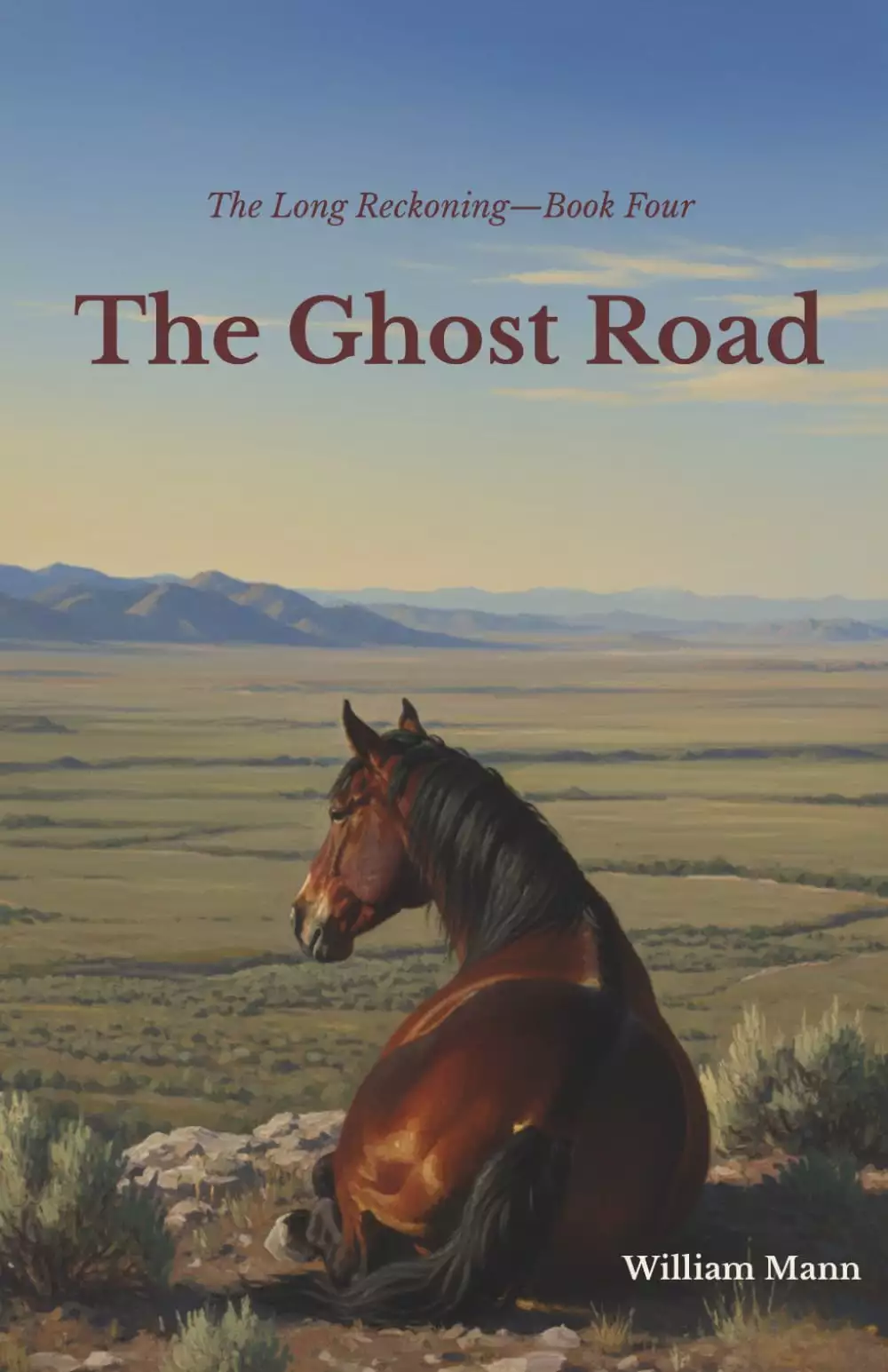
She was gray around the muzzle now, more gray every year. The rest of her was still dark, still the deep cordovan brown she had always been, rich as old leather, her mane and tail black as paint. In her younger years, people had stopped to look at her. They still did, sometimes, even now. She had carried him through things that had killed better horses. Through the Cimarron in flood, the water chest-high and the current mean. She had not panicked, had just kept driving her legs and trusting him to point her right. Through a firefight outside of Adobe Wells, where the air had been nothing but noise and smoke and the smell of blood. She had stood while other horses screamed and bolted, her ears flat but her feet planted, waiting. He had asked a great deal of her over the years. More than was fair to ask of any animal. She had never once quit on him.
He did not think about this. He measured out her grain, freshened her water, and left her to it.
The goat watched him from across the pen with an expression that suggested it was already planning something. He could not prove it, but it was evident. He filled the water trough, tossed in some hay, and left without turning his back on the animal.
He made coffee on the small iron stove and drank it standing at the window, watching the light come up over the scrub. The Davis Mountains sat blue and low on the southwestern horizon as they always did, as they would long after he was in the ground, indifferent to the whole business. This was his country now, had been for going on eleven years. Not his by birth or by love exactly, but his, as a pair of worn boots are yours — by use, by the shape they have taken of you over time. Texas was his home now. Georgia was behind him. Out here, there was just the flat, pale sky and the dry ground. His few animals and the rhythm of days that asked nothing of him and gave nothing back suited him fine.
The Hardee hat he had worn through half his life hung on the hook next to the door. He took it from the peg, fingered the brim, then put it back.
He had done the work. He had written what he saw, not more and not less, and he had carried out the orders placed in his hands without the cruelty some men seemed to need. He had known good people along the way, had treated them fairly, had told himself that counted for something. A man could do harm cleanly, he believed, if he did the work steady and wrote down only what he saw. He had believed this for a long time.
He had his routine, and he kept to it. Mornings were chores and coffee. Middays were his own. Once a month, on a Tuesday, he rode into Redhills for his monthly stipend and a trip to the barber. His Army pension was not enough to get drunk on but enough to stay housed and fed and tobacco’d through the month, which was all he required. He was not a man with expensive needs.
He saddled Maribelle after the coffee, and they went at her pace, which was not fast but was steady. The road to Redhills was eight miles of hardpan and scrub oak, and she knew every yard of it. He passed the fishing hole going out, which was less of a hole than a wide, slow bend in a creek that ran brown and shallow most of the year. He did not stop. He would stop coming back, maybe. If old Joe were there, he would sit a while.
Redhills was not much of a town. It had a livery, a dry goods store, a cafe, a telegraph office, and a postal window inside the general store where Harlan Pruitt sorted mail and dispensed government stipends with equal indifference. Billy Lee tied Maribelle outside, went in, and waited while Pruitt finished with a woman buying ribbon.
“Grogan,” Pruitt said, and turned to the pigeonholes behind him. He came back with an envelope, the usual one, and set it on the counter along with a second envelope that he placed on top of the first as if he wasn’t sure which one was more important. “Letter too. Came in with the government post.”
Billy Lee looked at the two envelopes. The second one had a seal on it that he recognized, even though he didn’t want to.
He tucked them both inside his coat.
“Anything else?” Pruitt said.
“No,” Billy Lee said.
He stopped at the fishing hole coming back. Joe was there, as he sometimes was on a Tuesday, sitting on his usual rock with a line in the water, and there were two others Billy Lee knew by sight if not by name — younger men, brothers maybe, from the settlement a few miles east. They nodded at him, and he nodded back and found himself a flat rock a little apart from them and sat.
Joe had come out to the Davis Mountains the same way Billy Lee had — quietly, without saying much about the years behind him. Men didn’t come this far unless they were looking to be left alone. That was something the two of them understood without ever putting words to it.
He did not fish. He never fished. He just sat, rolled a smoke, listened to the water, and let the noise in his head settle.
The letter was in his coat. He could feel it.
The talk among the others was quiet; men-fishing quietly, nobody wanting to disturb the water. He wasn’t listening particularly. His mind was on Pruitt’s counter, on that second envelope with its seal. Probably something about the pension. Some new regulations about documentation, a clerk in Washington needed a form filled out. He had filled out forms for the Army his entire adult life. He supposed he would fill out forms for them until they put him in the ground, and possibly there would be a form for that, too.
Then he heard the word.
Not a word he knew. A name. Wovoka.
He did not move. Joe was asking something, leaning forward a little as he did when something interested him, and one of the younger men was speaking in a low voice, and Billy Lee caught words and pieces of words — a man in Nevada, the Paiute, a vision, the dead returning, a dance. The young man’s voice carried none of the dismissal you heard from men speaking of superstition or foolishness. He spoke of something that mattered. Something that was moving through the world right now, today, as real as the weather.
Wovoka.
Billy Lee looked at the water.
After a while, he said his goodbyes and mounted up, and they started back down the road toward home.
He read it that evening, after supper, by the lamp. It was Army language, clipped and formal, the kind of letter that had been written by a man who had written many such letters and had long since stopped thinking about the person on the receiving end. There was an officer out of Fort Douglas who had his name, apparently, and had sent this to his last known address on the stipend rolls, and the letter explained briefly that there was a situation developing in Nevada, a religious movement among the Paiute and others, a man called Wovoka who was drawing followers from many nations, and the Army had an interest in understanding what exactly was occurring before the situation developed into something requiring a more formal response.
The letter said they were asking if he might be willing to ride out and take a look.
The language around the asking made clear it was not quite asking.
There was a line near the bottom that said if he found himself unable to undertake this assignment due to age or infirmity, he should reply by telegraph at the Army’s expense, and no further obligation would be incurred.
Billy Lee set the letter down on the table. He looked at it for a while. Then he picked it up and set it on the shelf above the stove where he kept things he wasn’t done with yet, and poured himself a measure of whiskey, and sat back down.
Outside, the goat was moving around the pen in the dark. He could hear it. Plotting something.
He drank his whiskey and went to bed.
In the morning, his mind was clear on the matter. He would send a denial. Respectful, brief, citing the distance and his age and the state of his horse and his general uselessness for the kind of work they were describing. He owed the Army nothing. He had given the Army the better portion of his life, his knees, three fingers of his left hand lost to frostbite outside of Fort Laramie in the winter of ‘63, and whatever it was a young man carried inside him that let him sleep easy at night. They had taken all of it. They were not getting anything else.
He had the words set in his mind before he finished his coffee. He saddled Maribelle, and they headed for Redhills.
He stopped at the fishing hole. Tuesday habit, or something else. Joe wasn’t there this morning, but the two younger men were, sitting close together on the bank, not fishing, talking in low voices. Billy Lee did not intrude. He sat a little distance off and rested Maribelle’s reins over the saddle horn.
The name again. Wovoka. And more now. The dance itself, spreading nation to nation, people who had nothing else left to reach for, reaching for this. The younger man’s voice had something in it Billy Lee had not heard in a long time, something he remembered from long ago, from a different road in different country, from the faces of people being walked away from everything they had ever known. He had seen them reach for things, too. Prayer, mostly. Song. The particular straightening of the spine that is not pride exactly, but is the refusal to let pride be taken along with everything else.
He sat and listened and said nothing, and after a while he clicked to Maribelle, and they went on toward town.
He went to the cafe first. He did not usually eat in town, but he sat down, ordered coffee and biscuits, and ate slowly, looking out the window at the street. He had the denial ready. He ran through it again. Clear, final, respectful. He was old. His horse was old. He had no business riding to Nevada.
He paid for his biscuits and walked to the telegraph office.
The operator looked up. Young fellow, ink-stained, a little bored.
“Help you?”
Billy Lee slid the Army letter across the counter to the fellow. He opened his mouth.
“I’ll go,” he said. “Tell them I’ll need two weeks to get ready. Tell them to expect me at Fort Douglas by the end of the month.”
The operator wrote it down without particular interest. Billy Lee watched him write it down. He waited while it was sent. He paid for it.
He walked back out into the street.
The sun was up full now, and the day was already warm. He stood there a moment outside the telegraph office and said several things under his breath that would not bear repeating in church. Then he turned and walked to the livery.
He looked at horses for a good long while. The liveryman showed him two good animals, sound and young. More than capable of the ride. Billy Lee looked them over carefully. He checked their feet and teeth and ran his hands along their legs as a man does when seriously considering a purchase.
He stood with his hand on the second horse’s neck. The horse was the right horse. He knew it before he had finished checking the feet. Sound, young, even-tempered, and fair-priced.
Maribelle nickered.
He looked toward the post out front. She was watching him. Her ears were forward. She nickered again, louder this time, and the second one was not a sound a horse makes when it wants something. It was a sound a horse makes when it has something to say.
He took his hand off the new horse.
He thanked the liveryman and walked back out, untied her, and stood beside her a moment, one hand on her neck. Her ear swiveled back toward him.
“All right,” he said. “All right.”
“You better not die on me. Not out there. You hear me? I need you to hold yourself together for this one last thing, and then we’ll both come home, and that will be the end of it.”
Her ear flicked. She turned her head slightly and looked at him with one large dark eye that had seen a great deal and forgotten none of it.
He mounted up.
They rode home in the afternoon light, the two of them, old and slow and pointed west.
The Woodcutter
The mountain had no name that the whites used. They called it by the valley below it, or by the ranch that sat at its base, or they did not call it anything at all because they had not learned yet to see it as something that matters. Wovoka had been coming here since he was a boy, first with his father and then alone, and he knew its moods as he knew the moods of the people he loved — by small signs, by the quality of the air, by how the light moved across its face in the late afternoon.
It was a cold first day of January, the start of the new year. The cold came down off the mountains and sank in deep, settling into the bones and staying. He had been cutting since first light. The ax was good, well balanced, and he worked without hurrying, his father’s lesson in him — let the tool do what the tool is made to do, don’t fight it, don’t force it. The wood split clean.
Below him, the valley lay open and pale, the Walker River a dark line through the sage, the mountains on the far side standing blue and indifferent in the cold. He had looked at that view his whole life. It did not diminish. Some things you look at enough times, and they wear down to nothing, but this was not one of those things. Every morning it was the same valley, and every morning it was different. He had decided long ago that this was how the world told you it was still alive.
He was no longer a young man anymore, though he was not old. Thirty-some years. Large for a Paiute, broad through the shoulders, with his father’s heavy brows and his father’s habit of going still when something required thought. The Wilsons had called him Jack since he was a boy working their ranch in the valley below, and he answered to it among whites without particular feeling either way. Among the Numu, he was Wovoka. The Cutter. He had earned the name honestly, with work like this, wood for the Wilson ranch, wood for his own fire, the ax swinging in the frigid mountain air since before he was old enough to do it well.
He had been preaching for three years now. Teaching the dance, leading the round dances in the evenings, telling people what his father had told him, and what his father’s teacher Wodziwob had told him before that. The dead were not gone, that the boundary between the living and those who had crossed over was not as final as it appeared, that the world could be renewed if the people lived rightly and danced and kept faith. He had not called himself a prophet. He had not called himself anything. He was a man who knew certain things and felt obligated to say them.
The people listened. Not all of them, not always, but enough. They came to the dances in the evenings, and they moved in the circle as the old ones had always moved, stepping sideways together, the songs rising into the cold Nevada sky, and sometimes a dancer would go rigid, fall, and lie still for a while before coming back. When they came back, they brought songs with them, new songs from the other side, and those songs were added to what they knew, and the circle kept moving.
He had seen his father do this. He had grown up inside this world.
He laid down his ax when he heard the noise.
It came from above him, or from everywhere at once, he could not say later which it was, only that it was large, larger than weather, larger than anything he had a name for. Not a sound exactly. A presence. Thunder is sometimes less a sound than a pressure against the whole body. This was that, and more.
He did not run. He set the ax down carefully, with attention, as you set a tool down when you are finished with it for the day, and then he lay down on the frosty ground and looked up at the sky and the sky was going dark, the sun departing in a manner it had no business departing, the light draining out of the afternoon as if something had decided the day was over.
And then he was gone.
He was in a place that was not the mountain.
The place had no edges and no distance. He was at the center of everything, and everything was within reach. There was light here, but not the light of the sun, something older than that, something that did not cast shadows. And there were people. More people than he could count, more than had ever gathered in Mason Valley, more than the valley could have held. He knew some of them. His grandmother had died when he was young. Others he knew by their faces, but whose names he had not thought of in years. They were not suffering. They were not waiting for anything. They simply were, present and complete, as mountains are.
And then God was there.
He could not have said what God looked like. He could say that God was there as the sun is there, even when you cannot look directly at it, known by its warmth, by how everything near it is illuminated. And God spoke to him, or put things into him that became words later, and what was said was not complicated. It was the simplest thing.
Go back. Tell your people they must be good, love one another, and not fight, steal, or lie. I am giving you this dance to give to them.
That was all. That was everything.
He came back to the mountain, the cold ground under him and the sky above him returning, the sun reappearing at the edge of what had been darkness, the light returning to the valley below. He lay still for a long time. The ax was beside him where he had left it. A woodpecker was working somewhere in the trees above, indifferent to everything that had just happened.
He was not the same man who had lain down.
He knew this without drama. Not a feeling of power or elevation. Nothing like that. More like the feeling after a long illness breaks, when the body returns to itself, and the world returns to its proper weight and color. Except that something had been added that had not been there before. A certainty. The kind that does not require argument or defense because it does not come from argument or thought. It simply is.
He picked up the ax. He looked at the valley below, the river, the far mountains, the pale sky of late afternoon. His grandmother had been there. She had not been suffering.
He began the walk down.
He told his wife first. She listened as she always did, completely, without interruption, her eyes on his face. When he was finished, she was quiet for a while, and then she said that his father had known this would come, that Tavibo had said so more than once in the years before his death, that the next one would be stronger, that the teaching would go further than it had gone before.
Wovoka sat with that.
He was not sure he wanted it to go further. He was a man who cut wood, led dances, and tended to his people in whatever ways he could. He had healed the sickness. He had called rain when the drought was bad. James Josephus from the Walker River reservation had come to him, desperate one summer, sitting with him through a long night while Wovoka said nothing and only listened, and on the third morning the rains came, torrential and unlike anything most people could remember. He did not take credit for the rain. He did not take credit for healings either. He was a vessel, not the source. His father had taught him the difference, and he believed it.
But what he had been given on the mountain was not a small thing to be tended quietly in Mason Valley. He understood that already. The dance was meant to spread. The message was for all the people, not just his own. Go back and tell them.
He had been told.
In the days that followed, he taught the dance again. The five-day ceremony, the circle moving along the path of the sun, the songs rising, the dancers falling into their visions, and coming back with new songs added to the old ones. The people came from the valley and from the reservation at Walker Lake, and they danced, and the word went out as it goes among people who share a grief. Quickly, quietly, carried by whoever was moving in whatever direction they happened to be going.
By spring, the delegations had begun to arrive.
They came from the east mostly, from nations he had heard of but never seen — Shoshone, Arapaho, Cheyenne, and then further, Sioux from the Dakota country, men who had ridden or walked or ridden the iron road to reach this valley and this man who was said to have died and come back with instructions. They sat with him, and he told them what he had been told, taught them the dance, and sent them home with what he had given them.
Be good. Love one another. Do not fight. Do not steal. Do not lie. Dance.
He told them to keep the dance among themselves, away from the whites, not because it was secret but because it would be misunderstood. He knew something about being misunderstood. He had grown up between two worlds, cutting wood for a white rancher’s family, learning their God from their Bible, going home in the evenings to his father’s fire and his father’s older knowing. He understood what happened when one world looked at another and found only what it expected to find.
He told them to be peaceful. He told them this many times, to many delegations, in many languages through many interpreters whose translations he could not verify. He told them the change that was coming would come on its own, through God’s action, not through theirs. Their part was to live rightly and to dance.
Whether they heard him, all of him, the whole of what he said, he could not know. Words travel and change as they travel. He knew this. His father had known it. Wodziwob had known it before that.
He cut wood in the mornings. He led the dances in the evenings. The delegations kept coming.
He had never been more than thirty miles from the valley where he was born. He had no plans to go further. The Wilson ranch was here, his people were here, the mountain was here. This was his ground, and he knew it. It knew him, and that was enough for a man. It had always been enough.
And yet the dance was going where he would not. It was crossing the mountains he had only ever looked at from below, moving out onto the plains he had never seen, reaching nations whose languages were as foreign to him as Chinese. The Arapaho carried it north. The Cheyenne carried it east. The Sioux took it all the way to the Dakota country, a distance so vast he could not hold it in his mind. Men who had come to him on foot or on horseback or on the iron road were going back the same way, carrying something he had been given on a cold mountain while cutting wood for a white man’s fire.
He thought sometimes about that. A man stays in his valley his whole life, and something moves through him and goes out into the world without him, the way a stone dropped in still water sends rings to shores it will never reach. He was the stone, not the rings. The rings were God’s message, emanating out to where they would go. What it became out there, beyond the mountains, beyond his sight and his voice and his ability to correct misunderstanding, that was not his to control. He knew this. He had said as much to his wife on the night he came down from the mountain. The message was not his. He was only the one it had passed through.
The valley was the same valley it had always been, pale and cold and wide under the mountains, the river running dark through the sage. Some mornings, he stood at the edge of it and looked out at the distance as he had looked his whole life, trying to read its moods, and what he read there he kept to himself.
God had given him a dance to give to his people.
He was giving it.
What the world made of it after that was not his to decide.
We hope you are enjoying the book so far. To continue reading...
Copyright © 2026 All Rights Reserved

 Please log in to recommend or discuss...
