Deadwood
Deadwood in the fall of 1884 never quite slept and never quite woke. It went on anyway, noise and mud and the sour stink of ambition, twenty‑four hours a day, seven days a week, indifferent to the men it chewed through.
Elias had been there three months.
Long enough to learn its rhythms. Long enough to know the men worth watching, the streets to avoid after dark, the arguments best left alone. Long enough that Hendricks’s stable felt like another life, the hay and leather, the children playing with Pup, Mrs. Patterson’s quiet gratitude, though it had been only two months since he’d ridden north out of the Black Hills with everything he owned tied behind his saddle.
He’d set up at the edge of town, where the noise finally thinned. A rope corral. A lean‑to for gear. Enough grass for the string he’d built, trading up from what Bridger left him. Six horses now. Good animals. He knew each one.
Biter stood apart from the others, as he always did. Mean and magnificent and entirely unconcerned with anyone’s opinion of him.
Pup lay near the corral gate. Head on his paws. Watching the street.
He was always watching the street.
The man came up the main thoroughfare on a Tuesday morning, moving through the crowd like water around rocks, not avoiding people, just never quite making contact. Big. Maybe fifty, maybe older. Hard to tell with men who’d lived rough. His face had stopped bothering with expressions years ago. Just flat. Watchful. The eyes taking everything in and giving nothing back.
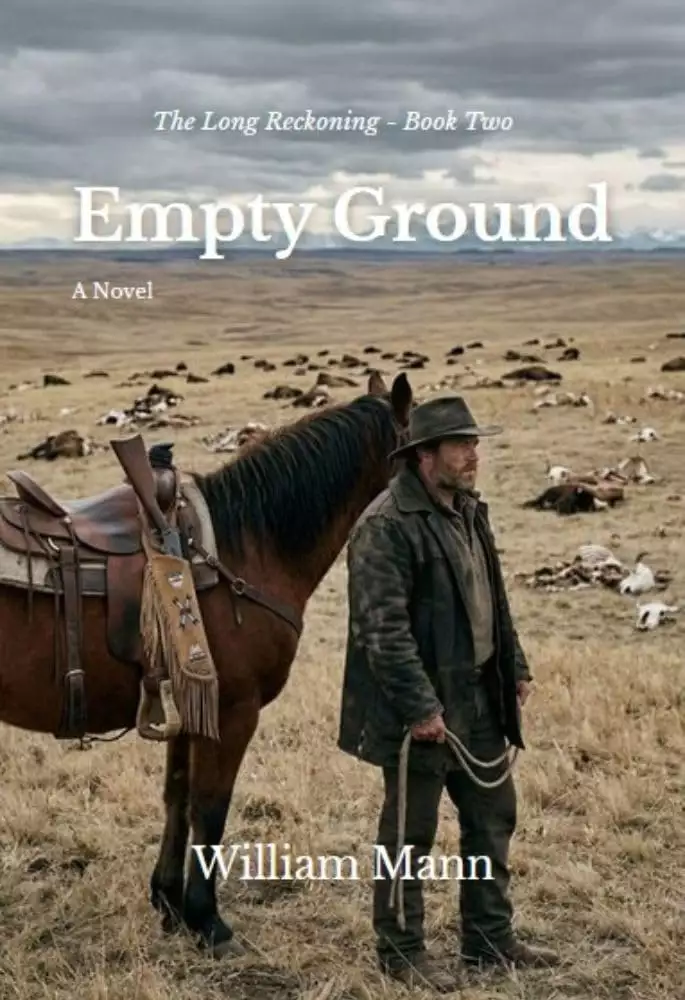
He wore a buffalo coat, worn thin at the elbows, the hide stiff with old grease and something darker. The coat alone told you something. Buffalo coats were common enough, but this one had the look of a man who’d made it himself, from an animal he’d killed and hadn’t cared much about the craftsmanship.
He stopped at the rope corral.
Looked at the horses.
Pup’s head came up.
Elias was replacing a shoe on a roan mare at the far end of the corral. He registered the stillness in the dog like you registered weather coming. Didn’t look up yet. Just noted it. “You selling?” the man said.
Irish.
The accent worn down by years and distance, but still there underneath, like an old scar under new skin.
Elias set the mare’s hoof down and straightened. Wiped his hands on his pants.
The man looked at the horses how a man looks at tools. What can this do for me. How long before it breaks.
“Looking for something specific?” Elias said.
“Trail horse. One that’ll cover ground. Don’t need it pretty.”
“Where you headed?”
“North. Maybe east. Wherever the work is.”
Elias looked at his string. Six horses. He knew what each one needed, what each one could give, what kind of man each would tolerate.
He looked at Pup.
The dog was on his feet now. Head level. Eyes on the man. Tail down. Still.
Elias thought of Hendricks. The way the old man would go still when a certain kind of customer stepped through the door. Not tense. Just still. Waiting to see which way it went. And afterward, when the man had gone, Hendricks would go back to his work without comment. Just pick up the hoof again. Keep working. As if some things didn’t need explaining.
“I don’t think I’ve got what you need,” Elias said.
The man looked at him. Something moved behind the flat eyes. Not anger. Just calculation.
“You’ve got six horses,” he said.
“None of them right for what you’re describing.”
The man was quiet. His eyes moved slowly across the string. Then they stopped on Biter.
“That gray,” he said.
“Not for sale,” Elias said.
“Everything’s for sale.”
“Not that horse.”
The man was quiet again. His eyes stayed on Biter. His hand moved, just slightly, toward the rope corral, fingers reaching for the top strand.
The growl came from low and deep, the kind that didn’t start in the throat. Pup hadn’t moved forward. Just stood there, the sound rolling out of him like something ancient and certain. Ears back, head low.
The man’s hand stopped.
He looked at Pup for a long moment. Pup looked back. Neither of them moved.
Something passed across the man’s face. Not fear. Just the recognition of a thing that meant what it said.
He let his hand drop.
“Mule man,” Elias said. “End of the street. Left side. Mule will serve you better on this ground anyway.”
The man looked at Elias. Looked at Pup. Then he turned and walked back into the street. Through the crowd. Water around rocks. Gone.
Pup watched until he was out of sight.
Then he turned and looked at Elias.
“Yeah,” Elias said quietly. “I know.”
He went back to the roan mare. Picked up her hoof. Kept working.
But he watched the street for the rest of the morning.
The mule trader’s name was Pruitt. A narrow man with a narrow face and the cautious eyes of someone who’d been cheated enough times to be suspicious of everyone, but not quite enough times to be smart about it.
Declan looked at the mules in the pen. Four of them. Two were too old, legs stiffening, the kind of animals that would get you halfway to where you were going and quit. One was young and green and would spend the first month trying to kill you. The fourth was maybe eight years old. Deep chest. Short back. The kind of mule that would work all day and ask for nothing but water and grain.
“That one,” Declan said.
Pruitt named a price.
Declan named a lower one.
Pruitt shook his head.
Declan looked at the mule. Looked at Pruitt. Looked at the mule again. He didn’t say anything. Just waited with the particular patience of a man who had nowhere else to be and nothing else to want and would stand here all day if that’s what it took.
Most men couldn’t stand silence. Pruitt was one of them.
He came down five dollars.
Declan paid him, most of it, and led the mule out of the pen. Pruitt was still counting the bills when Declan turned the corner.
He’d short‑changed him four dollars.
Pruitt probably wouldn’t notice until later. And even if he did, he wouldn’t be sure. That was the thing about men like Pruitt. They were never quite sure.
Declan tied the mule to a post outside a saloon and went in.
Not to drink. He didn’t drink. Drink made men stupid, and Declan had spent too many years watching what stupid looked like to want any part of it. Just to sit for a moment out of the wind and think about the next thing.
The saloon was the kind of place Deadwood had a hundred of. Low ceiling. Tobacco smoke thick enough to cut. Men hunched over cards or drinks or both. A piano in the corner that someone was playing badly.
He took a table near the wall where he could see the door.
Always near the wall. Always facing the door.
He’d learned that somewhere on the road between New York and here. One of the small lessons the continent had taught him. There were men in the world who would take from you if you let them, and the only way not to let them was to see them coming.
He ordered coffee. Sat with it. Thought about the horse trader.
The man with the wolf dog.
There was something about him that sat wrong with Declan. Not threatening. Not weak. Steady in a way that most men in Deadwood weren’t steady. Like he’d seen something that had settled him. Like he knew something Declan didn’t.
Declan didn’t like men who knew things he didn’t.
And the dog.
He’d looked into that dog’s eyes and seen something he hadn’t seen in an animal in a long time. Maybe ever. Not aggression. Not fear. Just clarity. The dog knew exactly what Declan was. Had looked at him like you looked at a thing you’d already decided about.
Declan finished his coffee. Left a coin on the table. Not enough to cover it.
He walked out into the street.
Deadwood in the afternoon was noise and mud and the smell of men who hadn’t bathed since summer. He moved through the crowd with ease. Watching. Calculating. Reading each face for what it wanted and what it had and whether either of those things was any use to him.
He was passing the row of cribs on the east side of the main street when he saw her.
She was sitting in the open doorway of one of them. Young. Maybe seventeen. Maybe less. Dark hair loose around her shoulders. She wore a dress too thin for the weather and too bright for daylight, and she sat with her hands folded in her lap while a man stood over her talking.
Declan didn’t know what the man was saying. Didn’t matter. The man’s posture said enough. The way he leaned. The way his hand rested on the doorframe above her head.
The girl wasn’t looking at him.
She was looking at something else entirely. Something that wasn’t the street or the man or the crib or Deadwood or any of it. Her eyes were open, but she was somewhere else. Gone inside herself to a place the man couldn’t reach.
Declan had seen that look before.
Once.
On a face he hadn’t let himself think about in years.
Maeve at the table in the cottage in Clare while Thomas came through the door. Maeve on the pallet in the room on Mulberry Street when the footsteps came up the stairs. That particular way she had of leaving without moving. Of being somewhere else while her body stayed.
He’d thought it was just Maeve. Something particular to her.
He understood now it wasn’t particular to anyone. It was just what happened to people when the world gave them no other way out.
He stood there for a moment.
The man was still talking. The girl was still somewhere else.
Declan’s hand moved toward his belt. An old reflex. Then stopped.
Not his business.
Never his business.
He’d learned that too somewhere between New York and here. Getting involved in other people’s trouble was how you got trouble of your own. The world was full of girls with that look in their eyes, and there was nothing you could do about any of them, and the ones who tried ended up dead or in jail or just used up.
He turned and walked away.
But the look stayed with him.
Maeve’s eyes in a stranger’s face.
The brush she’d carried across an ocean.
Her hands, empty on the pallet.
He walked to where the mule was tied. Untied him. Swung up.
The mule moved out steady and indifferent beneath him.
Declan rode to the edge of Deadwood and stopped.
Looked north.
Then east.
Then south toward where the hills flattened into prairie.
Wherever the work is, he’d told the horse trader.
That had always been true. That had been true since the day he walked out of the Five Points with a stolen stake and the continent spread out in front of him like something that didn’t know yet what he was going to do to it.
He touched his heels to the mule.
Rode south.
Behind him, Deadwood went on being what it was.
Ahead, the prairie opened up.
And somewhere in the distance between where he was and where he’d come from, the story of how Declan Shea arrived in a place like this was waiting to be told.
County Clare
Morning found Declan Shea on the cold floor again, the thatch above him dripping in slow, steady betrayal.
A rat crossed near the far wall. He watched it go. There were always rats. They knew the house as well as he did.
His mother had kept them out once. That was before the cough settled in her chest and refused to leave.
He lay still for a moment, listening. Maeve’s breathing, slow and steady from the pallet across the room. The wind off the Atlantic finding every gap in the stone walls. And beneath it, the sound he’d learned to dread, his father’s boots on the path outside.
He was up before the door opened.
Thomas Shea filled the doorframe the way bad weather fills a valley. Big. Wet. Smelling of the docks and something darker underneath. He looked at Declan standing in the middle of the room and said nothing. Just moved past him toward the fire, what was left of it, and held his hands out.
“Where’s your mother,” he said. Not a question.
“Sleeping,” Declan said.
Thomas grunted. Looked toward the curtain that divided the room. Behind it, Eileen would be awake. She was always awake when Thomas came home. But she’d learned, same as Declan had, that sometimes stillness was its own protection.
Maeve appeared at the curtain’s edge. Ten years old. Dark-haired like their mother, with the same careful eyes that missed nothing.
“Go back,” Declan said.
She looked at her father. Looked at Declan. Went back.
Thomas didn’t seem to notice. He’d found the bottle he’d left that morning, checked the level, and sat down in the one chair the cottage had. The chair had been Eileen’s father’s. She’d brought it from her family’s house when she married. Thomas claimed it in the first week and never gave it back.
Declan stood near the door and waited for whatever came next.
Whatever came next was always something.
The good days were the ones when his mother was well enough to sit up.
Not well, she hadn’t been well in two years, not since the winter the cough came and stayed, but well enough. Well enough to call Maeve to her, take the brush from the shelf, and work through the tangles in the girl’s hair while she talked.
She talked about the old stories mostly. The warriors. The kings. Cú Chulainn defending Ulster alone at the ford. Fionn Mac Cumhaill and the Fianna ranging across the hills. The world as it had been before it got small and wet and hungry.
“Your name,” she told Declan once, while Maeve sat still under the brush. “Do you know what it means?”
He shook his head.
“Full of goodness,” she said. “That’s what I named you. Full of goodness.” She looked at him over Maeve’s head, her eyes too bright the way they got when the fever was on her. “Don’t let anyone take that from you.”
He hadn’t known what to say to that. Just nodded and looked at the floor.
He was fourteen and already understood that goodness was something the world worked hard to take.
She died in November.
Not dramatically. Not the way the stories went. Just got quieter and quieter over the course of a week until one morning the quiet didn’t stop.
Declan sat with her until the light changed. Maeve pressed against his side, not crying. They’d learned not to cry where Thomas could hear.
His father stood in the doorway for a moment when he came home that evening. Looked at Eileen’s still shape under the blanket. Looked at his children sitting beside her.
Then he went and found his bottle.
That was all.
Declan thought he couldn’t hate the man more than he already did.
He was wrong.
The months after were the months he didn’t think about.
Thomas drank more. Worked less. The money Declan brought home from the docks, loading, unloading, whatever they’d give a fifteen-year-old boy, disappeared into Thomas’s pocket and came back as whiskey smell and broken crockery.
Maeve stayed close to Declan. Followed him to the door in the mornings. Waited for him at the path in the evenings. She’d stopped talking much after Eileen died. Just watched. Those careful eyes taking everything in.
It was the watching that saved her, in the end.
Or maybe it was Declan.
He came home late one evening in the depths of winter, later than usual, a coin in his pocket from an extra hour’s work. The cottage was dark. No fire. That was wrong, Maeve always kept a fire.
He stood in the doorway.
Heard something.
What happened next, he never spoke of. Not on the ship. Not in New York. Not in forty years of moving west across a continent that didn’t care what a man had done before he arrived.
When it was over, Thomas Shea was on the floor, and Declan was standing over him, his hands dark, his breath coming hard, and Maeve was pressed into the corner with her knees pulled up and her eyes on her brother.
“Get up,” Declan said. “Get what you can carry.”
She got up.
She went to the shelf, lifted their mother’s brush, and held it to her chest for a heartbeat. Then she nodded.
They were out the door before the neighbors’ fires began to smoke.
We hope you are enjoying the book so far. To continue reading...
Copyright © 2026 All Rights Reserved

 Please log in to recommend or discuss...
