
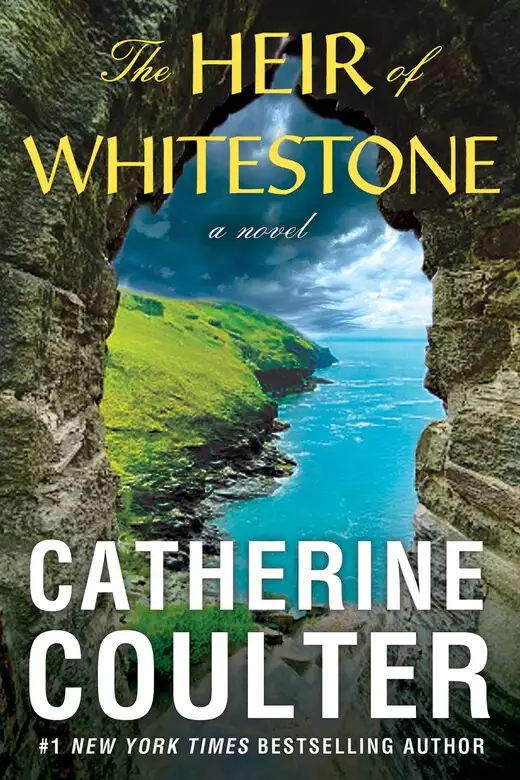
The Heir of Whitestone
- eBook
- Audiobook
- Hardcover
- Book info
- Sample
- Media
- Author updates
- Lists
Synopsis
A brilliant young innovator with a mysterious past and a boldly sharp-witted Lady uncover deadly secrets in #1 New York Times bestselling author Catherine Coulter’s thrilling, new Victorian-era romantic mystery filled with daring escapes, exciting twists, witty humor, and characters you won’t soon forget.
When Alex Ivanov was 12, someone tried to kill him. Now, 11 years later, they still want him dead.
England, 1842. Queen Victoria reigns, Buckingham Palace is overrun with rats, and the streets of London are filled with intrigue.
Alex Ivanov is a brilliant young innovator, designing cutting-edge train engines. But Alex has a secret—he isn’t really Alex Ivanov. As a boy, he was pulled from the Thames, presumed drowned, with no memory of who he was. Rescued and raised by the formidable Ryder Sherbrooke, Alex has built a new life, but his past is catching up with him.
Lady Camilla Rohman has problems of her own. Trapped by a scheming stepmother and a family determined to see her married off, she is as clever as she is desperate. When fate throws her into Alex’s path, their connection is undeniable.
But as their whirlwind romance turns into marriage, danger follows. On their honeymoon, a series of deadly attacks make one thing clear—someone wants Alex dead. As they race to uncover the truth, old enemies and long-buried secrets come to light, leading them to a shocking revelation that will change everything…
Release date: February 24, 2026
Publisher: Kensington Books
Print pages: 400
* BingeBooks earns revenue from qualifying purchases as an Amazon Associate as well as from other retail partners.
Reader buzz
 Please log in to recommend or discuss...
Author updates
The Heir of Whitestone
Catherine Coulter
He had to calm, he knew that, but it was so hard. He forced himself to breathe deeply, slowly, slowly, and a bit of the awful fear lessened. He realized he was in the hold of a boat, had to be small because it rocked gently side to side. He was probably in the hold of a skiff. How long had he been here slumped against rough boards, his wrists and ankles tied with stout hemp? Where was he?
Someone had hit him on the head, tied him up, brought him here.
How much time had passed?
Where was his brother? “Simon?”
He called out his brother’s name again, and another time, but there was only the creaking of the boards beneath him. He didn’t want to, but he had to believe either Simon wasn’t here with him or he couldn’t answer him. Or he was dead. Graham felt shock, awful fear, no, no, maybe they’d gagged Simon after they’d struck him down like Graham. But wouldn’t he have awakened by now? He knew he’d have heard his younger brother breathing, even gagged.
He called his name again, then again.
Simon’s dead, Simon’s dead.
He leaned back against the wooden hold wall, closed his eyes. In his gut he knew he could shout for help forever and no one would come and if someone did hear him, he wouldn’t care.
Graham had to accept he was in deep trouble. Someone had done this to him. But why?
He was hungry and really thirsty now. Wait. He heard voices from above him on the deck of the skiff, then a louder man’s voice, but he still couldn’t understand the man’s words. Were there two men? And they were arguing?
Calm, calm, he had to be calm and think. It only made sense he and Simon had been taken for ransom. Their father was wealthy. He would also be mad with fear, willing to pay any ransom to get his sons back. He knew to his soul his father would offer up his own life to save him and Simon. He felt tears choke his throat. Simon. No, he didn’t have to be dead, maybe Simon was bound as he was and unconscious behind those wooden crates stacked opposite him, secured to the wall with stout rope on the other side of the hold.
He tried again to pull on the rope tying his wrists behind his back. Maybe he could roll over and over and open one of those crates, maybe find a knife, anything he could use to get himself free. He tugged and pulled forward and realized soon enough he couldn’t roll anywhere. He could only move a foot from the wall because there was a rope securing his tied hands to the boards behind him. He pulled and pulled, but it was no good. He felt blood on his hands, felt wrenching pain in his shoulders and arms.
He couldn’t give up, just couldn’t. There had to be something, some way to get free—his thoughts turned back upon themselves, repeating over and over in a loop, and he finally felt frozen in place. Over and over he tried to think of who could have struck him down and brought him to this boat. And Simon? Of course he’d been struck down too. Had they been separated? But why? Why wouldn’t the men have put them together?
Think, Graham.
It’s not for ransom.
The men who’d struck him down and brought him here wanted something else, but what? He was fourteen years old, Simon thirteen. What could two boys give them if they weren’t taken for ransom?
Simon is dead, they hit him too hard and he died. No, Graham couldn’t, wouldn’t accept that. How many hours had passed since he and Simon had been in the home wood arguing about the best position to hold a bow before letting an arrow fly, arguing as only two brothers could, calling each other names even as they ran back toward the shed where their bows and arrows were stored. Because Graham was fourteen months older than his brother, he was ahead of him. Then Simon had called out to him, and now Graham realized there’d been something strange in his voice. Did he want him to slow down? No, Simon would never say that, he’d only run his feet off to catch Graham. He’d stopped, ready to taunt Simon when suddenly, he’d been struck on the head and the world was gone.
Had Simon seen their attackers? And he’d called out to Graham, to warn him? How many men were there? There had to be at least two, one to bring down each brother. Without warning Graham felt his belly twist in on itself, not from nausea but from raw fear, for himself and his brother. He leaned over and vomited, dry heaves since he hadn’t eaten since breakfast. When was breakfast? How long ago? One day, two? How long had he been tied here in the hold of this skiff?
Graham pictured his father’s face, frantic with fear, searching everywhere, shouting their names, tearing up the countryside to find him and his brother, all their people, all St. Lucy Head’s townspeople searching with him. But who would ever look on a small skiff? And where was the skiff? Bobbing in the waves near the cliffs in the Channel?
No, the skiff wasn’t in the Channel. He’d sailed many times in and out of Sally’s Cove. He knew how the waves flowed and rippled or soared high and deadly, and this wasn’t it. This was slow, gentle rolling. But then where was he? Where was the skiff? How long had he been here?
Yet again Graham worked the ropes on his wrists, but there was still no give at all. If he stopped pulling and jerking on the knots, would the blood on his hands dry? He fell back against the wood-planked wall, and felt hope leach out of him.
Get yourself together, Graham, don’t just sit there and give up. You use your magnificent brain. Come on, you’re my son, you never give up.
Not his father’s voice this time—it was his mother’s, loud, insistent, right in his face. But his mother was dead, dead when he was only five years old, but he remembered her voice, the strength in her arms when she hugged him, her kisses on his cheek. And her laugh, full and happy and loud, and more kisses. He whispered, his voice thin and frightened, “Mother?”
Of course she wasn’t there. He wanted to cry again, but wait—she’d told him to use his magnificent brain? He had a magnificent brain? If he hadn’t felt so rotten, he would have laughed. No, no, be calm. Never panic. He felt new resolve, at least he believed it was resolve, one of his father’s favorite words, or desperation, more like.
He gritted his teeth and pulled with all his strength. To his amazed surprise, he felt the board behind him split. He pulled away from the wall. He worked his bound wrists to the top of the board and off. He felt the rope dangle between his wrists. He managed to roll onto his side and began inching his way across the wooden floor, not more than eight feet away. The boards beneath him weren’t even, jagged in places. The skiff was very old. He felt a nail rip into his shirt, and he yipped with pain, but kept inching. Slowly, awkwardly, he managed to push himself up and press his back against the boxes, breathing hard.
He said his brother’s name. No answer. He whispered his brother’s name, prayed. No answer.
He hadn’t seen clearly from across the hold, but now he saw the stacked crates were tied with not one, but two ropes. One above his head. He felt his will crack. No, no, he had to somehow get the rope untied, he could do it, he had to, no choice, no choice. He was limber, skinny as a snake. He managed to scoot his tied hands under his butt and work out his legs until his hands were tied in front of him.
He felt elated. He began to work the knots with his teeth.
He heard footsteps, worked faster.
Light flooded the small hold.
A man’s voice said, “Well now, aren’t you a smart nit, got yourself free from the wall. Don’t know how you managed to do that, but no matter. It’s time to give it up.” A stranger, an older man with a seamed, sun-weathered face, his tangled dark hair threaded with white, leaned over him. “Now, lad, you won’t drown because you won’t feel a thing. You’ll just float away, forever.”
“But why? Who are you—”
A heavy bar came down on his head.
PRESENT
Outside Westminster Palace
London
March 1842
Tuesday
For someone who didn’t know who he was, it didn’t seem to bother Alex. He sat at his ease on an ancient wooden bench on the bank of the Thames outside Westminster Palace, his head tilted back to enjoy the precious sunshine, always a blessed event in England. Because he wasn’t a dolt, an umbrella lay beside him on the bench next to his new hat and goat-leather gloves.
Alex smiled. He knew to his bones something was going to happen, something amazing. Although Ryder had said little, Alex knew he was excited too. It was hard, Ryder admitted, but Alex simply had to wait. He was vaguely aware of men’s voices, none of them close enough to make out their words, all he knew for sure was none of the men were Ryder. He hated waiting, knowing he would bring him news, but what exactly the news would be, he didn’t know. But he simply knew it was something grand. He clung to Ryder’s words he’d overheard him saying to his wife, Sophie, before they’d come up to London. If this happens, it will change his life.
Change his life. Alex hummed with anticipation. He’d been Ryder’s secretary for a year, and wasn’t it strange he wasn’t including him in his meetings with other members of Commons? He’d always sit in a corner taking notes, listening, to get the men’s measure, to be discreet, charming and deferential. He was simply to watch these men and learn. And when he got bored, he could retreat into his brain and continue developing and cataloguing his ideas and design experiments for the train engine, and prepare prospectuses on costs to implement his ideas during the days and evenings when he wasn’t otherwise engaged. But for now he was to observe. Alex had been mildly excited to be in the bowels of English government, but he quickly learned very little was ever accomplished. The gentlemen consumed gallons of tea since anything stronger was frowned upon in these august halls, and they spent most of their time gossiping about their peers, their hunting prowess and their mistresses. Ryder had only laughed at this observation, confided business that meant anything was done in small groups over port at White’s. And Alex gave him his opinions of the various gentlemen, his estimate of the size of their brains and the thickness of their wallets and their level of willingness to side with Ryder on child labor laws.
It wasn’t that the House of Commons met every day or so, which meant Alex spent most evenings at Ryder’s club White’s, again listening, observing, and he learned more than he’d ever imagined watching the gentlemen gamble.
But this trip was different. He thrummed with anticipation, with hope. Upon their arrival at Portman Square, the home of the Sherbrooke townhouse, Ryder had taken him to his tailor, Mr. Smythe-Jumper on Savile Row, to refresh his wardrobe, emphasis on evening garb. “An excellent tailor is a gentleman’s best weapon,” Ryder told him. “That and a brain.” And he’d eyed Alex and nodded, buffeting his shoulder. “You are going to accomplish amazing things, Alex.”
A precise, crisp girl’s voice said from above him, smoothly and without pause, “You’re going to turn red soon, maybe blister your too-handsome face, which means you’re probably conceited, and would continue to be even though your face would be covered with nasty blisters. I will save you and hold my parasol over your face and thus you won’t be taken for a herring and thrown into a cooking pot, though that probably wouldn’t happen, not if ladies were around you, admiring you.”
Too-handsome face? Alex had opened his eyes during this very smooth and pause-free monologue and looked up at a girl with rich chestnut hair plaited on top of her head in thick braids, an unusual style, one he hadn’t seen before, but it suited her face. Her eyes were a clear hazel behind glasses that were sliding down her straight nose. She had a nice mouth currently grinning down at him like a sinner who’d filched the collection plate, and a stubborn chin, not at all dissimilar to his aunt Sophie’s. She wore small gold earrings with a sapphire set in each.
He smiled, a devastating smile, she noted, and worked hard to be unmoved by that smile. He said, his voice all lazy and smooth, “Thank you, but a red face would be a small price to pay for the warmth and the sunshine. A herring isn’t red, it’s silver with a green back.” He closed his eyes again just to see what she’d say next. He knew she wouldn’t simply walk away, not this girl.
She said, “I believe you’re quite wrong about herring, but I shall be magnanimous and let your incorrect observation float away, maybe swim away would be more apropos. My mother, who isn’t here because she’s in Heaven, always said it’s important to enjoy the sun when it makes a surprise visit since it hates England and only comes out when Mother Nature forces it to.
“Since you look like a gentleman and speak like a gentleman, you should offer to hold the parasol over both of us.”
Alex cracked open an eye again, patted the seat next to him. “Forgive me for not standing up as a gentleman should, but the lovely sun has melted my bones and I find I cannot move. So please sit down and we can sun-bask together, no parasol needed—just yet. Perhaps you can tell me why ladies aren’t supposed to enjoy the sun on their faces.”
“I don’t understand it either, but it’s something my companion and maid, well, my best friend for years upon years, always insists on, says she doesn’t want me to look like a flower girl with a baked face, although I do love flowers.”
Alex saw a footman, young, dressed in gold and dark blue, standing some six feet behind the young lady, his expression both agonized and stoic.
Well, it was true the chit wasn’t behaving as a well-bred young lady should, speaking to him first, no introduction by an older very proper individual, and now she sat beside him, a perfect stranger in a rather plain day dress, arranging her dark gray skirts around her. Fortunately she wasn’t wearing so many crinolines that her skirts would either cover his legs or push him off the bench. He saw a stout black leather walking shoe sticking out. She wore a darker finely stitched blue pelisse over her gown. He said, “Where is your chaper-one? One usually doesn’t see young ladies near the seat of government except for the queen and that’s only once a year. Nor does one see ladies speaking to strange men without appropriate introductions, anywhere, for that matter.”
Like him, she raised her face to the brilliant sun, gave a low hum of pleasure, and said without looking at him, “Since there is no one about to call me a floozy and Henry my footman would never say a word, I’m free to do what I wish, well, within bounds, naturally. Besides, you look like a well-mannered gentleman wearing very nice clothes and thus supposedly safe to a young lady’s virtue. Since there is no one proper to give us an introduction, I will take matters into my own hands.” She looked at him now, gave him a big grin showing straight white teeth. “I wanted to see the blue of your eyes up close. There are so many different blue shades, quite remarkable really, a startling blue, a vivid blue I’ve never seen before. Mayhap they’re a wild blue like an animal might have in the wild. Actually, to be honest, your eyes highlight your too-handsome face. With those eyes, even with your dark hair, it’s impossible not to think of a pirate on the high seas, looking for prey.”
She finally stopped, took a breath. Alex was mesmerized. He had startling blue eyes? Wild? Well, all right, his eyes had been remarked upon before, frequently, actually, and always by girls who always seemed to be close. All he cared about was his eyes could see very nicely, thank you. A pirate? Too-handsome face?
“As to my virtue, if you annoy me, I will crook my finger and my footman Henry will rush over to trounce you—well, he would try, bless his heart. Although Henry would be fierce, I daresay I could take him down myself. Why are you here, all indolent like a lizard sitting on a rock? Shouldn’t you be at one of the gentlemen’s clubs drinking a lovely snifter of French brandy or perhaps reading Homer to improve your mind?”
Alex eyed this mouthy young lady. “I’m waiting for my guardian. And you?”
She said readily, “I’m here to meet my father. Well, to be honest, I’m surprising him. He doesn’t expect me since I’m supposed to be on my way to Bath to visit Aunt Deveraux, who is quite deaf and yells and all the neighborhood hears her and doubtless enjoys her endless tales of seduction back in the olden days when she was young. Her cook, Mrs. Tartle, makes the most marvelous loganberry scones, a miracle all agree. As I said, she is quite deaf and you have to shout in her ear, my aunt, not Mrs. Tartle, then back away quickly because she can’t hear herself either so when she talks, she bellows. My ears are ringing within a day, close to deaf by the end of my visits.” She paused, smiled. “Ah, her stories, yes, they really are quite naughty, perhaps I’d have to go as far as to say occasionally prurient, like the time she drank absinthe with Napoleon and he put his hand up her skirt. Everyone in the neighborhood enjoyed that story. Did I tell you she also keeps the windows open, even in the winter, so perhaps her stories reach the Roman Baths. But truthfully, she’s repeated the same stories since I was twelve so now I could tell them to her, no detail left out.” She paused, sighed.
Alex eyed her, fascinated. “Really? Napoleon put his hand up her skirt? Where was Josephine? Weren’t there others about?”
“Well, certainly, but Aunt Deveraux said he had no shame and quite the roving eye and not a single brake on his lust, and then she giggles.” Cam frowned. “Although she didn’t say, perhaps Josephine was sitting on his other side and Napoleon had his other hand up her skirts as well.
“To be honest, I quite enjoy her, but you see there’s Pilcher Gayson. I heard Pilcher say to his older brother that he, Sydney, could have London and the House of Lords once their father departed our earthly climes and he became Baron Riggs of Blythe Point, and isn’t that a pretentious name for a property? As for Pilcher, all he wants is to marry me for my impressive dowry, save his father from financial difficulties, which I understand are soon to be very grave, and hunt. I must be honest here, Pilcher is appalling.”
“Appalling? Wanting you to marry him for your money, yes, that’s appalling, but you don’t mean that. Tell me, why exactly?”
“Pilcher chews on his fingernails, smacks his lips while he’s eating halibut, and the worst, the most unforgivable?” She leaned closer. “He waltzes like a lame ostrich. No, wait, I must rethink that. I’m wrong, the very worst is his appalling name—Pilcher—too close to pilchard, you know, that oily fish the Cornish make into stargazy pie. I see you’re not familiar with stargazy pie. The pilchards’ heads line the crust so they’re staring up at you, supposedly at the sky, hence the stargazy name.” She shuddered. “I ask you, would you name your son Pilcher?”
“No, I most certainly would not,” Alex said, trying not to laugh. “You’re right about his name, better Cod or Herring than Pilcher. I’ve never seen nor heard of stargazy pie.”
She grinned at him, pleased to her toes, and found it nearly impossible not to stare at those amazing blue eyes of his. From his father? His mother? Maybe from Zeus? She said, “I’ve never seen one either and I don’t want to. I’m told they originated in Mousehole, a small fishing village in Cornwall.
“Yes, Cod of Herring as a name is an improvement. His older brother, Sydney, has excellent manners, dances well, but alas, he has horrid breath because he eats garlic in his breakfast eggs, brags it keeps him slim.”
She closed her eyes and turned her face up to the sun. She said without moving, “So because of Pilcher, I really don’t want to go back to Bath and that’s why I’m here to talk Papa around to my way of thinking. But Averil—she’s my new stepmama—she wants me out of her house. She holds powerful sway over Papa. It is painful to watch, I mean Papa is old—not without-his-teeth old—but you know what I mean. He’s my father, not a young buck. Averil believes Pilcher is the perfect answer to my problems since I’m rather in a social pickle at the moment because I clouted Teddy Jewel, the toad, for trying to kiss me and put his hand down—well, never mind that. She’s hopeful no one in Bath has heard of my physical attack on poor Teddy The Toad and that’s why I’m to be exiled. I’m an embarrassment, she says in addition to being violent, and just because a gentleman lost his head in a single moment of seeing only the barest hint of my bosom.”
Alex stared at her and yet again admired her perfectly wonderful monologue to him, a perfect stranger. She was telling him things he really shouldn’t be hearing, but then again, maybe she was an exception. He was riveted. She was tall, not at all the fashion since the new queen Victoria wasn’t even five feet tall. But like the little queen, this girl was slender as a sapling. He said, “When your father sees you here, what will he do?”
“If he’s with his cronies he’ll behave as though he expected to see me and smile and be all jovial. And then when we’re alone I daresay he’ll try to burn my ears even though he’ll want to laugh because he wouldn’t want to spend time with Aunt Deveraux. She’s his much older sister, at least fifteen years older, and this is amazing—she still has her own teeth. She is always giving him unwanted advice and I know he wants to throttle her, but of course he merely smiles and nods.” She paused, sighed. “Then Papa will try to scold me because he knows he must since I’m a lady now and no longer a saucy little girl because Averil will make him.”
Sadly, the sun went behind a dark cloud that surely hadn’t been in the sky but a moment before and a raindrop hit the top of her parasol. Alex quickly opened his umbrella, held it over both of them.
“Thank you,” she said, and folded her parasol. “I don’t wish to destroy this lovely Christmas present I gave to my sister but she tossed it in the dust bin. Actually, Eliza would like to smack me most of the time, or ignore me. I’ve never understood why. My maid and companion, Cilly, thinks Eliza didn’t want me to be born since she was the princess of the house, but I was born and I’m here and Papa loves me.” She turned, called out, “Henry, take shelter and have no worries. This gentleman will stay on the righteous path.” The footman, no older than Alex, gave her a pained look and dashed toward a building portico.
“Righteous path? You mean, unlike Napoleon, I won’t put my hand under your skirt?”
She cocked a perfectly arched brow at him, gave him a shameless grin. How odd to be sitting beside a strange girl holding an umbrella over the both of them and Alex didn’t know her name nor she his. He had little experience with well-spoken, obviously aristocratic girls like this one, but—his mind skipped to the lovely Jayne, introduced to him by his uncle Ryder so she could teach him what was what and make him believe in heaven. When in London, he always visited Jayne, brought her presents and prodigious enthusiasm, knew enough now to give her a little slice of heaven as well. He blinked. “I apologize. My name is—he paused, grinned to himself, and said, “Alexi Alejandro Ivanov.”
Her lovely arched eyebrow climbed up again, just above her glasses’ frame. “Alexi? Are you Greek? Russian?”
Alex’s voice was smooth as a creek stone as he smoothly recited his history he and Ryder had created for him before he’d gone to Oxford. Money, title and mysterious beginnings, are what is needed, Ryder had said, and rubbed his hands together. Alex said, “I am originally from Kiev. However, you can call me Alex, most do.”
“Your middle name is Alejandro? Are you also Spanish? A mongrel of sorts? Are you a heathen? Come now, is such a name really from the Ukraine?”
“Oh yes.”
“Hmm, Ivanov sounds quite quixotic, not at all what one would expect, not one of our common herd of names. Ivanov, your name melts on the tongue like ice cream. I prefer Alexi as well, but since we are in England, sharing an umbrella under an English sky, I shall call you Alex. I’m Camilla, but most call me Cam, except my sister who never calls me anything unless she’s forced to because she says I’m skinny, nothing but a bother, and homely, and my worst sin? I wear glasses in public, even at balls, and that is surely an affront to our father’s name.” She sighed. “My stepmama calls me Camilla and I know she agrees with my sister.” She shoved her glasses back up her nose and tried to look indifferent, and failed.
Alex said slowly, studying her face, “I can say with perfect honesty you are not ugly. As for your glasses, they make you look distinctive, make your eyes look quite mysterious. I like them. Should you like me to smack your sister?”
She laughed. “My sister is strong, not as strong as I am, but still, she’d likely smack you back. Well, no she wouldn’t, she would think you far too handsome, very possibly right proper husband material, depending of course on your financial situation and your bloodline. I’ve seen paintings of monarchs and their families. So many are married to this or that royal cousin and mix their bloodlines and produce ugly and quite revolting offspring. Have you noticed this?”
“I cannot disagree with your assessment. One thinks of pharaohs in ancient Egypt marrying their sisters. It makes the common man of the time seem quite intelligent.”
She gave him an approving look. “That was rather elegantly stated. Even though no one cares, you still made yourself sound like a deep sort with unplumbed depths. I shall try to remember what you said, however, and try to cleverly insert it into a conversation. Imagine, marrying your sister.” Cam sighed. “Alas, if you were my sister Eliza’s brother I doubt not she would be sorrowful at the connection given you look like a god. Even now, engaged, I know she would look at you and sigh, but believe me, she would never leave poor Winstead Towbridge, her fiancé. Don’t get me wrong, Winstead is really quite fine-looking and nice. It is a pity.”
“I do not look like a god, that is absurd. Why is it a pity?”
“Because Winstead—she calls him Winnie—can you imagine how demeaning that is? Well, he’s a very nice man and my sister isn’t. My father wanted to present me to the queen, but Averil, my stepmother, argued I would embarrass him and my poor sister, not to mention Winstead and his very well-received family. She tells my father over and over I would fit in better if I went to live with Aunt Deveraux in Bath, forever, or on a small island in the South Seas, if she could manage it.”
Amazing. She’d spit that all out in a single breath. He said, “Your stepmother’s name is Averil? An odd name. Perhaps she’s a heathen? Just as I am? Did she raise you? Were you an unpleasant child?”
“Oh, she didn’t raise either me or my sister or my brother, Bryant, who thankfully is ten years my senior and lives in Boston of all places, and runs a shipping business. So Papa had scarce met her when they wed and she moved into the London house with her maid, Elvira, who is as nasty as her mistress. Averil is twenty-six and considers herself the most lovely and desirable woman in London, maybe in all of Southern England, Northern France as well. I think she made up the name to be special. Maybe her real name is Maude or Jezebel.” She sighed, pushed up her glasses. “My father thinks she’s perfect. I don’t know what my brother thinks, he came for the wedding but returned. . .
We hope you are enjoying the book so far. To continue reading...
