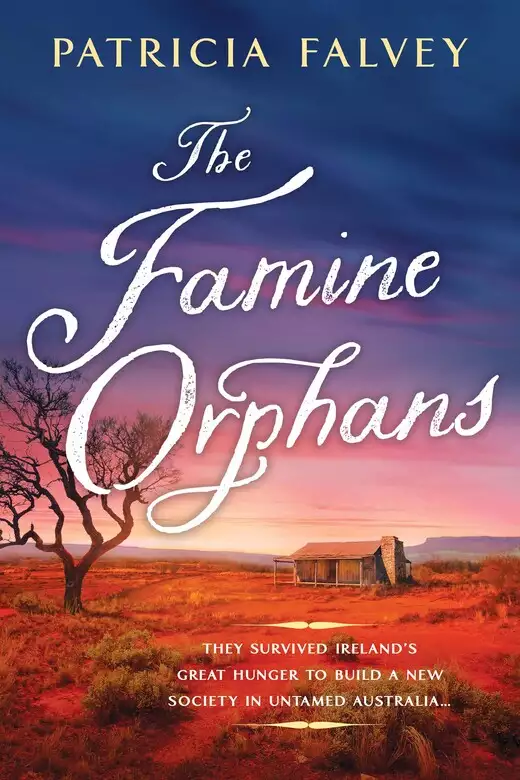
A powerful, captivating novel of historical fiction from the acclaimed author of The Titanic Sisters, based on the little-known story of the thousands of young women sent from Irish workhouses to Australia after the Famine.
1848: The girls, 4,000 in all, come from every part of Ireland—from the shores of Galway to the Glens of Ulster and Belfast’s teeming streets—to board ships bound for Australia. All were chosen from Ireland’s crowded workhouses. Most are orphans. The Earl Grey Scheme was presented as an opportunity for young women to gain employment as domestic servants in the Colony. But there is another, unstated purpose—the girls are to “civilize” the many men sent there as convicts, so that settlements can be built.
Kate Gilvarry has spent six months in a Newry workhouse, subsisting on a diet of watery porridge. She knows there’s no future for her either within its walls or outside, in a ravaged, starving land. But once Kate’s ship completes the harrowing voyage, she and her companions find their reception in Sydney dismayingly unwelcoming, as anti-Irish sentiment grows. Homesick, and disillusioned by love following a shipboard crush, Kate strives to fit in, first as the servant of a demanding English woman, then as a farmer’s bride in the Outback.
When heat and drought force her husband to leave for long periods to work on a sheep ranch, Kate is left alone to fend off wild animals, drifters, and her aching loneliness. She longs to return to Ireland. But first, this beautiful, unforgiving country will teach her about resilience and survival, and the limitless possibilities that come with courage and love.
Evocative and compelling, The Famine Orphans is a testament to the young women whose pioneering spirit left an enduring legacy in a land so far from home.
Release date:
May 27, 2025
Publisher:
Kensington Books
Print pages:
368
* BingeBooks earns revenue from qualifying purchases as an Amazon Associate as well as from other retail partners.
I’m an old woman now and I want to get it all down before I die. You might think I’ve already forgotten much of it, but you’d be wrong. Like all Irish stories, this one has woven the light and dark threads of joy and sorrow into a shawl of memory that has wrapped around my heart and will never let go. It is not only my story but the story of all the young girls who lived it with me.
It began one day in the summer of 1845 when my wee brother, Christy, came running into our cottage holding what looked like a ball of black slime in his two hands. He was white in the face, his eyes bulging as if he’d seen a ghost. He choked out his words.
“The potatoes, Ma, look at them. They’re rotten.”
Ma spun around from the washbasin. “Och, Christy, don’t be joking us.” She moved closer and let out a gasp. “What the devil is that in your hands? Take it outside this minute.”
Four-year-old Maeve edged closer to him.
“Phew, it smells!” she said, wrinkling her nose.
Da came in right behind Christy, a pained look on his face.
“’Tis no joke, Mary,” he said, slumping down in the armchair beside the turf fire. “There’s a powerful blight on the crop.”
He nodded at Christy. “Take that muck outside and wash your hands at the well before you come back in.”
Christy shuffled off. Maeve and I looked from Ma to Da, neither of us daring to say a word.
“Och maybe it’s just on that one tract,” Ma whispered, “surely it’s not the whole crop.”
Da sighed. “Ah, but it is, Mary. Jimmy Fox and Bandy Hughes were just over here telling me the same thing. Their fields are full of rot. Not a healthy potato left in the ground.”
Ma made a sign of the cross. “Please God it’s only this crop. We’ve seen this before. Your own da used to talk about it. Remember that time years ago they were afraid they’d all starve? But the next crop came in healthy.”
Da shook his head. “Pray all you want, Mary. But I don’t think God will spare us this time.”
When the first crop came in healthy the following spring, we began to think Da had been wrong. We breathed a sigh of relief and went on about our business as if the blight of the previous year had never happened. But Da wasn’t wrong. Within a few months it returned, even more widespread than before. By the end of 1846, nearly every potato crop in the land was ruined, and the dreaded word “famine” rose from a whisper to a roar that was carried on the wind across the island of Ireland.
Like other tenant farmers, our family was dependent on the potato crop for our livelihood. For as long as I can recall Da had rented a few acres of land from Mr. Charles Smythe, who owned a powerful amount of land in Upper Killeavy in South Armagh where I was born. It was a common arrangement all over Ireland for men like my da to work as a laborer in the landlord’s fields for a small wage and the chance to lease a bit of ground where he could grow enough crops to feed his family and sell any spare produce for a small amount of money that went towards the rent. It might only be an acre or two, and the land might not be the most fertile, but having a patch of land to call his own brought pride to the hearts of men like Da, whose ancestors had been chased from their land by a succession of invaders. Every year Da planted potatoes. There was room, as well, for cabbage and turnips and for chickens and maybe a cow or a pig if, like Da, you had the spirit for it. But it was the potatoes that were our salvation. Even with just a small patch of land, a man could grow enough to feed his family year-round and leave them well-nourished even if there was no meat on the table.
I loved growing up on our wee farm, playing among the green fields of Upper Killeavy and round the foothills of Slieve Gullion mountain. Ours was a happy family, although a small one by Irish standards—the oldest was my brother Paddy, then myself, then came Christy, followed by wee Maeve. Da was hardworking and well respected, but Ma was the heart of the family. She was a great one for listening to other people’s sorrows. In those days our cottage was often filled with people—neighbors and strangers alike—while the teakettle bubbled constantly on the turf fire. Ma had been born in nearby Newry town into a family of thriving Protestant shopkeepers who disowned her when she married Da. She had, in their minds, committed two unforgivable sins—one, she had married beneath her station and, two, she had converted to Catholicism. But Ma had taken well to life on the farm, and the neighbors slowly came to admire her and seek her advice, including help with letters and such. Unlike many of them she could read and write. She taught Da and the rest of us to do the same.
It never crossed my mind that my life would change—I thought the carefree, happy days would go on forever. But I was wrong. After that first day when Christy brought the rotting potatoes into our cottage, everything changed. Soon the stores we’d filled with the only healthy crop of 1846 were empty again. Over the remainder of that year, and on into the next, we sold the pig, then the cow, and eventually the chickens, so we could get money to help pay our rent. All our neighbors were in the same boat as ourselves. What made our situation more desperate was that there were crops like wheat and barley and corn growing in the landlords’ fields but they were no good to us since we weren’t allowed to touch them. They were saved for export to the English mainland and beyond.
What I remember most about that time was the months after months of hunger. It was nothing like the vague pang of hunger you’d get sometimes but forget as soon as you were distracted from it. This hunger was like a ravenous demon that clawed ceaselessly at my belly, even during sleep. I bore it silently as did all of us except wee Maeve, whose wailing quieted to a whimper as her strength ebbed away. We buried her in September of 1847.
A week later, my brother Paddy announced he was leaving for England. A normally quiet lad, he stood facing us, twirling his cap in his hands, and made a speech I think he’d been practicing for days.
“I’ve got to go,” he began, ignoring Ma’s cries. “I can stay here no longer watching this suffering. I know I have hardly any money, but I still have my strength. I intend to get work on one of the merchant boats leaving Newry Docks in exchange for a free passage to Liverpool. I can haul heavy sacks as well as any man—better even.” He gave a shy smile. “There’s bound to be plenty of work to be had over there and, when I’ve enough saved, I’ll come back. By then, please God, the famine will have eased,” he said, pausing and gazing into each of our faces, “and if it hasn’t—well, we’ll have money for the fare to sail away from this cursed place!”
He was not to be talked out of his plan.
When we thought things couldn’t get worse, Mr. Smythe arrived on a cold October morning, to warn us he would have to put us out of our cottage if Da couldn’t pay the back rent he owed on his lease.
“I’m sorry things have to be this way, Mick,” he said as he accepted a cup of tea from Ma. He went on talking in a rush of words about every tenant being behind on rent and the big increases in Poor Law taxes he was having to pay for the new Newry Workhouse that had been built just a few years before. “You see, the rate is based on the amount of ground I own, including your wee patch, Mick, as well as on your cottage. And without the rents from you and your neighbors I’ll have no choice but to tear all the cottages down.”
He gave a heavy sigh as if he was expecting sympathy, but none of us said a word.
All that night Ma and Da and the neighbors sat in the kitchen, drinking tea and talking about what to do, while I sat in the corner with my arm around Christy. “Where will we go?” they repeated over and over. “We’ve no money to pay the rent we owe, let alone enough to emigrate.”
No one mentioned the workhouse. For as long as I could remember I knew that all over Ireland people had a terrible fear of workhouses. Da had often said he’d rather die than ever go to one of them places. “Once you’re in there, they break your spirit and you’re condemned to a life of poverty,” he used to say, “and you end up buried in a pauper’s grave.” I used to shudder when he talked about it, though never did I think we’d one day be facing that possibility. But we had nowhere else to turn. Ma’s relations had not spoken to her since her marriage to Da and, even if they had relented, my parents would have been too proud to ask them for help. In the end even Da agreed the workhouse was our only choice.
Early on the morning when Mr. Smythe’s agents were due to come with their crowbars and knock down our cottage, we hitched our old pony to the cart, filled it with our meager possessions, and set out for Newry Workhouse. Ma said she couldn’t bear to stay and watch our home destroyed, nor would she make a show of herself crying and begging to be let stay on like some of our neighbors had done. I was grateful we hadn’t lingered, but as we walked away, I fought the urge to look back just one more time at my childhood home.
We were not alone that morning. People just like ourselves—starving people who’d been put off their land—crowded the road that led from Slieve Gullion mountain down to Newry town like a procession of weary ghosts. It was mid-November, and a bitter wind blew scattered flakes of snow against our faces. Even though we had left in the dimness of early morning, the day seemed to draw in so fast that we lost the daylight in no time. In the darkness our old pony stumbled and collapsed into a ditch. No amount of coaxing could get her to stand up again.
We unhooked the cart and went on our way, pushing it in front of us. But it was soon clear that the four of us hadn’t the strength to push it for the rest of the journey. If Paddy had still been with us, we might have succeeded, but he wasn’t and there was no point wishing things were different. In the end we left it, and all our possessions with it, on the side of the road.
Ma brushed away tears. “At least some other poor craturs might get some good out of them,” she whispered.
The effort of trying to push the cart seemed to have taken all the strength out of her and she looked ready to collapse. I rushed towards her and took her by the arm to steady her.
When at last the outline of Newry Workhouse came into sight in the dim distance Da suddenly stopped and begged us to go on without him.
“You’ll stand a better chance of them letting you in without me,” he said. “They save what little pity they have for women and children.”
Ma and I stopped dead in our tracks and stared at him. I put my face close to his. I wanted to shout at him. Tell him he had no business leaving us now. But even in the dim light I could see the tears shining in his eyes and my throat squeezed shut against any words of anger. I looked at Ma. Surely she could talk sense into him. But, instead, she drew him into her arms, put her head on his shoulder, and wept aloud. Wee Christy clung to her skirts and sobbed. They stood like that for a long time until Da pushed them gently away and turned to me.
“Look after them, Kate,” he said. “You’re a big girl now, strong and with a good head on your shoulders.”
I pushed down the protest that wanted to explode from me. What was the point of arguing? Ma had already forgiven him. I nodded. “I’ll try my best, Da,” I said.
He sighed. “Go on now, there’s the girl. I’ll come for you soon.”
I took Christy’s hand and told Ma, who by then was in a bad way and could hardly walk, to lean on me. Together we climbed the hill to Newry Workhouse. The year was 1847 and I was fifteen years old.
Six months to the day after we arrived at the workhouse, I turned sixteen. It was the first birthday I could remember when there’d been no celebration at all. Even in those early years of the famine Ma had managed to find the ingredients for a currant cake with white icing, and she’d brought it to the table, lit with a wee candle, and Maeve and Christy and Paddy all cheered while Ma smiled and Da looked at me with tears in his eyes. Now, as I sat beside Ma on the straw pallet where she lay, I tried to picture every detail of those moments before they faded away from my memory for good.
A sudden May storm turned the sky black and set the dormitory windows rattling while rain pelted like bullets against the panes. Ma began to cough and I moved closer to her to try and keep her warm. I thought back to that November evening when Ma and Christy and I joined the queue outside the workhouse. A storm had been raging that night as well, but we were so numb with hunger and grief that we scarcely noticed it. Ma could barely stand up and Christy clung to me. I knew I would have to be the one to take charge as I had promised Da that I would.
People pressed around us, gaunt-faced and wide-eyed. Some hardly looked human at all, their skeletal bodies so shrunken I could hardly tell the men from the women. I turned away from them, swallowing hard, and pushed Ma and Christy forward. We had long ago abandoned our belongings, leaving us only the rags we stood up in. It struck me then that maybe we looked just as bad as everybody else.
It’s a quare thing to realize that when you’re close to starvation nothing matters to you in the whole world—not power, not pride, not shame—nothing except food. And it was the specter of starvation, like a sudden insanity, that drove me to steer Ma and Christy through the growing tide of people to the front door of the building, into the big open lantern-lit room and right up to a severe-looking man who turned out to be the master of the workhouse himself. I don’t know where I found the strength but I spilled out our story in a torrent of hysterical and disconnected words. The stern expression on his face never changed and, looking back on it, I think he was overwhelmed with the scene in front of him, but he let us through. The only time Ma came to her senses was when a matron tried to wrest Christy out of my grasp, explaining that boys had to be separated from the women. Ma’s eyes burned as she screamed at her. Like the master, the overwhelmed matron had waved us on through, though she called after us.
“I’ll be back for him in the morning!”
As I sat lost in memory, there was a sudden commotion outside the dormitory door and I left Ma to see what it was. As I drew closer, I heard laughter. I must be imagining things, I thought. Laughter was a rare thing to hear in a place like this. The door opened and young Mary Timmins poked her blond, curly head in.
“Ah, good, Kate, you’re awake so. You left the dining hall early and we were afeard you might be asleep.”
I stared at her, wondering what she was on about. Mary turned behind her and opened the door wide.
“Come on in, girls, she’s awake.”
I stood aside and in marched a half dozen young girls wearing workhouse shifts, each one carrying a candle. They formed a circle around me and began singing “Happy Birthday!”
I thought I must be dreaming. Surely this was not Mary Timmins and the other young girls I’d been teaching to read and write for the past few months? Surely it was a chorus of angels, their thin, frail voices serenading me—or maybe they were ghosts! Many of the women in the dormitory sat up from their pallets, rubbing their eyes. Then Matron O’Hare appeared, smiling in a way I had never seen her do before.
“Happy birthday, Kate Gilvarry,” she said. “The girls here wanted to let you know how much they appreciate all you’ve done teaching them to read and write.”
Mary Timmins took something from her pocket and handed it to me with a shy smile.
“’Tis the best we could do, Kate!”
I looked down at the piece of white cardboard, cut and folded like a greeting card, and covered with wee drawings and each girl’s signature in colored ink. The girls crowded around me and started speaking all at once.
“We’ve signed our names like you taught us, Kate.”
“That’s my wee drawing. D’you like it?”
“Sorry we don’t have any cake.”
“Matron helped us.”
I looked around at them, at their gaunt, thin faces and their wide, innocent eyes, and I fought back sudden tears. I reached out and hugged each of them.
“’Tis the best birthday celebration I’ve ever had,” I said.
I felt a hand on my shoulder and turned around to see Ma, smiling at me.
“Isn’t this a grand thing, darling?” she whispered. “You always said you wanted to be a teacher, so you did.”
I didn’t sleep that night. The storm had long ago let up and the place was quiet except for the occasional coughing or sighing of the women lying on the straw pallets. I lay next to Ma as I had done every night since we’d arrived. I had cried after the girls left—cried for them, cried for myself, cried for Ireland, and for all the poor souls who had fled to America and Canada, and for all the poor souls who had perished before they could flee. When my tears ran dry, I prayed. I prayed for wee Maeve in heaven, and for Paddy somewhere across the sea, and for Da, wherever he might be. Then I prayed for Christy, who was all alone with the other boys in a separate wing of the workhouse, and for Ma, who lay peacefully beside me on the bed. Then I made a pledge to God, aloud for anyone to hear, that I would get out of this place, that I would find Paddy and Da and take all of us home, wherever that might be.
During the first weeks after we arrived at the workhouse, we were given food three times a day—stirabout with milk for breakfast, bread and tea for supper and, for the main midday meal, meat and vegetables. But, like everywhere else in Ireland, there were no potatoes. One woman told us that they still served them when she had come into the workhouse the year before.
“Sure I thought it was a miracle,” she recalled, gazing wistfully into the distance. “I looked at them in such wonder. There were some inmates who gulped them down with their two hands and others who hid them under their smocks or in their pockets. Them’s the ones were severely punished when they were caught.” She shook her head at the memory, then smiled. “Ah, but I ate them slowly, reverently like, as if taking Communion, enjoying the taste and smell and feel of them. Ah, it was grand, so it was!”
But it had been too good to last. The potatoes disappeared. The stores were empty, and the workhouse guardians were unable to find more to buy. Meat became scarcer, too, and all the while the inmate population continued to grow—from four hundred when we’d arrived to over one thousand in a matter of months. Now, all we got at midday was a bowl of watery soup. We were grateful for it, of course, but as I watched Ma grow thinner, her complexion turn sallow and her eyes more deadened, I was determined not to let her give up hope.
Besides the scarcity of food, money also grew short in the workhouse. Schoolmasters and -mistresses brought on to teach the children were sacked or set to other tasks. That was when I volunteered to teach Mary Timmins and the others to read and write. The class had been filled at first, but eventually dwindled to the half dozen who refused to listen to those who said they were wasting their time.
“What good will knowing how to read and write do you when you’re kicking up daisies beyond in the paupers’ graveyard?”
I hadn’t realized how easy it was to lose hope in a place like this. The girls who dropped out were put to the task of picking oakum. They sat all day ripping apart old hunks of rope with blistered fingers and teasing out the fibers, which were then sold to shipbuilders who mixed them with tar to seal the lining of wooden ships. How could they have chosen to spend their time doing that over trying to improve themselves for the future? Why would they do such a thing? Slowly, the answer became clear to me. They didn’t believe they had any future beyond this place. After that, it took every bit of strength I had to keep up the hopes of the remaining girls—and my own, as well.
About two months after my birthday, Matron came through the dining hall one lunchtime, tapped on the shoulders of about two dozen girls, myself included, and told us to come with her. We gave each other puzzled looks and some of the girls began firing questions at Matron.
“Where are we going? Why? Have we done something wrong?”
The rules at the workhouse were so strict we were always terrified of breaking them. Punishment was harsh—at best, flogging, at worst, being thrown out onto the street.
“I’m not after stealing anything, Matron,” said Patsy Toner, a short girl my age, with a booming voice that belied her size. She had wild, tousled red hair, green eyes, a ruddy complexion and a vocabulary that would have made a sailor proud. I knew little about her background but I’d heard she’d been a street urchin in Newry before coming to the workhouse. Like most of the other girls, I stayed clear of her for fear of inviting a torrent of abuse from her sharp tongue.
Matron paused and turned around to the string of girls following her in a disorderly procession.
“You’ve done nothing wrong, girls,” she said. “Master Dunne wants to introduce you to a visitor who has something important to tell you. Now stop talking and hurry up.”
We followed her down two sets of stairs and through a door marked “Board Room.” We filed in behind her and sat down on the two rows of chairs she pointed to. We were quiet now, looking around at the grandeur of the room with its polished floor and portraits of stern-looking men hanging on the paneled walls. I supposed they were the workhouse guardians and this was where they held their meetings. In front of us was a stage on which stood a long, polished wooden table behind which were placed five high-backed, upholstered chairs. We shifted uneasily in our seats and waited. The door opened and Mr. Dunne, the workhouse master, strode in.
Some of the girls, including Mary, jumped to their feet and curtsied.
“Will you stop making shows of yourselves,” said Patsy in a loud whisper. “He’s not the bloody Pope!”
Matron turned around. “Quiet!” she hissed.
Master Dunne ignored us as he climbed onto the stage and sat down in the middle chair. He was followed by a sallow-faced man in a brown coat two sizes too big for him. He was middle-aged, balding, and had a long, sharp nose. He sat down next to Master Dunne, pulled out a large handkerchief and blew his nose lustily. He never looked at us either. I began to wonder why Matron had bothered to bring us.
Master Dunne signaled to Matron, who climbed hurriedly onto the stage and sat down on the other side of him, looking anxious. Master Dunne still had not looked at us but nodded towards Matron. She stood up and cleared her throat.
“Girls,” she began in a timid voice.
“Louder, Mrs. O’Hare,” shouted Master Dunne.
She flushed and started again. “Girls, you all know Master Dunne beside me.” Mary Timmins began to clap but Matron froze her with a stare. “He has called you here to meet our visitor.” She nodded towards the newcomer. “This is Mr. Begley, who has come all the way from Dublin to speak to you today. He has news that will be very important to your futures so please pay close attention.”
Matron sat down and Mr. Begley stood up.
“Er, ladies,” he began before interrupting himself with a mighty sneeze. He blew his nose again, this time at a greater volume than before. “As Matron O’Hare has suggested, I have some news of great importance to all of you.”
His voice was so extraordinarily high-pitched that some of the girls began to giggle.
“I have been appointed by the English government and the Board of Guardian Overseers to acquaint you with a program that will greatly affect your futures.”
“Bloody Brit,” whispered Patsy.
“For several months now the British Government, under the direction of Lord Earl Grey, has been developing a program which will give young women like yourselves the chance to become domestic servants on the continent of Australia.” As if anxious to get through his speech he began to talk more quickly and as he did the girls grew quiet. Some of them clutched each other’s hands. One or two began to weep and I knew they were afraid that they were going to be thrown out of the workhouse. I was worried about the same thing myself. But then Mr. Begley said something that shone a new light on things. We didn’t have to go!
“Lord Grey is the British secretary of state for the colonies, including Australia, and has worked out this program with the Australian authorities and your Board of Guardians. The program is totally voluntary, but if you wish to go, your passage from Ireland to Australia will be paid for, you will be outfitted with new clothes, and guaranteed jobs in the best possible establishments in New South Wales. You will also be paid the going wage for your work.”
He stopped and gave what I supposed passed for a smile and waited. The room was silent. If he was expecting applause, he would have been waiting a long time. Master Dunne, finally looking directly at us, stood up and began to speak in his deep, commanding voice. He was clearly annoyed.
“Yes, the program is voluntary, but not all of you will be suitable. Besides being between the ages of fourteen and nineteen years, you will have to be of upright moral character, industrious, and able to at least speak English. The ability to read and write in English is highly desirable.”
Mary Timmins turned to smile at me.
“Furthermore, you will need to have a sponsor who will attest that you meet all these requirements before you will be accepted. Those of you who are accepted will be expected to be a credit to Newry Workhouse. Finally, I want to say that this is a wonderful opportunity being offered to you not only by the British and Australian governments but by the guardians of this workhouse who will be paying for your clothes and transportation to Dublin. I hope you are all extremely grateful.”
He turned to Matron. “Matron O’Hare will try to answer your questions and give you more details.”
With that he climbed down from the stage and nodded for Mr. Begley to join him. Together they walked out of the room looking straight ahead.
When they had gone, the girls erupted.
“Where’s Australia, Matron? Is it far?”
“When will we be going?”
“When will we get our new clothes?”
“What’s the catch, Matron? Sure the English would never give us anything for free.”
“Could my sister go, too, and maybe my ma?”
“Who’ll pick the girls to go?”
“I wouldn’t trust that oul’ feller, Begley, farther than I could throw him. I didn’t like the cut of his jib at all,” said Patsy to anyone who’d listen as Matron escorted us from the room and gathered us in the hall.
“I’m afraid I don’t have all the answers,” Matron said, “but I will find out all I can. In the meantime, go and get ready for supper. I’ll meet you afterwards and explain as much as I am able.”
At supper I told Ma about Mr. Begley and what he had said.
“He tried to make it sound as if they were doing all of this out of the goodness of their hearts,” I said, “but most of us didn’t believe him. Patsy Toner said there had to be a catch.”
Ma smiled. “Patsy never has a good word to say about anyone. You know that.”
“Aye, but plenty of the rest of us think she might be right. We’ll know more when we meet with Matron later.”
Ma said nothing so I hurried on.
“Anyway, Ma, catch or no catch, I’ll not be leaving here without you and Christy.”
Finally, Ma spoke. “I wouldn’t be too hasty, Kate. It might be the best thing that could happen to you.”
Before I could reply, Matron tapped me on the shoulder and signaled me to join her and the other girls in the now empty dining hall.
When we were settled, Matron pulled up a chair and sat in front of us so she was eye level.
“I expect you are all very anxious to hear more about the scheme Mr. Begley proposed,” she began. “Firstly, you should know that it’s already begun. Two ships carrying girls from workhouses in Ulster left for Australia, one in June, called the Earl Grey, and the second, called the Roman Emperor, earlier this month.”
“And what happened to them? Did they arrive safe? And do they all have jobs like Mr. Begley said?”
Matron took a deep breath.
“They haven’t arrived in Australia yet,” she said. “The journey takes three to four months.”
You could have heard a pin drop, then the silence was followed by a rush of exclamations.
“Three months? My God, that’s longer than it takes to sail to America!”
“Where in God’s name is this Australia anyway?”
Patsy Toner piped up. “And when will our lot leave?”
“You’re scheduled to sail next month, in August,” said Matron, “on a ship called the Sabine.”
“So we’ll still not know by then how the others got on,” said Patsy, determined to make her point. “We won’t even get word by the time we leave. If it takes three months for them to get there, then it will take another three months to get a letter back. That means November, at the earliest, and by then we’ll either be in Australia or swimming with the feckin’ fishes at the bottom of the ocean!”
Several girls gasped. I could see Matr
We hope you are enjoying the book so far. To continue reading...

 Please log in to recommend or discuss...
