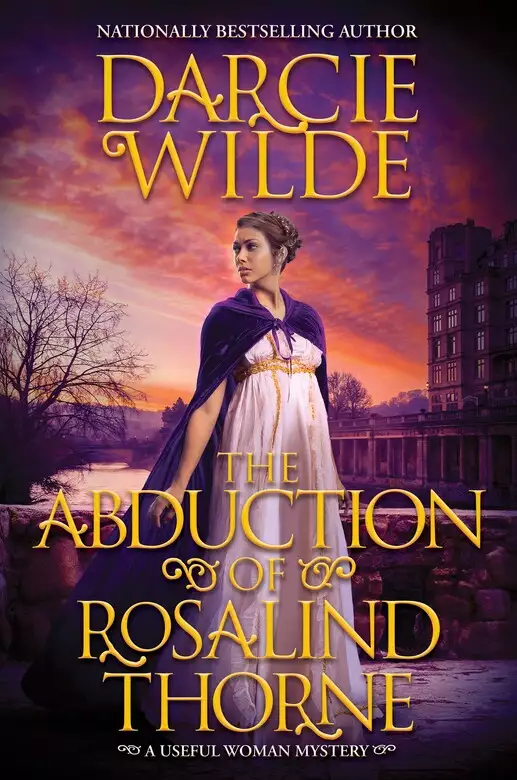
Brimming with intrigue, the latest novel in this charming Jane Austen-inspired mystery series finds resourceful Rosalind Thorne—a discreet sleuth for Regency London’s ladies of ton—facing her most perilous, and awkward, predicament yet…
Rosalind is newly, happily engaged to ex-Bow Street officer Adam Harkness, but lunching with the new fiancée of her old love is still discomfiting. Yet, Clara Kinsdale needs her help, and Rosalind is not one to turn away a lady in distress. It seems Clara's father, Sir Anthony Kinsdale, has fallen for beautiful widow Mrs. Sylvia Lynn—who may be a fortune hunter, or worse . . .
Sir Anthony is a profligate baronet, who has pinned his financial hopes on two events: Clara's marriage, and his horse winning the upcoming sweepstakes at Lansdown, on which he has wagered heavily. Clara is afraid that her father is being fleeced by the charming—and cunning—Mrs. Lynn and wants Rosalind to expose her.
But Clara does not realize that her sisters, Elizabeth and Cynthia, are harboring their own secrets and Elizabeth especially will do whatever she must to obstruct plans to separate their father from Mrs. Lynn.
Rosalind and Adam travel to Bath to meet the family. But their gathering is interrupted by Admiral Walsingham, who is leasing Kinsdale House. Despite his dire finances, Sir Anthony is evicting the admiral—though his reasons appear laughable. Not laughable is that Sir Anthony is found dead soon after their argument, having apparently tumbled from his bedroom window while intoxicated.
It would be easy to assume the tragedy was an accident, except Admiral Walsingham is found dead at nearly the same time. Secrets, schemes, fraud and forbidden love all drag Rosalind and Adam into a web of high-stakes gambling, murder—and extreme danger. But can they unravel it before they become the next victims. . .
Release date:
June 30, 2026
Publisher:
Kensington Books
Print pages:
384
* BingeBooks earns revenue from qualifying purchases as an Amazon Associate as well as from other retail partners.
… she was ashamed of herself, quite ashamed of being so nervous, so overcome by such a trifle; but so it was.
Jane Austen, Persuasion
“Are you certain you don’t want me to stay?” asked Alice, for the third time.
Rosalind smiled at her friend. “I’m positive.”
The two women stood together in front of the long mirror in Rosalind’s boudoir. Rosalind had just taken delivery of three new gowns from her modiste, as well as two new bonnets with matching pelisses in the latest styles. It was a luxury that would have been unthinkable to her a few years ago.
The dress she wore currently was a deep forest green, trimmed with blond lace. In recent years, the mode had declared that a woman’s dress should be a relatively plain, straight sheath with a high waist and square neckline. But slowly, that fashion was being replaced by a lower waist, fuller skirts, puffed sleeves, and a higher ruffled collar. Rosalind found herself admitting that the new style looked rather well on her. Rosalind was a tall woman with a heavy fall of dark gold hair and deep blue eyes. Now that she was in her middle twenties—a time society considered “mature,” especially for an unmarried woman—she was permitted to put aside pastels and dress in the bolder colors that better suited her complexion. The newer, more fitted bodice was also more flattering to her figure, which might best be described as queenly.
In addition to Rosalind’s own reflection, the mirror also showed Alice hovering behind her, looking unusually anxious. Tiny, quick, dark Alice Littlefield had been Rosalind’s best friend and confidante since they met at school. Alice could face the worst of storms and remain cheerfully defiant. To see her so worried about an afternoon luncheon made Rosalind smile.
“It’s only natural you should be nervous,” Alice was saying. “I would be nervous.”
“It seems to me we’ve had this conversation before.” Rosalind turned away from the mirror to her dressing table.
“A variation on it,” said Alice. “When you were getting ready to go to Cassell House over the business with Helen Corbyn. Which ended with what was supposed to be your final break with Devon.”
Rosalind sighed as she leaned forward to pin an enamel brooch in the center of her collar. “Devon and I did not break. We parted as good friends.”
“And now he’s back,” said Alice.
“Did you expect him to vanish?”
“Of course not. However, I never expected your former fiancé to bring his new fiancée to your house for lunch.”
Rosalind suppressed a sigh. “Devon was never my fiancé.”
“But he wanted to be, and you wanted it as well.”
Rosalind was silent for a moment. Alice was right. Rosalind was a daughter of the baronet, Sir Reginald Thorne. While such a position came with many advantages and privileges, they were all contingent on adhering to a long list of expectations. Rosalind was to advance her family’s interests. She was to keep their secrets and be the outward face of their inviolate respectability. She was never to engage in any type of employment in exchange for money.
Most importantly, however, she must marry a man of equal or higher rank as soon as that became feasible.
When she was a young woman, it seemed to Rosalind that she would easily accomplish each item on this list. Her education might be piecemeal due to abrupt shifts in her father’s whims and financial status, but it thoroughly covered those accomplishments suited to a gently bred young lady, such as music and modern languages. She’d made her debut at Almack’s and entered into the social season on a firm footing. She’d attracted the attention of Devon Winterbourne, the younger son of the Duke of Casselmaine. There had been difficulties, but Rosalind had believed that they would eventually marry, and that she would settle into a peaceful domestic existence managing a household, raising children, and taking her place in society as a hostess.
Then, it all went wrong.
Her father’s debts, and his crimes, destroyed the family fortunes. He fled in the middle of the night, taking Rosalind’s older sister Charlotte with him. Rosalind and her mother were left alone in the ruin.
Strain and scandal broke her mother’s mind, and then her health. Rosalind was taken in by her godmother. In that good lady’s house, she learned that her only hope of survival, respectability, and marriage was to make herself useful to the ladies of other families among the gentility.
To everyone’s surprise, Rosalind proved to have a gift for organization, and for comprehending who made the wheels of the world turn. She took her time to cultivate all manner of relationships in furtherance of her various aims—whether it was to organize a grand ball at the height of the season or acquire two tickets to a particularly popular theatrical performance.
Eventually, Rosalind’s status as one of society’s “useful women” expanded from helping her various ladies with guest lists and charity balls to solving more consequential dilemmas that might even include blackmail, or murder.
What had been a series of private favors turned into a mode of living, and then into a business. Discreet gifts of money became a schedule of fees drawn up by her man of business. A coterie of wealthy and independent women invested in her enterprise and now expected a share of its profits in return. Rosalind’s name and her accomplishments were reported in the newspapers. Her activities were discussed—and debated—in drawing rooms.
For most of her life, Rosalind had been taught that such a state of affairs would only leave her wretched and degraded. No respectable woman would agree to know her. And yet, here Rosalind stood in her comfortably furnished boudoir, in the pleasant house to which she held the lease. She was in charge of a full staff of servants. Her bank account was sound enough that she had recently been able to suggest to her man of business that some of the profits should be invested in the shares. Her desk was piled high with requests for help from women across Great Britain.
Even her relationship with Alice had changed. Alice had gone from being her housemate and staunchest friend to her official assistant, and the recipient of a salary that Rosalind paid to her quarterly.
This difference between what she’d always been taught and what she had experienced was a contradiction. It was confusing. And Alice was correct. It had indeed taken Rosalind a long time to accept it and she had indulged in much self-doubt and many vacillations along the way. Even though she had sought these changes, she had also hung back, afraid to leave the shelter provided by society’s rules.
Especially when it came to her choice of husbands.
“What is it that really worries you, Alice?” asked Rosalind.
Alice frowned. “I don’t know, exactly. It took you so long to get … comfortable with what you’ve become. With who you’ve become. I’ve been afraid … well, regret is a powerful thing.”
“I do not regret Devon,” said Rosalind firmly.
“But how do you feel about the Duke of Casselmaine?” asked Alice.
And there, at least by some measures, was the real question.
By the rules of society, Rosalind’s rank must follow her husband’s. A duke’s wife became a duchess, but a baker’s wife—no matter what her status had been previously—became a baker.
When Rosalind had met Devon Winterbourne, he was the younger brother. It was Hugo Winterbourne who stood to inherit the title and the estate of Casselmaine. But the profligate Hugo had died suddenly, and Devon had come into the title. Unfortunately, this happened at the same time that Rosalind’s family was breaking apart and her world—and her prospects—were collapsing.
She and Devon did not see each other for years after that. When a combination of fortune and misfortune brought them together again, Rosalind found her circumstances, and her feelings, had changed beyond recall. Instead of becoming part of one of the oldest and most highly placed families in England, Rosalind had become engaged to one Mr. Adam Harkness.
Adam was formerly a principle officer of the famed Bow Street Police Station, and a solid son of London’s working classes. Rosalind loved him with a depth she’d never expected to feel for anyone, and his devotion took her breath away.
Rosalind turned around and pressed Alice’s hand.
“I never loved the Duke of Casselmaine, not even when I was given the chance.” This was nothing less than the truth, but it felt like both a relief and a bit of a surprise to say it out loud.
Alice’s own smile was wry. “This is a ridiculous conversation, isn’t it?”
“No,” replied Rosalind firmly. “I’m grateful for your concern, truly. Especially when so much is set to change. However, it is time for you to be on your way. You cannot keep Mr. Colburn waiting.”
Alice Littlefield had once earned her living as a gossip writer for the twice-weekly paper the London Chronicle, but more recently, her first three-volume novel had been published by the famed, and very shrewd, Henry Colburn. The reviews had been good, and Mr. Colburn described the sales as “most promising.” He was now anxious to hear about the progress of Alice’s new endeavor, and to this end had invited her to luncheon with himself and Mrs. Colburn.
“Very well,” said Alice. “But I could—”
Now Rosalind laughed. “Let me face down the demons of my past. I promise you I shall not weaken.”
“I would give a great deal to see Casselmaine’s face when he learns you called him a demon.”
Rosalind returned her best “headmistress” frown. “Go, Alice.”
Alice threw up her hands. “I’m going! I’m going!”
Suiting actions to words, Alice gathered her gloves, her notebook, and her reticule from the various places they had been strewn about the room. She kissed Rosalind’s cheek and took herself off downstairs. Rosalind stayed where she was until she heard Alice’s cheery, and very probably cheeky, farewell to the footman, Mortimer. Then, she heard the door to the street close.
Rosalind turned back to her reflection. The dress was lovely. The whole of her appearance was entirely correct. Her emotions …
She was not nervous, not really. She did not find herself filled with sorrow, regret, jealousy, or any of the other petty and maudlin feelings that were supposed to come when reuniting with a lost love. But neither was she calm. Her heart was beating too quickly; she could not bring herself to sit down. She paced from the window to the mirror, and back again.
Just as she was turning to pace back to the window, the door opened and Laurel, the upstairs maid, entered.
“If you please, Miss Thorne, his grace the Duke of Casselmaine and Miss Kinsdale have arrived.”
Rosalind laid her hand against her stomach, as if that would calm its unaccountable tremblings.
“Thank you, Laurel. Tell them I shall be down directly.”
Laurel took her leave and Rosalind faced herself in the mirror once more.
“What is it I’m afraid of?” she asked her reflection. Because she was afraid. She had not wanted to admit it—not to Alice, not to herself—but it was true. Because there was one question she had not let herself, or Alice, ask.
What if I can’t like her? What then?
Rosalind looked into her own eyes for a long moment. “Well, I won’t know if I’m hiding in here.”
With that, Rosalind drew her shoulders back and lifted her chin. She turned and opened the door. It was time to face her past, and her future.
Still, however, she had the sensation of there being something more than immediately appeared …
Jane Austen, Persuasion
Once, Rosalind and Devon Winterbourne had danced furtively around the London ballrooms, treading on each other’s toes and laughing about it. Now, as Lord Casselmaine, he stood gracefully to meet her as she entered the sitting room.
“Lord Casselmaine.” Rosalind presented her hand to Devon so he could bow over it. “How very good of you to accept my invitation.”
Devon Winterbourne, Duke of Casselmaine, had always been handsome. When Rosalind had first met him, he had been a tall youth with an easy laugh, intelligent blue eyes, and a sweep of black hair. As he grew into his position, his title, and himself, he transformed into a strong man with a comfortable presence that could turn commanding when he needed it to. He had managed to keep the kindness and the humor of that youth, however, and Rosalind admired him for it.
“Delighted that you should have us, Miss Thorne.” Devon straightened and turned to the woman beside him. “May I introduce you to my fiancée, Miss Clara Kinsdale?”
Rosalind turned to greet Miss Kinsdale, and her first thought was striking.
Clara Kinsdale was tall. Even Rosalind had to lift her chin slightly to look her in the eye. She was willowy, with long arms and sloping shoulders. Her eyes were an arresting emerald green and her hair a rich auburn. Her whole air was one of capability and intelligence, but Rosalind also glimpsed a trace of humor underneath it all. Her dress was a fresh muslin sprigged with green and lavender, and fashioned after the latest mode, and she wore it well.
Rosalind smiled, and—given all her earlier dithering and imagined fears—it was easier than she had expected.
“I am delighted to meet you, Miss Kinsdale.” Rosalind dipped a curtsy in greeting and received Miss Kinsdale’s in return. “Thank you so much for coming. Won’t you please sit down?” she said to them both. “Luncheon will be ready shortly.”
Claire, who worked as Rosalind’s housekeeper and also did the offices of a parlor maid, arrived with the tea tray. Any potentially awkward initial silence was alleviated by the ceremony of pouring out, inquiring as to whether Miss Kinsdale took milk or lemon (milk). Did she care for sugar (just one please)? And please do try one of the ginger biscuits, which were Mrs. Singh’s specialty.
Devon took his tea as he ever did, without milk but with two sugars, and showed no hesitation in helping himself to a biscuit.
According to the ceremonies of parlor etiquette, now was the time for the light conversation to begin. Miss Kinsdale stepped up at once to face this particular challenge.
“What a lovely home you have, Miss Thorne.”
“Thank you,” replied Rosalind. “We have been very comfortable here. I understand you’re residing in Bath, Miss Kinsdale?” This detail had been included in Devon’s letter, although it was one of only a few.
“Yes. We removed there for my father’s health.” Miss Kinsdale spoke the words smoothly. However, Rosalind’s long experience with drawing room manners told her there was a great deal waiting underneath that simple phrase. “As I’m sure Casselmaine has told you, our family property is near to his.”
“I trust your journey to London was uneventful?” continued Rosalind, which was a remark that either party could answer.
“Very pleasant,” said Devon. “The roads were quite dry for the time of year.”
And so it went, back and forth. They took turns with their remarks on the roads, the fine summer weather, the commonplace difficulties of coaching inns. Miss Kinsdale kept up her end with practiced ease. She had clearly been raised to the ways of parlors and politesse, just as Rosalind had been.
For the most part, Devon seemed content to hold back and let Rosalind and Miss Kinsdale have the greater share of this initial conversation. Rosalind remained aware of him, however. She noted how his attention flickered about the room, taking in the furnishings, the books, the draperies. He was looking to see if she was as easy and comfortable as she seemed. He was wondering, she knew, if all was indeed right with her.
Rosalind found herself warmed by this sign of his continued care, but also slightly piqued. Before she had time to examine this emotion, Claire returned and announced that luncheon was served.
“Will Mr. Harkness be joining us?” asked Devon as they went through to the dining room.
“He sends his regrets,” said Rosalind. “He has been detained on business.”
In fact, Adam was tracking down a vengeful former employee of the printer who published the famous Boyle’s Court and Country Guide. Mrs. Boyle was a widow who had taken over her husband’s business. She had come to Rosalind in a state of anger and alarm. Someone had been calling on prominent persons and telling them that if they wished to be listed in the guide’s future editions, they would need to pay for the privilege. The man then collected their money and vanished.
“Fortunately, the fellow also seems to lack imagination,” Adam had told Rosalind yesterday. “He’s using the guide itself, and soliciting his victims one street at a time, in alphabetical order.”
Adam hoped to catch up with this orderly miscreant before suppertime.
Because they had no knowledge of Miss Kinsdale’s personal tastes, Mrs. Singh had prepared a highly traditional summer luncheon. There was a green salad and lobster and mayonnaise, which was followed by lamb cutlets in white sauce and new potatoes dressed with lemon and parsley. A strawberry and rhubarb tart stood on the sideboard for their dessert.
Thankfully, Miss Kinsdale was not one of those fashionable women who felt it necessary to display a dainty appetite. She let herself be helped to some of everything and even took seconds of the lobster and the salad. All in all, Rosalind found herself very satisfied with Devon’s choice.
As if your permission was needed, she scolded herself.
And yet she knew in some obscure way that it was. In the same way, some corner of herself wanted Devon to approve of Adam. It was not logical, but it was nonetheless real.
“Oh, Miss Thorne, I called on Mrs. Percival Short the other morning,” Miss Kinsdale remarked as Devon helped her to more potatoes. “She sends her regards.”
“I did not know you were acquainted with Mrs. Short,” said Rosalind. “Tell me, how is her sister? And the new baby?”
With that, the conversation broadened to common acquaintances and their families. By now, the three of them had relaxed enough to begin including stories of past amusements and favorite, well-worn bits of gossip. At the same time, Rosalind felt worry begin to tap at the back of her mind. Something simmered beneath the surface of this conversation. As the meal progressed, Devon’s glances toward Miss Kinsdale changed from admiring to anticipating, and even anxious. Miss Kinsdale was responding to his meaningful looks with tiny, fleeting frowns.
Rosalind told herself to be patient, but it was not easy.
At last, the tart was finished and they all adjourned again to the parlor. Claire brought fresh tea and Rosalind once again handed round the cups. As she poured her own tea, Rosalind decided it was time to take matters in hand. She turned to Devon.
“Was there something particular you wanted to talk about, Casselmaine?”
Devon laughed. “Good lord, have we been that obvious?”
“I’m afraid so, yes.” Rosalind smiled. “Perhaps, Miss Kinsdale, you would do me the favor of letting me know what this is about?”
“Oh dear.” Miss Kinsdale blushed ever so slightly. “I’m sorry. Casselmaine did tell me I should be direct, but I couldn’t bring myself to do it.”
“Manners can be very hard to set aside,” said Rosalind, thinking of all her recent past and her struggle to accept it. “But there is something, isn’t there?”
“There is.” Miss Kinsdale stopped, shook her head at some inner thought, and began again. “I must confess, Miss Thorne, I asked Casselmaine to introduce us. You see, I find I am very much in need of your help.”
She would have liked to know how he felt as to a meeting. Perhaps indifferent, if indifference could exist under such circumstances.
Jane Austen, Persuasion
Rosalind felt her brows arch. She resisted slipping a glance toward Devon. “Of course, I’d be glad to help in any way I can. What has happened, Miss Kinsdale?”
Rosalind found herself hoping that it was a matter of introductions, or guest lists, or being unable to find some particular item needed for the engagement celebration. A second glance, however, showed how Miss Kinsdale’s demeanor had changed. The poised, polite woman had become uncertain, and a little angry. Whatever troubled her, it was nothing so trivial as her guest list.
Devon nodded encouragingly to Miss Kinsdale. Rosalind had the distinct feeling that if she had not been there to see it, he would have taken his fiancée’s hand.
“It is regarding my father,” said Miss Kinsdale. She set down her teacup and knotted her fingers together. Rosalind recognized the gesture. Miss Kinsdale was fighting to maintain that disinterested demeanor that all gently reared young women were taught they must display when in company.
“I don’t know how much you know about my circumstances, Miss Thorne,” Miss Kinsdale said. “The Kinsdales are country people, not known for much except a love of horses. In the past, our family raised some notable thoroughbreds. But my father … he is not a careful manager of his own resources.”
“I understand,” said Rosalind. She did. This was an extremely common story. Law and custom granted fathers, husbands, and brothers complete charge of a family’s finances. However, not all men were educated or equipped to manage such responsibility. The results could range from dispiriting to disastrous.
“The income from rents, stud fees, and the sale of our brood mares has not been enough to make up for the estate’s expenditures in recent years.” Miss Kinsdale paused and took another swallow of tea.
“I imagine your father gambles on his horses as well,” said Rosalind.
“His, and others. He believes himself to be an infallible judge of horseflesh, and people.”
Again, Rosalind nodded. Pride was another very common element in these stories.
When Miss Kinsdale spoke again, her voice was little more than a whisper. “I am being very blunt, I know. A daughter should be more discreet about her father’s faults.”
“That is what we’re always taught,” said Rosalind. However bad circumstances became, mothers, daughters, and most especially wives were expected to maintain a decorous silence regarding their circumstances in order to preserve the family reputation. “But there comes a time when plain speaking is all that is left to us.”
The tiniest smile flickered across Miss Kinsdale’s features. “Casselmaine said you would understand.”
But he clearly did not tell you why. Rosalind felt a small rush of relief. She was not sure where that reaction came from, because it seemed to indicate she had somehow doubted Devon would keep her secrets.
I and my conscience will need to have some conversation after this.
But that was for later.
“So, we have sold our stock, even our saddle horses.” Miss Kinsdale glanced at Devon. Her hand moved slightly, as if she wanted to reach out to clasp his, but remembered at the last minute that they were in company. “Finally, we rented the house to Admiral Robert Walsingham. Our family—that is myself, my father, and my two sisters—removed to Bath. The idea was that we could live there with greater economy.” She met Devon’s eyes briefly, and her blush returned.
Devon smiled gently. “What Miss Kinsdale isn’t saying is that she also wanted to avoid me.”
“He, however, was not interested in being avoided,” put in Miss Kinsdale.
“—And so I followed her to Bath,” Devon continued. “And made myself perfectly at home on her doorstep.”
“I’d tried to refuse him, you see,” said Miss Kinsdale. “He’d asked me to marry him and then everything collapsed, and I couldn’t—”
“—but I determined I was not going to repeat past mistakes,” said Devon quietly.
Rosalind found she had to drop her gaze to the sugar bowl at this. Thankfully, Miss Kinsdale did not seem to notice.
“So, I found myself being very much courted,” Miss Kinsdale said. “And, well, I confess I became entirely wrapped up in trying to decide what I should do about it. As a result, I didn’t pay sufficient attention to what was happening with my family. No, don’t worry,” she added quickly to Devon. “I’m not blaming myself.” Obviously, this had been a subject of much discussion between them. “It is simply the truth. I wasn’t paying attention. It was Cynthia who first realized that something was amiss.”
“Cynthia is Clara’s younger sister,” Devon supplied. “The oldest is Elizabeth.”
“And the latest trouble began with Elizabeth.” Miss Kinsdale frowned again. “Or at least, she was the door by which trouble managed to enter. You see, shortly before we came to Bath, Elizabeth became acquainted with a young widow named Mrs. Sylvia Lynn. Mrs. Lynn is a lovely woman with engaging manners and claims an acquaintance with some of the best people in the district. All of this recommended her to my father as a suitable companion for Elizabeth, indeed, for all of us, once we did move to Bath.” Miss Kinsdale’s tone remained bland, but Rosalind could see the spark of anger in her eyes. “It was through Mrs. Lynn’s frequent visits with my sister and her inclusion in our family parties that my father became acquainted with her.”
Rosalind felt she now understood, at least in part, where this story was leading.
“After I told my family that I’d accepted Casselmaine’s proposal, Cynthia came to me and said she was afraid that Mrs. Lynn was visiting us as much to spend time with Father as with Elizabeth. Elizabeth was delighted. But Cynthia was worried.”
“Why?” asked Rosalind.
“Bath widows have a certain … reputation.”
“As fortune hunters?” suggested Rosalind.
“Yes,” said Miss Kinsdale. “And the connection had grown … much closer of late.”
Meaning her father was most likely conducting a romantic affair with Mrs. Lynn.
“Obviously, we have nothing of our own that would attract a fortune hunter,” Miss Kinsdale went on. “And anyone who bothered to ask would easily find that out. But my being engaged to Casselmaine changes matters.”
Rosalind nodded. Since Devon had assumed the title, he’d worked hard to restore the family’s fortune.
“What is it that made you suspect Mrs. Lynn’s intentions?” asked Rosalind. “Aside from the timing of this closer connection?”
Miss Kinsdale considered this. Rosalind waited. Devon felt the strain, she knew. He wanted to explain; he wanted to direct the situation; he wanted to support and protect Miss Kinsdale, but he also knew the best way to do these things was to let her speak for herself.
This was the Devon Rosalind had always known, and she was glad to see him here and now.
“To be honest, what raises the most concern is that the gossip is so inconsistent,” said Miss Kinsdale finally. “When it became clear that my father was developing a regard for Mrs. Lynn, Cynthia and I began asking our Bath acquaintance about her. And the stories we heard back … they clashed. Everyone agrees that she was widowed, and that her previous husband had been a London financier who had left her with a modest fortune. As she had no plans to marry again—at least not immediately—she’d decided her money would go further in Bath.”
“Elizabeth told us this much,” put in Devon. “And I’ve heard some of it from Mrs. Lynn myself.”
“But beyond that …” Miss Kinsdale made a helpless gesture. “We have heard alternately that her family is Irish but her mother raised her in London. However, we’ve also heard that her family is from Manchester and made their money from the new cotton mills, but sold their interests and moved down to London.”
“There’s also a story that her father was a diplomat who profited from his posting in Paris and then returned to set up his establishment in London,” put in Devon.
“Oh, yes,” said Miss Kinsdale wearily. “I’d forgotten that one.” She shook her head again. “But when it comes down to it, no one can agree on what they’ve heard, and no one can remember having met her or her family in London, or Paris, or Manchester, or anywhere else.”
Rosalind could well understand why these incons. . .
We hope you are enjoying the book so far. To continue reading...

 Please log in to recommend or discuss...
