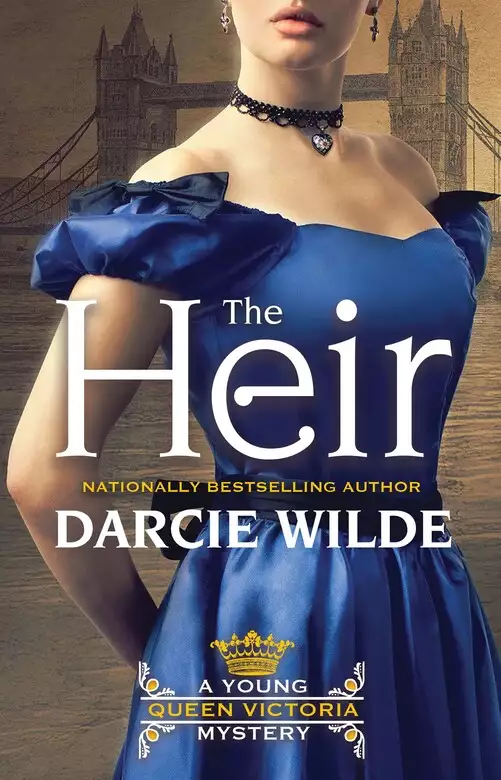
Destined for a life beyond her wildest dreams, born fifth in succession to the throne, and determined to get to the bottom of a most foul puzzle. The future queen becomes a rebellious sleuth when she vows to solve the mystery of a dead man scandalously discovered on the grounds of Kensington Palace—by her.
The young Victoria remembers nothing but Kensington Palace. Arriving as a baby, she has been brought up inside its musty, mold-ridden walls. Others may see the value of Kensington’s priceless artifacts and objets d’art, but the palace is a jail cell for young Victoria. Raised with an incredibly strict regimen to follow, watched at all times by her mother, the controlling, German-born Victoire, and Victoire’s prized advisor, the power-hungry Sir John Conroy, the bright 15-year-old is allowed no freedom at any time—except that which she steals or wheedles for, always in the company of Conroy’s resentful daughter, Jane.
But one fateful afternoon, Victoria slips away from her mother to ride out on her beloved gelding, Prince. With reluctant Jane in tow, the princess gallops out from the palace green. But what would normally be an uneventful trot around very familiar terrain presents the mutinous princess with a most bewildering sight—a dead man, and on the grounds of the palace, no less.
Determined to get to the bottom of the inscrutable puzzle, young Victoria is met with shocking disrespect and any number of obstacles. Sir John lies to her, her uncles and aunts join with her mother to stonewall her questions and curtail her movements. But Victoria will not be deterred. With Jane Conroy as a tentative and untrustworthy ally, Victoria’s first “case” is underway . . .
Release date:
August 26, 2025
Publisher:
Kensington Books
Print pages:
336
* BingeBooks earns revenue from qualifying purchases as an Amazon Associate as well as from other retail partners.
“I’m trying!” whined Jane Conroy. Perched uncomfortably on Smokey, her plump mare, the girl had already fallen a full length behind.
“It’s a beautiful day!” Victoria tried, even as the wind snatched at her hems and the edge of her bonnet. The chill air smelled of soot, mud, and rain. This late in July, it should be hot and dry, but it had been raining for three days straight. As a result, Victoria had been stuck inside. She was not going to waste this clear spell, however brief it might prove. “Don’t you long for a gallop?”
“You mustn’t, Your Highness.” Hornsby, today’s groom, looked positively panicked. “Your mother would never allow it.”
As if I were not fully aware of that.
But Mama was inside the palace, and Victoria (and Jane and Hornsby) were outside. They had already ridden beyond the gardens’ straight paths and formal hedges. The Round Pond, with its honking geese and suspicious swans, was likewise behind them. Ahead was nothing but an unbroken carpet of grass and low hills stretching to the gate that divided the palace grounds from the park beyond.
Prince felt Victoria’s restlessness. He shifted underneath her, letting her know he wanted to run as much as she did.
Jane tipped her head back to look at the lumpish gray clouds that obscured the sky. From the way the other girl screwed up her face, one might have thought they were about to drop down and smother her. Instead, a single raindrop fell and smacked her in the eye.
“Ouch! Oh!”
Victoria ducked her head and tried hard not to smile.
“We can’t,” Jane mumbled as she wiped at her eyes. “Father will be angry. I promised to bring you back at the first sign of rain!”
She had, in fact. That promise and Jane’s dreary presence were the only reasons Victoria had been able to ride out at all today.
It was not fair. But it was all a part of the “Kensington System.” That system dictated how Victoria’s life was to be lived. It required that every minute of her day be accounted for and, worse, that she never be alone. So, if Mama could not ride out, Victoria was stuck with Jane or stuck indoors.
She had tried to remain patient today. She had sat dutifully through having her hair done and had stood still while being dressed. She’d attended to her lessons in geography and history and penmanship and music (not that this last was any great trial). She’d stayed quiet while Mama inspected her journal and her books and examined her tutors as thoroughly as her tutors examined Victoria.
After her journal had been pronounced satisfactory, Mama had gone to confer with Sir John about some one or the other of the plans for the tour of the northern counties they had declared she would undertake in September.
This resulted in Victoria having a rare ten minutes with nothing to do and only Lady Flora Hastings and her own governess, Louise Lehzen, watching over her.
And, of course, Jane Conroy. Jane slumped sullenly in a chair with her needlework in her lap and a copybook beside her. Jane was hopeless on horseback, hopeless with a needle or a piece of music or a sketching pencil or a paintbrush. Hopeless in the face of her father’s endless commands.
Victoria tried to muster some sympathy for the other girl. Jane did not want to be here any more than Victoria wanted her, and yet, like Victoria, here she was. Today and every other day.
Victoria stood in front of the windows with her spaniel, Dash, in her arms. She looked out across the gardens. At least she tried to. Streaks of grime obscured the view. When she was six, she’d been asked what she wanted for her birthday. She’d answered that she would like to have the windows washed. She remembered the startled faces of the adults around her and their nervous laughter. But nothing had come of it. Victoria had received dolls and books and an enamel brooch rather than what she had actually wanted.
The sunlight—when there was any—remained blurred by a film of dust and soot. The view—what there was of it—turned into a spoiled watercolor of green and gray, so that the whole apartment remained gloomy even on the brightest of days.
Even Dash knew it wasn’t right. He whined softly and pawed at the window.
You want to be out, too, don’t you? She kissed the top of his head.
It was true that Kensington Palace was a palace. It was huge, filled with rare and precious things, and housed a changeable cast of persons belonging to the royal family. It was also true, however, that the doors creaked and stuck, that mice had nibbled the edges of the fine carpets, and that damp bloated the trompe l’oeil murals lining the king’s staircase until the painted faces of the people depicted there bulged and cracked.
Mama told her that when they first arrived, there had been mushrooms growing in their rooms. As a very little girl, Victoria had been fascinated by the idea. It made her think of fairy rings. She’d hunted for mushrooms in all the corners, but she only ever found shadows and spiders and blossoming stains of thick black mold.
“Do not let yourself be fooled, Victoria,” Mama told her (and told her and told her). “We are lodged in this dingy hole because his family hates me, and they hate me because I will not let them get hold of you. You will never be their hostage and plaything, romping about with their bastards and cronies until you are spoilt as rotten as the rest.”
“Enough,” muttered Victoria to herself. She could not, she would not, stand here anymore, waiting for the next instruction, order, or direction.
Victoria hugged Dash quickly. Then she faced the room.
“I shall go for a ride,” she declared. “Prince needs the exercise.”
“Certainly not in this weather, ma’am!” cried Lady Flora, as shocked as if Victoria had suggested she was going to dance naked in the gardens. “You mustn’t think it.”
Jane Conroy just pulled a face. “It’s going to rain.”
“Not for hours yet,” said Victoria, as if her words could make it true.
“Shall I go speak with your mother for you, ma’am?” asked Lehzen.
Victoria imagined saying, She is busy with Sir John. I will only be gone for a little while. She would then simply go into her dressing room, have the waiting maid bring out her habit, and give orders that the groom saddle Prince and bring him to the courtyard. It was what another young woman might do. Other young women could move without asking permission and without hands to hold.
Hands to hold them back. Hands to keep them from going anywhere at all.
Because those other young women were not Princess Victoria, heir to the throne of the United Kingdom. If she left these rooms without Mama’s permission, there would be a scene, and she would be locked in her boudoir for days.
Sir John and I are only trying to protect you.
“You need not bother, Lehzen. I will go to her myself.”
“What is it Lehzen need not bother with?”
Victoria started. She could not help herself. Mama had returned.
Victoire, Duchess of Kent—Mama—was a tall, elegant woman. How could I have such a short, plump little girl, hmmm? It is the influence of your father’s blood. Her dark hair fell in dramatic ringlets, much thicker than Victoria’s own blond hair. Sit still, Victoria. You cannot be seen with your hair hanging down like a wild thing. What will people think of you? She had wide-set eyes that could take in every detail of a room, or a person, with a single glance. Pay attention , Victoria. If the dean sees you drift away in the middle of a conversation, what will he think of you?
Dash squirmed in Victoria’s arms, and she set him down. He immediately ran for his basket and wriggled under the blanket. It was as if he could already sense a very different sort of storm coming.
“Victoria, why are you standing there?” Mama’s voice could contain equal amounts of weariness and anger. It was her finest accomplishment. “Come away at once. How many times have you been told not to linger about in front of the windows? What if someone on the road was to stop to gawp at you? What would they think?”
“They might think that I am looking to see if the weather is good enough to go out for a ride,” Victoria replied. “Prince needs the exercise, and I have finished my journal and my letters.” And my workbooks and my piano practice and . . .
“No, Victoria,” said Mama. “It is a foul day. What if you got wet and took cold? Besides, we must make sure you are prepared for the dinner. Prince Liechtenstein in particular should see you at your best. You are aware that he will report on your behavior to—”
“I will just go around the grounds,” said Victoria. “I will be no more than one hour. It will not rain before then, and I will be back in plenty of time for you to quiz me for the dinner.” Again.
“I said no, Victoria. Now, come along.” Mama held out her hand for Victoria to take. Under the Kensington System, Victoria could not walk anywhere alone. Especially not down the stairs. She must be held. She must be steered. She must be managed and instructed and ordered.
But she had been kept inside for three days by the rain, and this might be her only chance for some air.
“I will go riding, Mama. I will not stay here so you can listen to me recite the names and histories of your dinner guests for the hundredth time.”
Mama leaned down and gripped Victoria’s chin in her strong white fingers.
“I see what you have been doing.” Her breath was hot and smelled of Madeira wine and licorice. “You have been standing here, idle, staring out windows, rehearsing all your wrongs. Disparaging your mother to your governess, to your ladies, and your friend.”
“Jane is not my friend.” Victoria forced the words through clenched teeth. Mama’s grip hurt her. She should be still.
I will not be still.
“Jane comes because Sir John makes her, and you let him,” Victoria grated. “It is not fair. I would never treat anyone in my family so poorly!”
Mama’s grip on Victoria’s chin tightened. Dash poked his nose out from under his blanket and barked once.
“I did warn Your Highness,” Lehzen murmured under her breath.
Mama’s head jerked up. Her grip loosened. Victoria twisted her chin away. Dash slid out of his basket and scampered to her side.
“What did you say, Lehzen?”
“I beg your pardon, ma’am.” Lehzen lifted her own chin, as if she herself was a duchess rather than the daughter of a Prussian schoolmaster. It was an attitude that never failed to infuriate Mama. “It’s only that I had already told Her Highness that an outing on such a day would be quite inadvisable.”
“Well, yes, I am sure I am always grateful for your advice in how to best care for the health and safety of my child!” Mama’s words oozed condescension and a thick, oily suspicion. “You may say that you warned her, but I know your ways. I’m sure it was you who put this notion of a ride into her head!”
“This is not Lehzen’s idea!” shouted Victoria. Dash pressed closer against her shin. “You will not blame her!”
“Well, now. What is this?”
Sir John breezed into the room. Jane immediately looked around her in panic, clearly trying to discover what she should have been doing. Mama, however, plunged into an attitude of dramatic relief.
“Victoria is determined to go riding!”
You say it as if I had been planning to burn the stables down.
“She has been plaguing me this half hour!”
“I did tell her that riding on such a filthy day was not to be thought of, Sir John,” said Lehzen. “But she has insisted she will go out with Jane.”
It was, of course, entirely wrong that Lehzen should lie to Mama or to Sir John. But now she had, and—Victoria could not help but note—Lehzen’s addition of Jane to the story made Sir John smile down from his great height. His eyes were a brilliant blue color and showed every emotion that flitted through his mind. Or rather he could make you believe that they did. That, in turn, made people of all stations want to trust him. Some because they believed he was openhearted. Some because they believed they could keep ahead of him.
But neither thing was true. Victoria watched him, and she knew better. When he was not exerting himself to charm, Sir John’s clear blue eyes examined the person in front of him carefully, seeking weaknesses he might expose. His seemingly easy smile was in reality an expression of his smug satisfaction. It sent chills down Victoria’s spine that were far worse than when he frowned.
“Well, I see no harm in it, ma’am, if Her Highness will take Jane.” As he looked to his daughter, Sir John’s smile stretched to show his teeth. “She’ll make sure they return at the first sign of rain. Won’t you, Jane?”
Jane looked as if she would rather be banished to the Outer Hebrides. But she got to her feet, her gaze pointed resolutely at the floor.
“Yes, Father,” she murmured.
Dash growled. Sir John’s head jerked around. Dash barked. To Victoria’s horror, Sir John drew his foot back just a little, just enough to aim a kick.
Heart thumping, Victoria snatched Dash up in her arms. Sir John seemed to re-collect himself, and he smiled.
“Yes, I think a ride with Jane would be very beneficial,” he said.
He pretended nothing had happened, but Victoria had watched and she had seen and she would not forget.
But that was all before. Now she was out of doors, in the fresh air. Prince trotted determinedly across the green. Dash barked happily and nosed about the grass, far too smart to get himself in the way of the horse’s hooves. A raindrop thumped against the back of Victoria’s glove. Another smacked Prince’s head, causing him to shake his ears.
“We need to go back,” whined Jane. “My father will be furious we were out this long.”
Your father maybe, thought Victoria. My father was a horseman. My father would have loved to ride with me.
Her father also died from a chill he’d caught in the rain. Another drop hit the edge of Victoria’s bonnet, and another. Victoria had been told the story a thousand times. A hundred thousand. The recitation had taken on the shape of catechism. Only instead of saving her soul, it was meant to keep her trembling indoors when the weather turned gray.
The thought of those hundred thousand lectures dissolved the last of Victoria’s patience.
Prince snorted. As if it was the starting gun, Victoria slapped his dappled flank with her crop. The gelding laid his ears flat and sprang forward.
“Ma’am, no!” cried Jane.
“Your Highness!” wailed Hornsby.
But they were too late. Prince was fast, and Victoria could ride him to the ends of the earth. And why not? She bared her teeth, as if to dare the world to try to catch up. Why shouldn’t I?
The gates were closed, but the walls were really only a suggestion between the grounds and the park (a fact that her mother pointed out endlessly to further frighten her). Victoria could take the jump. Prince could do it easily. They would vault over the wall and land firmly on the other side. Dash would wriggle right under the gates. Together, they would make for the carriage drive.
The wind whistled in her ears—an urgent, exhilarating sound. Victoria leaned low over Prince’s neck, his reins gathered up in her gloved hands. She laughed. Because they could not stop her. They could not even catch her. Not poor, dreary Jane or pinch-faced Hornsby. She would leave them behind—them and this whole miserable day.
The gallop filled the whole of Victoria’s senses—the speed of the world whirling past her; the thunder of Prince’s hooves and the heat and life radiating from him; the work of keeping her seat, keeping Prince from stumbling, keeping control of the reins, keeping her eyes ahead to watch for rabbit holes or hillocks.
Freedom.
Victoria’s bonnet flew backward and dangled by its ribbons. Her hair uncoiled down her back. Rain pattered against her scalp. Jane and Sir John and Mama, the palace, the system, the dreaded dinner—they were all miles behind now. Not one of them could be shocked by her bare head.
Freedom!
Rain stung her face and eyes, but she did not pull Prince back. If he did not mind a bit of rain, why should she? She shouted for pure delight and touched Prince’s flank with her crop again. Let them try to catch her. Prince would outrun them all. He’d carry her away.
Away from Mama and her lectures and her pinches and her tears.
Away from Sir John Conroy and his shouting and his speeches and his demands that she obey his system without question.
Away from Jane, their limp, reluctant spy.
They’d topped the rise. Prince’s breathing was growing labored; the ground underfoot was slick with fresh rain. Dash barked in the distance, letting her know he would catch up soon. The downslope ahead was steep. Victoria pulled back the reins to slow Prince down, disappointment welling up in her. But her wish for flight was not worth the risk of his legs and her neck and . . .
And Prince shied.
The gelding screamed. Victoria screamed. The world slipped and spun and slammed against her. For a moment, there was nothing but sparkling stars and one great howl of pain that ripped through her skull and bones. She couldn’t see. She couldn’t breathe.
Then, ever so slowly, came the realization that she was lying on her back. On the slope. In the wet grass. Icy rain filled her eyes and trickled into her nose. Dash was barking in frantic distress, but the sound seemed very far away.
Victoria sputtered and twisted, trying to right herself and perhaps quiet the ringing that filled her ears.
And found she was staring down at a dead man.
Jane saw Prince rear up. She saw the princess fall. In that instant, all her breath stopped in her throat.
They will blame me.
She looked to the horizon, wondering how far she could get before they fetched her back again. Would they lock her in the Tower?
While Jane sat frozen, barely holding on to the reins, Hornsby raced past her on his bony brown mare and disappeared over the rise.
Dash was barking wildly, demanding that someone, anyone, come and see what had happened.
Despite the fear raging inside her, Jane found herself reflecting distantly that no one had ever said such a thing to her before. She slid awkwardly from Smokey’s back and stumbled up over the hill.
The princess was sitting up on the sloping ground. Dash stood beside her, barking like it was the end of the world. Mud and water soaked into her skirts, and rain fell on her bare head. Her face had turned green with nausea and blue with cold. She blinked stupidly at the dark hillock below them and then up at Jane. The familiar sharp young woman was entirely missing from her wide eyes.
“There’s a dead man,” said the princess.
Jane stared. First at the princess and then down the slope toward the hillock that seemed to command her attention. Hornsby had dismounted to catch hold of Prince’s reins. With the horses and the groom in the way, it was impossible for Jane to see anything clearly.
“He’s dead,” the princess told Jane. “I saw it.”
Dash whined and pawed at her skirt. The princess did not look at him. Jane, not knowing what else to do, scooped Dash up into her arms.
Hornsby had managed to calm Prince and was now leading him back up the slope. His mare remained where he’d left her, and looking between the horse’s legs, Jane could see a lumpish black shape. Hornsby glanced behind him—once, twice—as if he thought his mare might bolt or someone might be following.
“Is Her Highness all right?” Hornsby’s face was almost as ashen as the princess’s.
“I . . . I don’t know.”
Jane and Hornsby stared at each other, both understanding that they were alone with the most important person in the world, and that if anything happened to her, it was their fault.
Hornsby broke the stalemate first. “Miss Conroy, you must get Her Highness indoors. I’ll . . . deal with things here.” He took Dash from her and set him down on the sodden grass.
“There’s a dead man,” said the princess again.
Hornsby, however, was an experienced servant. He knew there was only one possible answer when one of the higher-ups spoke in this way.
“As you say, Your Highness. Now, if I may, I think it would be best if you were not on the damp grass. Perhaps Miss Conroy . . . ?”
Jane forced herself to move. She grabbed the princess’s shoulders, and heaved her to her feet. Hornsby held Prince’s reins with one hand and the stirrup with the other. Between them, they wrestled the princess up onto his back. Prince danced and shuddered and seemed determined to have done with them all. Thankfully, the princess was able to keep her seat, even though she could not seem to tear her eyes away from the green.
Hornsby boosted Jane unceremoniously onto Smokey, then handed up her reins and the princess’s reins.
“Hurry, Miss Conroy,” he said. “But for God’s sake, be careful.”
Jane gritted her teeth and urged Smokey forward. Dash followed, issuing the occasional bark, which the horses ignored. Thankfully, now that the horses realized they were heading back for their dry, warm stables, they were more than ready to comply with her awkward commands. In fact, it was difficult to hold them to a walk.
If Prince begins to canter, the princess will fall again. What will I do then? She’ll break her neck this time!
The rain was increasing. Jane had forgotten to put the princess’s bonnet back on. Rain trickled down her gray face, and she huddled in her saddle, her eyes still staring straight ahead. She didn’t even look down at poor little Dash loping dutifully beside her, stopping every so often to shake the rain from his ears.
Can someone go blind from hitting their head? No. Don’t think it.
There were days when Jane hated the princess. She hated her acid tongue and her determined rebellions, hated the way she constantly needled Father and the duchess. She hated the arguments and disorder, and most of all, she hated the gleam that came into the princess’s eyes when she invented some fresh defiance.
But this dead, dazed look terrified her.
“Say something, ma’am,” Jane begged. “Please, just . . . say something.”
The princess blinked. “I . . . I’m cold.”
Now Jane could hear her teeth chattering. Panic cracked open that much farther. The Duke of Kent had died from cold. Jane knew that. Everybody knew that. If the princess took ill, if the princess died—even if they didn’t lock her in the Tower, Jane would be thrown out of the palace, out of her home, and left in the street to starve. Father wouldn’t even look back. Mother wouldn’t stop him. Her sister, Liza, might not even bother to watch it happening. Her brother, Ned, definitely would not.
“If we can go a little faster,” Jane tried.
Prince snorted and tossed his head. Jane’s words might not reach the princess, but the horse’s unease did. The princess blinked and shook her head, and some semblance of her normal self seemed to seep back into her demeanor.
The princess reached for her reins but saw that Jane held them, and frowned with annoyance.
“Give me my reins,” the princess ordered.
Jane thought she might dissolve from sheer relief.
“We must get back. I have to tell Mama. And I’m perfectly fine.” Her pinched, pained face and chattering teeth gave away this blatant lie. Still, Jane was perfectly happy to pretend.
She handed over the reins and pulled Smokey back just far enough so that the princess could take the lead. That would make things look less like a disaster. Like there was less to blame useless Jane Conroy for.
A shout went up from in front of them. They’d been spotted. Now that Jane had attention to spare, she could see the palace gardens and the yard were filled with shifting figures. People surged toward them. The duchess or Papa had grown worried, and the palace staff had been turned out to find them.
Her. They are all out to find her.
A flock of grooms and what seemed like half of Kensington’s footmen surrounded them. Everyone was crying and exclaiming and shouting orders. The footmen—begging their pardon, moaning over the state of them—pulled them off the horses. They were then handed off to the flock of uniformed maids and cloaked ladies-in-waiting, who surrounded them and whisked them back inside.
Of course the duchess was there in the sitting room. In fact, the duchess stood in the same spot by the windows where the princess had been earlier. Father stood there with her, holding her hands as she gazed, panic-stricken, through the blurred glass. Louise Lehzen, the princess’s governess, and Lady Flora hovered in the background.
The cluster of maids herded Jane and the princess—who hugged Dash to her chest—into the room. Lehzen charged forward to pull the princess away from them. Jane was left beside the doorway. Victoria was shaking badly. So was Jane.
The duchess dropped to her. . .
We hope you are enjoying the book so far. To continue reading...

 Please log in to recommend or discuss...