- Book info
- Sample
- Media
- Author updates
- Lists
Synopsis
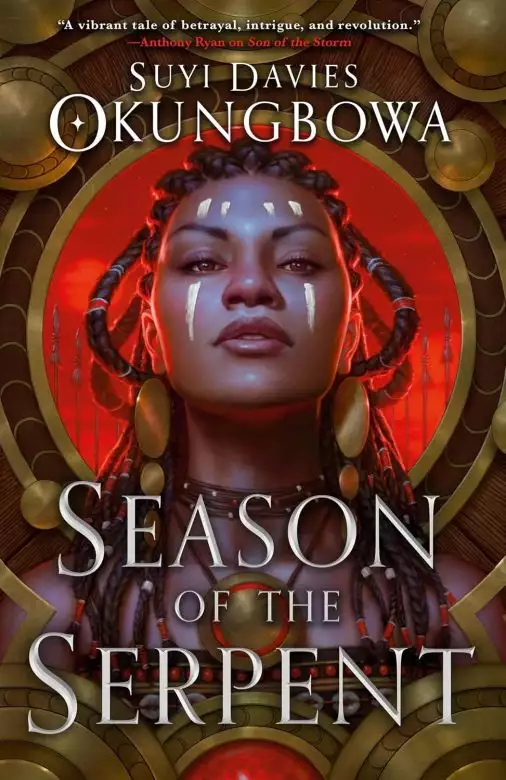
Award-winning author Suyi Davies Okungbowa returns in the final installment of the Nameless Republic trilogy with a tale of villains, allies, and a world on the brink of destruction, perfect for fans of Tasha Suri, Evan Winter, and James Islington.
The old world has fallen. Now is the time of serpents.
The continent is split. The islands have sunk. The empire of Bassa is no more. With the resistant Nameless Republic and the conquering Kangalaland on the brink of war, all must choose a side: ally, or fall. Oon's heroes and villains must rise from their ashes and meet a Third Great War.
Peace won't come easy. Long-lost family will fight to reach Danso before war erases him forever. Lilong has survived the island catastrophe but lost her power, and will do anything to get it back. And fate will find Esheme where it left her-will the dead queen rise again?
For Oon, the first season of the five states is a season of serpents. After the storms pass and winds blow, what will remain? And who will survive?
Praise for The Nameless Republic:
'A thrilling, fantastical adventure that introduces a beguiling new world . . . and then rips apart everything you think you know' S. A. Chakraborty
'An original and fascinating epic fantasy full of bold characters, bloody action, and brutal politics' James Islington
The Nameless Republic
Son of the Storm
Warrior of the Wind
Season of the Serpent
Release date: August 11, 2026
Publisher: Orbit
Print pages: 480
* BingeBooks earns revenue from qualifying purchases as an Amazon Associate as well as from other retail partners.
Reader buzz
 Please log in to recommend or discuss...
Author updates
Season of the Serpent
Suyi Davies Okungbowa
First Season of the Five States
Fourth Mooncycle, 13
BIEMWENSÉ HAD LIVED LONG enough alone on Whudasha’s edge to know when the clap at her doorway did not come from familiar hands. Yet when she swung the bamboo curtain aside, she was surprised to find the familiar face of Rudo staring back at her. That is, until she peered behind the girl to find three figures—strangers—standing with her.
“Dehje, Yaya,” all greeted.
Biemwensé leaned on the doorway and pretended the strangers weren’t even there.
“How is your uncle?” she asked Rudo.
“Old,” the girl replied. “Sick. Soon dead.”
“Don’t speak of your Elders like so.” Biemwensé clicked her fingers. “I have a remedy for his sore throat.”
“Oh! You will visit him in town?”
Biemwensé scoffed. “Not even him can lure me to that forsaken place. Wait here.”
She went inside and returned with the remedy wrapped in broad leaves, handing it to the girl. “Tell him to mix it with honey and drink at morning and night.”
Rudo looked the package over. “It smells foul.”
“One of these days, you will learn how to shut that mouth of yours.” Biemwensé squinted, to the figures behind Rudo. “I bet it’s your wide mouth that’s led these people to my home.”
At this, one of the strangers—a young athletic-looking man, probably a performer of some sort—stepped forward.
“Forgive our intrusion, maa,” he said, speaking Mainland Common. “We come in good faith, and do not quite consider ourselves to be strangers. In fact, we are—”
“They say they know your friend!” Rudo interjected, leaning in conspiratorially. “You know, the one you said I should never speak of?”
Biemwensé reined in the desire to reach forward with a knuckle and give the girl’s head a good rapping.
“Child,” she said, “before I close my eyes and open them, you better run off to your uncle now.”
After Rudo had scurried back to the heart of the protectorate, cackling as she went, Biemwensé turned her attention to the strangers, who so far had exercised the patience of predators. After squinting hard enough, she surmised they were all young (forty to forty-three seasons at most), of Bassai Emuru caste (they stood like they belonged here even though they, too, were refugees), and bearing the demeanour of one who could not wait to share good news.
It had better be good news. She’d received enough bad tidings to last a lifetime.
“So, Danso’s friends, you say?” she asked.
All three nodded enthusiastically.
“We were shocked when they said what he did,” the second—a woman—said. “We knew him bone-deep—we never believed he would do those things. Thank moons the truth is finally coming to light.”
“We’re trying to see if we can learn what really happened to him,” said the third, another woman. “Where he went, and where he is now.”
Biemwensé sighed, nodded. “Well, don’t just stand there, then. This is not the kind of tale I can tell on my feet.”
The strangers came in and sat, introducing themselves as Abu (the man) and Uria and Nowssu (the women). Only after they sat did Biemwensé realise how fidgety they were, unsure of themselves and incapable of any sort of harm. Just like Danso, in that way. Like most Bassai refugees who had settled in Whudasha, they also seemed to have aged faster than normal, bags accumulating beneath their eyes. Wartime would do that to you.
“So,” said Biemwensé, after offering them lemongrass tea, which they received gratefully, “which parts do you want to hear?”
This was not a story she’d ever borne a desire to share. The very reason she’d returned to Whudasha was to put it behind her, all that had happened since she found that young man unconscious beyond the Peace Fence, his ghastly undead bat hanging upside down from a tree. But she told these three anyway: everything she could remember—the good parts, the ugly bits, the unsavoury underpits. And it felt good too. Turned out that she desired a purging of sorts after all, an opportunity to get these memories out of her own head. There wouldn’t be many more opportunities like these.
The trio listened at first, rapt. They flinched at points in the narrative, like during her recap of how Danso got the Skopi under his control, and how he’d used its lightning power in the savanna. They were uneasy when she told them of the fight in the Dead Mines, of his actions in Chabo and his disposition in Chugoko when she’d last seen him. The more she spoke, the more she witnessed the recognition drain from their faces, as if the man she spoke of was not their friend but a stranger. Which was just as well, because she did feel the same back in Chugoko, when she’d watched that travelwagon pull away and roll out to the Lonely Roads East. The Danso who rode out in that wagon was no longer the helpless young man she’d met in Whudasha.
What she did not tell them, though, was that she was of the belief that he had not survived the trip. If the emperor of Bassa herself had not made it through, Biemwensé thought the chances that Danso and the rest of his travel group did so were slim.
As she observed the trio some more, she picked up that something else was afoot. The man, Abu, kept looking to the women, especially Uria, with whom he seemed to have a relationship of sorts. All three cast furtive glances at one another every now and then, and Biemwensé soon realised their anxiety was borne of something other than finding out the truth about their so-called friend.
“All right, spit it out,” she said, cutting her story short. “Tell me why you’re really here, or you can crawl out of my house the way you came.”
The three shared a few more glances, before the soft-spoken Uria said: “You know why, Yaya.”
Biemwensé gritted her teeth, hating that she did, indeed, know why. She’d been dreading this day from the moment she’d returned to Whudasha and parted ways with her travel companions. There was a time when she’d become startled by every loud sound, fearing that the day of reckoning had finally arrived and Whudans had gathered their cutlasses and torches and descended upon her home. She’d never expected it to happen like this: quietly, with strangers masquerading as friends.
“Go on,” she encouraged.
“We came to warn you because we heard you knew our friend,” said Abu. “That you helped him when he was here. We thought you deserved it.”
Biemwensé nodded. “Hmm. Have they found her?”
The three shook their heads.
“But everyone is growing restless,” said Nowssu. “Even some of us refugees. We hear many in the trading quarter every day talking about somebody needing to come out here and drag you to the community centre, force you to explain yourself.”
“Mm-hmm.” Biemwensé knew the Whudans would never do that—they respected her too much, especially after learning of Kakutan’s bestowal of the mantle of Supreme Magnanimous upon her. But that kind of toxic rhetoric was bound to stir up some with fewer inhibitions than most, especially people in the new refugee population, who did not always understand that Whudans talk but never do. If this continued unabated, she might be getting more strange visitors in her quiet corner of the protectorate, and they were likely to be less kind than these three strangers.
This left her with only one choice: She would have to find First Consul Nem herself.
It had not taken long after arrival to realise that the woman she’d picked up on the Emperor’s Road to Whudasha was indeed the emperor’s own maa, the de facto ruler in the emperor’s absence. Few in the refugee population had ever been to the Great Dome, and therefore had never set eyes on the emperor or her maa to recognise them. But the Idu nobles who’d also escaped Bassa recognised Nem from their days hiring her as a fixer. Biemwensé had already returned to her home here on the eastern edge when the secret came out in the central quarter, and the protectorate went into an uproar.
Things unravelled quickly. Nem and her Second disappeared before any action could be taken. Many cried for blood, Whudans and Bassai and immigrants all. They wanted their Supreme Magnanimous, the very person responsible for this travesty, to bring this enemy of the people to heel, satiate their desire for revenge and retribution. That very woman and her daughter had made them refugees, and they wanted to stick a knife in her, make her—and in tandem, the empire—bleed.
But Biemwensé had no interest in more bloodletting. She would rather never return to town, if that was the only way to avoid it.
“What about the Ajabo?” she asked the trio. “What do they think?”
Abu shrugged, as did the women. “Nothing. They are yet to come out of their caves.”
“Has anyone tried to talk to them?”
“Not since last time,” said Uria. “Not after what happened.”
“Mmm.” It was just as well. Biemwensé reckoned that if generations of her people had been driven out of multiple lands, she, too, would largely distrust strangers trying to poke noses into her business. If she had the same power of ibor that the Ajabos did, and knew how to use it like they did, she’d employ it in guarding herself too, drive back everyone as the Ajabos had done the one time a Whudan contingent attempted to approach their caves.
“All right.” Biemwensé rose. “Thank you for this information. I appreciate it. Now, you should be on your way before anyone knows you came here. Don’t need you getting in trouble with the locals.” She wagged a finger. “Remember, you are visitors here. You can be kicked out of the Peace Fence, upon which you’ll be forced to see what it’s like to return to a home that has become the jaws of a leopard.”
She shuffled them out of her house. At the door, Nowssu kept prodding Uria, angling her head in Biemwensé’s direction.
“What is it?”
“Nothing that matters,” said Uria. “But one Ajabo woman did come out of the caves. We hear she came to the quarters, asking around about a child she was looking for.”
“Nobody really paid her any attention,” Nowssu said. “They were too busy staring.”
“Okay? And why is this of use to me?”
“Well,” said Nowssu, tentative, “she asked for the Supreme Magnanimous, and someone did point her in this direction. So perhaps you may receive another visitor soon?”
Biemwensé thanked them and sent them on their way. She began to plan for the impossible task of finding First Consul Nem. But in the meantime, she would have to do something unthinkable in Whudasha: She was going to build a door.
A day later, before Biemwensé could get to work building a door, there was another clap at her entryway. A middle-aged woman—small hands, a warm smile, and a strict demeanour—stood there.
Not just any woman. An Ajabo woman.
Biemwensé, having already met an islander, was not quite as perplexed by this woman’s presence as the rest of Whudasha seemed to be, and had been from the moment the Ajabos suddenly showed up in the protectorate. Yet she did not know what to make of this woman. She did not quite look like Lilong did—she was high-brown in the way that would’ve placed her in the Yelekuté caste if she’d lived in Bassa, but also close enough to the Bassai concept of yellow that she would be instantly deemed an islander. Neither here nor there, it turned out. A Shashi, in every sense of the word.
The woman appraised Biemwensé patiently, as if trying to decipher if she was worthy of the words she was yet to speak. Biemwensé appraised her in return, noting that her forearms and neck bore decorative inked markings, many depicting images, figures, concepts, and tongues Biemwensé had never encountered. The woman wore her wrappers differently too, in a way that was reminiscent of older manners, before the current Whudan adoption of Bassai styles. And her hair—it was cut close to her scalp. A walking Bassai abomination. Perhaps she belonged here after all, in more ways than one.
“Greetings, Yaya Biemwensé,” the woman announced, finally. “I am Chwytu of the Ajabo. I hear you are looking for the First Consul of Bassa?”
Biemwensé leaned forward, interest piqued.
“Indeed, Chwytu of the Ajabo,” she replied. “And what of it? What can I do for you?”
The woman smiled a small, self-satisfied smile. “Perhaps the better question is what I can do for you. And the answer is that I know exactly where the First Consul is, and I can take you there if you wish.”
Biemwensé angled her head. “I see. But you want something first.”
“Indeed,” said the woman. “I am looking for my child, and I hear you’re the person to speak to.”
“And who is this child of yours?”
The woman softened for a moment, her expression wistful.
“I don’t know if he still goes by the same name,” she said, “but last I laid eyes on him, his name was Danso.”
Chabo
First Season of the Five States
Fourth Mooncycle, 3
BLACK MOTES DRIFTED OVER Chabo.
Little by little, piece by piece, the former colony had begun to char. Starting from the ramshackle communities in its outskirts, those which did not have the same protections of the companies as those nearer the centre did—they were the first to turn black, to drown in thirsty orange flames. Next were the company settlements, emptied one by one by little pressures—changes to the climate, changes to desertland power structures, changes to the accessibility of merchant caravans that formed the very source of their survival (the trade routes, too, had become just as empty). So it was that they ventured farther into the grasslands in search of better raid targets, and so it was that an empty abode was kinder to kindling than a lived-in one.
In the desertlands, the most dangerous weapon wasn’t a spear or sword or even magic. It was fire.
Kangala had spent enough time in the Sahel to know that not only was fire a quicker mode of weakening an enemy, it was also economically sound. A cheap ambush, wild and unpredictable, with a wide area of impact. Every attacking force’s pleasure dream, especially when said attacking force had travelled this far from the mainland and did not quite have the wherewithal to engage in an on-the-ground battle.
Last to become a blackened husk, and finally—because this was Kangala’s aim after all—was the hiding place of the Gaddos, the garden amid Chabo’s greenest thicket. This, it turned out, had to be helped along with a variety of fuels. Every flower, every fruit, everything alive and blooming—roasted. Down came the thicket, then the hut, then the garden and its hanging lanterns and its well-cultivated grass and shrubbery. The smoke was thicker, whiter, rising in a column and mixing seamlessly with the clouds. Down came black and grey ash, settling and clinging to clothes, skin, tongue, eyelash.
Kangala, stationed at the colony’s only ridge, blinked. Ash fell from his eyelids into his eyes, and he wiped it away, a wet blackness smearing the back of his hand. He rubbed that on the camel next to him, then returned to his gazing over Chabo. The southwest overlook on which he stood offered him an omnidirectional view of the burning and evacuation below.
Unfortunate was his singular thought.
The Gaddos, like most companies, had moved most of their operations elsewhere, and so were nowhere to be found when he’d sprung this surprise raid. Sacking the colony, therefore, left a bittersweet taste for him. The only people still here were individuals who didn’t work for any particular company, hands and alms-seekers trying to survive the hard conditions of their circumstances. These weren’t people he considered threats, which was why he’d given strict instructions that they not be harmed. Their abodes had to be torched, though, sadly. Everything had to be razed to the ground. It was the only way to be sure no enemies were left.
Well, the missing Gaddos—and the other renegade companies—weren’t his enemies yet. But they were breeding grounds for rebellious spirits, and therefore a wellspring of potential enemies. As every former emperor of Bassa had learned the hard way, it wasn’t people who needed to be attacked in order to squash a rebellion—it was their spirits. So here he was: saving people, killing spirits. At least no one could accuse him of being a murderer.
Standing beside him on the outlook, his daughter, Ngipa, said: “Well, that’s the last of that.”
Kangala knew it wasn’t the last of anything. Enemies were like ticks—one had to pluck them quickly from underneath a camel’s fur, lest they thrive, get fully engorged, produce countless more ticks. One had to pluck an enemy at the right time, before it became engorged with power. It was the lesson the Bassai emperor and many before her had refused to learn, but he was not unwilling to learn and act swiftly upon it.
He might have missed the Gaddos and their counterparts today, but he’d at least made sure they’d have nowhere to return to. But this was by no means over. If anything, it was just the beginning.
“Tell Oroe it’s time to head back,” he said, and turned from the ridge.
They’d been away from Bassa for a while, longer than he was comfortable with. To be fair, he had little to worry about in terms of an attack. His camp had grown exponentially since he’d settled on the mainland side of the border. More of his extensive family had made the trip down from the Sahel, with the last batch soon to arrive. Most of the desertlanders who had fought alongside him had also set up satellite camps around his, seeking protection. And then there were the mainlanders who had no love for their last emperor, but also no love for the mainland movements that rallied against her, as well as no desire to become refugees on the coasts. They, too, stuck with him.
All were now calling it Kangalaland, or Little Sahel. He hated that.
Kangala had thought he’d made it clear that he wished to have no banner. It was why he had made sure, after emptying the Great Dome of its inhabitants, to never move in there himself. That was meant to be a signal that he did not want to rule Bassa, did not want to bear the weight of being emperor of any kind. All he wanted was his own patch of land in which to exist.
Now that he had that, it sadly came with multiplying enemies. Most, thankfully, still existed beyond his immediate proximity. The nearest threat so far was those still loyal to the empire, living independently in the sliver of unclaimed territory between—he hated to say this—Kangalaland and the newly installed Nameless Republic. Fifth and Sixth Ward, if he was to be precise (not that wards existed anymore, in that sense). It was there that former peace officers and civic guards roamed the corridors, insisting upon loyalty to the Bassai Ideal, upon waiting for a new emperor to retake the Great Dome, or amassing numbers and taking it themselves. They called that slice of land New Bassa. But the name did not catch on for the same reason their investment in a recapture did not—even they knew it was over.
Bassa was over—for good.
Then there was the Nameless Republic, behind that blockade. A whole other matter he would need to take his time dealing with.
Oroe and Ngipa returned and joined him in the former colony’s mainway. Kangala checked each building himself to be sure everything had been brought down: the public house, the depository, the abodes, the stables. He had to be sure. There was no room for a survivor who would then grow up to make his demise their sole goal in life. There was to be no future banner-bearer for the Ravaging Mongrels or the Tremor of the Sands, or worse, the Gaddo Company.
Once he was satisfied with the depth and completeness of the incineration, he rode to where Oroe’s troops had gathered the survivors.
They looked just as stricken and emaciated as he’d expected. Living out here in the desertlands without some form of community support was brutal. Even before the weather had begun to turn so drastically and all water had begun to slowly disappear, even before these monstrous beings had begun to emerge from the sands—the desertlands had always been near impossible to survive. And that was all he needed to remind them of.
“You have two choices,” he announced, while Ngipa translated. “You can come with us, and set up camp outside of”—he groaned, gritted his teeth—“Kangalaland. Or you can stay here and die. Choose wisely.”
He did not wait to see if they understood, or had a response. He did not really care. He simply wanted to return home, to a warm bed, to the warm cheeks of his younger children, to the warm thighs of his wives, all of whom were making their way down from the Sahel. Especially his favourite—he’d forgotten her name now. They’d only just gotten joined before he’d made this trip south. They’d never even gotten around to consummating their joining. He was looking forward to that.
“What now?” asked Oroe, as Kangala alighted from his camel and transferred into a royal travelwagon—the only imperial symbol he’d retained. Not simply because he enjoyed travelling in style—he did—but because the vessel was perfectly built for these very purposes.
“What do you mean?” he asked, settling inside the wagon. Ngipa joined him, and Oroe brought up the rear, shutting the door behind them.
“What next?” Oroe pressed. “Where next?”
Kangala retrieved a duster and worked the ash off his clothes. He shut the window to prevent more of the choking smoke from making its way inside.
“That is the wrong question.” He settled in for the journey, pondering the right question, the one that brought results, that had finally landed them where they’d wanted to be all this time: Where not next?
The Nameless Republic
First Season of the Five States
Fourth Mooncycle, 9
FIRST, TONGUE: SEEKING, TICKLING, finding. Small joys blossomed in Kakutan’s lower belly. Beads of perspiration gathered above her lip. She gasped, and licked at them.
Ifiot retracted her head from between Kakutan’s thighs, slipped in fingers, and began to move. Her opposite hand found Kakutan’s lips, which took them in and sucked. The slow movement below mirrored that above, syncopated. Fingernails, filled with slick, dug into Kakutan’s tongue, releasing salt and steel.
She turned over and let Ifiot enter deep inside her. Every movement a sensual brush, the tingling of a bell fingers could not reach. Moons, she thought, or said, she wasn’t sure which. Satisfaction escaped her throat, wisps of hair matted to her temples. Ifiot responded with slower, deeper strokes, all lean muscle and suffocating musk.
Sweat gathered in their armpits, charted rivulets down their backs. Kakutan bit her lip, fell to her elbows, arched her back. Thoughts melted away, replaced by an insatiable hunger for more, more, more.
Soon, she was atop a hill, falling. She opened her lips and let go, limbs quivering. Everything went white and empty, and nothing existed. Then she was back to the wet, soaked present, after which it was time to return the favour.
Ifiot always dressed first, which Kakutan did not mind because she preferred to lie in bed, smoke, and watch. There was something mesmerizing about that body, the way Ifiot’s angular shoulders tapered into a back that was tender but sturdy, that fed into buttock muscles that tensed whenever she moved. In the near-darkness of the room, Kakutan had trained her eyes to see and memorise every inch of her lover’s body.
They were in one of the small abodes the Nameless faction once used as safe houses, back before the blockade went up and they became an independent state. This one was tucked into an outskirt of Twelfth, with an entry level only accessible via a corridor. Which was why even though the light of late morning shone outside, their room remained in shadow, like much of the Nameless faction had once been.
Kakutan took a drag of her pipe and watched Ifiot’s firm buttocks disappear into a pair of pantaloons. She did not think it was fair that she was the warrior here, yet Ifiot was the one blessed with a warrior’s edges. An attractive one, too, who was yet to begin to feel the pressures of aging, like her. She did not hate her body, of course—curves and softness had their uses. Besides, it made people underestimate her, which was good. She was small, older, rounder—often invisible. They would not see her coming.
Especially at the meeting today.
“Nameless, eh?” Kakutan said, as Ifiot put on her tunic. The woman never dressed in Bassai wrappers, despite being Bassai herself, but preferred to wear desertlander clothing, often gifted to her by immigrant friends and comrades. It was part of her resistance—to never put on the fashion of the oppressor, as she would say—as well as a demonstration of her allyship with the now-free immigrants.
“Nameless,” Ifiot repeated, a wry smile tugging at her lips.
Kakutan blew a plume of smoke from her pipe. “They will want a name. And a leader.”
“And I will tell them the same thing I have said many times over,” said Ifiot. “It is not a nameless or leaderless revolution. It is—”
“—all our names, and we are all its leaders,” Kakutan finished. “I’m aware.”
“You can’t cut the head off a snake if it has no head.”
“Also aware.”
“Then that settles it.”
“For you, maybe. Remember, this is not a matter of truth or reason. This is war. War is politics, and sadly, politics is emotion.”
Ifiot turned to regard Kakutan, who was still naked in bed. She gave her lover an endearing once-over and chuckled.
“Is that from the Supreme Magnanimous education you received?”
“Don’t start.”
Ifiot held up her hands. “I’m just saying…” She angled her head. “Our people say that If you wrestle another into the mud, you must stay there to keep them down. We got here by wrestling in the mud. We’re not going to win now by trying to get out of it.”
“This isn’t about winning. These are our allies.”
“Everything is about winning, Kaku.”
“Maybe. But for this meeting, at least, we should be most focused on getting a good bargain.”
Ifiot scoffed. “Bargaining is the tool of one who has already lost. I mean, you once tried to bargain for your people. Look how that ended.”
Kakutan sucked deeply on her pipe, biting down on the wood, trying not to show how much that stung. But the red of her pipe burned bright for too long, and Ifiot knew she had overstepped. She sighed and sat on the bed.
“I’m sorry. I should not have said that.”
“Yes, you should not have,” said Kakutan. “You young people have no respect for elders.”
Ifiot burst into laughter. It was big and throatful, with a whinny buried within that made her sound like a little child and a mature adult all at once. Kakutan had no choice but to chuckle with her.
“You’re not even twenty seasons older than me!”
“Fourteen seasons is enough.”
“Let me guess, your friend Biemwensé used to say things like that.”
Friend. Kakutan tossed the word in her mouth, savoured the taste. Once, she would not have thought that woman her friend. But after the places they’d gone together, the things they’d seen and experienced, the truths about themselves and each other they’d come to recognise, friend was too inadequate a descriptor.
Sister, maybe. Kin.
“My sister-kin, Biemwensé,” Kakutan corrected. “And yes, she’s a big advocate of the elder argument.”
Silence came after the laughter, as the weight of all that had been lost since the blockade settled on them. Aside from the loss of friends now trapped on the Bassai side of the blockade, times had become much harder for those living on the Nameless side too. Bassai or immigrant or Whudan—they all felt it equally. Even with support from the hinterlanders and swamplanders, who were now arriving in the outer wards no longer in trickles but in droves, there was still much to be desired.
For once, we should stop thinking about ourselves and start thinking about what they want. This was what she had promised Biemwensé she would do, that she would look out for her boys, that she would look out for their people here as Biemwensé would do back in the protectorate. The hinterlander and swamplander leaders were coming to the table to negotiate an allyship in what was surely a forthcoming war with the Sahelian who now led Kangalaland. If their queries and demands did not serve the people’s needs, it surely was an unwise time to play such politics.
Perhaps Ifiot was right: It was time to be rooted, firm, and unyielding.
Ifiot, as if listening to her thoughts, rose then. Something shifted in. . .
We hope you are enjoying the book so far. To continue reading...